About the Report: This Digital Shelf Insights report analyzes how Colgate, a category-defining oral care brand, executes its marketplace strategy across Amazon and Walmart.
It examines assortment depth, pricing, discounting, ratings and reviews, category mix, listing stability, and seller dynamics to understand how the brand adapts execution across platforms while maintaining a consistent strategy.
By comparing Amazon and Walmart side by side, this Colgate marketing strategy report highlights where the brand drives scale, protects value, and how platform mechanics shape visibility and shopper trust.
The analysis is powered by the MetricsCart Digital Shelf Analytics platform and is based on observations from October 10–24, 2025.
Introduction
Colgate-Palmolive, founded by William Colgate, entered the oral care market in 1873. Nearly 200 years on, the brand has held the #1 toothpaste position for more than four decades, despite sustained pressure from global players like P&G. Today, Colgate commands close to 40% of the global toothpaste market.
E-commerce is now a significant growth engine for the company, accounting for over 16% of global net sales as online discovery and purchase become routine for consumers. But Colgate doesn’t apply a one-size-fits-all approach across all digital commerce channels.
Its digital strategy differs meaningfully from its traditional retail playbook, and that difference explains why the brand continues to lead, even as buying behavior shifts online.
Key Highlights of Colgate on Amazon vs Walmart (October 10–24, 2025)
- Colgate lists 43,229 products on Amazon, while Walmart carries only half of that, at 21,751, indicating the brand’s stronger focus on assortment depth and SKU expansion on Amazon.
- Average Colgate pricing stands at $15.01 on Amazon versus $44.58 on Walmart, showing Amazon’s volume-led pricing and Walmart’s bulk-premium skew.
- Discount levels average 6.21% on Amazon compared to 3.43% on Walmart, pointing to higher promotional intensity on Amazon.
- Colgate products have generated over 1.5 billion reviews on Amazon, while Walmart records just 4.9 million, underscoring a significant engagement and discovery gap.
- Ratings remain consistent at approximately 4.5 stars across both platforms, signaling stable product perception despite differing execution models.
- Platform-owned sellers account for the majority of reviews on both Amazon and Walmart, reinforcing centralized trust dynamics
- Over 97% of Colgate listings remain non-sponsored on both marketplaces, reflecting a heavy reliance on organic visibility.
- Amazon’s listings fluctuate between 2,500 and 3,200 products daily, while Walmart remains stable between 1,389 and 1,504, reflecting contrasting catalog management approaches.
Overview of Colgate’s Global Marketing Strategy
Colgate-Palmolive runs a marketing strategy built for scale, consistency, and longevity. The brand operates with a clear global framework that works across developed and emerging markets without frequent reinvention.
At the strategic level, Colgate focuses on three priorities:
- Being present in every relevant buying channel,
- Maintaining a consistent brand promise worldwide, and
- Anchoring communication around oral health rather than cosmetic appeal alone.
This allows Colgate to defend market leadership even in highly price-competitive environments.
READ MORE | Betty Crocker Marketing Strategy: Behind The Sweet Mix of Success
How Colgate Builds Brand Trust and Loyalty
Trust is Colgate’s strongest competitive moat. The brand earns it through credibility, repetition, and habit formation.
Colgate’s branding strategy consistently positions the brand as an oral health expert, leveraging dentist recommendations, clinical claims, and science-backed messaging. This is especially effective in a category where consumers are risk-averse and prefer proven solutions over experimentation.
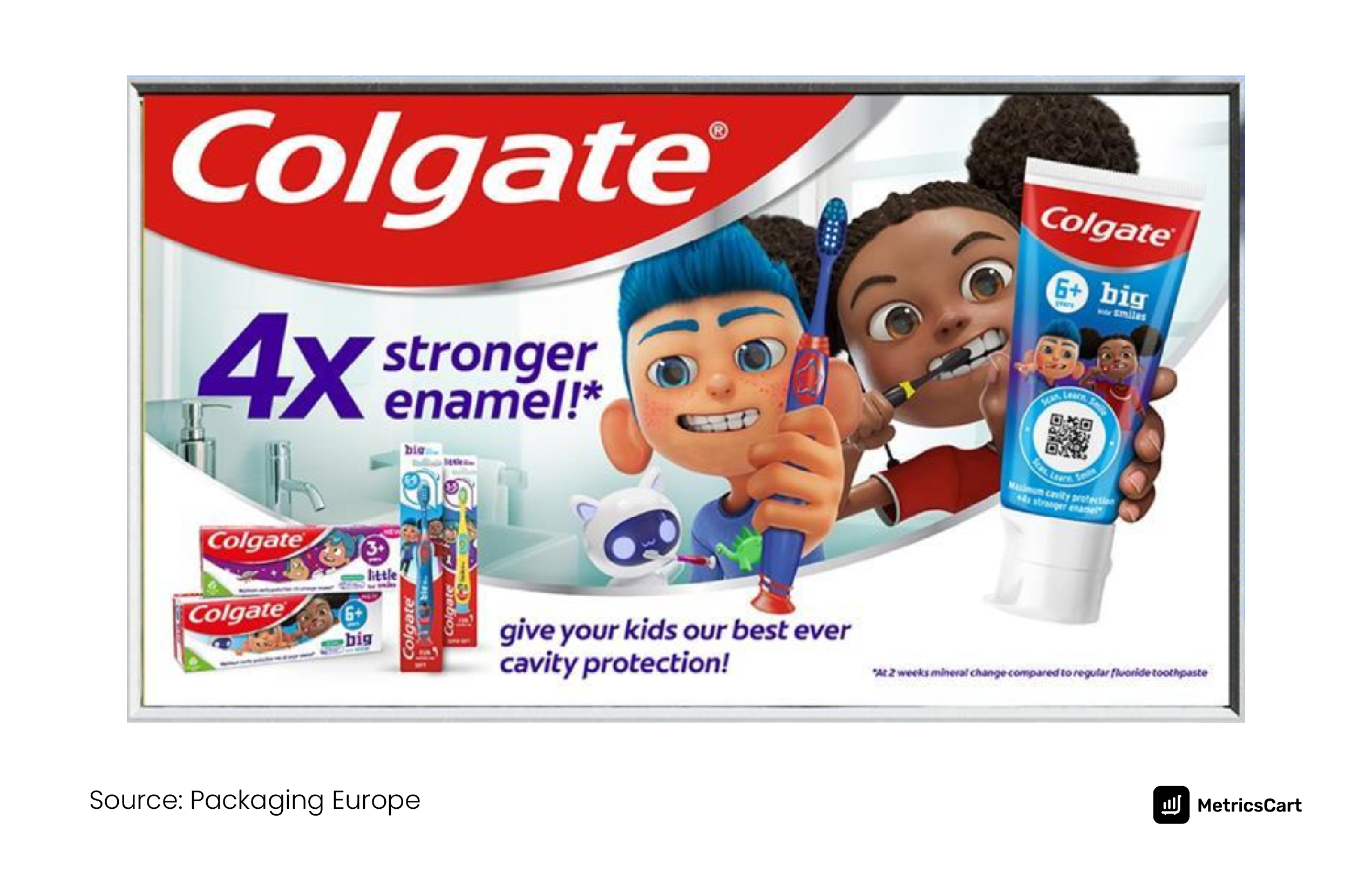
Beyond advertising, Colgate invests in large-scale oral health education programs, often targeting children and families. These initiatives influence daily brushing habits early in life, creating long-term loyalty that competitors find difficult to disrupt later.
Colgate also avoids aggressive short-term discounting that could erode trust. Instead, it reinforces reliability. Same brand, same promise, across decades.
For many households, Colgate becomes a default choice rather than an active decision, which is the strongest form of loyalty.
Did you know? Colgate-Palmolive was among the first companies recognized by PETA for its efforts to reduce animal testing, that is, testing only when required by law and actively working toward alternative, non-animal methods. This conscious effort by the brand effectively appeals to the Gen-Z crowd, who care deeply about sustainability, ethics, and corporate accountability.
Colgate’s Product Positioning and Innovation Strategy
Colgate’s product strategy is built on clear segmentation, not constant reinvention. Innovation is steady, incremental, and tightly aligned with consumer needs.
The portfolio is structured to cover:
- Mass-market oral care focused on cavity prevention and daily hygiene
- Specialized solutions for sensitivity, gum health, and whitening
- Dedicated children’s products designed to build early brand familiarity
Each product variant addresses a specific problem rather than lifestyle positioning, keeping the brand grounded in function and outcomes.
Innovation focuses on formulation improvements, clinical efficacy, and compliance with local regulations rather than flashy features. This allows Colgate to refresh products regularly without confusing consumers or fragmenting the brand.
Positioning remains consistent across the portfolio: every product, regardless of price tier, reinforces Colgate’s role as a dependable oral care brand rooted in health, not trends.
Amazon vs. Walmart: Colgate’s Channel-Wise Marketing Approach
Colgate’s marketing strategy is not uniform across e-commerce platforms. Instead of applying a single playbook, the brand adapts its assortment, pricing, promotions, and visibility tactics based on how shoppers behave on each marketplace.
This becomes especially clear when comparing Colgate on Amazon vs Walmart. Amazon and Walmart serve different shopper intents, and Colgate’s channel-wise execution reflects that difference clearly.
Assortment Depth and SKU Strategy
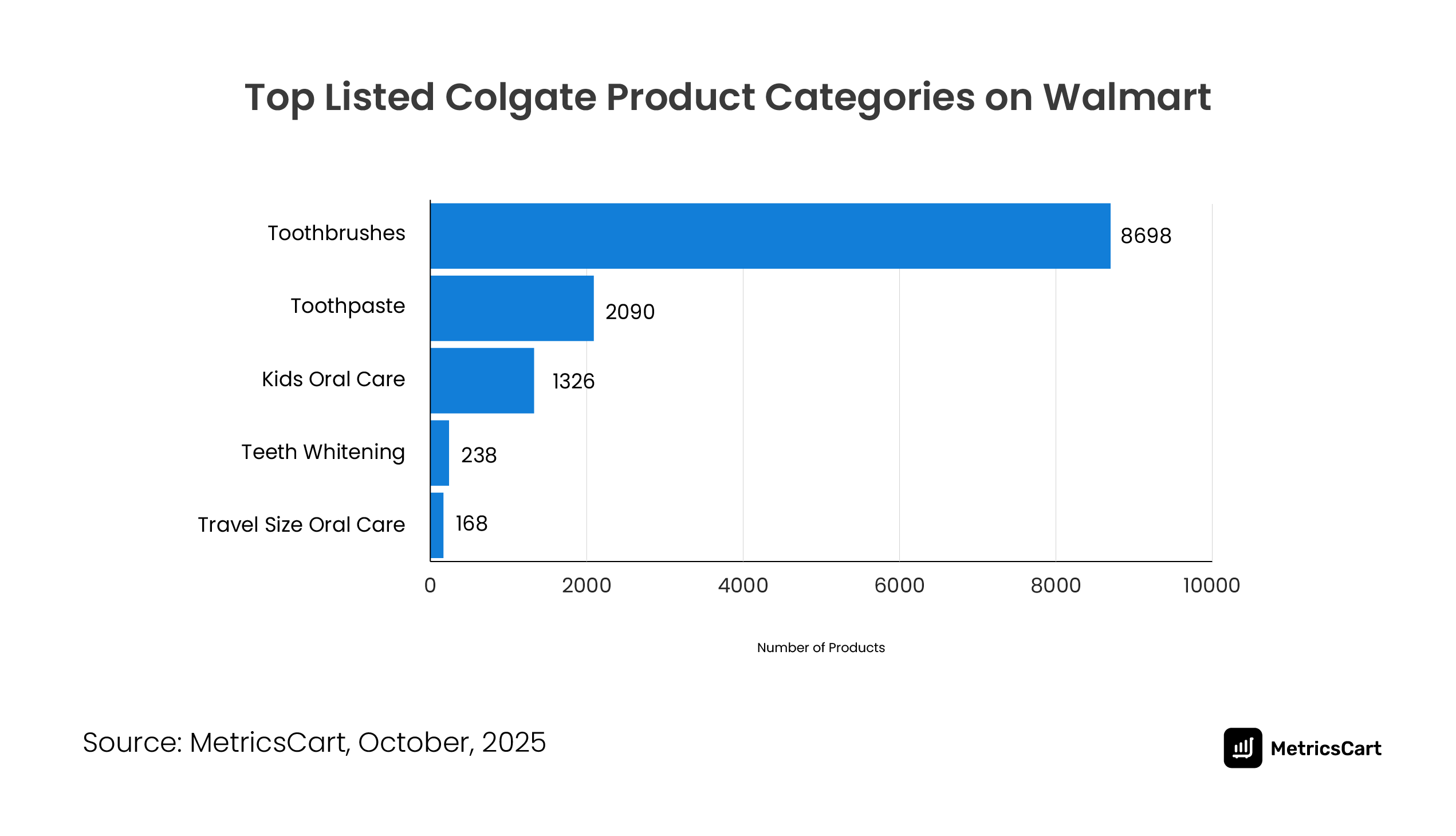
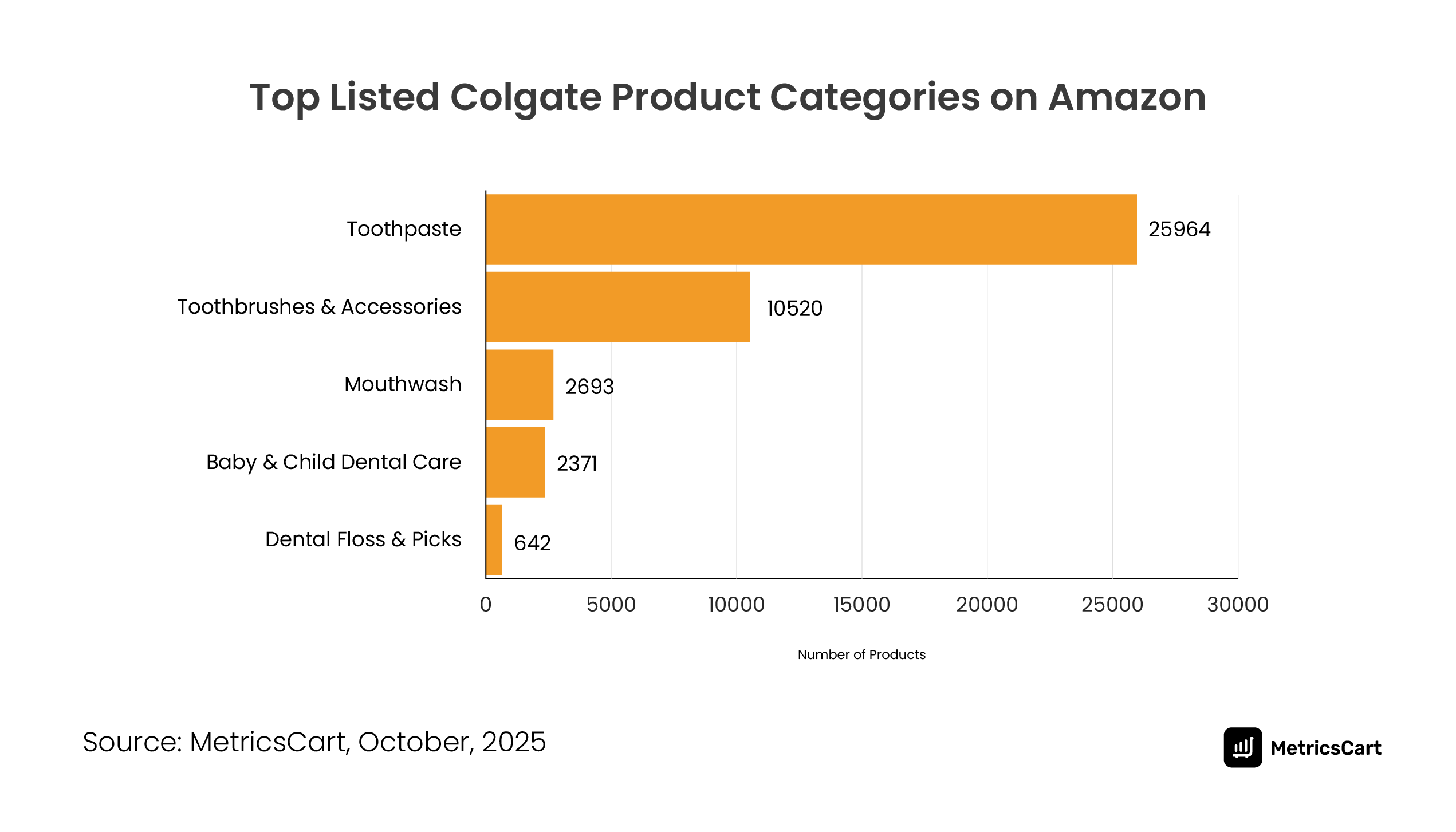
A core component of Colgate’s brand strategy is its differentiated assortment planning, which varies based on the platform.
As illustrated in the chart above, toothpaste dominates Colgate’s listings on Amazon, with a staggering 25,964 products. This represents a significant portion of its catalog, showing that Colgate’s Amazon strategy focuses heavily on maximizing variety and accessibility. The expansive selection includes various flavors, formats, and sizes, catering to a broad spectrum of consumer needs.
Toothbrushes & accessories come in second, with 10,520 listings, underscoring the brand’s emphasis on complementary oral care products. While Mouthwash and Baby & Child Dental Care also feature, they represent a smaller portion of the catalog, reinforcing that Amazon’s catalog leans more toward high-turnover, regular-use products like toothpaste.
Colgate’s Amazon marketing strategy is focused on maintaining a significantly deeper catalog. The platform hosts 43,229 Colgate SKUs, nearly double the number compared to Walmart (21,751 products).
This wide assortment on Amazon supports:
- Greater keyword coverage
- Higher discoverability
- Long-tail demand capture
In contrast, Colgate’s Walmart marketing strategy focuses on a more controlled and curated assortment. Fewer SKUs are listed, with a stronger emphasis on core, high-performing products.
Walmart’s strategy emphasizes hardware-oriented products like toothbrushes (with 8,698 listings), aligning with Walmart’s customer behavior, which tends to favor bulk-buying and practical, high-use items. Colgate’s toothpaste offerings on Walmart are more limited (2,090 products), reflecting a curated selection that prioritizes quality over quantity.
The standout categories on Walmart include:
- Toothbrushes, with 8,698 listings, led, followed by toothpaste with 2,090 listings, highlighting Walmart’s focus on everyday, essential oral care products.
- Kids Oral Care ranks third with 1,326 products, demonstrating Walmart’s targeting of family-oriented shoppers.
- Teeth Whitening and Travel Size Oral Care, which offer smaller selections, suggest these categories are more niche or seasonal.
This strategy aligns with Walmart’s stricter catalog governance and its traditional retail model, in which inventory is streamlined to efficiently meet broad consumer needs.
Pricing Structure and Pack Architecture
Pricing differences between the two platforms are driven largely by pack architecture rather than product quality.
On Amazon, Colgate products are priced lower on average at $15.01, while Walmart’s are significantly higher at $44.58. This pricing disparity reflects differences in shopper behavior across platforms.
- Amazon shoppers prioritize convenience and frequent replenishment
- Walmart shoppers are more inclined toward bulk purchases and planned household buys
By adjusting its pricing strategy, Colgate capitalizes on the unique shopper priorities of each platform, ensuring appropriate positioning that aligns with consumer needs.
READ MORE | How To Win Quality-Focused Shoppers on Amazon?
Discount Behavior and Promotion Intensity
Colgate’s promotional strategy also differs clearly by platform. The average discount on Amazon is 6.21%, nearly double Walmart’s 3.43%. This reflects Amazon shoppers’ higher price sensitivity and expectation for deals.
On Amazon, Colgate participates more actively in promotions to support conversion and volume. Walmart relies less on frequent discounting, instead delivering value through larger pack sizes and higher upfront pricing.
This difference shows that Colgate adjusts promotion intensity to match platform-specific shopper behavior.
Reviews, Ratings, and Shopper Trust Signals
Shopper engagement is one of the biggest contrasts in Colgate’s Amazon vs Walmart performance. Amazon has over 1.5 billion reviews for Colgate products, while Walmart has approximately 4.9 million.
The most reviewed Colgate products on Amazon are:
| Most Reviewed Colgate Products on Amazon | |
| Product | Reviews |
| Colgate Extra Clean Toothbrush, Medium Toothbrush for Adults, 6 Pack | 118480 |
| Colgate Cavity Protection Toothpaste with Fluoride, Great Regular Flavor, 6 Ounce Tube, 6 Pack | 64077 |
| Colgate Optic White Overnight Teeth Whitening Pen, Enamel Safe and Vegan, Teeth Stain Remover to Whiten Teeth, Teeth Whitening for Sensitive Teeth, 35 Nightly Treatments Per Pen, 0.08 Oz,2 Pack | 59941 |
| Colgate Optic White Advanced Hydrogen Peroxide Toothpaste Pack, Teeth Whitening Toothpaste, Enamel-Safe Hydrogen Peroxide Formula, Helps Remove Tea, Coffee, and Wine Stains, ICY Fresh, 2 Pack, 4.5 oz | 49609 |
| Colgate Baking Soda & Peroxide Toothpaste – Whitens Teeth, Fights Cavities & Removes Stains, Brisk Mint, 6 Ounce (Pack of 2) | 43784 |
Meanwhile, the most-reviewed products on Walmart are as follows:
| Most Reviewed Colgate Products on Walmart | |
| Products | Reviews |
| Colgate Total Alcohol Free Mouthwash, Peppermint, 1.0 L | 11435 |
| Colgate Total Pro-Shield Alcohol Free Mouthwash, Spearmint – 1L, 33.8 Fluid Ounce | 11215 |
| (2 pack) Colgate Optic White Renewal Teeth Whitening Toothpaste, Mint, 3 oz Tube | 9469 |
| Colgate Baking Soda and Peroxide Whitening Toothpaste, Brisk Mint, 6 oz, 3 Pack | 2153 |
| Colgate Cavity Protection Toothpaste with Fluoride, Great Regular Flavor, 6 oz, 3 pack | 1967 |
Despite this vast difference in review volume, product ratings are nearly identical, with Amazon averaging 4.52 stars and Walmart 4.50 stars. This suggests that Amazon functions as a review-driven trust platform, where social proof plays a major role in decision-making.
Walmart, by comparison, relies more on brand familiarity and retailer credibility, reducing dependence on reviews.
Listing Stability and Seller Dynamics
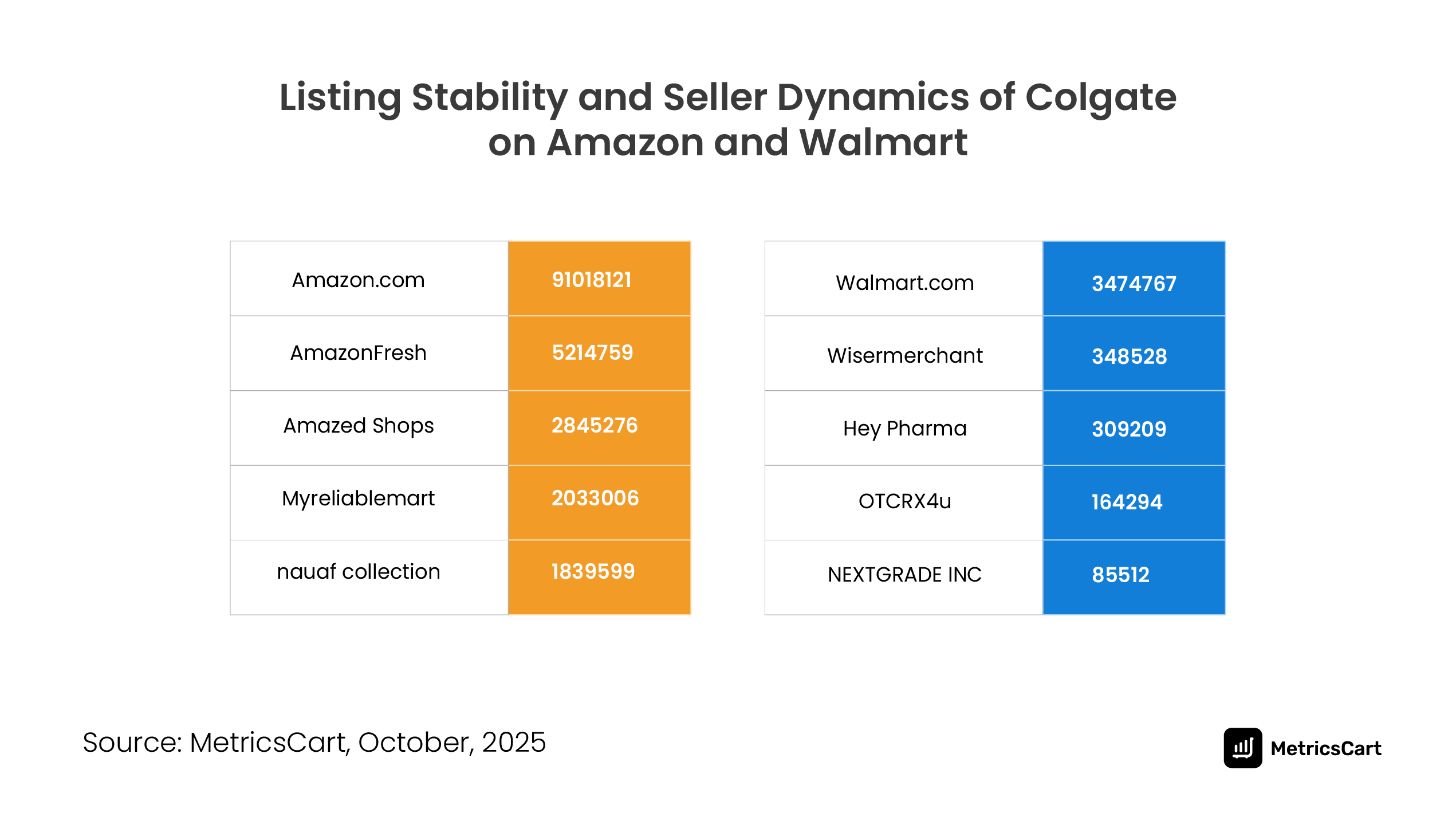
On Amazon, Colgate listings fluctuate daily between 2,500 and 3,200 products, reflecting third-party seller activity, inventory changes, and ongoing listing updates. Walmart listings are far more stable, ranging between 1,389 and 1,504 products, indicating tighter platform control and fewer seller-driven changes.
On both platforms, platform-owned sellers dominate review volume and shopper trust. Amazon.com and AmazonFresh lead on Amazon, while Walmart.com is the primary seller on Walmart. This concentration allows Colgate to maintain consistent brand representation across both channels.
What CPG Brands Can Replicate From Colgate’s Marketing Strategy
Colgate’s marketing strategy offers several practical lessons for CPG brands selling across large marketplaces like Amazon and Walmart. The success does not come from aggressive advertising or complex campaigns, but from disciplined channel-specific execution.
Here are the key strategies any CPG brand can follow to win on the digital shelf:
- Treat each marketplace as a separate shelf: Colgate does not run a single e-commerce strategy. Amazon and Walmart get different assortments, pricing logic, and promotion intensity based on shopper behavior.
- Win visibility through assortment depth where discovery matters: On Amazon, Colgate floods the shelf with variants and packs to dominate search and keyword coverage. More SKUs mean more digital shelf real estate.
- Use pack architecture to control price perception: Smaller packs on Amazon keep prices accessible and drive repeat purchases, while bulk and premium packs on Walmart support higher ticket values and margin protection.
- Discount selectively, not emotionally: Colgate increases discounting only where shoppers expect deals, mainly on Amazon, instead of training customers to wait for promotions everywhere.
- Let reviews act as your primary trust signal: High review volume and consistently strong ratings make Colgate products feel safe to buy, especially on Amazon, where social proof directly impacts conversion.
- Rely on organic strength before paid visibility: Most Colgate listings are non-sponsored, showing that strong brand equity, reviews, and listing quality can outperform heavy ad spend on the digital shelf.
Brushing It All Down
Colgate’s performance across Amazon and Walmart shows that winning the digital shelf requires disciplined, platform-specific execution rather than a one-size-fits-all strategy.
By adjusting assortment depth, pricing, pack architecture, promotions, and trust signals to match shopper behavior on each marketplace, Colgate drives scale on Amazon while protecting value on Walmart.
For CPG brands, replicating this approach and ensuring long-term success requires continuous visibility into digital shelf dynamics. MetricsCart enables it by giving brands the ability to track assortment, pricing, discounts, reviews, and seller behavior in real time, helping them make faster, data-driven decisions to win across marketplaces.
Disclaimer: MetricsCart is the exclusive owner of the data used in the Digital Shelf Insights reports. Any kind of third-party usage entails due credit to the source material.
Drive Real Growth for Your Brand.