You have probably heard some version of this sentence more times than you can count, especially if you’re in the e-commerce circles like me:
“Prepare for the agentic era. AI shopping is coming.”
And to be honest, at this point, the phrase itself induces more fatigue than urgency (for me).
We have seen enough “next big shifts” over the last decade to become justifiably skeptical. Voice commerce was supposed to change everything. Chatbots were supposed to replace customer support. Web3 was supposed to rewrite retail economics. Most of it arrived late, partially, or not at all.
What makes the current moment different is not the ambition of the vision, but the speed at which it is materializing.
Within months of OpenAI announcing its Agentic Commerce Protocol (ACP) in partnership with Stripe, Google has now introduced its own version: the Universal Commerce Protocol (UCP).
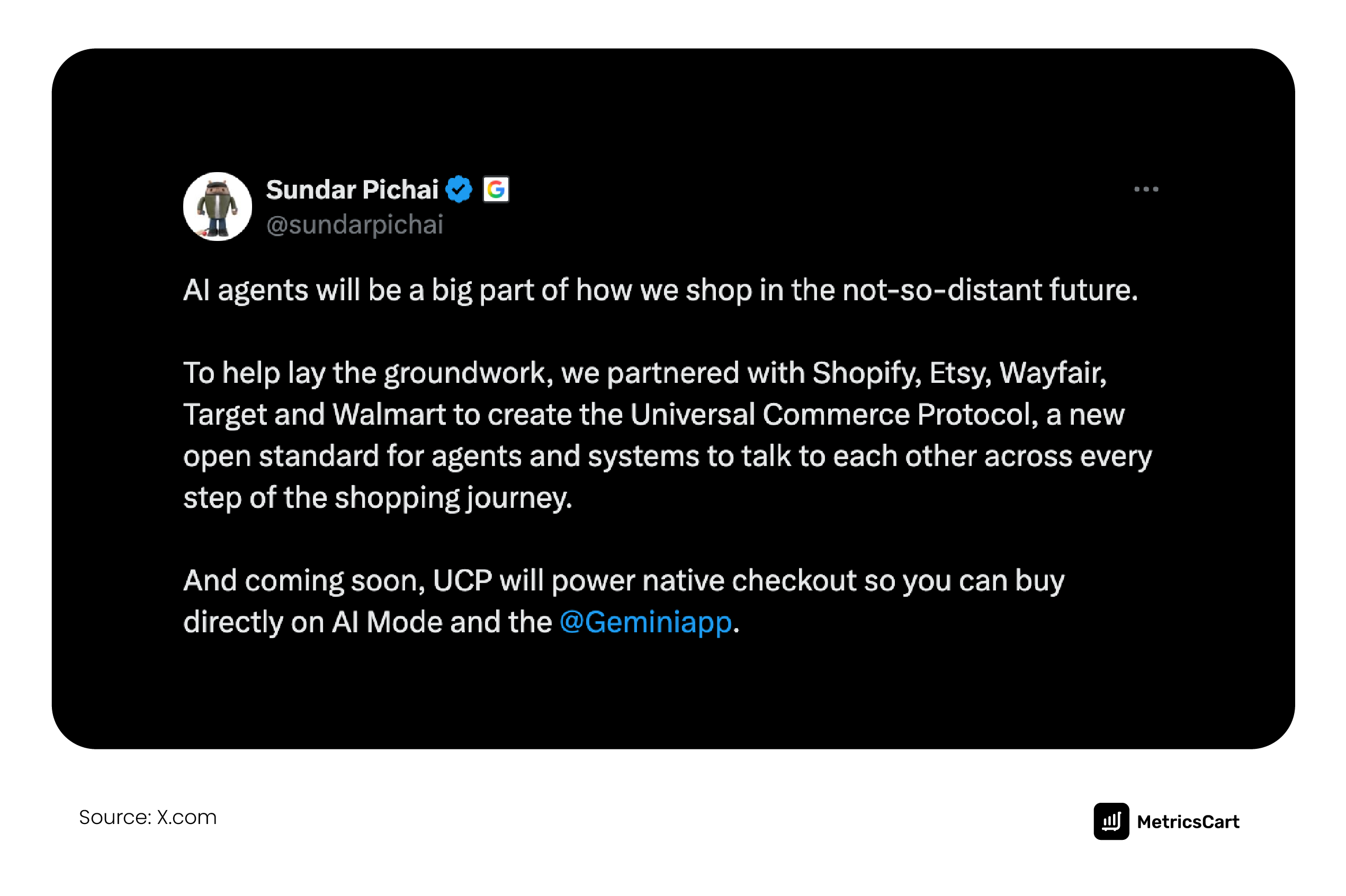
And unlike many previous announcements that lived comfortably in keynote slides, UCP is already being positioned as foundational infrastructure, backed by large retailers, marketplaces, and payment systems.
What is Google Universal Commerce Protocol
To understand UCP, it helps to start with the problem it is trying to solve.
Today’s e-commerce ecosystem is built on fragmentation. Every marketplace, retailer, and platform has its own APIs, data formats, and workflows. And so, integrating with five retailers often means building five different connectors, each with its own maintenance overhead, authentication quirks, and breaking changes.
But more than that, this ‘traditional’ model barely scales for human-facing interfaces itself. So imagine that interface becoming an LLM or a conversational agent expected to transact autonomously—zero scalability is guaranteed.
Google’s Universal Commerce Protocol is designed to standardize how commerce systems communicate with AI agents across the entire buying lifecycle. It is an open, machine-readable protocol that allows agents to interact with merchants from discovery through checkout and into post-purchase management.
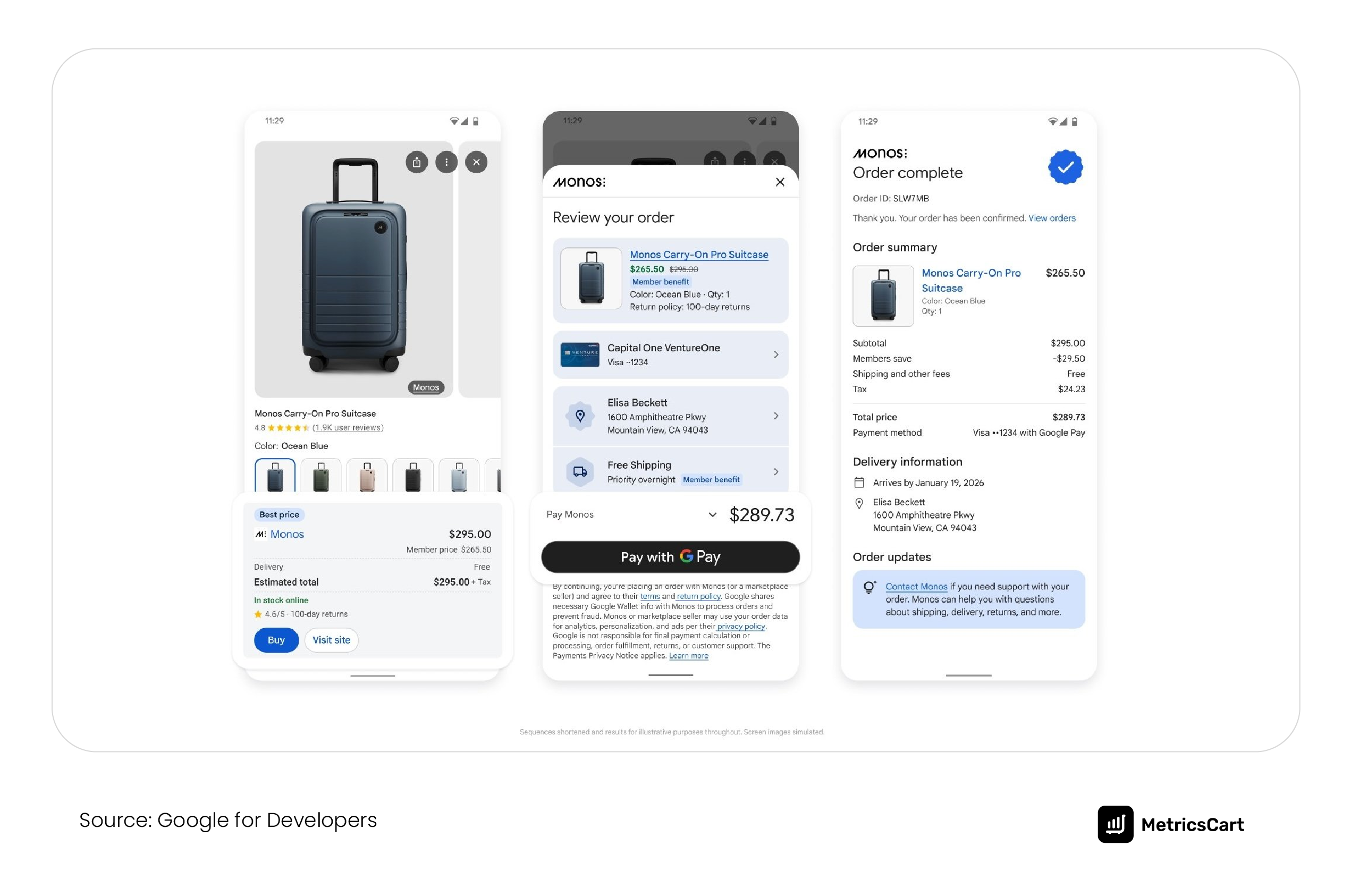
While the core UI of UCP centers on the “Buy Now” button and “Zero-Click” as the ultimate KPI, its actual use case is limited to easy payments or checkout. Instead, it covers the full loop. That means, using UCP, an AI agent can:
- Discover products based on intent rather than keywords
- Evaluate pricing and availability
- Apply promotions
- Build carts across one or multiple retailers
- Execute checkout securely
- Handle post-purchase actions such as tracking, cancellations, or returns
And all of this will occur inside a conversational interface like Google Gemini, without a shopper ever visiting a traditional product listing page.
That last point is uncomfortable, and intentionally so. It challenges the assumption that product pages, search result grids, and filters are the immutable center of e-commerce.
Whether that balance holds over time is still an open question, but the direction of travel is clear.
How Google’s UCP Works
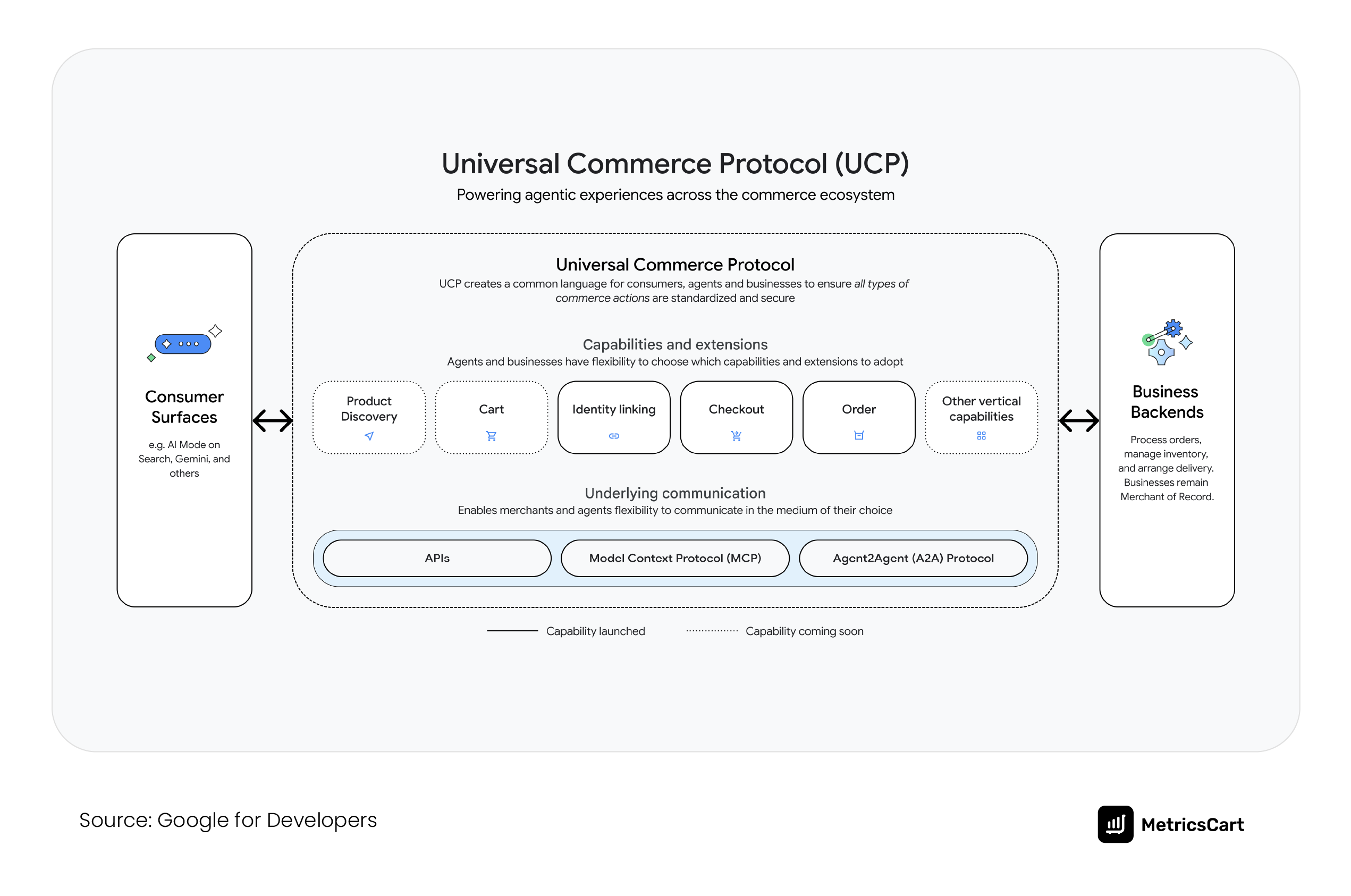
UCP’s architecture is modular and capability-based, which is a meaningful departure from older, monolithic commerce standards.
Instead of forcing every merchant to support a full suite of commerce features, UCP allows merchants to expose a manifest declaring the specific capabilities they support. These capabilities can include
- product discovery,
- pricing and promotions,
- cart creation and checkout,
- identity linking,
- loyalty programs,
- subscriptions, or
- post-purchase operations.
AI agents discover these capabilities dynamically and adapt their behavior accordingly.
This capability negotiation levels the playing field for brands, allowing small and mid-sized merchants to participate without massive technical overhead. The agent adapts to the merchant, not the other way around. From a scalability perspective, this is essential if agentic commerce is to move beyond a handful of enterprise pilots.
UCP also preserves the merchant as the Merchant of Record, so that their pricing logic, fulfillment, inventory ownership, and customer data remain under merchant control. And the agent acts as an orchestrator, not an owner of the transaction.
This design choice is critical for adoption because only a few brands would willingly hand over full transactional control to a platform, especially one that already dominates discovery.
Payments within UCP are enabled through compatibility with Agent Payments Protocol (AP2) and similar standards. These allow agents to execute payments via cryptographically verifiable mandates without storing raw payment credentials. In a world where autonomous agents transact on behalf of users, this is essential to ensure security, compliance, and trust.
Moreover, UCP is transport-agnostic. It supports traditional REST APIs and is designed to work with newer paradigms such as Agent-to-Agent (A2A) communication and the Model Context Protocol (MCP). This means commerce actions can be orchestrated across multiple agents and systems without brittle, custom-built bridges.
From an infrastructure standpoint, this makes UCP more than just another API spec.
How Google’s UCP Differs From Other Emerging Commerce Protocols
The most obvious comparison I see is Google’s UCP vs. OpenAI’s ACP.
ACP is tightly focused on transaction execution. It excels at enabling AI-driven checkout flows, especially in ecosystems already integrated with Stripe. It is opinionated, streamlined, and optimized for fast adoption where payment infrastructure is already aligned.
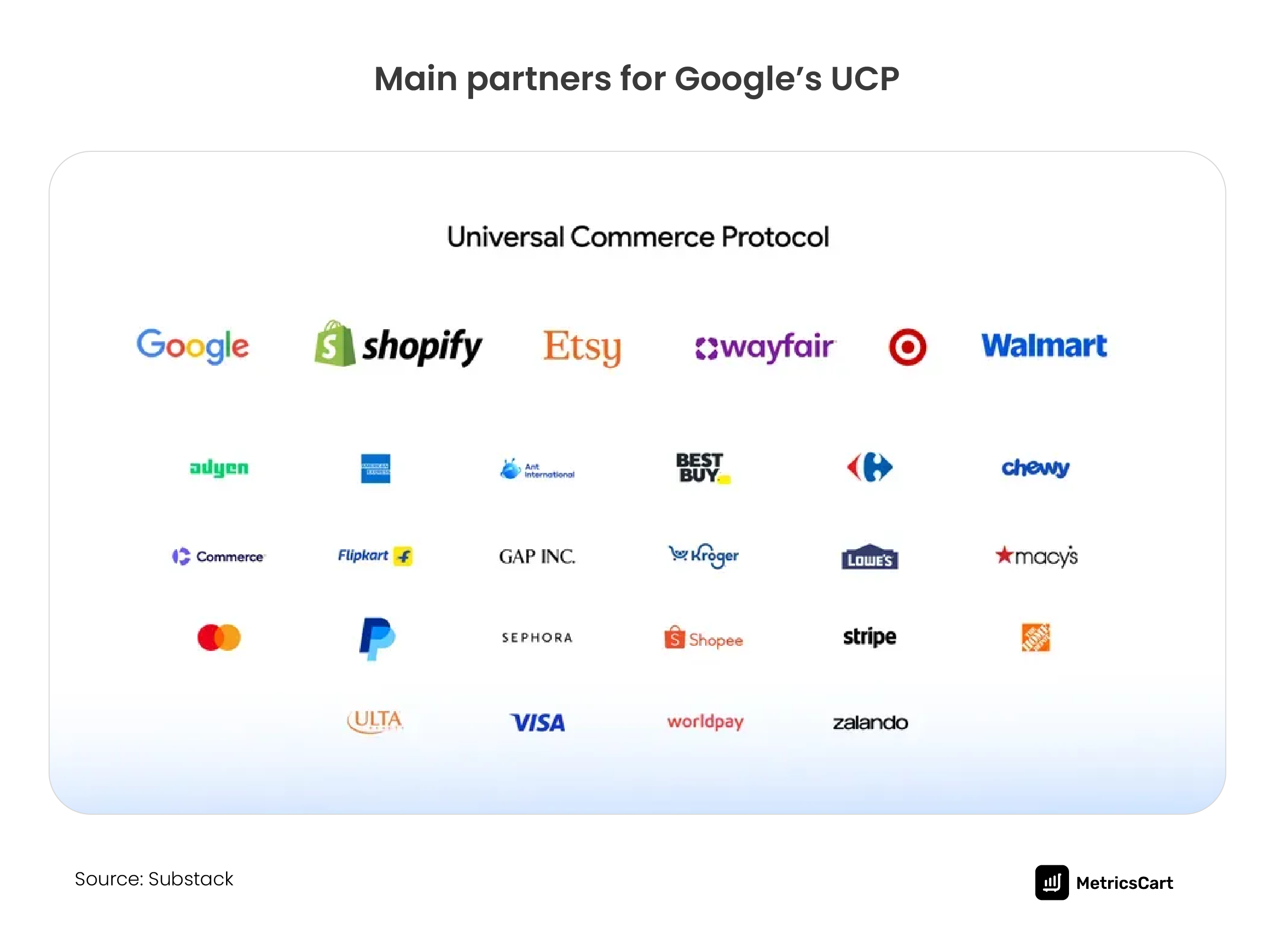
UCP, by contrast, is broader and more infrastructural. Google is positioning UCP as a foundational layer rather than a checkout accelerator, and that difference shows in both scope and intent. UCP already partners with large retailers, marketplaces, and payment systems (including Shopify, Etsy, Walmart, Visa, and Stripe) to support the entire commerce lifecycle.
While ACP is designed to answer “How does an agent complete a purchase?”, UCP is designed to answer “How does an agent understand, evaluate, and transact with commerce systems end to end?”
UCP spans discovery, pricing logic, promotion eligibility, cart construction, checkout, and post-purchase workflows. It is intentionally payment-agnostic and built to interoperate with multiple agent frameworks, identity systems, and transport layers.
Where ACP optimizes for speed to checkout, UCP optimizes for standardizing the language of commerce itself.
There are also adjacent protocols worth separating from this comparison. Frameworks like the Model Context Protocol (MCP) and Agent-to-Agent (A2A) communication are not commerce standards.
However, they handle how agents share context, delegate tasks, and coordinate actions across systems. So in practice, they sit beneath or alongside commercial protocols such as UCP and ACP.
Think about it this way:
- MCP defines how agents understand context
- A2A defines how agents communicate with each other
- UCP defines how agents transact with commerce systems
They are complementary rather than competitive. But UCP is the layer that directly reshapes how products are discovered, compared, and purchased in an agent-mediated world.
Here’s a more comprehensive comparison of UCP vs ACP.
| Aspect | Google Universal Commerce Protocol (UCP) | OpenAI Agentic Commerce Protocol (ACP) | MCP & Agent-to-Agent Frameworks |
| Core Objective | Standardize how AI agents interact with commerce systems end-to-end | Enable AI agents to securely execute transactions | Enable agents to share context and coordinate actions |
| Primary Focus | Discovery, pricing, carts, checkout, and post-purchase workflows | Transaction execution and payments | Orchestration, not commerce |
| Role in Shopping Journey | Shapes how agents evaluate and choose where to buy | Handles how agents complete a purchase | Supports decision-making behind the scenes |
| Payment Model | Payment-agnostic, interoperable with multiple systems | Tightly aligned with Stripe-centric flows | Not applicable |
| Merchant Control | Merchant remains Merchant of Record | Merchant remains Merchant of Record | Not applicable |
| Design Philosophy | Broad, infrastructural, capability-based | Narrow, opinionated, execution-focused | Foundational plumbing |
| Speed vs Scope | Optimized for long-term standardization | Optimized for fast adoption | Optimized for coordination |
| Impact on Digital Shelf | Redefines how products are discovered and compared | Focused on transaction execution, so minimal impact on discovery | No direct impact |
The Strategic Reality Brands and Retailers Must Accept
From where I sit, Google’s Universal Commerce Protocol is not something brands should react to with excitement or panic. It is something they should read as a directional signal.
Big tech companies competing to establish a monopoly in a given area is no surprise. But here, even though a quiet race is evident, it’s not really about Google vs. OpenAI (or others). Here, the layer being contested is how commerce systems expose themselves to machines, rather than to marketplaces or payment rails.
And once shopping becomes agent-mediated, brands no longer optimize only for human attention. They are optimizing mostly for machine interpretation, and that shift will happen long before a single “AI checkout” headline feels mainstream.
Google’s UCP makes that reality harder to ignore. In fact, it surfaces questions many brands have postponed for years.
- How clean and consistent is your product data across retailers?
- How trustworthy are your pricing and availability signals in real time?
- How much of your digital shelf performance is structural, and how much is cosmetic?
These questions will become increasingly relevant because unlike humans who rely on relational trust signals, AI aggregates statistical trust. They do not infer intent from storytelling or compensate for missing information. They evaluate what is available, reliable, and executable. If the signals are weak, the brand is simply not considered.
For instance, think about a simple agent-driven decision.
A shopper asks an AI agent to reorder a protein powder they’ve bought before, at the best available price, with delivery within two days.
Brand A has inconsistent product titles across retailers, delayed inventory updates, and promotions that fail eligibility checks. Brand B exposes clean product data, real-time availability, and clearly executable pricing rules.
The agent does not “prefer” Brand B. It simply completes the task. Brand A never enters the consideration set.
I do not believe agentic commerce will replace brands or retailers. But it will narrow the margin for error. Brands that invest early in structured data, dependable operations, and visibility into how their products are evaluated across channels will adapt smoothly. Those who wait for certainty will find themselves optimizing for interfaces that no longer matter. UCP, in that sense, is less a product announcement and more an early warning. The interface of commerce is changing, and the preparation window is shorter than it appears.
Where MetricsCart Helps
At MetricsCart, we understand that visibility in an agentic world begins with structured, high-quality data and evolves into engagement and execution intelligence that reflects how AI agents interpret and act upon that data.
As commerce becomes more conversational, the signals that matter most will be those indicating relevance to intent, price, availability, competitiveness, and fulfillment reliability.
To prepare for this shift, MetricsCart helps brands:
- Build and validate rich, machine-readable product data
- Align pricing and availability signals with real-time operational reality
- Measure performance through intent-driven, agent-evaluated outcomes
- Prepare for interoperability standards that AI agents can consume
UCP is more than a protocol; it is a blueprint for the future of commerce itself. The brands and platforms that understand it early, invest in it strategically, and measure it effectively will lead in the next era of retail.
Optimize Your Digital Shelf for The Agentic Future With MetricsCart.