The 2026 power tools market is on the cusp of a massive shift. According to Future Market Insights, the global power tools market is expected to touch $41.7 billion in 2026 and grow to $71.2 billion by 2036, with a CAGR of 5.5%.
The industry stands at a fascinating crossroads where, on one hand, innovation in cordless technology and AI integration is creating smarter and faster tools. On the other hand, consumers are increasingly discerning, armed with more information than ever to guide their purchase decisions. That means performance and user experience have become the ultimate currency.
This report looks at the best power tools for 2026 through the lens that matters most today: how customers actually talk about products once they start using them.
Behind the Insights: What MetricsCart’s Consumer POV Reports Reveal
At MetricsCart, we believe that truly understanding consumer sentiment requires more than just tracking basic review scores. Our Consumer POV reports provide a 1-year analysis of various categories, grounded in a thorough research of real-time customer feedback across a variety of online platforms. Our research looks at what customers value, what frustrates them, and what drives brand loyalty.
Rather than just focusing on raw ratings or star counts, the findings emphasize the emotional sentiment behind customer reviews, revealing the root causes of satisfaction and dissatisfaction. These insights will give you a clearer understanding of which features are truly driving customer decisions and which pain points are forcing consumers to look elsewhere.
For this power tools annual report (December 2024-2025), we sourced feedback from:
- Brand DTC (Direct-to-Consumer) websites
- Home improvement retailers
- Specialty tool retailers
- E-commerce platforms
We analyzed 6,270 reviews spanning 15 impact tools (impact drivers and impact wrenches) from 9 leading brands, providing a comprehensive look at what customers really think about their purchases. This is consumer feedback at scale, allowing us to identify patterns, pain points, and satisfaction drivers that influence purchasing behavior in the power tools category.
This layered research taps into key consumer reviews (the what layer) across 12 important aspects, from power and battery life to ergonomics and reliability. We break down the reviews by aspects and use cases, like automotive, DIY, and construction, and identify user profiles such as contractors, mechanics, and homeowners (the why layer). By tracking brand mentions and loyalty signals, the findings reveal customer switching behavior and retention (the so-what layer).
READ MORE | 5 Best Running Shoes in 2026 [Exclusive MetricsCart VoC Report]
Highlights
- Flex outperforms Milwaukee and DeWalt with a 4.75 rating and 93.6% positive sentiment, showcasing exceptional execution.
- Milwaukee’s Surge 2760 fails to meet expectations, earning a 3.47 rating, significantly harming brand loyalty.
- Hercules challenges premium brands by offering top-tier satisfaction at a budget-friendly price, with a 4.71 rating.
- Impact wrenches consistently outperform drivers with an average rating of 4.61, preferred by automotive professionals for torque.
- Milwaukee faces significant churn, with 71 loyalty signals showing that many customers are reconsidering their brand allegiance.
Leaderboard Snapshot: Best Power Tools for 2026
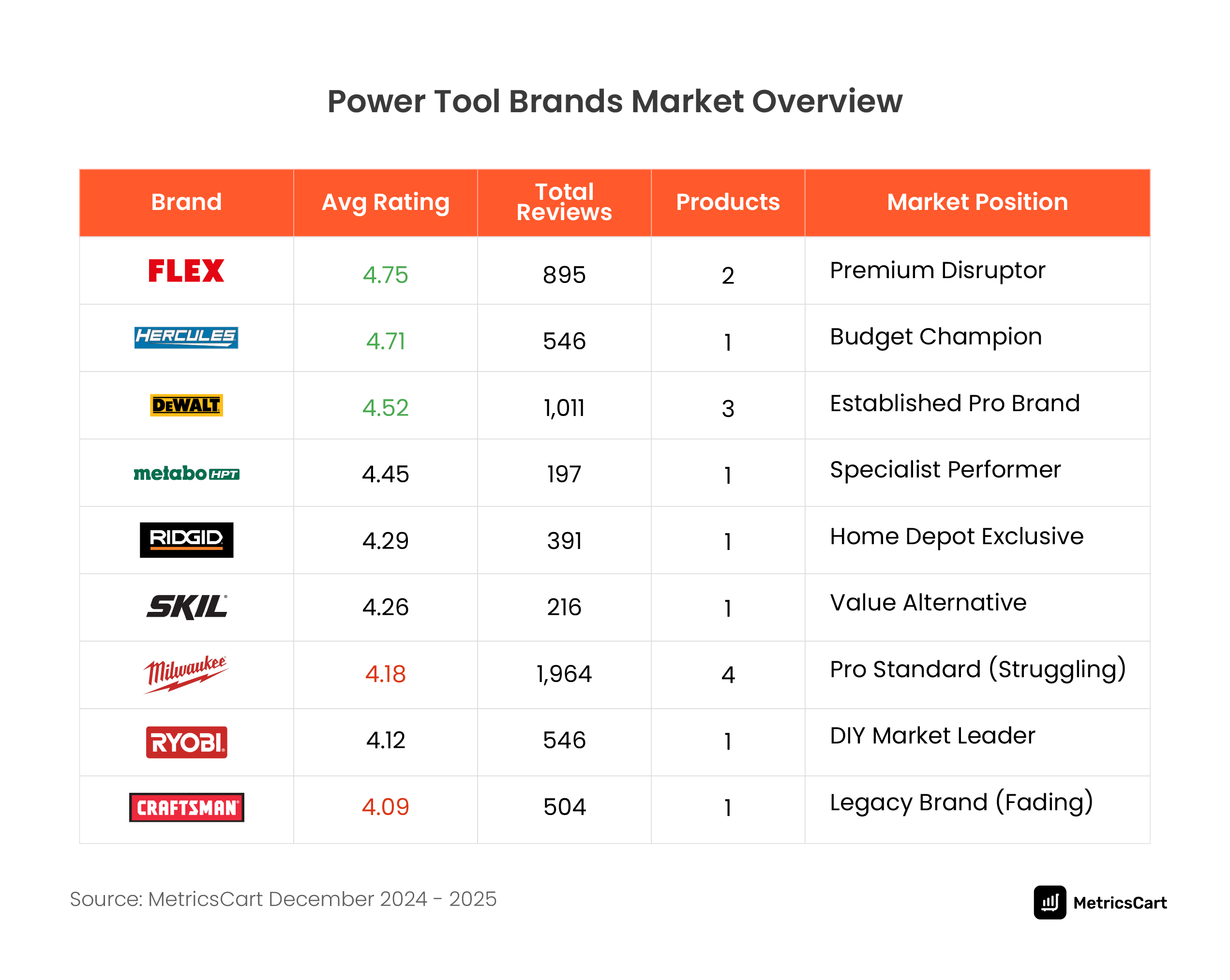
The 2026 power tools market is already beginning to show clear signs of disruption, with emerging players like Flex and Hercules gaining significant ground, while traditional leaders such as DeWalt, Milwaukee, and Ryobi are navigating shifting consumer expectations.
At the top of this table, Flex emerges as the clear premium disruptor, scoring a 4.75 average rating with 895 reviews across two products. It’s notable that Flex is redefining the balance between performance and affordability, positioning itself as a challenger to the traditionally dominant brands.
Hercules, with its 4.71 average rating, stands as a budget champion. While it doesn’t yet boast the extensive product line of Milwaukee or DeWalt, its single product is performing remarkably well, signaling that consumers are willing to trade premium pricing for performance when the value proposition is strong enough.
On the more traditional side, DeWalt, with a 4.52 rating, remains an established pro brand. Though it leads in terms of total reviews (1,011), it’s clear that new entrants like Flex and Hercules are beginning to challenge DeWalt’s dominance.
Legacy brands are beginning to lose ground. Milwaukee, though still a pro standard brand, is facing challenges with a 4.18 rating and 1,964 reviews. Similarly, Ryobi is holding strong in the DIY market, but its 4.12 average rating reveals a gap between its consumer base and those looking for professional-grade performance.
Ryobi (4.12) faces 23 loyalty broken signals and reliability concerns. Milwaukee’s The Surge 2760 (3.47) brings down the brand average and, more importantly, customer trust. With 71 ‘loyalty broken’ signals across products, the highest of any brand, Milwaukee faces a reputation crisis that marketing alone cannot solve.
Flex, Hercules, and the Rise of Performance-First Buying Behavior
Power Tools Product Ranking by Customer Sentiment
| # | Product | Rating | Positive | Neutral | Negative | Reviews |
| 1 | Flex 24V Impact Wrench FX1451 | 4.88 | 98.1% | 0.4% | 1.5% | 482 |
| 2 | Hercules 20V Brushless HCB81B | 4.71 | 94.0% | 2.9% | 3.1% | 546 |
| 3 | DeWalt 20V Quiet Hydraulic DCF870 | 4.69 | 91.8% | 1.4% | 6.8% | 147 |
| 4 | Flex 24V Quick Eject FX1371A | 4.59 | 88.4% | 5.1% | 6.5% | 413 |
| 5 | Milwaukee M18 Fuel Impact Wrench 2962 | 4.51 | 87.1% | 3.7% | 9.2% | 326 |
| 6 | DeWalt 20V Max XR DCF891 | 4.50 | 87.0% | 2.0% | 11.0% | 546 |
| 7 | Milwaukee M12 Fuel 3453 | 4.49 | 86.6% | 3.5% | 9.9% | 546 |
| 8 | DeWalt 20V High-Torque DCF860 | 4.47 | 85.2% | 5.3% | 9.4% | 318 |
| 9 | Metabo HPT 36V WH36DCM | 4.45 | 86.8% | 0.0% | 13.2% | 197 |
| 10 | Milwaukee M18 Fuel 2953 | 4.37 | 84.1% | 3.1% | 12.8% | 546 |
| 11 | Ridgid 18V Brushless R862312 | 4.29 | 82.9% | 3.6% | 13.6% | 391 |
| 12 | Skil PWRCore 20 ID6739B-10 | 4.26 | 82.4% | 5.1% | 12.5% | 216 |
| 13 | Ryobi 18V One+ HP PBLID04 | 4.12 | 76.4% | 7.9% | 15.8% | 546 |
| 14 | Craftsman V20 Brushless CMCF830 | 4.09 | 76.0% | 5.4% | 18.7% | 504 |
| 15 | Milwaukee M18 Fuel Surge 2760 | 3.47 | 57.3% | 10.3% | 32.4% | 546 |
Looking at the findings from MetricsCart’s research, it’s clear that the market is gravitating towards performance-first buying behavior.
At the top of the list, Flex’s 24V Impact Wrench FX1451 stands out with an exceptional 4.88 rating, driven by 98.1% positive sentiment. This performance has positioned Flex as a premium disruptor in the industry, with Flex’s emphasis on power, battery life, and durability resonating strongly with consumers.
Hercules 20V Brushless HCB81B has also emerged as a strong competitor. With a 4.71 rating and 94% positive feedback, Hercules challenges premium-priced brands like Milwaukee and DeWalt by offering impressive performance at a competitive price point. This tool’s performance, particularly in torque, reliability, and battery longevity, has made it a budget champion, appealing to consumers who want quality without the premium price tag.
This is consistent with consumer behavior trends in the power tools market, which highlight the shift toward affordable alternatives in high-performance tools. Consumers are increasingly willing to shift their loyalty to brands that offer quality at a better price point, and Hercules has effectively tapped into this desire for value-driven products.
Meanwhile, the traditional leaders in the market are feeling the pressure. Milwaukee’s M18 Fuel Surge 2760 scored a 3.47 rating, with 57.3% positive sentiment and 32.4% negative sentiment, marking a significant dip compared to other products in the Milwaukee lineup.
Consumers expect consistent performance, and Milwaukee’s failure to meet expectations with this specific product has created a loyalty erosion risk, which we will discuss further in this report.
Why Impact Wrenches Are Outperforming Drivers Across Customer Reviews
The overall category of impact wrenches is seeing sustained interest and growth, correlated with rising professional demand in sectors such as automotive maintenance and heavy construction, where time savings and torque capacity directly impact productivity and satisfaction.
Meanwhile, impact drivers, though still essential in broader construction and DIY markets, face a more competitive landscape where buyers evaluate value and versatility rather than raw performance excellence.
This means that manufacturers focusing on impact wrenches, especially high-torque, battery-powered models, are better positioned to win praise and loyalty from customers whose priorities align with professional use cases, validating why impact wrenches are outperforming drivers in MetricsCart findings.
READ MORE | The Future of Wyze: Key Insights Into Pricing, Reviews, And What’s Next?
When Innovation Backfires: What Went Wrong with Milwaukee Surge 2760
Milwaukee Surge 2760: Anatomy of a Product Failure
| Metric | Value |
| Average Rating | 3.47 (Lowest in entire dataset) |
| Positive Sentiment (4-5 stars) | 57.3% (vs 83.5% category average) |
| Negative Sentiment (1-2 stars) | 32.4% (Highest in dataset) |
| Loyalty Broken Signals | 40 (Single highest product) |
| Value Perception Rating | 2.92 (Worst in category) |
Let’s dissect the anatomy of a product failure.
The Milwaukee Surge 2760 is the perfect example of how a product innovation, designed to stand out in a competitive market, can backfire when core consumer needs are compromised.
Despite being marketed as a quiet impact driver with innovative hydraulic technology, the Milwaukee Surge 2760 has failed to meet consumer expectations on key performance metrics, making it the lowest-rated product in the research.
The tool’s 32.4% negative sentiment stands out, and what’s more concerning is the 40 loyalty-broken signals, the highest in our findings.
While Milwaukee’s hydraulic quiet technology was intended to set it apart by offering quieter operation, the trade-off sacrificed power and speed for noise reduction. For customers who rely on power and torque for professional applications, this compromise has been a deal-breaker.
Let’s Zoom In
A closer look at the customer feedback reveals several key frustrations:
- Power Complaints: 66 mentions of insufficient power, with users specifically pointing out that the tool lacked the torque needed for demanding tasks.
- Speed Complaints: 25 mentions of slow performance, with customers highlighting that the hydraulic mechanism slowed down the tool compared to traditional impact drivers. This aligns with broader consumer expectations, where speed and power are paramount for professional users in fields like construction and automotive work.
- Noise Paradox: Despite the “quiet” technology being a selling point, 15 reviews specifically mention that, while the tool may be quieter, the lack of power and speed made it ineffective for high-demand tasks.
- Return Rate Indicator: With 23 mentions of returns or dissatisfaction with performance, Surge is suffering from significant brand erosion.
Interestingly, satisfied customers (57.3%) do appreciate the quiet operation. However, the product fails to meet the needs of the larger pro user group, who demand more power and torque for their tasks. The target market for the Surge 2760 was not well defined, and the tool ultimately failed to sail on two boats.
What DeWalt Did Right
When we look at DeWalt’s Quiet Hydraulic DCF870 (rated 4.69), we see a different outcome. DeWalt’s hydraulic model boasts a 95% positive sentiment, in stark contrast to Milwaukee’s 57.3%. The success of DeWalt lies in its ability to balance innovation with customer expectations, offering quiet operation without sacrificing the performance metrics that matter most.
Who’s Using These Power Tools & What Brands Must Know
Use Case Segmentation
| Use Case | Reviews | % of Total | Avg Rating |
| Farm/Ranch | 148 | 2.4% | 4.57 |
| Automotive/Mechanic | 1,515 | 24.2% | 4.48 |
| Home DIY | 613 | 9.8% | 4.39 |
| Construction/Framing | 360 | 5.7% | 4.35 |
| HVAC/Electrical | 594 | 9.5% | 4.08 |
| Woodworking | 727 | 11.6% | 4.02 |
One of the clearest patterns emerging from this power tools customer feedback report is that ratings are not only about product quality. They are deeply shaped by who is using the tool and what job they expect it to perform.
When we look at the use case segmentation, satisfaction shifts dramatically across applications, revealing why certain tools dominate the leaderboard while others struggle despite strong brand equity.
The Automotive/Mechanic segment, which makes up for 24.2% of total reviews, shows the highest satisfaction with an average rating of 4.48. This aligns closely with what we have already seen in the best power tools for 2026 leaderboard, where impact wrenches and high-torque tools lead performance rankings.
Automotive users tend to prioritize torque, reliability, and consistent power delivery over versatility. That explains why products like the Flex FX1451 and Hercules HCB81B perform strongly. These users evaluate tools based on real workload efficiency rather than feature lists, which naturally pushes brands that focus on raw performance higher in ratings.
In contrast, Woodworking, accounting for 11.6% of reviews, records the lowest average rating at 4.02, despite being a sizeable segment. This is a strong signal that many impact drivers may not fully align with woodworking expectations, where precision, control, and lower impact force matter more than brute torque.
From an R&D point of view, this reveals a structural mismatch between tool design and use case. For example, woodworking-focused communities often favor brands that emphasize control and finesse rather than high-output power, suggesting that product-market fit varies significantly by application.
The HVAC/Electrical segment, at 9.5% of reviews with a 4.08 rating, adds another layer to the story. These professionals frequently work in tight spaces, which shifts their expectations toward compact design, maneuverability, and ergonomic balance. Note that, later on in this power tools annual report, you’ll come across how compact size becomes a strong positive driver.
Meanwhile, Home DIY and Farm/Ranch users sit in the middle of the satisfaction curve, reflecting mixed expectations. DIY buyers often balance affordability and ease of use, while Farm/Ranch users value durability but may encounter limitations when tools are optimized for urban construction environments.
This power tools customer review report peels the multitude of layers of use case segmentation because reviews are a reflection of contextual performance. The same product can be celebrated by mechanics and criticized by woodworkers, which makes segmentation critical for understanding the true meaning behind review scores.
READ MORE | Benefits of Customer Feedback Tracking: Everything You Need to Know
What Customers Love Most About Power Tools
Aspect-Level Analysis
| Aspect | Mentions | % Reviews | Avg Rating | Signal |
| Compact/Size | 1,366 | 21.8% | 4.72 | Best driver |
| Power/Torque | 3,067 | 48.9% | 4.59 | Core value |
| Build Quality | 946 | 15.1% | 4.59 | Trust driver |
| Ergonomics | 1,014 | 16.2% | 4.57 | Comfort |
| Speed/Control | 1,559 | 24.9% | 4.51 | |
| Professional Use | 1,914 | 30.5% | 4.37 | |
| Battery Life | 2,310 | 36.8% | 4.30 | Watch |
| Value | 1,199 | 19.1% | 4.28 | Watch |
| Noise/Quiet | 495 | 7.9% | 4.19 | Mixed |
| Reliability | 365 | 5.8% | 3.71 | Problem |
What exactly makes customers love a tool enough to rate it highly? The aspect-level insights make one thing very clear. Across the best power tools for 2026, customer satisfaction is the combination of raw performance, usability, and trust in durability that consistently shapes positive sentiment.
Power and torque appear in nearly half of all reviews at 48.9% mention rate with an average rating of 4.59. This reinforces what we saw earlier with automotive users and impact wrench dominance. Customers are not simply impressed by marketing claims. They reward tools that deliver measurable strength under real workload conditions.
Brands like Flex and Hercules rank higher largely because they align closely with this expectation. External industry positioning also supports this trend, as cordless power tool growth is being driven by higher-output battery platforms that promise professional-grade torque without sacrificing mobility.
Close behind is compact size, which ranks highest at 4.72 when mentioned. This insight ties directly back to HVAC and electrical use cases discussed earlier, where maneuverability and access in tight spaces matter just as much as power.
Build quality and ergonomics also play a major role, both averaging above 4.5, highlighting how trust and comfort work together to drive loyalty. Customers want tools that feel solid, balanced, and dependable during extended use. This explains why professional users tend to reward brands that invest in materials and design refinement.
Meanwhile, aspects like battery life and value sit in a “watch” category. They are frequently mentioned but do not always guarantee strong ratings, suggesting that buyers now view long battery life as a baseline expectation rather than a differentiator.
Perhaps the most revealing insight comes from the lower end of the table. Reliability, despite appearing in fewer reviews, carries the lowest average rating at 3.71, signaling that customers often mention reliability only when something goes wrong. This connects directly to the earlier discussion around innovation missteps and product failures. When reliability becomes a talking point, it usually indicates a breakdown in trust.
Flex vs. Milwaukee: A Classic Disruptor vs. Legacy Battle
Best-in-Class by Aspect
| Aspect | Best Product (Rating) | Worst Product (Rating) |
| Power/Torque | Flex 24V FX1451 (4.92) | Milwaukee Surge 2760 (3.56) |
| Battery Life | Flex 24V FX1451 (4.90) | Milwaukee Surge 2760 (3.50) |
| Compact/Size | Flex 24V FX1451 (4.97) | Ridgid R862312 (4.33) |
| Build Quality | Flex 24V FX1371A (4.90) | Milwaukee Surge 2760 (3.21) |
| Ergonomics | Flex 24V FX1451 (4.97) | Milwaukee M18 2953 (3.67) |
| Value | Flex 24V FX1451 (4.92) | Milwaukee Surge 2760 (2.92) |
One of the most revealing patterns in this power tools annual report is how clearly the category splits between a rising disruptor and a legacy heavyweight.
The Flex 24V FX1451 dominates the aspect leaderboard, leading across nearly every core performance category, including power/torque, battery life, compact size, build quality, ergonomics, and value. This consistency explains why Flex sits at the top of the best power tools for 2026 conversation.
What this highlights about consumer behavior is a fundamental shift toward a more performance-driven mindset.
In contrast, Milwaukee, traditionally the industry leader, is struggling with disruptive innovation like the Surge 2760, which failed to live up to its brand promise. This underscores a critical insight, which is how today’s consumers are loyal to brands that consistently meet performance expectations. Consumers are no longer willing to accept compromises, even from well-established brands.
Loyalty on the Verge: Signals of Switching Hidden Inside Reviews
Loyalty Broken Signals by Product
| Product | Churn Signals | Risk Level |
| Milwaukee M18 Fuel Surge 2760 | 40 | CRITICAL |
| Milwaukee M18 Fuel 2953 | 31 | HIGH |
| Craftsman V20 Brushless CMCF830 | 27 | HIGH |
| Ryobi 18V One+ HP PBLID04 | 23 | MODERATE |
| Hercules 20V Brushless HCB81B | 22 | MODERATE |
These signals come from 234 reviews that contain explicit loyalty-breaking language such as “switching brands,” “last one I’ll buy,” or “done with this brand.”
With an average rating of just 2.83, these reviews indicate actively dissatisfied customers reconsidering their brand allegiance. This is an early warning sign of brand erosion, and it’s clear that loyalty is fragile in the power tools market.
Milwaukee emerges as the brand with the highest number of churn signals, leading the pack with 71 total signals. What stands out here is that 40 of these signals come specifically from the Milwaukee M18 Fuel Surge 2760, a product that consistently fails to meet consumer expectations (as seen in previous sections).
Following Milwaukee, the Milwaukee M18 Fuel 2953 ranks second, with 31 churn signals, marked as a high risk. This indicates that the problem isn’t isolated to the Surge model; it points to broader brand trust issues with Milwaukee’s product line.
Despite Milwaukee’s long-standing reputation for performance, these reviews show that consumers are actively reconsidering their loyalty to the brand, particularly when their expectations of power, torque, and durability aren’t being met. Other brands like Craftsman, Ryobi, and Hercules also show churn signals, but they are relatively lower, which indicates that while there’s still brand loyalty to be won, Milwaukee’s challenges are far more pressing.
For Milwaukee and other brands facing similar challenges, addressing performance issues and rebuilding trust must become a top priority if they hope to avoid losing a significant portion of their loyal customer base in 2026.
What Emotional Language Reveals About Customer Sentiment
Emotional language is a powerful indicator of customer sentiment and can reveal more than just a star rating.
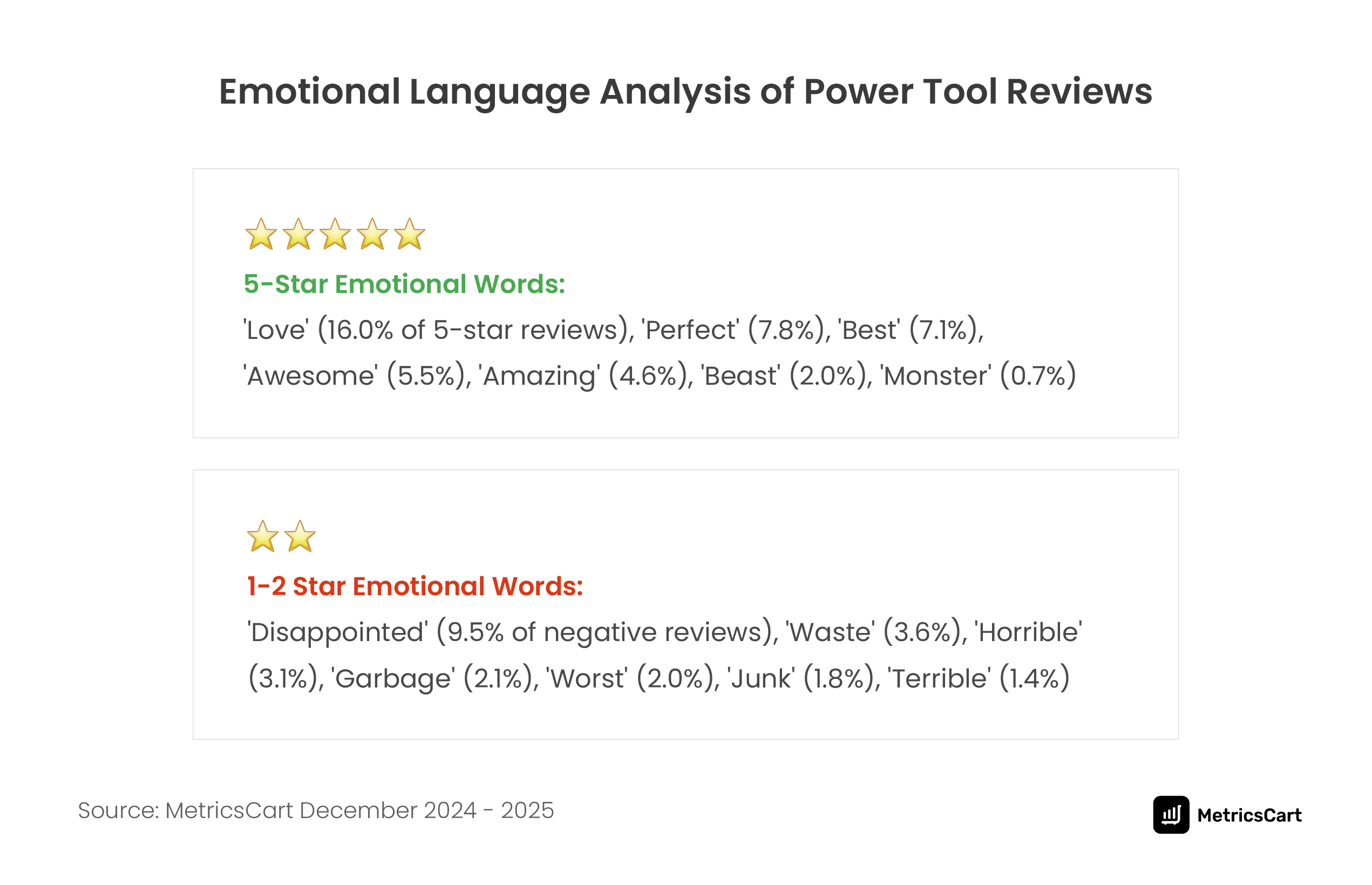
The positive emotional words from 5-star reviews highlight that the highest satisfaction is tied to a strong sense of connection with the product. Words like “Love” (16%), “Perfect” (7.8%), and “Best” (7.1%) show that consumers are emotionally engaged when a product meets or exceeds their expectations.
On the flip side, the negative emotional language from 1-2 star reviews provides an equally telling picture of customer dissatisfaction. Words like “Disappointed” (9.5%), “Waste” (3.6%), and “Horrible” (3.1%) reveal that when a product fails to meet expectations, it evokes a sense of frustration and regret. These emotional cues suggest that consumers feel let down by the product’s performance or lack of value.
Additionally, words like “Worst” (2%) and “Garbage” (2.1%) point to deep dissatisfaction, signaling that the emotional gap between customer expectations and actual performance can cause serious brand damage.
This provides a roadmap for targeting specific pain points and improving the user experience. Brands that prioritize customer-centric design and function are more likely to garner positive emotional language, leading to higher satisfaction, loyalty, and ultimately, market success.
And, there are competitive cross-mentions within these reviews that highlight how often people compare across brands (likely after switching). This provides critical insights into how consumers perceive different brands and where competition is intensifying in the marketplace.
READ MORE | 5 Best Customer Insight Tools Smart Brands Swear By
Design Gaps in Power Tools Revealed by Customer Voice
Quick Win Opportunities
| Issue | Mentions | % Negative | Avg Rating | Priority |
| Chuck/bit retention | 146 | 24.0% | 3.75 | HIGH |
| Trigger sensitivity | 217 | 20.3% | 3.94 | HIGH |
| Belt hook/clip | 131 | 16.0% | 4.07 | MEDIUM |
| LED light positioning | 1,287 | 11.0% | 4.41 | MEDIUM |
| Battery drain concerns | 229 | 3.9% | 4.62 | LOW |
Customer feedback analysis offers a treasure trove of insights for product design and R&D, particularly for identifying and resolving design issues that significantly impact user satisfaction.
By listening to real-world feedback, brands can pinpoint specific areas for improvement and drive innovation in areas that matter most to consumers. MetricsCart’s power tools customer review report reveals several design opportunities as high priorities based on customer sentiment.
With 24% negative sentiment and a 3.75 average rating, chuck/bit retention is the most pressing issue. Customers are frustrated with bits falling out, improper seating, and wobbling, problems that impact both tool performance and safety. Addressing this could offer a significant competitive advantage.
The 20.3% negative sentiment related to trigger sensitivity highlights a clear demand for better speed control. Customers want a trigger that responds with precision. Professional users, especially, need variable speed control for delicate tasks.
While less critical, issues with battery life and drain appear in 3.9% of reviews. Though this is a lower priority, battery optimization remains important for improving overall user experience, particularly in the growing cordless tool market.
By focusing on these design opportunities, brands can use consumer feedback to drive their R&D efforts, ensuring that the next generation of tools not only meets but exceeds consumer expectations.
What This Means for Brand Strategy in 2026
As traditional brands like Milwaukee and DeWalt find themselves grappling with the realities of consumer expectations, newcomers like Flex have shown that product execution is the ultimate deciding factor. It all boils down to who pays attention to critical consumer insights.
The insights from MetricsCart’s power tools customer feedback report chalk out the need for strategic action in several areas:
- Performance is paramount: Consumers are increasingly focused on tools that offer exceptional power, reliability, and value. Flex has capitalized on this with its performance-first approach, and others must follow suit.
- Milwaukee’s urgent focus: The Surge 2760 failure has eroded trust, and Milwaukee must address key gaps in power and torque. Rebuilding trust through quality improvements and offering extended warranties could restore customer confidence.
- Flex’s momentum: With classic aspect leadership, Flex has a chance to become the market leader by expanding visibility and using its strengths in compact size and reliability.
- Craftsman & Ryobi’s focus: Both brands need to solve battery quality issues to regain consumer confidence. Craftsman should explore battery replacement programs to improve satisfaction.
- Target automotive markets: Impact wrenches dominate in automotive use cases, receiving the highest satisfaction ratings. Brands should adjust messaging to appeal to this growing professional segment.
If your brand wants to top the list of best power tools for 2026, you know the mantra now: listen to what your customers are saying, when it matters most. And, in a category like power tools, consumers are talking way beyond the reviews on your PDP on YouTube product reviews, TikTok, and more! Are you tuned into the conversations about your brand?
With MetricsCart’s ratings and review analysis and Consumer Insights Platform for social listening, brands can understand real-time customer sentiment and unlock actionable insights to guide strategic decisions. Dive into your customer feedback and optimize your products to meet 2026 expectations. See how our insights can help drive smarter innovation and be the brand consumers love!
Disclaimer: MetricsCart is the exclusive owner of data used in the Consumer POV reports. Any kind of third-party usage entails due credit to the source material.