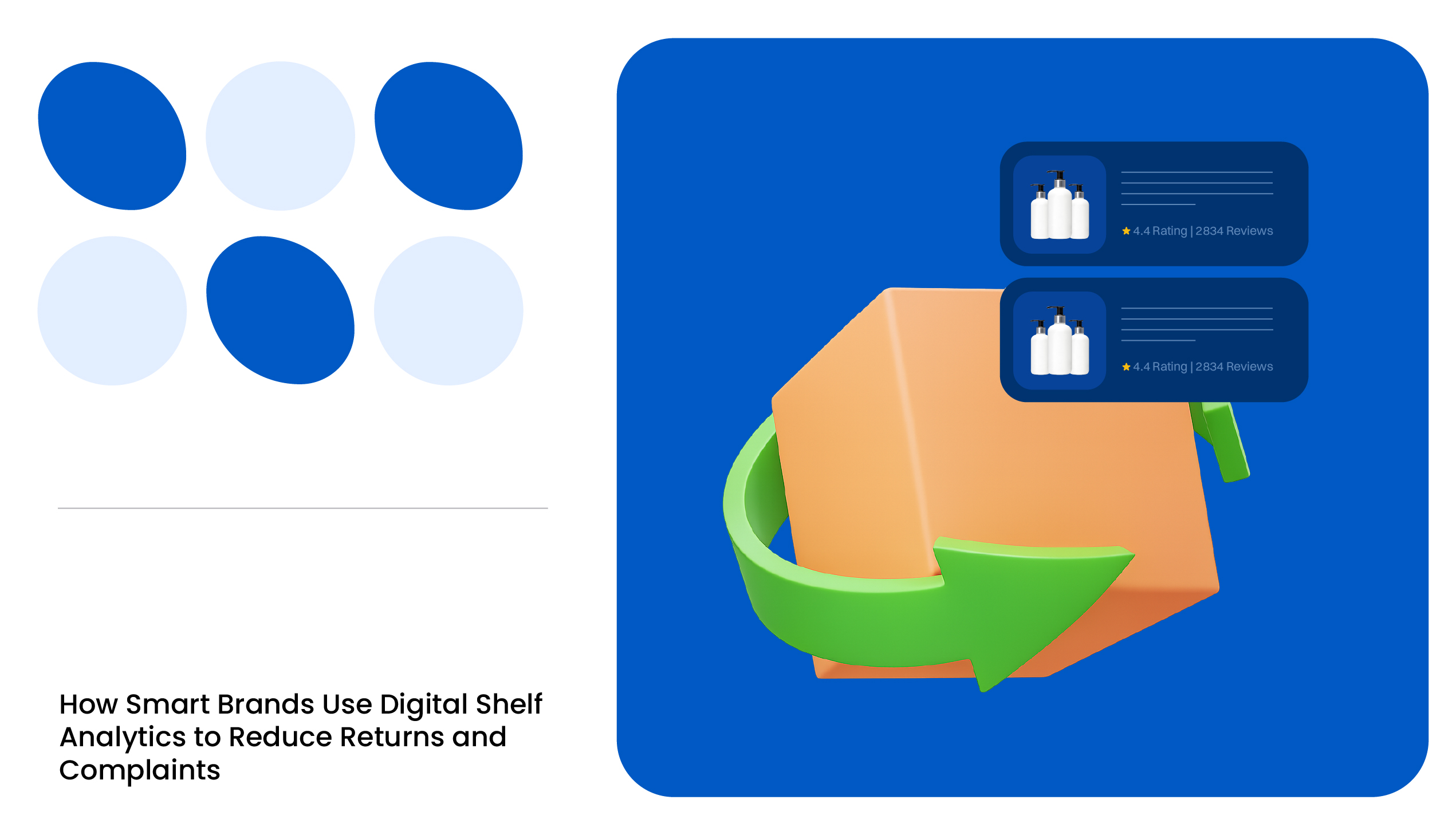
If you think returns are a logistics issue, let me just stop you right there! Returns are not a warehouse problem. Returns are not a customer service problem. Returns are a digital shelf problem.
Most brands treat returns as an operations problem: better warehouses, faster refunds, smoother reverse logistics. But the real problem starts earlier.
A shopper sees photos, reads bullets, checks specs, scans reviews, glances at the price, and builds a picture in their head. They buy based on that mental model. When the product arrives and doesn’t match, even in a small detail, the return is already guaranteed.
Most returns are not always product failures. They are expectation failures. They originate on the digital shelf.
This is why more brands are now using Digital Shelf Analytics (DSA) to reduce returns and complaints. Digital shelf analytics gives brands the same visibility shoppers have. When used correctly, DSA powers the most effective e-commerce return rate reduction strategies by helping teams act before issues escalate.
Why Do Consumers Return Products?
Shopify reports that return rates today hover between 16 and 30%, depending on the category. That means one out of every three shoppers may end up sending your product back.
And when a return comes in, the business loses more than revenue. You lose labor hours, shipping fees, inventory freshness, customer trust, and, in many cases, future sales. Once the total cost is calculated, the financial hit often sits somewhere between 20 and 65% of the product value.
And here are the key triggers that make customers return products:
Mismatched Product Expectations
This is the classic case of the shopper saying it looked different online. It might be a dress that fits tighter than expected or a blender that looked smaller on the listing images than it actually is. When customers feel the product does not match what they imagined, the return is almost guaranteed.
Inaccurate or Incomplete Product Content
Think of a shopper buying a kitchen appliance with no accurate wattage information, missing noise-level details, and outdated compatibility notes. They feel uncertain before the purchase and disappointed after it. Research from inRiver shows that incomplete content is one of the most cited reasons for product returns.
Inconsistent Pricing Across Retailers
Nothing damages trust faster than a shopper finding the product at a much lower price on a different marketplace hours after buying. The product may be fine. The experience is not. Pricing inconsistency, unauthorized discounting, and MAP violations are major drivers of preventable returns.
Poor Post-Purchase Clarity
If you have ever tried to assemble furniture with a vague diagram, you already understand this problem. Instructions, component lists, and compatibility details must be clear. When they are not, customers send perfectly functional products back.
Review Issues Not Noticed Early
Reviews are the closest thing we have to real-time customer diagnostics. You will often see the same pattern repeat itself. “Runs small,” “missing screws,” “color is misleading,” “battery drains in two hours.” By the time these patterns reach your support team, the return spike is already in motion. The brand needed to intervene sooner.
READ MORE | Reviews impact your supply chain operations! Check out Role of Customer Feedback in Supply Chain: Why It Matters More Than Ever

How To Use DSA to Reduce Returns and Complaints?
You do not reduce returns by guessing. You reduce them by closing the expectation gap at the points where it opens. Here is how digital shelf intelligence does that, and how dedicated software makes it repeatable at scale.
1. Content Accuracy and Completeness
This is the fastest lever to pull. Start by treating your PDP like a contract. With a content compliance tool, audit every title, bullet, attribute, dimension, and other specs like ingredients, claims, pack size, variants, etc. It resurfaces mismatches, missing fields, and noncompliant claims in real time. When those corrections go live, you reduce product returns with digital shelf data at the SKU level, and shoppers receive what they expect.

In Episode 8 of the Digital Shelf Insider podcast, Chris Perry, CLO, firstmovr, shared eye-opening insights into shopper-centricity, product page content optimization, and how to break internal silos for CPG brands. Tune into the full episode here:
2. Visual Quality and Image Consistency
Images set expectations faster than text. Image audit can help detect low-resolution hero shots, missing angles, color inaccuracies, incorrect variant imagery, and unauthorized image swaps by third-party sellers. Enforce a single source of truth for visual stacks and syndicate consistently. Brands that tighten image parity across retailers reduce aesthetic-driven returns because the product that shows up looks like the product that sold.
3. Complaints and Review Monitoring
Customer reviews are your early warning radar. With digital shelf analytics, you can monitor review velocity, extract recurring issues with keyword and sentiment models, and auto-flag anomalies at the SKU-variant level.
Ratings and review monitoring software help cluster themes and surface the ones that move returns. When “missing screws” or “color bleeds” trends appear, push content fixes, add assembly steps, update compatibility notes, and escalate quality checks. This is how you minimize customer complaints using analytics before they degrade ratings or conversion.
4. Price Integrity and Assortment Governance
Returns do not only reflect product fit. They also reflect how (un)fair the purchase felt. Use DSA to track pricing, MAP violations, and sudden discounting. Lock down assortment definitions and variant relationships so that shoppers do not buy the wrong thing because the marketplace presents the wrong thing. This is another direct path to reduce product returns with digital shelf data.
Pair price monitoring with MAP monitoring and enforcement. The software should sweep for unauthorized discounting, identify duplicate or misleading listings, and alert you to take timely action. Proactive, tech-assisted return reduction underscores the value of better pre-purchase signals, which include price clarity.
READ MORE | Digital shelf analytics is the key to smarter retail media strategies. Check out Cracking the Code: Digital Shelf Analytics for Next-Level Retail Media Strategy for Brands.
KPIs That Improve with Digital Shelf Intelligence
Keep an eye out for the following to see how well using DSA to reduce returns and complaints is impacting your business:
Return rate: When you stabilize content, images, pricing, and reviews, return rate trends down. Many programs see a three to eight point improvement across priority SKUs in the first cycle. That is a direct reflection of e-commerce return rate reduction strategies done right.
Complaint rate and Consumer Satisfaction Score (CSAT): When customers get exactly what the product page promised, support queues get quieter. As PDP accuracy improves, review themes are addressed early, and price integrity is protected, complaints naturally fall, and customer satisfaction increases. Fewer surprises mean fewer tickets.
PDP accuracy score: The backbone of digital shelf performance is PDP accuracy. Keep in check attributes, spec parity, and image set parity with content compliance audits across the retailers that matter. Digital shelf analytics makes this measurable and repeatable across channels.
Customer feedback: Ratings and reviews are one of the most reliable downstream indicators of whether your digital shelf is telling the truth. Teams using DSA to reduce returns and complaints see this KPI behave almost like a health monitor.
Margin gain through fewer returns: More than just a CX win, reducing returns improves margin. Returns carry shipping, inspection, repack, and liquidation penalties. Even a one-point drop in return rate on high-velocity SKUs can protect six figures annually.
If your goal this year is to protect margin, elevate customer experience, and keep your product pages aligned with what customers actually receive, it’s time to treat digital shelf intelligence as a core operational system rather than a reporting layer.
MetricsCart gives teams that system. With real-time digital shelf analytics, get the right digital shelf intelligence to minimize customer complaints and returns. Book a walkthrough now to see how MetricsCart boosts your brand growth online.
Ready To Take Your Brand Performance to the Next Level?
FAQs
Digital shelf analytics is the continuous monitoring of your product pages across retailers. It tracks content accuracy, image parity, pricing integrity, search placement, and reviews so you can correct issues at channel speed. It is core to using DSA to reduce returns and complaints.
You can see where fields are missing, where images are wrong, where price and assortment drift, where search rank falls, and where review themes indicate a brewing problem. Those are the inputs you need to minimize customer complaints using analytics and to reduce product returns with digital shelf data.
Track return rate by SKU and retailer, PDP accuracy score, time to correct content, rating trends, review velocity, pricing parity, and MAP violations, and margin impact from avoided returns. These are standard anchors in modern e-commerce return rate reduction strategies.
Audit and fix PDP accuracy, enforce image consistency, stabilize price and assortment, mine reviews daily, and close the loop with fast, verified syndication. Add AI scoring to prioritize SKUs that are most at risk. This is a practical path to use DSA to reduce returns and complaints.
They show you exactly where expectation breaks. When you fix the content, the imagery, the price integrity, and the recurring review themes, customers receive what they expected and keep it. That is how you reduce product returns with digital shelf data, minimize customer complaints using analytics, and lock in durable results from your e-commerce return rate reduction strategies.