Highlights
- A MAP violation occurs when a seller publicly advertises a product below the brand’s minimum price, whether on product pages, in ads, in emails, in search results, or on social media.
- MAP controls the advertised price, not the selling price. Mixing up the two leads to enforcement mistakes.
- The most damaging violations in 2026 are not direct price drops. They are coupons, Subscribe & Save discounts, and bundle per-unit pricing that lower the real price while the listed price stays compliant.
- Unauthorized sellers are the most persistent source of MAP violations. They never signed the agreement, they rotate storefronts, and they have no reason to protect the brand’s pricing.
- MAP violations are not illegal. They are policy breaches. But inconsistent or coercive enforcement can create antitrust risk under the Sherman Act.
- A MAP policy that does not define coupons, subscriptions, bundles, and cart-level pricing as part of the “advertised price” has built-in loopholes that sellers will exploit.
- Compliant retailers are the first to leave when violations go unaddressed. They see no consequences for violators and decide the margin compression is not worth staying.
Here is what most brands get wrong about MAP violations. They think the problem is sellers openly breaking the rules. It is not. The real problem is that most violations in 2026 do not look like violations at all.
They look like a compliant listing with a coupon quietly attached. A Subscribe & Save discount that chips away at the price floor on every recurring order without anyone doing anything manually. The listed price looks fine. The price the customer actually pays does not.
That is what makes MAP violations so hard to stay ahead of. They are not rare. Unauthorized resellers breach it 50% of the time. Authorized ones, 20%. And yet the most damaging ones still go undetected.
The obvious ones, a seller listing below your floor, still happen. But the ones causing the most damage are the ones your team walks past every day because the product page looks clean.
A MAP violation, at its simplest, occurs when a seller advertises a product below the brand’s minimum price. But as this guide shows, the simple definition barely scratches the surface of how it plays out in practice.
MAP Violation Meaning: A Simple Explanation
A MAP violation occurs when a retailer or seller publicly advertises a product at a price below the brand’s minimum advertised price. The keyword is “advertised.” MAP does not control what a retailer charges at checkout or in a private deal. It controls what the customer sees on the product page, in search results, in ads, in promotional emails, and on social media.
When that visible price drops below the floor the brand has set, it is a MAP violation. Whether intentional, accidental, or automated, it is still a violation.
The reason this matters is straightforward. The price customers see online becomes the price they expect to pay. Once that expectation drops, it affects every channel where the brand sells, not just the listing where the violation occurred.
What Is MAP Pricing?
To understand how a MAP violation happens, you first need to understand what MAP pricing covers and where it applies.
MAP pricing is the minimum advertised price a brand sets for its products. The brand defines it. Resellers agree to follow it. It is not a suggestion. It is the floor below which no seller can publicly display a price.
That floor applies to every surface where a customer can see the price: product pages, marketplace listings, Google Shopping ads, email promotions, social media posts, and banner advertising.
It does not apply to in-store private transactions or to prices that only appear after a customer adds a product to the cart, though more brands are now updating their policies to cover cart-level pricing as well.
The brand sets MAP unilaterally and applies it the same way across every seller. No exceptions, no negotiations. That consistency is what makes it enforceable. The moment a brand starts making exceptions for specific sellers, the policy weakens, and violations become harder to act on.
For a deeper look at how brands track competitor price movements across channels, see our pricing and promotion intelligence page.
MAP Price vs. MSRP: Key Differences Brands Must Know
This is where many brands run into trouble. MAP and MSRP sound similar. They are not. And confusing the two leads to enforcement decisions that either go too far or do not go far enough.
MAP is the lowest price a seller can publicly display. The brand sets it. Resellers agree to it. If a seller advertises below MAP, the brand can take action, ranging from a warning to cutting supply.
MSRP is what the brand thinks the product should sell for. It is a recommendation, nothing more. A retailer can ignore MSRP entirely without consequences.
The difference matters for this guide because MAP violations are enforceable. MSRP deviations are not. When a seller advertises a product at $149 with a $199 MSRP, that is their choice. When a seller advertises a product at $149 with a $169 MAP, that is a violation.
Knowing where that line sits is what separates a brand that enforces effectively from one that either overreacts to MSRP deviations or underreacts to actual MAP breaches.
For a full breakdown of how these pricing terms work together, see our guide on the difference between MSRP and MAP.
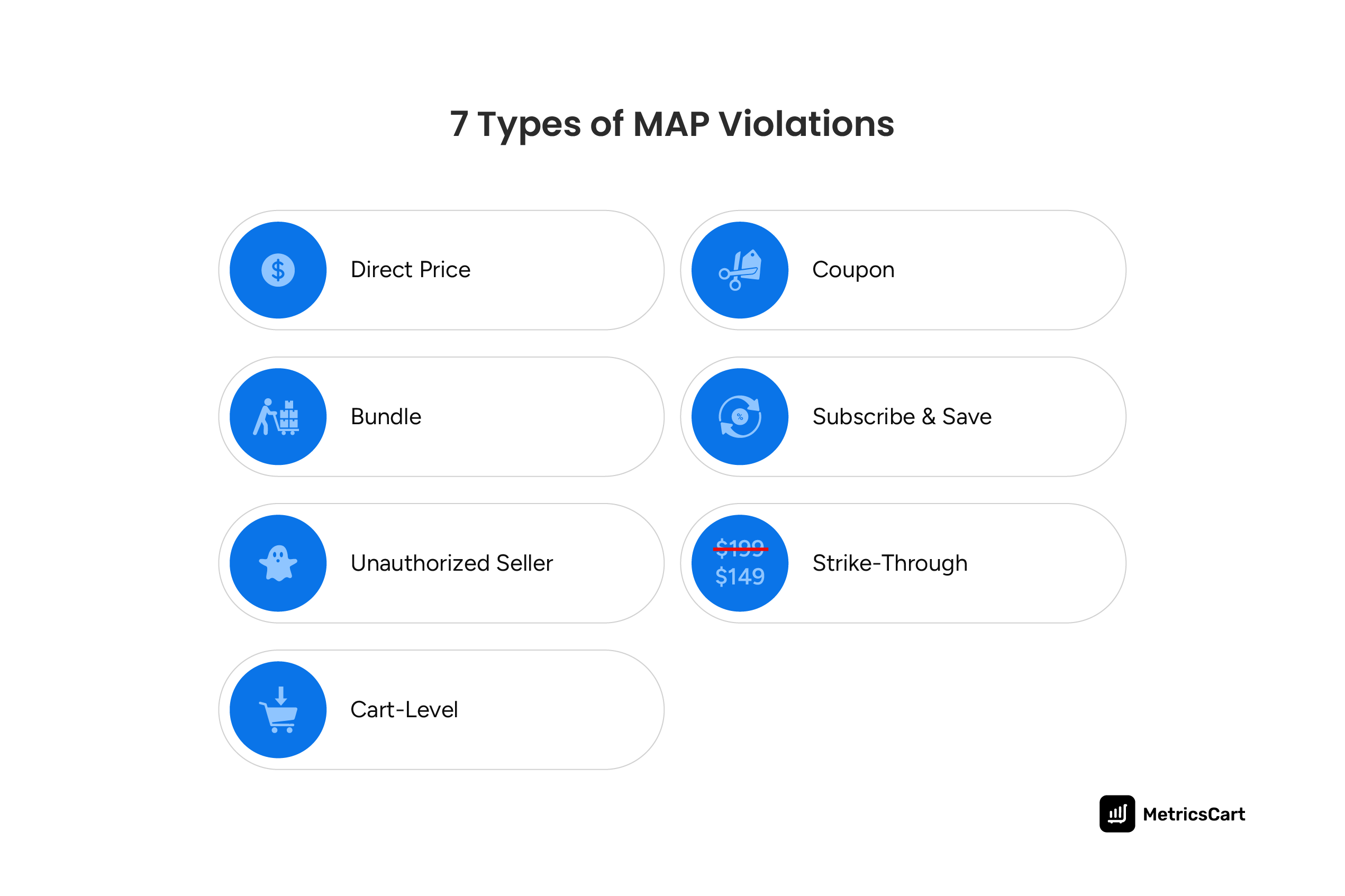
Types of MAP Violations
Not every MAP violation is a straightforward price drop. The most damaging violations are those that appear compliant on the surface but break the price floor in ways that standard monitoring misses.
Here are the most common types of brands encountered across Amazon, Walmart, and other marketplaces.
Heading: 7 Types of MAP Violations
Direct Price Violation
The simplest form. A seller lists a product below MAP on the product page, in an ad, in a promotional email, or on social media. The price is visible and clearly below the floor.
The most cited real-world example is Birkenstock vs. Costco. In 2020, Costco sold Birkenstock sandals at a fraction of their roughly $135 retail value, in direct violation of MAP.
Birkenstock’s CEO publicly denounced the move, but Costco continued selling at the reduced price. What makes this case particularly instructive is the enforcement lever Birkenstock had already pulled before the public dispute: the brand had stopped supplying Costco directly over earlier pricing disagreements.
Cutting off supply is one of the most decisive actions a brand can take against a persistent violator, and Birkenstock used it.
Easy to spot, but only if monitoring is continuous. Sellers often correct direct violations within hours, so a tool that scans only once a day will miss them entirely..
Coupon and Promotional Code Violation
The listed price meets MAP. But the seller has attached a digital coupon or promo code that drops the effective price below the floor at checkout.
The product page looks compliant. The actual price the customer pays is not. Amazon allows sellers to attach coupons independently, which means a listing can appear MAP-compliant while advertising a lower effective price right on the product page. This is one of the most common and most commonly missed map pricing violations in 2026.
Bundle and Multipack Violation
A seller creates a custom bundle or multipack that brings the per-unit price below MAP without changing the individual product’s price.
The bundle carries a different product ID, so it does not appear in standard SKU-level monitoring. On Amazon, any seller can create a bundle without the brand’s approval. On Walmart, the same applies. The brand often does not know the listing exists until a reseller complains.
Subscribe & Save / Subscription Discount Violation
Amazon’s Subscribe & Save program automatically applies a 5-15% discount on recurring orders. A seller priced exactly at your MAP floor is breaching it on every subscription order without any manual intervention.
In categories like health, beauty, grocery, and household essentials, where subscription rates are highest, this type of minimum advertised price violation runs continuously. No seller action needed. The platform discount does the work.
Unauthorized Seller Violation
Sellers who never signed the brand’s MAP agreement list products below MAP because they have no reason not to. They acquired inventory through liquidation, gray-market channels, or wholesale leakage at costs low enough to allow profit even at below-MAP prices.
They rotate storefront names. They operate across multiple marketplaces. They have no relationship with the brand and no incentive to protect its pricing. This is the most persistent type of map policy violation across all platforms.
Strike-Through and Comparison Pricing Violation
A seller displays “Was $199, Now $149” or “Save 25%” messaging. The listed price might technically meet MAP, but the visual presentation advertises a lower effective price.
This is common on Google Shopping, in marketplace ads, and in email promotions. The customer sees the lower number first. That is the price they anchor to, regardless of what the shelf price shows.
Cart-Level and Add-to-Cart Violation
The product page shows a MAP-compliant price. But when the customer adds the product to the cart, a lower price appears.
Whether this counts as a MAP price violation depends entirely on the brand’s MAP policy language. If the policy addresses only “listed” or “displayed” prices and does not mention cart-level pricing, sellers will exploit this gap. Brands writing or updating their MAP policies in 2026 should address this explicitly.
Why do MAP Violations Happen: Root Causes Brands Don’t See
Most MAP violations are not random acts by rogue sellers. They follow patterns, and the root causes are often inside the brand’s own operations.
Weak or Ambiguous MAP Policy Language
If the MAP policy does not define what counts as the “advertised price,” sellers will interpret it in their favor. Policies that do not address coupons, subscriptions, bundles, cart-level pricing, or comparison messaging leave the door open for violations that are technically compliant but practically destructive.
The more specific the policy, the easier it is to enforce. The vaguer it is, the more arguments sellers have when confronted.
Unauthorized Resellers with No Policy Agreement
They never signed the MAP policy. They acquired your product through channels you do not control. Your pricing agreement means nothing to them.

This is not a niche problem. In Season 2, Episode 1 of the Digital Shelf Insider, Megan Harmon, Managing Partner at Thorncrest Brand Protection, makes the case that unauthorized sellers are the single hardest MAP challenge brands face today, because you cannot enforce a policy against someone who never signed it.
Watch the Full Episode of Digital Shelf Insider here:
That is the core issue. You cannot enforce a policy against someone who never agreed to it. These sellers rotate storefronts, operate across multiple marketplaces, and acquire inventory at costs low enough to profit at any price.
Distribution Chain Leakage
Products pass through multiple hands before reaching the marketplace. A brand sells to a distributor. That distributor sells to a wholesaler. That wholesaler sells to a marketplace reseller. By the time the violation surfaces, the brand has no relationship with the end seller and no visibility into how the product got there.
Liquidation makes it worse. Excess inventory sold to recover value is bought by bulk buyers who list it below MAP because their acquisition cost allows them to profit at any price.
Automated Repricing Without Price Floors
Repricing tools on Amazon and Walmart adjust seller prices multiple times a day to stay competitive for the Buy Box. Without MAP-aware price floors configured, these tools can automatically push listings below MAP.
One seller’s violation feeds the next. The repricing tool does not know or care about your MAP policy. It just matches the lowest price it sees.

How to Identify, Document, and Report a MAP Violation
Build Your Evidence Record Before You Act
Every MAP violation needs a complete evidence record before any enforcement action:
- Seller name or ID.
- Product listing URL.
- Listed shelf price.
- Effective price after coupons, subscriptions, and discounts.
- Timestamp of when the violation was live.
- Screenshot of the listing at the time of the violation.
This documentation is what makes your enforcement credible. Without it, sellers deny, delay, or ignore. With it, you have a case that holds up in every conversation, from a first warning to a supply suspension.
Report It Through the Right Channel
Once a violation is documented, here is where to take it.
- Direct seller contact. Start here. Send a formal notice with the full evidence attached. Many first-time violators correct when presented with proof. Keep the tone factual, not threatening.
- Amazon. Brand Registry’s Report a Violation portal is the channel. Amazon will not act on pricing alone, but if the violation overlaps with IP misuse (unauthorized brand images, incorrect product descriptions, modified packaging claims), it gives you a path.
- Walmart. Walmart’s brand protection channels handle escalations. Well-documented cases with seller details, evidence of violations, and a history of repeat offenses are processed faster.
- Internal escalation. Follow your tiered enforcement workflow. First notice, formal warning, supply restriction, termination. Log every step.
For Amazon-specific detection and prevention, see our guide on Amazon MAP violation detection and prevention.
The steps above give you the framework. Putting them into practice across hundreds of SKUs and multiple marketplaces is where it gets harder.
The MAP Monitoring Masterclass covers how brands are doing exactly that, with real examples, common mistakes, and how teams handle repeat offenders without burning reseller relationships.
How MetricsCart Detects and Resolves MAP Violations Across Channels
Most MAP monitoring tools watch the shelf price and stop there. That catches direct price violations. It misses everything else.
MetricsCart is built to detect the violation types described in this article, not just the obvious ones. Brands like PepsiCo, Mattel, and PVH trust MetricsCart to monitor pricing and seller activity across their catalog. Here is how the platform works.
Multi-Platform Violation Detection.
MetricsCart scans beyond the listed price. Coupon-adjusted pricing, Subscribe & Save discounts, bundle per-unit calculations, and cart-level pricing are all covered across Amazon, Walmart, and 150+ retailer websites. Every violation type in this guide is monitored through a single platform.
Seller Identification and Unauthorized Account Detection.
Every seller on your listings is tracked and checked against your authorized reseller list. New or unrecognized accounts are surfaced as soon as they appear. Sellers operating across multiple storefronts are connected by behavioral patterns. Your enforcement starts with a name and a history, not a guessing game.
Capture Every Detail of the Violation
Each violation is recorded with the seller ID, listing URL, advertised price, effective price, timestamp, and a screenshot of the listing at the time of the violation. That evidence package is what turns a first warning into a credible enforcement action and a repeat offense into a defensible supply suspension.
Industry: Specialty Food & Beverage How Real-Time Price Monitoring Helped a European Cheese Brand Maintain Premium Positioning A European cheese brand needed to protect its premium pricing across multiple online retailers. Price drops on one platform were affecting positioning on others. With MetricsCart’s real-time price monitoring, the brand gained visibility into pricing movements across channels and acted on inconsistencies before they could spread. Result: +4% improvement in overall gross margin.
Cross-Channel Enforcement Visibility.
Sellers do not limit themselves to one platform, and neither do their violations. MetricsCart covers Amazon, Walmart, and 150+ other retailers under one monitoring layer, so no violation slips through simply because it happened on a channel your team was not watching.
Close the gap between your MAP policy and what is actually happening on your listings.
FAQs
A MAP violation occurs when a retailer or seller advertises a product below the brand’s minimum advertised price. It applies to publicly displayed prices on product pages, in ads, in emails, and in search results. It does not apply to private transactions or in-store negotiations.
In e-commerce, it means a seller has listed or promoted a product at a price below the brand’s MAP floor on a marketplace, a retailer’s website, or an advertising platform. Online violations are harder to catch because coupons, subscriptions, and bundle pricing lower the effective price without changing the listed shelf price.
A MAP pricing violation concerns the advertised price that customers see publicly. A selling violation is about the transaction price, what customers are actually charged. MAP policies control what is displayed. They do not control what happens at checkout or in a private negotiation.
No. A MAP violation is a breach of a brand’s commercial policy, not a law. However, how brands enforce MAP can create legal risk if enforcement is selective or coercive, or if it involves price-fixing agreements between competitors.
Through a tiered process: detect the violation with automated monitoring, verify it with evidence, contact the seller with documentation, escalate with formal warnings for repeat offenders, and restrict or terminate supply for persistent violators
Yes, and more. MetricsCart detects MAP violations across all pricing surfaces, including coupons, Subscribe & Save, and bundle per-unit pricing that standard tools miss. It combines violation detection with seller identification, enforcement workflows, and digital shelf visibility across 150+ retailers.