Key Highlights
- Amazon does not enforce MAP policies for brands, making continuous monitoring essential.
- One unauthorized seller can trigger rapid ASIN-wide pricing spirals through Amazon’s dynamic repricing systems.
- Amazon’s Featured Offer (Buy Box) structure pressures sellers to undercut competitors, increasing MAP violations.
- Amazon also operates as a distributor through Vendor Central, creating additional MAP compliance challenges for brands.
- Effective Amazon MAP monitoring requires automated scanning, not manual audits or spreadsheets.
- Brands should monitor effective prices after coupons, Subscribe & Save discounts, and bundle offers, not just listed prices.
- Grey market inventory and distributor leakage are major causes of recurring MAP violations.
- Tiered enforcement workflows help brands respond faster and more consistently to violations.
- Multi-marketplace monitoring is critical because MAP violations often spread beyond Amazon to Walmart, eBay, and other channels.
- MetricsCart helps brands automate MAP monitoring, identify unauthorized sellers, and enforce pricing policies across 150+ marketplaces.
- A kitchen electronics brand reduced unauthorized MAP violations by 65% and protected $1.2M in brand value using MetricsCart.
“When you implement those MAP (Minimum Advertised Price) and those UPP (Unilateral Pricing Policy) policies and pricing goes up, you become a much more valuable partner for your retailers.”
Megan Harmon, Managing Partner, Thorncrest, opened the season 2, Episode 1 of the Digital Shelf Insider Podcast with this exact reality. When your pricing remains stable, it is not just your profits that improve. Your brand credibility strengthens, retailer relationships become healthier, and authorized sellers gain more confidence in carrying and protecting your products.
The problem is that maintaining pricing integrity on Amazon is far harder than most brands expect.
One unauthorized seller undercuts pricing, Amazon’s dynamic pricing systems react instantly, third-party sellers begin matching the lower price, and suddenly the entire ASIN enters a pricing spiral before compliance teams even notice the first violation. By the time you notice and react, the Buy Box has already moved three times, and retailer trust is halfway out the door.
That is exactly why Amazon MAP monitoring has evolved from occasional manual audits into continuous, automated pricing intelligence.
What Is Amazon MAP Monitoring
MAP, or Minimum Advertised Price, is the lowest price a reseller is allowed to publicly advertise for a product. It does not necessarily control the final selling price inside a cart or private transaction, but it sets the minimum visible advertised price across marketplaces and retailer listings.
Brands create MAP policies to:
- Protect pricing integrity
- Prevent destructive price wars
- Maintain premium brand positioning
- Preserve retailer margins
- Ensure fair competition across authorized sellers
Amazon MAP monitoring is the process of continuously tracking Amazon product listings to ensure that this price threshold is not violated.
Learn everything you must know about Minimum Advertised Pricing policies. Attend our MAP Masterclass course.
Why Does Amazon Make MAP Monitoring Harder Than Other Channels?
The MAP monitoring tactics that work in traditional retail MAP enforcement often fail on Amazon for various reasons.
Amazon does not enforce your MAP policy
Amazon’s pricing systems are designed to optimize for customer-facing price competitiveness, not brand agreements.
Amazon will not remove a listing because it violates your price floor, will not share seller contact details with you, and its own retail arm is not exempt from the repricing dynamics that cause violations. This is Amazon’s stated position, and it hasn’t changed.
The Featured Offer (Buy Box) creates structural pressure to undercut
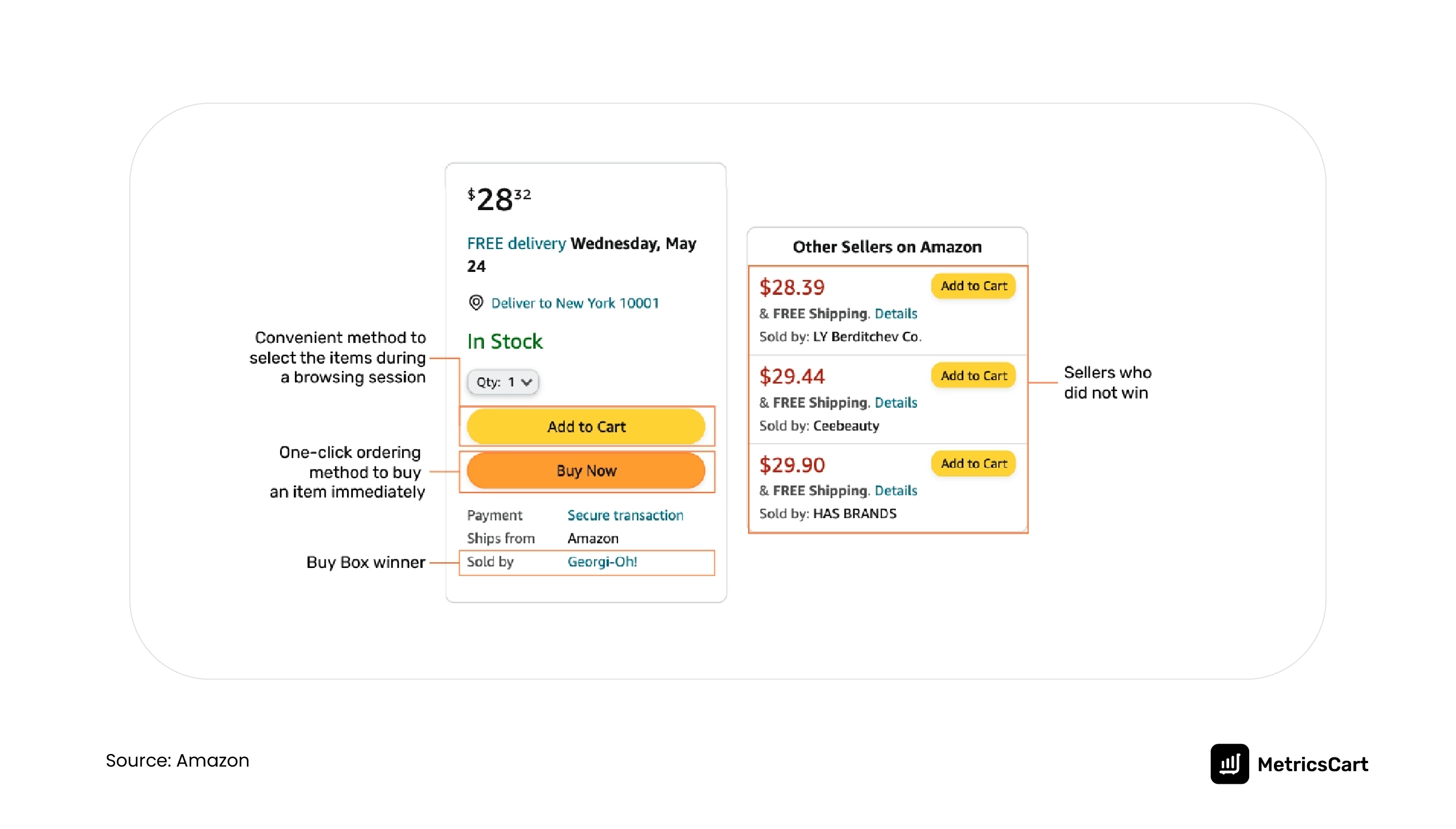
The Amazon Buy Box, now called the Featured Offer, is the default seller customers see when they click “Add to Cart” or “Buy Now.” Since nearly 85% of Amazon sales occur through these buttons, winning the Buy Box often determines who captures most sales on an ASIN.
Price plays a major role in Buy Box visibility. So when one seller drops below MAP, Amazon may reward them with greater visibility, pushing other sellers to lower prices as well to stay competitive. This creates a pricing spiral that can quickly spread across the entire listing.
Amazon’s dynamic pricing and MAP violations
Amazon’s system is built to favor the lowest price above all else. Plus, it also employs automated repricing systems that continuously adjust prices based on competitor activity, Buy Box changes, marketplace trends, and seller behavior.
So when one unauthorized seller drops below MAP, other sellers often begin matching that lower price automatically within minutes, triggering a pricing cascade across the entire ASIN.
READ MORE | Dynamic Pricing in E-Commerce: Strategies and Insights
Amazon’s Role as a Distributor and Its Impact on MAP Compliance
Most brands think of Amazon purely as a marketplace. But through Vendor Central, Amazon also operates as a first-party (1P) distributor, buying inventory directly from brands and reselling it as “Sold by Amazon.”
This creates a major MAP policy compliance challenge because Amazon Retail can price products however its algorithms decide. Its automated repricing systems react to competitive signals across the ASIN without considering your MAP policy. When Amazon Retail drops below MAP, that lower price often becomes the benchmark that every other seller starts matching.
The problem is that brands have very limited control here. Amazon does not commit to MAP compliance inside Vendor Central agreements, and brands cannot realistically enforce pricing policies against Amazon Retail the same way they would against traditional resellers.
The 2021 US Consumer Product Safety Commission (CPSC) ruling classifying Amazon as a distributor added more legal accountability for product safety and liability, but it did not change Amazon’s freedom to price products below MAP. What it did reinforce, however, was the importance of distributor accountability and upstream inventory control.
For brands, this means MAP enforcement can no longer focus only on sellers. It also requires:
- Continuous Monitoring of Amazon Retail Pricing: Catch 1P price drops instantly to prevent algorithmic price spirals from destroying your marketplace margin.
- Tracking Distributor Leakage: Find out exactly which wholesale partners are breaking channel rules and leaking your inventory.
- Identifying Grey Market Supply Sources: Trace how closeout, liquidator, or cross-border stock is finding its way onto the digital shelf.
- Managing Unauthorized Inventory Movement: Controlling your product flow before it ever reaches an Amazon fulfillment center.
READ MORE | How Supply-Chain Leaks Create MAP Violations (And How to Prevent Them)
How to Set Up Amazon MAP Monitoring: A Step-by-Step Workflow
Effective Amazon MAP monitoring is an operational process, not a one-time setup. Here is how to build a workflow that catches violations early and drives consistent enforcement.
Step 1: Establish a Clear, Legally Sound MAP Policy
Before monitoring anything, your MAP policy needs to be unambiguous and legally defensible. A Minimum Advertised Pricing policy is a unilateral pricing agreement you have with your sellers, on the terms that they will not advertise your products below a set threshold price. It is not a price-fixing agreement, but it must be structured to avoid antitrust exposure.
Your policy should specify
- which channels it covers (Amazon, Walmart, eBay, brand websites, etc.),
- what constitutes a violation (listed price, effective price after coupons, or both),
- the consequences for violations at each tier (warning, inventory suspension, termination), and
- how to communicate the policy to new and existing sellers.
Have legal counsel review your MAP policy document before distribution. This is especially important if you plan to send cease-and-desist letters, as the legal weight behind your enforcement depends on a properly constructed policy.
READ MORE | MAP Policy for Brand Protection: How to Enforce and Monitor It in 2026
Step 2: Build Your ASIN and SKU Master List
MAP monitoring is only as good as the product catalog it covers. Build a complete master list that maps every SKU in your brand catalog to its corresponding ASIN or ASINs on Amazon (a single SKU can have multiple ASINs across product variations, bundles, or regional listings).
Include your current MAP price for each SKU, any variant-specific pricing, and the date the MAP was last updated. This becomes the baseline your monitoring system compares against actual listed prices across all active offers.
Audit this list quarterly at minimum. New ASINs can be created by sellers merging listings, splitting variations, or creating unauthorized bundles that pull your product into a new listing with different pricing dynamics.
Step 3: Deploy Automated Scanning Across All Active Marketplaces
Manual price checks cannot scale. An Amazon MAP monitoring platform like MetricsCart deploys automated web crawlers to scan 150+ online marketplaces continuously. It captures listed prices, effective prices after discounts, and seller identity across every active offer on your ASINs.
When a listing drops below your MAP threshold, the system flags it automatically and captures timestamped evidence, which is a critical requirement for enforcement.
What to look for in a MAP monitoring tool:
Step 4: Build a Tiered Enforcement Workflow
Not every Amazon MAP violation warrants the same response. A tiered enforcement workflow lets you match the intensity of your response to the severity and recurrence of the violation.
Tier 1 — Automated warning notice: The first violation from a seller triggers an automated warning email or MAP enforcement letter. The letter should reference your policy, identify the specific violation (ASIN, date, documented price), and give the seller a defined window to correct the listing (typically 48–72 hours).
Tier 2 — Escalated notice: A second violation or failure to respond to the Tier 1 notice triggers a more formal escalation — often a cease-and-desist letter, suspension of future inventory orders, or both.
Tier 3 — Termination and legal action: Repeat, egregious, or large-scale violators may be terminated from authorized seller status and, if appropriate, pursued through legal channels — particularly if the violation involves counterfeit product or trademark infringement that gives Amazon grounds to remove the listing.
Automated enforcement platforms can trigger Tier 1 notices immediately upon violation detection, which dramatically reduces the window in which a violation goes unaddressed.
The goal is to make the cost of violating MAP higher than the short-term revenue gain from a lower price.
READ MORE | A Beginner’s Guide to MAP Enforcement in E-Commerce
Step 5: Address Grey Market Supply at the Source
Enforcement letters sent to anonymous grey market sellers often have a limited effect. These sellers have no ongoing business relationship with your brand to protect, so the leverage of termination doesn’t apply. The more effective intervention is supply chain control.
Audit distributor purchase patterns quarterly to identify unusual order spikes that may indicate inventory being diverted to unauthorized channels. Add explicit resale restrictions to distributor and retailer agreements, specifying that inventory may not be sold to unauthorized resellers, through FBA, or outside defined geographic territories.
Amazon’s Transparency program is worth evaluating for brands with significant grey market exposure. By applying unique serialized codes to every unit, the program allows Amazon to verify product authenticity at the fulfillment center and block unverified units from reaching customers, cutting off the FBA pathway for grey market inventory.
READ MORE | Grey Market Sellers: How They Operate, and Why Brands Should Care
Step 6: Use Monitoring Data as Ongoing Brand Health Intelligence
MAP monitoring data does more than flag violations. It provides a continuous picture of how your products are priced across the digital shelf. Use it to identify which ASINs are most frequently violated, which sellers are repeat offenders, and which channels create the most downstream pricing pressure on Amazon.
Over time, this data becomes a distributor accountability tool. If a specific distributor’s territory consistently correlates with grey market activity on Amazon, that’s a signal worth acting on in your supply chain review, even if you can’t trace a direct line between the distributor and the unauthorized seller.
3 Best Amazon MAP Monitoring Tools
Manual MAP monitoring is not scalable, especially if you have a big portfolio of products. Here are the top 3 automated MAP monitoring tools.
MetricsCart
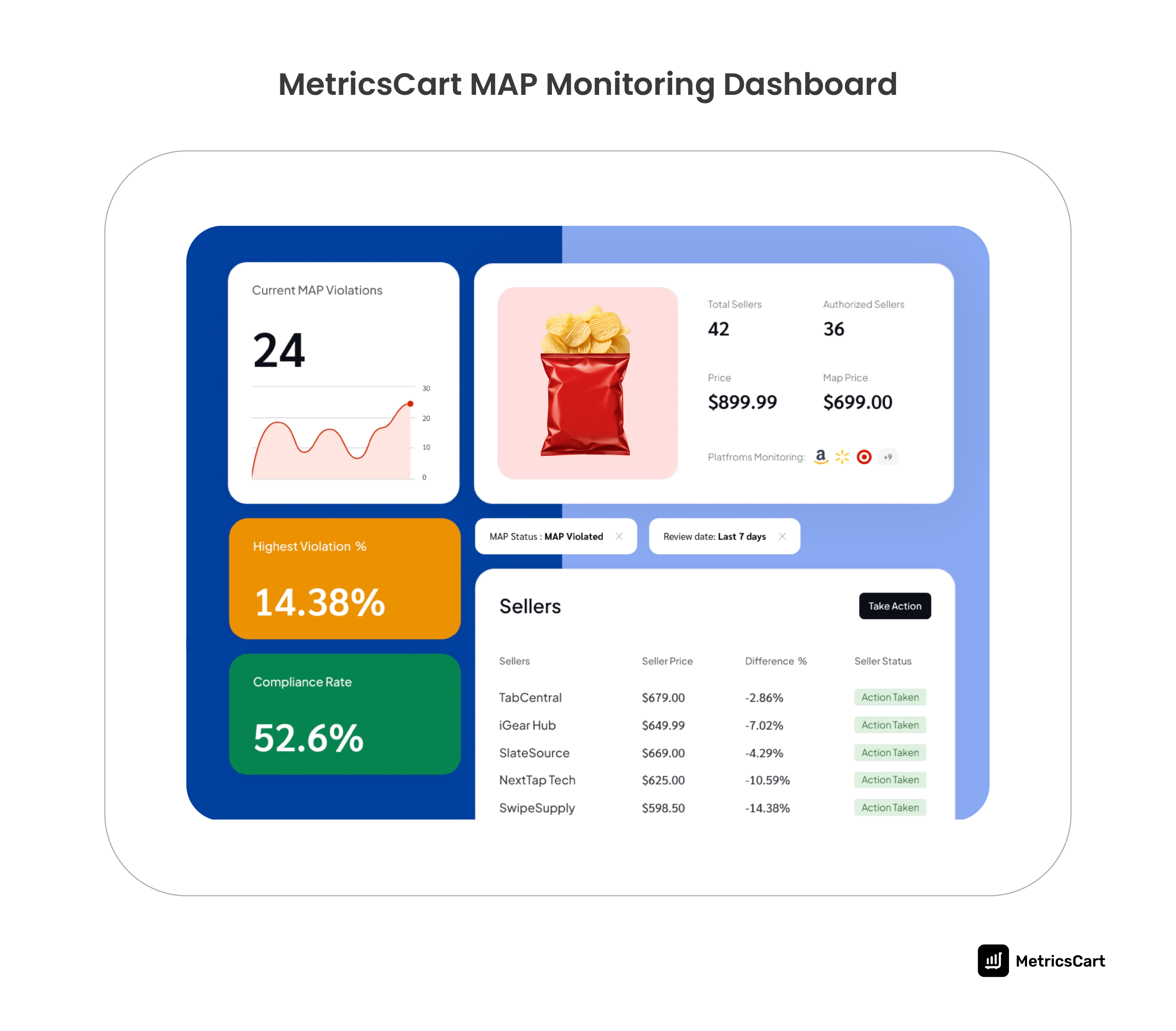
MetricsCart is one of the best MAP monitoring and enforcement platforms built for brands that want continuous visibility into pricing violations, unauthorized sellers, and marketplace activity across Amazon and other major marketplaces. The platform combines automated MAP monitoring with broader retail analytics, including pricing intelligence, content compliance, ratings and reviews tracking, Share of Search analysis, and competitor performance monitoring.
Key capabilities include:
- Real-time MAP violation detection across 150+ marketplaces
- Unauthorized seller identification and tracking
- Automated enforcement workflows and violation reporting
- Historical pricing intelligence and distributor leakage analysis
MetricsCart is best suited for brands looking for an all-in-one digital shelf and MAP compliance solution.
Bright Data
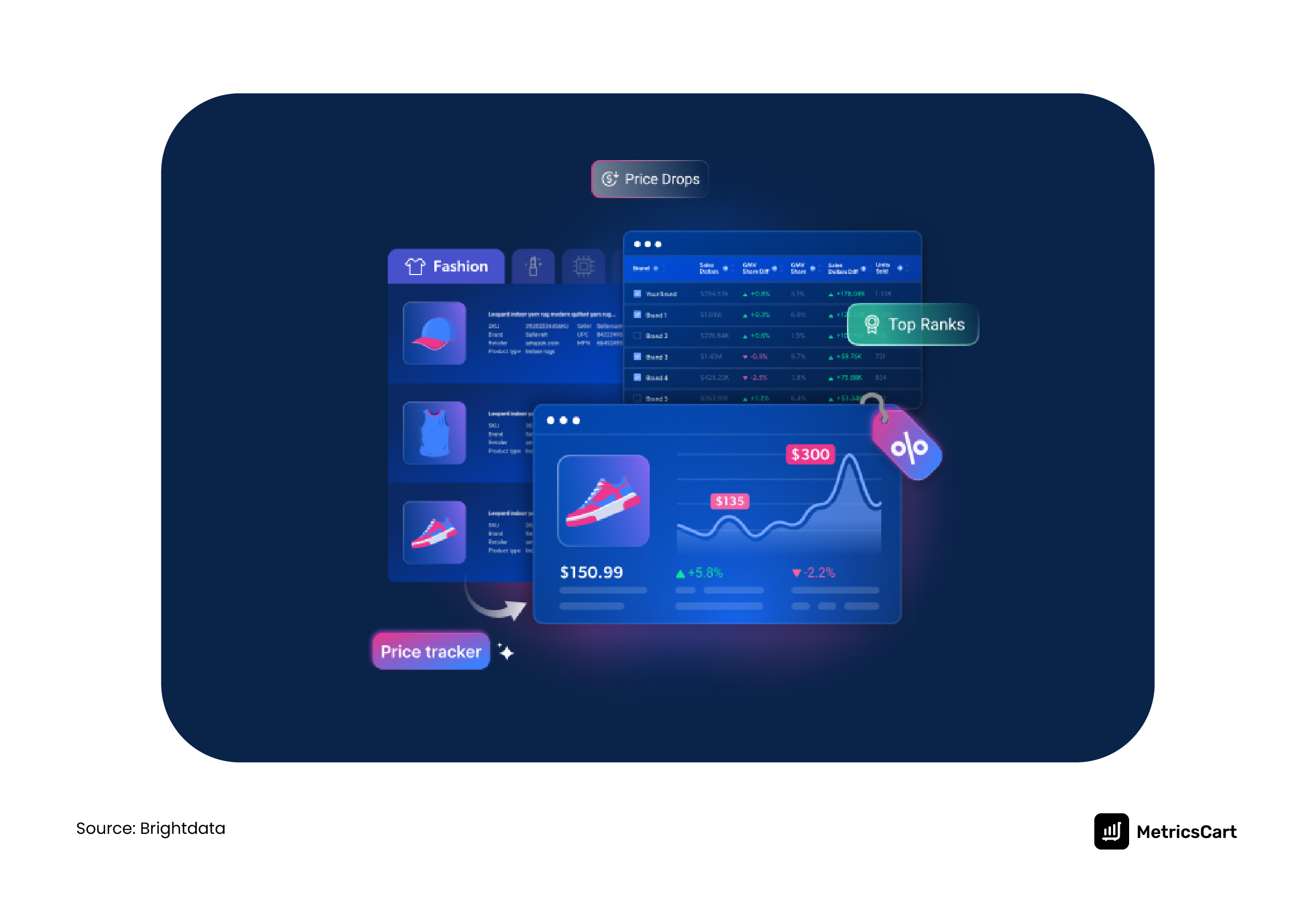
Bright Data is primarily a web data collection and proxy infrastructure platform that can also support custom MAP monitoring operations. Unlike dedicated MAP enforcement software, Bright Data provides the infrastructure brands or agencies can use to scrape marketplace pricing data at scale across Amazon, Walmart, eBay, and other online retailers.
Key capabilities include:
- Large-scale web scraping and data collection
- Proxy and IP rotation infrastructure for marketplace monitoring
- Customizable data extraction workflows
- Real-time marketplace price tracking
- API access for integrating pricing data into internal systems
Bright Data is best suited for enterprises or technical teams that want to build custom MAP monitoring systems rather than use a prebuilt enforcement platform.
Price2Spy
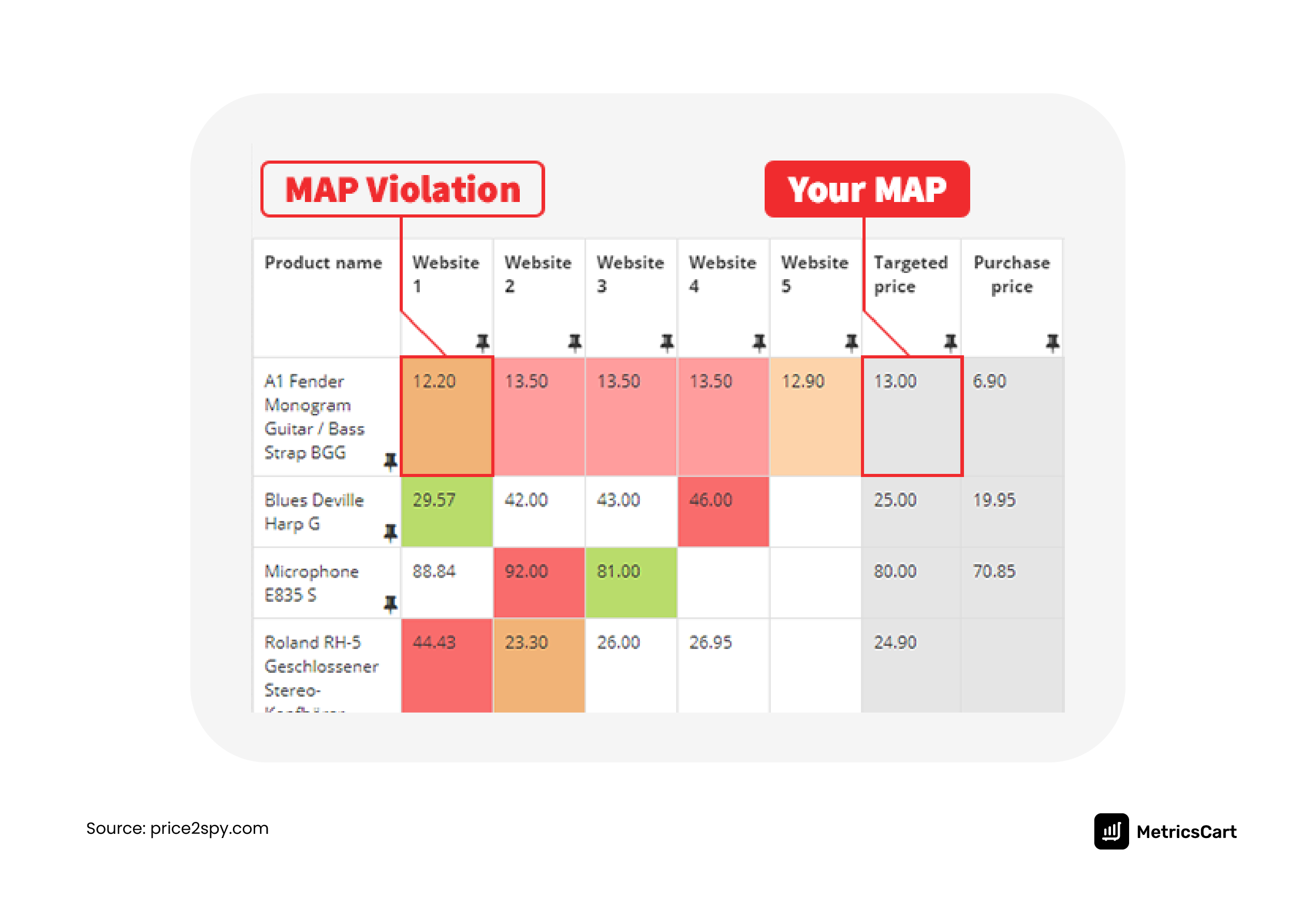
Price2Spy is a competitor price monitoring and MAP compliance platform designed for brands and retailers that need automated pricing surveillance across e-commerce marketplaces. The platform tracks product pricing changes, detects MAP violations, and supports automated alerts and reporting.
Key capabilities include:
- Automated competitor and reseller price tracking
- MAP violation alerts and reporting
- Historical pricing analytics
- Multi-marketplace monitoring support
- Dashboard-based monitoring and compliance management
Price2Spy is best suited for brands seeking a dedicated pricing intelligence and MAP monitoring platform with relatively fast deployment and straightforward reporting workflows
4 Common Amazon MAP Monitoring Mistakes That Undermine Enforcement
Even brands with strong MAP policies often struggle with enforcement because the operational workflow behind the policy is weak. Amazon’s pricing environment moves too fast for inconsistent monitoring, delayed responses, or disconnected distributor controls.
Here are some of the most common mistakes that quietly undermine Amazon MAP enforcement:
Monitoring Amazon only
Violations that start on Amazon frequently spread to Walmart, eBay, and specialty retailers within days. A seller who’s been warned on Amazon often shifts activity to another marketplace. Multi-channel monitoring is not optional if you want to prevent this.
Treating all violations the same
An authorized distributor violating MAP once is a different problem from an unknown grey market seller with no reseller agreement at all. The enforcement pathway, the urgency, and the underlying fix are different. Monitoring tools that identify seller authorization status let you route violations into the right workflow immediately.
Monitoring just the shelf price
Digital coupons, Subscribe & Save, and bundle pricing create Amazon MAP violations that don’t show up in the listed price. In 2026, brands that only check the headline number are missing a significant portion of their actual violation footprint.
Slow enforcement response
A violation notice that arrives three days after the event signals to sellers that your monitoring is intermittent. Fast response — ideally automated, within hours — is what creates deterrence. Deterrence, not just correction, is what stabilizes compliance over time.
Save Over $1M with MetricsCart Automated MAP Monitoring and Enforcement Solution for Amazon
MetricsCart is a digital shelf analytics and automated MAP monitoring platform designed to help brands detect pricing violations, identify unauthorized sellers, and protect pricing integrity across marketplaces like Amazon, Walmart, and eBay.
Instead of relying on manual audits and delayed enforcement, MetricsCart continuously scans online marketplaces, tracks seller activity, captures effective pricing after discounts, and flags MAP violations in real time. The platform also helps compliance teams automate enforcement workflows, monitor repeat offenders, and identify upstream distributor leakage that often fuels recurring grey market activity.
In simple terms, MetricsCart helps brands move from reactive cleanup to proactive pricing protection.
One example comes from a kitchen electronics brand that struggled with chronic unauthorized seller activity and recurring MAP violations across Amazon. Despite having a defined MAP policy, violations continued spreading faster than the internal team could manually monitor and enforce.
After implementing MetricsCart’s automated MAP monitoring and enforcement workflow, the brand was able to:
- Reduce unauthorized third-party MAP violations by 65%
- Achieve 92% overall MAP compliance
- Protect an estimated $1.2 million in brand value
📖 Read the full case study here:
How a Kitchen Electronics Brand Eliminated 65% of MAP Violations and Protected $1.2M in Brand Value
The reality is that ensuring MAP compliance on Amazon in 2026 requires more than sending occasional warning emails after pricing damage has already happened. Brands need continuous visibility into how products are priced, who is selling them, how unauthorized inventory enters the marketplace, and how pricing instability spreads across channels.
That is exactly what automated MAP monitoring platforms like MetricsCart are built to solve.
Save Your Brand From the Uncertainties of Amazon Dynamic Pricing.
FAQs
No. Amazon does not recognize or enforce brand MAP policies. Sellers cannot be reported to Amazon for a MAP violation alone. Amazon’s Marketplace Fair Pricing Policy is focused on customer trust, not brand pricing floors. Enforcement is entirely the brand’s responsibility, typically through third-party MAP monitoring software and direct seller outreach.
Yes. MetricsCart provides automated MAP monitoring and enforcement features comparable to dedicated MAP compliance platforms such as TradeVitality and MAPtrapp. The difference is that MetricsCart also includes broader digital shelf analytics capabilities like pricing intelligence, content compliance, Share of Search, ratings and reviews analysis, and retailer performance tracking within the same platform.
Amazon’s automated repricing system adjusts prices based on competitor data and market signals, without regard for brand MAP policies.
When one seller drops below MAP to win the Buy Box, competing sellers’ repricing tools match the lower price automatically. If Amazon Retail itself is selling the product, its algorithm may reprice the listing below MAP based on the new market benchmark — creating a cascade that locks in a below-MAP equilibrium across the entire ASIN within hours.
In July 2024, the CPSC ruled that Amazon’s FBA program makes Amazon a “distributor” under the Consumer Product Safety Act, not merely a logistics provider. This means Amazon bears legal responsibility for product safety recalls on hazardous items sold through FBA.
For MAP compliance, the ruling gives brands stronger grounds for demanding supply chain accountability from Amazon and authorized distributors, but it does not create a direct MAP enforcement mechanism — Amazon still does not police brand pricing floors.
Grey market inventory typically enters Amazon through distributor leakage (excess inventory sold to liquidators), retail arbitrage (arbitrage sellers buying products at discount and relisting on Amazon), or international grey market channels (unauthorized importers buying in lower-cost markets).
Once in FBA, grey market units are commingled with authorized inventory in Amazon’s fulfillment centers, giving them Prime shipping status and making them indistinguishable from authorized stock — which lets grey market sellers compete directly in the Buy Box.
The most effective approach combines three elements: continuous automated monitoring to detect violations in real time, tiered enforcement workflows that respond within hours of a detected violation, and supply chain controls (distributor audits, restricted resale agreements, Amazon Transparency codes) that limit grey market inventory from entering FBA in the first place.
Brands using purpose-built MAP monitoring platforms like MetricsCart consistently achieve compliance rates above 90% compared to brands relying on manual monitoring.