UK e‑commerce has matured into one of the most sophisticated digital markets globally. In 2025, e-commerce sales accounted for roughly 38.1% of total UK retail sales. This is a structural change driven by consumer expectations, a proliferation of digital touchpoints, and new competitive dynamics that make data visibility essential.
Market analysts estimate the UK online retail industry will be worth ~$317 billion in 2026, expanding at 9.72% CAGR through 2031.
At the same time, the digital commerce in the UK is undergoing a multi-factor evolution:
- AI and automation have moved from experimentation to execution, shaping pricing, promotions, and inventory management.
- Consumers continue seeking value and convenience, putting pressure on brands to adapt pricing and fulfilment strategies dynamically.
- Omnichannel experiences have become table stakes: BOPIS, click‑and‑collect, and same‑day delivery are rapidly expanding.
But with maturity comes intense complexity. Brands are fighting tooth and nail for microscopic gains online. Navigating without a digital shelf analytics tool is like trying to navigate the London Underground blindfolded during rush hour. You might make it, but it’s going to be painful, you’ll probably lose your wallet, and you’ll definitely end up at the wrong destination.
This guide is your manual for finding the right way to grow your brand online. We are going to break down the best digital shelf monitoring tools in the UK 2026 has to offer, dissect why you need them, and show you exactly how to choose the right partner to stop flying blind and start dominating your category.
Highlights
- The UK e-commerce market is on track to hit $317 billion in 2026, and competition for digital shelf space has never been more brutal.
- Manual monitoring is no longer a viable strategy. Gartner projects a 30% annual cost reduction for brands that replace it with digital shelf analytics tools.
- The five platforms covered, MetricsCart, CommerceIQ, Intelligence Node, Stackline, and Brand Nudge, each serve a distinct use case.
- MetricsCart leads for CPG and consumer electronics brands needing full-suite coverage across 100+ retailers, with an AI co-pilot that delivers answers for brand teams.
- Emerging trends: predictive analytics, generative AI interfaces, and quick commerce shelf monitoring. This will separate future-proof platforms from those that age poorly. Know which camp your shortlist falls into before you sign.
Why Brands in the UK Need Digital Shelf Monitoring Tools
Spreadsheets, manual spot checks, and a junior analyst spending their Tuesday morning refreshing product pages. Sounds very efficient, only if it were in 2018. In 2026, this is a liability.
The UK’s e-commerce infrastructure has become extraordinarily complex. Brands now sell across Amazon UK, Tesco, eBay, Argos, and a constellation of niche DTC marketplaces, each with its own algorithm, content requirements, pricing dynamics, and review ecosystem.
And then there’s the increasingly urgent context of quick commerce. Amazon Now’s UK launch in early 2026, bringing 30-minute delivery to London, is the opening move in a new competitive dynamic. When consumers can get your product (or your competitor’s) in under an hour, availability data needs to be real-time. E-commerce analytics tools UK brands rely on must be architected for this new pace.
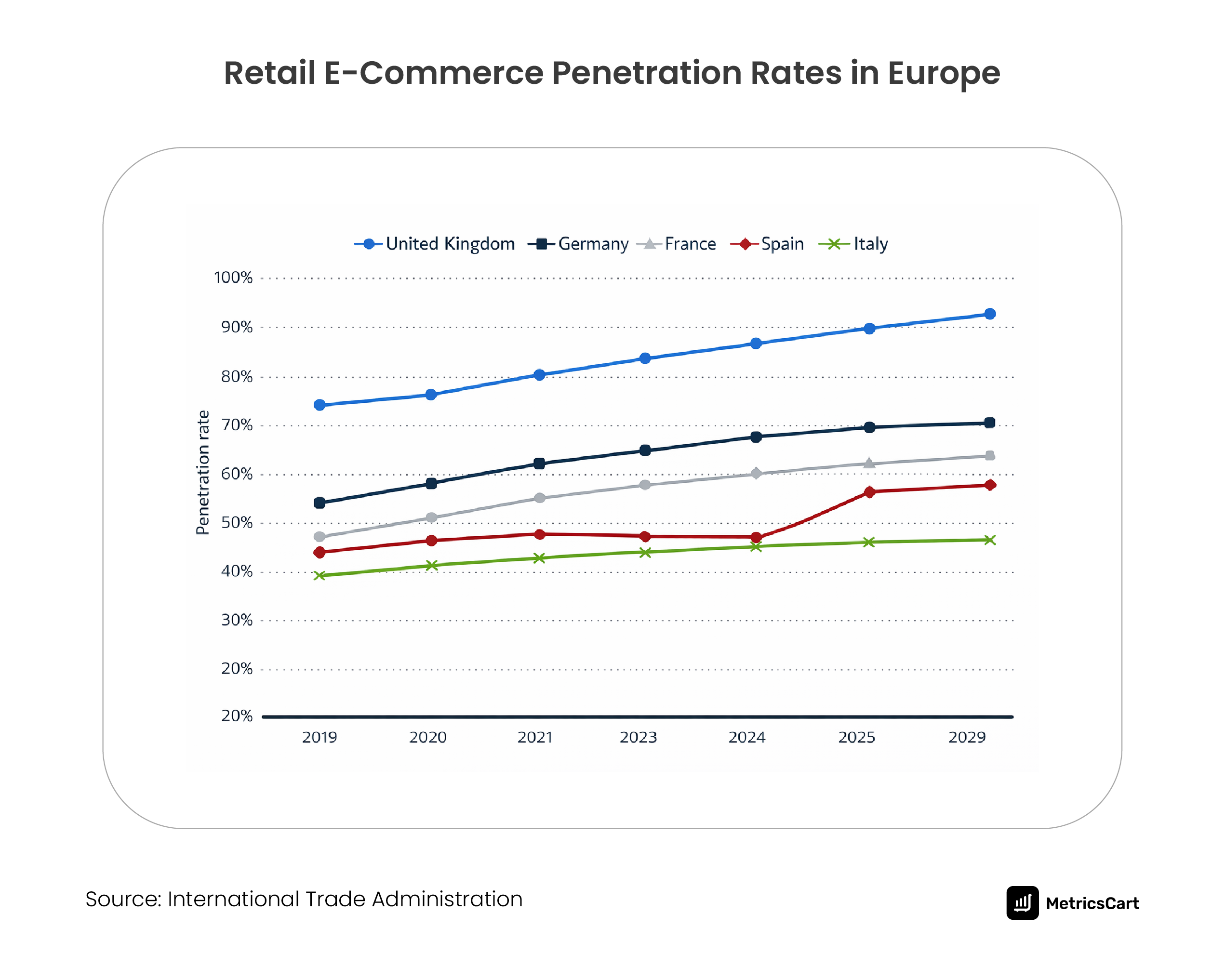
The UK’s nearly 90% online shopper penetration rate, the highest in Europe, means your customer is already on the digital shelf. The question is whether your products are showing up correctly when they go looking.
And that’s exactly why your brand needs to look into the best digital shelf analytics tools in the UK in 2026.
READ MORE | 6 E-Commerce KPIs for the Digital Shelf: Must-Know Guide for Brands
Best Digital Shelf Monitoring Tools in the UK for 2026
The digital shelf analytics market was valued at $ 2.5 billion in 2024 and is projected to reach $ 6.8 billion by 2033, growing at a 12.1% CAGR.
That growth reflects genuine enterprise demand for digital shelf insights. With that backdrop, here are the platforms that UK brand teams and e-commerce leaders should be seriously evaluating.
1. MetricsCart

MetricsCart is a purpose-built full-suite digital shelf analytics platform that covers over 100 retailers globally, making it one of the most comprehensive platforms for UK brands for digital shelf optimization.
With centralized, real-time insights into brand performance across multiple functions, each solution is engineered to close a specific revenue gap that UK brand teams face on the digital shelf every day.
What sets MetricsCart apart from other digital shelf analytics platforms is the AI co-pilot: an intelligent layer that surfaces quick, structured insights for brand teams without requiring analysts to spend hours interrogating dashboards.
Here is a closer look at what MetricsCart delivers across its core solution areas, plus the platform capabilities that tie them together:
- Assortment and Availability Tracking: Monitors product availability and assortment health at the SKU level across tracked retailers, alerting teams to out-of-stock conditions and ranging gaps before they compound into revenue damage.
- MAP Monitoring and Enforcement: Tracks Minimum Advertised Price compliance across the reseller network in real time, with violation alerts and a historical audit trail to support distributor enforcement conversations with a tiered enforcement action plan.
- Content Compliance: Audits listings against configurable brand standards; image count, title length, keyword inclusion, bullet points, A+ content status, with retailer-specific deviation alerts across all 100+ monitored retail environments.
- Price and Promotion Monitoring: Tracks competitive pricing and promotional activity across retailers, giving brand teams the market context needed to price strategically rather than reactively.
- Share of Search: Measures your brand’s search visibility relative to the category’s competitive set across retailer platforms, with trend tracking that surfaces share losses before they appear in revenue.
- Ratings and Reviews Analysis: Monitors customer ratings and reviews and NLP-driven sentiment, themes, and sub-themes; extracting specific complaint and praise patterns that product and marketing teams can act on before an issue becomes a brand event.
- Competitive Intelligence and Real-Time Market Insights: MetricsCart knows the market doesn’t wait, so it keeps pace with the dynamics of digital commerce to provide up-to-date insights for quicker, more informed decision-making across teams.
- Consumer Insights Analytics: Tracks consumer conversations beyond PDPs to understand the pulse of consumer sentiment and demands.
- AI Co-Pilot: Surfaces fast, structured insights for brand teams in natural language; flagging anomalies and answering shelf performance questions without complicated custom report builds.
For CPG and consumer electronics brands managing complexity at scale, MetricsCart’s architecture is a strategic operating requirement.
READ MORE | E-commerce Product Monitoring: The Ultimate Explainer for 2026
2. Brand Nudge
Brand Nudge is built specifically for brand content compliance monitoring across UK retail websites, with particular depth in the grocery and FMCG retail environment.
Brand Nudge stands out with the granularity of its monitoring, the specificity of its UK retailer coverage, and the workflow layer that allows teams to actually fix what the platform finds rather than just document it.
It covers everything from retail media monitoring and price monitoring to content compliance and promotion insights.
Key features include:
- Retail Promotion Insights: Monitors every deal, mechanic, and competitor promotional tactic across the category; identifying which mechanics drive profitable growth versus margin loss, and helping teams optimise discount depth, timing, and duration.
- Retail Media Monitoring: Tracks where banners, sponsored placements, and product ads appeared, benchmarks brand visibility by campaign and timeframe, and identifies missed placements or spend inefficiencies in real time.
- Price Elasticity Modelling: Combines historical sales data, competitor activity, and market conditions to model how demand responds to price changes.
- Retail Pricing Insights: Tracks and compares price position across retailers, channels, and regions globally, giving commercial and sales teams the real-time pricing visibility they need to defend margin.
- Intelligence for Retailers: A proprietary data science layer for retail partners, covering category-level pricing impact, search algorithm insights, and assortment and promotional prioritisation based on commercial data.
It is ideal for CPG brands that need integrated pricing intelligence, digital shelf monitoring, and retail media verification, especially where commercial, sales, and e-commerce teams need to work from the same dataset to align on margin, ranging, and retail execution.
3. CommerceIQ

CommerceIQ occupies a strategically distinct position in the digital shelf analytics landscape. It is a system built to act on shelf signals in real time. By combining shelf analytics with retail media automation and supply chain intelligence, CommerceIQ is designed for the kind of e-commerce operation where the cost of a missed signal is not a report-and-review exercise but an immediate revenue event.
For UK brands whose revenue is substantially anchored in Amazon.co.uk, CommerceIQ delivers native, depth-integrated support for Amazon’s ecosystem, search ranking, buy box health, advertising attribution, and availability monitoring, with these functions tightly interwoven rather than sourced from separate modules.
A quick glance at the key features:
- Retail Media Automation: Ad bids adjust automatically based on live shelf conditions, stopping spend on out-of-stock products and reallocating to where conversion is possible.
- Digital Shelf Analytics: Tracks search ranking, buy box health, content quality, and availability across Amazon UK in a single integrated view.
- Supply Chain Integration: Stock threshold alerts can trigger replenishment workflows directly, connecting shelf monitoring to operational response.
- Content Optimisation: Detects and resolves PDP issues through PIM integration and automated content syndication across retail channels.
- E-Commerce Sales Management: Centralises sales and inventory data with gap-to-plan alerts to keep performance on track.
It is best suited for brands with substantial Amazon UK presence seeking to combine shelf analytics with retail media automation and supply chain responsiveness.
4. Intelligence Node

Intelligence Node has built its market position on competitive pricing intelligence and assortment analytics.
In the UK market context, this translates to pricing and availability monitoring across domestic and international e-commerce channels, with particular strength in the competitive benchmarking that brands in price-sensitive categories depend on.
Here’s a quick look at the key features:
- Competitive Pricing Intelligence: Real-time and historical price tracking, promotional cadences, and elasticity signals across retailers to inform pricing strategy.
- MAP Compliance Monitoring: Tracks minimum advertised price violations with a historical audit trail for price control and reseller governance.
- Assortment Analytics: Identifies competitor SKU gaps and category growth vectors to support portfolio and range decisions.
- Availability Monitoring: SKU-level availability tracking with out-of-stock alerts across monitored retail channels.
- Category Benchmarking: Surfaces how your brand’s pricing and assortment compares against the full category competitive set, not just selected rivals.
Intelligence Node is ideal for brands in price-competitive categories needing deep competitive pricing intelligence and assortment analytics.
5. Stackline

Stackline is one of those digital shelf analytics platforms that operates from a retail intelligence and consumer demand perspective, combining shelf monitoring with market share tracking, category trend analysis, and advertising performance intelligence.
The platform’s retail media intelligence layer benchmarks advertising efficiency across sponsored products, sponsored brands, and display formats against category averages, allowing brands to understand whether their UK retail media investment is above or below average in terms of return.
Here are the key features at a glance:
- Market Share Tracking: Category-level share data above SKU monitoring; the strategic view that supports QBRs, investment allocation, and competitive response.
- Retail Media Benchmarking: Analyses advertising efficiency across formats benchmarked against category averages, to reveal whether media ROI is above or below the competitive set.
- Search Ranking and Visibility: Tracks keyword-level search positioning on Amazon UK with trend data connected to business performance metrics.
- Consumer Demand Analytics: Surfaces category-level demand and search trend signals to help brand teams anticipate where consumer interest is moving.
- Advertising Attribution: Links media investment to shelf-performance outcomes, separating advertising-driven sales from organic conversions.
Stackline works best for brands seeking category-level market intelligence, Amazon-centric performance analytics, and retail media efficiency measurement.

How to Choose the Right Digital Shelf Monitoring Tool?
The single most expensive mistake while choosing among e-commerce analytics tools in the UK is to pick one that solves the problem you have now rather than the one you’ll have in eighteen months. Given the implementation lead times and contract terms, you are effectively making a two- to three-year decision.
Here is a framework that goes beyond the standard feature checklist.
Start with Your Revenue Exposure
Before evaluating platforms, quantify what your current gaps are costing you. If out-of-stocks on Amazon UK during peak periods are your primary problem, that anchors your evaluation around availability monitoring frequency and alerting capabilities.
If your MAP erosion is destroying preferred-retailer relationships, then pricing intelligence and audit-trail quality become your evaluation criteria.
The digital shelf analytics platform that solves your highest revenue problem wins. ‘
Interrogate Data Freshness and Methodology
Today, with the onset of same-day deliveries and the rise of rapid commerce, consumer availability expectations are measured in minutes, and daily data refreshes are becoming inadequate for certain categories.
Understand exactly how each platform collects its data, web scraping frequency, API integration status with specific retailers, sample methodology for search ranking data, and match that against your operational tempo. If you’re managing promotions on a 48-hour cycle, you need data that can keep pace.
Evaluate Integration Architecture Seriously
Organizations that fail to integrate digital shelf analytics applications with back-end product data sources risk failing to see a return on their investment. And it is a commercial warning.
Digital shelf analytics platforms that cannot connect to your PIM, ERP, or retail media management systems will require manual workflow workarounds that erode adoption and limit the actionability of their insights. Assess integration capabilities with the same rigour as analytics capabilities.
Consider Your Team’s Analytical Bandwidth
A platform with extraordinary analytical depth is valuable only if your team has the bandwidth to extract value from it. Assess tools against the size and sophistication of your e-commerce analytics team.
Let’s say, if you have two people managing digital shelf operations across twenty brands, a platform that requires significant configuration and interpretation will underperform relative to its potential. Conversely, if you have a dedicated analytics function, a more sophisticated platform will outperform a simplified one over time.
Run a Pilot on Your Actual Problem
Demand a structured proof of concept for your highest-priority use case across your specific retail channels, using your actual SKU set.
Generic demos are designed to showcase strengths; pilots reveal limitations. Give the platform a specific business question, ‘Why did our search rank on Amazon UK drop 12 positions for this keyword in this period?’ and evaluate how well it can answer it.
The quality of that answer tells you more than any feature comparison matrix.
READ MORE | Future of CPG 2026: AI, Retail Media, and the New Rules of Digital Commerce
Emerging Trends in Digital Shelf Analytics
Digital shelf monitoring tools in the UK that you evaluate today are not the platforms that will exist in three years. Understanding where the category is heading helps you avoid locking into an architecture that will age poorly.
1. Generative AI and Natural Language Query Interfaces
McKinsey has projected that generative AI applications in retail could yield USD 240 billion to USD 390 billion in value, spanning analytics functions including pricing, product presentation, and demand forecasting.
In digital shelf analytics specifically, this is manifesting as natural language query interfaces, allowing a brand manager to ask ‘Which of our products lost search rank on Ocado in the last 30 days, and what changed?’ rather than having to construct a dashboard filter sequence.
Early implementations are promising; mature implementations that can both diagnose and prescribe will transform the category.
2. Predictive Shelf Analytics
The industry is actively transitioning from retrospective reporting of ‘here is what happened’ to predictive intelligence: ‘here is what is likely to happen next, and here is what you should do about it.’
Predictive out-of-stock alerts that trigger before the stockout occurs, based on demand velocity and current inventory signals, are already in production at the best digital shelf analytics tools in the UK in 2026.
Predictive search rank modelling, forecasting how a content change or price adjustment will affect search position, is the next frontier.
3. Unified Digital and Physical Shelf Data
For omnichannel brands, the artificial separation between digital shelf analytics and physical retail analytics is becoming less tenable.
Platforms that can integrate in-store planogram compliance, physical availability data, and online shelf data into a single view of brand execution are beginning to emerge.
In the UK’s highly developed omnichannel retail environment, where Tesco, Sainsbury’s, and Boots operate tightly integrated physical and digital channels, this convergence is particularly relevant.
4. Quick Commerce Shelf Monitoring
The growth of quick commerce in the UK, from Amazon Now to Gorillas to Getir, is creating a new shelf monitoring requirement that most incumbent platforms were not built to address.
Availability on a rapid-delivery platform is both more volatile and more consequential than on a standard e-commerce site; a 15-minute stockout during a peak period can permanently redirect a consumer to a competitor.
Platforms that can monitor availability and search rankings across quick-commerce apps, with the data freshness those channels require, are addressing a genuinely underserved need.
The UK quick commerce market’s projected trajectory to USD 32.77 billion by 2032 makes this an increasingly important capability to evaluate. This growth follows a valuation of approximately $9.36 billion in 2025.
Ready to Elevate Your Digital Shelf Performance?
Your products are live across dozens of UK retailers right now. Some listings are probably wrong. Some prices are drifting. Some buy boxes are gone. And without a digital shelf analytics platform, nobody on your team knows which ones.
MetricsCart’s full suite of digital shelf analytics covers 100+ retailers, flags issues before they compound, and gives brand teams fast answers through an AI co-pilot built for exactly this kind of operational complexity.
Contact us to book a walkthrough. Bring your hardest shelf problem. The demo is free. The cost of not knowing isn’t.
The Digital Shelf Doesn’t Wait, and Neither Should You.
FAQs
Digital shelf analytics refers to the process of monitoring and optimizing your product’s performance across digital channels, including pricing, inventory, reviews, and visibility. It provides insights into how products are displayed and perceived by customers online.
Digital shelf analytics tools like MetricsCart help brands optimize their product listings, track competitor performance, manage pricing, and improve customer engagement, ultimately driving better sales and visibility.
These tools track product listings across various e-commerce platforms, providing data on price, availability, reviews, and competitor performance. They then analyze this data to provide insights that help optimize product performance and sales.
Digital shelf monitoring is the operational layer: detecting that your product is out of stock on eBay or that a competitor has undercut your price on Amazon. Digital shelf analytics is the intelligence layer built on top of monitoring data: understanding why your search rank declined, how your share of search is trending against category competitors, and what actions are most likely to improve performance. Mature platforms like MetricsCart integrate both, with monitoring providing the real-time alerting and analytics providing the strategic insights and intelligence.
There is no universal answer; the right tool depends on your specific retail channel mix, team capabilities, and the problems costing you the most revenue. For CPG and consumer electronics brands needing comprehensive multi-retailer coverage with a full suite of digital shelf analytics in the UK, MetricsCart is a great choice.