Highlights
- Modern infant car seat R&D is failing because it prioritizes lab-tested safety while overlooking real-world parenting frictions such as overheating, installation complexity, and cleaning difficulty.
- Safety has become a baseline expectation in the premium market, not a competitive differentiator for the best infant car seat brands.
- Overheating complaints and the “sweaty baby” problem are becoming major drivers of negative sentiment in infant car seat reviews.
- Parents increasingly associate installation complexity with poor product design and reduced safety confidence.
- Real-world usability issues like sedan compatibility, footprint size, and maintenance are shaping purchase decisions more than marketing claims.
- AI-driven review monitoring solutions and digital shelf analytics are becoming essential tools for the future of infant car seat R&D.
The global baby car seat market is projected to surpass $8 billion over the next decade, driven by rising safety awareness, stricter regulations, and increasing demand for premium parenting products.
But despite advancements in crash testing, side-impact protection, and safety certifications, many parents remain deeply frustrated with their infant car seat experience. The problem is no longer a lack of engineering sophistication. The problem is that many brands are still designing for laboratory success instead of real parenting environments.
Across Amazon reviews, Reddit discussions, TikTok parenting communities, and retailer Q&A sections, a clear pattern is emerging in modern infant car seat reviews. Parents are not primarily complaining about crash safety. They are complaining about:
- Babies overheating during short drives
- Installation systems that feel unnecessarily complicated
- Seats that do not fit compact or mid-sized vehicles
- Covers that are frustrating to remove and clean
- Premium products that fail to justify their price in everyday use
This growing disconnect highlights a larger issue within infant car seat R&D. The brands winning today are using advanced review monitoring and analysis platforms like MetricsCart to identify recurring consumer pain points hidden inside thousands of infant car seat reviews.
They are not simply the brands building the safest seats on paper. They are the brands designing products that reduce emotional and operational friction for exhausted parents navigating daily life.
The New Parent Economy Operates on “Zero-Fail Expectations”
A few categories carry the psychological pressure of infant baby car seats. Unlike smartphones or headphones, parents do not “experiment” with five different models before settling on one. Most families make a single purchase and expect near-perfection immediately.
That expectation fundamentally changes how reputation spreads.
In categories like electronics, a mediocre experience may result in a neutral review. In baby gear, a mediocre experience can eliminate an entire referral chain.
One unhappy parent in a prenatal class, parenting Facebook group, WhatsApp community, or daycare network can quietly influence dozens of future purchasing decisions. This matters because parents trust peer recommendations more than advertisements.
And increasingly, those recommendations are shaped by digital shelf behavior:
- Amazon ratings and reviews
- Reddit parenting discussions
- TikTok parenting creators
- Walmart and Target reviews
- Community parenting forums
- Product Q&A sections
In this category, silence is not neutral. If parents are not enthusiastically recommending your product, the referral engine eventually breaks. That creates a massive challenge for brands competing to become the best infant car seat option in an increasingly crowded premium market.
Safety Has Become a Baseline; Not a Differentiator
For years, infant car seat marketing has centered on crash testing, side-impact protection, steel-reinforced frames, and safety certifications. But modern parents largely assume those standards already exist.
In premium categories, especially seats priced above $300 to $500, safety is no longer viewed as a competitive advantage. It is viewed as the minimum acceptable requirement.
The real differentiators now live in operational usability. One of the most frequently repeated complaints in infant car seat reviews remains handling and movement. Based on a recent consumer sentiment analysis conducted by MetricsCart review monitoring software on baby car seats, handling and movement appeared as the top theme with 15.7% positive sentiment and 8.65% negative sentiment.
The more confusing the handling process feels, the less safe the product appears psychologically, even if engineering standards are exceptional. Parents equate simplicity with confidence. If a seat requires a 20-minute YouTube tutorial to set up, repeated belt adjustments during use, or a confusing latch system, emotional trust erodes immediately.

The “Sweaty Baby” Problem Is Bigger Than Brands Realize
One of the most revealing patterns in infant car seat reviews is the frequency of overheating complaints. Parents repeatedly describe babies emerging from seats with soaked backs, damp hair, red skin, or visible discomfort even during relatively short drives.
On parenting forums and Reddit communities, concerns about overheating have become increasingly common topics of discussion.
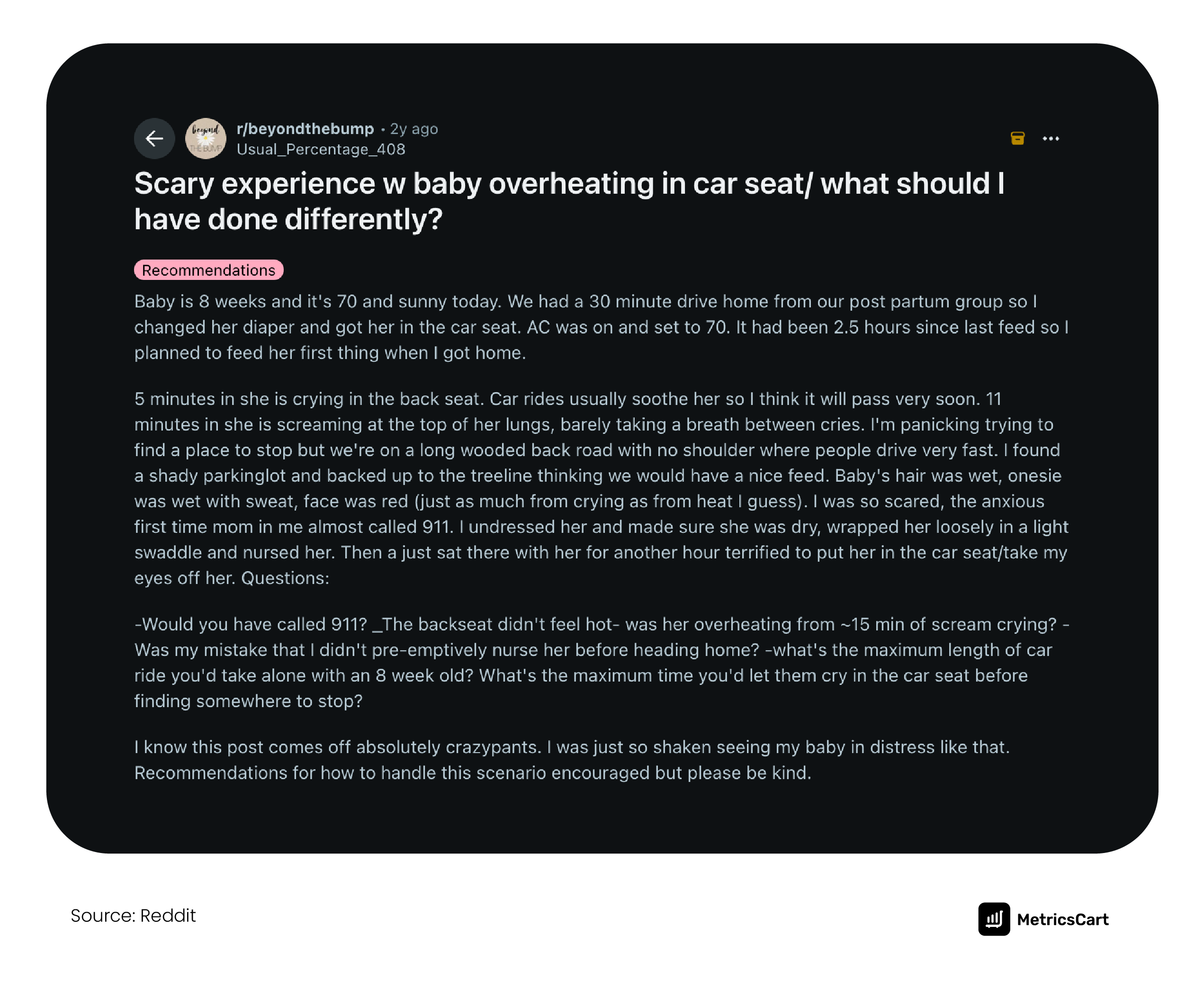
What makes this especially important is that parents rarely interpret overheating as a “comfort issue.” They interpret it as a design failure.
Modern infant car seat models rely heavily on dense foam padding, synthetic fabrics, and layered protective materials that prioritize structural performance but reduce airflow. The result is thermal discomfort that damages customer trust.
And because parenting communities are highly recommendation-driven, negative experiences spread quickly. A single “my baby overheated in this seat” story can influence future buyers far more than expensive safety marketing campaigns. This is why thermal regulation is becoming one of the most important hidden variables in infant car seat R&D.
Brands that fail to solve breathability issues risk long-term referral damage even if their safety scores remain excellent.
Real-World Vehicle Geometry Is Still Being Ignored
Many premium infant car seats are designed and photographed in idealized environments:
- Large SUVs
- Studio lighting
- Spacious interiors
- Minimal passenger constraints
But actual consumer reality looks very different. A growing volume of reviews mentions that seats force front passengers uncomfortably forward, especially in compact and mid-sized sedans. This creates a major disconnect between product development and actual consumer behavior.
Parents are no longer evaluating only “Does this fit my baby?” They are evaluating:
- Does this fit my car?
- Does this fit my daily commute?
- Does this fit a family lifestyle?
- Does this fit urban parking realities?
The “mid-sized sedan test” is becoming a far more important design benchmark than many brands acknowledge.
Maintenance Is Now Part of Product Experience
Another overlooked driver of reviews is cleaning friction. Parents are increasingly measuring baby products based on maintenance debt:
- How quickly can covers be removed?
- Can stains be cleaned easily?
- How long does reassembly take?
- Can this be handled during sleep deprivation?
A car seat cover that takes 30 minutes to remove may technically be “washable,” but consumers interpret that as operational inefficiency. In the newborn phase, every additional minute matters. Parents do not separate product performance from maintenance burden. They experience them as the same thing.
Inflation Has Changed the Premium Equation
The premium infant car seat category has become dramatically more scrutinized in the last two years. With tariffs, supply chain pressures, and inflation increasing prices across baby gear, parents are asking harder questions about value.
Consumers are no longer impressed by “premium” branding alone. They now expect premium products to solve tangible daily problems.
That means:
- Easier installation
- Better cooling
- Smaller footprints
- Faster cleaning
- Better portability
- Smarter modularity
If the product fails in those moments, the $500 price tag becomes a liability instead of a status signal.
Why Review Intelligence Is Becoming an R&D Necessity
Many legacy brands still treat reviews as a customer service function. That is increasingly a strategic mistake. In categories like infant car seats, review intelligence functions as an early-warning detection system.
A recurring “sticky buckle” complaint may indicate a broader mechanical issue long before a formal investigation or recall occurs. A spike in overheating comments may reveal a material engineering weakness. Repeated mentions of installation confusion may indicate a documentation failure rather than a hardware failure.
In several recent cases, manufacturers faced recalls, lawsuits, or safety scrutiny related to harness systems and restraint mechanisms following publicized consumer complaints. This is where AI-driven review monitoring and analysis are becoming essential.
Brands can now map recurring themes across:
- Retailers
- Review clusters
- Competitor products
- Geographic regions
- Star-rating segments
- Vehicle types
- Parenting demographics
The opportunity is no longer just sentiment tracking.
It is predictive product intelligence.
The Future of Infant Car Seat R&D Will Be Built on Behavioral Data
The next generation of category leaders will likely look very different from traditional engineering-first organizations. They will combine compliance engineering with continuous voice-of-customer intelligence.
That means integrating:
- Review theme mining
- Voice-of-customer analytics
- Digital shelf analytics
- Return reason analysis
- Q&A monitoring
- Social listening
- Post-purchase behavioral feedback
directly into the product development cycle. Because modern parents are already conducting large-scale field testing in real time. And they are publishing those insights publicly every day. The brands that respond fastest to those behavioral signals will shape the future of infant car seat R&D.
Stop Designing for the Lab Alone
Crash testing will always matter. Regulatory compliance will always matter. Engineering rigor matters.
But modern parenting products are no longer evaluated only inside controlled environments. They are evaluated:
- In hot parking lots
- During sleep deprivation
- In compact city cars
- During rushed daycare drop-offs
- In 15-minute grocery runs
- In emotionally overloaded households
This is where platforms like MetricsCart are becoming essential to the future of infant car seat R&D. By continuously analyzing infant car seat reviews, retailer Q&As, sentiment trends, and recurring consumer complaints, brands can identify real-world usability issues far earlier than traditional feedback methods allow.
From overheating and installation friction to vehicle fit and maintenance challenges, MetricsCart helps product teams turn everyday parenting frustrations into actionable product development insights, enabling brands to design not just for compliance but for real-life parenting experiences.
Discover the Hidden Drivers Behind Infant Car Seat Returns with MetricsCart.