Highlights
- Product Pulse Quadrants is now live inside MetricsCart Ratings & Reviews Analysis.
- See review momentum in four clear states: Positive Surge, Negative Surge, Positive Drop, and Negative Drop.
- Go beyond sentiment scores to understand what is actually driving customer praise or frustration.
- Use KPI Chips, drivers, themes, product components, and emotion signals to get immediate context.
- Spot product issues earlier, validate what is working, and prioritize action with more confidence.
For years, ratings and review analytics have focused on outcomes.
Ratings tell you whether customers are satisfied. Sentiment tells you whether feedback is generally positive or negative. Review volume tells you how much customers are talking. These metrics are valuable, but they rarely explain the full story.
Imagine a baby stroller receiving 2,000 reviews over the course of a quarter. A traditional review dashboard might tell you:
- Average rating declined by 0.2 stars
- Negative sentiment increased by 8%
- Review volume increased by 12%
While useful, those insights still leave critical questions unanswered:
- What specifically is causing dissatisfaction?
- Is the issue product-related or shipping-related?
- Is the trend accelerating or stabilizing?
- Is one product component responsible for most complaints?
- How urgent is the issue compared to other products in the portfolio?
That’s why we’re excited to introduce Product Pulse Quadrants, a new feature inside MetricsCart Ratings & Reviews Analysis solution that helps brands understand not only what’s happening in their reviews, but what’s driving the change. Let’s understand more about the Product Pulse Quadrants feature of MetricsCart in detail.
What is Product Pulse Quadrants By MetricsCart?
Product Pulse Quadrants is a new review intelligence feature in MetricsCart that helps brands identify products experiencing significant shifts in customer perception and understand the factors driving those shifts.
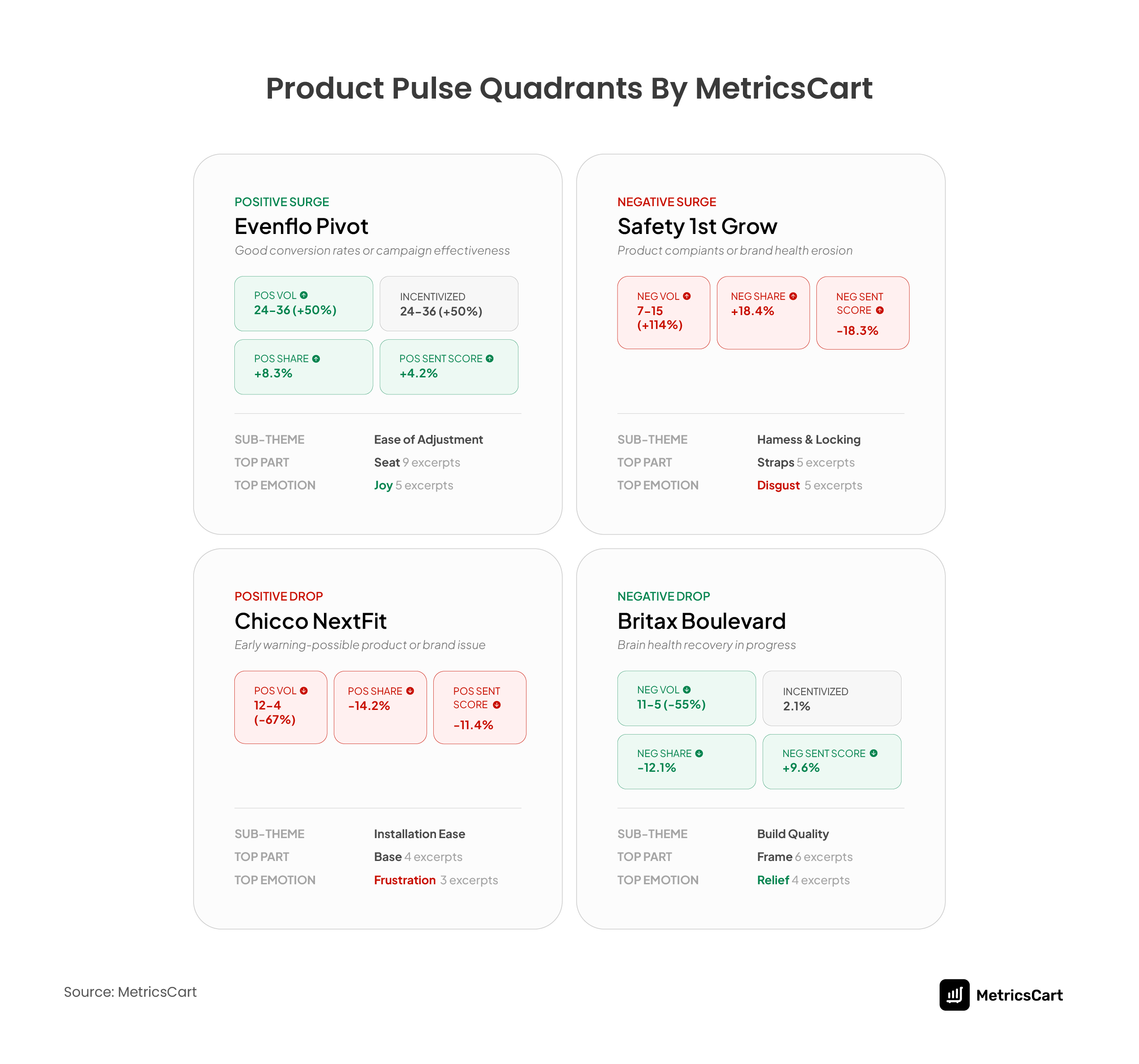
Instead of treating reviews as a flat stream of comments or a simple sentiment score, Product Pulse Quadrants feature of MetricsCart organizes product performance into four clear states:
- Positive Surge: Products gaining stronger positive momentum in reviews.
- Negative Surge: Products seeing a rise in negative feedback that may need attention.
- Positive Drop: Products losing positive momentum, even if ratings have not declined sharply yet.
- Negative Drop: Products showing signs of recovery after negative feedback, or a reduction in negative pressure.
This matters because a product can look stable at the surface while customer sentiment underneath is shifting quickly. Product Pulse Quadrants help teams catch that movement earlier and understand what is behind it.
The feature does not just show where a product sits. It adds context through KPI Chips and drivers so brands can see how sharp the change is, whether it is building or fading, and what kinds of customer themes are influencing the shift.
In short, Product Pulse Quadrants helps brands turn review data into action.
Why Review Momentum Matters More Than Sentiment Alone?
Sentiment scores are useful, but they only tell part of the story. A score may go up or down, but that still leaves teams with the same question: what changed, and why?
Why “Consumer Sentiment Is Down” Is Not Enough
If sentiment falls, the next step is not to react blindly. Teams need to know whether the change is being driven by quality complaints, packaging defects, durability issues, fit problems, or safety concerns.
Without that context, review sentiment analysis becomes a reporting exercise instead of a decision-making tool.
A team might know a product is underperforming, but not whether the root cause is:
- a product formulation issue,
- a usability problem,
- a shipping or packaging failure,
- or a temporary reaction to a campaign or promotion.
That is why sentiment alone often creates more questions than answers.
READ MORE | How Can Sentiment Analysis Help Improve Customer Experience?
How Momentum Reveals Whether Change Is Building Or Fading
Review momentum gives brands a different lens.
Instead of only measuring whether feedback is positive or negative, it shows whether that pattern is accelerating, cooling off, or reversing. That helps teams understand whether they are looking at a short-term spike or a growing brand concern.
For example, a few negative reviews may not be a major issue on their own. But if those comments are increasing week over week and all point to the same product component, the signal becomes much more meaningful.
The same applies to positive momentum. A product may be gaining praise because a new version resolved an old issue, or because a campaign is bringing in the right audience. Knowing that matters for planning, forecasting, and replication.
Why Brands Need Context Before Deciding What To Fix
Brand teams rarely have unlimited time or resources.
They need to decide which products to investigate first, which complaints require immediate escalation, and which wins are worth scaling. Context is what makes that possible.
Product Pulse Quadrants provides that context so teams do not spend hours manually reading reviews just to answer basic questions about what is changing and why.
How Does MetricsCart Turn Reviews Into Actionable Insights?
MetricsCart helps brands move from broad review monitoring to deeper review intelligence.
From Review Volume To Decision-Ready Signals
High review volume alone does not tell a team where to focus. A product with hundreds of reviews may still be stable, while another with fewer reviews may be showing a sharp shift in customer perception.
Product Pulse Quadrants help separate noise from meaningful movement. It highlights which products are showing stronger momentum shifts so teams can prioritize faster.
From Surface-Level Ratings To Product-Level Understanding
A rating drop does not explain whether the issue is with the core product, a specific component, or the customer experience around it.
MetricsCart connects the feedback to product-level signals so teams can see what people are actually reacting to. That means the analysis goes beyond a number and starts pointing to the real source of the problem or opportunity.
From Manual Review Reading To Structured Intelligence
Reading reviews manually can help uncover detail, but it is not scalable.
Teams cannot reasonably sort through thousands of comments every week and expect to catch every emerging pattern. Product Pulse Quadrants structures this information so that recurring themes and sub-themes, shifts in sentiment, and product-specific issues can be seen faster.
Instead of browsing review after review, teams can move directly to the signals that matter.
From “What Happened” To “Why It Happened
This is where MetricsCart adds the most value.
The platform does not stop at showing that something changed. It traces the change back to the review drivers behind it. That includes:
- customer themes,
- product components,
- and the dominant emotion in the feedback.
So if reviews are falling because of concerns around fit, ease of use, packaging, or safety, the team can see that directly and respond with confidence. That is the difference between monitoring and intelligence.

How Brands Can Use MetricsCart’s Product Pulse Quadrants Day To Day?
Product Pulse Quadrants was built to help brands act more quickly and more strategically on customer feedback.
Identify Products Driving Stronger Conversion Or Campaign Impact
Not every spike in reviews means something is wrong. Sometimes a product is gaining traction because a campaign is resonating, a new launch is performing well, or a product change is landing positively.
Product Pulse Quadrants helps brands identify products with positive momentum so they can understand what is working and potentially scale it across other products or channels.
Spot Rising Complaints Before Brand Health Weakens
Negative reviews do not always create an immediate crisis. Often, the warning signs show up before ratings actually drop.
By detecting negative surge patterns early, brands can catch emerging complaints before they start affecting broader brand health. That gives teams time to investigate, respond, and reduce the risk of a larger issue.
Measure Whether Recovery Efforts Are Actually Working
When brands make a fix, they need proof that it helped.
- Did the new packaging reduce complaints?
- Did the product update improve usability?
- Did the support response ease frustration?
Product Pulse Quadrants help teams monitor whether review momentum is improving after a change, so recovery efforts are not based on guesswork.
Understand Whether Increased Review Volume are Organic or Campaign-Driven
Sometimes, review volume increases because a campaign brought more traffic. Sometimes the lift is due to genuine product satisfaction.
Those are not the same thing.
Product Pulse Quadrants help teams see whether positive movement is organic or campaign-driven, which is valuable for evaluating true product performance versus promotional impact.
Prioritize the Products that Need Attention First
Most brands do not have the bandwidth to investigate every product equally.
Product Pulse Quadrants help teams focus on the products showing the most meaningful shifts, whether that is a positive opportunity worth expanding or a negative issue that needs immediate attention.
That makes it easier to direct time, resources, and cross-functional collaboration where it matters most.
What Makes Product Pulse Quadrants Different?
Many review analytics tools can tell you whether feedback is positive or negative. Product Pulse Quadrants goes further by showing:
- how the momentum is changing,
- what drivers are behind the shift,
- which themes are most visible,
- what product component is being discussed,
- and what emotion is dominating the conversation.
That combination matters because brands do not just need a scorecard. They need a path to action.
Traditional dashboards often force teams to do another round of investigation before they can make a decision. Product Pulse Quadrants reduces that gap by surfacing the signal and the context together.
It is designed for teams that need to move faster, whether they are monitoring brand health, evaluating product performance, or trying to understand the impact of a launch or campaign.
READ MORE | Choosing the Right Online Review Management Software: A Brand Perspective
Product Pulse Quadrants Is Now Live In MetricsCart
Product Pulse Quadrants is now available inside MetricsCart Ratings & Reviews Analysis.
For existing customers, this means review intelligence just became more actionable. For brands evaluating advanced review analytics, it means there is now a clearer way to understand not only what customers are saying, but what those reviews really mean for product performance and brand health.
Instead of manually reading hundreds of reviews or relying on lagging metrics, teams can now see where momentum is building, where it is slipping, and what is driving the change.
Because the real value of review analysis is not just knowing that sentiment moved.
It is knowing why it moved, what to do next, and which products deserve attention first.
Get the context behind every rating and review trend.
FAQs
Product Pulse Quadrants is a new feature inside MetricsCart Ratings & Reviews Analysis that helps brands understand review momentum and the drivers behind customer feedback.
MetricsCart connects review trends to themes, product components, emotions, and momentum shifts so teams can understand what is happening and why.
Because sentiment scores show direction, but drivers explain the reason behind the change. That context makes it easier to act.
It groups products into quadrants such as Positive Surge, Negative Surge, Positive Drop, and Negative Drop, then adds KPI Chips and drivers to show how the trend is moving.
Brands can identify issues earlier, validate product fixes, understand what is working, and prioritize action based on the strongest review signals.