Highlights
- Nintendo holds 134 out of 1,499 video game products on Target with a $49 average price, the highest of any brand, and occupies 7 of the top 10 best-selling spots as of March 2026.
- The average video game on Target is priced at $38.30 with a 21.85% average discount rate, but the range spans from $3 digital indie titles to $500 for the Meta Quest 3 VR headset.
- Teen-rated games lead Target’s video game shelf with 506 products at $39, and combined with Everyone 10+ (357 products) and Everyone (315 products), family-accessible ratings make up the majority of the catalog.
- Only 27 out of 1,499 video game products on Target carry sponsored placement tags, with Nintendo holding 19 of those 27 spots at an average sponsored price of $52.
- The deepest discount in Target’s video game category is 90% off on Mario and Rabbids Sparks of Hope Gold Edition, which also ranks third in sales at 9,000 units per month.
About the Report
This research report provides an in-depth analysis of video game market trends on Target from March 6 to March 20, 2026. With 1,499 products tracked across brands, genres, age ratings, and seller networks, it covers how video games are priced, discounted, reviewed, and sold on one of the US’s largest retail platforms.
By leveraging MetricsCart’s digital shelf analytics software, we examined product performance, pricing strategy, discount behavior, sponsored placements, customer reviews, and daily sales activity across a 15-day tracking window.
Before You Hit Play
Once dismissed as a passing fad, video games are one of the biggest entertainment businesses. An average American spends 12.8 hours a week playing video games, more time than most people spend exercising, reading, or cooking combined in the same period.
What started as a bouncing dot on a laboratory screen in 1958 became Pong in arcades, Mario in living rooms, and Fortnite on every device imaginable. Each decade brought a new platform with a fresh audience, and an industry bigger than anyone predicted.
Today, video games are not just a casual pastime. They are how people connect and tell stories. A teenager in Ohio and a 45-year-old parent in California are both gamers. So is the college student streaming on Twitch and the retiree playing Candy Crush on their phone. The audience grew so fast and so wide that the old image of who plays games barely applies anymore.
The numbers reflect that shift:
- The revenue from the worldwide gaming market was estimated at almost $522.5 billion in 2025, more than film and music combined
- Nearly two-thirds of Americans play video games regularly
- The average gamer today is 36 years old
And the industry is keeping its pace. New platforms keep arriving. New franchises keep breaking records. And at the retail level, the shelf keeps evolving with new titles, formats, price points, and brands competing for the same shopper’s attention every single week.
Overview of the Video Game Shelf at Target
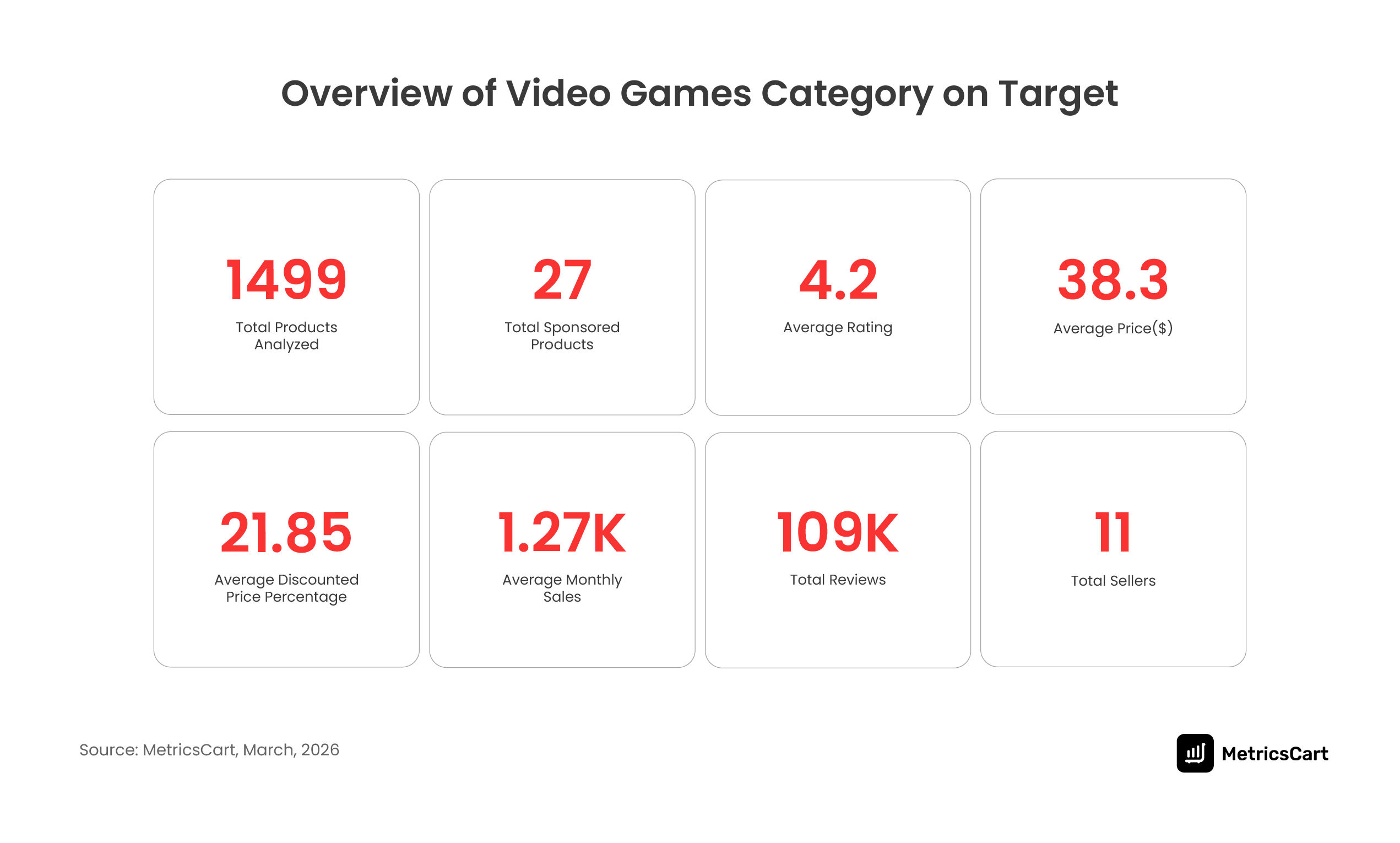
Based on MetricsCart’s research from March 6 to March 20, 2026, Target’s video game category is a busy, competitive shelf. The numbers tell an interesting story right from the start.
With 1,499 products analyzed, 27 sponsored placements, an average rating of 4.2, and an average price of $38.30, this category serves a wide range of shoppers. The average monthly sales of 1.27K per product and a total of 109K reviews across the catalog indicate consistent buying activity. This is not a category that spikes and drops. It is one that sells steadily week after week.
A few things stand out at the category level:
- The average discount rate of 21.85% shows that promotions are a regular part of the shelf strategy.
- 11 sellers compete for the same shopper, which means price perception is shaped by multiple parties, not just the brand itself.
- 27 sponsored products out of 1,499 is a relatively small number, suggesting that only a handful of brands are actively investing in paid visibility
The $38.30 average price sits in an interesting middle ground. It is affordable enough for a casual purchase but high enough to signal that this is not a discount shelf. Most shoppers landing on Target’s video game category are looking for a specific title, a platform-compatible game, or a gift, and price is one factor among several.
Video Game Trends on Target: 15-Day Pricing and Activity Breakdown
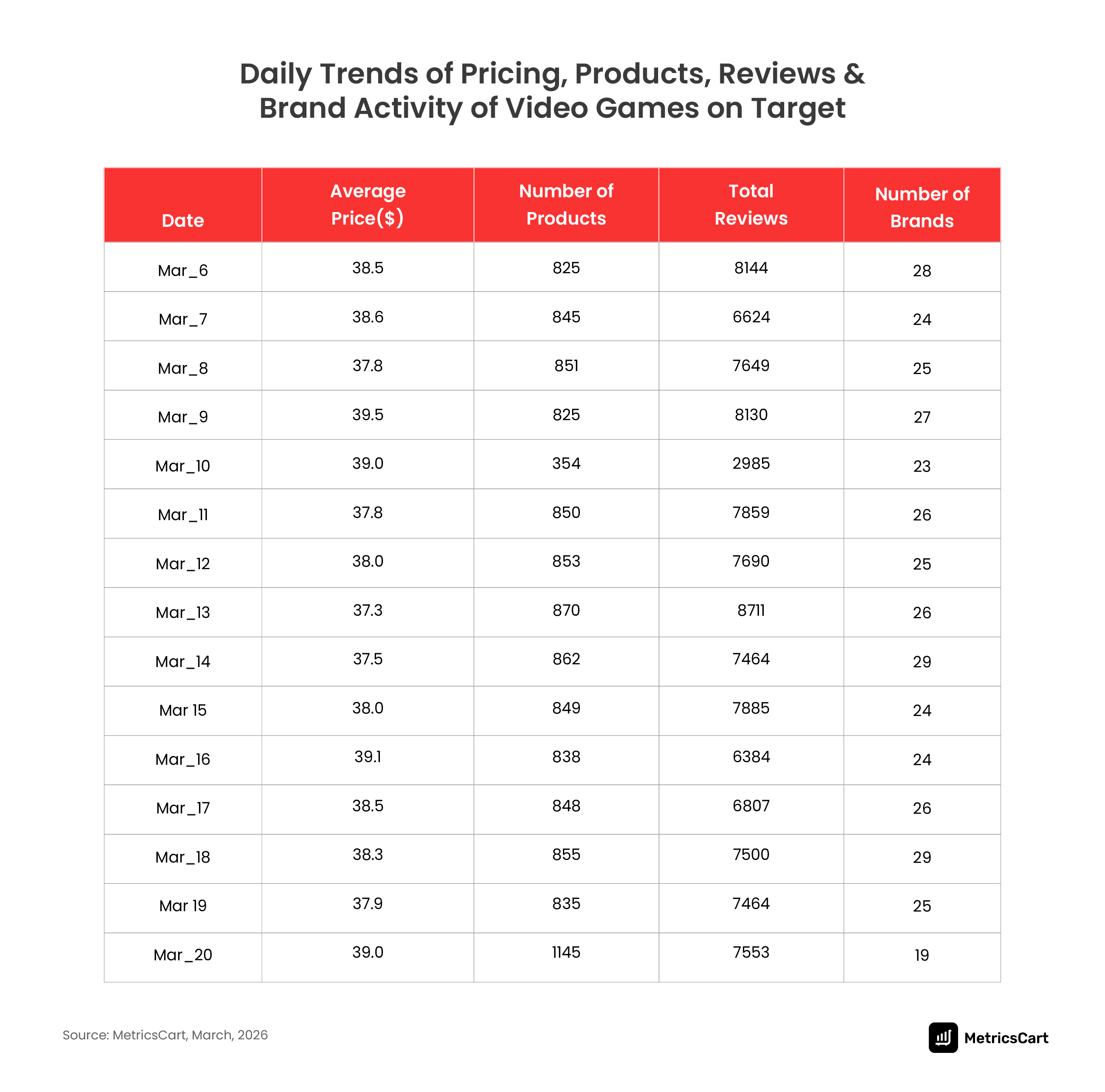
Looking at daily changes helps you understand how volatile or stable a category really is. In video games on Target, the answer is: mostly stable, with a few notable moves.
Average prices held within a narrow $37.30 to $39.50 band over the full 15 days. That level of stability suggests Target is not running random flash sales or unnecessary price swings in this category. The pricing discipline here is tight.
March 10 is the outlier. Product count dropped to just 354, less than half the usual daily count. Review volume also fell to 2,985, the lowest in the window. This could signal a temporary catalog refresh, a data sync issue, or a platform-level update on Target’s end. Brands monitoring their shelf presence should flag days like this. A sudden drop in product count does not always mean a problem, but it always means something has changed.
On March 20, the product count spiked to 1,145, the highest of the entire window. At the same time, the brand count dropped to just 19, the lowest of the period. That combination is unusual. It suggests a small number of brands flooded the shelf with listings on that date, likely through digital catalog expansions or new SKU uploads.
Which Video Game Brands Are Available at Target?
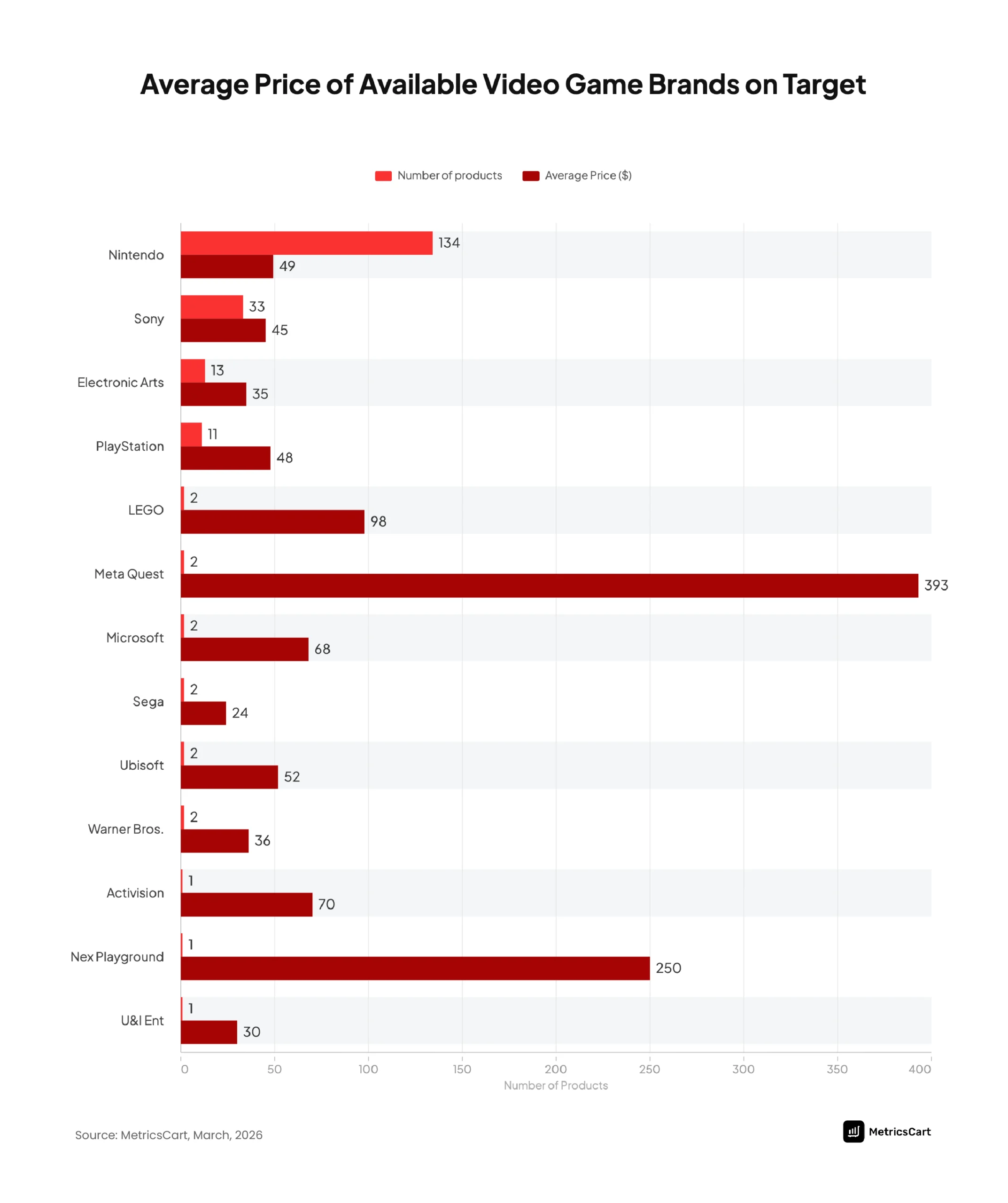
If you scan Target’s video game shelf, one thing becomes obvious fast. Nintendo owns it.
MetricsCart’s analysis of 1,499 products across the category shows a lopsided shelf. A small number of brands occupy most of the space, and one brand accounts for more than the rest.
Nintendo leads with 134 products at an average price of $49. It is the highest average price among all brands in the dataset, sitting well above the category average of $38.30. Nintendo is mostly competing on franchise loyalty and catalog longevity.
Here is why the gap is so wide:
- Hardware exclusivity. Nintendo makes games exclusively for its own hardware.
- Owned franchises. It owns every major franchise it sells, from Mario to Zelda to Pokémon.
- No expiry on the catalog. Unlike most publishers, Nintendo does not pull older titles off the shelf after a year or two.
A copy of Zelda: Breath of the Wild from 2017 sits in the same catalog as a Switch 2 launch title from 2026. That long-tail approach is how you build a 134-product presence while competitors sit in single digits.
Below Nintendo, the shelf thins out quickly:
- Sony (2nd) — 33 products, $45 average. Built around the PlayStation 5 lineup, with pricing that reflects a mix of newer releases at full price and older titles that have already gone through one or two discount cycles. Solid presence, but roughly a quarter the size of Nintendo’s catalog.
- Electronic Arts (3rd) — 13 products, $35 average. A different strategy from Nintendo’s or Sony’s. EA’s catalog leans heavily on annual sports franchises like Madden and EA Sports FC, plus a tail of older titles priced to move.
The takeaway from this data is clear. Sponsored placement on Target works best when it amplifies products that already have reviews and a price point that matches shopper expectations. Nintendo understands this better than anyone else on the shelf.
ESRB Age Rating Breakdown of Video Games on Target
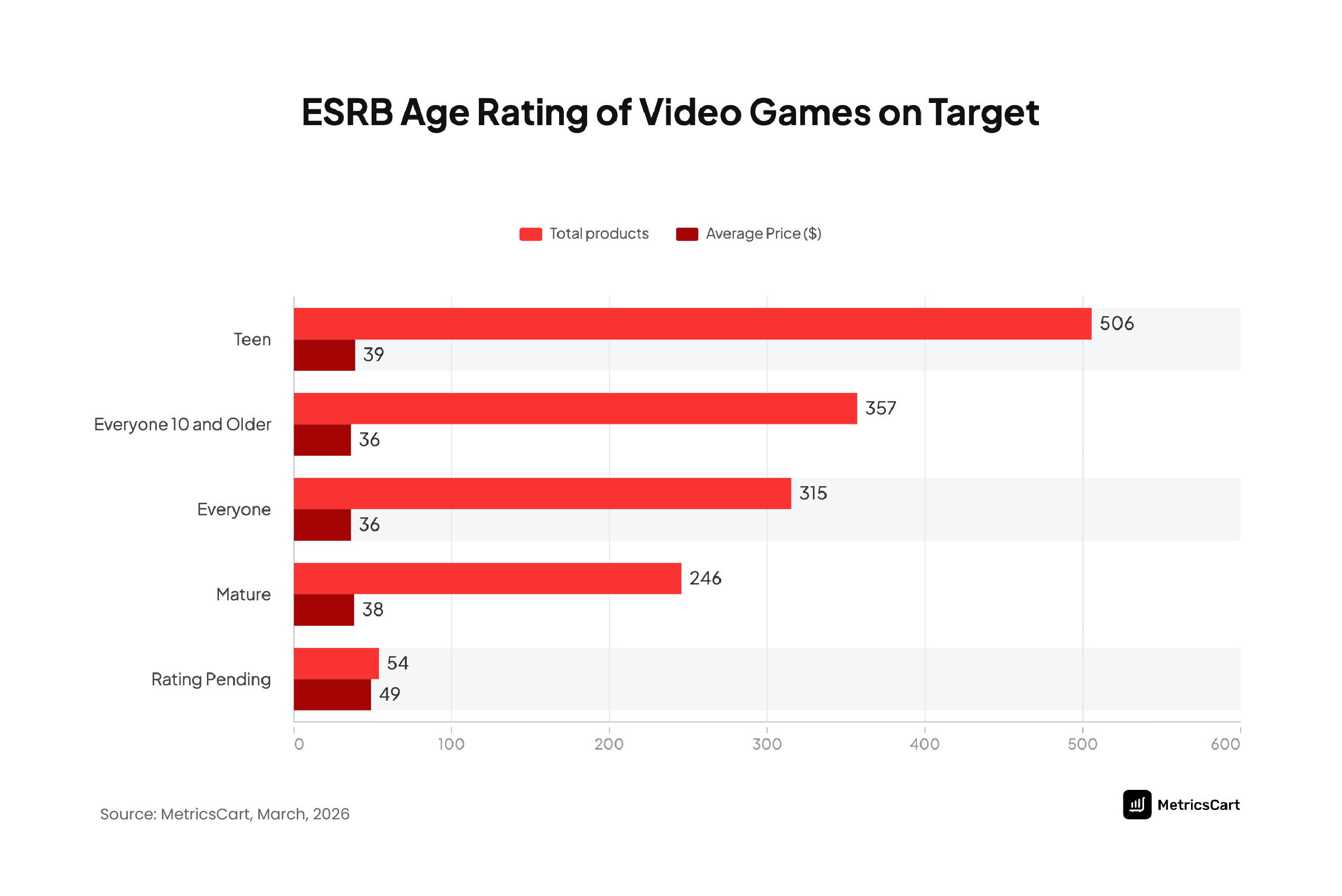
Age ratings shape who buys what and how brands position their products on the shelf. The ESRB distribution on Target reveals where the category leans.
The Teen rating leads with 506 products at an average price of $39, making it the largest segment on Target’s video game shelf. This makes sense. Teen-rated games appeal to the widest range of buyers.
They have enough depth and action to hold the attention of adult casual gamers, while staying within content boundaries that parents are comfortable with. That dual appeal is why this rating tier attracts more products than any other.
Titles in this tier include popular franchises across adventure, sports, and RPG genres. For brands, the Teen tier is the highest-traffic lane on Target. If your catalog skews toward this rating, you are competing in the most crowded space, but also the one with the most buyer traffic.
Everyone 10+ follows with 357 products at $36. This tier is the family-friendly sweet spot. It captures the gift-buying audience: parents, grandparents, and relatives shopping for kids between 10 and 15.
The slightly lower average price reflects the presence of more budget and mid-tier titles. Everyone (all ages) adds another 315 products at $36, rounding out a combined family-oriented segment of 672 products. Together, these two ratings dominate the casual and family gaming shelves.
Mature-rated games account for 246 products at $38. This is a smaller but dedicated segment. Mature titles typically carry stronger brand loyalty and higher per-unit engagement; buyers know what they want and search for specific titles.
Rating Pending titles average $49 across just 54 products, the highest average price in the breakdown. These are likely newer releases or pre-orders that have not yet received their final ESRB classification, and their premium pricing reflects launch-window positioning.
Genre-Wise Distribution of Video Games on Target
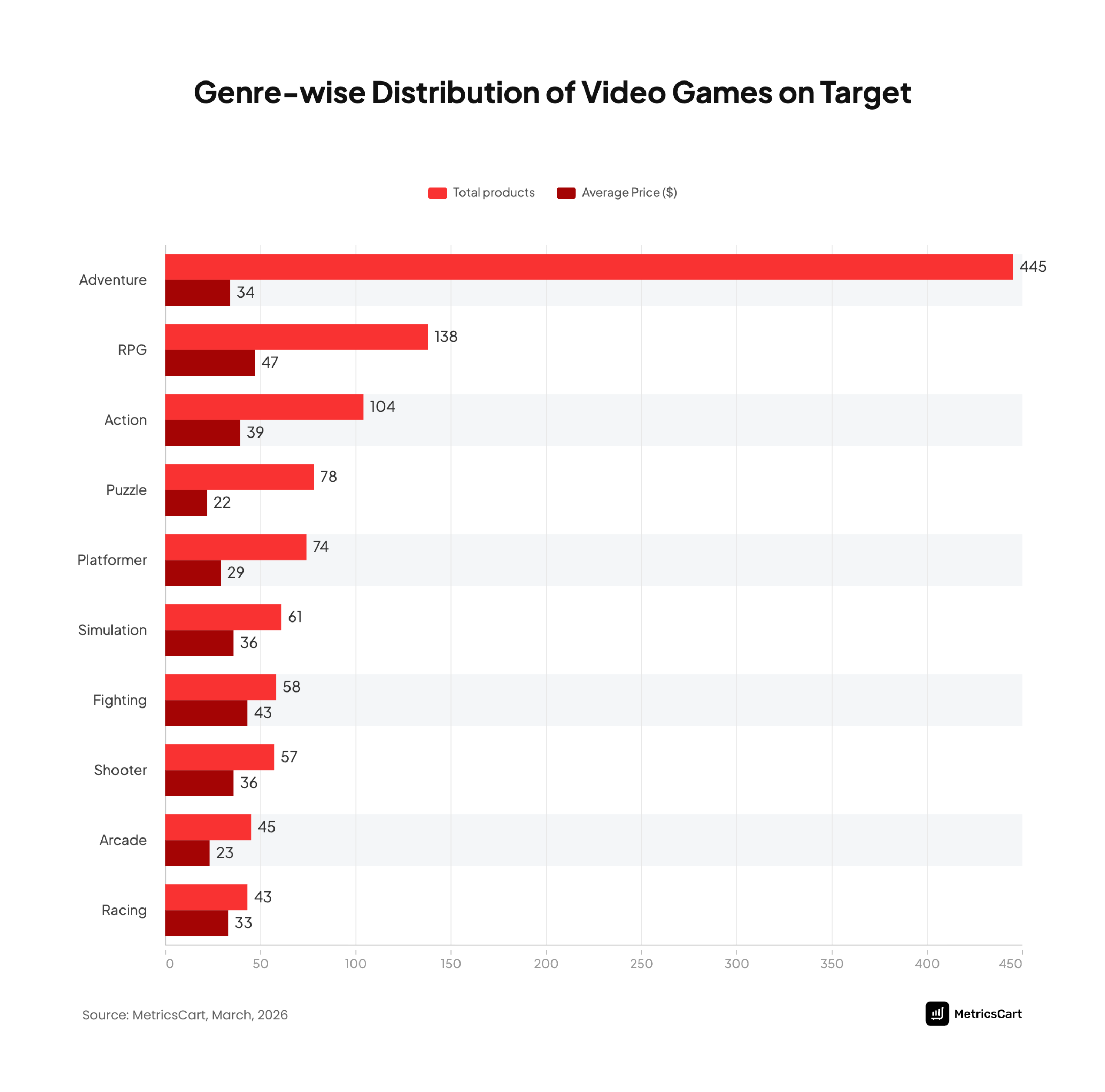
Genre-wise classification from MetricsCart’s research findings provides a clear picture of which kinds of games Target shoppers are actually looking for and which genres command a price premium.
By product count, the shelf is heavily front-loaded:
- Adventure — 445 products, $34 average. More than three times the size of the next genre.
- RPG — 138 products, $47 average.
- Action — 104 products, $39 average.
- Puzzle — 78 products, $22 average.
- Platformer — 74 products, $29 average.
The Adventure genre’s dominance is directly tied to Nintendo. The majority of Nintendo Switch titles, from Zelda to Pokémon to Mario, are classified as Adventure. When one brand controls 134 of 1,499 products, and most of those products fall into a single genre, that genre will dominate the count. The $34 average price for Adventure also reflects Nintendo’s mix of new releases and digital back-catalog titles, which pulls the average down from the premium end.
Price tells a different story than volume. RPG and Fighting are the two highest-priced genres at $47 and $43, respectively. RPG titles tend to be premium, long-form experiences like Dragon Quest and Final Fantasy that command higher prices due to their depth.
Fighting games like Mortal Kombat and Street Fighter often come in Collector’s and Premium editions that drive up the average price. Shoppers buying in these genres are not price-sensitive. They know what they want, and they are willing to pay for it.
At the other end, Puzzle and Arcade sit at $22 and $23, respectively, the most affordable genre averages on the shelf. These are mostly digital Nintendo Switch titles and casual games designed for short sessions.
Low price points in these genres are not a sign of weak demand. They reflect a different type of buyer, someone who wants a quick, low-commitment experience rather than a 40-hour RPG.
Which Are the Top-Selling Video Games on Target?
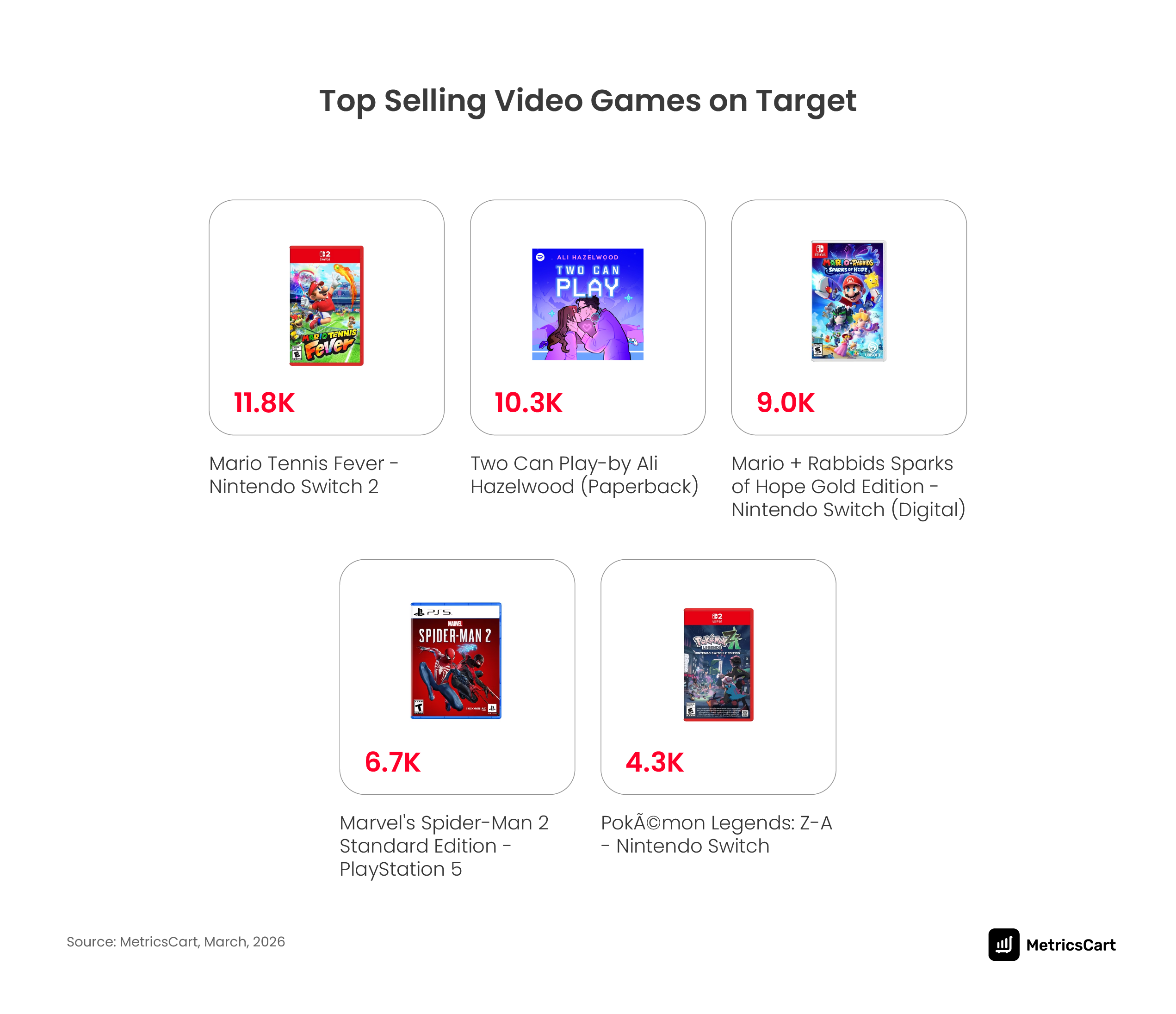
According to MetricsCart’s top seller analysis, Nintendo leads the category rankings; PlayStation appears twice in the top list; and, unusually, a non-game product ranks among the top-selling “video games” on Target.
Mario Tennis Fever for Nintendo Switch 2 leads with 11,800 monthly sales. The reason is straightforward. This is a launch title for the Switch 2, which hit shelves in early 2026.
When a new console arrives, buyers need games to go with it. Mario Tennis Fever was right there on day one, backed by a franchise that parents and players both trust. Launch window titles do not need to be groundbreaking. They just need to show up when the excitement is highest.
The second spot is an odd one. Two Can Play by Ali Hazelwood pulled 10,300 monthly sales, but it is a paperback book, not a video game. It ended up on this list because Target’s system filed it under the video game category by mistake. It is worth mentioning because anyone using these numbers for competitive benchmarking should know that the second-best-selling product here is not actually a game.
Mario and Rabbids Sparks of Hope Gold Edition comes in third at 9,000 monthly sales. This title is not new. It has been out for years. What pushed it back into the top three is a 90% discount, the steepest in the entire category.
At that price, shoppers who would never have considered it at full cost gave it a look. It worked. Volume surged. But there is a cost to this approach. Once buyers see a game at $6 instead of $60, that becomes the price they remember. Future titles in the same franchise may face resistance at full price because shoppers will wait for the next deep discount.
Marvel’s Spider-Man 2 on PlayStation 5 is the best-selling non-Nintendo title at 6,700 monthly sales. It is a strong performer with lasting appeal, built on IP that continues to pull buyers months after launch. MLB The Show 26 is the only other PlayStation entry in the top ten at 4,000 monthly sales.
Which Are the Top-Reviewed Video Games on Target?
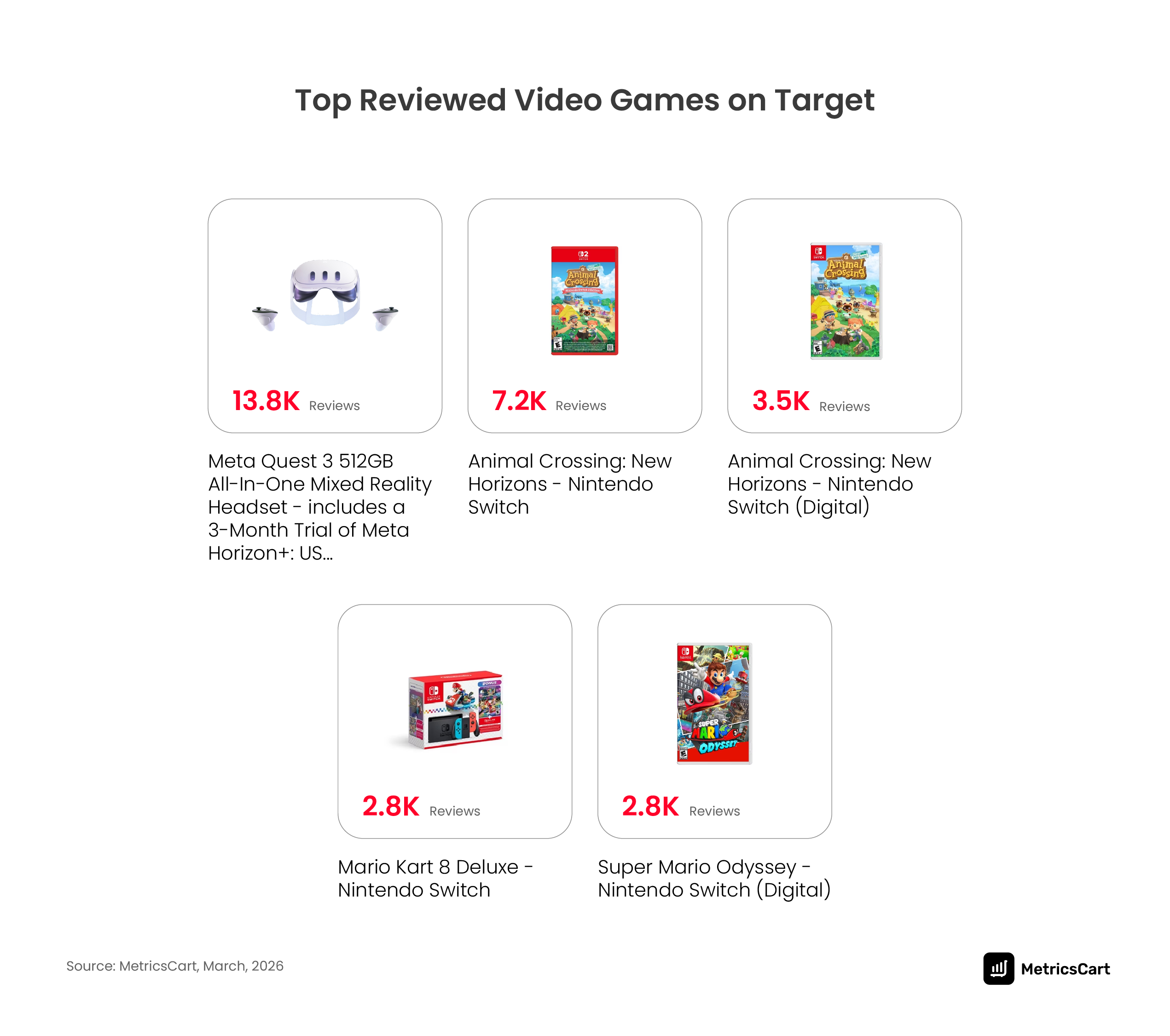
Review volume on Target’s video game shelf tells a story about staying power, and one unexpected hardware product dominates everything else.
The MetricsCart research team has used our review-monitoring tool to identify the top-reviewed video games on Target.
The analysis shows Meta Quest 3 leading with 13,800 reviews. As discussed in the pricing section, this is a VR headset in the games category. Its review count reflects years of high-volume sales and a passionate user base, not just traditional gaming behavior. It is the most reviewed product on the shelf. Also, it is the most expensive, the most niche, and technically not a video game.
Among actual game titles, Animal Crossing: New Horizons on Nintendo Switch leads with 7,200 reviews for the physical format and an additional 3,500 for the digital version. Combined, Animal Crossing: New Horizons has over 10,700 reviews across both formats on Target alone.
Based on MetricsCart research, the Meta Quest 3S at $300 and the Meta Quest 3 at $500 are the most expensive items in Target’s video game category. Both are VR headsets rather than software titles, highlighting how hardware classified under gaming skews the upper end of the price spectrum.
Their presence in the video game category reflects how retailers classify hardware primarily used for gaming, but their price points are incomparable to those of everything else on the shelf.
This is a 2020 game that is still accumulating reviews in 2026, and that kind of sustained review volume reflects a game with genuine long-term appeal.
The pattern across the top-reviewed titles is consistent and telling. Every top-reviewed game title without exception is a Nintendo Switch game. Some are new, most are older, and all of them continue to generate reviews because they keep generating sales. Nintendo’s catalog does not have a shelf life like most games. The right title from 2017 or 2020 can still sit in the top ten most reviewed products in 2026, simply because Nintendo keeps finding new buyers for it.
For any brand trying to compete on review volume in this category, that is the real challenge. It is not about releasing a game with strong launch reviews. It is about releasing a game that people keep buying and reviewing for years.
Pricing Strategy for Video Games on Target
MetricsCart’s MAP Monitoring tool on Target highlights a video game catalog that operates across two distinct price worlds, each designed to serve different shopper segments.
Ideo game catalog shows a shelf that operates across two very different price worlds and understands exactly how to serve both.
The $38.30 catalog average does not tell the full story. The real picture emerges when you look at the extremes. At the top, the Meta Quest 3 costs $500. At the bottom, digital Nintendo Switch titles start at $3. That is a $497 spread across a single category on a single retailer’s shelf.
What sits in between is equally revealing. Most products cluster in the $30 to $50 range, which is the sweet spot for a considered but accessible video game purchase. New releases, standard editions, and platform exclusives all live here. This is where the volume is and where brands compete most directly for the same shopper.
Most Expensive Video Games on Target
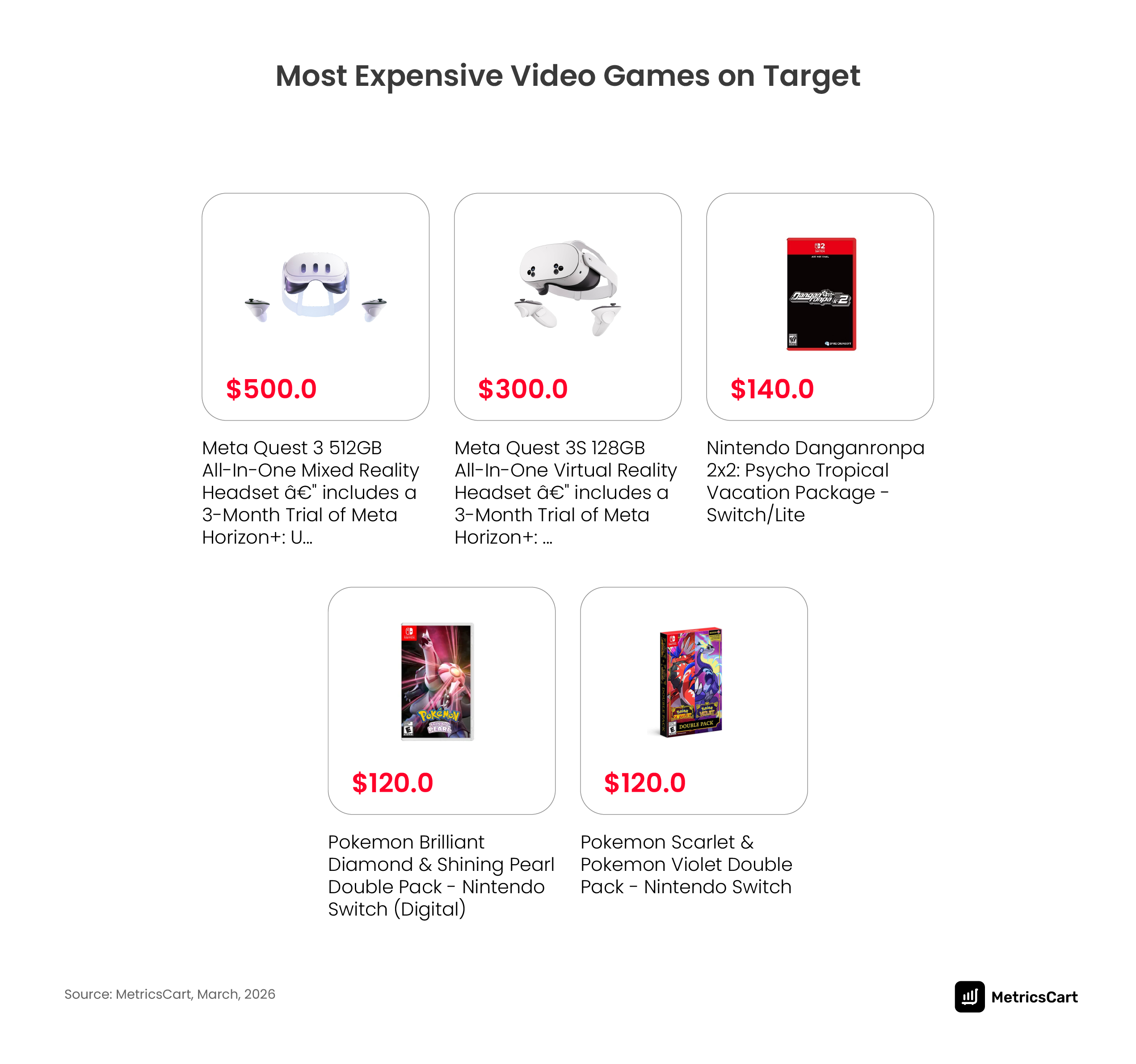
The most expensive products on Target’s video game shelf are not video games in the traditional sense, and that matters.
Among actual video game titles, the most expensive is the Nintendo Danganronpa 2×2 Psycho Tropical Vacation Package at $140. This is a bundle of two games packaged together for a single premium price. It tells you something important about how premium pricing works in this category. High-priced game titles are almost always bundles, double packs, or special editions, not single standard releases.
Below it, the premium tier follows the same logic:
- Danganronpa 2×2 Psycho Tropical Vacation Package — $140. A two-game bundle, the priciest actual title on the shelf.
- Pokémon Brilliant Diamond & Shining Pearl Double Pack — $120. Bundle pricing.
- Pokémon Scarlet & Violet Double Pack — $120. Bundle pricing.
- Dragon Quest Treasures Digital Deluxe Edition — $100.
- Immortals Fenyx Rising Gold Edition — $100.
- MLB The Show 24 Digital Deluxe Edition — $100.
The $100 mark is where Deluxe and Gold Editions consistently anchor.
The pattern across the most expensive video game titles is consistent. Double packs and deluxe editions dominate. Shoppers paying $100 or more are paying for more content, not just a single experience.
Most Affordable Video Games on Target
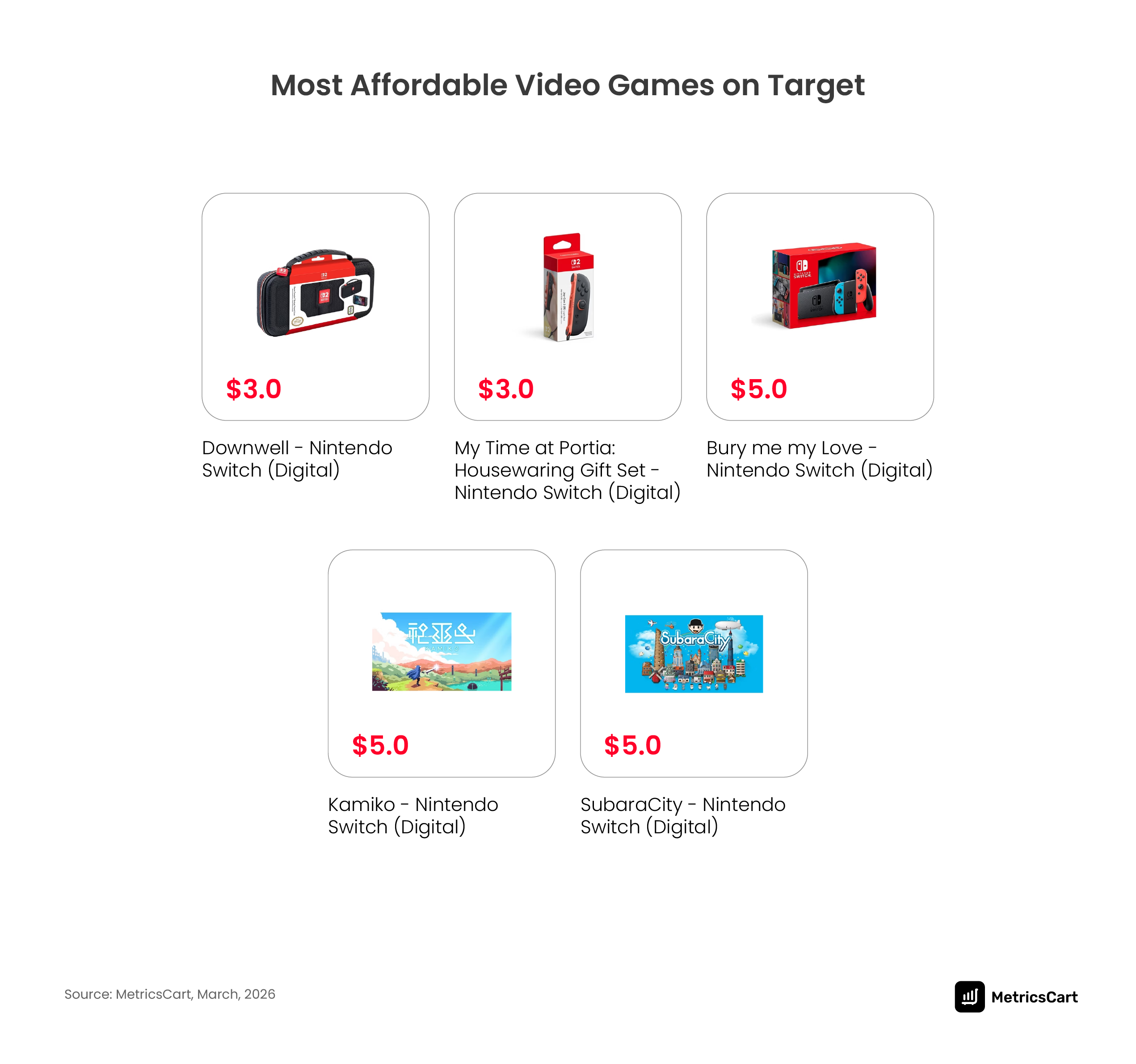
At the other end of the shelf, MetricsCart shows the most affordable video games at Target, starting at just $3, and every single one is a Nintendo Switch Digital title.
The entry tier stacks up by price point:
- $3 — Downwell, My Time at Portia. The lowest price point in the entire category.
- $5 — Bury Me My Love, Kamiko, SubaraCity, Totes the Goat, Witch and Hero.
- $6 — Brawlhalla, Florence.
- $7 — Lost in Harmony, SEGA Ages Sonic the Hedgehog.
The fact that every title in this affordable tier is a Nintendo Switch Digital product is not accidental. Digital distribution removes physical production, packaging, and shipping costs entirely. That allows publishers to permanently price titles at $3 to $7. This is a structural feature of the digital market, not a promotional one.
For brands selling physical game copies, this creates a real pricing challenge. A physical game cannot compete with a $3 digital title on price alone. What physical games offer instead is the tactile experience, collectability, and the ability to resell, none of which apply to a $3 digital download.
Which Brands Have the Highest Sponsored Placements on Target?
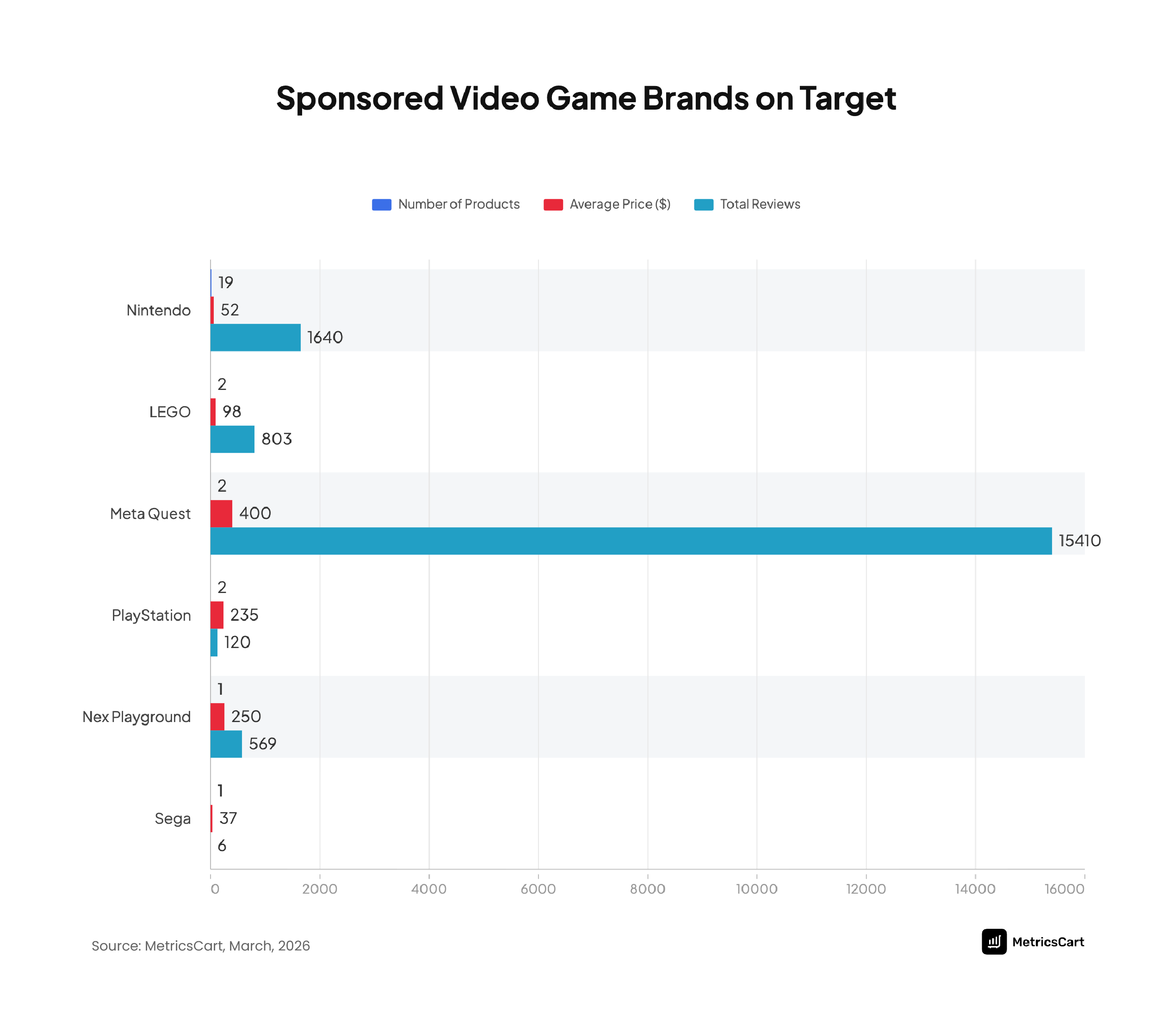
Nintendo dominates sponsored placements with 19 products, which is 70% of all sponsored listings in the category, with just six brands running any sponsored content at all. Nintendo’s average price for sponsored products is $52, which is higher than the overall category average of $38.30.
This tells us Nintendo is not boosting its cheapest titles. It is putting paid visibility behind its mid-to-premium products, the ones where higher price points justify the ad spend through stronger return on ad investment.
LEGO and Meta Quest each run 2 sponsored products, but at very different price points. LEGO’s sponsored items average $98, pointing to premium gaming sets or bundles. Meta Quest’s sponsored average of $400 reflects its VR hardware, where the high ticket price and 5,410 total reviews make sponsored placement a high-stakes but potentially high-return investment.
The low overall count of 27 sponsored products is the bigger story. It means the sponsored ad space in Target’s video game category is wide open. For brands with the budget, this is a low-competition environment to test retail media ads.
Which Brands Have the Highest Average Discount on Target?
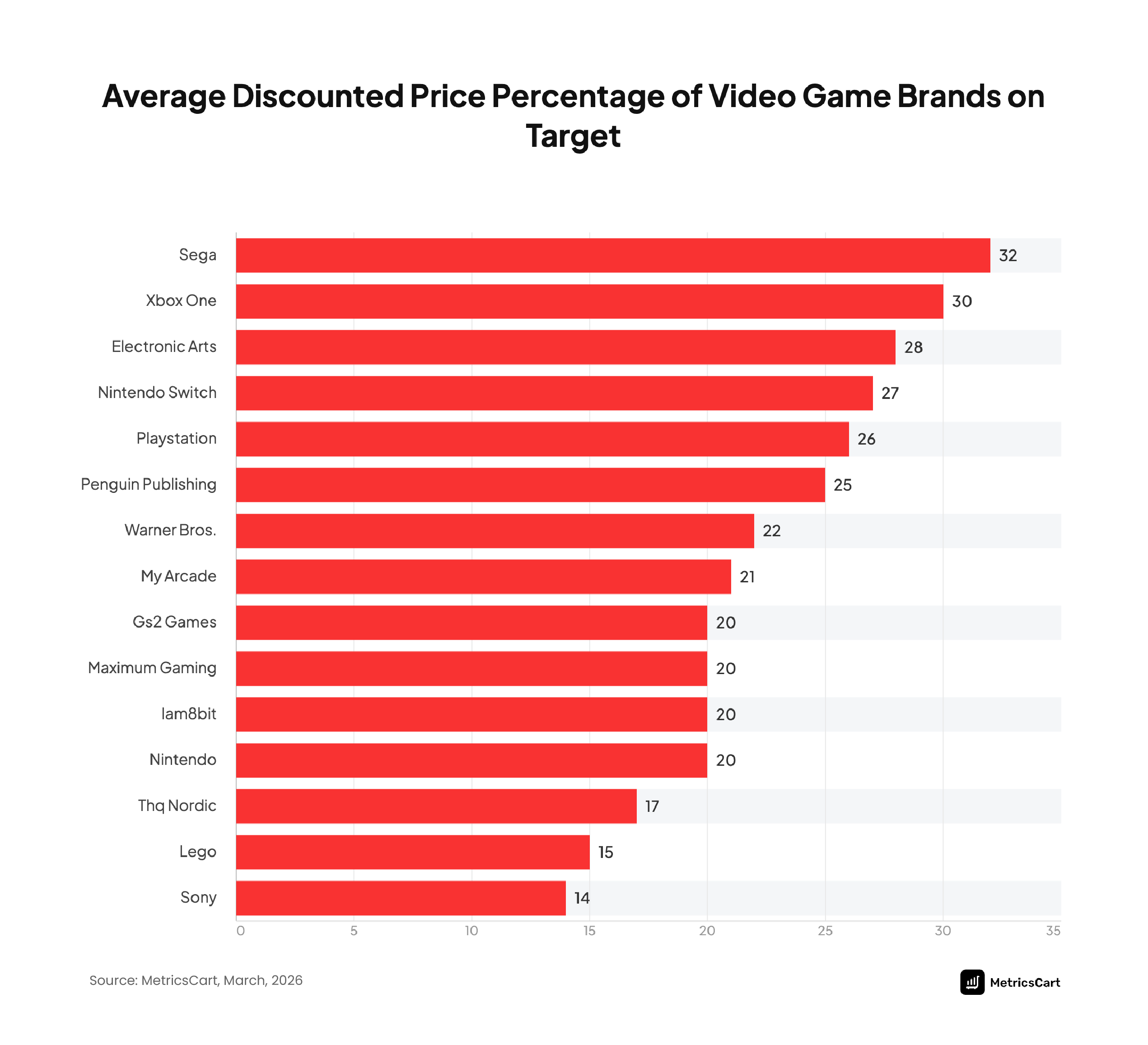
MetricsCart’s brand-level discount analysis highlights a clear hierarchy of discount intensity across Target’s video game shelf, with each brand’s position reflecting distinct pricing strategies and lifecycle dynamics.
Sega leads with an average discount of 32% across its catalog, followed by Xbox One at 30% and Electronic Arts at 28%. Nintendo Switch and PlayStation sit at 27% and 26%, respectively. Sony and Lego have the most conservative average discounts, at 14% and 15%, respectively.
Sega and Xbox One leading on discounts reflects the reality of their catalog position. Sega’s titles on Target are largely older games, SEGA Ages titles, classic franchises, and catalog releases that are not in active demand at full price. Xbox One, as a platform, is a previous-generation console, and its titles are being discounted to clear inventory ahead of current-generation alternatives. These are not strategic discounts. They are platform transition signals.
Electronic Arts at 28% is more nuanced. EA’s sports titles like FIFA, Madden, and NBA Live have a natural annual cycle in which the previous year’s edition drops sharply in price the moment a new one launches. A 28% average across the catalog reflects that annual repricing rhythm, predictable, structured, and tied to the sports calendar.
Nintendo at 20% is the most controlled discounting behavior on the shelf. Given that Nintendo has 134 products and is the dominant brand in the category, a 20% average discount suggests deliberate price management. It is promotional enough to drive volume on older titles and conservative enough to protect the value of new releases and platform exclusives.
How Does Target Discount Video Games?
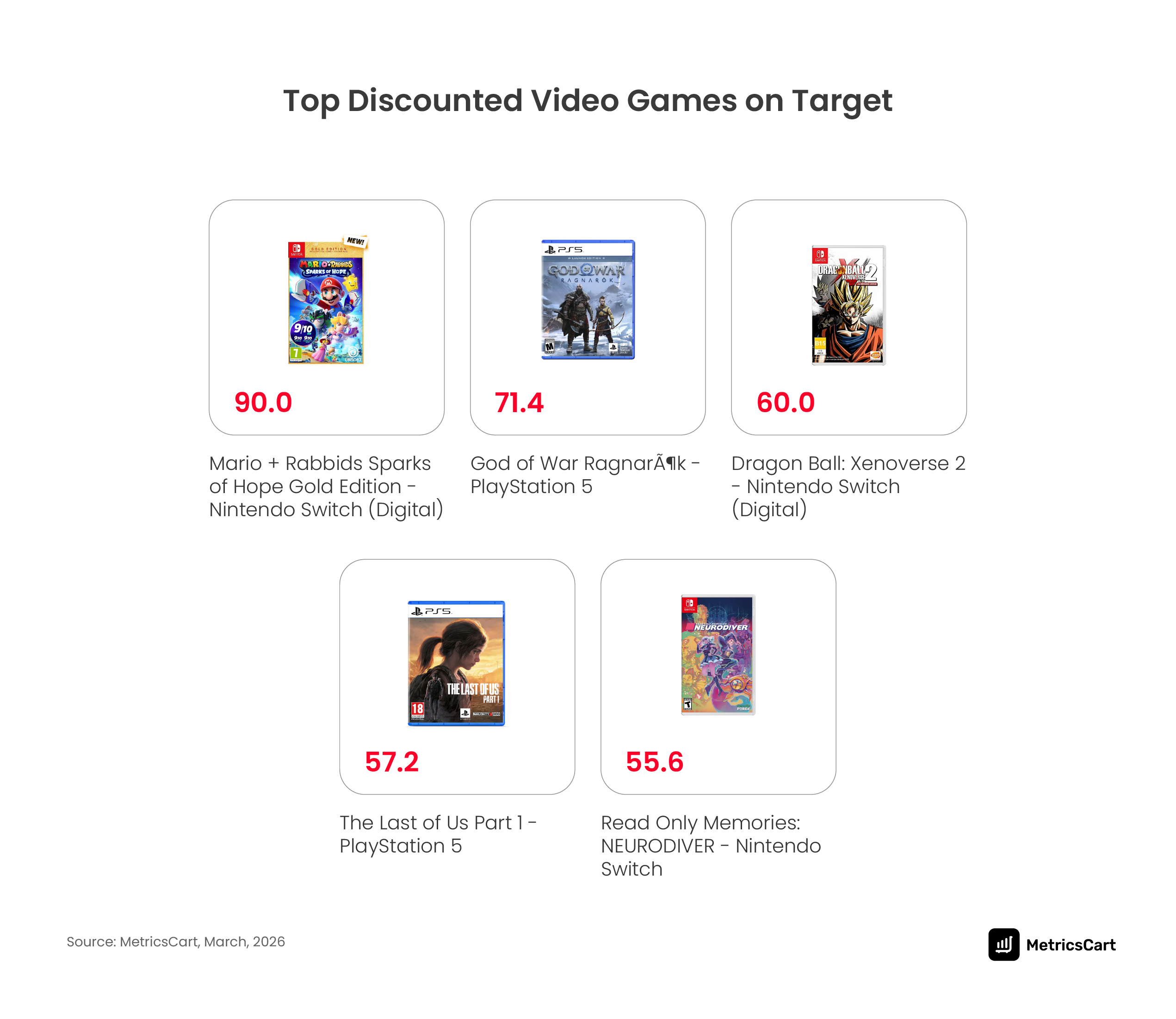
Discounting on Target’s video game shelf follows a clear pattern. The deepest cuts go to older premium titles, not new releases.
MetricsCart’s analysis of the top discounted products shows Mario and Rabbids Sparks of Hope Gold Edition leading at 90% off, the deepest discount in the entire category. God of War Ragnarok on PlayStation 5 follows at 71.4% off, Dragon Ball Xenoverse 2 at 60% off, and The Last of Us Part 1 at 57.2% off. Most of the top 10 most discounted titles carry markdowns above 50%.
What connects all of these titles is that they are all older games. Mario and Rabbids Sparks of Hope was originally a premium bundle release. God of War Ragnarok launched in 2022. Dragon Ball Xenoverse 2 is even older. When a game stops selling at its original price and stock needs to move, a 50% to 90% markdown is how it gets done.
There is a secondary effect worth noting. A 90% discount on a premium Gold Edition bundle makes a previously expensive title accessible to a completely different shopper. Someone who would never pay $60 for a game might happily spend $6 on the same title. That expands the catalog’s effective audience without requiring a permanent price change.
Mario and Luigi Brotherhood and Paper Mario: The Thousand-Year Door both appear twice in the top 10, once for the physical version and once for the digital version, both at 50% off. This indicates that Target is discounting both formats simultaneously, an aggressive move to clear stock across distribution channels.
How Brands Can Save Their Game
Target’s video game shelf rewards brands that show up consistently, price with intention, and pay attention to what the competition is doing. Three takeaways stand out.
- Be present before you try to be popular. The brands with the most products on the shelf are also the ones with the most sales and reviews. Visibility feeds on itself. More listings mean more chances to appear in search, more reviews accumulating, and more price points covering different buyers. A thin catalog is a ceiling on everything else.
- Know what a discount costs you beyond the margin. Deep discounts drive volume. That is not in question. But every steep markdown teaches shoppers a new price. If your audience learns to wait for sales, full-price launches become harder over time. The best-performing brands on Target discount selectively, not reflexively.
- Do not ignore the spaces your competitors have not filled. Sponsored ads, underpenetrated genres, and underserved age ratings are all gaps. When most brands are crowding the same lane, open lanes become opportunities.
The common thread across all three is timing. Knowing when to list, when to discount, and when to invest in visibility is what separates the brands that lead a shelf from the ones that just sit on it.
That kind of timing does not come from quarterly check-ins or gut calls. It comes from watching the shelf every day. What changed in pricing? Who added a new listing? Where review counts are climbing or stalling. Platforms like MetricsCart give brand teams this view across retailers like Target on a continuous basis, turning shelf movement into decisions that actually land on time.
The gaming category at Target will continue to shift. New consoles, new launches, new discount cycles. The brands that stay ahead will be the ones paying attention before the shift, not after.
See the move before your competitors do – on screen and on Target.