
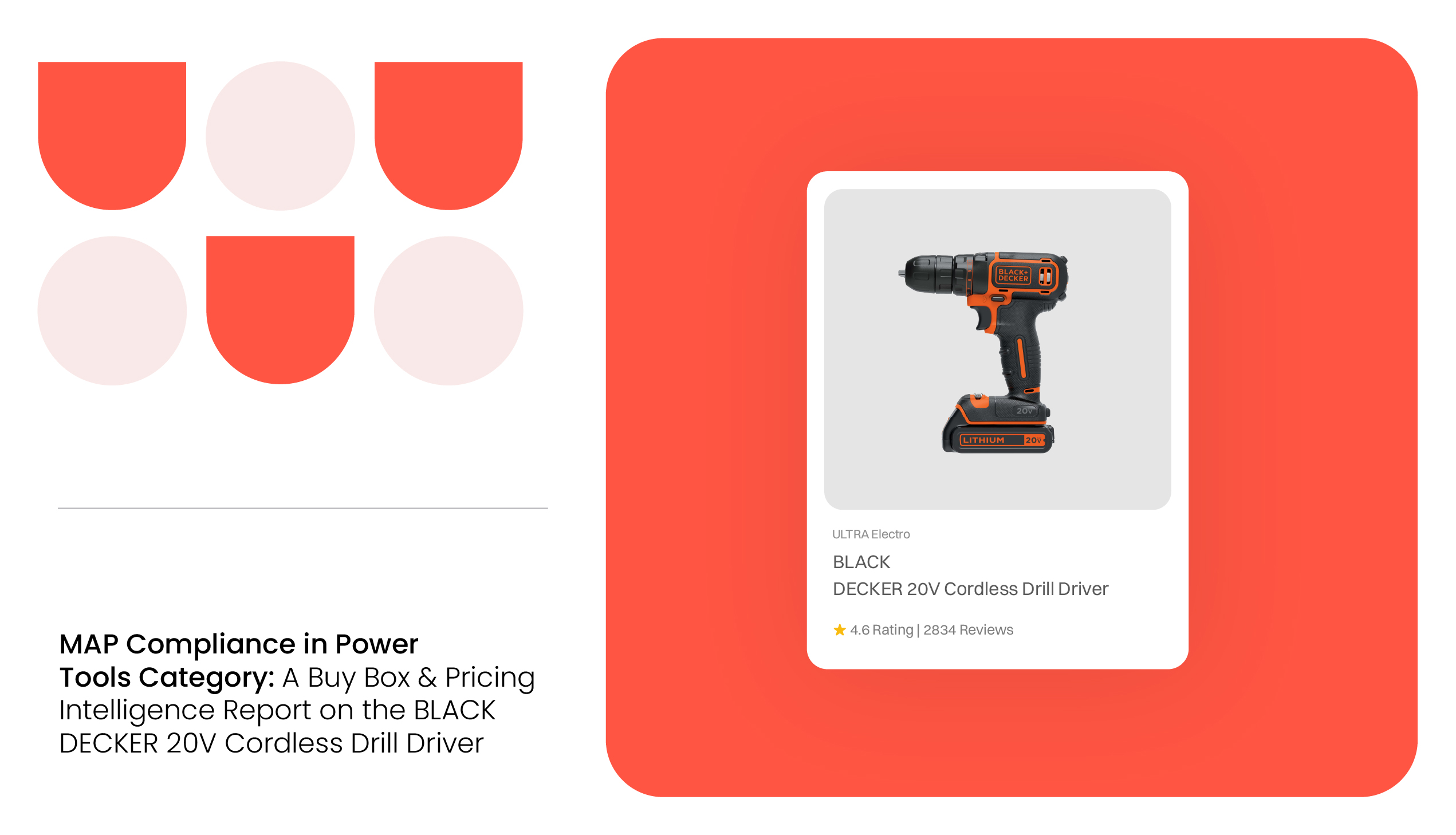
Price erosion usually follows a familiar pattern. Sellers accumulate on a listing. They undercut one another to win the Buy Box. The advertised price falls in steps that monitoring can detect as they happen. This listing does not follow that pattern.
This report examines the price erosion of the BLACK+DECKER drill driver. The advertised price fell below MSRP and remained fixed throughout the tracking period. There was no seller competition to drive it down and no Buy Box turnover to explain it.
The analysis assesses erosion relative to MSRP, Buy Box ownership, and seller density and churn. It then determines whether the cause is competitive pressure or a pricing decision that requires review.
Brand: Black+Decker Marketplace: Walmart US Tracking period: July 1 to July 31, 2026 (30 days) Pricing health: Critical Category: Home Improvement › Tools › Power Tools › Power Drills › Driver-Drills Product URL: BLACK+DECKER 20V Cordless 3/8 in Drill Driver, 1.5Ah, Battery and Charger Included
Tracking Summary
MetricsCart tracked the BLACK+DECKER 20V Cordless Drill Driver on Walmart US for 30 days, from July 1 to July 31, 2026, to assess MAP compliance and price erosion against MSRP.
The Buy Box price held flat at $49.99 against an MSRP of $84.88, staying 41.1% below the reference for the full window. Across 4 sellers, Walmart held the Buy Box for 23 of 30 days, with the BLACK+DECKER brand’s own account taking the other 7. Pricing health is flagged as Critical.
What This Report Covers
- Price Erosion: how the Buy Box price compared to its $84.88 reference over the month.
- Buy Box Ownership: Who held the offer, and at what price?
- Seller Density and Price Movement: whether the price moved as the seller field changed.
- Seller Churn: who joined, who left, and who stayed.
- Findings and Recommended Actions: where things stand and what to do first.
Understanding Power Tool Pricing Strategy
Power tools are priced in a few distinct ways, and the model a brand runs shapes how much a low hardware price actually matters. Three approaches cover most of the category:
- Platform lock-in: The bare tool or entry kit is priced low, sometimes at a loss, to bring buyers onto a battery platform such as 20V MAX. The margin comes later, from add-on tools and batteries that only work within the system. BLACK+DECKER and DeWalt run this model.
- Value-based pricing: Premium and professional tools priced on performance, durability, and brand trust, with no reliance on a lock-in consumable. The tool itself is the product and the margin.
- Bundle pricing: Battery-and-charger kits priced as a package to raise the entry ticket and basket size above a bare-tool listing.
Price Health of the BLACK+DECKER Drill
Price health answers one question quickly: does this SKU need intervention now, or can it wait for the next quarterly review? Here it needs attention, though not for the usual reason.
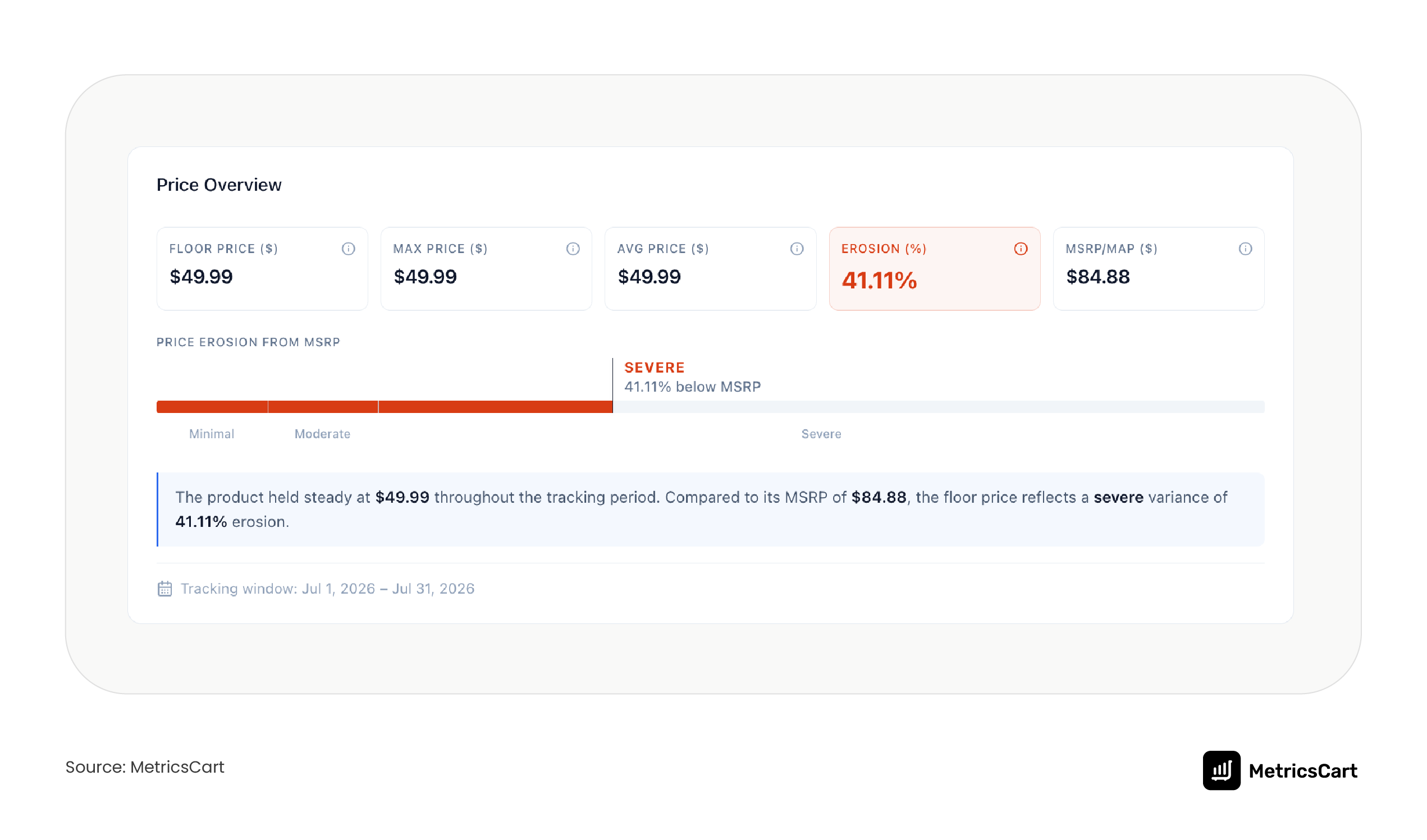
The price held at exactly $49.99 for all 30 days, opening and closing $34.89 below the $84.88 MSRP. Two facts matter more than the flat line itself.
- The full 41% gap was present on day one, so the erosion was inherited, not developing.
- 2. The price showed zero variance across the month, which rules out a promotion, since a sale would have risen and fallen. This is a set price, not a discount.
That combination, fully formed on arrival and unmoving since, defines the problem. A sliding price is an active threat that monitoring can catch mid-decline. A settled price is a decision already absorbed by the retailer, the sellers, and the shopper, and it will not correct on its own. For leadership, this is why a single monthly erosion figure is the cleanest KPI: it turns a calm-looking listing into one honest number, 41% below MSRP, holding.
Price Erosion % of the BLACK+DECKER Drill Against MSRP
Note: MSRP is used as the reference because no MAP floor was provided. All variance is stated against $84.88.
The floor, maximum, and average prices all sit at $49.99. The price did not vary once across the window.
Price erosion is the gap between the selling price and MSRP, calculated as (MSRP − price) ÷ MSRP. Here, it works out to ($84.88 − $49.99) ÷ $84.88, or 41.1% below MSRP, which is categorized as “severe.”
- The full $34.89 gap was present on day one. None of it accumulated during the tracking period.
- The price never moved, suggesting a settled price level rather than a temporary promotion.
- A full month at $49.99 establishes that figure as the reference price in the shopper’s mind.
- Any move back toward $84.88 now reads to shoppers as an increase rather than a correction.
Once erosion passes roughly 80% below MSRP, a SKU enters CRAP territory: Can’t Realize Any Profit, where no seller in the chain can cover landed cost, fulfillment, referral fees, and returns. At 41.1%, this listing is well short of that threshold, and with flat pricing and stable sellers, it is not trending toward it. The erosion here is a positioning problem, not a race to the bottom.
Buy Box Ownership Analysis of the BLACK+DECKER Drill
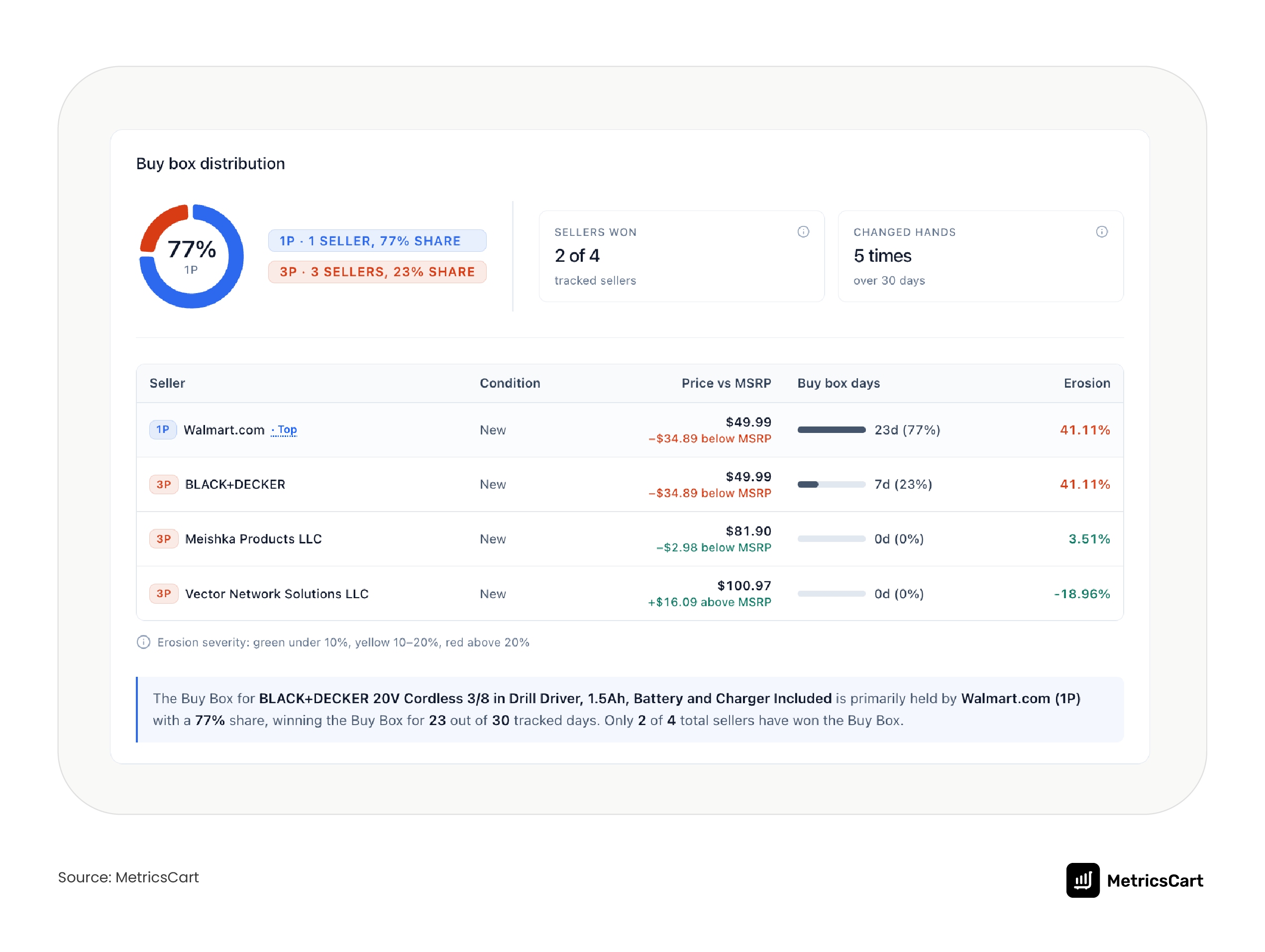
Walmart (1P) held the Buy Box 23 of 30 days (77%) at $49.99. The BLACK+DECKER brand’s own 3P account held the other 7 days (23%), also at $49.99. Only 2 of 4 sellers ever won it. Concentration is Controlled.
- The two winning sellers, Walmart and BLACK+DECKER, both price at $49.99, so the low price is set by the retailer and the brand itself, not by an outside discounter.
- The two non-winning sellers list well above the box: Meishka Products at $81.90 and Vector Network Solutions at $100.97, the latter above MSRP.
- No seller is positioned just below the Buy Box waiting to undercut it. The low price is the authorized price.
For channel and marketplace managers, this is the central read. “We are winning the Buy Box” and “we are winning the Buy Box at a price 41% below MSRP, set by our own accounts” describe two very different business positions, and only one of them is sustainable.
Seller Density of the BLACK+DECKER Drill and Its Effect on Price
Seller density is the number of active sellers competing on a listing. For most listings, a rising seller count is the first warning of erosion, since each new seller adds pressure to undercut and win the Buy Box. Watching it closely means the problem shows up weeks before the price moves. Here, that signal is silent, and the reason matters.
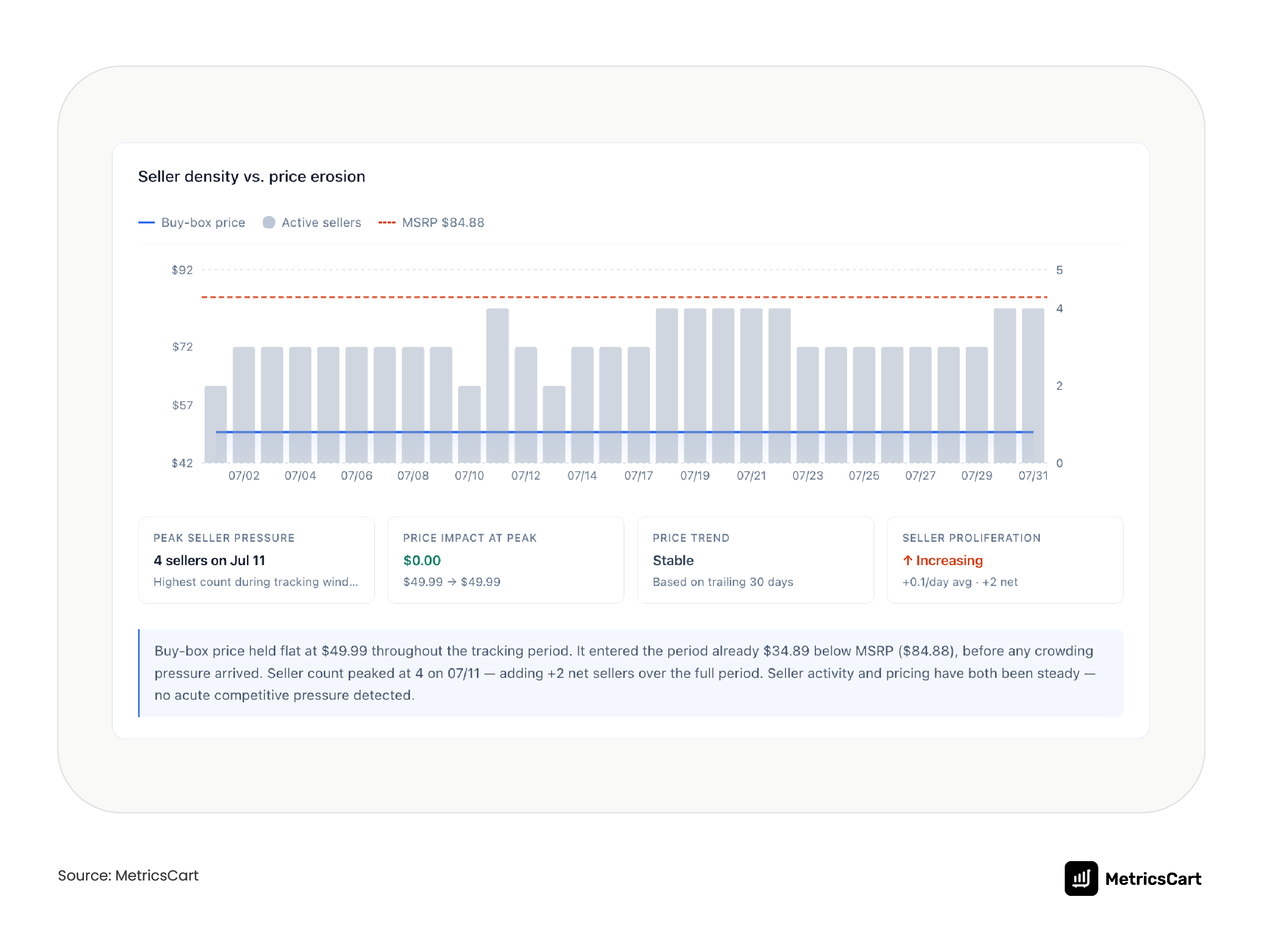
- Seller count peaked at just 4 on July 11, added only 2 net sellers all month, and held a near-flat trend of +0.07 per day.
- The Buy Box price stayed at $49.99 throughout. Seller count and price agreed on one thing: neither moved.
- No group of sellers is competing the price down, and no gray-market inflow is pushing it.
This difference decides what action makes sense. On a crowded listing, the response is enforcement: identify the sellers, trace where their inventory comes from, reduce the pressure, and the price recovers. That approach does not apply here.
The two sellers holding the Buy Box, Walmart and the brand’s own account, set the price at $49.99 and kept it there. With no seller to enforce against, the price can only be corrected at the source that set it.
Seller Churn of the BLACK+DECKER Drill: Entrants, Exits & Persistent Sellers
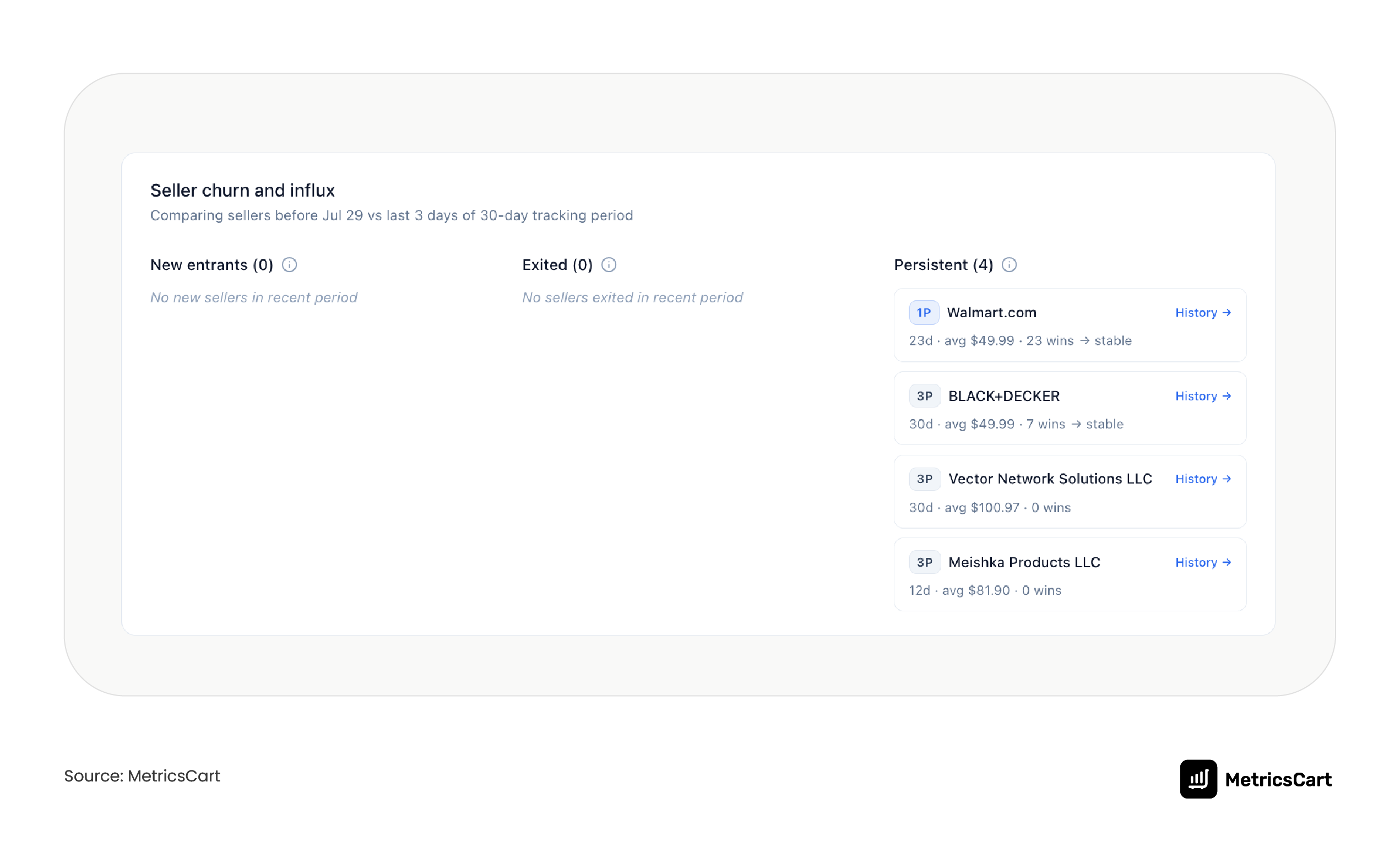
Seller churn tracks how the seller field changes over time. MetricsCart sorts sellers into three groups: New Entrants (first seen in the recent period), Exited (active earlier but now gone), and Persistent (present throughout). The mix shows whether a listing is being actively targeted, stabilizing after prior pressure, or in a fixed state.
New Entrants (0): No new sellers appeared during the final tracking period. Nothing fresh is moving onto the listing.
Exited (0): No sellers dropped off either. Nobody is being pushed out or losing interest.
Persistent (4): The same four sellers held their positions across the full 30 days, each at a steady price. Walmart and BLACK+DECKER at $49.99, Vector Network Solutions at $100.97, and Meishka Products at $81.90. Two of the four (Walmart and the brand’s own account) sit at the low price and win the Buy Box; the other two sit above MSRP and never win it.
Zero on both sides of the churn is the finding itself. There is no incoming threat to monitor and no violator to remove. The price is stable because the sellers are stable, and both trace back to a pricing decision rather than outside pressure.
Bestseller Chances and Buy Box Wins of the BLACK+DECKER Drill
Only 2 of 4 sellers ever won the Buy Box, and both priced identically at $49.99. The field is concentrated rather than crowded, so the ranking risk is not a fragmented price signal but the low price point itself.
A listing that sits 41% below MSRP with stable, single-price ownership sends Walmart’s algorithm a consistent signal, which supports ranking stability. The concern is not volatility. It is that a strong, stable ranking position is anchored to a price well below the brand’s intended one.
Recommended Actions for Power Tool Brands
- Reference-price review — The price has held at 41.1% below the $84.88 MSRP for a full month. Confirm whether $84.88 still reflects the actual selling price of this kit, since the market has treated $49.99 as the real price for 30 days.
- First-party and brand-account alignment — Both winning sellers, Walmart 1P and the BLACK+DECKER 3P account, set the same $49.99. Any price correction must begin with these two, since outside sellers are not driving the number.
- Monitor for change, not crisis — With zero churn and flat pricing, this SKU needs monitoring rather than urgent enforcement. Set a trigger for a new sub-$49.99 seller or any movement in the Buy Box price.
- Track margin in dollars, not just erosion % — Convert the $34.89 per-unit gap into a monthly margin figure so pricing is read as a P&L issue at the leadership level.
Appendix A: How This Was Tracked
MetricsCart checked the listing on Walmart US every day for 30 days, using its Digital Shelf Analytics and MAP Monitoring software. For each check, the Buy Box was recorded against the seller showing at that moment.
Every seller was logged by type (1P, 3P), along with days active, price, and Buy Box wins. Prices were taken daily in US dollars, including coupon and promo prices where shown. All comparisons use the $84.88 MSRP, since no MAP floor was provided.
Appendix B: Evidence & Limitations
- Covers July 1 to July 31, 2026 only, based entirely on what was observed on the Walmart listing (ID 51824806).
- MSRP ($84.88) is the reference point, since no MAP was available for this SKU.
- Erosion is measured from the flat $49.99 Buy Box price. One seller, Vector Network Solutions, listed above MSRP at $100.97 and is recorded as negative erosion.
- Cost figures depend on the unit volume the brand provides; the per-unit gap is fixed at $34.89.
- Read these recommendations alongside the brand’s own pricing and distribution rules.