Digital commerce has evolved from a simple exercise in digital shelf “hygiene” into a primary engine of business growth. For years, brands focused on monitoring basic metrics – product pages, stock levels, search rankings – as a checklist.
Now, heading into 2026, the game is changing. Most retailers have achieved near real-time visibility into demand and inventory, and even developed predictive models for trends. Yet merely knowing isn’t enough!
2025 showed that improved insight did not always translate into proportional business impact. Why? Because too many organizations still treat intelligence passively. The window of opportunity for an insight can close before decision-makers react.
2026 marks a decisive shift from monitoring to acting. The winners of this next era will be those who operationalize their data: turning actionable intelligence in digital commerce into real-time decisions that drive revenue.
The Marketplace Maturity Curve
A major driver of this shift is the maturation of online marketplaces. Platforms like Amazon, Walmart, Target, and emerging niche players are no longer “optional” channels – they are strategic growth engines.
In fact, online marketplaces accounted for 62% of global e-retail sales in 2024 (about $2.4 trillion), underscoring that winning in e-commerce means winning on the digital shelf. Leading brands approach marketplaces with the same rigor once reserved for key brick-and-mortar accounts. They recognize that each platform has unique dynamics and must be managed deliberately.
Instead of a one-size-fits-all approach, savvy brands are “winning selectively” using e-commerce competitive intelligence to tailor strategy by channel. This means using data to decide where to double down on certain products, prices, or campaigns.
For example, a data-driven digital shelf strategy might reveal that high-margin, fast-moving SKUs thrive on Amazon, whereas Walmart is ideal for scaling lower-cost essentials, and Target’s curated model suits premium or lifestyle-oriented items. Armed with such competitive insights, brands can calibrate pricing, content, and promotions for each marketplace to maximize ROI.
By treating marketplaces as core growth engines and leveraging intelligence to navigate them, brands set themselves up to win in an increasingly fragmented e-commerce landscape.
Rise of Cross-Functional Digital Shelf Teams
As digital commerce becomes a growth engine, organizations are breaking down silos to make digital shelf intelligence a cross-functional effort. No longer confined to a small e-commerce team, insights from the online shelf now inform decisions in marketing, sales, supply chain, category management, and even finance.
The reason is simple: online performance impacts all facets of the business, so it demands an integrated response. For example, marketing and content teams need to know whether product pages or images aren’t converting, while supply chain teams need alerts on out-of-stocks, and sales/finance teams watch pricing and profitability signals. Each function brings a piece of the puzzle.
The benefit of cross-functional alignment is speed and coherence. When teams collaborate through a shared digital shelf “command center,” decisions that once took weeks (or fell through cracks entirely) can be made in days or hours. Brands that establish this connective tissue internally are able to execute changes (price updates, content refreshes, inventory shifts, etc.) with the agility that matches the real-time nature of e-commerce.
From Data Overload to Actionable Insights
Despite investments in analytics, many brands still drown in data but starve for insight. Static dashboards, quarterly reports, and siloed spreadsheets create data overload without driving action.
The pivot that 2026 demands is to transform raw data into actionable e-commerce insights delivered at the right time to the right decision-makers.
What makes data actionable? It comes down to three attributes:
- Prescriptive: It’s not enough to know what is happening; teams need to know what to do about it. This is the realm of prescriptive analytics – the stage of analysis that goes beyond describing or predicting to provide clear recommendations. For example, instead of merely reporting a drop in conversion rate, an actionable insight might prescribe updating the product title or running a targeted promotion to fix it.
- Outcome-tied: Actionable insights are linked to business outcomes and KPIs that matter – they don’t exist in a vacuum. Too often, companies fixate on vanity metrics or drown in dozens of KPIs that aren’t aligned with strategic goals. The new best practice is to design your analytics around key outcomes (such as revenue, profit, market share, and customer satisfaction) and surface insights that directly impact them.
- Workflow-embedded: Perhaps most importantly, actionable intelligence is delivered within the flow of work, not on a static dashboard that someone has to remember to check. This means integrating alerts and insights into the communication and execution tools teams use daily. For instance, if a MAP price violation or an out-of-stock occurs, the system can instantly notify the responsible team and even assign a task to fix it.
Untapped Insights: The Next Profitability Lever
Beyond the usual suspects of price and sales data, there’s a wealth of untapped signals on the digital shelf that many brands have yet to fully leverage – and these can be the next big levers of profitability.
Let’s highlight a few critical but often under-measured signals and how a data-driven digital shelf strategy can turn them into tangible business outcomes:
Sentiment Shifts in Reviews
Every review star rating is actionable intel if used correctly. A sudden spike in negative reviews can foreshadow a product issue or a competitor’s weakness. Rather than just monitoring star averages for vanity, leading brands perform sentiment analytics on review text to detect shifts in consumer perception.
For example, if reviews reveal recurring complaints about a new feature, that’s a cue to update the content or even adjust the product itself. Conversely, an uptick in positive sentiment can signal an opportunity to double down on marketing for that item. This kind of insight drives profitability by improving products, reducing returns, and informing marketing messaging that resonates.
READ MORE | How Can Sentiment Analysis Help Improve Customer Experience?
Pricing Fluctuations & Competitive Price Gaps
Pricing is the most obvious profit lever, yet the nuance often lies in the dynamics – how prices change in response to competitors, stock levels, or demand. Many brands still rely on periodic price checks, missing the real-time fluctuations that erode margin or volume.
Actionable intelligence in digital commerce means receiving alerts on market price moves (e.g., a key competitor suddenly dropping the price by 10% on a top SKU) and knowing when to react or hold. It also means identifying scenarios where you can maintain a price premium.
E-commerce competitive intelligence around pricing lets you optimize both top line and margins, rather than blindly racing to the bottom.
Content Fatigue & SEO Decay
Product content (titles, descriptions, images, A+ media) isn’t a set-and-forget asset. Over time, content can become outdated or simply lose effectiveness as competitor content improves and consumer search behavior changes. Content fatigue might show up as declining click-through rates or stagnant conversion despite stable traffic.
Actionable insight here means identifying which product detail pages are “tired” – maybe the keyword ranking is slipping, or shoppers aren’t engaging with the images like they used to. Modern digital shelf analytics software, like MetricCart, tracks content performance metrics such as content scorecards, bounce rates, and time on page to flag when a refresh is needed.
READ MORE | The Impact of Inconsistent Product Content on Brand Growth
Assortment Gaps & Category Opportunities
Another untapped goldmine is using intelligence to identify what you’re not selling but should be. Every category has white spaces – segments or products that consumers want, but you might not offer (or not offer in a given channel). Competitive digital shelf analytics can illuminate these gaps.
For instance, by monitoring competitors’ assortments and new product launches, you might spot that a competitor is seeing success with a product type you lack. Or you discover that in a certain retailer category, there are high-volume search queries with few good results, indicating unmet demand. Closing these gaps can become a new revenue stream.
Likewise, tracking availability data can highlight when a competitor goes out of stock on a hot item – a prime moment for you to push your equivalent product and capture spillover demand. Brands armed with real-time marketplace data react to such signals instantly, reallocating inventory or boosting ads to capitalize on a competitor’s stockout. It also prevents over-stocking costly inventory in low-demand areas by showing you what’s truly moving.
In all these cases, the common thread is connecting digital shelf signals to concrete business actions. It’s not just about listening to data, but responding to it in a way that drives profit or prevents loss.
MetricsCart platform, for instance, is built to surface these previously untapped insights in real time and make them immediately usable. Whether it’s alerting you that your top product’s star rating fell below 4.0, or identifying that a competitor’s weekend promotion opens a 48-hour window for you to capture share, the platform focuses on the signals behind the scenes that materially impact your sales and profitability.
The payoff can be significant: by acting on these insights, brands turn what used to be surprises or “unknown unknowns” into strategic decisions and continuous improvement. In a game of inches where e-commerce profitability is hard-won, mining these signals can be the difference between meeting your quarter’s targets or missing them.

AI: The New Execution Backbone
To truly operationalize all this intelligence at scale, brands are increasingly turning to Artificial Intelligence as the backbone for execution. AI-driven systems can continuously monitor, interpret, and even act on digital shelf data in real time.
Here are a few ways AI is powering actionable intelligence in digital commerce:
- Automated Anomaly Detection & Alerts: AI systems excel at monitoring vast datasets and pinpointing anomalies far faster than any human team. On the digital shelf, this means AI can watch every SKU across every channel for unusual patterns – sudden drops in search ranking, abnormal price changes, stockouts, rating dips, and trigger instant alerts.
- Predictive and Prescriptive Recommendations: AI not only finds issues; it can predict future ones and recommend proactive fixes. Machine learning models can analyze historical trends and correlations to forecast events such as demand surges, stockout risks, or the next likely competitor move.
- Closing the Loop with Automation: The ultimate vision of AI in retail intelligence is to enable self-driving actions for routine decisions, leaving humans to focus on strategy and exceptions. For instance, some brands use AI to automatically pause ad spend on products that go out of stock or to automatically block a seller when MAP violation evidence exceeds a certain threshold.
AI is becoming the backbone of execution for digital commerce intelligence, detecting every signal that matters, predicting what’s next, and recommending actions in real time. As a result, brands can be much more agile and “alive” to the market – adjusting prices, inventory, content, and campaigns to seize opportunities and neutralize threats. In the next era of retail, this AI-empowered operation will likely define the retail winners.
READ MORE | AI in E-Commerce: Predict Purchase Intent With Machine Learning
Omnichannel Consistency as a Trust Driver
Another pillar of winning in 2026 and beyond is delivering a unified brand presence across all channels – not just for branding’s sake, but as a driver of customer trust and conversion. In an omnichannel world, shoppers interact with your brand in many places: marketplaces, D2C sites, Instagram or TikTok Shops, quick commerce delivery apps, and even physical stores.
They expect these touchpoints to be seamless and consistent. If your pricing, product info, or brand messaging is inconsistent, customers lose confidence. Conversely, a harmonious experience across channels builds credibility.
Today’s shopper journey is highly interconnected and data-connected – consumers might discover a product on social media, check reviews on Amazon, price-compare on Google, and finally buy from a marketplace or store. At each hop, they should see the same core information and brand ethos.
“Omnichannel consistency” means your product details (titles, descriptions, images), pricing, promotions, and brand tone are aligned across all channels. When brands deliver a cohesive experience, they create deeper trust and recognition, and ultimately a competitive advantage.
Consistency is not just about aesthetics; it’s also about synchronized execution. For example, if you’re running a limited-time promotion or launching a new product, it needs to roll out uniformly across Amazon, Walmart, Target, your website, and any other sales channel – with inventory to back it up – so that a customer gets the same deal and information wherever they prefer to shop.
If a shopper sees a discount advertised on Instagram but then finds a higher price on your Amazon listing, trust is broken, and that sale is likely lost. Similarly, if your product is positioned as premium on your site but a third-party seller is undercutting the price on a marketplace, it erodes your brand equity.
Thus, omnichannel intelligence involves monitoring all channels in real time to ensure alignment: consistent pricing (guarding against unauthorized undercutting), consistent content (no outdated descriptions lingering on one retailer), and consistent availability (preventing, say, your D2C site from showing “out of stock” while a retailer has plenty of inventory).
The MetricsCart Takeaway: From Insight to Execution, 2026 and Beyond
The future of retail will not be won by those who simply have the most data, but by those who act on data the fastest and most effectively. It’s about turning the digital shelf into a dynamic, self-optimizing engine for your business.
As we head into 2026, now is the time to ask: Is your organization ready not just to monitor, but to execute? Are you turning analytics into daily ROI? If not, you may be leaving significant growth on the table.
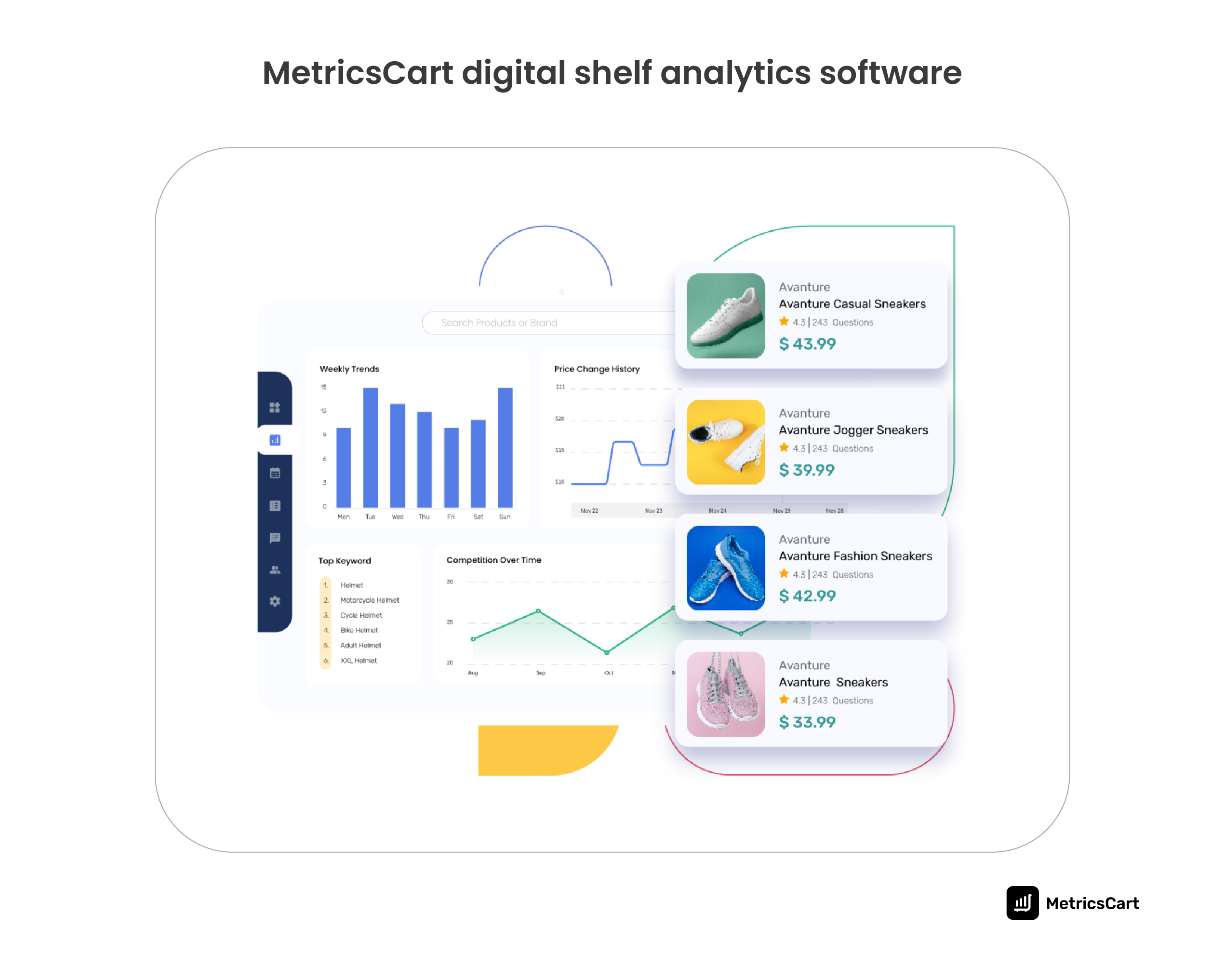
The good news is, solutions like MetricsCart are here to help you make that leap. 2025 showed us that retail is no longer constrained by a lack of data or insight – the constraint now is how quickly and smoothly we can translate insight into action. By investing in actionable intelligence capabilities, you’re essentially designing your organization to win in this new landscape.
Ready to Move From Monitoring to Executing on the Digital Shelf?
FAQs
Actionable intelligence in digital commerce refers to insights that don’t just describe what’s happening on your online shelves, but prescribe what to do next. It transforms raw marketplace data — such as pricing, availability, reviews, and content performance — into clear, real-time actions that improve visibility, sales, and profitability.
Because the pace of e-commerce has outgrown static dashboards and quarterly reports. In 2026, brands win by reacting to digital shelf changes instantly — not weeks later. Actionable intelligence empowers teams to act on signals like price shifts, stockouts, or sentiment drops the moment they occur, ensuring agility and competitive advantage.
Traditional analytics often focuses on reporting and visualization — showing what happened. Actionable intelligence goes a step further by embedding insights into daily workflows, sending alerts, and recommending specific next steps. It bridges the gap between knowing and doing
MetricsCart helps brands monitor every SKU and channel in real time — surfacing insights tied directly to business outcomes. From detecting MAP violations and pricing gaps to identifying content fatigue or sentiment shifts, MetricsCart turns these signals into instant, prescriptive actions teams can execute across marketing, sales, and supply chain.
Yes. MetricsCart is designed for scalability — offering enterprise-grade digital shelf intelligence at accessible pricing, starting at $300 per month. This allows both emerging and established brands to turn insights into impact without heavy infrastructure or data science overhead.