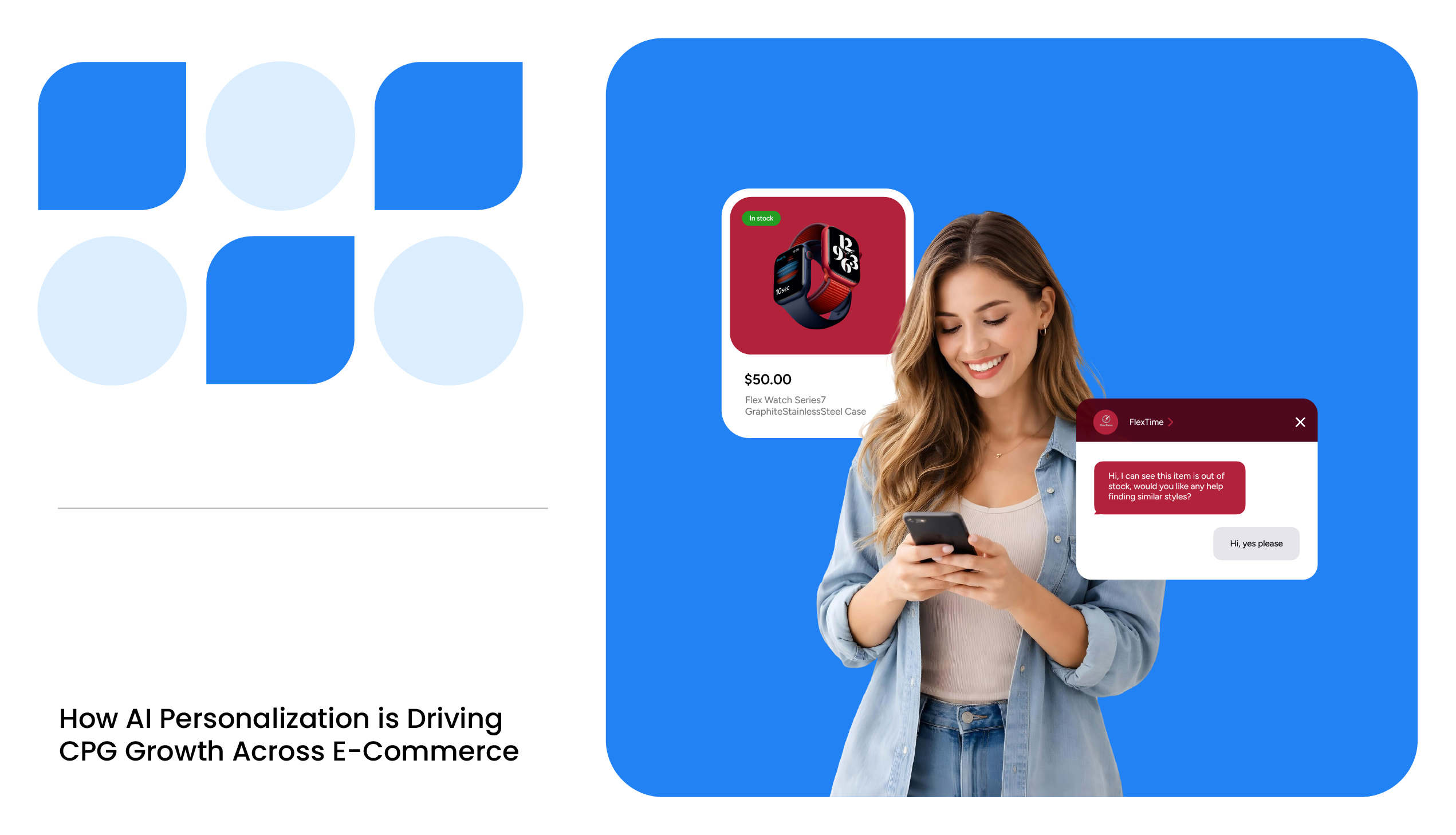
Have you noticed how some CPG brands seem to understand exactly what shoppers want, while others struggle to stay visible in crowded digital marketplaces? The difference increasingly comes down to relevance.
Today’s consumers shop in ecosystems powered by algorithms. Amazon recommends products based on browsing behavior, Walmart personalizes assortments by location and purchase patterns, and quick-commerce apps adapt their suggestions in real time. In a world where choice is endless, brands are competing not just for purchases but for attention.
And shoppers are rewarding brands that get personalization right. Deloitte reports that nearly three in four consumers are more likely to purchase from brands that deliver personalized experiences, and those consumers spend up to 37% more with them.
Yet only a small percentage of brands are delivering personalization that shoppers actually recognize as relevant.
This is where AI personalization is transforming the CPG industry. By combining machine learning with shopper behavior, ratings and reviews, search trends, and digital shelf signals, brands can create more relevant shopping experiences at scale.
The result is better product discovery, higher conversion rates, stronger retention, and more efficient retail media performance.
In this blog, we’ll explore how AI personalization works in practice for CPG brands, the business impact it drives, and how CPG teams can operationalize it using digital shelf analytics like MetricsCart and shopper insights.
What is AI Personalization in CPG E-Commerce?
AI personalization means using machine learning and advanced data science to tailor every aspect of the shopping experience to each customer. Instead of broad segments (e.g., “women ages 25–34”), AI personalization analyzes each shopper’s history, behavior, and context in real time and adjusts content accordingly.
This can include personalized product recommendations, dynamically targeted promotions, customized search results, and tailored messaging across channels (emails, social, apps, ads, etc.).
But how is personalization different from customization?

As Jennifer Alexander says in episode 48 of the Digital Shelf Insider podcast, personalization is what the brand does based on what it already knows and not what the customer configures for themselves.
It reduces cognitive load, filters out the irrelevant, and makes the next action feel obvious. When it’s done right, the customer feels understood without having to spell anything out. Watch the full episode here:
Therefore, for CPG brands, this means that algorithms can identify, say, that a household loves anti-aging skincare versus fragrance-free products, and then automatically serve each group different campaign content.
Key Differences Between Traditional vs. AI Personalization
- Segmentation: Traditional uses fixed demographic/behavioral buckets; AI uses automated clustering and individual profiles.
- Speed: Traditional updates weekly/monthly; AI responds in real time (even session by session).
- Channels: Traditional often focused on email or the brand site; AI spans marketplaces, apps, ads, email, social, etc.
- Decisioning: Traditional uses marketer-defined rules; AI uses predictive models to choose the best product or message for each shopper.
Using AI, CPG teams can finally start to personalize even within the walled gardens of Amazon, Walmart, Instacart, etc., by feeding those algorithms with better signals (like review themes or dynamic pricing) and by buying more targeted retail media. We’ll see concrete examples below.
How does AI Personalization Drive CPG Growth?
AI personalization impacts every stage of the online funnel. Here are four core benefits driving CPG growth:
Personalized Product Discovery Increases Conversion Rates
When AI matches shoppers with products they’re most likely to love, conversion rates soar. Personalized product recommendations alone now drive a huge portion of online revenue. For example, Amazon’s recommendation engine is estimated to generate roughly 35% of the site’s total sales.
In practice, this means Amazon pushes items in “Recommended For You” or “Customers Who Bought This Also Bought…” algorithms, dramatically boosting those products’ sales.
AI also personalizes search results. If a shopper frequently buys organic snacks, AI-powered retail search and advertising will rank their favorite snacks higher and surface similar items with shared keywords. By presenting the right products to the right people at the right time, shoppers encounter fewer obstacles, reducing cart abandonment and boosting conversion rates.
AI Personalization Improves Repeat Purchases and Customer Retention
Once a shopper has made a first purchase, personalized follow-ups can nurture loyalty. AI models track what people bought and when they might run out, enabling proactive outreach. For example, if someone buys a pack of diapers, AI can predict the next purchase interval and trigger timely reordering ads or emails.
These “intelligent replenishment” messages usually beat generic newsletters. AI can also personalize cross-sell and upsell recommendations based on individual tastes. The impact on loyalty is clear. When shoppers feel recognized, they buy more often.
In practice, AI helps segment customers by loyalty signals and respond accordingly. For high-frequency buyers, it might send surprise rewards or early-access offers. For churn-risk segments, it might provide incentives of the right size at the right time. Overall, personalization shifts marketing from one-size-fits-all promos to one-on-one engagement.
Hyper-Personalization Helps Brands Reduce Discount Dependency
AI personalization also allows CPG brands to be smarter about pricing and promotions. Instead of blasting blanket discounts to everyone, AI can tailor offers so that only the right segments receive deals.
For example, if a shopper has expensive tastes, they might see a bundle offer or premium trial-size sample; a budget-conscious segment might see a discount coupon. This hyper-personalization means brands don’t have to slash prices for all.
In addition, most shoppers prefer customized deals over mass coupons. By giving each shopper the precise offer that motivates them, brands protect margins. When brands tailor pricing only to the most price-sensitive (e.g., via targeted ads or personalized coupons), they see higher average order values and a larger share of shelf than if they cut prices site-wide.
How Amazon and Walmart Use AI Personalization
CPG brands must play by the personalization rules set by the big retailers. Amazon and Walmart both invest heavily in AI to personalize the shopping experience for their users, and CPGs need to align with those systems.
Amazon’s Recommendation Engine and Search Personalization
Amazon is the original personalization powerhouse. Its website and app are built on AI: every search, browse, or purchase trains its recommendation algorithms. Amazon’s “Customers who bought this also bought…” and “Recommended for you” widgets alone play a vital role in its total revenue.
Behind the scenes, Amazon’s A9 search engine is also personalized. It uses a shopper’s purchase history, browsing behavior, and even Amazon clickstream data to re-rank search results.
For example, two customers searching for “shampoo” on Amazon may see different top products: one sees an anti-dandruff formula that the system knows they like, while the other sees a hydrating shampoo. Amazon’s consumer segments (Prime members, frequent buyers in a category, etc.) also feed into these algorithms.
For CPG brands, this means optimizing for Amazon’s AI. A high star rating, recent reviews, and rich product content with relevant keywords all help Amazon’s personalization models pick a product to show.
Brands should ensure each product detail page (PDP) is tuned for Amazon’s algorithm: clear titles, accurate bullet points, frequent review collection, and images that AI can “read.” In short, to play in Amazon’s AI game, brands must feed the algorithm the best possible signals.
Walmart’s Omnichannel AI Personalization Strategy
Walmart has made “personalization” a cornerstone of its digital strategy. In 2024, Walmart introduced the concept of “Adaptive Retail,” aiming to bring “shopping to customers in exactly the ways they want and need”. Its corporate site emphasizes that “customers crave personalized shopping experiences” and is developing a Content Decision Platform to tailor content to each individual.
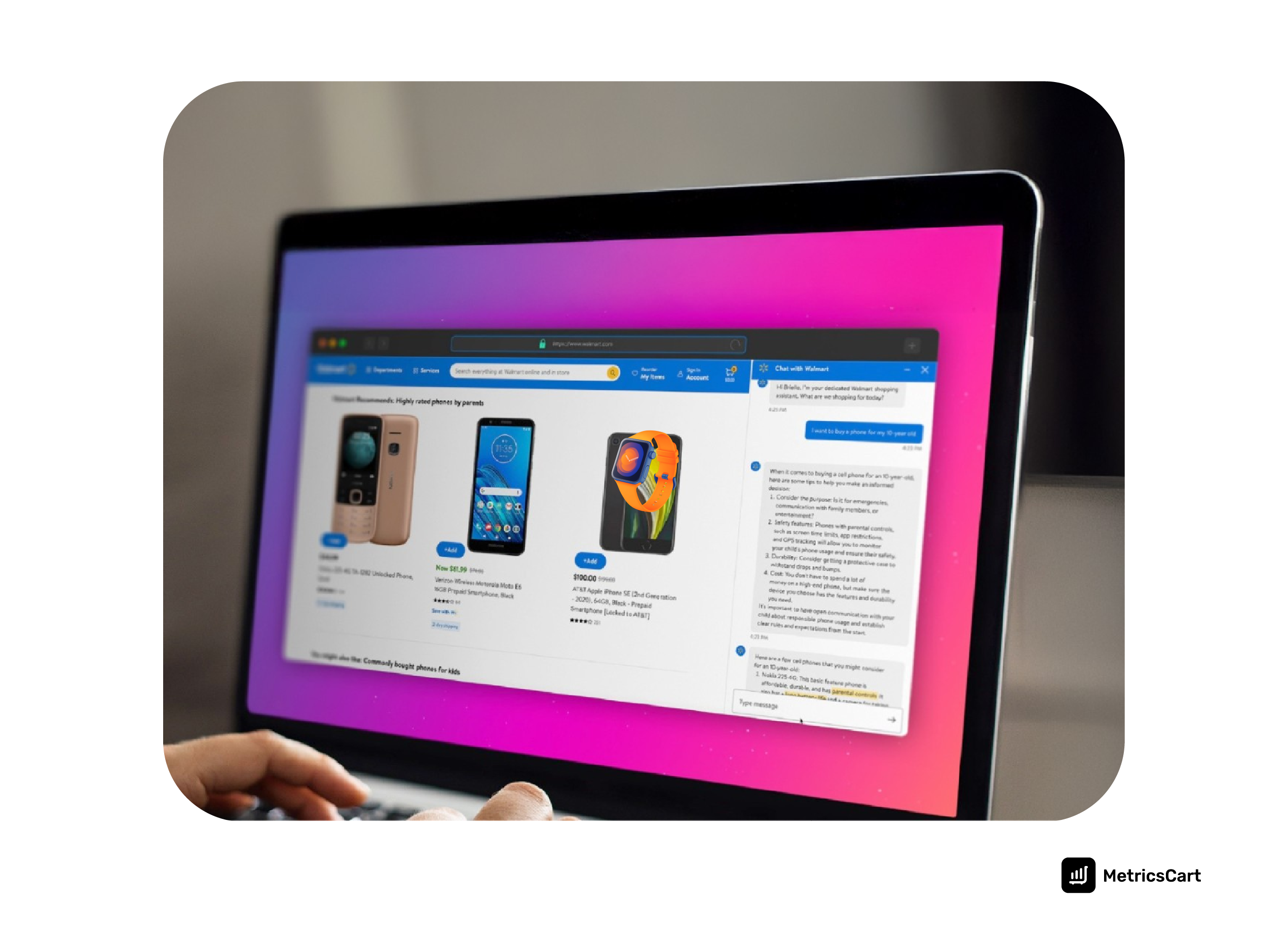
Walmart personalizes in several ways. Its website personalizes product recommendations on the homepage (e.g., “Picked For You”) based on your browsing and purchase history. Walmart+ members see personalized deals and reminders on the app.
If a shopper frequently buys from certain brands or categories, Walmart’s AI will highlight those brands more prominently in search results. Walmart Connect also allows brands to personalize ads to customer segments using Walmart’s first-party data (e.g., targeting “outdoor enthusiasts” with camping gear ads).
Walmart’s investment in AI is evident in its results: e-commerce sales grew by over 25% in late 2024, even as brick-and-mortar sales were flat. For CPG brands selling on Walmart.com, this means utilizing Walmart’s AI tools (promoted products, sponsored search, personalization A/B tests) to stand out.
Because Walmart also captures in-store and app data, its AI can even personalize offers based on local store visits or app engagement. In short, Walmart’s play is omnichannel personalization: whether the customer is on the app, website, or in a physical store, the system tries to present the right products (and ads) to that shopper.
CPG brands should note:
Both Amazon and Walmart reward relevance and freshness. Products with up-to-date reviews, accurate content, and historical sales momentum are more likely to be picked up by their AI.
Conversely, if a product has stale reviews or pricing issues, it will lag in these personalized rankings. This is why tracking metrics such as share of search, review sentiment, and MAP price compliance using an advanced digital shelf analytics software like MetricsCart is critical to feeding these AI engines.
The Role of Ratings, Reviews, and Shopper Signals in AI Models
AI personalization isn’t magic; it’s driven by data, especially the signals CPG brands already have but may not fully leverage. Two big sources of signals are ratings & reviews and shopper behavior data. These feed into the AI models that drive recommendations, search ranking, and ad targeting.
How AI Uses Review Sentiment for Product Recommendations
AI can read between the lines of reviews. Modern natural language processing (NLP) lets algorithms extract sentiment (positive/negative) and themes (e.g., “tastes great,” “long-lasting,” “affordable”) from thousands of product reviews.
For example, if many reviewers of an energy drink mention “jitter-free energy,” the AI can tag that product as suitable for “sensitive caffeine” segments. That tag then influences personalization: the model might recommend this drink to health-conscious shoppers or to those who repeatedly searched for “clean energy supplement.”
Brands can use this too. MetricsCart’s rating and review analysis platform parses review text to find the top keywords and sentiments for each product. If we see “smell” and “texture” dominate a category’s reviews, we’ll feed that insight to marketing: highlight fragrance-free aspects, or target users who buy unscented products.
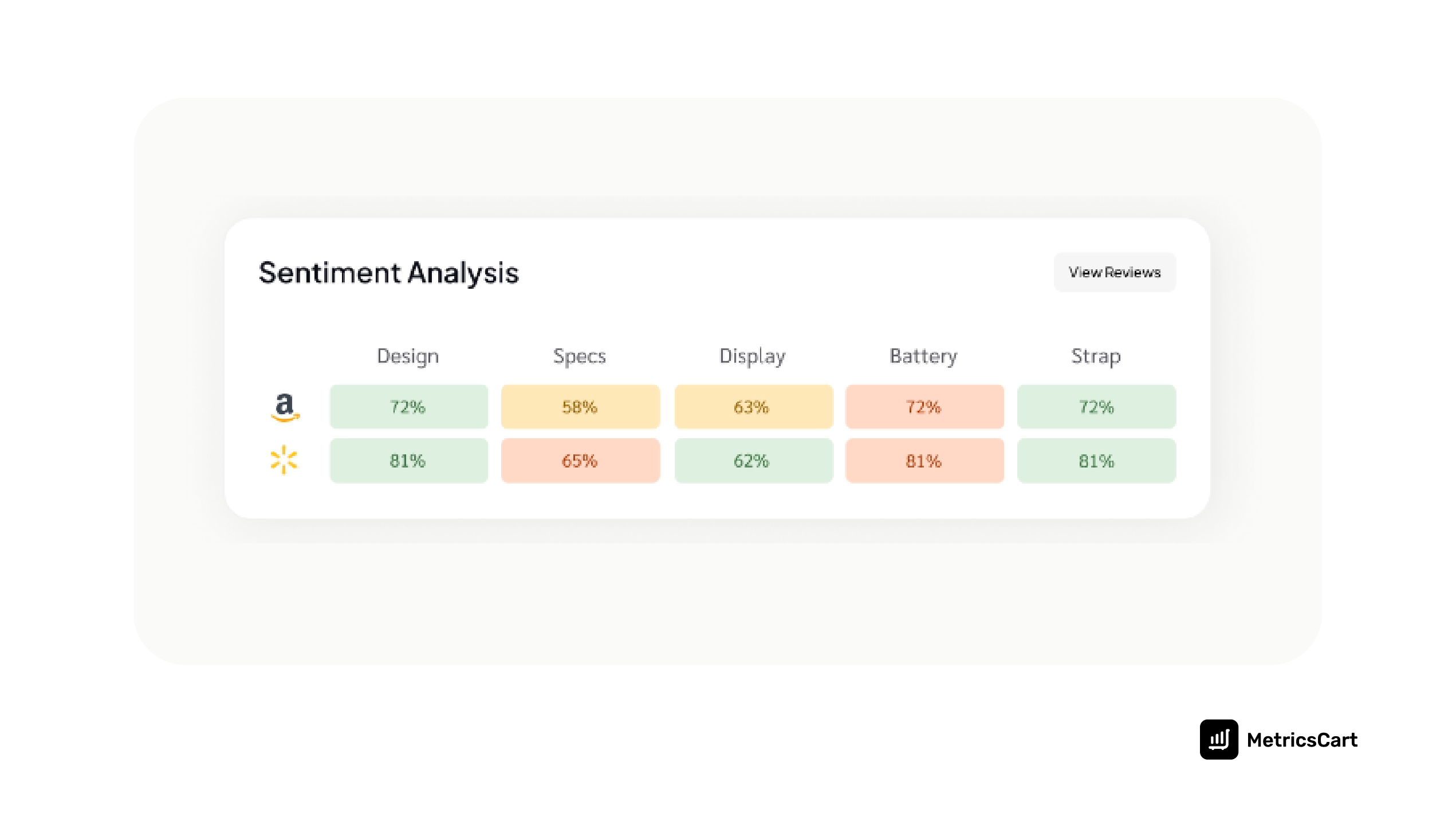
AI can automatically surface top-performing review themes as product tags (e.g., “long-lasting scent” or “gentle formula”). When used in personalization, this means a product will be recommended not just by category or brand, but by the attributes customers care about.
Ratings and reviews thus become inputs to the personalization “brain,” guiding it to match products to the customers who will appreciate them most.
READ MORE | Performing Review Sentiment Analysis: A Step-by-Step Guide
Why Review Velocity and Ratings Matter for Visibility
It’s not just what reviews say, but when they say it. In AI-driven retail search and recommendations, review recency and volume are key signals. If a product has a burst of fresh positive reviews, algorithms will often boost its rank, as it’s seen as trending or improving. Conversely, an item with stagnant or aging reviews can fall behind.
Star ratings also have a big impact. Products that cross the 4.0-star threshold tend to see a jump in conversion rates. If AI sees that one shampoo has a 4.2-star rating while a similar one has 3.8, it’s more likely to recommend the higher-rated one. CPG brands should therefore focus on lifting ratings through proactive review collection and responding to feedback.
Moreover, AI models look at rating distribution. A product with many reviews and a solid 4+ average (but not 5.0) is often considered trustworthy. In fact, 46% of shoppers distrust perfect 5-star products (they suspect fake reviews). So AI might actually favor a well-reviewed 4.7-star product over a “perfect” 5.0-star one.
By monitoring these review metrics with tools like MetricsCart, brands can see which items the AI is likely to favor or ignore.
Ratings and review dynamics feed directly into AI personalization: they signal which products are of the highest quality and most loved, and even color how personalization algorithms learn shopper preferences. Brands that nudge up their ratings (e.g., by improving product or customer service) will see not just happier customers, but also better AI-driven visibility.

How MetricsCart Helps Brands Operationalize AI Personalization
All of the above (AI models, recommendations, shopper segments) require reliable data. This is where MetricsCart comes in: we bridge the data gap between brands and retailers, so AI personalization can be informed by real-world signals.
Using Digital Shelf Analytics to Understand Shopper Behavior
MetricsCart can monitor 150+ retail sites, capturing each product’s price, availability, content, and performance metrics (such as search rank and share-of-search). By analyzing this digital shelf data, we uncover what customers are doing: which keywords they search, which products they click, and how those change over time.
Importantly, we connect these shopper signals back to each brand’s portfolio. If a product’s rank or basket share spikes on Walmart, the MetricsCart platform flags this. Perhaps it’s because ratings just climbed, or a retail media campaign went live. These insights feed the AI: now, personalization engines can see that signal, reinforcing the idea that XYZ is trending with consumers, and thus should be recommended more often.
How Ratings and Review Analysis Improve AI Personalization
MetricsCart consumer sentiment analysis feature also digs into the text of reviews and Q&A. We use NLP to tag the most frequent attributes and sentiment in reviews for each product. This helps brands know exactly which benefits or pain points to emphasize. When integrated with personalization, these tags become features in recommendation models.
For example, if we detect that “easy to digest” is a top review theme for a vitamin supplement, the AI can correlate that with user behavior and start suggesting that supplement to users who’ve engaged with digestive health content.
On the flip side, MetricsCart tracks review volume and velocity. If a product’s review count stalls or declines, we alert the team. This allows faster A/B testing (e.g., trying a new ad creative or bundling tactic) to revive interest. The quicker a brand can react, the quicker its AI personalization engine has fresh data to work with.
Tracking Pricing Changes and MAP Violations Across Retailers
Price is one of the strongest signals influencing both shopper behavior and AI-driven personalization. Recommendation engines, retail media platforms, and promotional algorithms increasingly factor pricing into how products are ranked, promoted, and surfaced to different customer segments.
But personalization becomes unreliable when pricing data is inconsistent across retailers. Sudden markdowns, unauthorized discounts, or MAP (Minimum Advertised Price) violations can distort how AI systems target and recommend products. A premium product shown at a deep discount on one retailer’s site, for example, can disrupt pricing perception and weaken campaign efficiency across channels.
MetricsCart MAP monitoring software helps brands monitor pricing across marketplaces in real time and allows teams to identify:
- retailer-level price fluctuations,
- promotional inconsistencies,
- unauthorized discounting,
- and MAP violations across ecommerce channels.
Instead of relying on delayed manual checks, brands get a centralized view of how products are priced and promoted across retailers like Amazon, Walmart, and Target. By feeding clean, normalized pricing data into AI systems, brands can ensure that:
- personalized offers remain accurate,
- retail media campaigns align with actual shelf pricing,
- And recommendation engines do not promote products based on outdated or misleading price signals.
AI +Personalization Is Becoming the Competitive Layer of CPG E-commerce
In a world of endless choice and split channels, AI-driven personalization is not optional for CPG brands; it’s the new competitive layer. CPGs that harness AI to improve discovery and deepen loyalty will see significant growth.
We’ve seen companies that invest in personalization grow ~10 points faster than their peers, and marketers report that personalized recommendations and campaigns drive higher conversion rates.
But personalization at scale only works when it’s built on accurate insights. That’s why digital shelf analytics like MetricsCart are crucial. We ensure the AI personalization engines have the right inputs (accurate reviews, current prices, true demand signals) and the feedback (sales/lift metrics) to continuously improve.
Armed with both state-of-the-art AI and deep shopper insights, CPG teams can make each customer feel seen, lift conversion, and drive retention, all without blanket discounts.
AI personalization is, in effect, the new formula for CPG e-commerce success. Brands that master it will break through the noise of the marketplace, gain share of search, and win customer loyalty in a one-to-one shopping era.
Want To Connect Digital Shelf Analytics With AI-Driven Personalization?
FAQs
It refers to using machine learning on large customer datasets (purchase history, browsing, reviews, etc.) to tailor product recommendations, content, and offers to individual shoppers in the CPG sector. Practically, it means customizing every touchpoint (search results, ads, emails, product page content) based on a customer’s preferences and signals.
Hyper-personalization is an extreme form of personalization where every interaction is unique to the individual. Rather than segmenting broad audiences, it treats each customer as a unique case and adapts dynamically. It often involves real-time data and AI to update messaging on the fly.
AI engines analyze review text and ratings to learn what product attributes resonate with customers. By extracting sentiment and keyword themes, AI tags products with these features. Recommendations are then driven not only by purchase data but by review signals: items with positive mentions in a relevant category get surfaced to shoppers interested in that keyword.
Yes. Personalized experiences make customers feel valued and understood, which builds loyalty. This loyalty comes from feeling seen: for instance, a timely reorder reminder or a hand-picked promo makes a customer more likely to return.
MetricsCart analyzes the digital shelf across retailers to provide signals on what shoppers are doing (search trends, clicks) and how products are performing (price, ratings, reviews, share-of-shelf). Brands use these insights to train and tune their AI models. By tracking pricing changes, MAP violations, and review sentiment, MetricsCart ensures the personalization engines have clean, up-to-date inputs.