Highlights
- Amazon’s Best Seller Rank (BSR) is based on recent sales velocity over historical sales, allowing new SKUs with strong launch performance to outrank long-established products quickly.
- Amazon updates BSR frequently, sometimes hourly in high-demand categories, making the rankings highly dynamic and giving new products opportunities to climb fast through concentrated launch-period sales.
- BSR is difficult to track manually since it’s updated hourly. So brands use tools like MetricsCart to automate BSR tracking and replicate the success of high-ranking SKUs.
- Conversion-optimized listings with strong titles, images, A+ content, keyword targeting, and competitive pricing improve conversion rates, which directly influence ranking performance.
- Aggressive launch tactics such as PPC campaigns, discounts, Subscribe & Save offers, and external traffic campaigns help new SKUs generate the early sales momentum needed to boost rankings.
- Review velocity and strong ratings matter more than total review count for new products. Consistent new reviews and ratings above 4.5 stars improve trust, conversions, and ranking stability.
- Maintaining inventory availability and using Fulfillment by Amazon (FBA) are critical for sustaining rankings, since stockouts, delivery delays, or losing the Buy Box can quickly reduce sales momentum and hurt BSR.
Introduction
Most brands assume that Amazon’s bestseller lists are dominated by products with years of sales and thousands of reviews. But how true is that?
Using the MetricsCart digital shelf analytics platform, our research team did an in-depth annual analysis of the top-performing products in the grocery and gourmet categories on Amazon from January 1, 2025, to December 31, 2025. On which, we noticed, many new launches are making significant strides in the rankings.
Brands like Celsius and Premier Protein are climbing fast. In fact, Celsius holds an average rating of 4.6 stars across more than 341,000 ratings, putting it ahead of legacy players like Red Bull and Monster Energy in both rating scale and engagement.
So what is actually driving this? How are new SKUs Amazon bestseller rank higher than others, and what can e-commerce and category managers learn from it? This article answers that.
READ MORE | Want to see the full analysis? Explore—Grocery & Gourmet 2025: The Year in Amazon Bestsellers.
How is Amazon Best Seller Rank Calculated?
Amazon’s Best Sellers Rank (BSR) is a number assigned to products after they’ve made at least one sale, and it reflects their sales performance relative to other products in the same category. A lower BSR means stronger sales performance. A product ranked #1 is the top seller in its category at that moment.
Amazon calculates BSR using both recent and historical sales data, but recent sales are weighted more heavily than older ones. This weighting structure allows newer products with high recent sales velocity to outrank older products temporarily.
This means a new product that generates a concentrated burst of sales at launch can climb the rankings dramatically, even against established competitors with years of accumulated purchase history.
READ MORE | MetricsCart offers monthly bestseller and category leader reports across multiple regions. Check them out now. Top Brands in the Amazon UK Bestseller List.
How Often Are Amazon Sales Ranks Updated?
BSR is also updated frequently. For top-performing products, the rank can shift hourly, meaning the list is genuinely dynamic. A new SKU that executes a strong launch week can appear on the bestseller page before most of its competitors have even noticed the listing exists.
BSR is not a universal rank across Amazon. It is specific to each category and subcategory. That means, a product can hold multiple BSR numbers if it appears across more than one category or subcategory. For example, A product ranked #1 in ‘Sports Nutrition Protein’ may rank #500 in ‘Grocery and Gourmet Food’.
Some brands use this to their advantage by placing products in competitive but realistic subcategories where the barrier to appearing on the bestseller page is lower. Also, to replicate these rankings, brands use MetricsCart to automate BSR tracking, which updates hourly, a frequency humans cannot monitor manually.

Key Drivers Helping New SKUs Amazon Best Seller Rank Climb Faster
Using MetricsCart’s proprietary Digital Shelf Analytics, we tracked 984 products across 267 brands. We noticed several new entrants winning rapid growth in market share, breaking through a category dominated by legacy names. And there are specific, observable reasons why it keeps occurring in Grocery and Gourmet specifically, and the MetricsCart report gives us real examples to understand the pattern.
1. Aggressive Early Sales Velocity
The single biggest structural advantage for new products is that Amazon’s algorithm doesn’t care how long a product has existed. It only cares about how fast the product is selling right now.
That means a new SKU that drives concentrated early sales through a well-funded PPC launch, an influencer campaign, or a Subscribe and Save promotion can outperform an established product that’s coasting on its historical data.
Plus, Amazon’s A10 algorithm is the current search-ranking system that determines product visibility in search results. Unlike its predecessor, A9, A10 places greater weight on external traffic, seller authority, and listing quality alongside sales data. This levels the playing field for new entrants who may lack review history but invest in conversion-optimized listings from day one.
Taking an example, Celsius and Premier Protein launched in January 2025, coinciding with the seasonal rise in health and wellness purchase intent. Their early sales velocity benefited from this demand window, which amplified the impact of their PPC spend on BSR movement.
2. Conversion-Optimized Listings
Another major advantage that helps new SKUs Amazon’s bestseller rank to climb faster is that their Product Description Pages (PDP) are built around Amazon’s current content standards from day one.
Listings that launch compliant avoid the friction that legacy products face when Amazon auto-updates non-compliant copy.
3. Strategic Pricing & Promotions
Price functions as both a ranking lever and a positioning signal. For new product launches, temporary price advantages, such as launch-period discounts or coupon stacking, are a proven way to generate the initial sales burst needed to move BSR.
The goal is not permanent underpricing but a temporary edge that builds enough purchase momentum to establish a BSR foundation and generate the first wave of reviews.
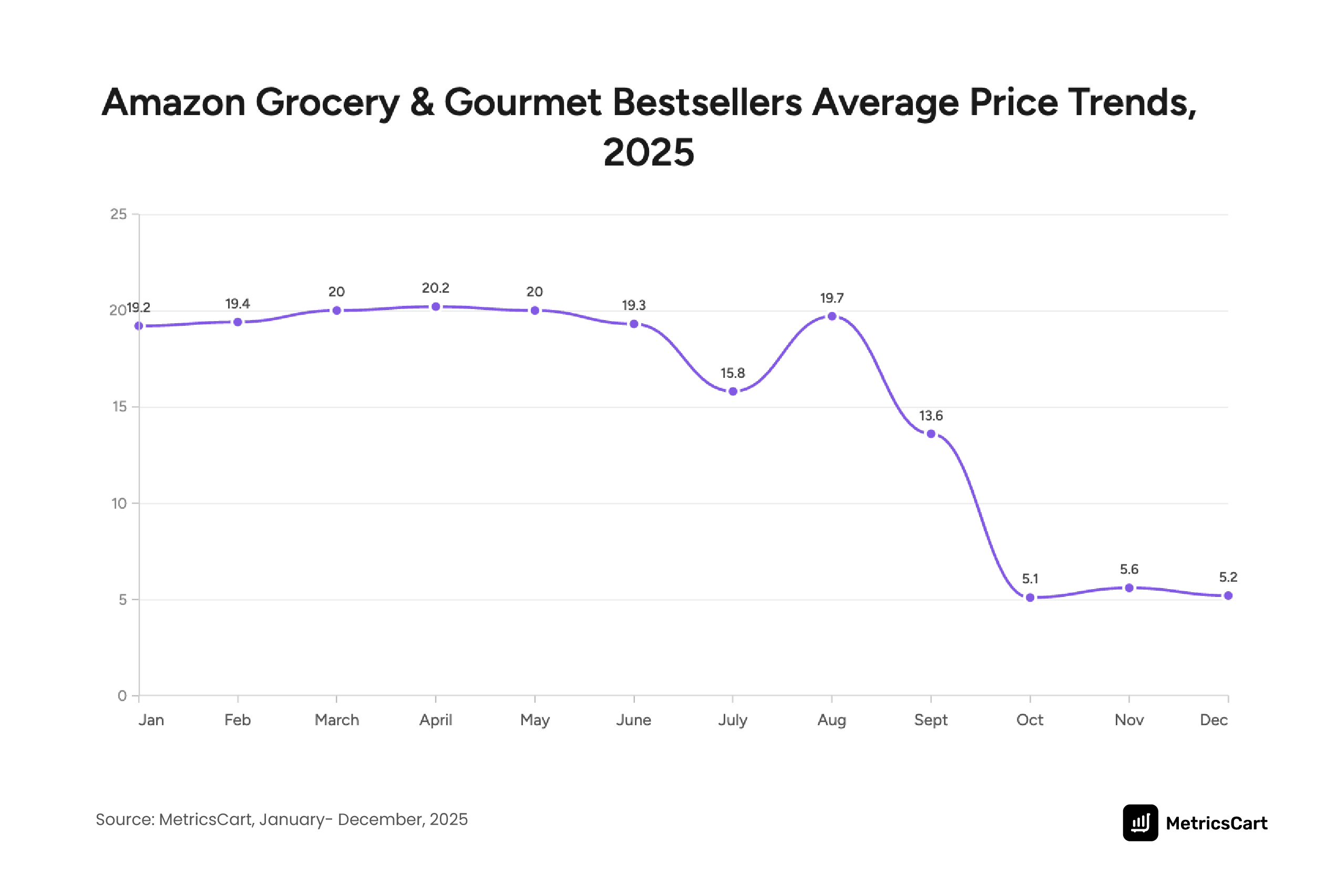
The MetricsCart price monitoring solution enables SKU-level analysis, showing that the average price across Grocery and Gourmet bestsellers is $19.51, with most products concentrated in the $1 to $10 range. And there, newer brands position themselves within or just below this band to accelerate conversions.
For example, brands like Celsius and Premier Protein use multi-pack formats and promotional pricing to remain competitive on a per-unit basis, even when their headline prices appear higher. This allows them to drive volume without eroding perceived value.
We also noticed that the Subscribe and Save feature is frequently overlooked during the post-launch phase, despite offering a measurable way to stabilize recurring sales volume. A 5-15% discount to convert trial buyers into subscribers locks in recurring monthly sales, stabilizing BSR during the post-launch period when ad spend typically decreases.
4. Review Velocity, Not Just Volume
Amazon does not reward products just for having a large number of reviews. What matters more is review velocity. Review velocity is the rate of new reviews per month and is a higher-weighted ranking signal than total review volume for new SKUs.”For new SKUs, this is a critical signal because it shows the product is actively selling and gaining traction, not just benefiting from past activity.
A practical benchmark is around 5 to 10 reviews per month for every $10,000 in monthly revenue. Programs like Amazon Vine help accelerate this process by enabling brands to collect verified reviews early in the product lifecycle.
Star ratings also play an important role. Products with ratings above 4.5 tend to convert better and signal quality to both customers and the algorithm. On the other hand, even a few negative reviews early on can impact conversion rates and slow ranking growth, making product quality and customer experience essential from day one.
Looking at the Grocery and Gourmet category, the top-ranking products are not just highly rated; they have built consistent review momentum over time. The top 10 products together have accumulated over 309 million ratings, with examples such as Nespresso Vertuo reaching 41 million ratings with a 4.8 average, and Premier Protein exceeding 63 million ratings with a 4.5 average.
These numbers were not achieved overnight. What sets these products apart is their ability to maintain a steady flow of reviews, which keeps them relevant in the algorithm and trusted by customers.
| Product | Brand | Average Rating | Total Rating Count | Average Rank |
| Star Performer Products | ||||
| Celsius Assorted Flavors Official Variety Pack, Functional Essential Energy Drinks, 12 Fl Oz (Pack of 12) | Celsius | 4.60 | 27790895 | 1 |
| Nespresso Capsules Vertuo, Variety Pack, Medium & Dark Roast Coffee, 30 Count Coffee Pods | Nespresso | 4.80 | 41452218 | 2 |
| Premier Protein Shake, Chocolate, 30g Protein, 1g Sugar, 24 Vitamins, Minerals, Nutrients, 11.5fl oz (Pack of 12) | Premier Protein | 4.50 | 63131896 | 3 |
| Sparkling Ice Black Raspberry Sparkling Water, Zero Sugar Flavored Water, 17 Fl Oz Bottles (Pack of 12) | Sparkling Ice | 4.61 | 35572603 | 5 |
| Monster Energy Zero Ultra, Sugar Free Energy Drink, 16 Oz (Pack of 15) | Monster | 4.70 | 25807606 | 5 |
5. Availability & Fulfillment
Momentum only works if it is uninterrupted. This is where many new launches fail, and where the ones that succeed quietly set themselves apart.
Amazon’s algorithm strongly favors products that are consistently in stock and ready to ship. When a SKU goes out of stock, its sales velocity drops instantly, and so does its Best Seller Rank. Recovery is not immediate. The algorithm does not “remember” past performance in a generous way. It simply reacts to current sales signals.
This is why most fast-climbing SKUs in the Grocery and Gourmet category rely on Fulfillment by Amazon (FBA). FBA improves:
- Prime eligibility
- Delivery speed
- Buy Box ownership (the default purchase button on a product page, which drives the majority of conversions).
All three directly impact conversion rate and sales continuity.
And in high-frequency categories, availability becomes even more critical because demand is habitual. Customers are not exploring. They are replenishing. If a product is unavailable, they switch instantly, and that shift in demand is reflected in rankings just as quickly.
READ MORE | Improve Your Sales With Amazon Buy Box Monitoring: What Brands Need To Know
How to Make New SKUs Win the Highest Bestseller Rank on Amazon
Knowing the drivers is useful. But having a structured execution plan is what separates brands that act on this knowledge from those who don’t. Here’s how you can ensure your next launch reaches the #1 Amazon Bestseller Rank fast:
Prepare and Follow a Pre-Launch Checklist
Before launching a new SKU, make sure you align on three things: demand, positioning, and readiness. And for that, here’s the checklist you can follow:
- Identify demand gaps within the category using real data
- Benchmark top competitors on pricing, reviews, and content
- Build a fully optimized listing with compliant titles and rich media
- Plan inventory to support at least 4 to 6 weeks of uninterrupted sales
- Allocate budget for ads, promotions, and review generation
Have the First 30-Day Execution Strategy
This phase is where sales velocity is built. Since Amazon weighs recent sales heavily, performance during this window has a disproportionate impact on ranking. The goal here is not slow growth. It is controlled acceleration.
Here’s what you can do:
- Run daily PPC campaigns targeting your top-converting keywords.
- Offer launch-period promotions to drive volume.
- Use Amazon’s Request a Review feature to build early feedback.
- Track your BSR daily and your conversion rate weekly.
- Identify which keywords are driving actual purchases and shift budget toward them.
Monitoring and Optimization Loop
After the first 30 days, the work shifts from volume-building to stability. Review your pricing relative to competitors weekly. Monitor competitor BSR movements to catch demand shifts before they affect you. Track review velocity and respond quickly to any negative feedback. Maintain your inventory coverage so no stockout interrupts your momentum.
READ MORE | E-Commerce Product Page Optimization: Tips and Examples
Final Thought: Rankings Are Engineered, Not Earned by Chance
Amazon’s Best Seller Rank is not a reward for having the best product. It is a measure of structured, consistent sales performance. A newer brand with a disciplined launch strategy will routinely outrank an established player who is coasting on past history.
The brands climbing the fastest right now are not guessing. They are tracking BSR movement in real time, reading category-level demand shifts, and making data-backed decisions about pricing, inventory, and ad spend on a rolling basis.
The algorithm is not mysterious. It rewards products that sell consistently, convert well, stay in stock, and accumulate genuine buyer trust over time. Build your launch strategy around those pillars, and the rank will follow.
And the strategies above require continuous, real-time data to execute well. This is where purpose-built digital shelf analytics platforms like MetricsCart provide a structural advantage. Rather than checking data points manually across separate tools, MetricsCart tracks SKU-level performance continuously, capturing real-time changes in rankings, pricing, availability, and content signals.
And instead of static snapshots, it builds a time-series view of BSR movement, helping teams identify which SKUs are gaining momentum, what competitors are doing differently in terms of pricing and promotions, and where demand is shifting within a category.
Using that information, you can easily move from reactive optimization to predictive decision-making, which is the real competitive edge in a market where BSR updates every hour, and a competitor can change the landscape overnight.
Become the #1 Bestseller on Amazon Now!
FAQs
Looking at the MetricsCart grocery and gourmet data through 2025 and into early 2026, several product types show consistent bestseller presence that signals ongoing demand, such as:
1. Energy and functional beverages
2. Premium coffee pods and capsules
3. High-protein meal replacement and shake formats
4. Flavored water and hydration
New products rank quickly by creating a concentrated burst of sales right after launch. This is usually driven by a mix of PPC campaigns, promotional pricing, external traffic, and high-converting listings. Since Amazon prioritizes recent sales performance, this early momentum can push new SKUs ahead of established competitors.
Amazon BSR is heavily influenced by recent sales rather than long-term performance. For new products, this means even a short period of strong sales can significantly improve ranking. The algorithm also considers factors like conversion rate, availability, and customer satisfaction alongside sales velocity.
The #1 seller on Amazon varies by category and changes constantly due to real-time sales activity. There is no single global #1 product across the entire platform. Each category has its own top-ranking product based on current sales performance.
Even with a good launch, new SKUs can fail if they lose momentum. Common reasons include stockouts, poor conversion rates, weak listing quality, or negative early reviews. Amazon’s algorithm responds to current performance, so any disruption in sales or availability can quickly affect rankings.