Key Highlights
- Amazon, Ring, and Blink together account for 1,955 of 2,327 bestselling products. That is 84% of the shelf controlled by three brands.
- The Ring Battery Doorbell held a Top-5 position for 23 of 25 tracked days in February 2026, with an average rank of 2.26.
- Every one of the 2,327 bestselling products carries a 4-star rating or above. 1,016 products (44%) are priced under $50. The bestseller list is built on affordable accessories, not flagship devices.
- Ring Battery Doorbell, Amazon Smart Plug, and Fire TV Stick dominate the category in both rank consistency and review volume.
- Amazon’s brand alone holds 52.6 million reviews. That is 62% of the category’s total 84.9 million across all 12 brands.
About the Report
This report analyses bestselling products in the Amazon Devices and Accessories category in the US between February 4, 2026, and February 28, 2026.
MetricsCart digital shelf analytics software tracked 2,327 products across 12 brands and 8 sellers, covering daily bestseller rank, pricing, reviews, and ratings across a continuous 25-day window.
The Shelf That Sells Itself
Every year, millions of Americans find themselves buying devices they did not plan for. Nearly three-quarters of Americans made an unplanned purchase in 2025, even while actively trying to spend less. Life shifts, a need arises, and a purchase follows.
With electronics sales projected to hit $112 billion in 2026, American homes are more wired than ever. There are Fire TV Sticks behind every television, Echo Dots on kitchen counters, and Ring doorbells at front doors. Amazon did not just build products for this moment. It built the shelf that those products sit on, and then filled it.
So when brands ask why their device or accessory is not moving on Amazon, the answer is rarely the product. It is the shelf; who owns it, how they maintain it, and how far ahead they already are on reviews, rank, and price positioning. Other brands do appear on the bestseller list, but breaking in is a different challenge entirely.
This report breaks down who is dominating the Amazon Bestselling list in the US, which products are holding the top positions week after week, where the price-volume actually lies in this category, and what the review data reveals about how difficult this shelf really is to crack.
The Amazon Devices and Accessories Shelf in February 2026: What the Numbers Reveal
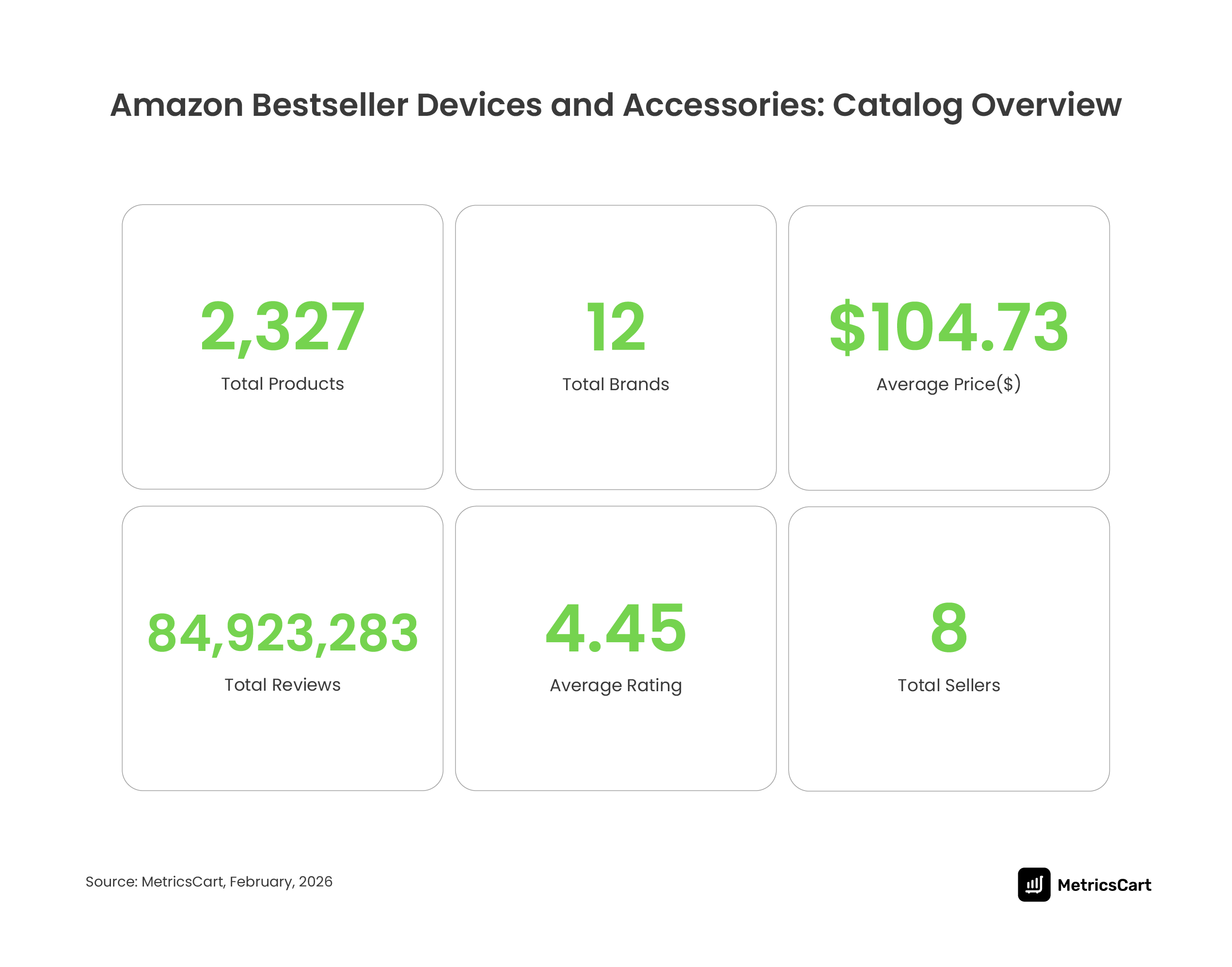
MetricsCart’s digital shelf analytics software tracked the Amazon Devices and Accessories category across a continuous 25-day window in February 2026. At the top level, the findings reveal a category that is far more concentrated than it appears from the outside.
Eight sellers controlling the distribution of 2,327 bestselling products is a tight structure for a category of this scale. The average price of $104.73 spans a range from $6.99 to $699.99, making it an unreliable indicator of where most purchases occur.
As the pricing insights in this report show, over 65% of all bestselling products are priced under $100. The average is pulled upward by a small number of high-value devices at the premium end.
The average rating of 4.45 reflects strong customer satisfaction but also points to something more structural. Every product on this list carries a 4-star rating or above. Products that fall below that threshold are absent entirely.
The average bestselling product on this list has over 36,000 reviews. A new brand cannot close that gap in a quarter. It takes years of consistent sales volume to build that kind of social proof, and until you do, the shelf works against you.
For brands evaluating this category, these numbers are the starting point. The sections that follow show where the concentration lives, which brands hold it, and what it means for anyone competing on this shelf.
Amazon, Ring, and Blink Own the Bestseller List and Lead the Rankings
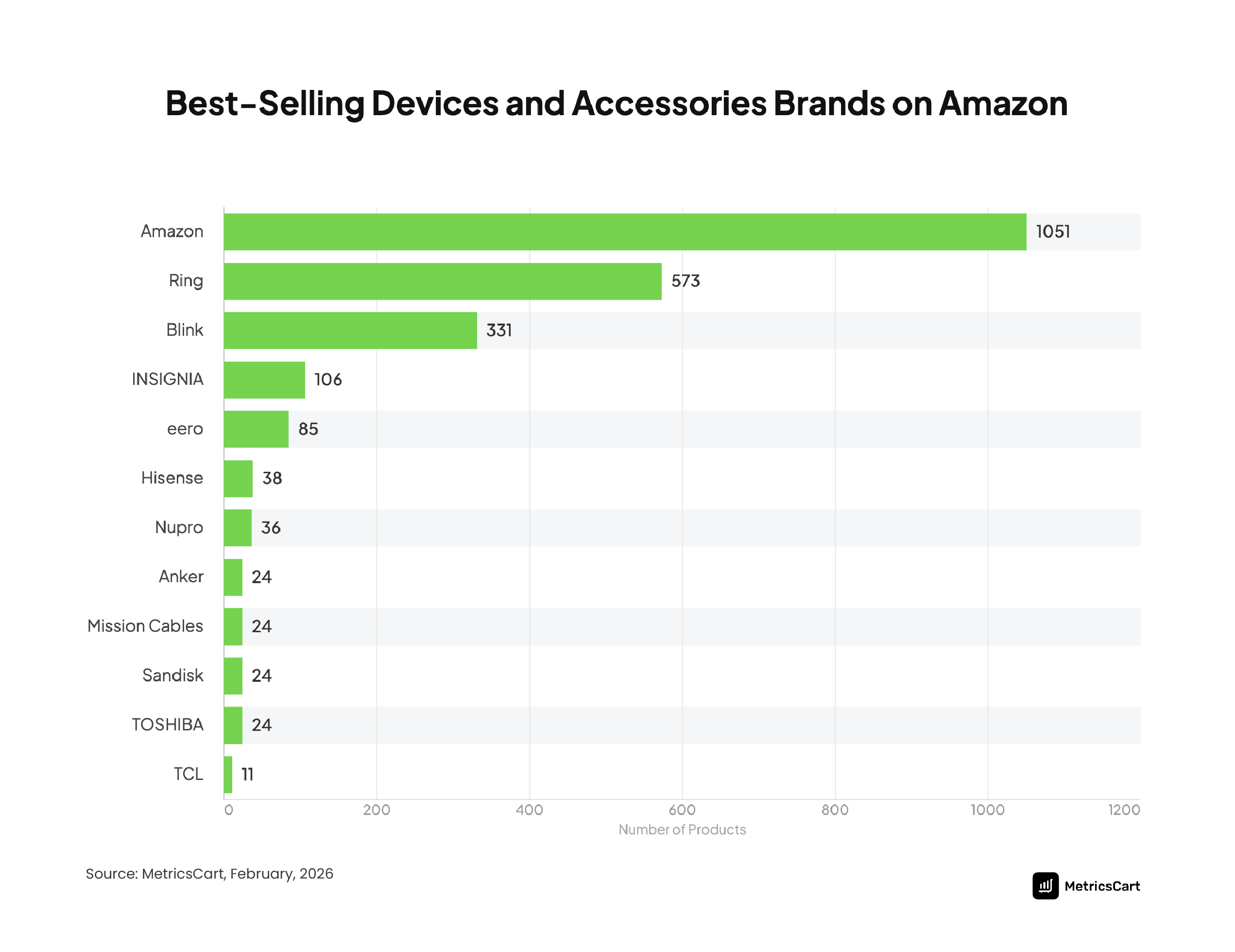
Among the various best-selling devices and accessories on Amazon, the top three brands account for 84% of the list.
MetricsCart findings reveal that Amazon leads with 1,051 products, followed by Ring with 573, and Blink with 331. Together, these three brands account for 1,955 of 2,327 bestselling slots. The remaining nine brands share 372 products, with INSIGNIA the closest at 106. After that, no brand crosses 90.
Amazon’s devices are built to work together; an Echo pairs with a Fire TV, a Fire TV connects to Alexa, and Alexa ties into every other Amazon product in the home. That connected setup creates a pull that goes beyond a single purchase. A consumer who buys a Fire TV Stick is more likely to buy an Echo next. A consumer who owns an Echo is more likely to buy a Ring doorbell.
Each product makes the next one feel like a natural addition rather than a new decision. That pattern of connected buying keeps consumers inside the Amazon ecosystem, drives repeat purchases across multiple product lines, and builds up reviews at a rate that no third-party brand, regardless of product quality or price, can match.
What makes this more significant is that product count alone does not capture the full depth of this dominance. The rankings add another layer.
Read More: Is Blink Leading Amazon’s Smart Home Category: Sales, Pricing & Review Insights
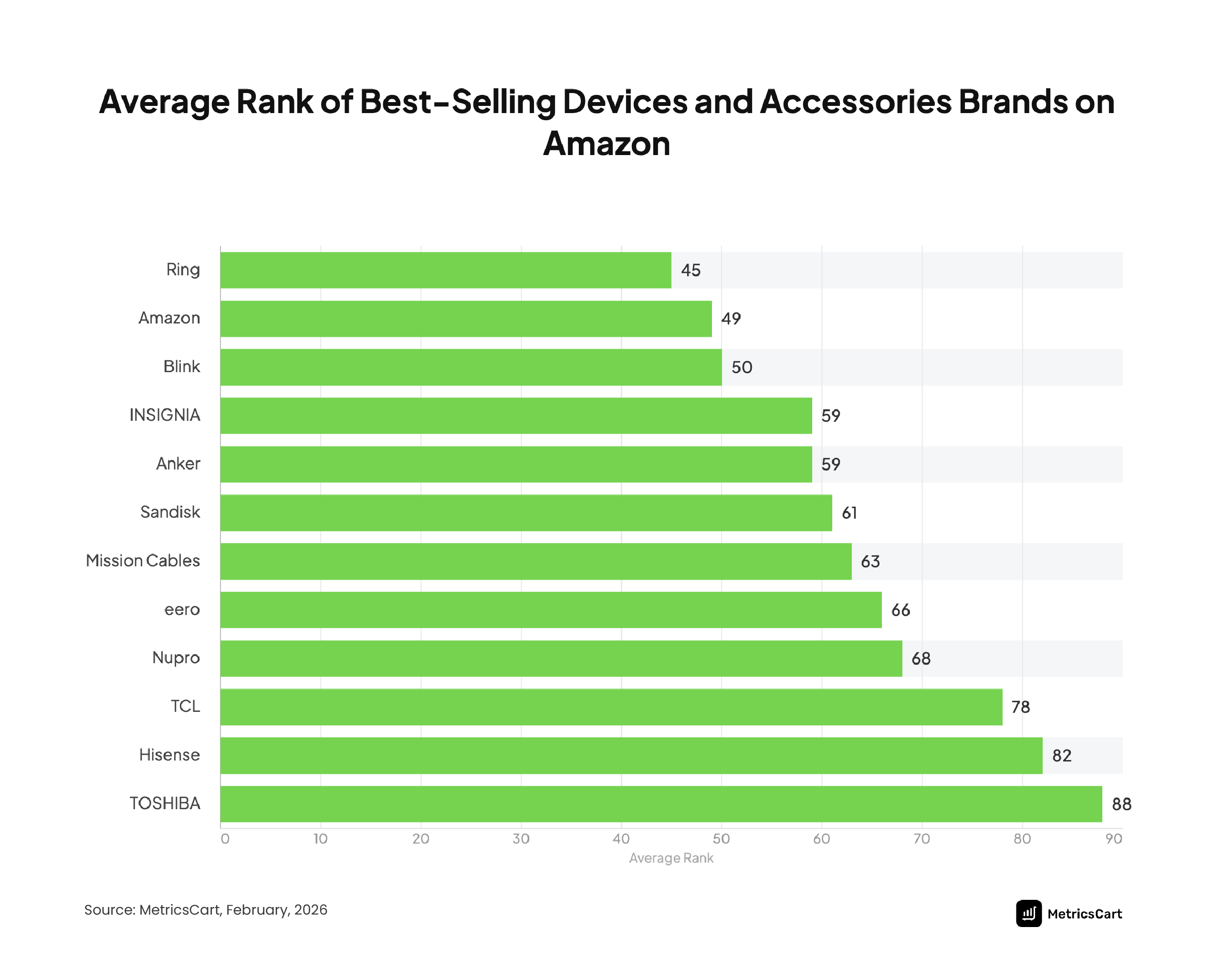
Ring holds the strongest average rank at 45, ahead of Amazon at 49 and Blink at 50. The fact that Ring leads Amazon in terms of rank despite having less than half its product count is analytically significant. Amazon’s 1,051 products span multiple sub-categories: smart home, streaming, e-readers, networking, and accessories.
Ring operates within one focused space: home security. Consumers searching for a doorbell or a security camera are high-intent buyers. They know what they need, and they buy. That focused purchase intent consistently produces stronger conversion rates, which in turn drives a stronger rank. Ring’s rank lead is not despite its narrower range. It is because of it.
Blink at rank 50 follows a similar logic. Its product range sits within home security, and while Blink and Ring operate on separate apps and subscriptions, both connect through Amazon Alexa.
Consumers already invested in Ring or Alexa devices are naturally drawn to Blink as a compatible, lower-cost camera option. Ecosystem alignment reduces purchase friction, and lower friction means higher conversion and a stronger rank.
What the Reviews Are Really Saying About Bestselling Amazon Devices?
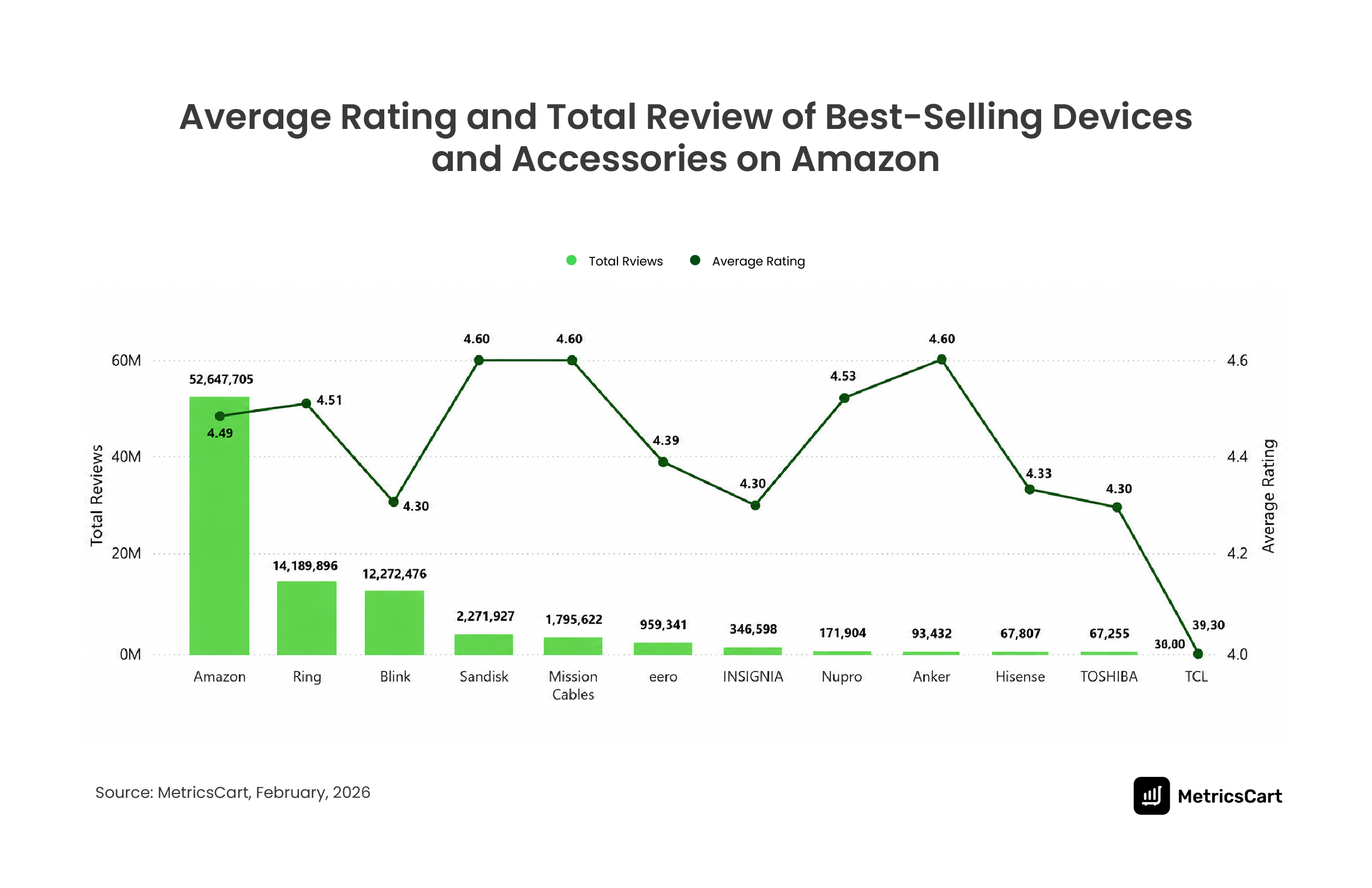
The MetricsCart research team found that Amazon’s brand has 52,647,705 reviews, more than Ring and Blink combined. Ring adds 14,189,896, and Blink adds 12,272,476. The nine remaining brands together account for less than 7% of total category reviews.
This concentration is the result of years of high-volume, low-price products accumulating reviews at a rate that third-party brands cannot match without comparable purchase frequency.
Which Products Have the Most Reviews on the Amazon Devices and Accessories Bestseller List?
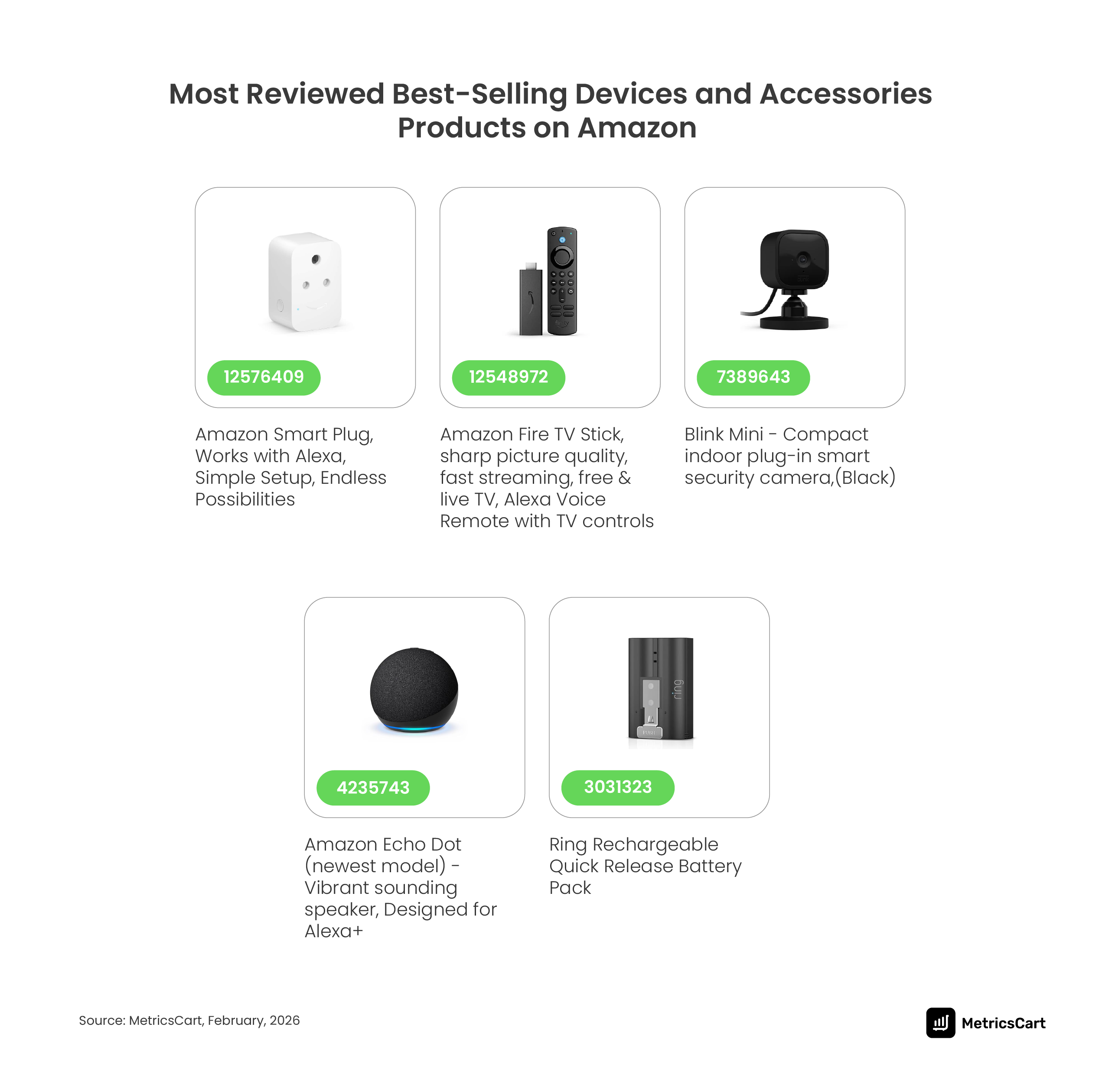
The Amazon Smart Plug leads with 12.57 million reviews. It is one of the most accessible entry points into the Amazon smart home ecosystem, typically priced under $30. Low prices drive high purchase volume, which improves review accumulation.
The Amazon Fire TV Stick sits just behind at 12.55 million reviews, driven by steady consumer demand as they move away from traditional cable. Both products benefit from ongoing, structural demand rather than seasonal spikes.
The Blink Mini, at 7.39 million reviews, is the highest-reviewed security camera on the list. It is compact, affordable, and works within the broader Amazon-Blink-Ring ecosystem, three factors that significantly lower the barrier to purchase.
The Echo Dot at 4.24 million and the Ring Rechargeable Battery Pack at 3.03 million round out the top five, both reflecting the same pattern: affordable, functional, ecosystem-compatible products accumulate reviews faster than any other type.
All 2,327 bestselling products carry a 4-star rating or above. 1,419 are rated 4 stars, and 908 are rated 5 stars. Not a single product with fewer than 4 stars appears on the list. In this category, maintaining a strong rating is the minimum requirement to stay on the Amazon bestseller list.
Which Products Dominated the Amazon Devices Top 5 Every Week in February 2026?
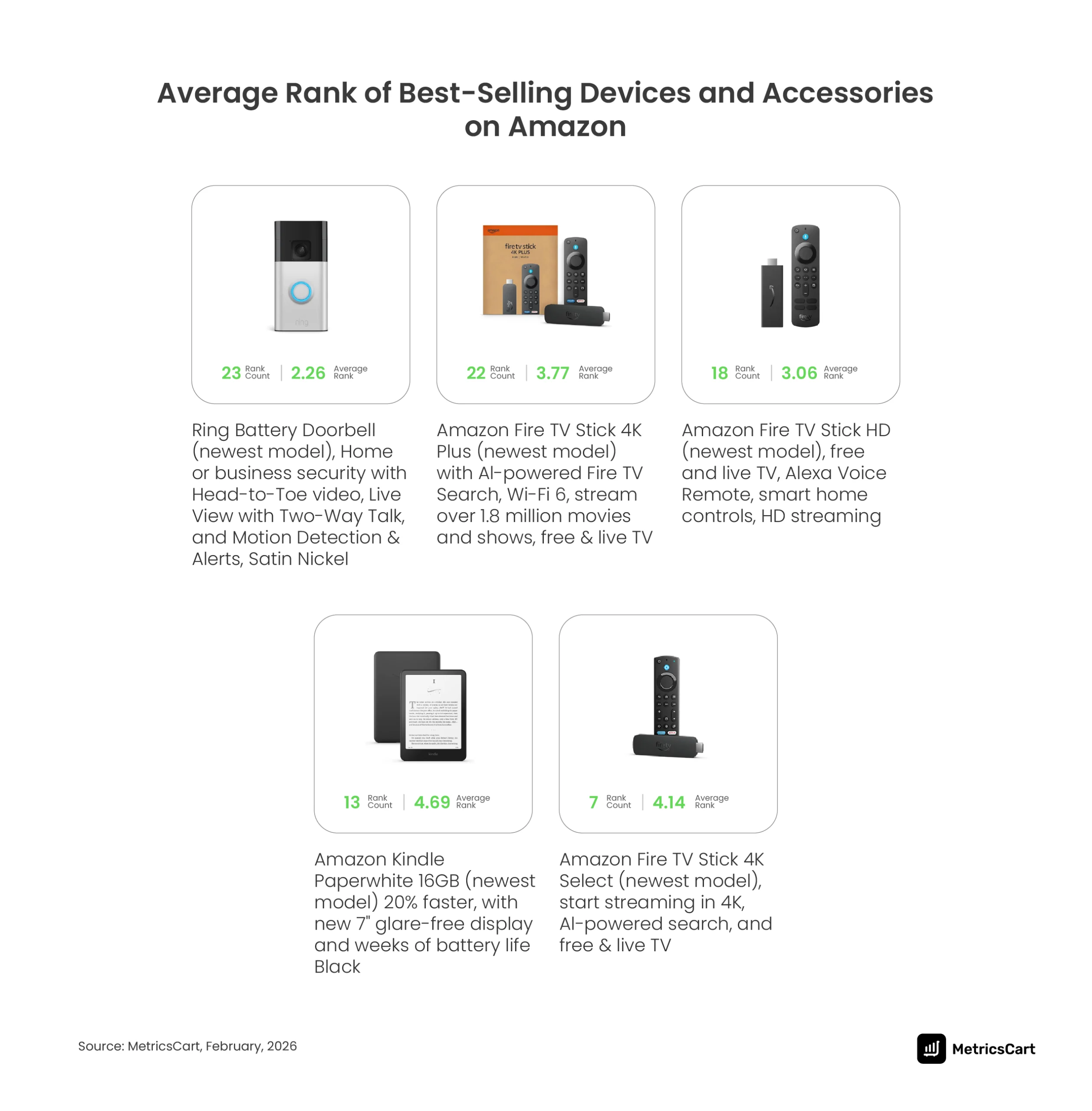
MetricsCart tracked Top-5 appearances across the full 25-day window in February 2026. The data shows a clear pattern. A small group of products held Top-5 positions with near-total consistency, while the broader list rotated around them.
The Ring Battery Doorbell appeared in the Top 5 on 23 of 25 tracked days, with an average rank of 2.26. That is a 92% Top-5 appearance rate across the full February window. Neither a promotional event nor a price drop drives this level of consistency.
It reflects steady, structural demand for home security devices that has built up over multiple years. The Ring Battery Doorbell has a product history, review base, and ecosystem integration to maintain this position without any short-term intervention.
Five of the eight most consistent Top-5 products are Fire TV Stick variants. The 4K Plus appeared on 22 days, the HD model on 18. These products benefit from a demand driver that does not slow down.
Every consumer who cancels a cable subscription needs a streaming device. Every new television purchase opens a potential sale. The Fire TV Stick range serves both needs across multiple price points, which is why multiple variants appear on this list simultaneously rather than one product replacing another.
READ MORE | Large Appliances Bestsellers on Amazon: Top Brands, Trends, and Insights
Over 65% of Bestselling Amazon Devices and Accessories are Priced Under $100
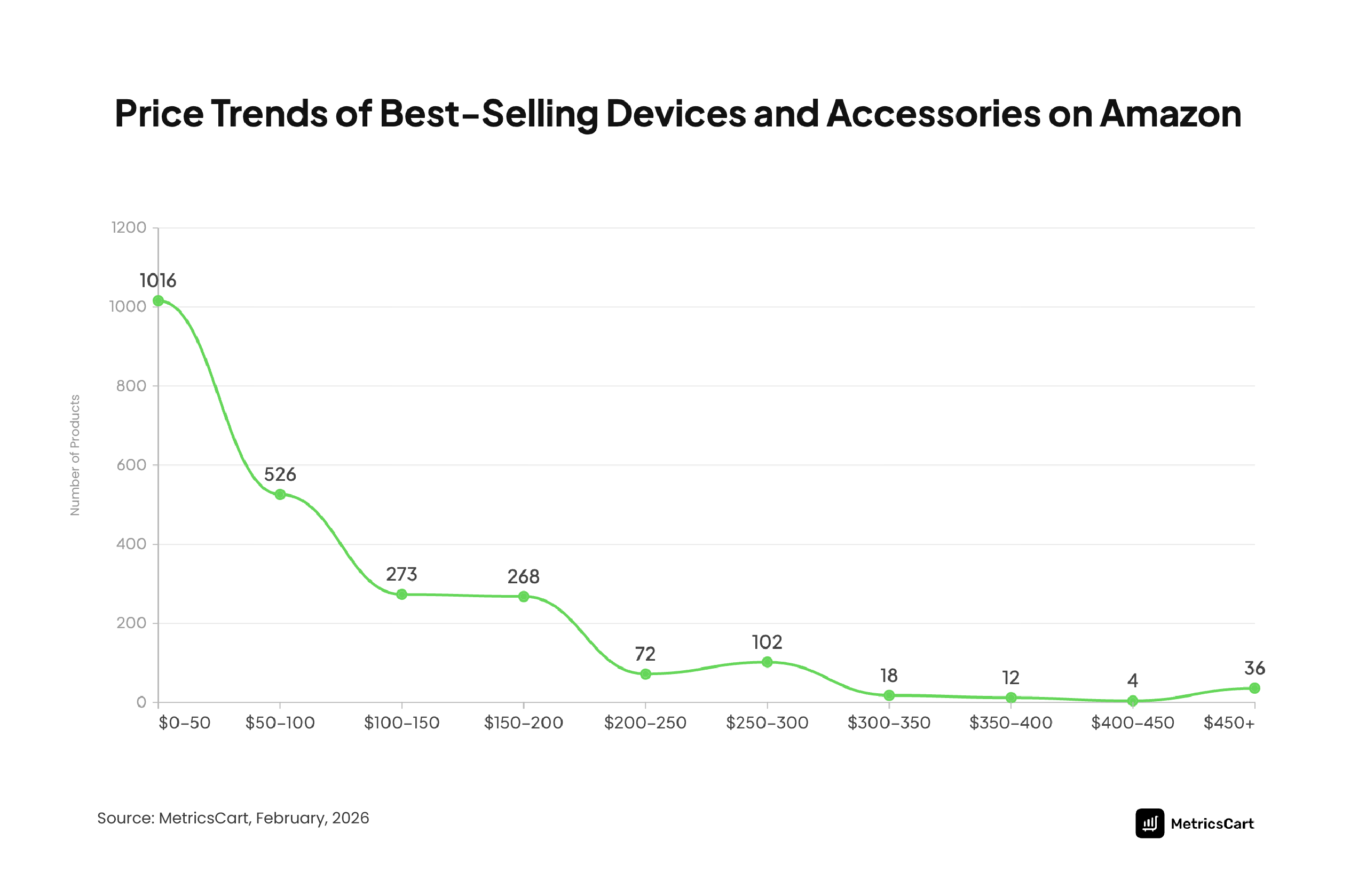
MetricsCart analysis reveals that 1,542 of 2,327 products, over 65% of the entire bestseller list, are priced under $100. The $0 to $50 band alone holds 1,016 products. After $100, the numbers fall sharply and remain low across every subsequent price band.
The $100-$150 band has 273 products. By the time you reach $300-$350, only 18 products remain. This is not a gradual decline. It is a structural feature of the category. Most consumers shopping in Devices and Accessories on Amazon are looking for affordable, functional products that complement a device they already own. The $0 to $50 range serves that need better than any other band.
What Are the Most Affordable Brands on the Amazon Devices and Accessories Bestseller List?
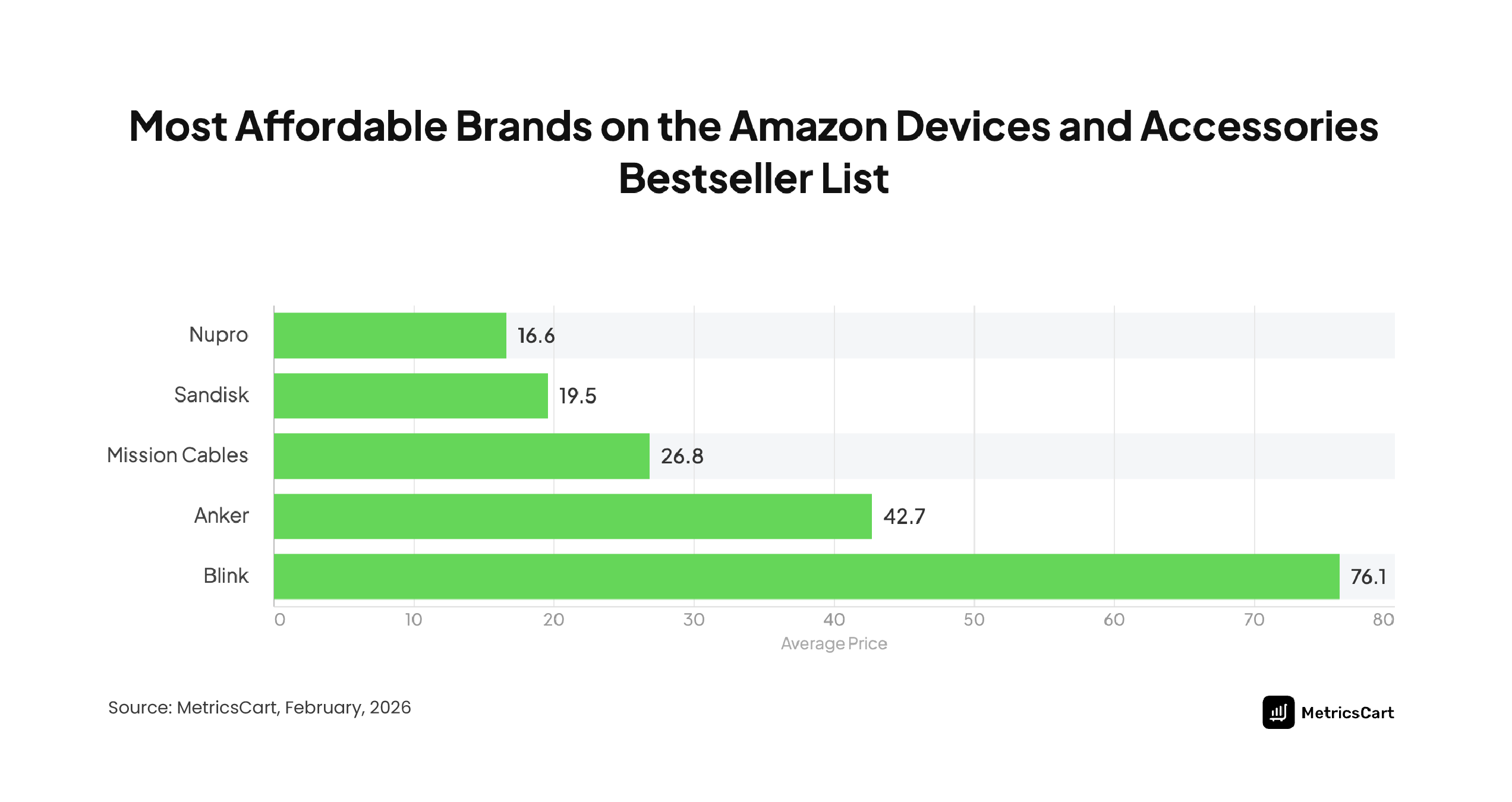
Nupro, Sandisk, and Mission Cables operate entirely in the accessories space. Their products are cables, mounts, storage cards, and power adapters. They are low-consideration purchases that serve consumers who already own an Amazon device.
At average prices between $16 and $27, these brands compete on compatibility and price rather than product differentiation. The result is high purchase frequency and faster review accumulation relative to their product count.
Anker at $42.70 adds a layer of brand trust to this model, with charging accessories that are known for reliability. Blink at $76.09 sits slightly higher because its core products, compact security cameras, are priced as entry-level devices rather than pure accessories.
What Are the Most Expensive Brands on the Amazon Devices and Accessories Bestseller List?
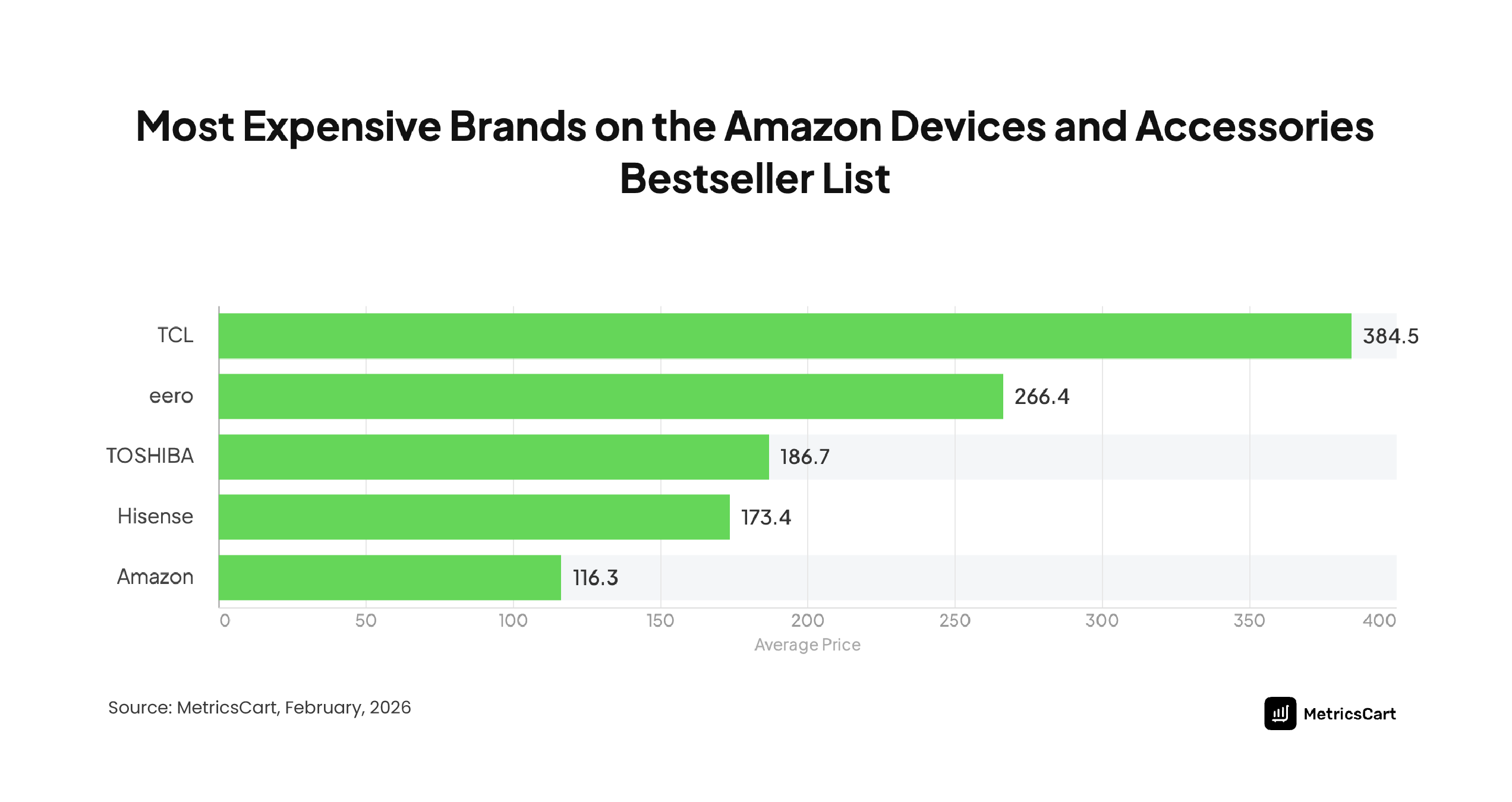
TCL at $384.53 and eero at $266.44 represent the premium end of the Amazon Devices and Accessories category. Both brands sell products that require active research before purchase, televisions and mesh Wi-Fi systems, respectively. These are not impulse buys. They are considered decisions made by consumers who have identified a specific need.
This buying behavior produces strong ratings; TCL, eero, TOSHIBA, and Hisense all carry ratings of 4.30 or above, but lower purchase frequency, which limits review accumulation and rank performance.
Amazon’s average of $116.34 reflects the breadth of its range rather than a premium positioning. It sells a $6.99 spare parts kit and a $699.99 mesh router under the same brand. The large number of low-priced accessories pulls the average down while premium devices push it up.
What Are the Cheapest and Most Expensive Products on the Amazon Devices and Accessories Bestseller List?
Cheapest Products
| Products | Price |
| Ring Spare Parts Kit for Video Doorbell (2nd Generation) | $6.99 |
| All-new Blink Video Doorbell Wedge Mount Black | $7.99 |
| Blink Weather Resistant 13ft Power Adapter for Blink Mini 2, Mini 2K+, Outdoor 4, and Outdoor 2K+ (White) | $9.99 |
Amazon-owned brands hold both ends of the price spectrum. The three cheapest products, priced at $6.99, $7.99, and $9.99, are accessories designed for existing Ring and Blink device owners. They solve a specific, immediate problem for a consumer already inside the ecosystem.
Expensive Products
| Products | Price |
| Amazon eero Pro 7 tri-band mesh Wi-Fi 7 router (newest model) – Supports internet plans up to 5 Gbps, Coverage up to 6,000 sq. ft., 3-pack | $699.99 |
| Amazon Kindle Scribe Colorsoft 64GB (newest model) 11 paper-like color display with front light Thin, light, powerful Write in notebooks, documents, and books. Includes Premium Pen – Fig | $679.99 |
| Amazon Fire TV 55″ 4-Series (newest model), 4K Ultra HD smart TV with Alexa Remote, HDR10+, fast processor, Dolby Audio, Ambient Experience, free and live TV | $459.99 |
The three most expensive products are full ecosystem investments. The eero Pro 7 router system, priced at $699.99, is a premium networking solution for large homes. The Kindle Scribe Colorsoft, priced at $679.99, is Amazon’s most advanced e-reader. The Fire TV 55″ 4-Series at $459.99 is a full smart television.
The fact that Amazon holds both the cheapest and the most expensive products on the list is not accidental. It reflects a deliberate strategy of covering the full price spectrum. A consumer enters the ecosystem through a $9.99 adapter and may eventually invest in a $699 router. The shelf is structured to serve them at every stage of that journey.
What This Means for Brands Competing on Amazon’s Device Shelf
MetricsCart findings present a clear picture of how this category works and what it takes to compete in it. Four structural realities stand out.
The shelf is highly competitive. Amazon-owned brands hold 84% of it. Third-party brands are not primarily competing with each other for the top positions. They are competing for the 16% that Amazon, Ring, and Blink have not already taken. That 16% is real, and brands like Anker, Sandisk, and Mission Cables are proving it can be captured with focused positioning and competitive pricing. But capturing it requires more than a good product. It requires a strategy built around the specific mechanics of this shelf.
Ratings are the entry point, not the differentiator. Every product on this list has a 4-star rating or above. Falling below that threshold removes a product from competition entirely. But staying above it does not, on its own, confer any competitive advantage. What drives rank is review volume, purchase frequency, and price positioning, none of which ratings alone can deliver.
Review the moats exist at every rank position. Products ranked 90 to 100 carry over 12.6 million combined reviews. A brand entering this category is not just competing with the top-ranked product. It is competing with 100 rank positions’ worth of accumulated social proof. Without a clear plan to build reviews quickly and consistently, the gap widens every day rather than narrowing.
Bestseller volume lives under $50. The $0 to $50 price band drives 44% of all bestselling product volume. Brands pricing above $100 are choosing a slower, smaller sub-market. That is a viable strategic choice, but it comes with lower potential for rank and slower review growth. For brands looking to establish a position on this shelf quickly, the sub-$100 accessory space offers the clearest path.
MetricsCart watches the Amazon shelf so you do not have to. Every day, it tracks rank movements, pricing shifts, and review changes across Amazon, Walmart, Target, and Best Buy, giving brands a clear picture of where they stand and what is moving around them. In a category this competitive, that kind of visibility is not a choice.
For brands in the Devices and Accessories category, understanding where the shelf stands today is the first step. Knowing how it moves tomorrow is what turns that understanding into action.
Find Out What Is Moving on Your Category Shelf Right Now!