Let’s be honest. Amazon sales tend to go up and down. One week, you are selling fast. The next week, demand slows down. But what if a part of your revenue showed up every month without you having to chase it?
That is where Amazon Subscribe & Save brings some stability. About 25% of U.S. Amazon customers actively use Subscribe & Save. Not because of advertisements. But customers choose familiarity and convenience.
Just like Prime made fast delivery part of everyday shopping, Subscribe & Save makes repeat buying feel natural.
There are everyday products. Groceries. Personal care. Pet supplies. Customers do not want to reorder them again and again. They want them delivered automatically. And when they subscribe, you stop selling once and start selling repeatedly.
This guide explores the top Amazon Subscribe and Save best practices for sellers and brands. What makes customers subscribe. And how brands can turn repeat orders into long-term growth.
Highlights
- Recurring subscriptions help bring more stability to sales by turning one-time purchases into repeat orders. This makes inventory and demand planning easier.
- Subscribe & Save helps your brand stay part of a customer’s routine. Automatic deliveries encourage repeat buying without heavy promotion.
- Eligibility depends on more than product category. Good account health, steady stock levels, and the right fulfillment setup all matter.
- Simple changes can improve results. The right discount, bundle, or delivery frequency can help increase subscriptions.
- Seller Central reports help brands track performance, understand subscribers, and make better day-to-day decisions.
What Is Amazon Subscribe & Save?
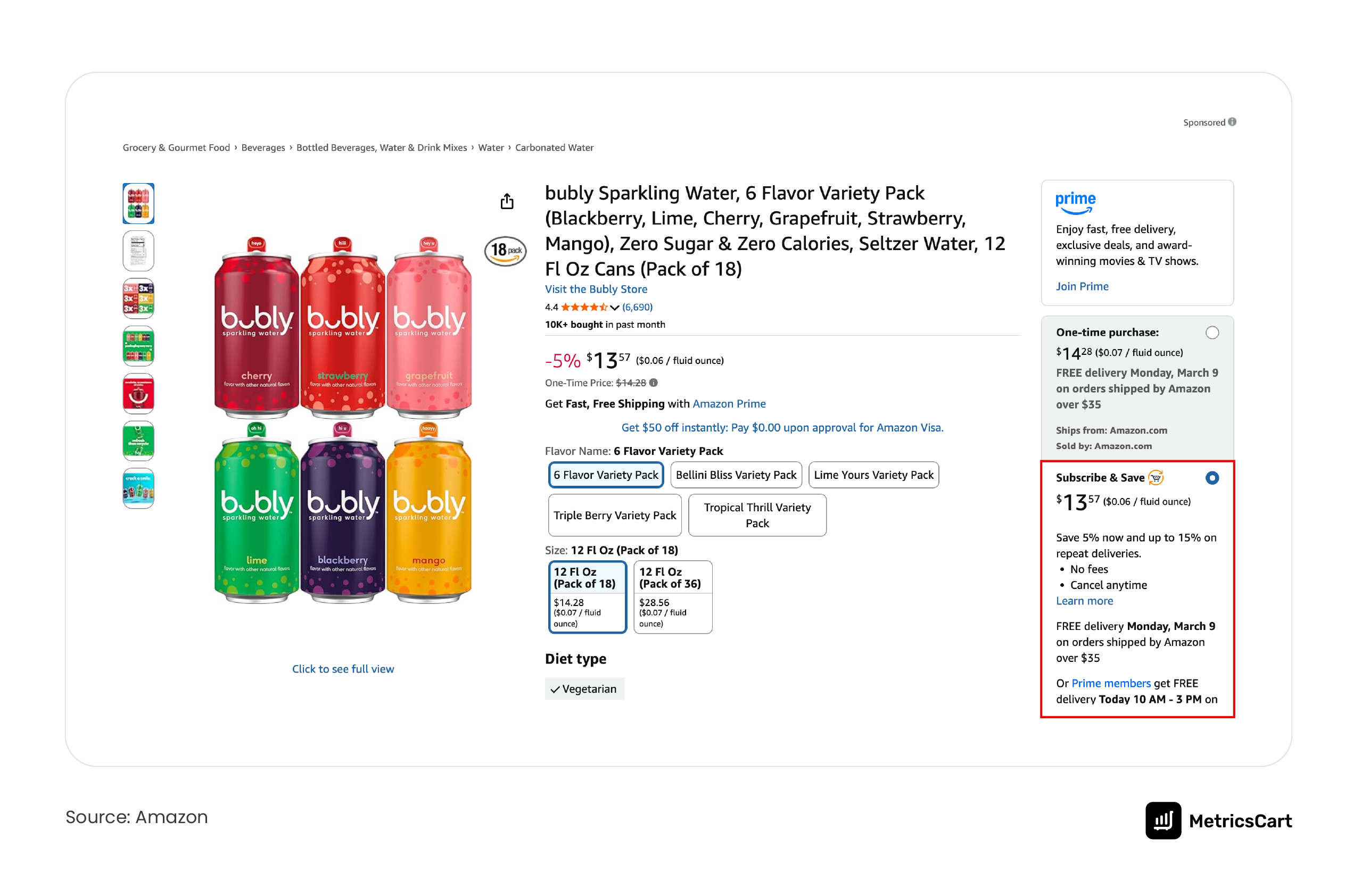
Amazon Subscribe & Save enables customers to receive regular deliveries of essential products, such as groceries, toiletries, and pet supplies. By subscribing, customers enjoy a discount and select a delivery frequency (30, 60, or 90 days). This encourages repeat purchases, improving customer retention over time.
For Sellers, this means
- Predictable sales with a steady flow of repeat customers
- Reduced marketing efforts as customers are committed to regular reorders
- Higher visibility in Amazon’s search results, as subscription products are given priority
Eligibility Requirements for Sellers
To participate in Amazon’s Subscribe & Save program, sellers must meet certain eligibility criteria. These include both seller-specific and product-specific requirements.
Seller Requirements:
- Active Professional Selling Account: Sellers must have a Professional Selling Account in good standing to participate.
- Brand Registry Enrollment: Sellers must be enrolled in Amazon’s Brand Registry as a brand owner or representative to qualify for automatic Subscribe & Save enrollment.
- Account History: A strong account history is required, typically with a seller feedback rating of 4.7+ and 3+ months of active selling. Some sources recommend these as prerequisites for being eligible.
For Fulfilled by Merchant (FBM) Sellers, additional performance metrics are necessary, maintained for 3 consecutive months:
- Free Domestic Shipping: Free shipping on domestic orders.
- Valid Tracking Rate: Must exceed 95%.
- Order Defect Rate: Should remain below 1%.
- Pre-Fulfillment Cancel Rate: Must be below 2.5%.
- Late Shipment Rate: Should be less than 4%.
- Delivery Accuracy: Must exceed 93.5%.
- Average Delivery Time: Less than 5 days.
Product Requirements:
- Stock Availability: Products must maintain an in-stock rate of 90%+ over the past 28 days to qualify.
- Pricing: Products should have an average selling price under $200 to avoid excessive price increases.
- Fulfillment Method: To be eligible for auto-enrollment, products must be Buyable via FBA (Fulfilled by Amazon). FBM is acceptable but may require additional approval.
- Repeat-Purchase Suitability: Products must be suitable for repeat purchases, such as health, groceries, household, and personal care items. Certain categories, like hazmat and perishables, are excluded from this program.
READ MORE | Amazon Product Launch Strategy: Everything You Need to Know
Enrollment
The enrollment process for Amazon Subscribe & Save varies based on the fulfillment method (FBA vs. FBM) after you meet the eligibility requirements (Brand Registry, performance metrics, etc.). Here’s a step-by-step guide to ensure a smooth enrollment:
Enable Subscribe & Save in Seller Central (Account-Wide Step)
- Go to Seller Central
- Navigate to Settings > Fulfillment by Amazon > Subscription Settings.
- Navigate to Settings > Fulfillment by Amazon > Subscription Settings.
- Activate the Program
- Click Edit > Enable and agree to the terms to activate Subscribe & Save for your brand. This step requires enrollment in Brand Registry to be eligible.
- Click Edit > Enable and agree to the terms to activate Subscribe & Save for your brand. This step requires enrollment in Brand Registry to be eligible.
FBA Products (Auto-Enrollment)
Eligible products fulfilled by Amazon (FBA) automatically enroll in Subscribe & Save once the program is activated. Here’s how it works:
- Automatic Enrollment: FBA SKUs meeting the eligibility criteria (90%+ in-stock, average selling price <$200, repeat-purchase suitability) are automatically enrolled.
- Discount & Frequency Settings:
- Discounts (minimum 5%) and subscription frequencies (30, 60, 90 days) are set automatically by Amazon based on your seller inputs or default settings.
- Limited customization options are available through templates to opt out of specific products.
- Discounts (minimum 5%) and subscription frequencies (30, 60, 90 days) are set automatically by Amazon based on your seller inputs or default settings.
FBM Products (Manual Request)
For Fulfilled by Merchant (FBM) products, enrollment requires a manual request per ASIN/SKU:
- Request via Subscription Settings: Go to the Subscription Settings page in Seller Central and request enrollment for individual ASINs/SKUs.
- Inventory Template: Use the inventory template to add or remove products via the SKU column. The action to take for each product is either “enable” or “disable”.
- Upload this template to the “Add/Remove S&S Products” page.
- Upload this template to the “Add/Remove S&S Products” page.
- Approval Based on FBM Metrics: Approval for FBM products depends on meeting certain performance metrics (e.g., tracking rate >95%, order defect rate <1%). If these metrics aren’t met, enrollment may be delayed or rejected.
- Frequency Options: Sellers can apply frequency options (30, 60, or 90 days), but Amazon will assess approval based on your FBM metrics.
Want Steady Sales and Growth?

What are the Benefits of Subscribe & Save for Brands and Sellers?
The benefits of Amazon Subscribe & Save are clear, especially when viewed through the lens of long-term business growth. For brands, this program brings significant advantages:
- Repeat Sales: By converting one-time purchases into repeat subscriptions, you stabilize your revenue stream. Subscriptions give you a more predictable sales flow. This eliminates the peaks and valleys that often accompany one-time purchases.
- Visibility and Exposure: Products enrolled in Subscribe & Save often receive higher visibility on Amazon. These products are given priority in search results. This, in turn, increases the likelihood that customers will see and purchase your product instead of your competitors’.
- Customer Retention: Subscriptions inherently build loyalty. Once a customer subscribes to your product, they’re more likely to continue purchasing. This improves their lifetime value to your business. This loyalty reduces the cost of acquiring new customers.
- Brand Awareness: Regular deliveries through Subscribe & Save keep your brand consistently in front of customers. As customers receive products regularly, they become more familiar with your brand. This consistency builds trust and greater brand recognition.
Together, these benefits help drive consistent sales and long-term growth.
READ MORE | Losing Sales on Amazon? 7 Hidden Reasons & their Solutions
One-Time Sales vs. Subscribe & Save: A Comparison
The table below compares key aspects of One-Time Sales and Amazon Subscribe & Save.
This highlights the differences in revenue predictability, visibility, customer retention, inventory risk, and marketing effort.
| Aspect | One-Time Sales | Subscribe & Save |
| Revenue Predictability | Volatile peaks/valleys | Steady 20–35% of total sales |
| Visibility | Standard search ranking | Badges + Buy Box priority |
| Customer Retention | 10% repeat rate baseline | 90% past 30 days; 20% higher LTV |
| Inventory Risk | High stockouts/overstock | Easier forecasting via reports |
| Marketing Effort | Constant Acquisition | Built-in loyalty, less ad spend |
How Can Brands Track the Results of the Subscribe and Save Program?
Tracking your performance in the Subscribe & Save program is essential for making data-driven decisions. Amazon provides detailed reports within Seller Central, where sellers can monitor key metrics:
- Subscribe & Save Performance Report: Provides insights into how your subscription products are performing. It includes data on items shipped, out-of-stock percentages, and average sale prices after discounts. By analyzing these metrics, sellers can evaluate which products are performing well and which may need adjustments.
- Subscribe & Save Forecasting Report: Predicts future sales based on existing subscription trends. It helps sellers plan for upcoming inventory needs, ensuring you have enough stock to meet customer demand.
By using these reports, sellers can optimize their Subscribe & Save strategy, adjusting pricing or subscription frequencies to improve performance.
Amazon Subscribe & Save: Best Practices for Sellers
Maximizing the potential of Amazon Subscribe & Save requires focused effort. Here are the best practices for sellers to follow:
Offer Higher Discounts:
Discounts are a major driver for subscriptions on Amazon Subscribe & Save. Offering a discount between 10%-15% can significantly increase conversion rates and encourage customers to commit to a subscription.
While offering discounts, sellers should balance attractive savings for customers with maintaining profitability.
Using targeted discounts, such as those offered during key sales events like Prime Day, can help clear overstocked inventory and boost subscription growth, giving customers an added incentive to choose regular reorders.
Optimize Subscription Frequency
The flexibility to choose between 30-, 60-, or 90-day subscription intervals helps cater to different customers’ purchasing habits. Some customers prefer frequent replenishment of consumables, such as toiletries, while others may need less frequent deliveries for bulk items.
By offering subscription options, sellers can appeal to a broader audience, increasing the likelihood that customers will subscribe.
Adapting the frequency to suit customer needs not only improves retention but also makes the subscription service more attractive to a wider range of shoppers.
Bundle Related Products
Bundling related products together creates more value for customers and increases the average order value (AOV). Offering complementary items, such as a shampoo and conditioner combo, allows customers to buy more from your brand, enhancing their shopping experience.
Bundles also make it easier for customers to get all the products they need in one subscription, reducing friction in the purchasing decision.
This approach can help sellers drive larger sales and build stronger customer relationships, as bundled offerings often lead to higher lifetime value (LTV) per subscriber.
Ensure Product Availability
Maintaining product availability is essential to preventing subscription cancellations. If a product goes out of stock, customers may discontinue their subscriptions or seek alternatives from competitors.
Sellers should leverage Amazon’s forecasting tools to better predict inventory needs and ensure products remain in stock, especially for high-subscription-rate items. By ensuring consistent availability, sellers can keep their subscriptions active, reduce churn, and maintain a steady stream of revenue.
Track Performance Using Seller Central Reports
Regular performance analysis is critical to optimizing Amazon Subscribe & Save strategies. Sellers should use Amazon’s Seller Central reports to monitor key performance metrics, including subscription growth, customer retention, and churn rates.
By tracking these metrics, sellers can identify areas for improvement, such as adjusting pricing or tweaking product bundles, to improve results.
READ MORE | 7 Tips To Improve Amazon Best Sellers Rank
Thinking Beyond One-Time Sales
Amazon Subscribe & Save is not just a part of Seller Central. For many brands, it is becoming part of the steady revenue they build over time. Sellers who stay consistent with stock, pricing, and retention? They are making a difference.
Customer habits are shifting, too. Around 80% of subscribers plan to keep or increase their subscriptions in 2026, and about 61% of them shop on Amazon weekly, compared to 34% of non-subscribers. That means sellers need not be chasing new traffic.
In the end, selling on Amazon is not only about finding new buyers. It is about staying part of a customer’s routine. Subscribe & Save gives brands a simple way to do that, sustaining customers over the long term and helping sellers grow with greater stability.
As subscription strategies evolve, brands that monitor pricing, availability, and digital shelf performance more closely will stay ahead. The MetricsCart app helps sellers connect these signals in one place, turning everyday subscription data into clearer, more confident decisions.
Want to See How Your Subscribe & Save Performance Compares to Competitors?
FAQs
Yes, it can be valuable for long-term growth. It helps turn one-time buyers into repeat customers. Many brands use it to improve sales stability. It also reduces the pressure to constantly acquire new customers.
Sellers must offer at least a 5% discount. This lowers the selling price slightly. Margins should be planned carefully before enabling them. The goal is to balance discounts with higher repeat sales.
Sellers choose the starting discount percentage. Some settings are managed automatically by Amazon, especially for FBA products. Sellers can opt in or opt out through Seller Central. Monitoring performance helps adjust strategy over time.
Yes, it encourages repeat buying through automatic deliveries. Customers do not need to reorder each time. This builds routine purchasing behavior. Consistent fulfillment helps keep subscribers active.
The product must first meet the eligibility rules. Stock levels and account health matter. Some categories are not eligible for the program. Check Seller Central settings if the badge does not appear.