Highlights
- Two brands, Similac and Enfamil, hold nearly 56% of the shelf on Target, with 39 and 38 distinct products, respectively, out of 138 total.
- Enfamil’s average price sits at $43 against Similac’s $25, a 72% gap on nearly identical SKU counts.
- Enfamil owns 3.11 million reviews across its Target catalog, roughly 18 times Similac’s 171K.
- Similac runs 16 sponsored SKUs to Enfamil’s 7, spending harder on paid placements to close the visibility gap.
- Only 11 of the 18 brands in the baby formula category tracked are available both online and in-store, leaving seven brands locked to the digital shelf.
What the Baby Formula Shelf on Target Reveals About the Category
Baby formula is one of the few categories in mass retail where the shopper’s decision cycle starts before the purchase and rarely ends after it.
The category has a switching trouble unlike almost anything else in CPG. Infants tolerate one formulation, and switching brands mid-feed carries real risk of digestive upset. So once a family chooses a formula, they typically stay for the full 12 months of infant feeding. That behavior turns every first purchase into a year-long revenue stream, which is why brands compete so hard for that initial trust signal and why review depth acts as a compounding moat.
Parents research heavily, stick with what works, and repeat-buy on autopilot until a change is medically necessary. This shapes the entire baby formula category on Target, from how brands price their SKUs to how much they spend on sponsored placements to how review counts stack up on the shelf.
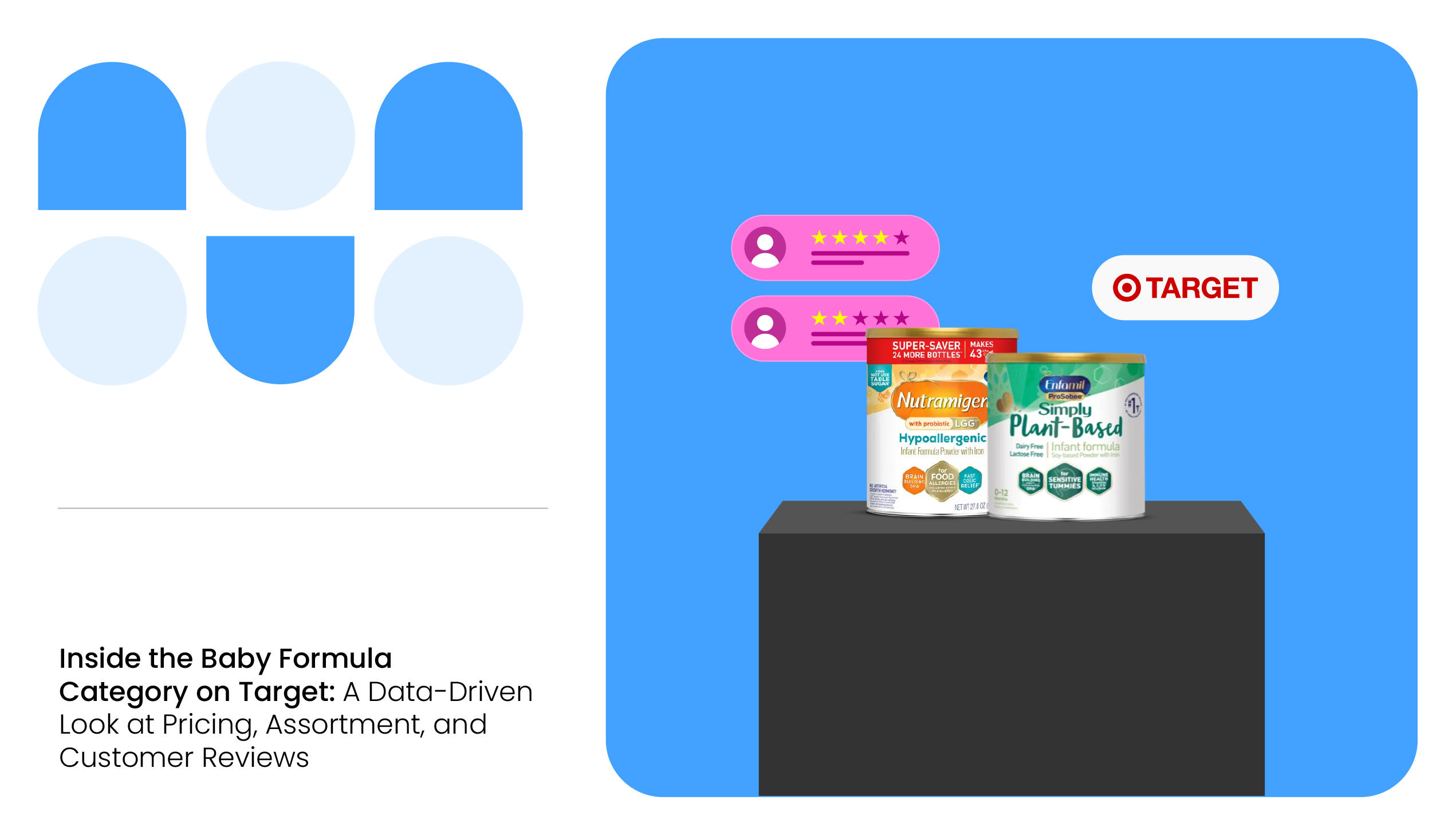
For this report, MetricsCart tracked 138 products across 18 brands and 4 sellers between May 12 and May 26, 2026. The findings surface a category where two brands dominate assortment, one brand dominates trust, and a handful of challengers are building review velocity that outperforms their SKU count. Let’s get into it!
About This Report
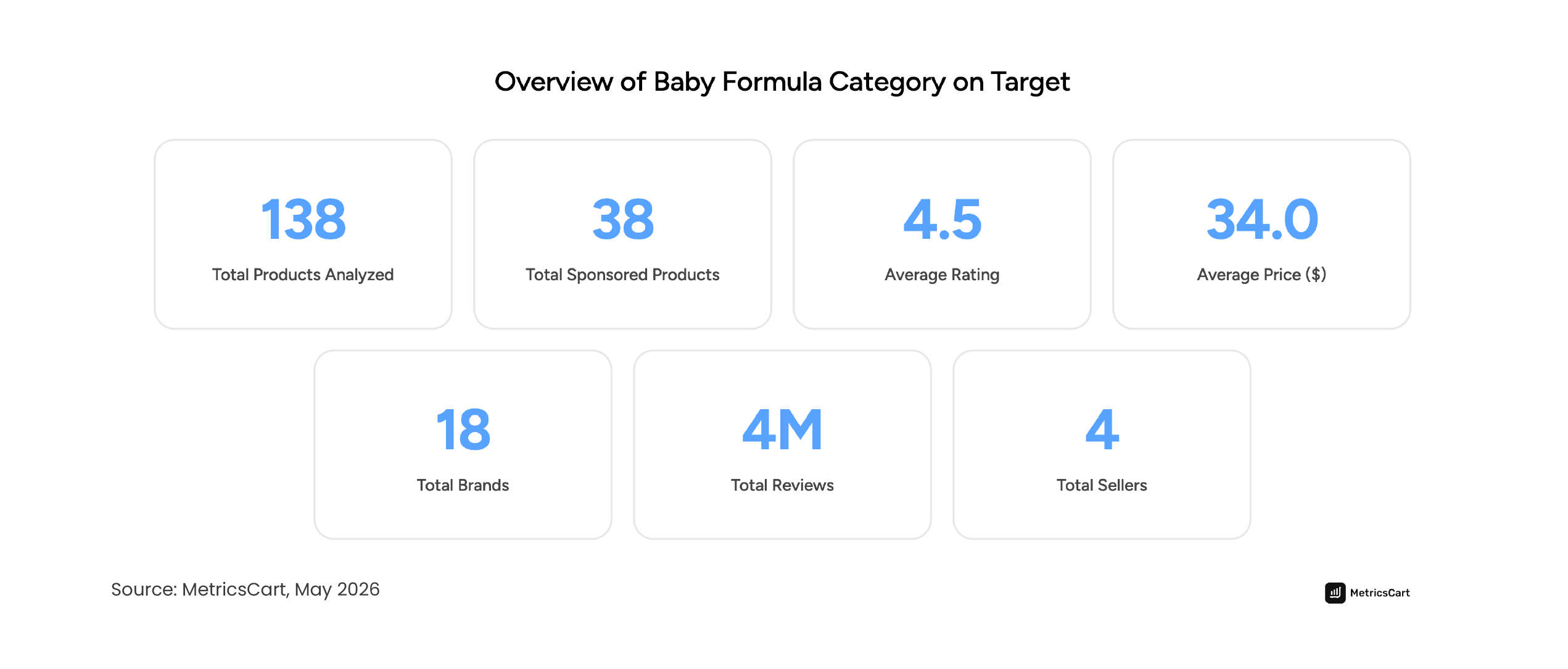
This report analyzes the baby formula category on Target across a two-week window, covering pricing distribution, brand-level assortment, sponsored placement intensity, review depth, distribution availability, and daily trend movements. MetricsCart tracked 138 SKUs from 18 brands. The average product carries a 4.5 rating, the average price is $34, and the category has accumulated approximately 4 million customer reviews across the shelf.
The data was gathered using MetricsCart’s digital shelf analytics software, which tracks pricing, availability, ratings, reviews, sponsored placements, and assortment across 150+ global retailers.
The Pricing Architecture: A $5 Entry Point and a $97 Ceiling on the Same Shelf
MetricsCart baby formula pricing analysis shows the price ladder in this category stretches from $5 at the entry point to $96.90 at the top, with the average sitting at $34.
That range tells you the shelf is doing two jobs at once: catering to specialty medical needs at one end and serving trial or single-feed convenience at the other.
What the Top-Priced Products Tell Us About Format vs Positioning
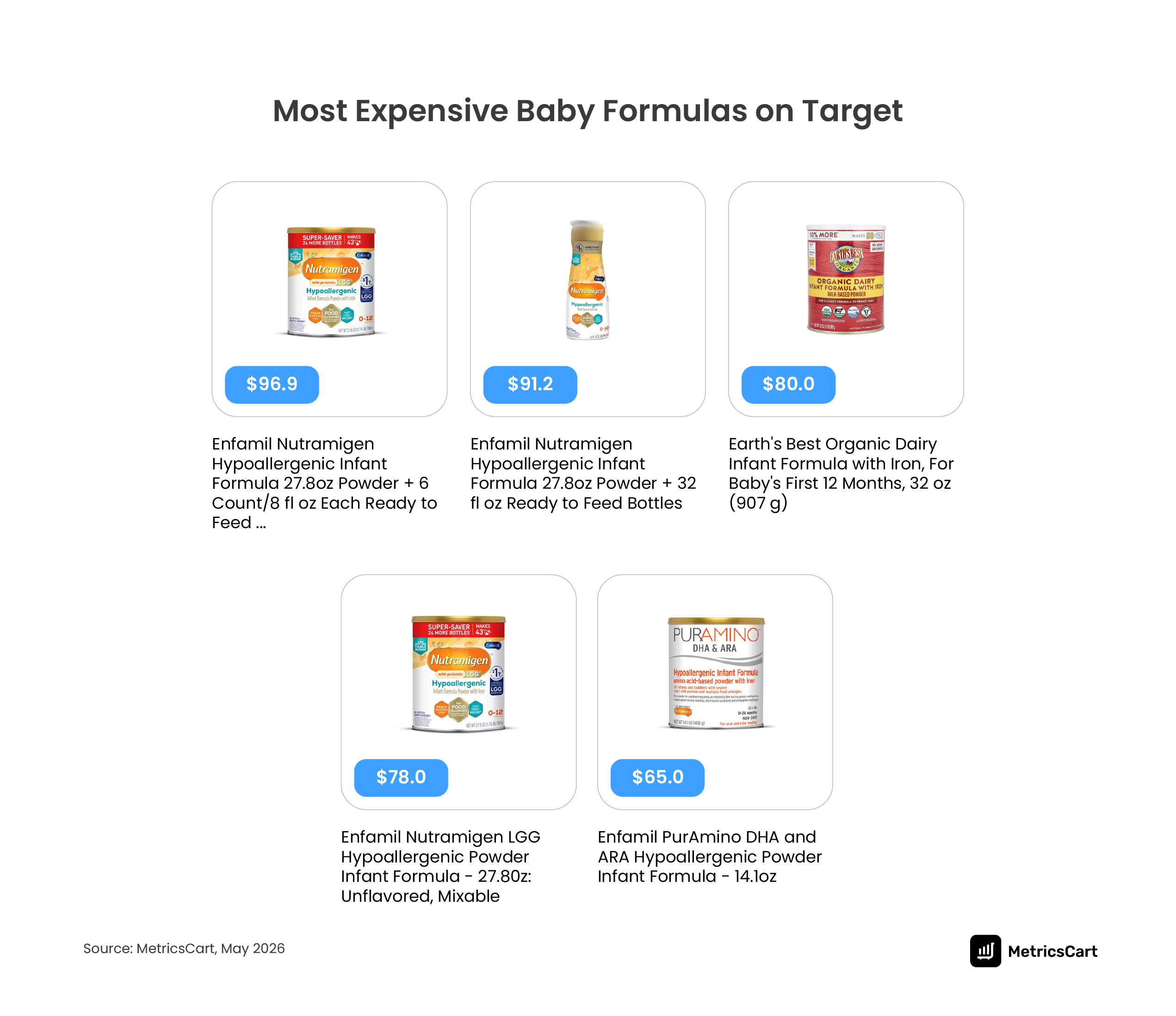
The premium tier is almost entirely an Enfamil story. MetricsCart found that 8 of the 10 most expensive products in the baby formula category on Target belong to Enfamil, with prices ranging from $60 to $96.90. The two non-Enfamil entries are Earth’s Best Organic Dairy Infant Formula at $80 and Similac Alimentum Non-GMO Hypoallergenic Powder at $61.60.
Specialty formulation and multi-format bundles are what push a product past the $60 mark. The top five includes Enfamil Nutramigen (hypoallergenic) in both powder + Ready to Feed combo packs ($96.90 and $91.20), Enfamil Nutramigen LGG at $78, and Enfamil PurAmino DHA/ARA Hypoallergenic at $65.
Ready-to-feed as a format shows up repeatedly in the premium tier, but only when paired with specialty positioning or multi-count bundles.
The Affordable End: Where Similac Offers Ready-to-Feed Format Under $12
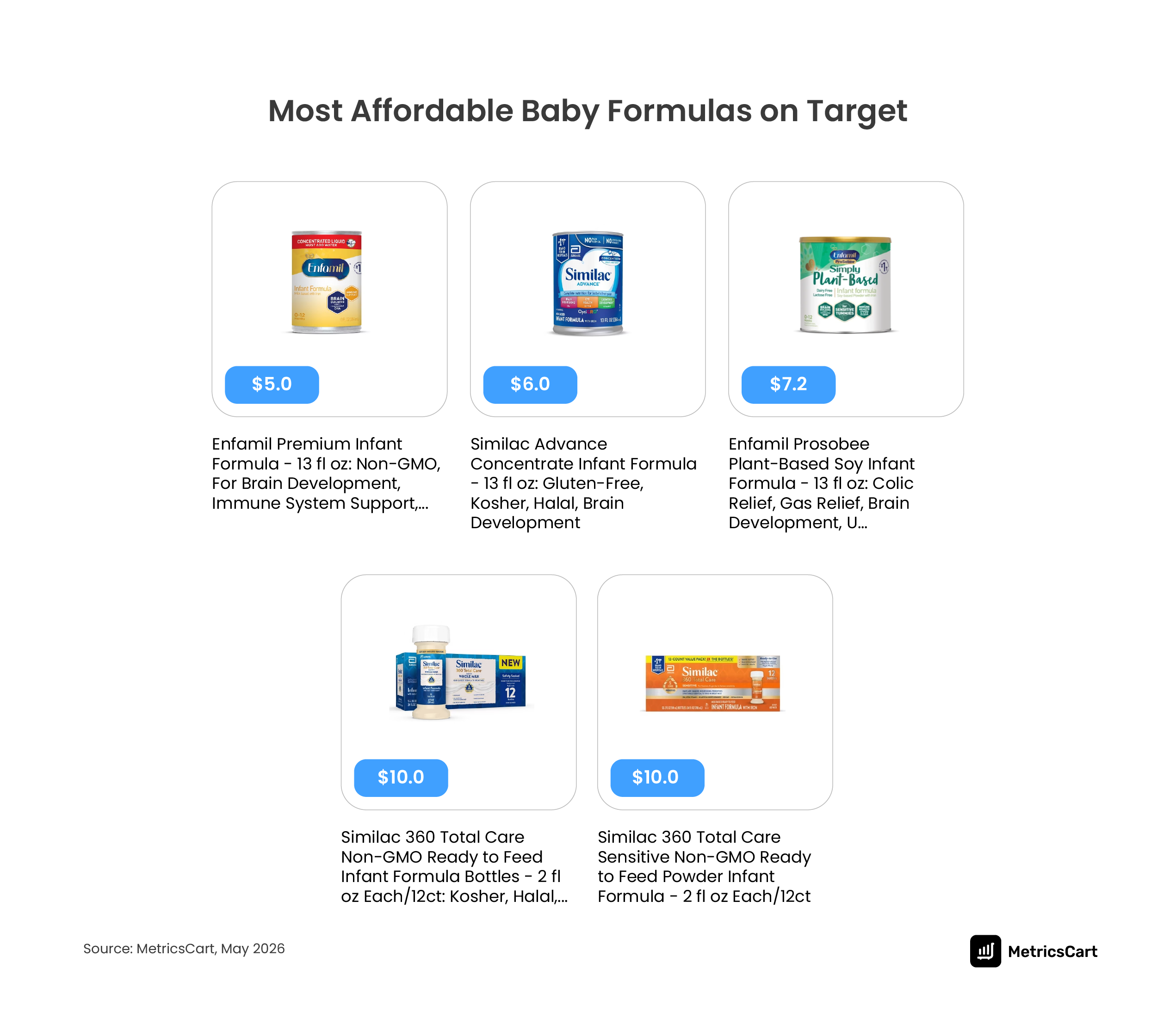
The affordable end runs from $5 to $11.50, and 8 of the 10 lowest-priced SKUs are Similac products. The two Enfamil entries in this tier are the Premium Infant Formula 13 fl oz at $5 and Prosobee Plant-Based Soy 13 fl oz at $7.20.
Ready to Feed shows up on both ends of the pricing ladder. In the affordable tier, it appears as single-serve 2 fl oz cups and standalone 32 fl oz bottles priced between $10 and $11.50. In the premium tier, it appears as multi-count bundles paired with powder canisters. Ready to Feed is not inherently a premium format on Target. Its pricing depends on pack size, count, and specialty positioning around the SKU it accompanies.
Baby Formula Assortment Concentration: Three Brands Own Nearly Three-Quarters of the Shelf
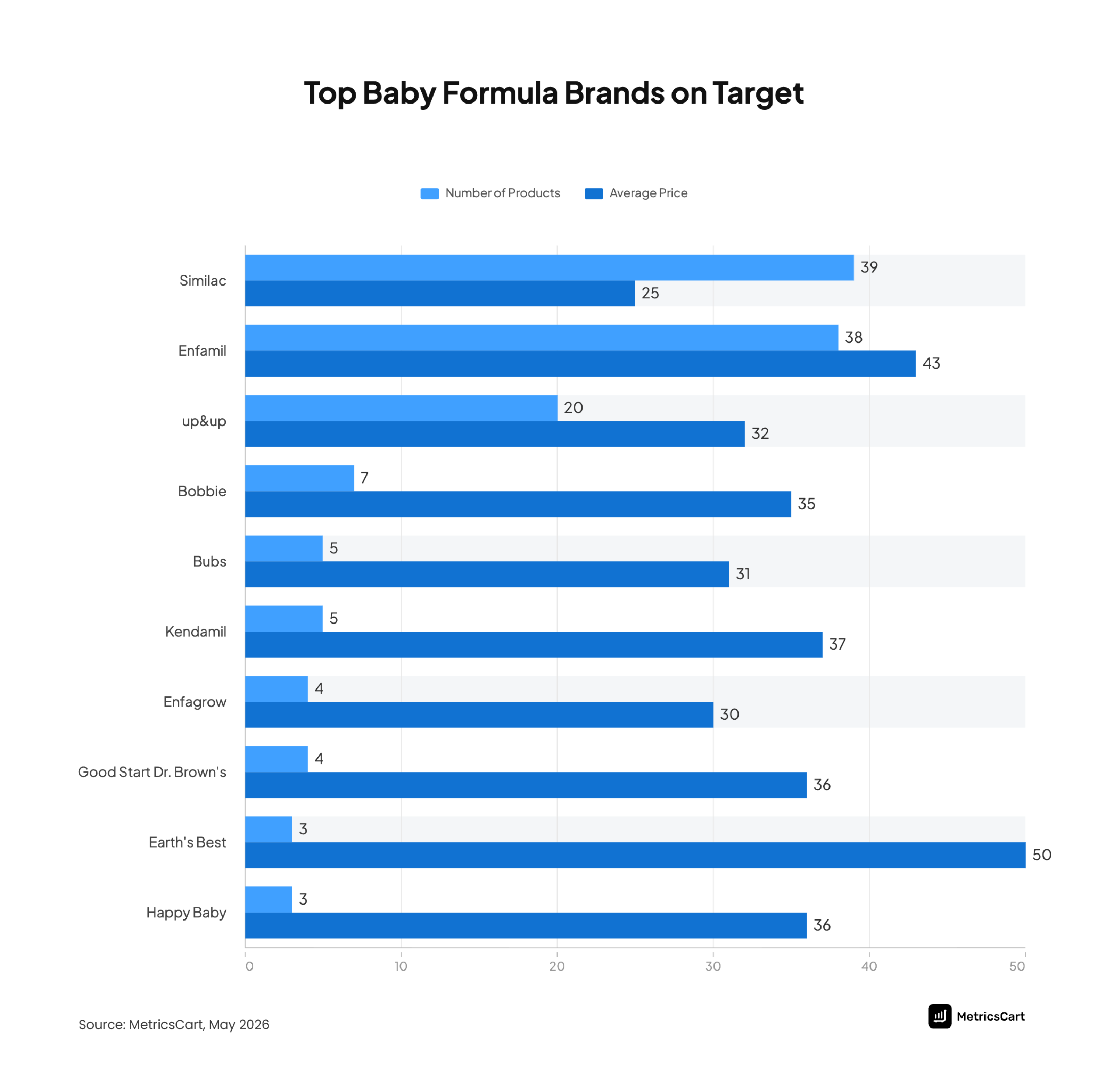
MetricsCart infant formula assortment analysis on Target says Similac, Enfamil, and Target’s own up&up private label together account for 97 of the 138 SKUs tracked, or roughly 70% of the total assortment. The remaining 15 brands split the last 41 slots between them, most with fewer than 5 products each.
Similac vs Enfamil: Same SKU Count, Very Different Average Prices
Similac and Enfamil are nearly tied on assortment (39 vs 38 SKUs), but their average prices tell two different stories. Similac averages $25 per SKU while Enfamil averages $43. Enfamil is pricing 72% higher on the same shelf, against a competitor with the same SKU depth.
Enfamil’s catalog leans heavily into specialty formulations (Nutramigen, PurAmino, NeuroPro Gentlease) that command a price premium. Similac’s catalog leans wider and cheaper, with a heavier weight on Ready to Feed singles and 360 Total Care variants.
Post-recall, Abbott has been focused on rebuilding standard-formula share, which explains the wider affordable-tier catalog and the lower average price. Enfamil, meanwhile, has doubled down on the specialty tier where its formulations have less direct competition.
The two brands are optically competing on the same shelf but functionally serving different shopper missions.
READ MORE | The Real Car Seat Problem: Why Parents Are Frustrated Despite Higher Safety Standards
The Challenger Slice: Bobbie, Bubs, Kendamil, and Nara Organics
Outside the top three, brand assortment in baby nutrition on Target thins out fast. Bobbie holds 7 SKUs at a $35 average, Bubs holds 5 at $31, Kendamil holds 5 at $37, Enfagrow holds 4 at $30, Good Start Dr. Brown’s holds 4 at $36, and Earth’s Best, Happy Baby, and Nara Organics hold 3 or fewer.
Every challenger sits in the $30 to $50 price band, positioning themselves as a paid-premium alternative to the mass-market leaders without touching the specialty medical tier where Enfamil dominates.
Kendamil and Bubs are worth flagging together. Both are European-heritage brands (Kendamil is British, Bubs is Australian) that gained US shelf presence after the 2022 shortage, when the FDA temporarily allowed imported formula to fill supply gaps. Some of those import approvals have since become permanent, which is how European formula ended up in Target aisles at all.
Earth’s Best carries the highest average price in the challenger group at $50, which reflects its organic positioning. Nara Organics goes higher at $44 on a single SKU. These are challenger brands using price as a positioning cue rather than trying to match Enfamil and Similac on assortment breadth.
If you want to see how your own brand assortment in baby nutrition stacks up against Similac’s shelf share or Enfamil’s price premium, MetricsCart tracks the movement daily across Target, Amazon, Walmart, and 150+ retailers.
READ MORE | Digital Shelf Insights: Best Selling Baby Products on Amazon
Sponsored Intensity: Who Is Actually Paying to Be Seen
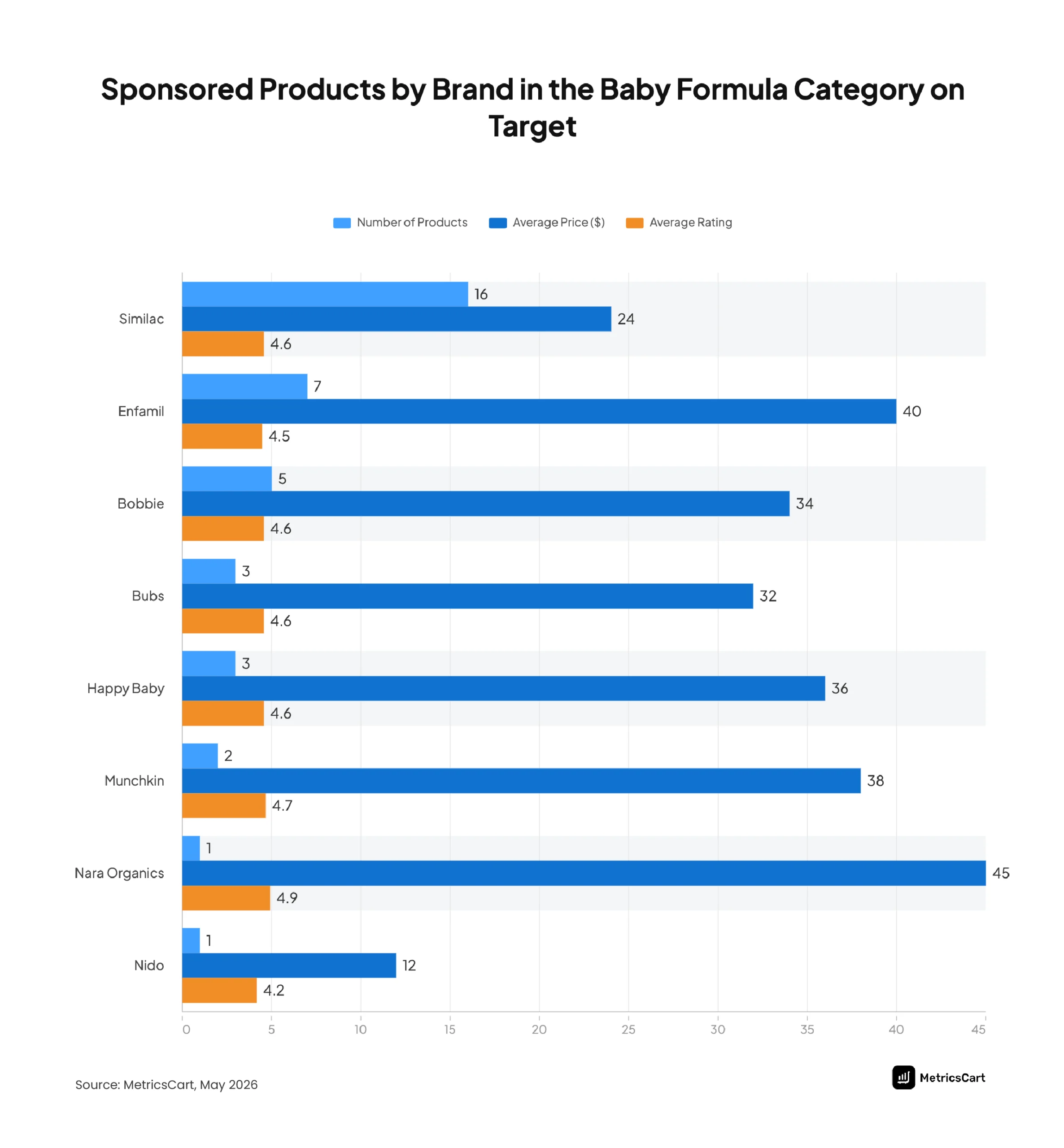
38 of the 138 tracked products are sponsored, and that spend is not distributed evenly. Infant formula marketing on Target’s shelf runs on a different logic than assortment alone, because in a trust-driven category where pediatrician recommendation and cumulative review depth carry disproportionate weight, sponsored placements function as a compensator rather than a primary lever.
Why Similac Sponsors More Than Twice as Many Products as Enfamil
MetricsCart found that Similac runs 16 sponsored SKUs to Enfamil’s 7, despite the two brands having near-identical assortment counts. Similac is sponsoring 41% of its catalog while Enfamil is sponsoring 18%. The lower-priced brand is paying harder for visibility.
Enfamil already owns the review moat and the specialty tier, so organic discoverability does the work paid media would otherwise have to. When a shopper searches Target for “infant formula,” and the top results carry 5K+ reviews, sponsored placements offer marginal lift.
Similac is in a different position. It carries a wider standard-formula catalog at a lower average price, competes with up&up private label at the value end, and needs sponsored placements to keep its SKUs above the fold in a shelf where Enfamil owns the organic top slots. This is what a rebuilding infant formula marketing posture looks like when read through the sponsored ratio: a brand using paid media to buy back visibility it lost during the post-recall period.
Challenger Brands Are Sponsoring Almost Every SKU They Have
For the smaller brands, sponsored intensity climbs sharply as a percentage of catalog. Bobbie sponsors 5 of its 7 SKUs (71%), Bubs sponsors 3 of 5 (60%), Happy Baby sponsors all 3 of its SKUs, and Nara Organics sponsored its only SKU (subsequently issued a voluntary recall on June 12, 2026, following CDC-reported infant botulism cases)
When you have a limited assortment, paid placement functions as a discoverability requirement, not a growth lever. A challenger with 1 to 7 SKUs cannot rely on organic browse traffic because the shelf-scroll surface area is dominated by the leaders. Sponsored placement is how a small-catalog brand engineers a first impression.
The average sponsored price for these challengers ($32 to $45) is meaningfully higher than Similac’s sponsored average of $24, which suggests challengers are protecting their premium positioning even when paying for placement. They are not discounting into paid slots the way a value-focused sponsor typically would.
The Review Moat: Why Enfamil’s 3.1M Reviews Are the Real Competitive Barrier
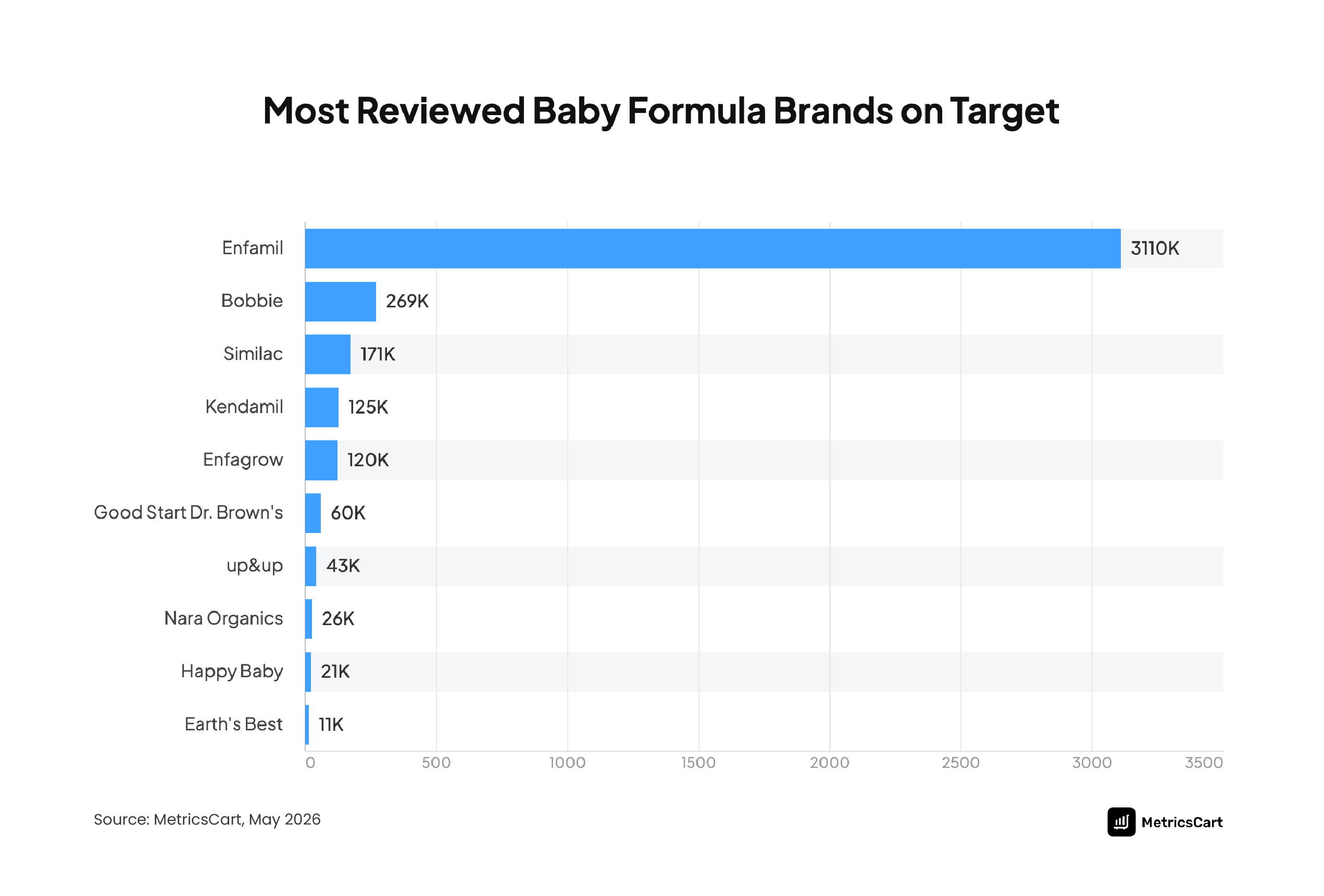
MetricsCart research shows Enfamil has accumulated 3.11 million reviews across its Target catalog. Similac, with nearly identical SKU count, has 171K. That is roughly an 18x gap on the same shelf.
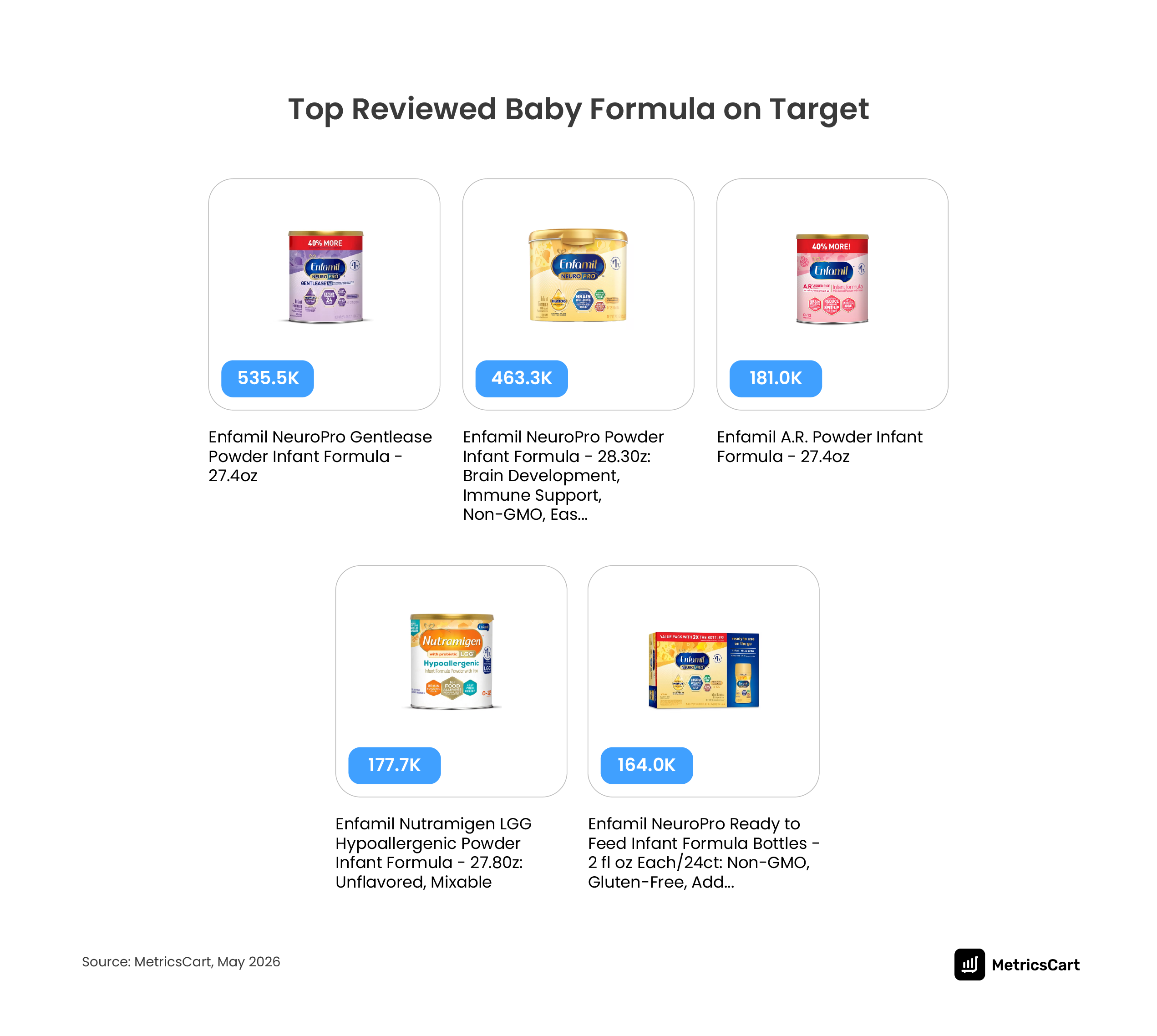
The review depth is visible at the SKU level too. All 10 of the most-reviewed products on Target are Enfamil, led by the NeuroPro Gentlease Powder 27.4oz at 535.5K reviews and NeuroPro Powder 28.3oz at 463.3K. No other brand has a single product in the top 10 by review volume.
Enfamil vs Similac
Three structural factors compound the gap between Enfamil and Similac. First, Enfamil has been on Target shelves continuously and at scale for decades, so its reviews have simply had more time to accumulate.
Second, the 2022 Abbott recall temporarily removed Similac products from many Target listings, and delisted SKUs lose their review history when relisted under new ASINs, which reset part of Similac’s accumulated review base.
Third, the biological switching cost keeps Enfamil buyers repeat-purchasing for a full 12 months, so every first review typically converts into 4 to 6 additional purchases and often a review update. That compounding effect is what turns 3.11M into a moat rather than just a number.
For a first-time parent searching Target, the top-ranked results carry hundreds of thousands of reviews, and every one of them is Enfamil. That is what defends Enfamil’s 72% price premium. The brand offers shoppers something Similac structurally cannot in a short timeframe: social proof depth in the customer reviews.
READ MORE | A Complete E-Commerce Review Analytics Guide: What Brands Need to Know
Bobbie’s Review Velocity: 7 SKUs, 269K Reviews
The second-highest-reviewed brand on the shelf is Bobbie with 269K reviews across just 7 SKUs. That works out to approximately 38K reviews per SKU, roughly 8.6 times Similac’s 4.4K per SKU and outpacing even Enfamil’s per-SKU average of 81.8K when adjusted for catalog age.
The mechanic behind Bobbie’s density is DTC brand equity. Bobbie launched in 2018 as a subscription-first, direct-to-consumer brand built around European-standard formulation and transparent sourcing. Its early buyers were self-selected superfans who chose the brand deliberately and reviewed it accordingly. When Bobbie expanded into Target, those buyers followed and continued reviewing on Target’s product pages, importing years of DTC brand loyalty into a retail review base. That is why Bobbie’s review-per-SKU ratio outperforms both national brands: its reviewers are converts, not browsers.
For a challenger brand, that ratio matters more than absolute review count. High reviews per SKU means each product is earning its shelf space independently, which strengthens the brand’s case with Target’s category managers for expanded assortment.
The up&up Paradox: Twenty Products, Only 43K Reviews
Target’s private label sits in an unusual position on baby nutrition reviews. up&up has 20 distinct SKUs on the shelf, the third-largest assortment in the category, but only 43K total reviews. That averages 2,150 reviews per SKU, well below both Similac and Bobbie.
The pattern is consistent across private label formula. Kirkland Signature at Costco, Amazon Basics, and Walmart’s Parent’s Choice all show the same review anemia relative to their sales volume.
Private label formula gets purchased often (roughly 15 to 20% of US infant formula sales are private label, according to category tracking) but reviewed rarely, because shoppers do not feel the same emotional investment in a store brand purchase they made for price reasons. Reviews are usually written to signal a brand affiliation, and there is no brand affinity to signal with a private label pickup.
For Target, this leaves a data gap on how shoppers actually feel about its own house brand’s performance, which is where continuous baby formula reviews and ratings monitoring earn their keep.
Steady Review Growth in a Subscription-Heavy Category
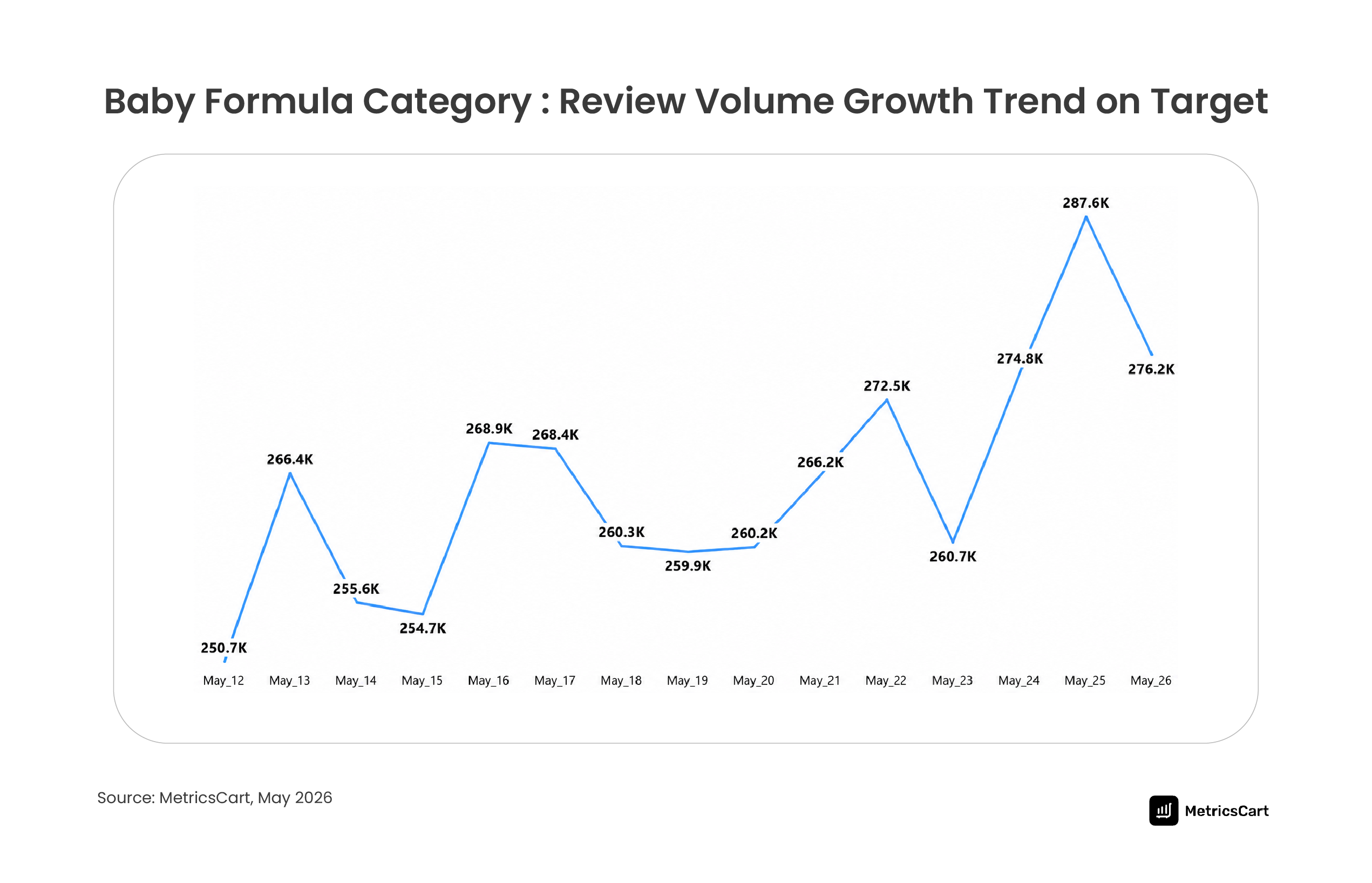
Total reviews moved from 250.7K on May 12 to 276.2K on May 26, roughly 10% growth in two weeks. Despite short-term declines on May 14 to 15, May 18 to 20, and May 23, the overall direction was up.
That 10% two-week growth annualizes to roughly 230% cumulative growth, which is consistent with a category where approximately 3.6 million US infants are born each year and cycle through 12 months of formula purchases with review opportunities every few weeks.
Steady review volume trends in a category like this are a health indicator. Sudden spikes usually mean a viral moment, a TikTok endorsement, or a recall event. Sudden drops usually mean an out-of-stock crisis or a delisted SKU. Neither shows up here, which is what Target wants from a subscription-heavy category that carries this much regulatory scrutiny and household reliance.
What the Baby Formula Category on Target Reveals About Broader Baby Nutrition Playbooks
Four distinct playbooks are running on this shelf, and each maps to a different competitive moat.
- Enfamil is running a review moat defense. It commands the specialty and premium tier, owns the highest cumulative review base in the category, and spends less on sponsored placements because 3.11M reviews do the discovery work paid media would otherwise buy. Its infant formula marketing on Target is optimized for shoppers who already know what they want, and its moat is trust accumulated over decades of pediatrician recommendations, WIC contracts, and hospital NICU discharge programs.
- Similac is running an assortment and paid media rebuild. It matches Enfamil on SKU count, undercuts on price, and doubles Enfamil’s sponsored intensity to compensate for a smaller review base that was partially reset by the 2022 recall. Its moat is Abbott’s century of retail distribution relationships and WIC eligibility, which explains why the brand still holds 39 SKUs on Target’s shelf despite the review gap. Similac is trading paid visibility for organic discoverability while it works to close a review deficit that will take years to narrow.
- Bobbie is running a concentrated challenger playbook. Fewer SKUs, higher sponsored ratio, aggressive omnichannel presence, and outsized review velocity per product. Its moat is brand affinity built during the DTC-only phase, which converted into review-per-SKU ratios that outperform both national brands.
- According to The New York Times Wirecutter, most parents choose a formula based on pediatrician recommendation and stick with it, which rewards challenger brands that earn recommendation earlier in the parent journey. Bobbie’s DTC brand equity is what lets it capture that earlier recommendation window.
- Everyone else is running a niche play. EleCare, Good Start, and Earth’s Best occupy specialty positions with 1 to 3 SKUs and premium pricing. Their moat is regulatory: FDA approval for medical-grade formulations creates a barrier that keeps competitors from entering the specialty tier quickly. External comparisons at Forbes Health reinforce that the buying decision in specialty formulation is almost entirely medically driven, which is why these brands can maintain premium pricing on tiny SKU counts.
The takeaway for anyone building or defending a position in the baby formula category is that these playbooks are not interchangeable.
READ MORE | Designing E-Commerce for Kids’ Products: Emotional & Quality Factors Driving Parental Choices
Win the Baby Formula Category with MetricsCart
MetricsCart tracks pricing, assortment, sponsored placements, ratings, reviews, and availability across Target, Amazon, Walmart, and 150+ global retailers, giving category teams the shelf-level clarity to benchmark against Enfamil, Similac, Bobbie, and every emerging challenger in baby nutrition.
Whether you need to monitor formula pricing trends on Target, audit competitor-sponsored intensity, or measure your own review velocity against the category, our digital shelf analytics software surfaces the movements that matter.
See How Your Brand Stacks Up Against Target’s Category Leaders.