- Amazon’s juicer category is fragmented: 92 brands share 171 bestseller listings, most with fewer than 2 listings each.
- Citrus juicers drive review volume on Amazon, taking five of the ten most-reviewed slots.
- The BLACK+DECKER 32oz Electric Citrus Juicer is Amazon’s most-reviewed juicer, with 467,600 reviews.
- Breville leads Amazon’s juicer category in both shelf presence (7 listings) and review volume (725,000 reviews).
- Hurom has the highest average price among juicers on Amazon at $712, yet ranks nowhere among the ten most-reviewed brands.
- Elite Gourmet has the lowest average price among juicers on Amazon at $19, yet out-reviews brands priced 10x higher and has 250,000 reviews.
About the Report
This report analyzes the juicer category on Amazon’s bestseller shelf using the MetricsCart Digital Shelf Analytics platform. The analysis covers 171 products tracked daily from May 11 to May 25, 2026, including product counts, brand presence, seller activity, pricing movements, ratings, and review volume.
By tracking these shifts day by day, the analysis shows how product type, price tier, and distribution shape visibility and demand in a fragmented appliance category.
How Big Is the Juicer Market, and Where Is It Growing?
For most of human history, making juice meant crushing fruit under a wooden press. Cider and wine came out of racks and cloth, and it stayed that way for thousands of years.
Then the machine got personal. Norman Walker built the Norwalk in the 1930s and turned juicing into something you could buy instead of build.
The Champion followed in 1955 as the first masticating juicer, small enough to live on a kitchen counter. By the 1990s, juice cleanses had celebrities, documentaries, and a promise that has carried the category ever since: this machine will make you the person you keep meaning to be.
People are still buying that promise. The US juicer market pulled in $489.4 million in 2024 and is on track for $736.1 million by 2030. Two shifts are moving underneath that number:
- Where people buy is changing. Supermarkets and hypermarkets still generate the most revenue, and online is the fastest-growing channel in the category, closing the gap each year.
- What the industry sells has split. Cold press is the growth story, with the cold-pressed juice market projected to grow from $4.48 billion in 2024 to 6.91 billion $ by 2029, while centrifugal machines still hold the largest share of sales on speed and price alone.
Put those together, and the digital shelf becomes the place where this category gets settled. This report analyzes Amazon’s best-selling juicers to understand what drives their success and where the gap lies between what brands offer and what shoppers choose.
Amazon’s Juicer Bestseller Shelf: Brands, Sellers, Prices, and Ratings
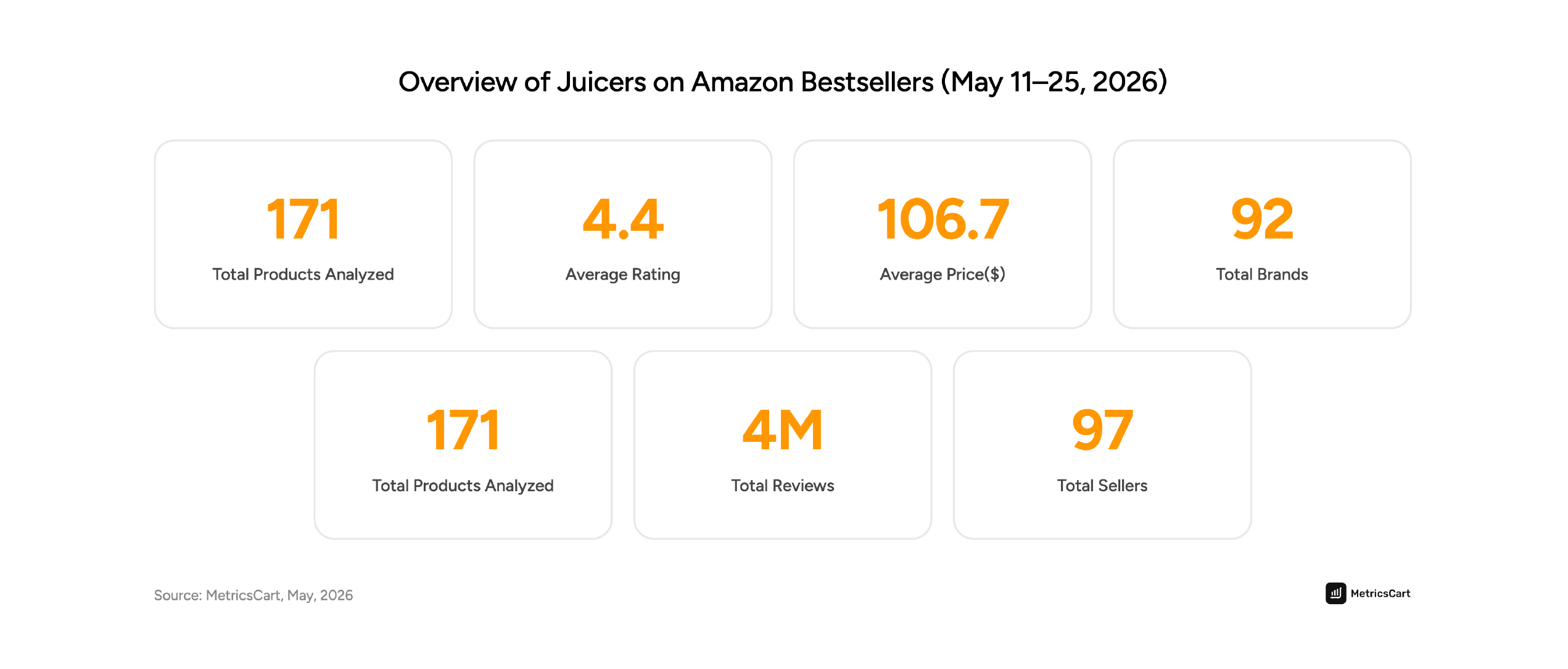
Based on MetricsCart’s analysis, Amazon’s juicer bestseller category included 171 listings between May 11 and May 25, 2026, across 92 brands and 97 sellers. The category averaged a selling price of $106.70 and a 4.4-star rating, with nearly 4 million reviews in total.
Read together, those figures describe a shelf that is crowded, cheap to enter, and rated almost uniformly.
The 171 listings are split across 92 brands and 97 sellers, putting both at fewer than two listings each. No brand holds enough space to win on assortment, and no seller holds enough to set the category’s price. The 4 million reviews confirm the demand. The 4.4 average rating shows ratings have stopped separating products, since almost everything here earns a similar score.
The $106.70 average is the number to treat with caution. It sits between a $7.10 reamer and a $749 cold-press machine, so it describes almost nothing on this shelf.
Cold Press, Centrifugal, or Citrus: What Amazon’s Juicer Shelf Is Made Of
| Juicer Type | Price Position | Shelf Characteristic |
| Cold Press | Premium | Occupies the highest price tier |
| Centrifugal | Mid-range | Appears across the price range. |
| Citrus | Budget | Occupies the lowest price tier. |
MetricsCart’s product-type analysis shows that Amazon’s juicer shelf is divided into three distinct segments, each occupying a different price band. Cold press juicers dominate the premium end of the market, citrus juicers compete at the budget end, while centrifugal models bridge the gap by appearing across a broad range of price points.
The reason they separate so cleanly is that type decides price, and price decides how a machine gets bought. A cold press machine is a considered purchase, replaced perhaps once a decade.
Citrus juicers, on the other hand, are lower-cost purchases that are more likely to be bought as replacements, gifts, or impulse purchases. Centrifugal juicers serve the broad middle of the market, appealing to shoppers seeking a balance between performance and affordability.
So the shelf is best read in one direction. Type sets the price, price sets the purchase frequency, and frequency sets the review volume, which ultimately drives rank.
Which Juicer Brands Dominate Amazon Bestsellers, and Why
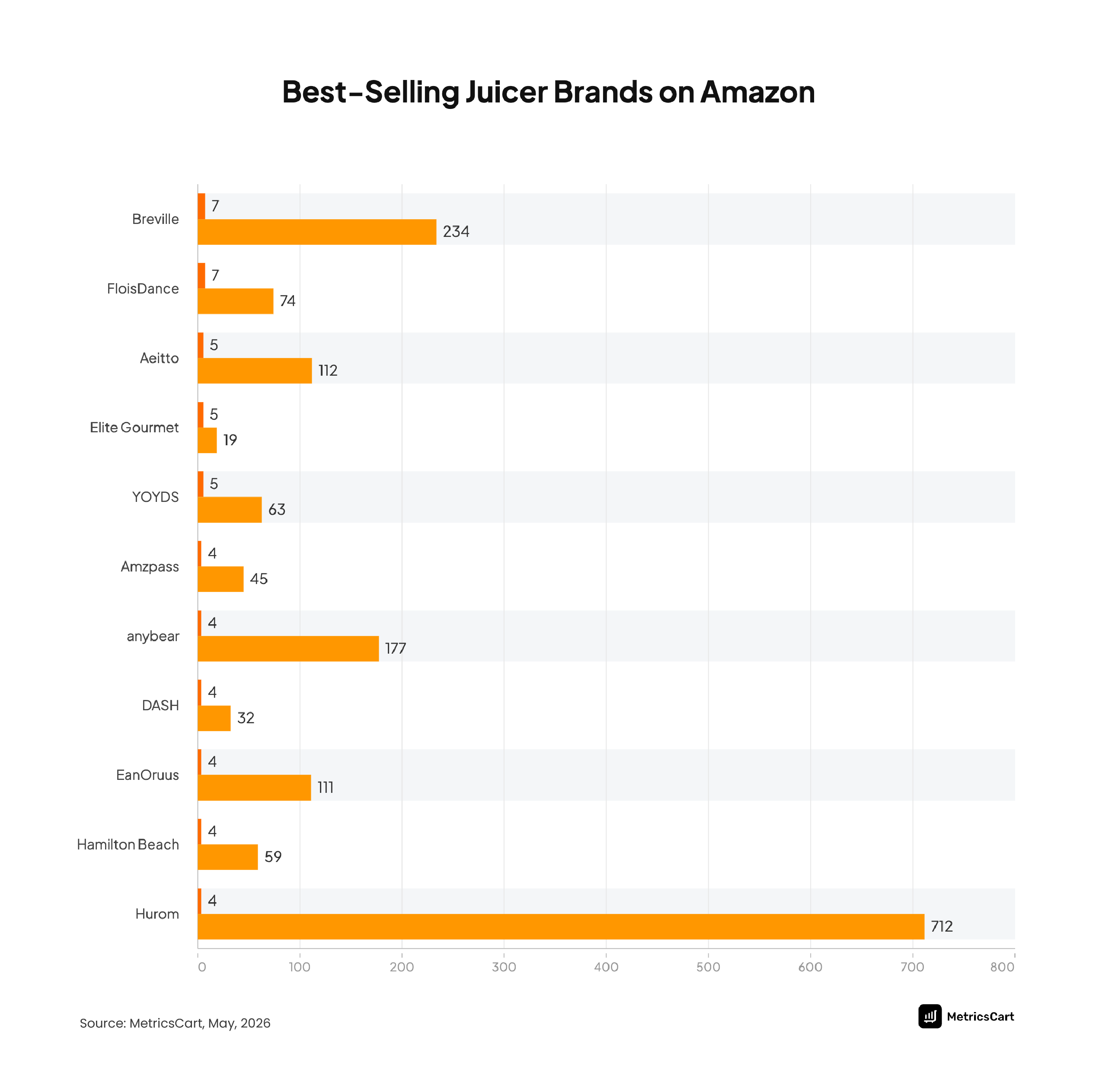
MetricsCart’s analysis of the top 10 juicer brands on Amazon’s bestseller shelf shows that listing count does not predict review volume. Breville and Floisdace both hold 7 bestseller listings, the highest in the category, yet Breville has accumulated 725,000 reviews at an average price of $234, while Floisdace has accumulated negligible reviews at an average price of $74.
By price tier, the data show review volume concentrated at the extremes rather than in the middle of the range. Elite Gourmet, priced at $19, holds 250,000 reviews. Hurom, priced at $712, also registers meaningful review activity.
Between these two points, five brands (Aeitto at $112, Anybear at $177, Amzpass at $45, YOYDS at $63, and DASH at $32) account for 21 combined listings but show comparatively low review volume relative to their shelf share.
Within the mid-premium tier specifically, Breville and Aeitto both occupy price points where Amazon buyers typically make repeat purchases, yet only Breville shows strong review accumulation. MetricsCart’s data attributes part of this gap in listing tenure: Breville’s Juice Fountain line has held bestseller positions across multiple prior reporting periods, while Floisdace’s and Aeitto’s listings show a shorter presence on the shelf. Tenure alone cannot be confirmed as the sole driver of the review gap from this data set, but it correlates with brands that have converted shelf presence into review volume.
Two findings follow from this analysis:
- Listing count and review volume are independent variables in this category — brands with identical shelf presence produce materially different review outcomes.
- Review accumulation favors the price extremes. Brands priced between $32 and $177 underperform on review volume relative to brands priced below $20 or above $700, based on the top 10 brands analyzed.
Best-Selling Juicers on Amazon: What Review Volume Reveals
Review volume is the closest public proxy for purchase frequency on Amazon. It misses basket size and repurchase rate, and it still tells you which machines shoppers keep returning to.
Most Reviewed Juicer Machines on Amazon
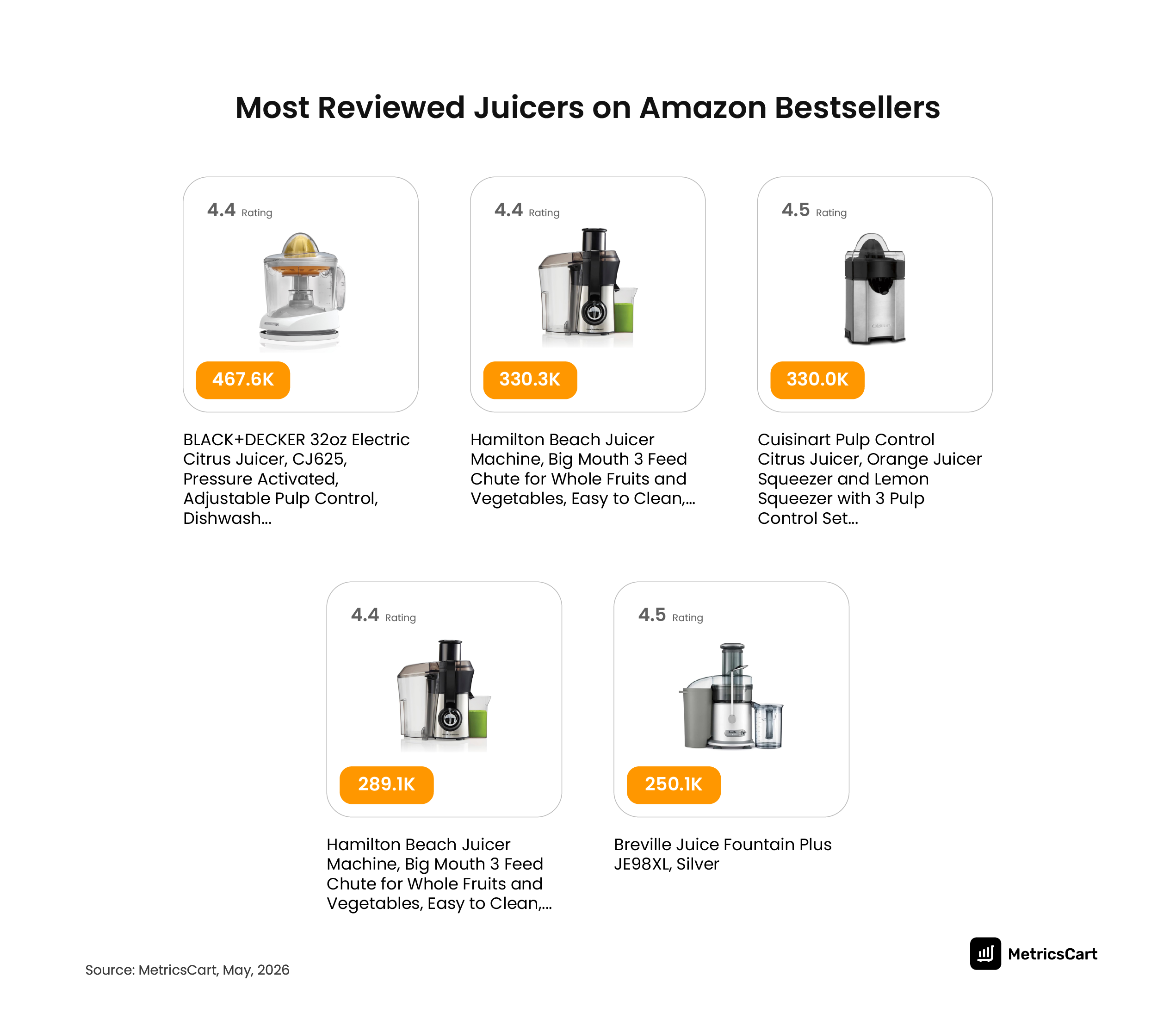
Using the MetricsCart rating and review analysis platform, the BLACK+DECKER 32oz Electric Citrus Juicer leads the category with 467,600 reviews and a 4.4-star rating. This is consistent with the category-level pricing pattern established earlier in this report: citrus juicers occupy the lowest price tier, and lower prices correlate with higher purchase frequency, which drives greater review accumulation over time.
Hamilton Beach’s Big Mouth juice extractor follows at 330,300 reviews, a mid-market centrifugal machine. The Cuisinart Pulp Control Citrus Juicer holds 330,000 reviews at a 4.5-star rating, marginally behind Hamilton Beach on volume and marginally ahead on rating.
Three findings emerge when this data is read against the category’s broader market structure:
- Review volume tracks current purchase frequency, not category growth. All ten most-reviewed products are citrus or centrifugal; cold-press, the segment with the higher projected growth rate, is absent. Bestseller review data reflects present shelf demand, not where category dollars are trending.
- Duplicate listings understate true demand. Hamilton Beach’s Big Mouth appears twice (330,300 and 289,100 reviews). Combined, it would outrank BLACK+DECKER outright, a consolidation gap that masks the category’s actual review leader.
- Breville’s efficiency holds at the SKU level, not just the brand level. Three Breville products place in the top ten, led by the Juice Fountain Plus JE98XL (250,100 reviews); the same replacement-purchase economics that make Breville the top brand overall are repeating across its individual listings, not concentrated in one hit product.
The absence of cold-press machines from this list is itself a market-relevant finding. If the cold-pressed juice market is genuinely on the growth trajectory suggested by industry projections, that growth is not yet visible in Amazon’s bestseller review data.
It may be occurring through channels this shelf-level analysis does not capture, such as direct-to-consumer sales or lower-frequency, higher-value purchases that accumulate reviews too slowly to compete with citrus and centrifugal machines on this metric.
Top Reviewed Juicer Brands on Amazon
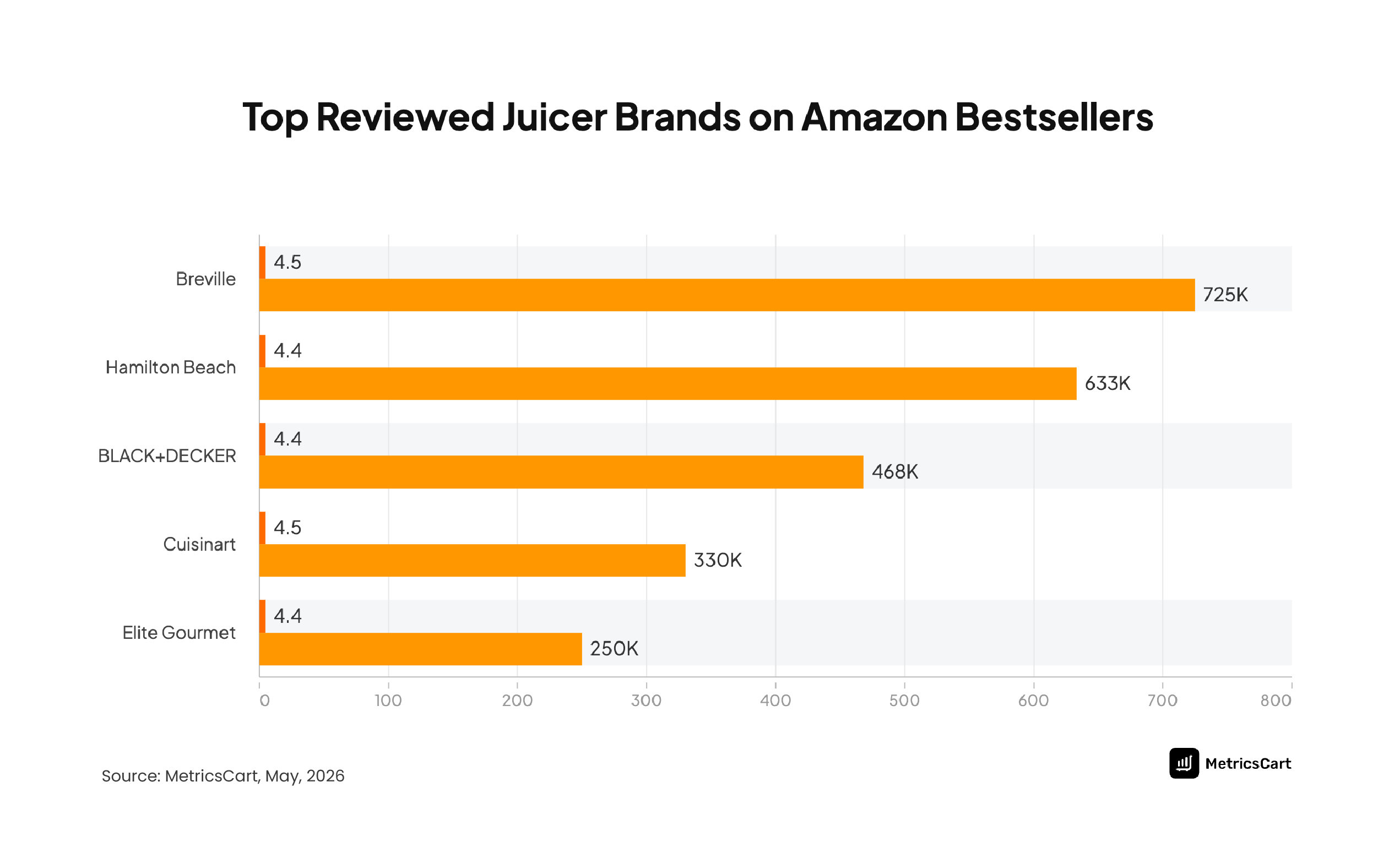
Breville leads with 725,000 reviews at 4.5 stars, built on three long-tenured centrifugal machines priced in the replacement band. Volume accumulated slowly, over years, in the part of the price ladder where households buy more than once.
Hamilton Beach follows at 633,000 reviews, concentrated almost entirely in the Big Mouth and its variants. BLACK+DECKER sits at 468,000, and essentially all of it comes from a single citrus juicer.
The rest of the chart holds Cuisinart (330,000), Elite Gourmet (250,000), Eurolux (214,000), Proctor Silex (203,000), LEBENLANG (125,000), LUUKMONDE (95,000), and Juilist (94,000).
Two absences say more than the rankings. Hurom carries the highest prices in the category and does not appear on this chart at all. Floisdace matches Breville’s shelf presence and does not appear either. Neither brand is failing at the product. Both are priced outside the band where reviews accumulate.
Elite Gourmet is the mirror image, placing fifth at a $19 average price.
Ratings again separate nothing. Every brand here has a rating between 4.3 and 4.6 stars. LEBENLANG holds the highest rating at 4.6 and ranks eighth by volume, which clearly demonstrates that a rating advantage does not translate into visibility in this category.
Juicer Price Trends on Amazon: The $7 to $749 Spread
Juicers on Amazon’s bestseller shelf range from $7.10 to $749, and the reasons for the price differences are different at each end.
Most Expensive Juicers on Amazon Bestsellers ($250.00 – $749.00)
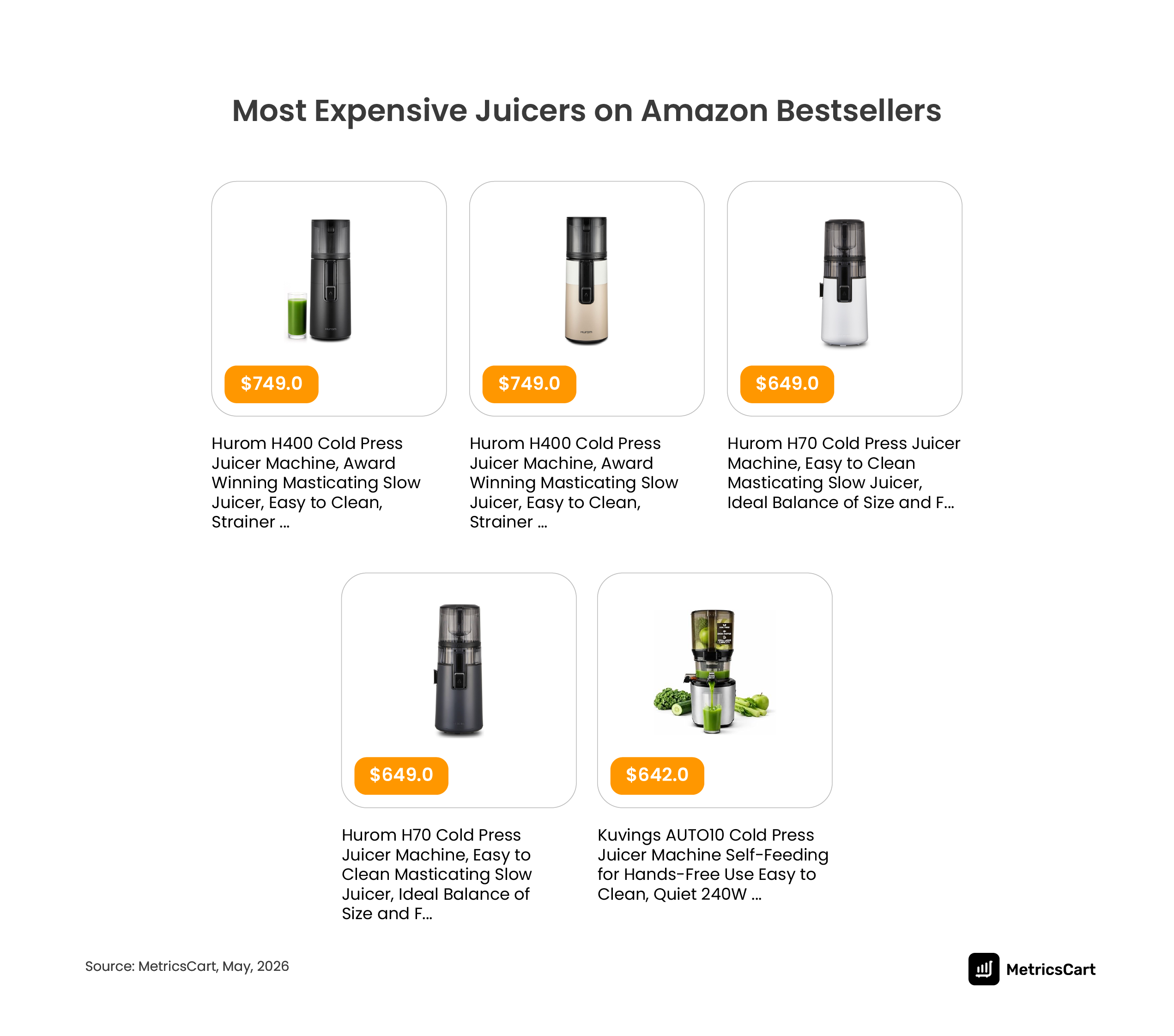
The Hurom H400 tops the shelf at $749, listed twice, with the H70 behind it at $649, also listed twice. Four of the highest positions belong to a single brand.
The premium tier is cold press, and cold press is costly to build. These machines crush produce slowly against a screw, which calls for a strong motor, a heavy gearbox, and a housing that can take the strain. A centrifugal machine only spins a blade. The build is heavier, so the price is higher.
That explains why the tier is expensive. It does not explain why Hurom sits at the very top, and above that baseline, three different things are being charged for:
- Distribution control. Hurom lists its Amazon range through its own storefront at its own price, so no reseller undercuts it, and no discounting drags the number down. Every other premium brand shares its listings with third parties. Hurom does not, and that is what holds $749 in place.
- Convenience. The Kuvings AUTO10 ($642) and Nama J2 ($599) are self-feeding, so the hopper draws produce in on its own. That removes the one chore cold press cannot design away, and buyers pay for the time it saves.
- Mechanism. Breville’s top machine, the Juice Fountain Cold XL ($399.90), sits far lower because it is centrifugal, cheaper to build, and cheaper to sell. Hurom sells a slow-juicing ritual; Breville sells a fast kitchen appliance.
Anybear closes the tier at $250, the lowest-priced cold press machine on the shelf.
Most Affordable Juicers on Amazon Bestsellers ($7.10 – $20.00)
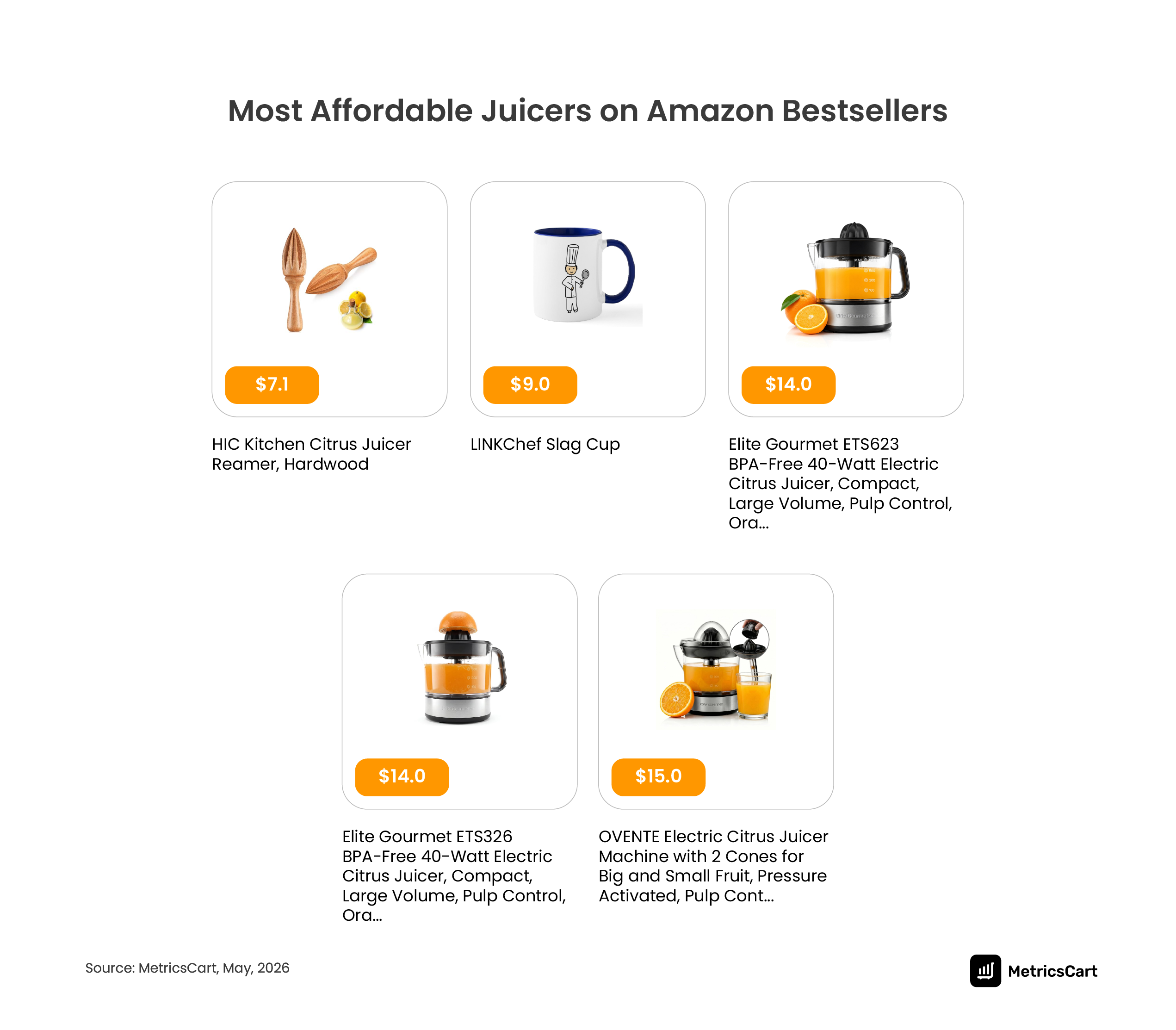
The cheapest listing is the HIC Kitchen Citrus Reamer at $7.10. It is a shaped piece of hardwood, with no motor, gearbox, or electronics. Once everything a manufacturer could charge for is stripped out, $7 is what remains.
The rest of the low end is cheap for a related reason: citrus asks very little of a machine.
- The LINKChef Slag Cup ($9) and Elite Gourmet’s ETS623 and ETS326 ($14) run on 40 watts, because spinning a cone against a halved orange needs almost no power.
- The fruit does the work. A centrifugal machine has to shred a whole apple and a cold press has to crush one, but a citrus juicer only presses fruit that is already soft. With little to engineer, there is little to charge for.
That is why the entire affordable tier is citrus.
Elite Gourmet builds a strategy on exactly that, holding four of the ten cheapest slots with near-identical 40-watt machines priced between $14 and $17.30, each aimed at a slightly different shopper. The approach earned 250,000 reviews and ranked fifth among the most-reviewed brands in the category.
Nine of the ten cheapest listings sit under $20, squarely in impulse territory. The two cheapest are manual, which places the floor of this category below the cost of the electricity to run one.
Who Is Selling Juicers on Amazon
Source: MetricsCart, May, 2026
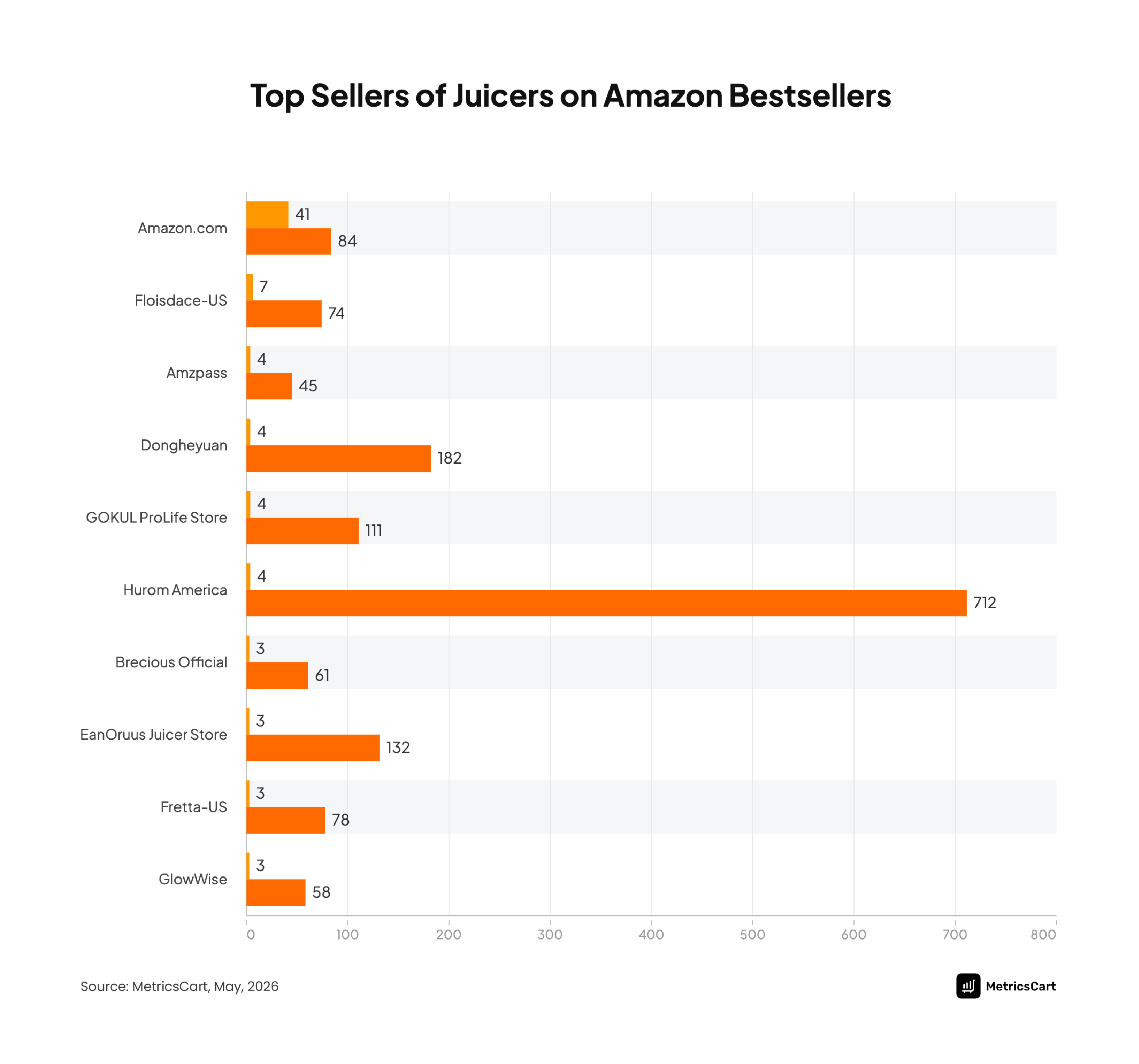
Amazon.com is the largest seller, with 41 listings at an average price of $84, almost six times the number of listings of the next seller. That $84 becomes the anchor; every other price on this shelf gets judged against.
Floisdace-US follows with 7 listings at $74, a brand storefront selling below the anchor.
Four sellers then tie at 4 listings each, and the spread is the finding:
- Amzpass at $45
- GOKUL ProLife Store at $111
- Dongheyuan at $182
- Hurom America at $712
Identical shelf presence, four different price realities.
Hurom America is the one to study. It is the only brand-operated storefront in the top ten and the only seller pricing at its own ceiling, because its entire Amazon presence sits inside a storefront it controls. That is why $712 holds while brands with wider distribution cannot defend half of it.
The risk sits in the tail. With 97 sellers across 171 listings, the average seller holds fewer than two products. Dongheyuan at $182 and EanOruus Juicer Store at $132 are priced well above the anchor with no brand signal in the storefront name, and that is the activity a brand team misses until the data is weeks old.
What Does Amazon’s Juicer Data Reveal About Category Whitespace
Every price point is taken, and the category is crowded, so the opening is not a missing product. It is a way of competing that few brands here have adopted. Four lessons carry beyond juicers to any crowded Amazon category.
- Price decides demand, which decides rank. Where a product sits on the price ladder determines how often it sells, and purchase frequency builds the review base that drives rank. Price is a demand lever before it is a margin lever.
- The extremes win and the middle stalls. A clear low-cost or premium position gives shoppers a reason to choose. A mid-priced product is too expensive for an impulse buy and too cheap to research, so it reaches neither. Commit to the end of the ladder.
- A premium price needs a repeat-purchase engine. High-priced, long-lived products struggle on a platform that rewards frequency, since something bought once a decade cannot accumulate reviews. Accessories, consumables, and replacement parts turn a one-time sale into a returning one.
- Proven low-end demand rarely gets tested at the top. When a format sells heavily at a low price, brands assume that is where it belongs and leave the premium version unbuilt. The demand is often ready for whoever tests whether it travels upmarket.
The thread across all four is this: on Amazon, a brand chooses a price, and in doing so, it chooses a customer, a purchase cycle, and a ceiling on its own visibility.
How MetricsCart Helps Brands Act on the Shelf
The findings in this report are only helpful if you can see them playing out on your own shelf and there is still time to act. That is what MetricsCart does.
It keeps an eye on price, reviews, sellers, and rank across every juicer listing, every day. So when a rival cuts its price or a reseller lists above you, you hear about it now, not weeks later when the sales have already gone.
That head start is the whole point. When you can see the shelf clearly, you can price it right, stop resellers from dragging your listings around, and step into an opening before anyone else notices it. On a shelf this crowded, where prices can move in a week, the brand that spots the change first is usually the one that wins.
Don’t Let Competitors Squeeze the Value Out of Your Amazon Shelf.