There’s no polite way to say it: people don’t trust brands, they trust people.
Today, nearly every shopper relies on reviews before making a purchase. 95% of consumers read customer reviews before buying anything online. Similarly, Spiegel Research Center found that displaying reviews can increase conversion rates by up to 270%, especially for higher-priced items.
Reviews have become so central to e-commerce that Amazon’s search ranking algorithm uses not just the number of reviews but also review recency, sentiment, and depth as ranking factors, making review analysis a strategic necessity, and not just a peripheral task.
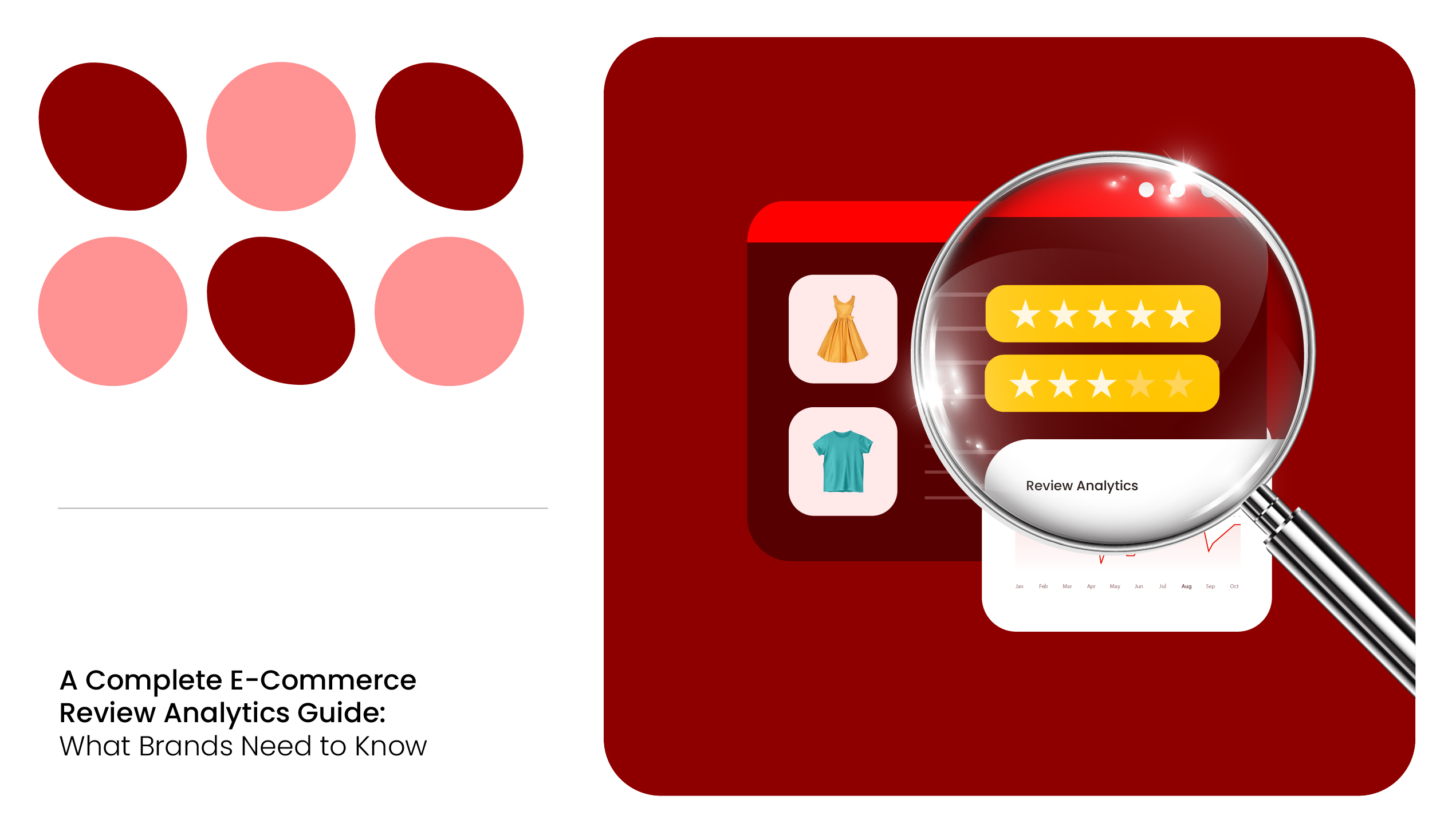
When consumers have unlimited choices, review data functions as real-time market research that signals what customers value, dislike, expect, or reject. This e-commerce review analytics guide walks through everything brands must know about using review intelligence to strengthen their digital shelf performance, improve product quality, and build trust.
What is E-Commerce Review Analysis?
At its core, e-commerce review analysis is the systematic process of collecting, interpreting, and acting on customer feedback from e-commerce platforms and user-generated content sources. Think of it as the difference between seeing reviews and actually understanding what customers are trying to tell you.
It includes understanding review volume, star ratings, written feedback, image and video reviews, creator commentary, and sentiment trends. The goal is to transform raw, unstructured reviews into insights that shape decisions in marketing, pricing, product design, and customer experience.
Across industries, from CPG to consumer electronics, reviews shape perception long before a customer interacts with a product or brand. They also shape search demand. For example, Google integrates star ratings as rich results for products and merchants, giving review-rich listings greater visibility and higher CTR.
Whether it’s Amazon’s ranking system, Google’s SERPs, Walmart’s PDP structure, or TikTok’s “People say” sections, the digital shelf rewards brands that monitor, analyze, and respond to reviews consistently.
Scope of E-Commerce Review Analytics
Modern e-commerce feedback analysis goes far beyond counting stars or filtering for 1-star complaints. It involves using natural language processing (NLP), machine learning, and thematic clustering to extract meaning from thousands of reviews at once.
This includes identifying recurring themes (delivery issues, durability concerns, scent complaints), mapping sentiment trends, comparing performance across SKUs, and benchmarking against competitor products.
The scope is broader than many brands realize. Review analytics covers:
- Product reviews on Amazon, Walmart, Target, and D2C websites
- UGC, creator-led product reviews on YouTube and TikTok
- Community discussion threads on Reddit
- Q&A sections on product listings
- Post-purchase surveys
- Influencer hauls, unboxings, and comparison videos
The modern consumer does not limit their voice to “verified reviews” anymore, and online review analytics now includes the expanded footprint of customer feedback.
Why Is E-Commerce Review Analysis Important for Brands?
And here’s the thing: the market doesn’t care how good you think your product is. It cares how good customers say it is. That’s the entire game. When you take review analysis seriously, you’re basically tuning in to the world’s most honest focus group, and they don’t sugarcoat anything.
If you’re not analyzing reviews, here’s what you’re missing:
- The language your customers actually use
- The features they love (which you should market harder)
- The problems they hate (which you should fix immediately)
- The emotions behind buying decisions
- The competitive advantages you didn’t realize you had
- The early warning signs of product issues
- The reasons customers churn or switch brands
Every brand wants to “be customer obsessed.” Review analytics is the customer obsession brands should aim for.
To understand this further, let’s look at how e-commerce feedback analysis builds brand growth.
How Does Review Analysis Boost E-Commerce Performance?
Review analysis directly impacts how customers perceive your brand, how your SKUs perform on marketplaces, and how your team makes decisions. Here are a few ways review monitoring and analysis boost brand performance:
1. Enhancing Brand Strategy
Brand strategy is your long-term narrative about who you are, what you stand for, and why customers should pick you over everyone else. Product review analysis gives you proof instead of assumptions.
If hundreds of customers say things like “this is my go-to travel serum,” that tells you your brand plays well in an “on-the-go” or “travel-friendly” narrative. If they keep saying “finally a supplement that doesn’t upset my stomach,” you have a gut-sensitivity positioning waiting to be codified into strategy.
Imagine a brand selling reusable water bottles. Internally, they think their advantage is “sustainability.” But reviews repeatedly mention “doesn’t leak in my bag,” “keeps ice all day,” and “fits car cup holder.” That suggests the strategic story is not “sustainable bottle,” it is “reliable, daily carry bottle that works with real life.” That is a different type of differentiation.
Customer review analytics lets you align your brand promise with what customers actually experience. That’s how the strategy becomes sharp.
2. Real-Time Data for Competitive Advantage
Most brands only realize they have a big problem when sales dip, ratings fall, or retailers complain. By then, the damage has already spread. E-commerce review analytics gives you a time advantage.
Imagine you are an Amazon seller in the electronics category. You launch a new set of wireless earbuds. For the first two weeks, things look fine. Then, the review sentiment begins to tilt negative. Early comments mention “disconnects from my phone randomly.” If you are running proper customer review analytics, you see that pattern forming. You can investigate firmware, issue an update, and respond to reviews quickly.
Your competitor, who does not run this level of product review analysis, may not notice until returns spike and their rating drops below four stars. The algorithm stops recommending them as strongly. You now have a competitive window.
Real-time review insights are less about graphs and more about reaction time. That reaction time is an edge.

3. Marketing
Marketing and retail media efforts become more effective when they reflect how customers naturally talk about your product. Customer review analysis provides this language. Customers often articulate benefits in ways that are more relatable, more persuasive, and more specific than brand-centric messaging.
When marketers adopt customer language and use phrases like “fits perfectly in the cup holder,” “stays cold all day,” or “connects in seconds, conversion rates rise.
Online review analytics also identifies objections customers frequently express, which can be addressed directly in ad copy, FAQs, or PDP bullet points.
The result is marketing that feels precise, grounded, and emotionally aligned with the buyer. Integrating customer feedback analysis into marketing strategy is one of the best ways to turn reviews into sales.
4. Product Research and Development
Product teams often ask, “What should we fix first?” or “What should we build next?” Review analytics answers with evidence.
Imagine a blender brand. Reviews reveal that people love the power but hate how hard it is to clean under the blades. The product review analysis shows that “hard to clean” is mentioned in 18 percent of negative reviews. It is more important than the noise level and the jar size complaints.
Product teams rely heavily on review analytics to identify recurring issues, understand which improvements matter most, and evaluate the functional performance of each SKU. Reviews reveal pain points that internal testing may miss, such as real-world usage problems, packaging failures, unexpected durability issues, or unclear instructions.
Reviews also highlight opportunities for innovation based on unmet customer desires. Over time, the aggregation of review insights creates a roadmap for version improvements, new variants, and even new product lines. Product development becomes more efficient and more aligned with customer needs when informed by structured review data.
READ MORE | Product Development Using Customer Feedback: Must-Know Tips for Brands
5. Improving Online Brand Reputation
A brand’s online reputation is deeply influenced by review consistency. A single frustrated customer can leave a detailed negative review that attracts high visibility. But dozens of positive reviews can stabilize brand trust if managed well.
Ratings and reviews analysis helps brands identify persistent issues that damage reputation and correct them early. It also helps CX teams prioritize which responses will meaningfully improve customer perception, which complaints require public acknowledgment, and which can be resolved through internal fixes.
When brands consistently act on review insights, sentiment stabilizes and long-term trust increases.
6. Price Strategy
Customers frequently comment on price perception. Review monitoring and analysis shows whether customers believe your product delivers value for money, whether they compare your pricing to competitors, and whether specific SKUs feel overpriced.
These insights guide pricing decisions, discount strategies, and bundling offers. For categories with high price elasticity, such as CPG or beauty, review-driven pricing insights help brands avoid unnecessary price drops.
For high-ticket items, such as appliances or electronics, review insights help brands maintain premium pricing by emphasizing the features customers value most.
With a robust review monitoring software like MetricsCart, you can dig deep into what customers are actually saying about your product online. Use that data to power your next strategy!
READ MORE | Role of Customer Feedback in Supply Chain: Why It Matters More Than Ever
How Review Analysis Works: A Step-By-Step Breakdown
Custom review analysis follows a predictable, structured process that transforms unorganized text into actionable insights:
Step 1: Gather Reviews from Multiple Sources
The first step in the review analytics workflow is consolidating feedback across all relevant channels. Customers speak on Amazon, Walmart, Target, Shopify, YouTube, TikTok, Reddit, brand-owned sites, and email surveys.
A multi-source approach ensures that insights are comprehensive rather than marketplace-specific. Without this step, brands risk interpreting only a narrow slice of customer voice and missing important issues present elsewhere.
Step 2: Clean and Prepare the Data
Raw review data is messy. It often contains spam, bot-generated feedback, duplicates, irrelevant comments, and unstructured text full of slang, typos, or emojis.
Before analysis begins, the data must be cleaned and standardized. Cleaning ensures that the insights generated are reliable. Otherwise, noise can distort trends and lead to misleading conclusions. Clean data sets the foundation for accurate e-commerce feedback analysis.
Step 3: Categorize Reviews Automatically
Machine learning models then classify reviews into categories and themes. This is where reviews move from unstructured text to structured intelligence. Themes such as quality, packaging, performance, value, taste, durability, installation, or customer service emerge.
Categorization allows teams to look at issues in a focused way rather than drowning in thousands of unrelated comments.
Step 4: Identify Key Themes and Keywords
The system then identifies recurring phrases and keywords. This reveals emerging issues and customer priorities.
If customers repeatedly mention “leaking,” “noisy motor,” “weird smell,” or “amazing texture,” these keywords help pinpoint exactly what the thematic issues represent. Keyword extraction helps identify new trends before competitors catch on.
Step 5: Visualize Insights
Finally, the system presents insights through dashboards and visualizations. Charts, heat maps, line graphs, comparison tables, and trend analysis visuals make it easy for decision-makers to understand complex data instantly. Clear visualization transforms analytical insight into organizational action.
READ MORE | Why MetricsCart is Your Ultimate E‑Commerce Review Tracking Solution?
What is Thematic Review Analysis?
Thematic review analysis is the process of grouping similar comments across thousands of reviews into clear, structured themes.
Instead of reading scattered feedback, brands see the primary categories of customer experience, such as quality, packaging, durability, flavor, fit, ease of installation, or customer service.
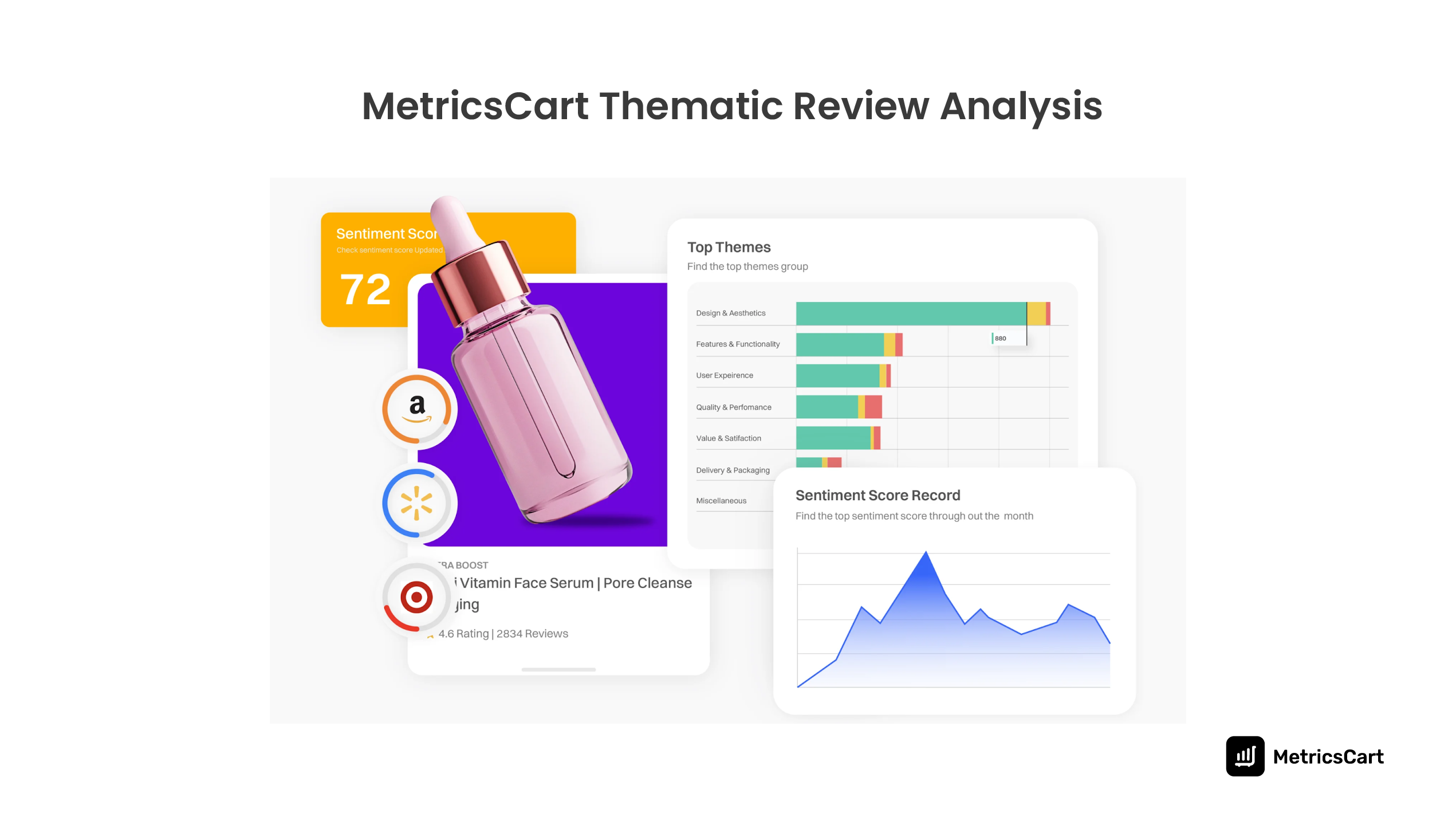
This method helps brands understand not only what customers say but how often they say it and how sentiment differs by theme.
How Thematic Review Analysis Works
Thematic analysis uses advanced machine learning techniques to identify recurring patterns in review text. It detects phrases that relate to each other, even when customers use different wording.
For instance, “lid broke,” “cap cracked,” and “hinge snapped” all map to the theme of packaging durability. This contextual understanding is what makes thematic analysis superior to simple keyword searches.
Once themes and sub-themes are identified, the system quantifies how often each theme appears, whether the trend is increasing or decreasing, and whether the overall sentiment around that theme is positive or negative. This structured approach replaces subjective manual interpretation with objective intelligence.
Why Thematic Analysis Is Beneficial for Brands
Thematic analysis brings clarity to complex data.
- It helps brands prioritize which issues require immediate attention by showing which themes have the highest volume of negative sentiment.
- It helps teams identify unexpected strengths by highlighting which aspects customers consistently praise.
- Most importantly, it allows brands to see patterns unobscured by individual review anecdotes.
When brands understand the major themes driving customer sentiment, they make more focused and effective improvements across product, packaging, and customer experience.
How Brands Use Thematic Review Analysis
Thematic and sub-thematic review data can power your multiple teams:
- Product teams rely on theme clusters to determine which improvements will deliver the greatest customer impact.
- Marketing teams use recurring positive themes to craft stronger product messaging and highlight differentiators.
- Customer experience teams monitor themes related to support, delivery, or unboxing issues.
- Leadership teams use themes as KPIs to measure brand health across categories.

What is Customer Sentiment Analysis?
Customer sentiment analysis is the process of understanding the emotional tone behind customer feedback. Rather than simply reading what customers say, sentiment analysis interprets how they feel. Emotion is often a stronger predictor of future behavior than star ratings alone.
Two customers may leave four-star reviews, but one may express frustration while the other expresses enthusiasm. Sentiment analysis captures this difference.
How Sentiment Analysis Works
Sentiment analysis uses NLP models trained to detect emotional cues in language. It examines adjectives, tone-describing phrases, intensifiers, negations, and even punctuation.
The system classifies each review as positive, negative, neutral, or mixed. More advanced models detect nuance, such as moderate vs intense dissatisfaction or subtle shifts in tone.
The final sentiment score becomes a quantifiable measure that can be tracked over time, analyzed by SKU, or compared against competitors.
Why Sentiment Analysis Is Beneficial for Brands
Sentiment analysis reveals emerging customer dissatisfaction long before the star rating changes. Ratings tend to be stable, but sentiment fluctuates more quickly and more accurately reflects emotion.
When sentiment drops, it signals that the customer experience has changed. Brands use sentiment analysis to understand which product features disappoint customers, which improvements restore confidence, and which competitors generate stronger emotional reactions.
This gives brands the ability to act before issues escalate into rating declines or revenue loss.
How Brands Use Sentiment Analysis
Here’s how review sentiment data becomes the emotional compass of the entire brand:
- Leadership teams use sentiment directionality to assess category health.
- Marketing teams analyze sentiment around value perception to refine messaging.
- Product teams analyze sentiment around performance or durability to guide engineering decisions.
- Customer support teams use sentiment to identify recurring dissatisfaction points.
MetricsCart’s review management system does it all, from thematic & sub-thematic analysis to decoding customer sentiment to reveal your next hero strategy.
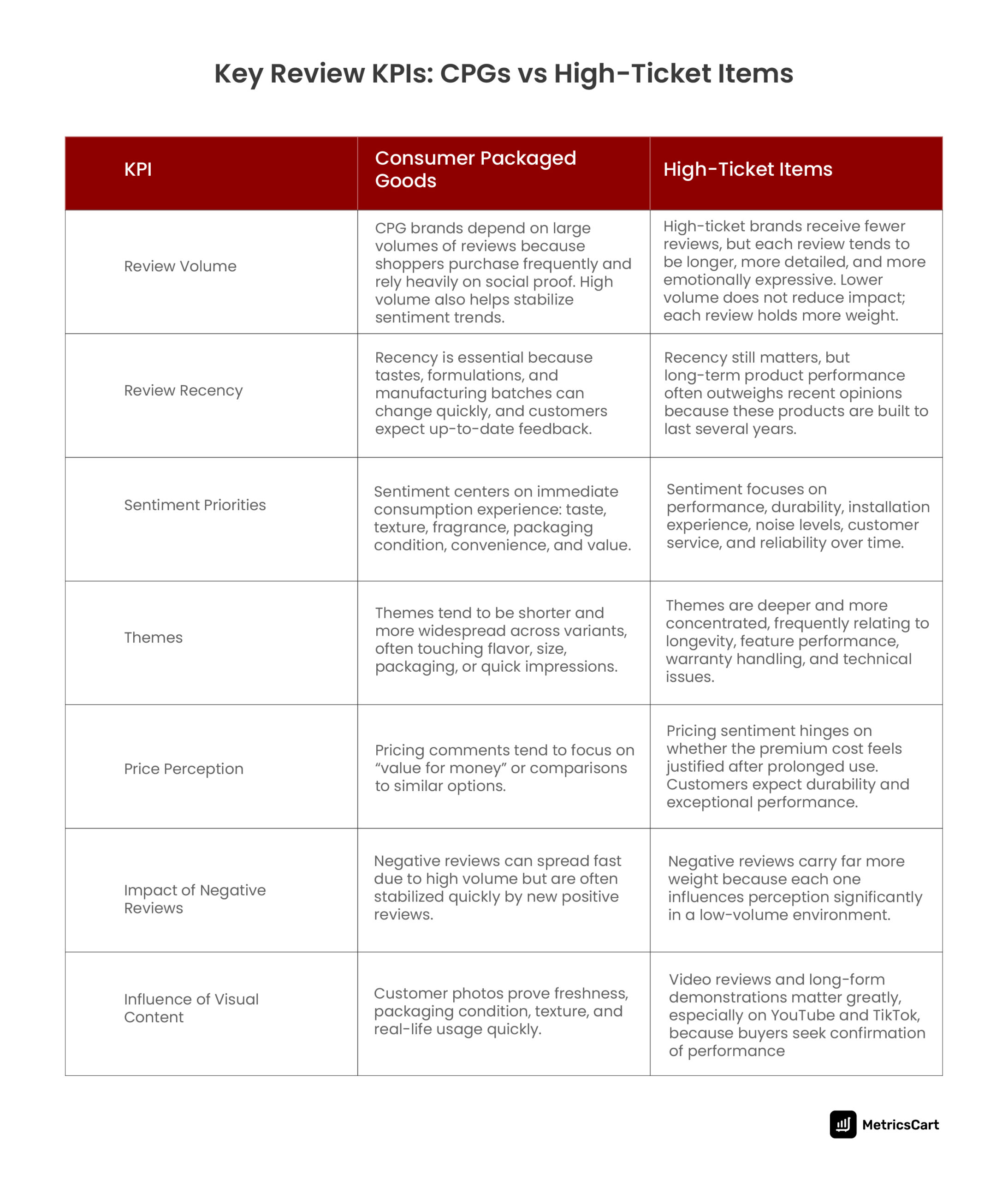
Key Review KPIs for CPGs and High-Ticket Items
Review KPIs differ substantially by category. Here’s a look at how it differs for CPG and high-ticket categories:
READ MORE | Weekly Review Tracking for CPG Brands: Why It Matters
How Product Review Videos on YouTube Offer More Insights
Text reviews capture customer thoughts, but video reviews capture customer reality. YouTube reviews reveal tone of voice, product handling, unboxing experience, long-term wear, real use-case demonstrations, and creator credibility.
Viewers see the product in motion, hear enthusiasm or dissatisfaction, and observe performance in real conditions. This offers deeper insight than text alone.
MetricsCart’s Consumer Insights platform extracts full transcripts from YouTube videos, analyzes themes within the spoken content, identifies emotional cues, and maps sentiment to product attributes.
This turns YouTube UGC into structured review intelligence. Brands gain access to insights that cannot be expressed through words alone, such as sound levels, texture, material quality, or visual imperfections.
MetricsCart focuses on the platforms where buying decisions actually form. This makes it uniquely equipped to identify UGC themes that move a shopper from awareness to intent and eventually to purchase.
Best E-Commerce Review Monitoring Tools
This e-commerce review analytics guide is incomplete without listing out the top ratings and review analysis tools. Choosing the right review monitoring software that caters to your brand’s specific needs is a make-or-break deal.
1. MetricsCart
Primary Strength: Unified ratings and review analytics with commerce-focused UGC intelligence.
What Makes It Stand Out: MetricsCart is a first-of-its-kind platform in the industry that brings together marketplace review analytics and deep UGC insights (Consumer Insights platform) from YouTube product reviews and online discussions, allowing brands to understand customer voice across the platforms where buying decisions genuinely start.
Its combination of SKU-level analysis, sentiment tracking, competitor benchmarking, and UGC intelligence makes it uniquely commerce-driven.
Ideal For: Enterprise-level and mid-sized brands that want both traditional review analytics and advanced UGC intelligence connected to real purchase behavior, brand loyalty, SKU strategy, and competitive dynamics.
2. PowerReviews
Primary Strength: Review collection and syndication at scale.
What Makes It Stand Out: PowerReviews offers strong pipelines for collecting first-party reviews and distributing them across major retail partners, making it valuable for increasing PDP review volume and consistency.
Ideal For: Brands seeking to improve retail PDP coverage through widespread review syndication.
3. Bazaarvoice
Primary Strength: Enterprise review syndication and broad retail network coverage.
What Makes It Stand Out: Bazaarvoice has one of the largest retail syndication ecosystems, enabling brands to push reviews across an extensive network of marketplaces and retailer websites.
Ideal For: Large omnichannel brands with significant retail distribution.
4. Yotpo
Primary Strength: DTC-first reviews with loyalty, SMS, and visual UGC integration.
What Makes It Stand Out: Yotpo excels for direct-to-consumer brands by combining reviews with loyalty programs, email/SMS flows, and shoppable UGC, making it ideal for boosting on-site engagement.
Ideal For: Shopify and DTC brands prioritizing first-party review collection and visual content.
5. ReviewTrackers
Primary Strength: Local and multi-location review monitoring.
What Makes It Stand Out: ReviewTrackers centralizes reviews from Google, Yelp, Facebook, and other location-based platforms, making it effective for brands managing in-person service experiences.
Ideal For: Multi-location brands, retail chains, service providers, and hospitality businesses.
The Future of E-Commerce Review Analytics
The future of e-commerce review analytics is multimodal. Brands will no longer analyze only text. AI will interpret video frames, voice tone, visual product demonstration, image quality, and even environmental context. Online review analytics will merge with UGC analytics, social conversation mapping, and predictive modeling to show not just what customers say but what they are likely to say next.
Reviews run the internet. They shape demand. They influence perception. They decide whether your product moves or sits on the shelf.
And here’s the wild part: your customers are telling you everything you need to know to grow, but most brands barely scratch the surface. They look at star ratings, maybe skim a few comments, and keep moving. What they don’t realize is that reviews are the most powerful, unfiltered, scalable source of customer intelligence available today.
Customer feedback analysis doesn’t just tell you how customers feel. It tells you what to fix, where to double down, what to emphasize, and what to eliminate. It gives every team, from marketing to product to leadership, the clarity they need to make better decisions.
That’s what we built MetricsCart for! With in-depth customer review analysis, thematic and sub-thematic breakdown, along with sentiment scores and UGC intelligence, MetricsCart’s ratings and review monitoring software is a complete customer intelligence solution for brands that want to win online!
Grow Your Brand with Industry-Leading Review Analytics!
FAQs
E-commerce review analytics is the process of collecting and analyzing customer reviews across platforms like Amazon, Walmart, and DTC sites to understand sentiment, identify themes, and extract insights that improve product, marketing, and customer experience decisions.
Brands analyze reviews by gathering them from multiple sources, cleaning the data, categorizing feedback into themes, applying sentiment analysis, and tracking patterns over time. This helps reveal what customers love, what frustrates them, and what drives purchase decisions.
Product review analytics improves sales by showing which product attributes drive conversion and which issues block purchases. Brands use these insights to fix product problems, strengthen PDP messaging, refine pricing, reduce objections, and highlight features customers consistently praise.
Reviews strengthen marketing by revealing the exact language customers use to describe your product. This helps marketers build more authentic messaging, address real objections, and highlight attributes that matter most to buyers, leading to higher engagement and conversions.
Thematic review analysis helps brands understand the most common topics customers talk about, such as quality, durability, or delivery. By grouping feedback into themes, brands can quickly see where they excel, where they need improvement, and which issues impact customer satisfaction the most.