Highlights
- Pricing strategy is not just a number on a tag. It shapes how customers think about your brand, how retailers position your products, and how your margins hold up over time.
- Run enough promotions, and you stop training customers to buy. You train them to wait until the sale price becomes the only price they are willing to pay.
- EDLP is not simply keeping prices low. It is a structural commitment that changes how a brand manages inventory, forecasts demand, and negotiates with suppliers.
- Many brands end up running High-Low at some accounts and EDLP at others without ever making that choice, resulting in pricing conflicts, Buy Box instability, and customers who no longer trust your product’s value.
- The biggest risk is not choosing the wrong pricing model. It is losing track of how your pricing is actually playing out across your seller network before the damage is already done.
In 2012, JCPenney made a decision that looked logical on paper. The company scrapped its High-Low promotional model and shifted to everyday low prices.
Within a year, sales had fallen 25%, and the company reported a net loss of $985 million. Customers did not leave because the prices were bad. They left because the pricing behavior they had been trained on for years was suddenly gone, and nothing about the new model felt familiar.
The lesson brands still draw from that episode is not that EDLP is wrong. It is that pricing strategy is not just a number on a tag. It is a commitment that shapes how customers think about your brand, how retailers position your products, and how your margins hold up over time. Choosing the wrong model or running two models at once without realizing it can cost more than most brands expect.
This article breaks down what High-Low and EDLP pricing actually mean, how each model works in practice, where each one creates risk for brands, and how to decide which one fits your category, cost structure, and retail channel setup.
What Is a High-Low Pricing Strategy?
High-Low pricing is a retail pricing model where a product is listed at a higher base price and periodically discounted through sales, promotions, or markdowns. The idea is straightforward: a higher price makes the product feel valuable, and a discount makes customers feel they are getting a deal.
How Does High-Low Pricing Work in Practice
Brands and retailers execute High-Low pricing through:
- Weekly circulars and flyers that highlight limited-time deals
- Seasonal promotions tied to holidays, back-to-school, or clearance cycles
- Flash sales and loyalty discounts that reward repeat buyers
- Markdown events used to move slow or aging inventory
The whole model rests on one simple truth: people love feeling like they won. A product listed at $80 and discounted to $55 feels like a better deal than one priced at $55, even though the customer pays the same amount either way.
The Point Where Promotions Start Working Against You
The problem is not the first promotional cycle. It is the tenth.
Research analyzing more than 160 million grocery purchases found that shoppers who regularly received discounts on preferred items were more likely to shift their spending toward EDLP retailers over time. The takeaway for brands is uncomfortable but important: run enough promotions, and you stop training customers to buy. You train them to wait.
When a product goes on sale often enough, two things happen quietly:
- The sale price becomes the real price. Customers no longer consider the full price to be honest. They see it as the price before the discount they know is coming.
- Full-price sell-through dries up. Shoppers hold off, and the brand slowly becomes unable to generate revenue without a promotion running somewhere.
When High-Low Pricing Makes Sense
High-Low is well-suited for:
- Categories with natural seasonality (apparel, holiday goods, consumer electronics)
- Products where excitement and urgency genuinely drive purchase decisions
- Brands with margin structures that can absorb periodic discounting without long-term damage
What Is Everyday Low Pricing (EDLP)?
Everyday Low Pricing is a model in which a product remains at a single, consistent price over time. There isn’t an inflated base price, no promotional cycles, and no waiting for the right week to buy. The price a customer sees today is the same price they will see three months from now.
How Does Everyday Low Pricing (EDLP)Work in Practice
EDLP is not simply keeping prices low. It is a structural commitment that quietly changes how a brand runs its entire operation, from how it manages inventory to how it talks to suppliers. The stable pricing customers see is actually the end result of a lot of internal discipline happening upstream.
In an EDLP model:
- Demand forecasting becomes more reliable. When there are no promotional spikes distorting order volumes, inventory planning gets significantly easier and cheaper.
- Supply chain costs come down. High-Low pricing creates unpredictable demand, inflating logistics and warehousing costs. EDLP smooths that out over time.
- Customers stop timing their purchases. Instead of waiting for the next sale, they buy when they actually need the product. That shift in behavior is more valuable than it sounds.
For smaller CPG and DTC brands, the real question is not whether EDLP sounds like a good idea. It is whether the margin at the target retail price, across every channel and without any promotional volume padding, actually holds up. If it does, EDLP is a genuinely strong strategic choice. If it does not, the model will gradually compress margins until it becomes unviable.
When EDLP Makes Sense
EDLP is well-suited for:
- Everyday consumables with stable, predictable demand
- Brands whose reputation is built on being reliable, not on being the best deal this week
- Multi-channel sellers where keeping prices consistent across retail accounts is as much a compliance issue as it is a strategy
How Is EDLP Different From High-Low Pricing?
The simplest way to understand the difference is this: High-Low pricing is a bet on customer excitement. EDLP is a bet on customer trust. Both can win. Both have also destroyed brands that adopted them without understanding why they worked elsewhere.
| Strategic Pricing Factor | High-Low Pricing | EDLP |
| Base Price | Set high, reduced during promotions | Consistently low, no inflation |
| Customer Behavior | Trains customers to wait for sales | Builds habitual, trust-based purchasing |
| Margin profile | High at full price, compressed during sales | Stable but thinner overall |
| Operational complexity | High — requires managing promotions and markdowns | Lower, simpler pricing calendar |
| Best suited for | Seasonal goods, fashion, impulse categories | Staples, groceries, everyday consumables |
| Risk | Customer conditioning, margin erosion | Requires scale and cost discipline |
| MAP compliance exposure | Higher promotional pricing creates inconsistencies | Lower — consistent pricing is easier to monitor |
| Channel consistency | Harder to maintain across retailers | Easier to enforce uniformly |
Why Do Retailers Choose EDLP Over Promotions?
Running promotions is more expensive than it looks. Every promotional event needs some level of planning, staffing, and marketing spend. For retailers managing thousands of SKUs, those added costs can grow fast.
On top of that, research from the 2025 Grocery Shopper Perspectives report found that 32% of consumers prefer prices that remain competitive rather than those that swing between full price and deeply discounted prices. That preference is even stronger among younger shoppers.
There is also a trust dimension that cannot be ignored. When a customer pays full price one week and sees the same product on sale the next, they feel like they got it wrong. That feeling sticks. EDLP removes that friction by making the price feel fair every time, not just on sale days. And once customers get used to that consistency, taking it away is very hard to undo without losing the trust built along the way.

Which Brands Use EDLP Pricing Strategy?
Walmart is the obvious example, but EDLP works for them because of decades of supplier relationships and a supply chain built around moving consistent, high volume. The low prices are what you see. The cost structure behind them is what actually makes it possible. Without that foundation, copying the pricing just means smaller margins.
Procter and Gamble switched to EDLP not because of a pricing philosophy, but because their promotions were creating real operational problems. Retailers were buying in bulk during trade deals and holding excess stock between them, which made demand hard to predict and supply chain costs higher than necessary. Consistent pricing fixed that.
The takeaway for smaller brands is simple. EDLP does not require Walmart’s scale. It requires knowing your numbers. If your margin at the target retail price holds up across every channel without promotions filling the gap, EDLP is worth it. If it does not, a controlled High-Low approach is probably the more honest fit for where your business stands today.
High-Low vs. EDLP: Which Strategy Fits Your Brand?
Choosing between High-Low and EDLP is not really about which model sounds better. It is about which one your business can actually support. Here are the key things to think through before you decide.
Know What Your Numbers Are Telling You
Before picking a pricing model, look at what is already happening. If your revenue dips every time a promotion ends, your business is already running High-Low, whether you planned it that way or not. If your margins hold up without promotional volume filling the gap, EDLP is worth considering seriously. The model should follow the numbers, not the other way around.
Match the Model to Your Category
High-Low works naturally in categories where demand is seasonal or trend-driven, and customers expect promotions. EDLP works better for everyday products where customers buy on habit and consistency matters more than excitement. Trying to run EDLP in a category built around promotional urgency, or High-Low in a category built around trust, creates friction that is hard to recover from.
Treat Pricing Consistency as a Compliance Issue, Not Just a Strategy
For brands selling across multiple retail channels, inconsistent pricing is not just a brand problem. It is a compliance risk. A promotion at one retailer that pushes the price below your MAP floor can trigger Buy Box loss on Amazon before anyone on your team notices. And without a system monitoring every channel in real time, that gap between when a violation happens and when you find out is where the damage lives.
Watch Out for the Hybrid Trap
Many brands end up running High-Low at some retail accounts and EDLP at others without realizing it. It usually happens gradually, one promotional deal at a time. The result is pricing conflicts across channels, Buy Box instability, and customers seeing different prices at different retailers, leading them to question what the product is actually worth. If your promotional calendar is not tracked across all accounts, this is probably already happening to some degree.
Pick One Model and Build Around It
The brands that run into the most pricing trouble are the ones that never made a clear choice. Drifting between models creates inconsistency that is hard to explain to retailers, hard to enforce across channels, and hard to walk back once customers notice. Pick the model that fits your cost structure and your category, commit to it, and build your promotional and compliance strategy around that decision.
Your Pricing Strategy Is Only as Good as Your Visibility Into It
The biggest risk for any brand, whether you run High-Low or EDLP, is not choosing the wrong model. It is losing track of how your pricing is actually playing out across your seller network.
By the time a MAP violation surfaces or the Buy Box disappears, the damage is usually already done. Most brands find out too late, not because they were not paying attention, but because they lacked a system to catch it in real time.
That is the gap that retail intelligence tools like MetricsCart are built to close. For High-Low brands, that means knowing the moment a promotional price dips below your MAP floor at any retailer.
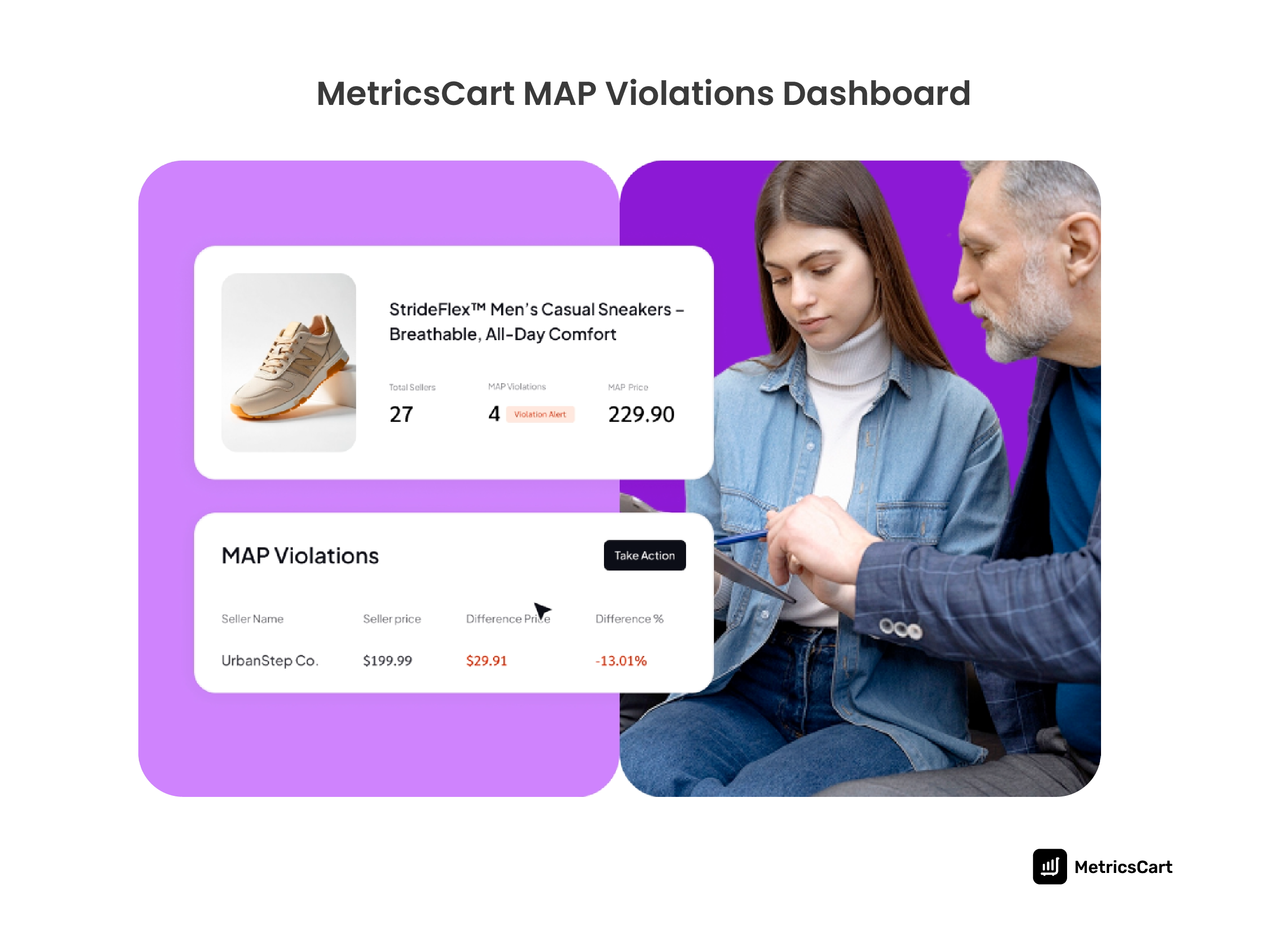
For EDLP brands, it means catching unauthorized price deviations before they spread across the network. The pricing model you choose only works if it is applied consistently across all markets where your product is sold.
Take control of how your pricing strategy plays out across every channel you sell through.
FAQs
High-Low pricing sets products at a higher base price and brings them down through promotions and discounts. EDLP keeps a single price consistent over time, with no promotional cycles. One is built on urgency, the other on trust.
EDLP is easier to manage across multiple channels because the price floor is consistent, and any deviation is immediately visible. High-Low pricing creates more exposure to MAP violations, especially when promotional timing is not coordinated across retail accounts.
Technically, yes, but it is one of the most common causes of unintentional MAP violations. Running promotional pricing at some retailers while holding a consistent floor at others creates pricing conflicts that are hard to catch manually.
Amazon rewards pricing consistency. When a promotional price at one retailer falls below MAP, Amazon flags the inconsistency and may remove the Buy Box from the listing. EDLP brands face this risk less often because the price floor stays stable.
The biggest risk is customer conditioning. When a product goes on sale frequently enough, customers stop buying at full price and wait for the discount. Over time, full-price sell-through drops, and the brand becomes dependent on promotions to generate revenue.
Start with your numbers. If your revenue drops significantly when promotions end, your business is already running on a High-Low pattern by default. If your margin at the target retail price holds up across every channel without promotional volume filling the gap, EDLP is worth committing to.