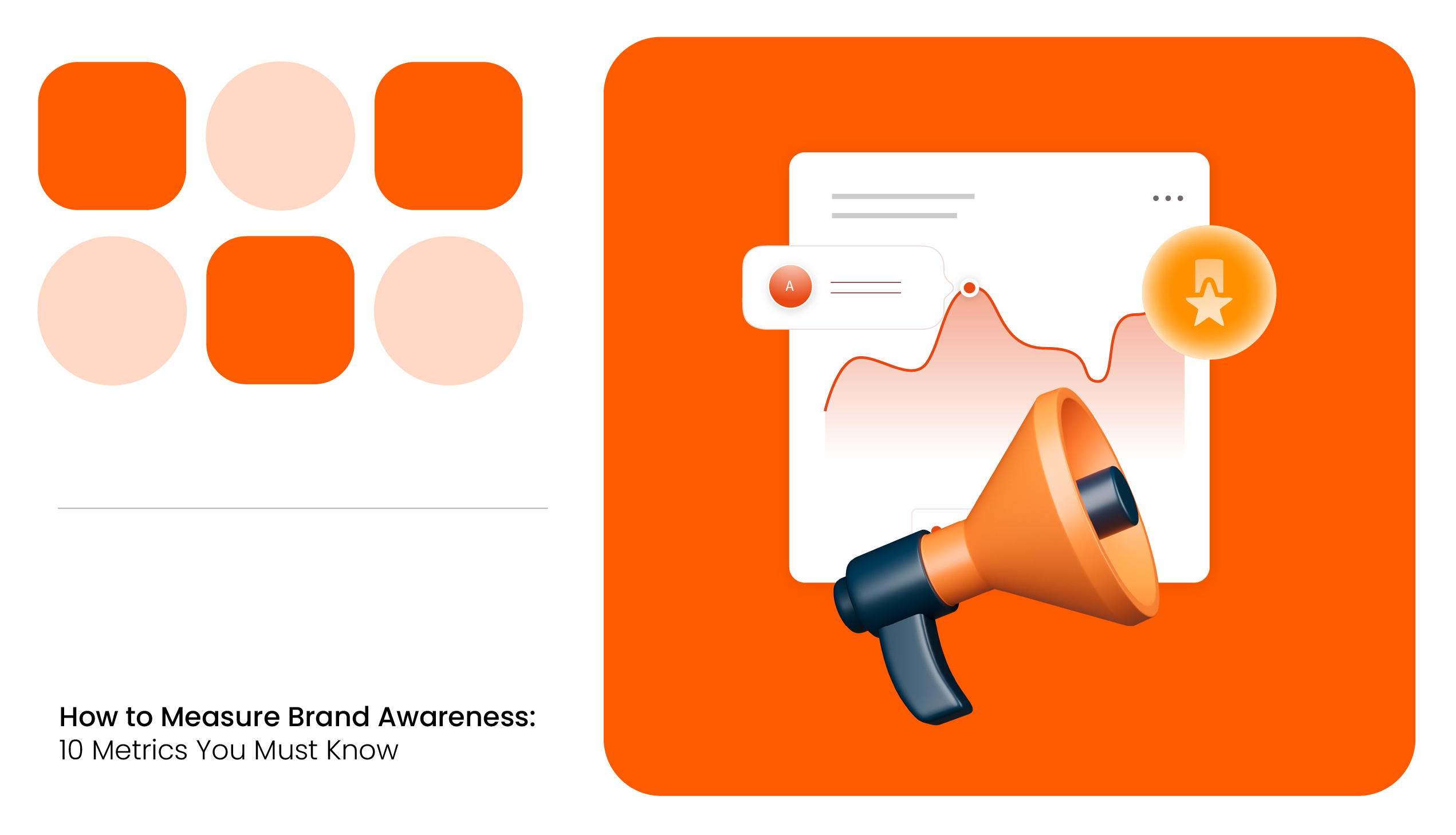
When teams say they want to measure brand awareness, they usually mean one of two things:
“Are more people noticing us?”
“Is that attention translating into easier growth?”
The problem is that most brands try to answer them with a single dashboard number (reach, impressions, followers). Brand awareness measurement is not impressions. It is not follower count. And it is definitely not “we ran a campaign so people must know us now.”
Brand awareness is a pattern. It shows up across search behavior, conversations, recommendations, reviews, and third-party validation. The only reliable way to track it is to treat it as a set of signals, measured consistently, with clear benchmarks.
That’s exactly what the 10 brand awareness metrics that we are about to discuss below do.
Why You Must Measure Brand Awareness
Brand awareness influences performance long before a shopper reaches the cart.
A shopper might first encounter a product in a TikTok haul, hear it debated in a Reddit thread, see it compared in a YouTube review, notice it again while scrolling a marketplace, and only then search for the brand by name. By the time that branded search happens, awareness has already been shaped by multiple voices that the brand does not control.
When awareness is weak, teams tend to compensate in expensive ways. They increase paid spend to “force” discovery, run heavier promotions to “overcome hesitation,” and over-index on retargeting to “convert late.”
Those tactics can work, but they are symptoms of the same underlying gap: the brand is not sufficiently recognized, remembered, or trusted early in the journey.
Awareness also isn’t neutral anymore. Edelman’s 2024 special report on brands and politics found 84% of people say they need to share values with a brand to buy it.
That means awareness is not just “have you heard of us,” it is increasingly “what do you believe we stand for.” If your brand awareness measurement system can’t capture what people associate with your brand, you are measuring the wrong thing.
10 Key Metrics to Measure Brand Awareness
Each of the following metrics captures a different way awareness shows up in real consumer behavior. None of them works in isolation. Together, they form a practical framework for ongoing brand awareness analysis.
1. Brand Mentions (Social Media + Web)
Brand mentions are one of the clearest signals that a brand exists in consumer conversations.
These mentions appear across social platforms, forums, blogs, review sites, news articles, and UGC video content on platforms like YouTube and TikTok. What makes them valuable is that many occur without any direct prompting from the brand.
Tracking brand mentions involves how often a brand name or product name appears across public digital spaces, including variations and common misspellings. Social listening tools typically provide both volume and context.
The real insight comes from understanding why the brand is being mentioned. Mentions in recommendation threads, comparisons, or problem-solving discussions indicate stronger awareness than simple tags.
Over time, consistent growth in organic mentions often precedes increases in branded search and direct traffic, making this an early awareness signal.
This is where UGC analytics becomes essential to brand awareness measurement. Conversations do not just say that a brand is known; they reveal how it is known and why it is being brought up.
Use MetricsCart’s Consumer Insights Platform, a social listening tool that turns conversations, reviews, and UGC into brand awareness benchmarks your teams can track and act on.
2. Share of Voice
Share of voice is the volume of mentions in the competitive context. It answers the question: when the category is being discussed, how often is your brand part of the discussion compared to alternatives?
Measurement is conceptually simple: your category mentions divided by total category mentions over the same time window, with a defined competitor set and keyword universe. The operational nuance is segmentation.
Share of voice should be tracked by channel and community because “voice” behaves differently on TikTok than it does on Reddit, and differently in review ecosystems than it does in press.
The importance of share of voice is that it prevents self-congratulation. A brand can grow 30% in mentions and still lose mindshare if the category grew 60%. It also becomes a leading indicator for shelf visibility in many categories, because attention tends to concentrate.
In markets where a few brands dominate conversation, anything that slips your share of voice usually shows up later as weaker click share, slower review velocity, and softer conversion efficiency.
READ MORE | A Guide to Voice of Customer Data Analytics in E-Commerce
3. Branded Search Volume
Branded search volume is the cleanest “recall” signal because it is initiated by consumers, not by your targeting. When shoppers type your brand name (or brand + product) into Google, Amazon, Walmart, or YouTube search, they are telling you something: the brand exists in memory strongly enough to drive action.
In measurement terms, this is tracked through Google Search Console (brand query impressions and clicks), paid search query reports, and keyword tools for broader estimates. For marketplaces, internal search reporting and retail media query data become the equivalent.
A mature approach separates branded search into product-intent terms (“Brand + shampoo”), navigational terms (“Brand website”), and issue terms (“Brand lawsuit,” “Brand safe”), because those represent very different awareness states.
The importance of this is commercial. Branded search growth usually correlates with easier demand capture: higher CTR, cheaper conversion, and less reliance on discounts. If your branded search is flat while spend is rising, you’re renting attention rather than building memory.
4. Customer Survey Results
Surveys remain core to brand awareness measurement, but only when used with discipline. They measure awareness directly in terms of customer perception: recognition (aided awareness), recall (unaided awareness), familiarity, and association. The mistake is treating surveys as a quarterly trophy or a brand team vanity report.
A useful survey program does two things. First, it measures unaided recall by category entry point (“When you think of electrolyte drinks…”), not just generic recall. Second, it includes an association prompt that forces clarity: “What do you know this brand for?” This is where positioning either shows up cleanly or collapses into vague answers like “good quality” or “I’ve seen it online.”
In brand awareness analysis, its importance is interpretive power. Behavioral signals tell you what happened. Surveys tell you what people believe and remember. When those conflict, surveys often explain why conversion stalls even when traffic rises, or why people recognize you but still choose a competitor.
5. Google Trends Data
Google Trends is not a forecasting tool. It is a momentum tool. It shows whether interest in a brand term is rising or falling over time relative to itself, competitors, or category keywords.
The measurement approach is to keep comparisons consistent: same region, same time horizon, and the same set of competitor terms. Trends become especially informative when you compare “brand” vs. “brand + category,” because it gives a crude view of whether awareness is expanding beyond existing customers.
Among brand awareness metrics, this one acts as an early warning. Trends often show a lift in curiosity before your analytics dashboards show a lift in conversions. It also highlights when competitor curiosity is accelerating while yours is plateauing, which is usually a signal that their awareness engine is working better right now.
6. Earned Media Coverage
Earned media coverage includes editorial mentions, independent reviews, expert commentary, and creator features that you didn’t pay to place as a straightforward ad. It builds awareness differently than paid. Paid creates exposure. Earned creates legitimacy.
For example:
- A consumer reads a “Best baby shampoos” article and clicks your brand link.
- A nutrition blog mentions your protein bar and links to your site.
- A creator’s YouTube description includes your brand link.
- A retailer’s buying guide links to your product page.
Measurement should go beyond “count of mentions.” The real evaluation includes relevance (category-fit publications matter more than broad lifestyle reach), message pull-through (are they repeating the positioning you want), and competitor comparison (did you gain voice, or did the whole category get covered).
The importance is that earned media often drives “passive familiarity” and brand authority. A shopper may not click when they read a roundup today, but three weeks later, they will recognize your name on the shelf and click faster. That’s why earned media is a genuine awareness asset and should be measured as such, not as PR vanity.
7. Referral Traffic & Backlinks
In a CPG context, referral traffic and backlinks are signals of third-party validation, not direct sales performance. They indicate whether a brand is being referenced, cited, and recommended by external sources that influence how consumers learn about a category before they reach the shelf.
The value of referral traffic and backlinks in brand awareness measurement is not the volume of sessions, but the fact that the brand is being discovered within trusted, research-driven contexts. These referrals shape familiarity and credibility before a shopper encounters your product.
They show who is willing to publicly associate their credibility with the brand. Over time, a growing number of relevant, category-specific backlinks indicates that the brand is becoming a recognized reference point in its space.
8. Customer Sentiment
Sentiment is the emotional direction of awareness. Without sentiment, you don’t know whether awareness is building equity or building risk.
Customer sentiment analysis typically uses NLP to classify mentions, reviews, and discussions as positive, neutral, or negative. But expert-grade sentiment tracking goes further. It ties sentiment to themes, sub-themes, and drivers: delivery, value, durability, authenticity, taste, safety, customer support, and “brand behavior” topics.
It is non-negotiable in brand awareness analysis because values and trust increasingly shape buying. Especially among the Gen Z and millennial cohort, brand awareness is rarely about how often have you heard about this brand but rather ”does that brand stand for the values I believe in”.
9. Social Media Engagement
People can see your content and forget it. Engagement suggests your content earned attention strongly enough to trigger action: a share, a save, a comment, a watch-through.
Measurement should focus on engagement rate relative to reach, and it should be segmented by content type. Saves often indicate future intent. Shares indicate advocacy. Comment quality indicates whether your message is landing or being debated.
The importance is that social media increasingly influences commerce decisions, particularly for younger buyers. Deloitte’s 2025 Digital Media Trends reported 63% of Gen Z and 49% of millennials say ads or product reviews on social media are the most influential to their purchasing decisions.
If social media shapes purchase decisions, engagement quality becomes a meaningful awareness signal, not just a content team KPI.
One more nuance: do not treat social media as the only awareness surface. Gartner predicted that 50% of consumers will abandon or significantly limit interactions with social media by 2025 due to perceived platform quality decay.
That’s a strong argument for measuring engagement across a broader awareness surface area: forums, reviews, YouTube, and other community spaces.
READ MORE | Search Listening In Marketing: How Brands Can Unlock Consumer Intent
10. Conversions
Conversions aren’t a “pure awareness” metric, but they are the downstream proof that awareness is reducing friction. When awareness improves, conversions often improve in a specific pattern: branded campaign conversion rates rise, direct traffic converts better, and the brand needs fewer promotional crutches to drive action.
Measurement must be segmented. Look at the conversion rate by source, particularly direct traffic, branded search traffic, and returning visitors. Also track assisted conversions. Awareness channels often don’t win last-click attribution, but they change who shows up later and how ready they are.
The importance is also supported by channel behavior data. EMarketer reported a study where paid search conversion rates were four times higher than paid social, a reminder that intent differs by channel and awareness work should not be judged by last-click standards alone.
Awareness raises the quality of future demand; that’s why conversions belong in brand awareness measurement, but interpreted correctly.
Why Social Listening Now Defines How To Measure Brand Awareness
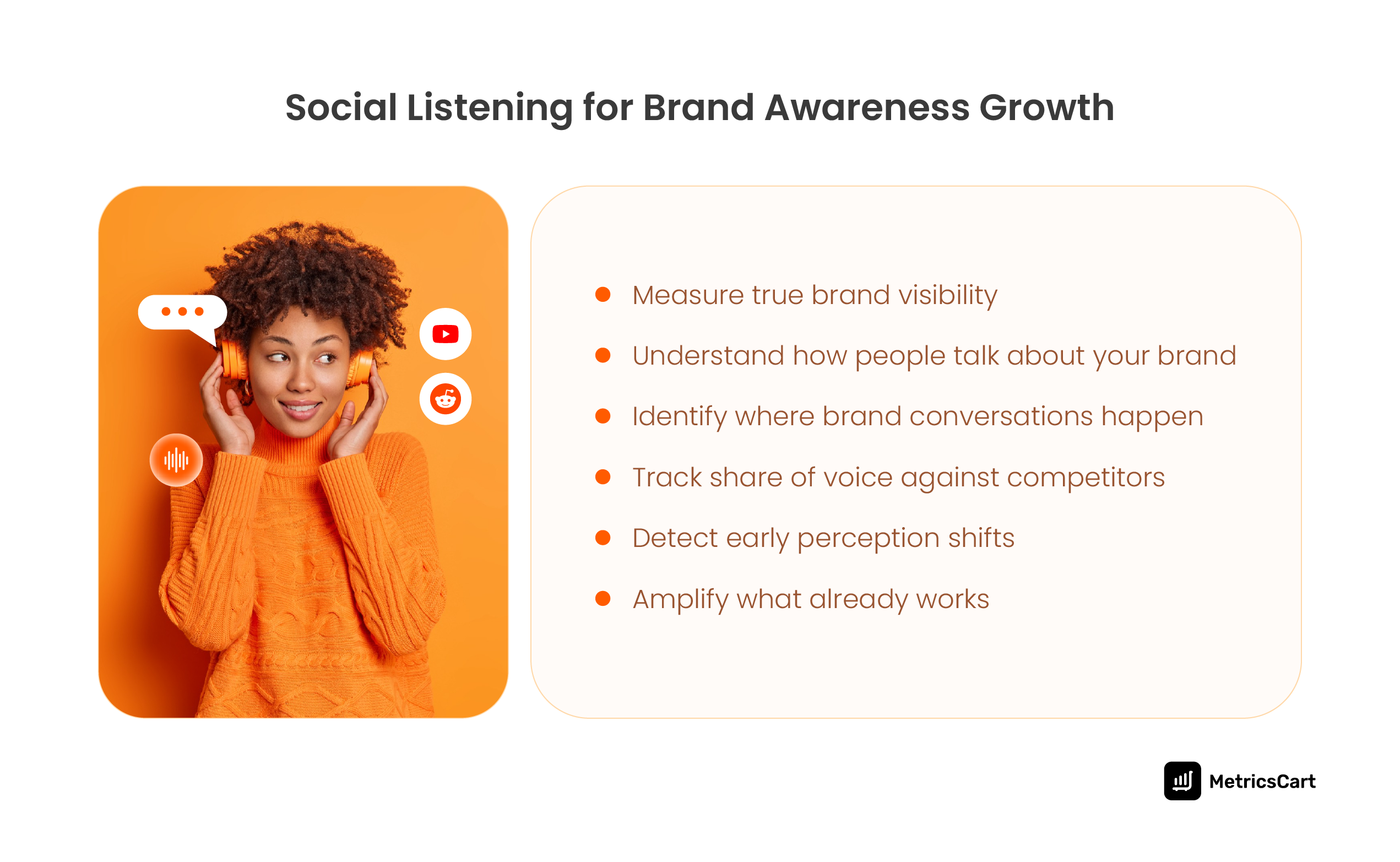
Today, awareness is built in the moments when consumers explain a product to each other, compare brands in comments, question claims in reviews, or recommend what worked for them.
These moments rarely happen on brand-owned channels, and they rarely show up in traditional dashboards. Yet they are often what decide which brands feel familiar, trustworthy, and worth choosing when the shelf finally appears.
This is why social listening matters. It captures awareness as it actually forms, not as it is assumed to exist. It shows what people remember about a brand, how they describe it in their own words, and how those perceptions shift over time. More importantly, it turns awareness from a vague concept into something teams can monitor, stress-test, and improve.
MetricsCart helps brands do exactly that. By translating real conversations, product reviews, and other user-generated content formats into clear awareness benchmarks, it allows teams to track not just whether awareness is growing, but how and why it is changing. That is what makes brand awareness measurable, actionable, and strategically useful.
Deeper consumer insights lead to stronger brand decisions. MetricsCart helps you get there. Get in touch with us to see our solutions in action.
Ready To Transform Consumer Conversations Into Brand Growth?
FAQs
There is no universal formula. Strong brand awareness measurement combines behavioral signals (branded search, engagement, referral traffic, conversion efficiency) with perception signals (surveys, sentiment, themes) and competitive context (share of voice). That combination is what makes brand awareness analysis reliable.
The most actionable KPIs include brand mentions, share of voice, branded search volume, survey-based recall, earned media coverage, sentiment direction, engagement quality, and direct or branded conversion efficiency. These are practical brand awareness metrics because they can be trended, segmented, and benchmarked.
Recognition (people know you), recall (people remember you without prompts), top-of-mind (you’re one of the first brands named), and dominance (you’re the default choice in the category conversation).
Scaling awareness typically comes from repeated exposure in high-trust contexts: strong creator and community presence, consistent earned media, search visibility, and a message that stays coherent across the digital shelf. Scaling also requires measurement discipline so you amplify what is actually increasing recall, not just impressions.
Measure it as a system. Track all key brand awareness metrics, weekly or monthly, and always interpret them together: volume (mentions), competitive context (share of voice), recall intent (branded search), perception (surveys and sentiment), and outcomes (conversion efficiency). That’s what turns marketing reporting into real brand awareness analysis.