Highlights
-
Voice of Customer (VoC) is the practice of capturing what customers think, feel, and say about your products, then turning that information into decisions.
-
Traditional VoC programs often miss product-level insights because they rely on aggregate scores instead of analyzing the actual language customers use.
-
Aspect-Based Sentiment Analysis (ABSA) breaks customer feedback down by specific product attributes, like packaging, taste, or durability, so teams can act on what actually matters.
-
Modern VoC platforms like MetricsCart Ratings and Review Analysis go beyond dashboards to surface competitive benchmarks, trend shifts, and aspect-based sentiment analysis.
Introduction
Shoppers often leave their reviews for a product on Amazon, Walmart, Target, and dozens of other marketplaces. They write about what they loved, what disappointed them, what they wished was different. That feedback is specific, unsolicited, and honest in a way that a survey rarely is.
Yet most e-commerce teams still track only star ratings and total review counts. They know a product is at 3.8 stars. They just do not know why, or what to do about it.
That is the gap Voice of Customer programs are designed to close.
This guide covers what VoC actually means in an e-commerce context, where most programs fall short, how modern tools handle customer feedback analysis, and how to build a program that translates reviews into real business decisions.
What is Voice of the Customer (VoC) and Why it Matters
Voice of Customer (VoC) is the process of collecting, analyzing, and acting on customer feedback to understand what customers think, expect, and experience with your products and brand. Feedback can come from surveys, reviews, support tickets, social media, interviews, and every interaction customers have throughout their buying journey.
For e-commerce brands, customer reviews are seen as the most valuable source of VoC.
Unlike surveys that capture feedback from a small group of customers at specific moments, reviews are continuous, unsolicited, and written in customers’ own words.
They reveal not only whether someone liked a product but also why they bought it, what nearly stopped them from purchasing, which features exceeded expectations, and what competitors are doing better.
In addition, a well-executed Voice of Customer (VoC) program delivers measurable business value:
-
Build stronger customer loyalty. According to Forrester, customers are 2.4 times more likely to remain loyal to brands that actively listen to feedback and resolve issues quickly.
-
Better meet customer expectations. Nearly two-thirds of consumers believe brands should do a better job of listening to their feedback and acting on it.
-
Drive faster business growth. Companies that consistently incorporate customer feedback into decision-making achieve 41% higher revenue growth than their less customer-focused peers.
READ MORE | Review Monitoring on Digital Shelf: Why it Matters?
Why Traditional Voice of Customer Programs Fall Short for E-Commerce Teams
Most e-commerce teams already have a Voice of Customer (VoC) program in place. They collect feedback through customer surveys, NPS, support tickets, social media, and product reviews. They also monitor average star ratings, review volume, and overall sentiment to understand how customers perceive their products.
While these metrics provide a useful overview, they rarely explain what is actually driving customer sentiment.
For example, a product with a 3.9-star rating tells you that customers are unhappy. It does not tell you whether they are frustrated with the packaging, sizing, durability, taste, battery life, or another specific product attribute. Likewise, a product with a 4.7-star rating may still have hundreds of reviews mentioning the same issue, but those insights remain buried within individual comments.
The problem becomes even bigger as review volume grows. Brands selling across Amazon, Walmart, Target, Shopify, and other marketplaces often receive thousands of reviews every month.
Reading, categorizing, and comparing that feedback manually is slow, inconsistent, and impossible to scale. As a result, many teams stop at surface-level analysis by tracking star ratings, review counts, sentiment scores, and a handful of one and two-star reviews.
This approach leaves several important business questions unanswered:
- Why did a product’s rating drop this month?
- Which product attributes do customers consistently praise or criticize?
- What recurring complaints appear across hundreds of reviews?
- Which customer needs are competitors satisfying better?
- How does customer sentiment vary across marketplaces?
- Which products require immediate attention before ratings and conversions decline?
With traditional, manual VoC programs, a brand manager could collect customer feedback. However, extracting meaningful insights from thousands of customer conversations and using them to improve products, marketing, and the customer experience still remains a challenge.
What a Modern VoC Program Actually Looks Like
A modern Voice of Customer (VoC) program goes beyond collecting feedback. It transforms customer conversations into structured, actionable insights that every team can use.
Instead of tracking only star ratings or review volume, modern VoC programs analyze reviews from multiple marketplaces, organize them by product attributes, monitor changes over time, and benchmark customer sentiment against competitors. This gives e-commerce teams a complete picture of what customers value, what frustrates them, and where products need improvement.
A typical e-commerce VoC workflow looks like this:
- Collect customer reviews from marketplaces such as Amazon, Walmart, and Shopify.
- Aggregate feedback into a single repository.
- Clean and structure the data using AI.
- Group reviews into themes and sub-themes such as Packaging, Taste, Fit, Battery Life, Delivery, or Ease of Use.
- Measure customer sentiment for each product attribute.
- Benchmark your products against competing brands.
- Track emerging trends and changes in customer sentiment over time.
- Generate reports that help product, ecommerce, marketing, and customer experience teams take action.
This shift turns Voice of Customer from a reporting exercise into a decision-making framework. Instead of spending hours reading reviews, ecommerce teams can quickly identify the issues that require immediate attention, discover which product attributes resonate most with customers, understand why competitors perform better in certain categories, and prioritize improvements that have the greatest impact on ratings, conversions, and customer loyalty.

In Episode 36 of the Digital Shelf Insider podcast by MetricsCart, Barry Thomas (Senior Global Thought Leader) and Rachel Dalton (Head of Retail Insights), Kantar explain how loyalty ecosystems like Walmart+ and Amazon Prime are quietly taking ownership of repeat purchase behavior, and why ratings, reviews, and creator content have become frontline trust signals for shoppers.
Watch the full episode here:
Why Aspect-Based Sentiment Analysis Is Essential for E-Commerce VoC Programs
Aspect-Based Sentiment Analysis or ABSA is the core technology behind modern customer feedback analysis. It is worth understanding how it works because it is what makes the difference between knowing that customers are unhappy and knowing exactly what they are unhappy about.
Traditional customer sentiment analysis reads a review and returns a single label: positive, negative, or neutral. That works fine for social media monitoring or brand reputation tracking. For product teams, it is not enough.
ABSA goes deeper. It reads a review like this:
“The flavor is incredible and the packaging looks great, but the powder clumps badly and it took two weeks to arrive.”
And instead of calling this a mixed review and moving on, it breaks it down:
- Flavor: Positive
- Packaging: Positive
- Mixability: Negative
- Shipping/Delivery: Negative
Each attribute gets its own sentiment score. Multiply this across thousands of reviews, and you start to see very clear patterns. Maybe 68% of negative mentions reference mixability. Maybe packaging sentiment has been trending upward since a redesign six months ago. Maybe shipping complaints spike every time a fulfillment partner changes.
Those are signals a product team can actually do something with. They can adjust the formulation. They can highlight the packaging in listing imagery. They can flag the fulfillment issue before it gets worse.
For ecommerce brands managing multiple SKUs, ABSA also makes it possible to compare products within a portfolio. You can see which products have the strongest sentiment on durability and which ones have persistent complaints about fit. You can prioritize development resources accordingly.
The attributes of ABSA tracks vary by category. For a food brand, it might be taste, texture, packaging, portion size, and value. For a personal care brand, it might be scent, skin compatibility, application ease, and packaging. A good VoC platform will allow you to define the attributes that matter most for your specific category.
Top 3 Voice of Customer Tools for E-Commerce Brands in 2026
The best Voice of Customer (VoC) platform depends on the type of customer feedback you want to analyze. Some platforms specialize in surveys and customer experience management, while others focus on extracting product intelligence from ecommerce reviews.
1. MetricsCart
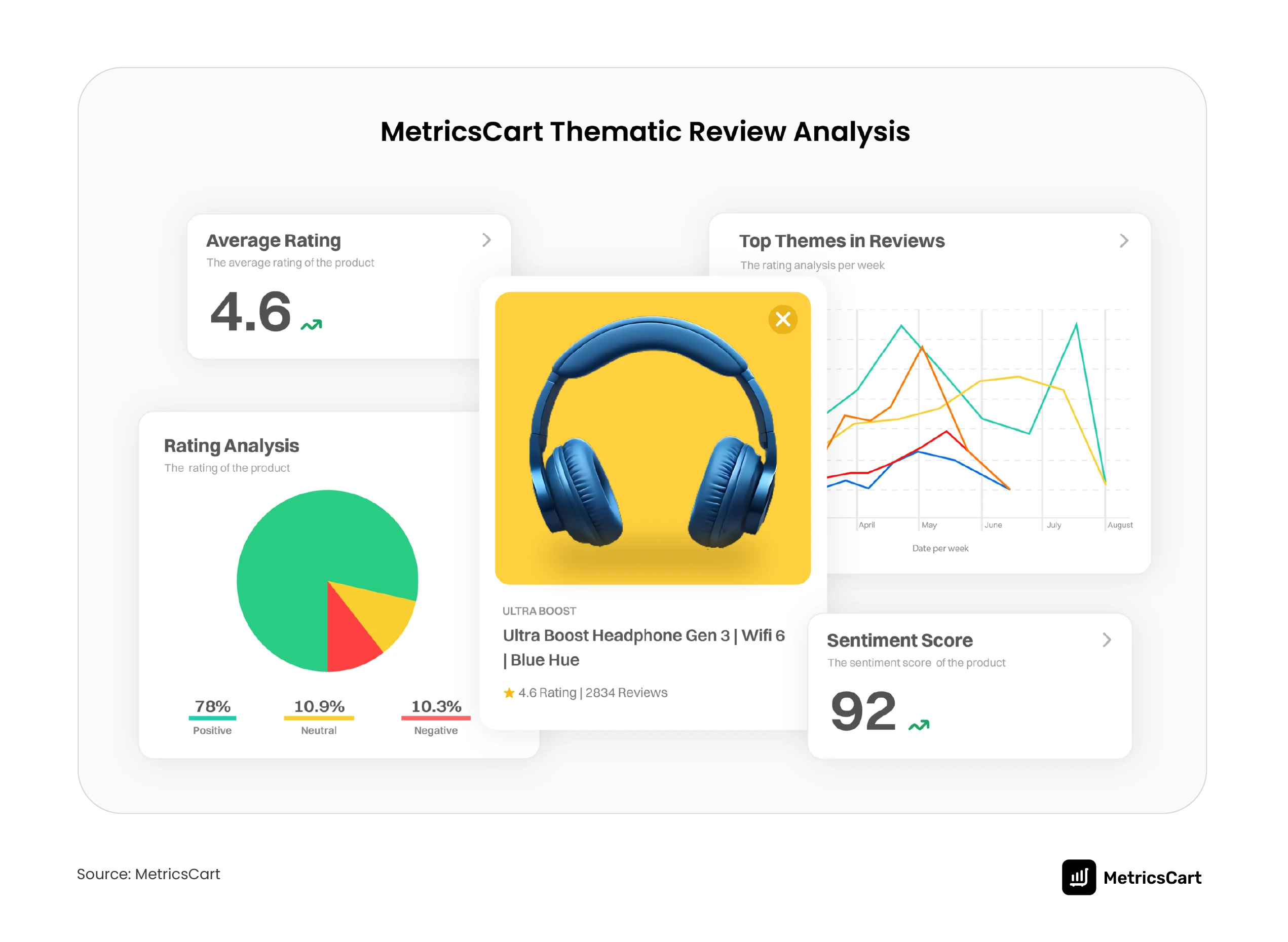
MetricsCart is designed specifically for ecommerce brands that want to turn customer reviews into actionable product intelligence. Trusted by global CPG brands like PepsiCo, MetricsCart turns reviews from across 150+ marketplaces into structured VoC intelligence, giving product, marketing, and ecommerce teams the insights they need to act faster and with more confidence.
Key features:
- Brings together insights from reviews across Amazon, Walmart, Target, and 150+ other retailer platforms into a single, continuously updated view.
- Applies Aspect-Based Sentiment Analysis to extract granular themes, sub-themes, product attributes, emotions, and supporting review excerpts. from review text
- Offers features like Product Pulse Quadrants that map review themes across two axes, frequency of mentions and trajectory over time, so teams can immediately see which complaints are both widespread and accelerating.
- Provide KPI Chips and drivers that explains what changed in customer sentiment and why, reducing the time between spotting a problem and acting on it.
- Gives pre vs. post change analysis that tracks how review themes and return-related complaints shift after updates, giving teams a clean before-and-after signal.
- Provides root cause mapping routes to each issue cluster directly to the responsible team, whether that is supply chain, product, or content, so complaints do not fall into a generic review queue.
- Competitive benchmarking using the same sentiment methodology to competitor products, so brands can see exactly where they stand relative to the market.
- Gives Retailer-level breakdown surfaces how review themes and return reasons differ between Amazon, Walmart, and Target shoppers, since the same issue can present differently across platforms.
- Trend and anomaly detection that flags sudden spikes in specific complaint themes before they compound into star rating drops or conversion losses.

2. Qualtrics
Qualtrics is one of the most widely used Voice of Customer platforms for collecting customer feedback through surveys, NPS, website feedback, and customer experience programs. It helps organizations measure customer satisfaction across multiple touchpoints and build enterprise-scale VoC initiatives.
While Qualtrics offers text analytics capabilities, it primarily focuses on structured feedback rather than marketplace review intelligence.
Best for: Enterprise customer experience teams running large-scale survey and feedback programs.
3. Thematic
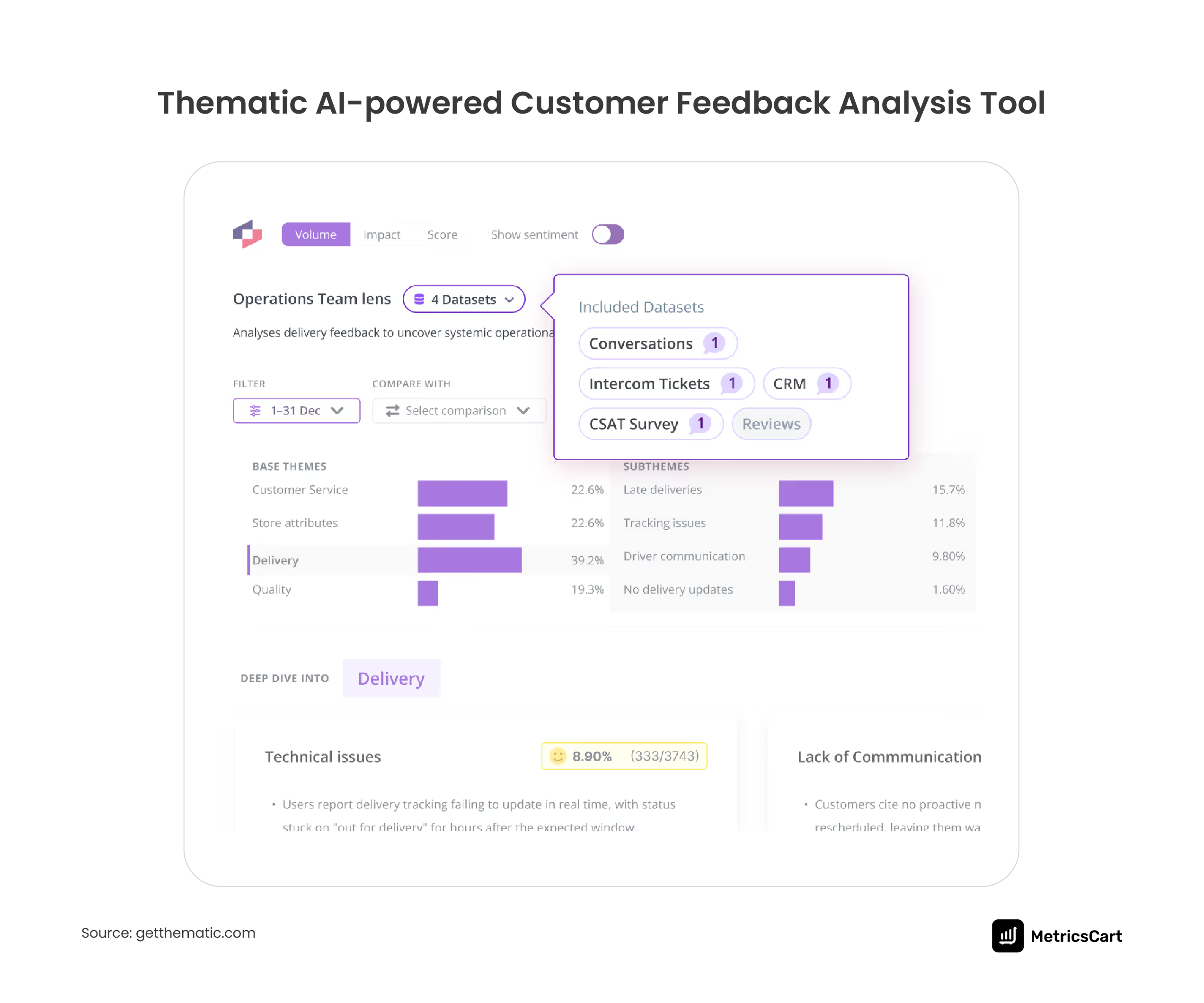
Thematic specializes in AI-powered customer feedback analysis. It automatically identifies themes and trends across surveys, support conversations, and reviews, helping businesses understand the reasons behind customer sentiment without manually tagging feedback.
Its strength lies in transforming large volumes of unstructured text into understandable themes and dashboards.
Best for: Organizations looking to analyze large volumes of customer feedback from multiple channels and identify recurring themes.
Which VoC Tool Should You Choose?
If your primary goal is to measure customer satisfaction through surveys and NPS, a platform like Qualtrics is a strong choice. If you want to identify themes across customer feedback from multiple channels, Thematic offers powerful text analytics.
However, if your focus is ecommerce and marketplace performance, you need a platform built for product reviews. MetricsCart combines scalable review analytics with Aspect-Based Sentiment Analysis, competitor benchmarking, and marketplace intelligence to help brands understand exactly what customers like, dislike, and expect from their products.
Building Your VoC Program: Where to Start
You do not need to overhaul everything at once. Most ecommerce teams that successfully build out VoC programs start with a defined scope and expand from there. Here are some steps you can follow
- Start with your highest-volume products. These generate the most review data and typically have the most to gain from structured analysis. A product with 2,000 reviews contains more insight than most focus groups could generate in a year.
- Pick two or three competitor products to benchmark against. You want to understand your position relative to the market, not just in isolation.
- Define what decisions you want VoC to inform. Product teams need different outputs than marketing teams. Being specific about the decision types upfront shapes how you structure the analysis and how you distribute the insights.
- Set a regular review cadence. The value of VoC compounds over time. Monthly or quarterly snapshots are useful starting points. Continuous monitoring is where the real advantage builds, because you catch problems and opportunities as they emerge rather than in retrospect.
Tracking it All Down
Customer reviews are one of the richest sources of product intelligence available to ecommerce brands today. The challenge has never been getting feedback. It has been making sense of it at scale, fast enough to actually do something with it.
A well-built VoC program, powered by Aspect-Based Sentiment Analysis, closes that gap. It takes thousands of unstructured reviews and turns them into specific, actionable signals for every team that touches the product, from development and marketing to ecommerce and customer experience.
The results this can drive are very real.
A boutique research firm working in the personal care category came to MetricsCart with a familiar problem: manually scraping and analyzing reviews across Amazon, Walmart, Target, Ulta, and Sephora was taking weeks and slowing down their ability to deliver strategy recommendations to clients.
Using the MetricsCart Rating and Review Analysis platform we processed over 15,000 consumer reviews across all five retailers in 48 hours. AI-driven sentiment analysis categorized feedback into specific themes like scent, packaging durability, and skin sensitivity, giving the firm a precise map of unmet consumer needs across the category.
The result was an 85% reduction in manual data work and three validated product opportunities with strong consumer demand signals that their clients could act on immediately.
You can read the full case study here.
That is what a modern VoC program actually looks like in practice. Not a dashboard that sits unread. Not a quarterly report that arrives too late. But a continuous, structured system that makes the customer’s voice impossible to ignore, and easy to act on.
Turn Your Voice of Customer Into Your Competitive Advantage!
FAQs
Customer satisfaction surveys are one input into a VoC program, but they are not the whole thing. VoC is a broader practice that includes any channel through which customers express their opinions, including reviews, support conversations, social media, and survey responses.
The key difference is that a survey asks specific questions you have decided to ask. VoC programs, especially those built on review analysis, capture what customers say unprompted, which often surfaces issues and opportunities that pre-defined survey questions would never uncover.
Because customers are telling you, in specific and actionable detail, what to fix, what to protect, and what to promote. Studies show that displaying customer reviews can boost sales by 19.8%, but the value of VoC goes beyond social proof.
It feeds product development, informs marketing positioning, reduces return rates, and helps brands stay ahead of competitive shifts. Brands that systematically learn from customer feedback move faster and make fewer expensive mistakes.
A personal care brand notices through review analysis that 40% of negative reviews for one of their moisturizers reference the scent as being too strong. This is not reflected in the star rating, which sits at 4.1 stars, because the product performs well on other attributes.
The VoC insight allows the product team to consider a fragrance-free variant and the marketing team to adjust how they describe the scent in the product listing. That is VoC working as intended: specific feedback leading to a specific business action.
A VoC strategy is the plan a brand uses to collect, analyze, and act on customer feedback in a systematic way. It defines which feedback channels to monitor, how feedback will be analyzed, which teams will receive which types of insights, how often the program will be reviewed, and how results will be measured.
A good VoC strategy is cross-functional, meaning it involves not just the insights team but also product, marketing, ecommerce, and customer experience stakeholders.
The most scalable way in ecommerce is to analyze the reviews customers are already leaving across marketplaces. This gives you large volumes of unprompted, honest feedback without requiring any additional data collection effort.
You can supplement this with post-purchase surveys, support ticket analysis, and social listening. The key is choosing a platform that can process unstructured text at scale and return insights at the attribute level, not just overall sentiment scores.
Every review contains insights that can improve your products, listings, and customer experience. Make them part of your Voice of Customer strategy.
VoC marketing uses customer feedback to shape product messaging, listing content, ad copy, and brand claims. It helps brands align what they say on the digital shelf with what customers actually value.