Do you think your consumers check in only on one website to make a purchase? Well, no.
According to eMarketer, more than 44% of your customers do their “research” across multiple websites before purchasing to compare prices, check alternatives, read reviews, and then compare again. In other words, purchasing behavior is fragmented, deliberate, and highly comparative.
This means your pricing must remain consistent across every channel where the product appears. But the real challenge doesn’t end there. Thanks to agentic commerce systems, automated repricing engines, and AI-driven marketplace algorithms, price matching is no longer a manual strategy executed by retailers reacting to competitors.
It is automated, continuous, and often aggressive. A single visible discount can trigger algorithmic repricing across multiple sellers within minutes. This is precisely why MAP compliance monitoring has shifted from being a legal safeguard to becoming a strategic pricing control mechanism.
Highlights
- Price matching, driven by algorithms, can lead to price wars and margin loss, making MAP policies essential for control.
- MAP policy ensures price matching stays within controlled boundaries, preventing price undercutting.
- MAP enforcement stabilizes pricing, protects margins, and strengthens retailer relationships.
- MAP compliance monitoring is crucial for protecting pricing integrity and brand value in an algorithm-driven marketplace.
- Effective MAP monitoring relies on continuous visibility, structured workflows, and data-driven analysis.
- MetricsCart, Price2Spy, and Browse AI offer automated real-time monitoring and enforcement.
Understanding MAP Policy: Definition and Purpose
A MAP policy is a set of rules that brands establish to control the minimum advertised price at which their products can be promoted. It does not dictate the final selling price. Instead, it sets a floor for the advertised price, ensuring retailers do not publicly display prices below a defined threshold. This policy is essential for maintaining price integrity and ensuring that brands are not devalued by retailers’ aggressive pricing tactics.
Brands often confuse MAP and MSRP, but they serve very different purposes:
- MSRP (Manufacturer’s Suggested Retail Price) is a recommendation.
- MAP is an advertising restriction agreed upon by authorized retailers.
MAP governs what customers see on product pages, marketplace listings, ads, and promotional banners. It does not necessarily control what happens at checkout. The goal is to prevent visible price undercutting that can destabilize the entire pricing ecosystem.
Another major difference is that MSRP has no enforcement mechanism, whereas MAP does.
That means, with accurate monitoring and consistent enforcement, you can turn MAP policy into a structured pricing control framework for your brand rather than just a paragraph that sits in your distributor agreement.
READ MORE| MAP Monitoring for Lean Teams: A Guide for Small Businesses
How MAP Enforcement Improves Pricing Consistency
You cannot just draft a MAP policy, then sit back, and expect it to magically fix every pricing inconsistency. The real impact of MAP lies in how consistently brands do MAP compliance monitoring and respond to violations.
In digital marketplaces, pricing is highly visible and highly reactive. Retailers use automated repricing tools that scan competitors and adjust prices in real time. When one seller advertises below MAP, others often follow to protect their position, especially in competitive environments like Amazon’s Buy Box. What begins as a single violation can quickly lead to widespread price erosion.
MAP enforcement interrupts that cycle.
By identifying violations early and taking structured action, brands prevent visible undercutting from spreading across channels. This stabilizes advertised pricing, reduces unnecessary price wars, and protects the average selling price (ASP).
MAP enforcement also strengthens retailer relationships. Authorized partners are more likely to invest in inventory, marketing, and customer experience when they know pricing rules are applied consistently. If MAP violations go unchecked, compliant retailers lose trust and may respond by discounting themselves aggressively.
On the other hand, strategically executed minimum advertised price enforcement delivers:
- Greater pricing consistency across marketplaces
- Reduced margin compression
- Prevent pricing erosion
- Ensure stronger channel discipline
- Improves brand positioning and customer experience
- Guarantees healthy retailer relationships
READ MORE | 10 Common MAP Policy Loopholes that Would Cost Your Brand
MAP Policy and Price Matching: How MAP Policy Supports Price Matching Compliance
Price matching is designed to help retailers stay competitive. But without guardrails, it can quickly lead to uncontrolled discounting. MAP policy provides that guardrail.
By setting a minimum advertised price, MAP establishes a clear floor that retailers must respect in public listings. This ensures that price matching does not translate into visible undercutting across marketplaces. Retailers can still respond to competition, but they cannot advertise prices below the defined threshold.
MAP policy also clarifies boundaries for retailers:
- They may offer in-cart discounts in some cases.
- They may use private promotions or loyalty incentives.
- They may match competitors within the MAP floor.
But they cannot publicly display prices below MAP.
With active compliance monitoring, brands can ensure that price matching remains strategic rather than reactive. Instead of triggering price wars, retailers operate within a controlled framework that preserves pricing consistency across channels.
In this way, MAP does not eliminate price matching. It structures it.
What Effective MAP Compliance Monitoring Actually Looks Like in Practice
Effective MAP compliance monitoring is not a one-time audit or a quarterly legal exercise. It is an ongoing, automated, and strategic process designed to maintain pricing consistency across every platform where your product appears. In today’s algorithm-driven commerce environment, brands cannot afford to treat MAP as a static policy. It has to function as a living control system.
At its core, MAP compliance monitoring rests on three foundational pillars: visibility, structured enforcement, and data intelligence.
Continuous, Cross-Channel Visibility
Manual spot-checking is no longer sufficient. By the time someone manually discovers a violation, automated repricing engines may already have responded, triggering a broader wave of price adjustments across competing sellers.
To stay ahead of this cycle, brands need real-time visibility across marketplaces and retailer websites. This includes SKU-level tracking and the ability to detect advertised price changes in real time. Also, it is not enough to know that a violation occurred. Brands need to understand when it started, how long it lasted, and how widely it spread.
Without consistent and automated monitoring, enforcement becomes reactive. And in digital commerce, reactive pricing control almost always means you are responding after margin erosion has already begun.
Clear and Consistent Violation Workflows
Monitoring alone does not solve the problem. Identifying violations is only the first step. What determines long-term success is how you respond and handle the violation.
Effective MAP compliance programs rely on structured response frameworks. This typically includes documented violation tracking, standardized warning procedures, defined escalation tiers for repeat offenders, and clear communication protocols with retail partners.
Consistency is critical. If the MAP threshold varies from retailer to retailer, the policy’s credibility weakens. Compliant partners may begin to question why they adhere to the rules while others do not. Over time, uneven enforcement can damage trust more than the original violation itself.
A disciplined workflow ensures that MAP enforcement remains objective, transparent, and repeatable.
Data-Driven Pattern Analysis
While single violations deserve attention, patterns provide strategic insight.
Brands should regularly analyze which retailers frequently violate MAP, which SKUs are most vulnerable to undercutting, and whether violations tend to cluster around promotional periods or inventory fluctuations. It is also important to assess how pricing violations affect key performance metrics such as Buy Box ownership, search visibility, and overall average selling price.
When this level of analysis is integrated into the monitoring process, MAP compliance evolves from a compliance checklist into a pricing intelligence engine. Instead of simply reacting to infractions, brands can anticipate risk, adjust distribution strategies, and refine enforcement priorities.
3 Best Tools for MAP Compliance Monitoring & Enforcement
Here are 3 tools for brands looking to automate monitoring, enforce pricing policies consistently, and protect their distribution channels from erosion and chaos.
1. MetricsCart
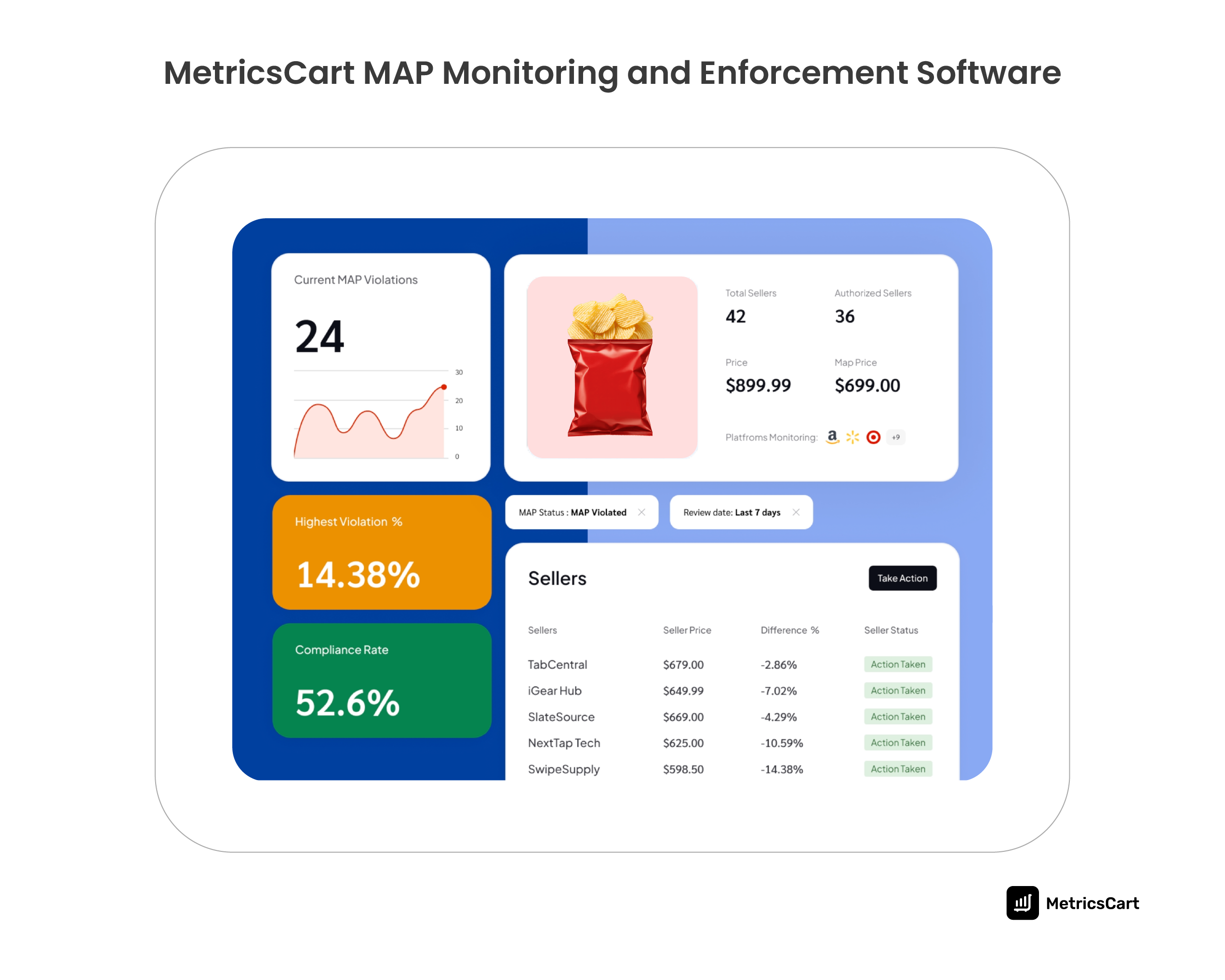
MetricsCart is one of the best MAP monitoring and enforcement tools available today. It enables brands to monitor and enforce their MAP policies across 100+ online retailers and e-commerce marketplaces, giving them full visibility into how their products are priced across the digital shelf.
Rather than relying on periodic manual checks, MetricsCart provides continuous, real-time tracking of advertised prices at the SKU level.
When a product falls below the defined MAP threshold, the system immediately flags the violation, captures supporting evidence, and sends automated warning emails to the violators, including time-stamped screenshots. This ensures that enforcement actions are done on time and are backed by clear documentation.
Beyond monitoring, MetricsCart strengthens enforcement workflows. The platform identifies both authorized and unauthorized sellers, tracks recurring violators, analyzes buy box impact, and even sends automated warning emails to sellers who breach MAP policies. This reduces manual outreach while maintaining consistent enforcement standards.
In addition, MetricsCart is one of the most affordable tools for MAP monitoring and enforcement. Its pricing starts at just $300/month, making the platform the best choice for small and large businesses alike.
Top Features
- Instantly detects, alerts, collects evidence, and sends warnings when the price drops below MAP.
- Provides SKU-level price tracking across 100+ online stores and marketplaces worldwide.
- Identifies and distinguishes between authorized and unauthorized sellers for easier management.
- Offers violation trend analysis to track recurring violations to spot patterns and risky sellers.
- Analyzes the impact of MAP violations on Buy Box ownership and sales performance.
- Protects newly launched SKUs from early price erosion.
- Maintains historical records of violations and enforcement actions.
- Allows brands to set custom alerts and compliance rules for tailored monitoring.
- Integrates MAP data with internal systems for seamless reporting and analysis.

2. Price2Spy
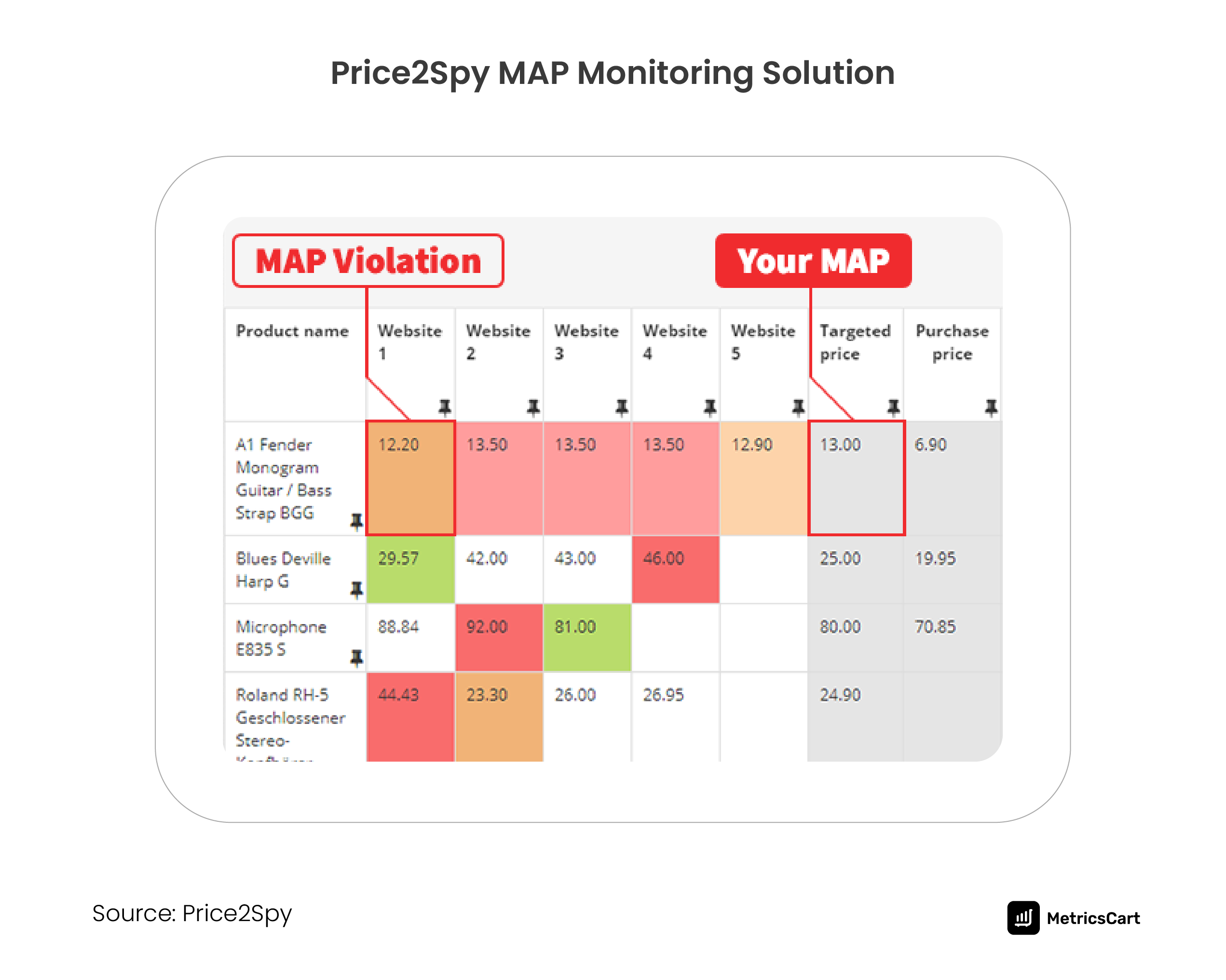
Price2Spy started as a competitive pricing tool, but over time, it has become a solid choice for MAP compliance, especially if you like context with your alerts.
The platform continuously scans prices across marketplaces and retailer sites, identifies MAP violations, and pairs those violations with historical pricing trends so you can see not just that something went wrong, but how and when it evolved. It automatically captures screenshots of offending prices, which turns spreadsheet chaos into actionable evidence.
Price2Spy also lets you slice and dice pricing data any way you want, which is great if your pricing strategy team demands graphs, charts, and presentations that “tell the pricing story.”
Top Features
- Alerts you when prices dip below the floor, with screenshots.
- Shows price behavior over time, so violations aren’t mysterious.
- Tailor reports by SKU, marketplace, or retailer.
- Works across marketplaces and traditional e-commerce sites.
3. Browse AI
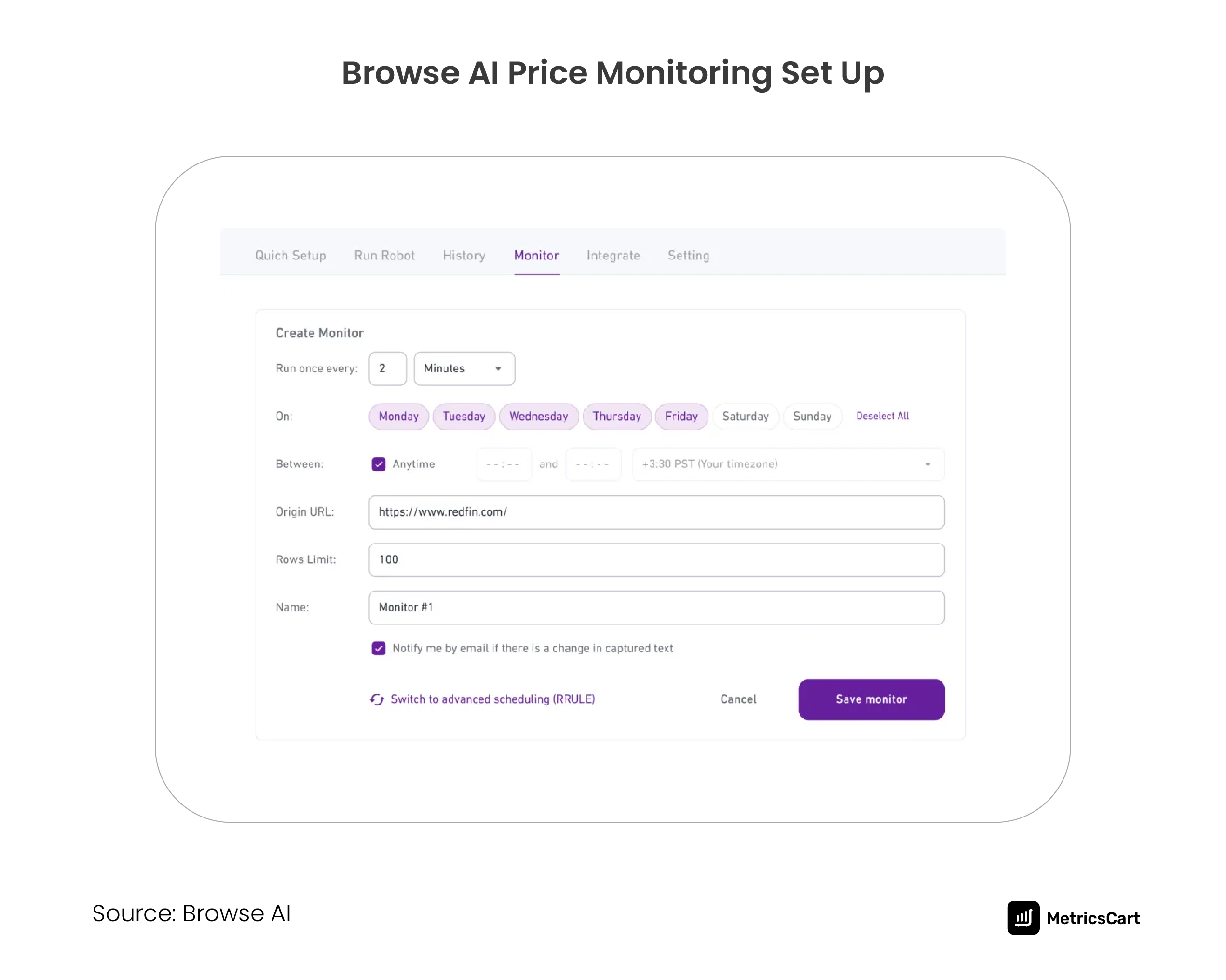
Traditional scrapers tend to break the second a retailer updates their website. Browse AI approaches monitoring differently: its adaptive bots actually learn how to extract data even when the underlying page structure shifts.
With Browse AI, you can build custom bots for specific retailer pages, and they will adjust themselves when layouts change. That means fewer broken monitors, fewer missed violations, and fewer late-night troubleshooting sessions.
The tool also captures screenshots and time-stamped data so you can see precisely when and how pricing behavior violates MAP, and it integrates with notification systems so you get alerts where you already work (email, Slack, API, etc.).
Top Features
- Keeps tracking even when retailer pages change.
- Tailor tracking to unique site structures.
- Get alerts with screenshots as violations occur.
- Push alerts to email, APIs, or messaging tools.
READ MORE| 7 Reasons Why MetricsCart Is the Best for MAP Monitoring & Enforcement: A Brand’s Perspective
Matching It All Up
MAP compliance monitoring has evolved from a simple legal safeguard to a strategic pricing tool that helps brands prevent margin erosion, control price undercutting, and strengthen retailer relationships. With effective monitoring and enforcement, you can ensure that pricing remains consistent across all channels and avoid the risks of aggressive, algorithm-driven repricing.
MetricsCart offers one of the best solutions for MAP compliance monitoring, providing real-time detection, automated alerts, and structured enforcement workflows. By using MetricsCart, you get complete pricing visibility across 100+ online retailers and marketplaces, manage pricing consistency at the SKU level, and prevent violations from impacting their bottom line.
Bulletproof Your Pricing Strategy with MAP Compliance Monitoring
FAQs
Price matching is when retailers automatically adjust their prices to match competitors, often driven by algorithms. This can lead to price wars, eroding your brand’s margins and profitability.
Strategies such as altering pack architecture, using SKU-level differentiation, and enforcing MAP policies can help brands protect margins and avoid getting caught in the cycle of price matching.
MAP (Minimum Advertised Price) policies are essential in creating a floor for pricing, helping prevent price erosion caused by competitors undercutting your prices. Effective enforcement of these policies can curb the impact of algorithm-driven pricing wars.
Yes, through strategic assortment differentiation, MAP enforcement, and tailored promotional strategies, brands can regain pricing control, even in an environment dominated by algorithms.
Price pack architecture involves adjusting the size, count, or bundle structure of your products. This breaks the direct comparability of prices, helping reduce the impact of price matching.