Highlights
- Increasing number of brands now use AI-driven MAP monitoring and enforcement tools to keep resellers in check, up from a handful in 2020. Manual monitoring is functionally obsolete.
- Research from the Kellogg School of Management confirms that higher distribution intensity is directly associated with higher MAP violation rates. Enforcement credibility is the primary deterrent.
- MetricsCart’s MAP monitoring and enforcement software tracks pricing across 150+ retailers with real-time price tracking, automated MAP violation tracking alerts, and timestamped violation evidence collection.
- MetricsCart’s dedicated Amazon pricing enforcement capabilities include Buy Box monitoring, hidden coupon detection, and unauthorized seller detection.
- MetricsCart also offers built-in tiered MAP enforcement workflows that automate the escalation path from first-violation warnings to legal-ready documentation.
Introduction
According to SellerApp, 70% of brands use automated MAP monitoring and enforcement. And yet, the gap between having a MAP policy and actually enforcing it remains enormous.
Most brands have a policy. They send it to new retailers in a PDF. They might even mention it during onboarding calls. And then they hope for the best.
This article explains what modern MAP enforcement software must do and why MetricsCart leads the category in 2026.
With MetricsCart’s MAP monitoring and enforcement software, track pricing across 150+ retailers, catch violations in real time, and enforce your MAP policy with automated workflows from a single platform.
READ MORE | Complete MAP Compliance Monitoring Guide: Strategies for 2026
The Real Cost of Weak MAP Monitoring and Enforcement
The damage from poor MAP violation tracking compounds across margins, channel relationships, and brand equity. Here’s what it can cost your brand:
Pricing Integrity and the Price Erosion Cycle
Price erosion in modern e-commerce is algorithmic. A single seller drops below MAP. Repricing bots on Amazon and Walmart detect the change and match within hours.
A Kellogg School of Management study found that higher distribution intensity is directly associated with higher violation rates and that retailers are more likely to violate MAP when the policy is expected to expire soon. More sellers plus weaker enforcement credibility equals more violations. It is a feedback loop.

On Episode 40 of the Digital Shelf Insider podcast, Michael R. Murphy, Partner at K&L Gates, explained that pricing policies exist to protect predictable dealer margins, avoid channel conflict, and prevent a destructive cycle of rebates, co-op demands, and product relaunches forced by pricing instability. A policy without monitoring and enforcement is just paper. Eventually, it leads to poor sales, tarnished brand reputation, and performance.
Watch the full episode here:
Channel Conflict and Retailer Relationship Damage
If price erosion is the financial cost of weak online MAP enforcement, channel conflict is the relational one.
Retailers track competitor pricing obsessively. When a buyer at a major chain sees your product advertised below MAP on Amazon, they honor the agreement, renegotiate terms, reduce shelf space, or drop the line. The conflict signals to every partner that your pricing policy is optional.
Every authorized reseller agreement must spell out exactly what happens when rules are broken, a clear strike system applied consistently, with no exceptions for large retailers.
The Unauthorized Seller Problem
Unaddressed violations attract more unauthorized sellers, compounding the enforcement challenge.
These sellers often source inventory through gray-market channels: liquidation, diverted stock, unauthorized distributors.
Harmon described how retailers with two doors in the middle of nowhere are doing three times the volume of a suburban store, family members opening businesses under different DBAs to move backdoor stock. One brand she works with had over 500 counterfeit packaging listings removed from TikTok Shop in 30 days.
Murphy and Harmon converge on a single point: pricing enforcement problems require an upstream solution. Authorization and transparency first. Pricing rules second. Without knowing who your sellers are and where they source inventory, your MAP policy will not work.
Check out MetricsCart’s MAP Masterclass to unlock more insights: https://www.youtube.com/playlist?list=PLyioClS_gEc41gr0QEhYWkNCXA9P2sYy9
Why MetricsCart Is the Best MAP Monitoring and Enforcement Software for Brands
MetricsCart’s MAP pricing protection features are the operational requirements channel managers deal with daily.
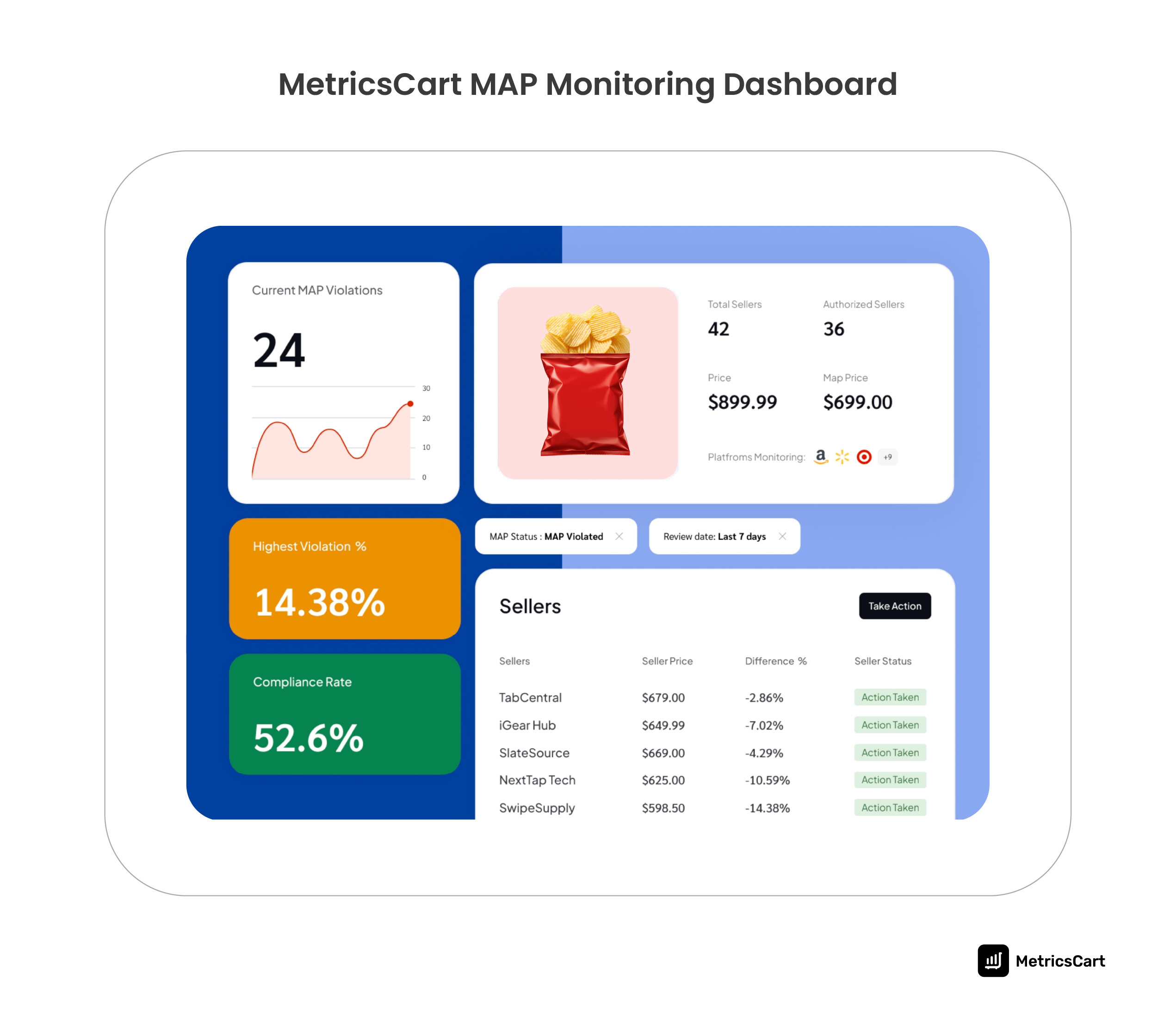
Real-Time MAP Violation Monitoring Across 150+ Retailers
Most MAP monitoring tools cover Amazon and maybe Walmart. MetricsCart tracks pricing across 150+ retailers and marketplaces, including Amazon, Walmart, Target, specialty e-commerce, regional platforms, and long-tail sites where enforcement is weakest, where unauthorized sellers operate.
The platform performs real-time price tracking at frequent intervals throughout the day. When a seller drops below MAP overnight, MetricsCart catches it before authorized partners see it in the morning. That speed differential of a few hours versus the 48–72 hours typical of manual or daily-batch monitoring is the difference between containing a violation and watching it cascade.
Automated Alerts That Flag MAP Violations Before They Spread
MetricsCart pushes instant alerts the moment a violation is detected, via email, dashboard, or workflow triggers. Configure the thresholds: alert when any seller drops more than 2% below MAP, when a specific repeat offender lists a new SKU, or when violation volume on a marketplace spikes above baseline.
Murphy noted on the Digital Shelf Insider that higher-cadence monitoring helps brands identify who leads price drops versus who follows. That distinction matters for enforcement. The seller who initiates a violation is a different problem than the algorithm-driven retailer who matches it hours later.
Advanced Seller Identification to Identify MAP Violations Fast
Knowing a violation exists is half the battle. Knowing who is behind it is the other half.
MetricsCart cross-references seller identities, storefronts, and historical behavior to trace violations back to specific actors, authorized partners breaking terms, or unknown third parties operating outside the distribution network.
A first-time violation from a long-standing partner calls for a different response than repeated undercutting from an anonymous storefront selling diverted inventory. Without seller-level identification, every violation gets the same treatment.

Granular SKU-Level MAP Monitoring
A dashboard that reports “12% of products have violations” without identifying which 12% is operationally useless.
MetricsCart sets and tracks MAP compliance at the individual SKU level. Every SKU gets its own threshold, alert rules, and enforcement triggers. Violations are rarely uniform; a seller might comply on hero SKUs while undercutting on lower-profile items where they assume no one is watching.
The Kellogg research confirms that violation patterns are systematic. They cluster around specific product characteristics and seller behaviors. SKU-level visibility surfaces those patterns and connects them to your broader pricing strategy.
Violation Trend Analysis and Repeat Offender Tracking
MetricsCart’s analytics engine surfaces which retailers violate during specific promotional windows, which sellers test boundaries on new launches, and whether violations trend up or down month over month. When you can predict which sellers are likely to violate, you can preempt the problem instead of chasing it.
The trend data connects to MetricsCart’s extended suite of digital shelf analytics, showing how pricing violations affect share of search, organic visibility, and brand reputation and performance.
READ MORE | Best MAP Enforcement Software in 2026
Amazon Buy Box Monitoring
Amazon operates by its own rules and is where most brands encounter their most costly violations.
The Buy Box captures roughly 80%+ of sales on any listing. When an unauthorized seller wins it at a below-MAP price, the brand loses pricing control and sales volume simultaneously.
Pricing on Amazon is shaped by algorithms and marketplace competition, not by brand agreements alone. MAP policies do not function as a direct enforcement mechanism inside Amazon’s marketplace, which makes monitoring critical.
MetricsCart’s Buy Box monitoring tracks which seller holds the Buy Box, at what price, and how often ownership changes. It also captures Amazon-specific loopholes basic tools miss: hidden checkout coupons, Subscribe & Save discounts of 5-15%, multi-packs priced below per-unit MAP, and unauthorized bundles.
Automated Tiered MAP Enforcement Plan
This is where MetricsCart diverges from basic price trackers. The platform automates the escalation process: first-violation warnings, second-strike notices, supply-restriction triggers, and legal-escalation flags. Each step is configurable to your policy. The system sends notices, logs actions, and creates a documented trail.
Harmon advocates exactly this: enforcement with real consequences, applied consistently. Consistency is operationally smart and legally necessary. Automated workflows enforce that consistency without relying on judgment calls from overstretched channel managers.
READ MORE | MAP Policy for Brand Protection: How to Enforce It in 2026
Comprehensive Compliance Reports and Dashboards
MetricsCart automatically captures timestamped screenshots, pricing histories, and seller information for every detected violation. It is the audit trail legal teams need for escalation and sales teams need for retailer conversations.
The compliance dashboards centralize visibility into violation trends, compliance rates by retailer, enforcement action status, and resolution timelines. Filter by time period, retailer, SKU, seller, or severity.
Superior Operational Efficiency and Ease of Use
MetricsCart prioritizes clarity over complexity, with pre-built views for common MAP workflows. Setup is streamlined, MetricsCart’s team handles vendor migration and retailer onboarding. Most brands are operational within days.
With MetricsCart, brands have seen:
- Reduction in MAP violations by approximately 40%.
- Around a 20% increase in compliance rates among authorized sellers.
- Boosted customer trust and satisfaction due to consistent pricing.
Pricing starts at $300/month. This highly accessible entry point makes enterprise-grade brand protection incredibly affordable. Brands can defend their margins and secure their pricing integrity without stretching their operational budgets.
Getting Started With MetricsCart’s MAP Enforcement Platform
1. Define Your MAP Policy Scope
Identify which SKUs have MAP pricing, which retailers need monitoring, and your enforcement escalation tiers. If your policy has gaps, Amazon-specific language, coupon and bundle coverage, and authorized seller definitions, MetricsCart’s team advises on best practices from hundreds of brand deployments.
2. Configure Monitoring and Alerts
MetricsCart’s onboarding team sets up retailer coverage, SKU catalog, MAP thresholds, and notification preferences. Most brands are live within days.
3. Activate Enforcement Workflows
Define what happens at each violation stage: automated warnings, second-strike notices, supply restriction triggers, and legal escalation flags. Configure templates, set timelines, and let the system handle sequencing and documentation.
4. Monitor, Analyze, and Optimize
Use the compliance dashboards to track violation trends, measure enforcement effectiveness, and identify emerging threats. The goal is not just catching violations but building a system where violations become less likely over time because sellers know the monitoring is real and the consequences are not negotiable.
Strengthen Your Pricing Integrity With MetricsCart
Your pricing policy is only as strong as your enforcement. MetricsCart gives channel managers, e-commerce directors, and brand protection leads the real-time monitoring, seller intelligence, and automated enforcement needed to keep pricing consistent across every marketplace.
Get in touch with us for a free assessment of your brand pricing control.
Detect MAP Pricing Violations Early and Protect Your Brand Online!
FAQs
MAP monitoring and enforcement is the practice of systematically tracking whether retailers and third-party sellers are advertising products at or above the Minimum Advertised Price a brand has established, and taking corrective action when violations occur. It includes automated monitoring, real-time alerts, seller identification, and evidence collection, with a policy framework that includes defined consequences.
MetricsCart scans pricing data across 150+ online retailers and marketplaces, comparing advertised prices against MAP thresholds at the SKU level. When a violation is detected, the platform sends automated alerts immediately, captures timestamped screenshot evidence, identifies the seller through advanced cross-referencing, and logs the violation in the enforcement dashboard. This lets brands identify MAP violations within minutes.
Yes. The platform includes dedicated Amazon pricing enforcement: Buy Box monitoring that tracks which seller holds the Buy Box at what price and how often ownership changes, seller identification that surfaces unauthorized third-party sellers, and tracking of Amazon-specific violation types, including hidden checkout coupons, Subscribe & Save discounts, and unauthorized bundles. Amazon’s algorithmic repricing can cascade violations across an entire category within hours, making this depth essential.
MetricsCart offers flexible plans starting at $300/month. Pricing scales with SKU count, retailer coverage, and enforcement workflow complexity.
Yes. MetricsCart integrates MAP monitoring, automated alerts, seller identification, enforcement workflow automation, evidence collection, and compliance analytics into one system. It is also part of MetricsCart’s broader Digital Shelf Analytics suite, connecting MAP compliance data with pricing and promotion intelligence, share of search analytics, ratings analysis, and assortment tracking.