Highlights
- Amazon carries fewer Nature Made products than Walmart, but generates nearly 47x more customer reviews.
- Walmart offers over twice the assortment size, while Amazon maintains stronger customer engagement and sponsored visibility.
- Premium Nature Made products are significantly more expensive on Walmart, largely driven by multi-pack listings.
- Essential vitamins and mineral supplements remain competitively priced across both retailers.
About the Report: This report analyzes Nature Made’s digital shelf performance across Amazon and Walmart using the MetricsCart Digital Shelf Analytics platform. The analysis is based on the brand’s marketplace performance tracked between May 12 and May 25, 2026, covering SKU count, pricing distribution, category mix, sponsored product visibility, seller activity, and review volume across both platforms.
By monitoring these shifts over time, this Nature Made product analysis helps CPG and health and wellness brands benchmark platform strategy and understand how assortment, pricing, and seller structure shape performance on the digital shelf.
Introduction
Nature Made is one of the most well-known vitamin and supplement brands in the US. For more than five decades, it has helped millions of Americans support their everyday health with products ranging from multivitamins and fish oil to probiotics, magnesium, and sleep supplements.
Today, Nature Made products are available in pharmacies, grocery stores, big-box retailers, and online marketplaces across the country. And as more shoppers buy health supplements online, Amazon and Walmart have become two of the brand’s most important sales channels.
But succeeding on these marketplaces takes more than offering a wide range of products and a legacy name. Pricing, product assortment, customer reviews, seller presence, and sponsored visibility all influence how shoppers discover products and decide what to buy.
Fun Fact: Nature Made is the first national broadline vitamin brand in the US to earn the United States Pharmacopeia’s (USP) Verified Dietary Supplement mark for many of its products.
Nature Made on Amazon vs Walmart: An Overview
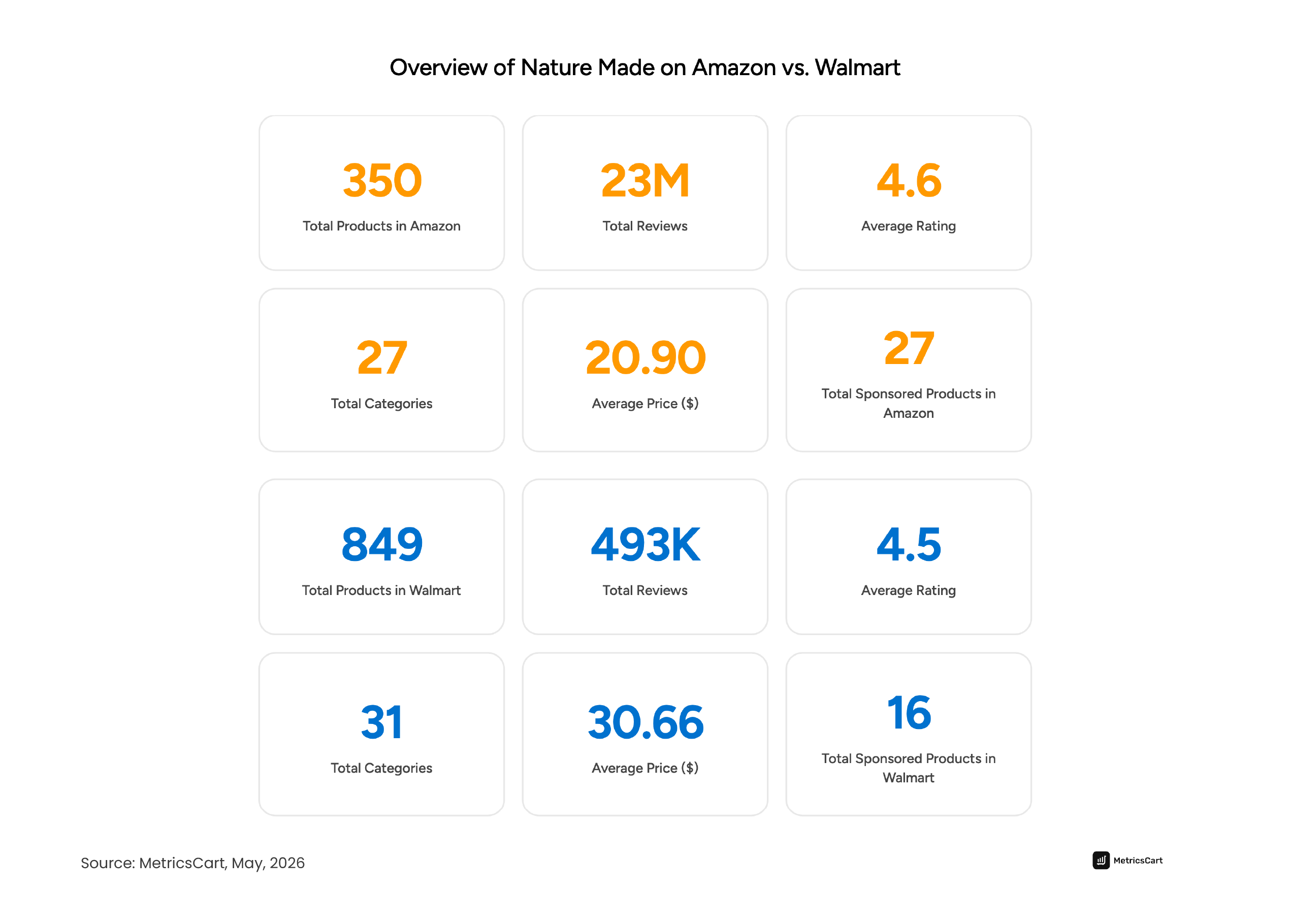
Nature Made has a strong presence on both Amazon and Walmart, but the brand’s digital shelf looks different across the two marketplaces.
Walmart offers a much larger catalog with 849 Nature Made products, compared to 350 products on Amazon. Amazon, however, sees much higher customer engagement, with more than 23M reviews across Nature Made products, while Walmart has around 493K reviews.
Average customer ratings remain consistently high on both platforms at 4.6 stars on Amazon and 4.5 stars on Walmart. The average product price is also lower on Amazon at $20.90, compared to $30.66 on Walmart.
Nature Made Product Analysis: Where Each Platform Concentrates the Assortment
Nature Made offers a wide range of health and wellness products on both Amazon and Walmart, but the product mix isn’t identical.
Vitamins and Supplements, as a broad umbrella category, dominate Walmart’s Nature Made shelf with 241 products. Within that mix, Multivitamins sit at the affordable end, while Dietary Supplements, at an average of $50, mark the most expensive category on the platform.
| Top Categories of Nature Made Products on Walmart | ||
| Category | Product Count | Average Price |
| Vitamins and Supplements | 241 | $41 |
| Vitamins | 173 | $28 |
| Immune Support | 104 | $21 |
| Omega 3 | 45 | $30 |
| Multivitamins | 40 | $20 |
| Stress Support Supplements | 34 | $23 |
| Women’s Multivitamins | 32 | $33 |
| Men’s Multivitamins | 27 | $23 |
| Minerals | 26 | $22 |
| Dietary Supplements | 22 | $50 |
Amazon’s catalog is also led by Vitamins, but categories such as Minerals and Essential Fatty Acids have a stronger presence. Compared to Walmart, Amazon’s assortment appears more focused on everyday supplements and specialized health products that are popular with online shoppers.
| Top Categories of Nature Made Products on Amazon | ||
| Category | Product Count | Average Price |
| Vitamins | 116 | $19 |
| Minerals | 51 | $20 |
| Essential Fatty Acids | 39 | $25 |
| Multivitamins | 37 | $20 |
| Sleep Supplements | 21 | $16 |
| Antioxidants | 18 | $34 |
| Blended Vitamin & Mineral Supplements | 13 | $25 |
| Herbal Supplements | 12 | $23 |
| Dietary Fibers | 6 | $20 |
| Prenatal Vitamins | 6 | $20 |
This category mix reflects the role each marketplace plays in Nature Made’s e-commerce strategy.
Walmart’s broader assortment helps the brand cater to a wider range of shopper needs in a single destination, while Amazon’s more focused catalog is built around high-demand products that shoppers frequently search for and repurchase.
Maintaining the right category mix for each retailer allows Nature Made to improve product discoverability, serve different shopping missions, and strengthen its presence across both marketplaces.
Nature Made Pricing Analysis: Amazon vs Walmart
Upon analyzing the pricing trends and patterns of Nature Made products using the MetricsCart price and promotion monitoring tool, we found that the brand is generally more affordable on Amazon than on Walmart.
Across the brand’s catalog, the average product price is $20.90 on Amazon, compared to $30.66 on Walmart. At first glance, this may suggest that Walmart is consistently more expensive.
The higher average price on Walmart is largely influenced by its broader assortment of premium products, particularly multi-pack bundles and dietary supplements. Amazon, on the other hand, has a more focused catalog with a larger share of products in the lower and mid-price ranges, bringing down its overall average price.
Interestingly, this price difference is less noticeable for everyday vitamins and mineral supplements. Many of these products are priced similarly across both marketplaces, indicating that Nature Made maintains consistent pricing for its core offerings while using assortment to differentiate each retailer.
This suggests that Nature Made isn’t simply pricing products differently on Amazon and Walmart.
Instead, the brand appears to tailor its product mix to each marketplace, allowing Walmart to cater to shoppers looking for larger bundles and premium supplements, while Amazon focuses on products with broader appeal and higher purchase frequency.
READ MORE | Losing Sales on Amazon? 7 Hidden Reasons & their Solutions
Most Expensive Nature Made Products: Walmart vs Amazon
Nature Made’s premium product lineup looks very different across Amazon and Walmart. While both marketplaces feature high-value supplements, the products driving the highest prices are not the same.
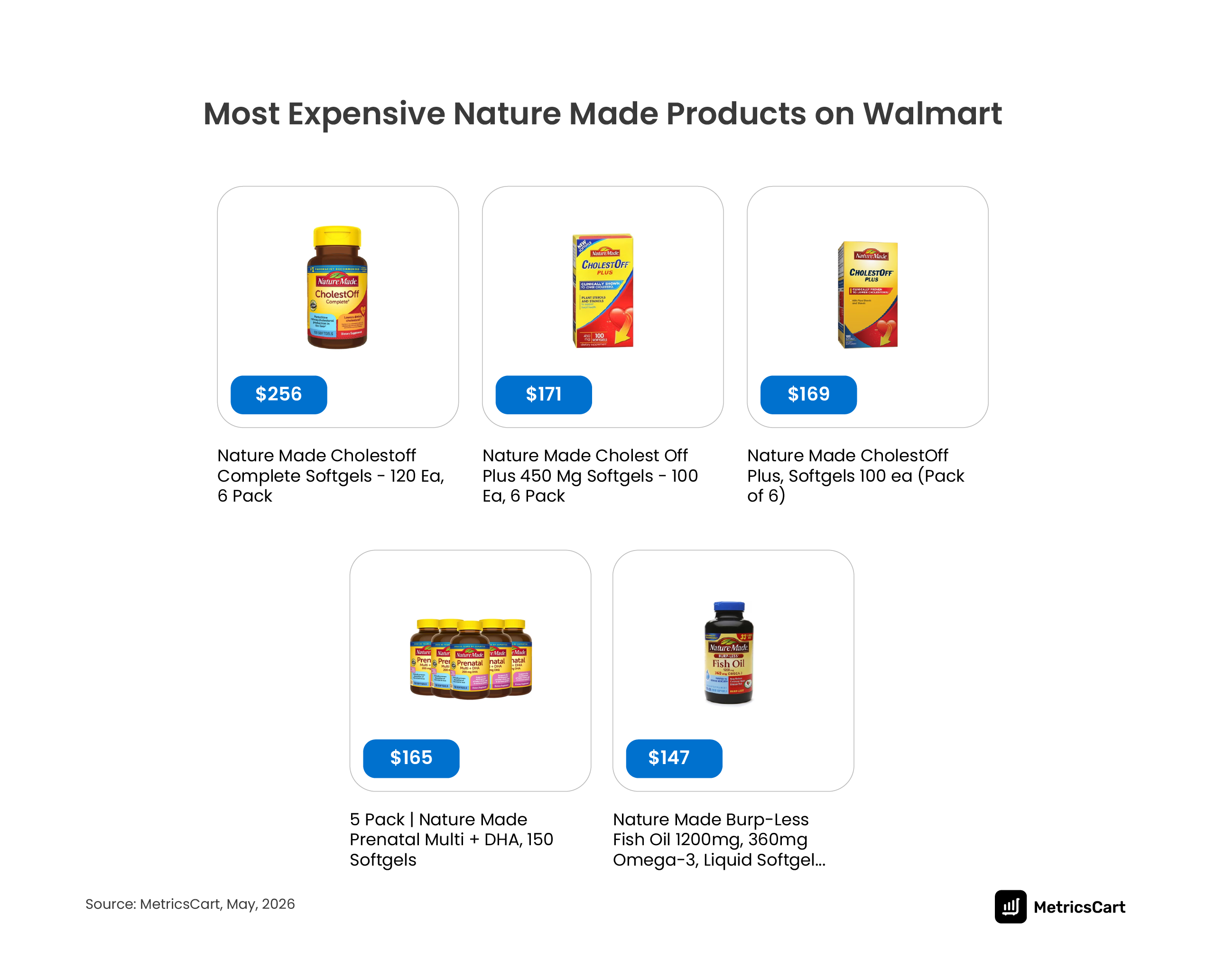 On Walmart, the most expensive Nature Made products are primarily combo packs and dietary supplements, with prices ranging from $126 to $256. These larger bundle packs are designed for long-term use and bulk purchasing, making them significantly more expensive than individual supplement bottles.
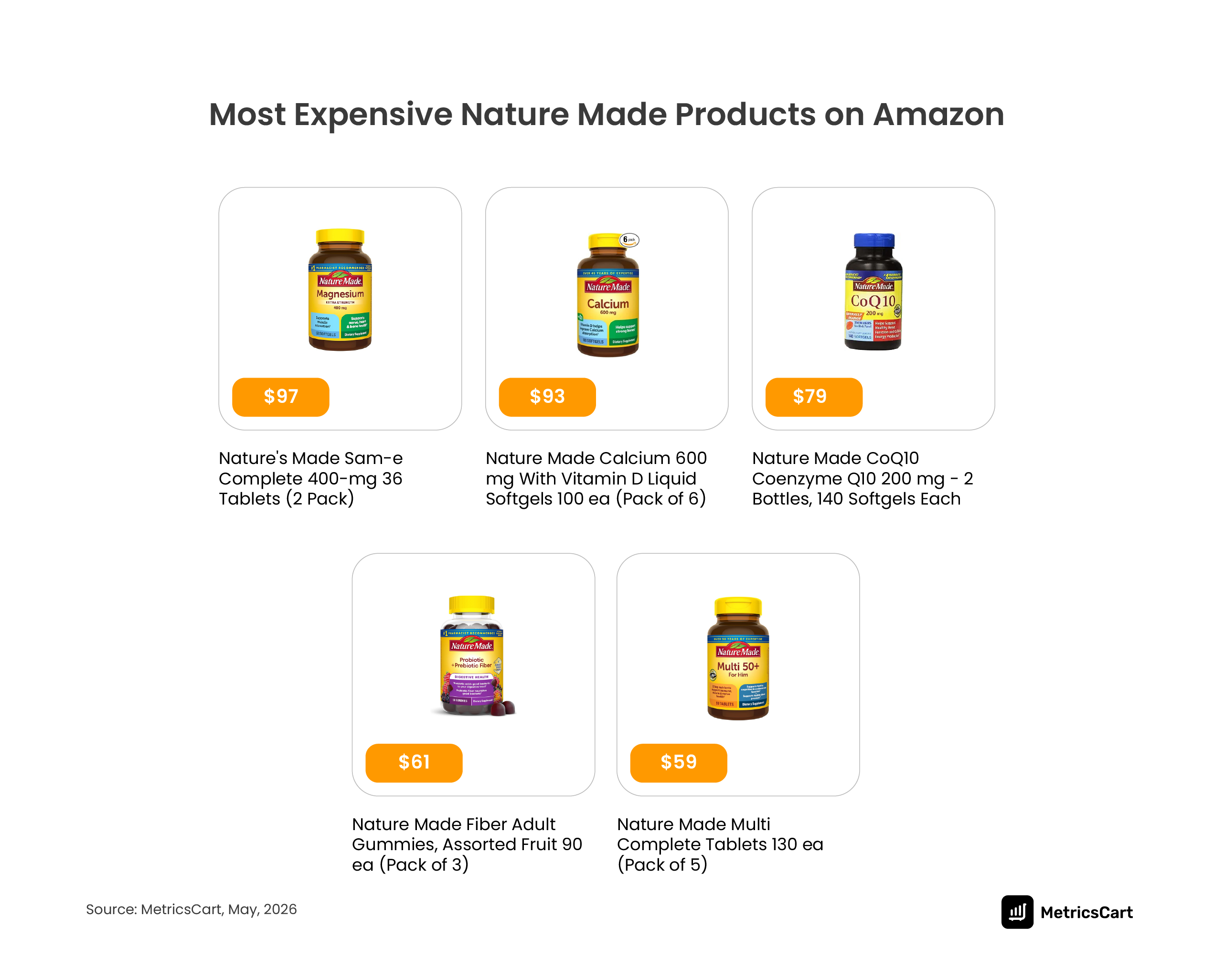
Amazon takes a different approach. Instead of large bundles, its premium tier is led by specialized health supplements such as SAM-e Complete, CoQ10 (Coenzyme Q10), and Triple Omega 3-6-9. Prices range from $48 to $97, with six of the top ten products falling between $48 and $61, creating a much narrower premium price band.
The comparison highlights an interesting marketplace strategy. Nature Made’s premium supplement assortment on Walmart is driven by product quantity through multi-pack bundles, while Amazon’s focuses on specialized formulations with higher perceived value.
This allows Nature Made to address different shopping behaviors across the two retailers, serving bulk buyers on Walmart while catering to shoppers seeking targeted health supplements on Amazon.
Most Affordable Nature Made Products: Amazon vs Walmart
At the other end of the pricing spectrum, Nature Made follows a remarkably consistent strategy across Amazon and Walmart.
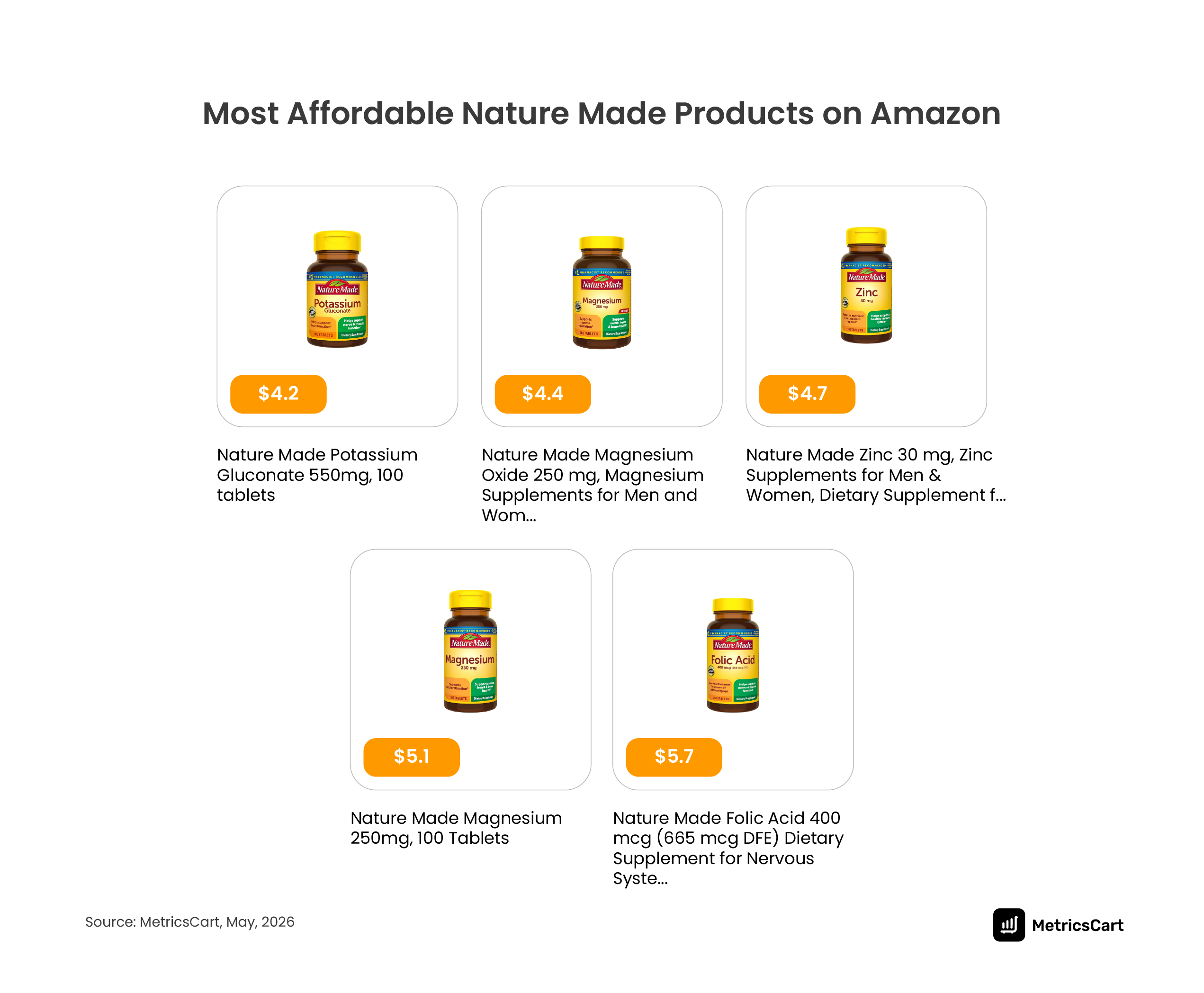
The brand’s most affordable products are priced between $4.20 and $7.00 on both marketplaces, with mineral supplements dominating this segment. In fact, the lowest-priced Nature Made product and its price are identical across Amazon and Walmart, highlighting a standardized pricing approach for many of the brand’s everyday essentials.
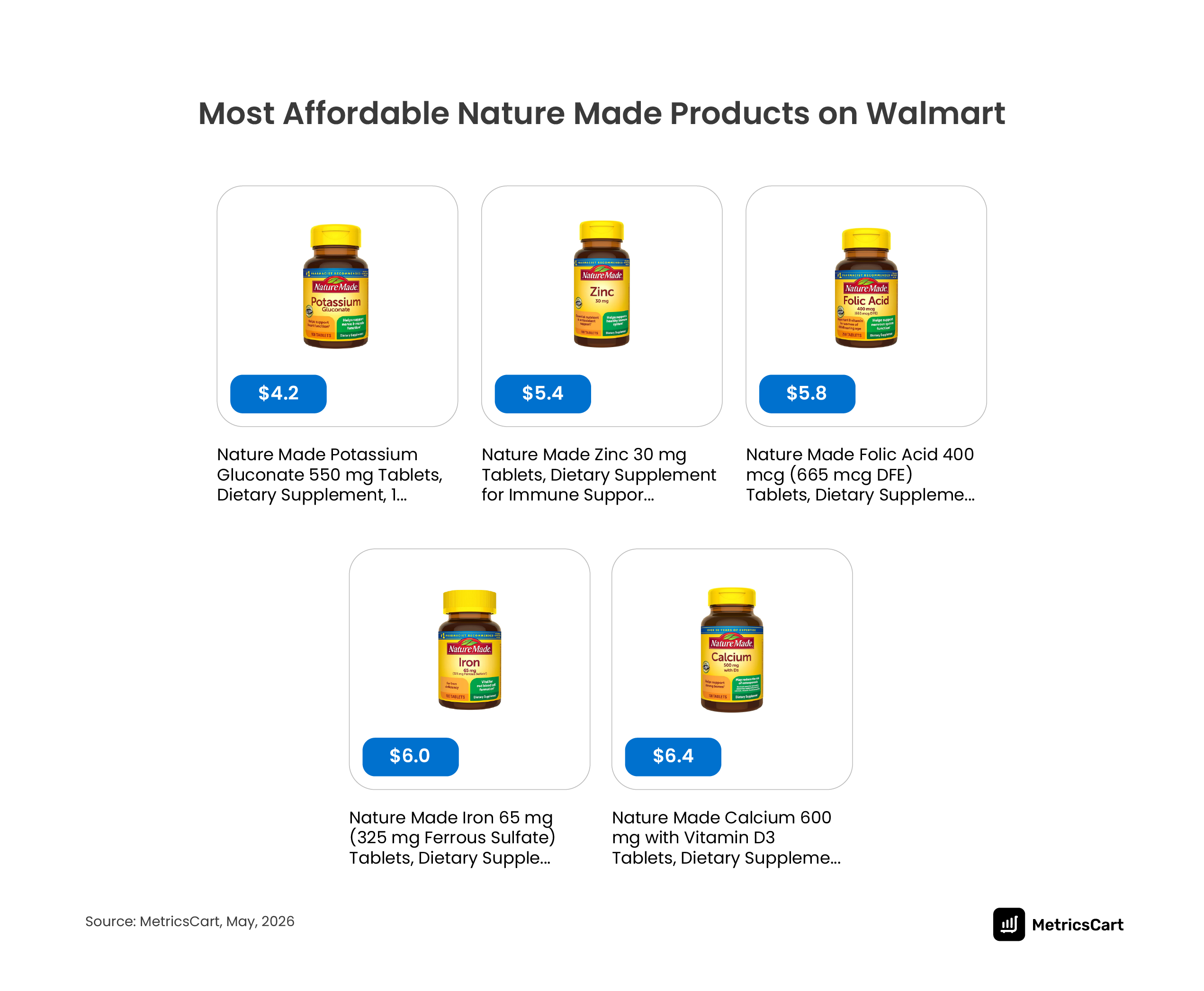
Walmart’s affordable assortment is tightly clustered, with eight of the ten least expensive products priced below $7.00. Amazon shows a similar pattern, where half of the ten most affordable products fall between $4 and $6, while the remaining products are priced between $6 and $7.
This consistency suggests that Nature Made prioritizes price competitiveness for its core vitamins and mineral supplements regardless of the retailer. Rather than competing on price alone, the brand appears to maintain stable entry-level pricing while differentiating the two marketplaces through premium products, assortment depth, and bundle offerings.
Review Trends: Amazon Generates Far Greater Customer Engagement
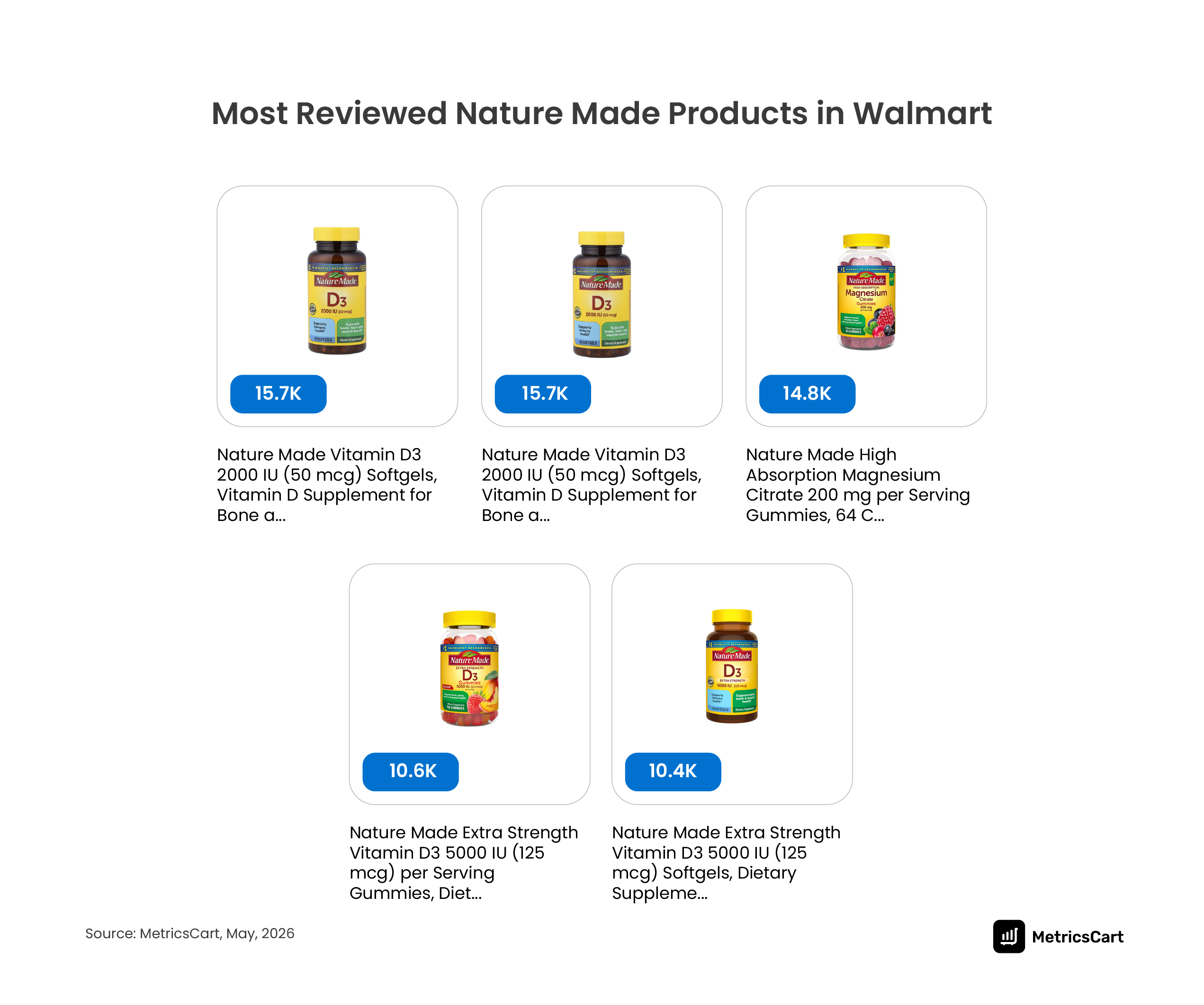
Review volume is one of the clearest indicators of customer engagement on the digital shelf. Using MetricsCart’s Ratings & Reviews Analysis solution, we analyzed the Nature Made products with the highest review volumes to understand repeat purchase behaviour and shopper demand across Amazon and Walmart.
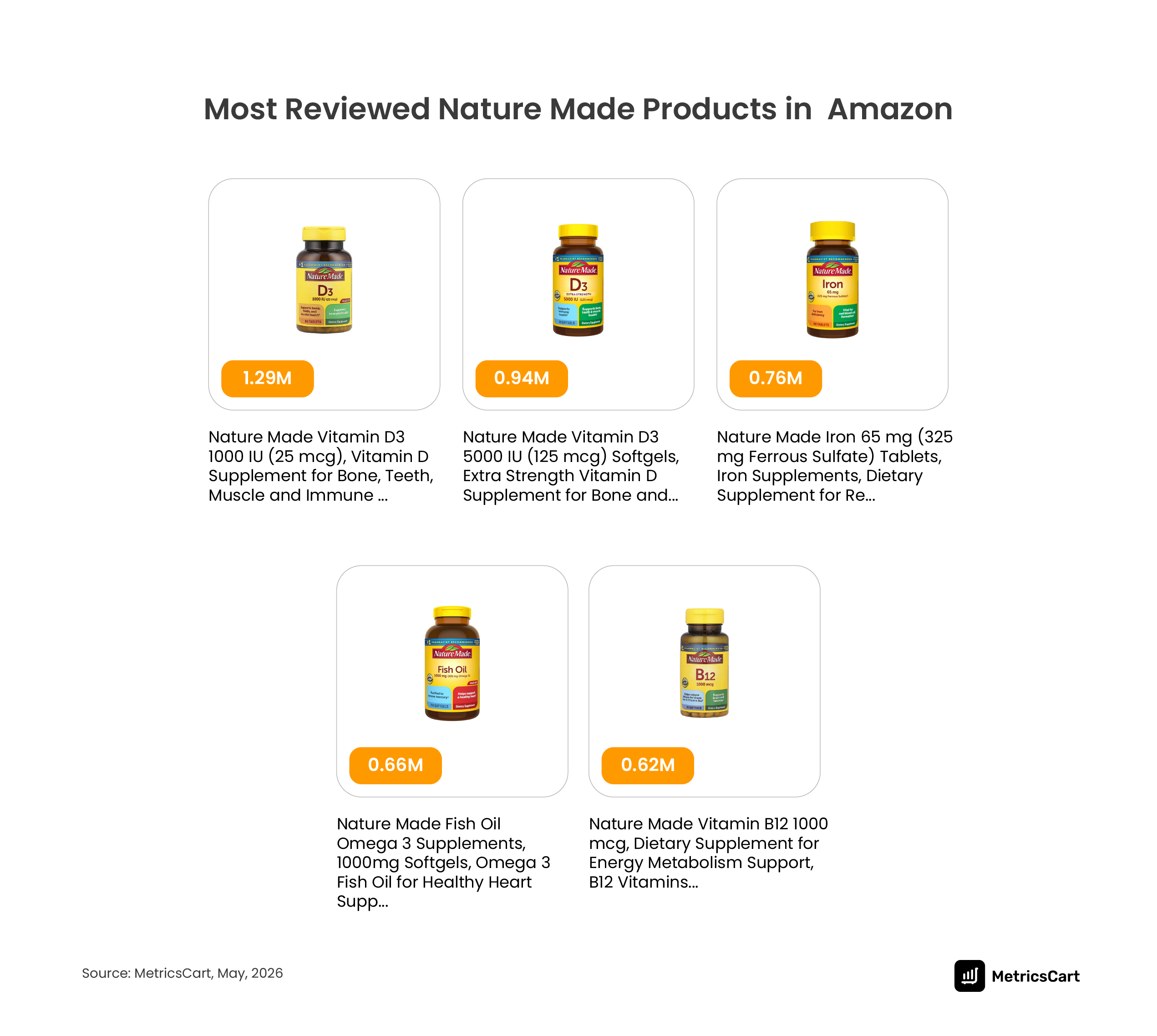
Vitamin D supplements are the most-reviewed sub-category on both Amazon and Walmart, a signal that daily Vitamin D supplementation is Nature Made’s strongest point of ongoing customer engagement, regardless of retailer.
The scale, however, is not comparable. Amazon’s top Vitamin D listing has accumulated approximately 1.29M reviews, while Walmart’s leading Vitamin D and magnesium listings sit in the thousands.
That gap reflects Amazon’s far larger active customer base for the brand, consistent with the 23M vs. 493K total review gap at the platform level.
Beyond Vitamin D, Amazon’s most-reviewed products include iron, fish oil omega-3, and Vitamin B12 supplements, all high-frequency, repeat-purchase health categories. This reinforces that Amazon functions as Nature Made’s primary channel for habitual, subscribe-and-forget style vitamin purchasing.
READ MORE | Customer Feedback Analysis in E-Commerce: The Must-Know Aspects for Brands
Review Volume for Nature Made on Amazon vs. Walmart Over Time
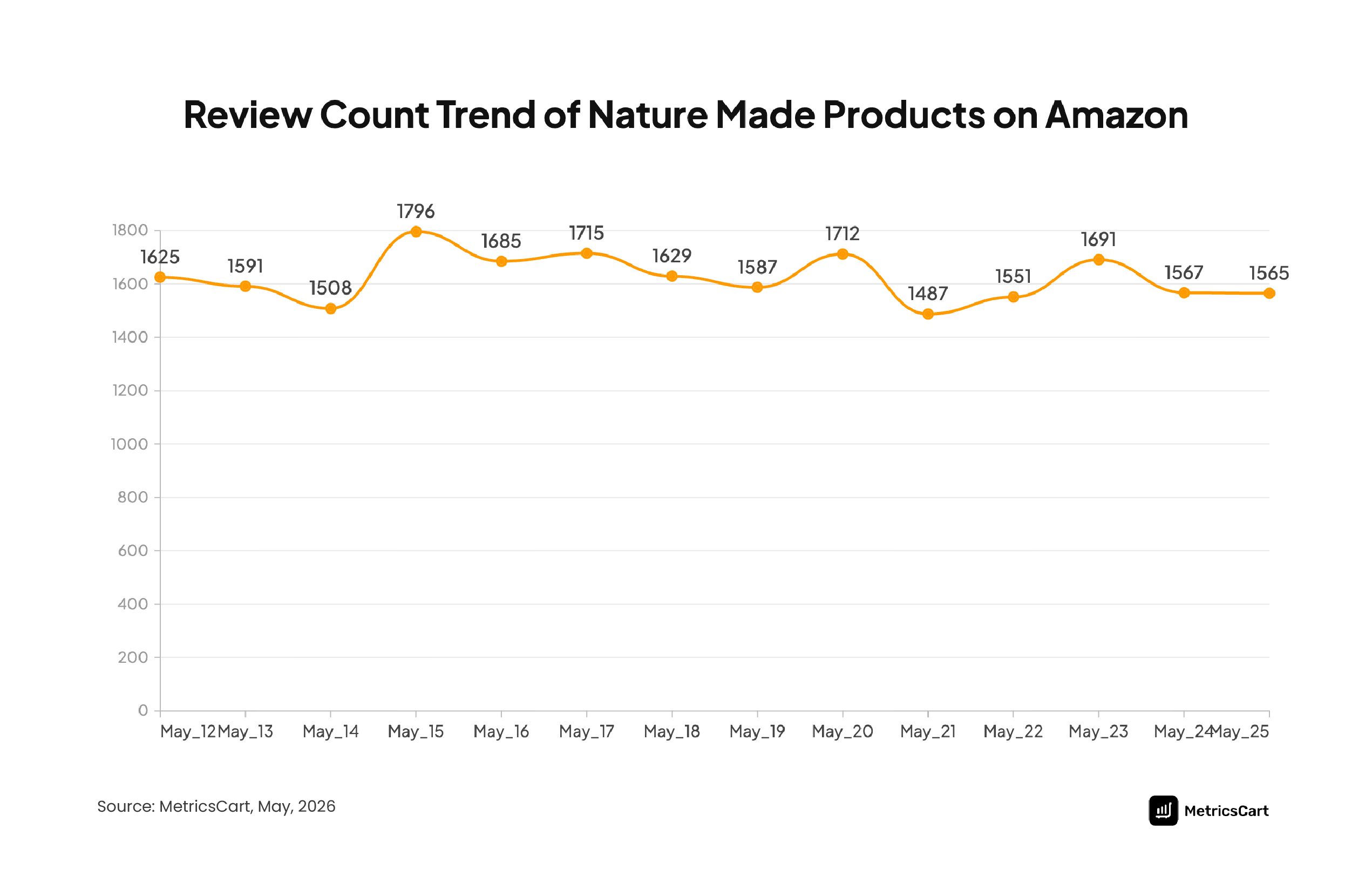
Across the two-week monitoring window, Amazon’s cumulative review count moved between roughly 1,487K and 1,796K, dipping to its lowest point around May 21 and peaking near May 15.
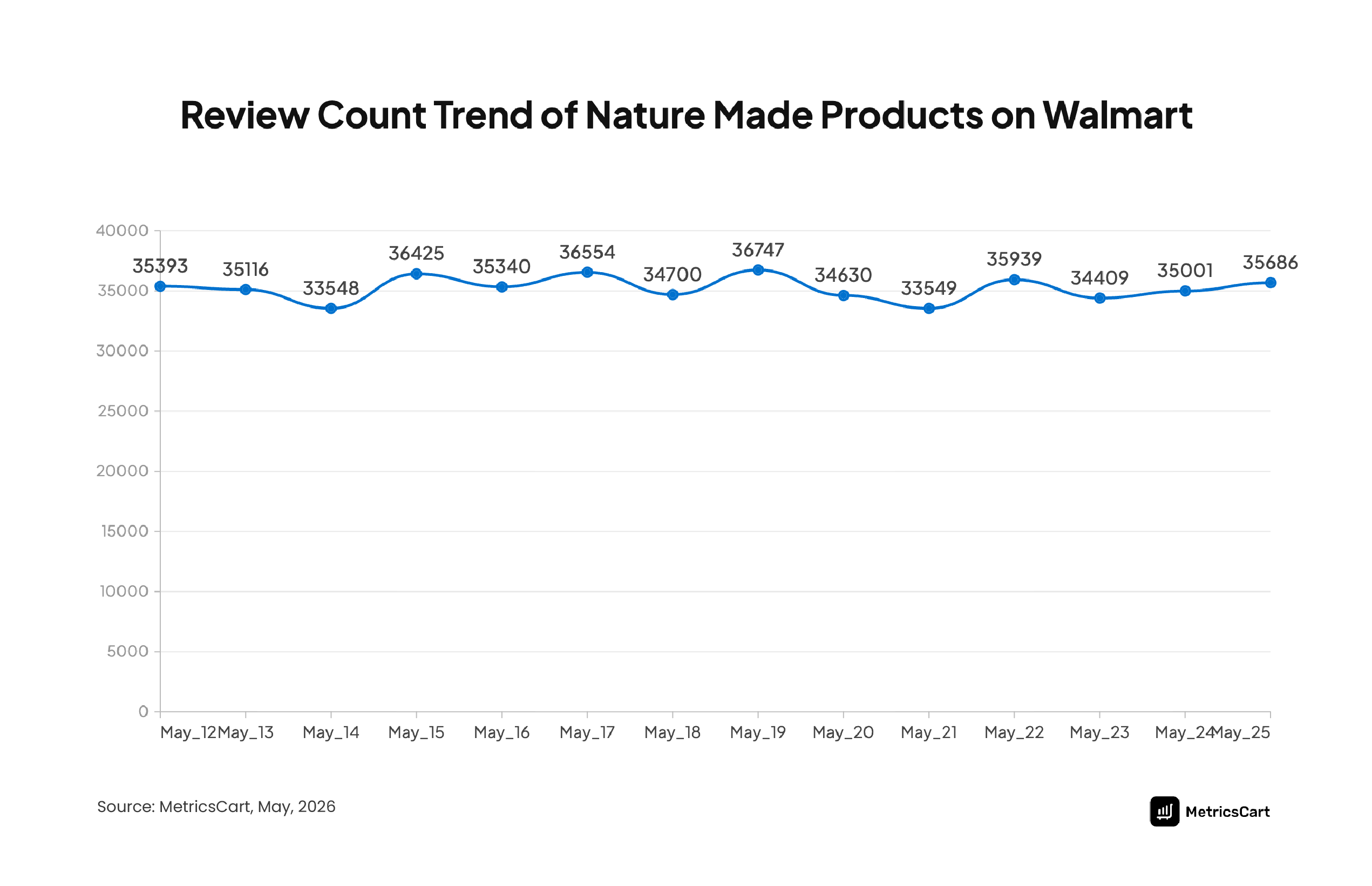
Walmart’s review count moved in a much smaller band, between roughly 33K and 37K, with its own low point on May 14 and peak on May 19.
Across the two-week monitoring period, both Amazon and Walmart showed modest fluctuations in cumulative review counts rather than a steady upward trend. This is typical for large product catalogs, where review totals are influenced by new customer feedback, listing changes, and catalog updates.
The bigger takeaway is the difference in scale. Amazon’s review volume is dramatically higher than Walmart’s, giving Nature Made stronger social proof and a richer source of customer feedback. For brands, monitoring review trends over time can help identify changes in shopper engagement, detect unusual activity, and uncover opportunities to improve products and listings before small issues become larger problems.
READ MORE | Do Review Recency and Volume Affect Sales? Everything You Need to Know
Nature Made Seller Analysis: The Seller Landscape on Amazon vs. Walmart
The seller landscape for Nature Made is largely dominated by the marketplaces themselves, but a few third-party sellers also play an important role in expanding the brand’s reach.
On Amazon, Amazon.com is the primary seller for many Nature Made products, while Walmart.com serves a similar role on Walmart. Beyond the marketplaces, Hey Pharma stands out as the leading third-party seller across both platforms, maintaining a strong presence in the brand’s catalog. Walmart also features Nature Made as a direct seller, a presence not observed on Amazon during the analysis period.
Another notable trend is that many of Nature Made’s affordable products are sold directly by Amazon and Walmart rather than third-party sellers. This gives shoppers greater confidence in product authenticity while allowing the marketplaces to maintain competitive pricing on high-volume items.
For brands, the seller landscape is more than a list of merchants. It can influence pricing consistency, Buy Box ownership, product availability, and the overall customer experience. Monitoring who sells your products across marketplaces helps identify opportunities to strengthen retail partnerships, maintain brand control, and quickly detect shifts in marketplace dynamics.
Retail Media: Sponsored Product Activity
Sponsored products play an important role in helping brands increase visibility on crowded marketplace search results. For Nature Made, sponsored visibility remained largely stable throughout the analysis period, indicating a consistent advertising presence.
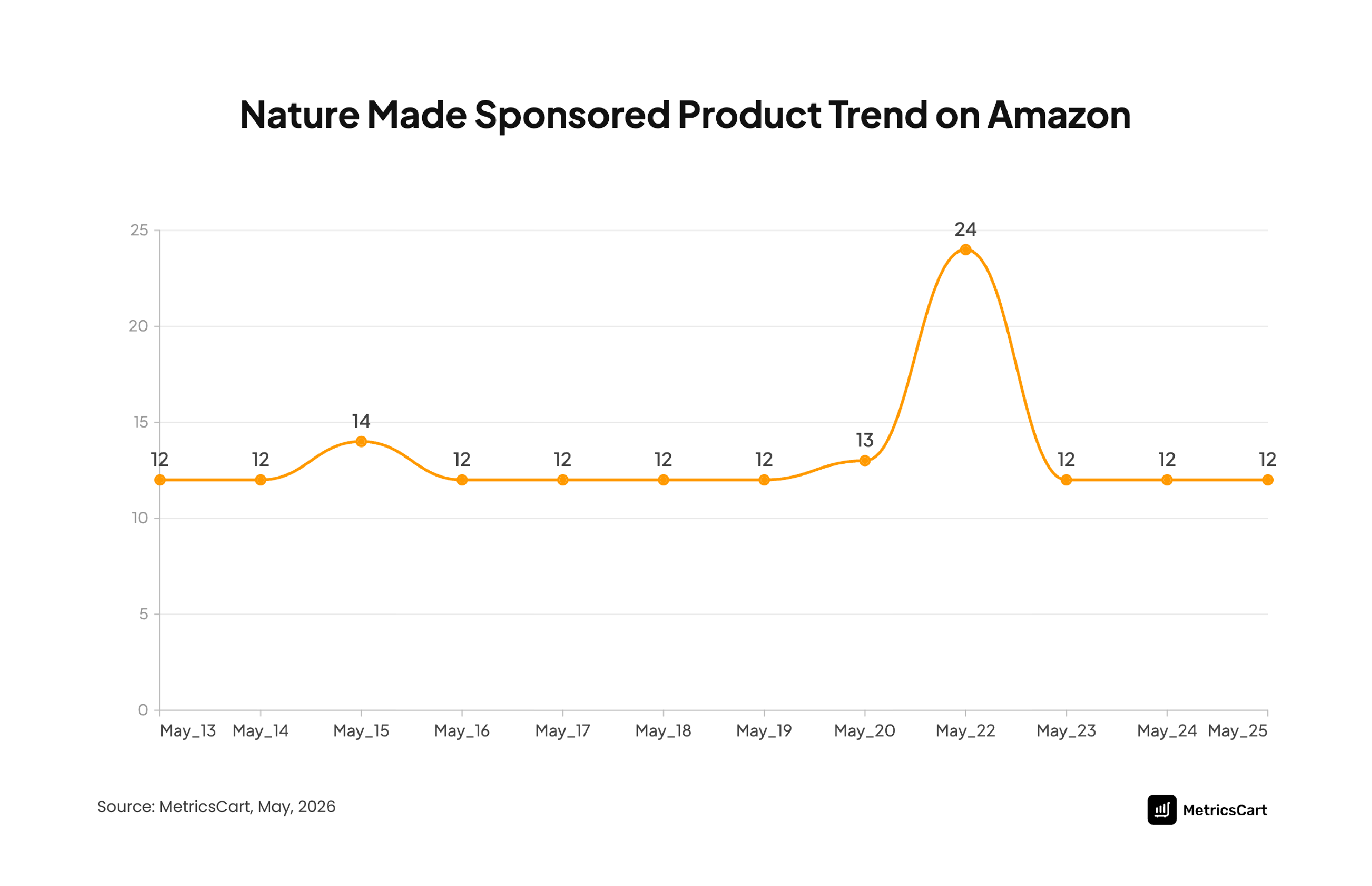
On Amazon, the number of sponsored Nature Made products stayed at 12 on most days. The only notable change occurred on May 22, when sponsored listings briefly increased to 24 before returning to their usual level.
The temporary spike may have been driven by a promotional campaign, increased advertising investment, or heightened competition for health supplement keywords. While a single-day increase doesn’t establish a long-term trend, it highlights how sponsored visibility can change quickly in response to marketplace activity.
For brands, monitoring sponsored product trends alongside organic visibility provides a more complete picture of digital shelf performance. Sudden increases or declines in sponsored listings can signal changes in advertising strategy, competitive pressure, or seasonal demand, helping ecommerce teams respond faster and optimize their marketplace presence.
What CPG and Wellness Brands Can Learn from Nature Made’s Digital Shelf
Nature Made’s digital shelf strategy shows that success isn’t about treating every marketplace the same. Instead, the brand adapts its assortment, pricing, and marketplace presence to match how shoppers browse and buy on each retailer.
Here are three key lessons for CPG and wellness brands:
1. More Products Don’t Always Mean More Customer Engagement
Walmart carries 849 Nature Made products, more than double Amazon’s 350. Yet Amazon generates over 23M reviews, compared to Walmart’s 493K. This shows that a larger catalog doesn’t automatically create stronger customer engagement.
Instead of measuring success by SKU count alone, brands should track how individual products perform in terms of reviews, ratings, conversions, and visibility. A smaller, well-optimized assortment can often outperform a much larger catalog.
2. Keep Everyday Products Consistent, Differentiate Through Premium Offerings
Nature Made maintains nearly identical pricing for its entry-level vitamins and mineral supplements across Amazon and Walmart, reinforcing a consistent value proposition for everyday shoppers. At the premium end, however, the strategy changes.
Walmart’s highest-priced products are driven by bulk combo packs, while Amazon’s premium assortment focuses on specialized supplements like CoQ10 and Triple Omega 3-6-9. This approach allows the brand to meet different shopper needs without compromising pricing consistency for its core products.
3. Monitor Your Seller Network, Not Just Your Products
Nature Made’s products are primarily sold by Amazon and Walmart themselves, but large third-party sellers like Hey Pharma also maintain a significant presence across both marketplaces.
As seller networks grow, brands need continuous visibility into who is selling their products, how prices compare across sellers, and whether marketplace activity aligns with their pricing and distribution strategy. Monitoring seller activity helps brands maintain pricing consistency, protect brand reputation, and quickly identify unexpected changes across the digital shelf.
READ MORE | 7 Common Digital Shelf Mistakes You Must Avoid
Supplementing Success with Digital Shelf Analytics Software
Nature Made’s digital shelf strategy confirms that success in e-commerce isn’t determined by having the largest catalog or the lowest prices. It comes from understanding how shoppers interact with your brand on each marketplace and continuously optimizing the factors that influence their purchase decisions.
Whether it’s maintaining the right category mix, balancing premium and entry-level pricing, monitoring seller activity, or tracking customer reviews and sponsored visibility, every digital shelf signal contributes to long-term marketplace performance. Brands that monitor these metrics consistently are better equipped to identify opportunities, respond to competitive changes, and deliver a stronger shopping experience.
MetricsCart is one of the best digital shelf analytics software that helps CPG and wellness brands monitor pricing, assortment, ratings and reviews, seller activity, retail media, and other digital shelf metrics across Amazon, Walmart, and 150+ online retailers, all from a single platform.
With deep, accurate insights into your digital shelf, you can benchmark against competitors, protect your pricing strategy, improve product discoverability, optimize retail media performance, and make faster decisions backed by real-time market intelligence.
Disclaimer: MetricsCart is the exclusive owner of the data used in this Digital Shelf Insights report. Any third-party usage must include proper credit to the source.
Discover the next growth opportunity hiding in your digital shelf with MetricsCart.