Highlights
- Oral-B structures 335 of its 468 Walmart products under $25, using low-cost floss and kids’ toothbrushes as entry points that build long-term repurchase habits across the catalog.
- Oral-B’s deepest discounts, up to 58.6%, land exclusively on consumables like floss, while average catalog prices held firm between $23.20 and $24.30 throughout the tracking period.
- With 298 adult-targeted products at an average price of $23 and just 4 senior-tier products at an average price of $87, Oral-B runs volume and margin as parallel strategies rather than competing ones.
- Seven of Oral-B’s top twelve weekly Walmart sellers are floss products, making floss the brand’s primary driver of repeat purchases rather than a secondary category.
- Walmart.com lists Oral-B at $28 on average, while the largest third-party seller prices the same brand at $21, a gap that shapes consumer price expectations without any action from the brand.
About the Report
This Digital Shelf Insights report examines Oral-B’s marketing strategy on Walmart, focusing on how pricing, product assortment, discounting patterns, and seller activity shape its performance across the oral care category.
Using MetricsCart’s digital shelf analytics software, we tracked 468 Oral-B products listed on Walmart between March 19 and April 2, 2026, analyzing pricing trends, age-group targeting, bundle strategy, seller landscape, and weekly sales performance to understand what drives Oral-B’s dominance on the platform.
The Brand That Made Oral Care Personal
Every year, Americans spend close to $189 billion on dental care. Yet tooth decay remains the most common chronic disease in children, about five times more common than asthma. Yeah, the smile gap is real, and it runs deep.
The global oral care products market was valued at $37.8 billion in 2024 and is projected to reach $54.07 billion by 2030, reflecting a sustained consumer shift toward preventive, routine-driven oral care across categories such as toothbrushes, dental floss, and replacement brush heads.
Oral-B was born in a California dental office in 1950, when a periodontist designed a softer, gentler toothbrush for patients recovering from gum surgery. That single act of care set the tone for everything that followed. From that first brush to today, Oral-B has stayed true to one idea: that better oral care should be within everyone’s reach.
More people are making it a priority, not just because they want a cleaner smile, but because the connection between oral health and overall health is harder to ignore.
Holding 35% of the global electric toothbrush market, Oral-B’s marketing strategy behind that number is exactly what this report unpacks.
Oral-B Marketing Strategy: An Overview
Oral-B’s strategy goes beyond selling toothbrushes. The goal is simple: be the first brand people think of for oral care.
When a dentist recommends something, it sticks in a way advertising usually can’t. Oral-B realized that back in 1950 and has been leaning into it ever since.
While most brands chase shelf space, Oral-B went after something harder to earn: the trust of the people who spend their careers looking inside people’s mouths. That one decision shaped a marketing strategy that most competitors have not been able to match:
- Oral-B has spent decades building credibility within the dental community, making professional endorsement one of the strongest pillars of its brand strategy.
- Oral-B was the first electric toothbrush to receive ADA acceptance, a distinction that set the clinical credibility standard for the entire category.
- Oral-B holds 35% of the global electric toothbrush market, ahead of Philips Sonicare at 28%, making it the largest brand by market share.
That combination is the part most competitors miss. Oral-B is primarily a hardware brand, offering toothbrushes, brush heads, and floss. Toothpaste brands typically lead oral care mindshare. Yet Oral-B sits at the top.
That does not happen through advertising alone. It happens when a brand shows up consistently, in the right place, for the right reasons, long enough that shoppers stop thinking of it as a product and start thinking of it as a go-to solution.
What makes that strategy harder to match is how Oral-B connects its commercial model to something real. Tooth decay is the most common chronic disease in American children, and millions of families cannot access basic oral care.
Oral-B looked at that gap and built a program around it. Through #ClosingAmericasSmileGap, P&G’s Crest and Oral-B together have donated over 2.5 million dental products, funded scholarships for underserved dental students, and run free screening events across the country.
And here is the part worth paying attention to: that mission shows up directly on the shelf. The majority of Oral-B products in Walmart’s catalog are priced under $25. On a platform generating 438K weekly sales across 468 products, that is a clear strategy.
How Big Is Oral-B’s Smile on Walmart?
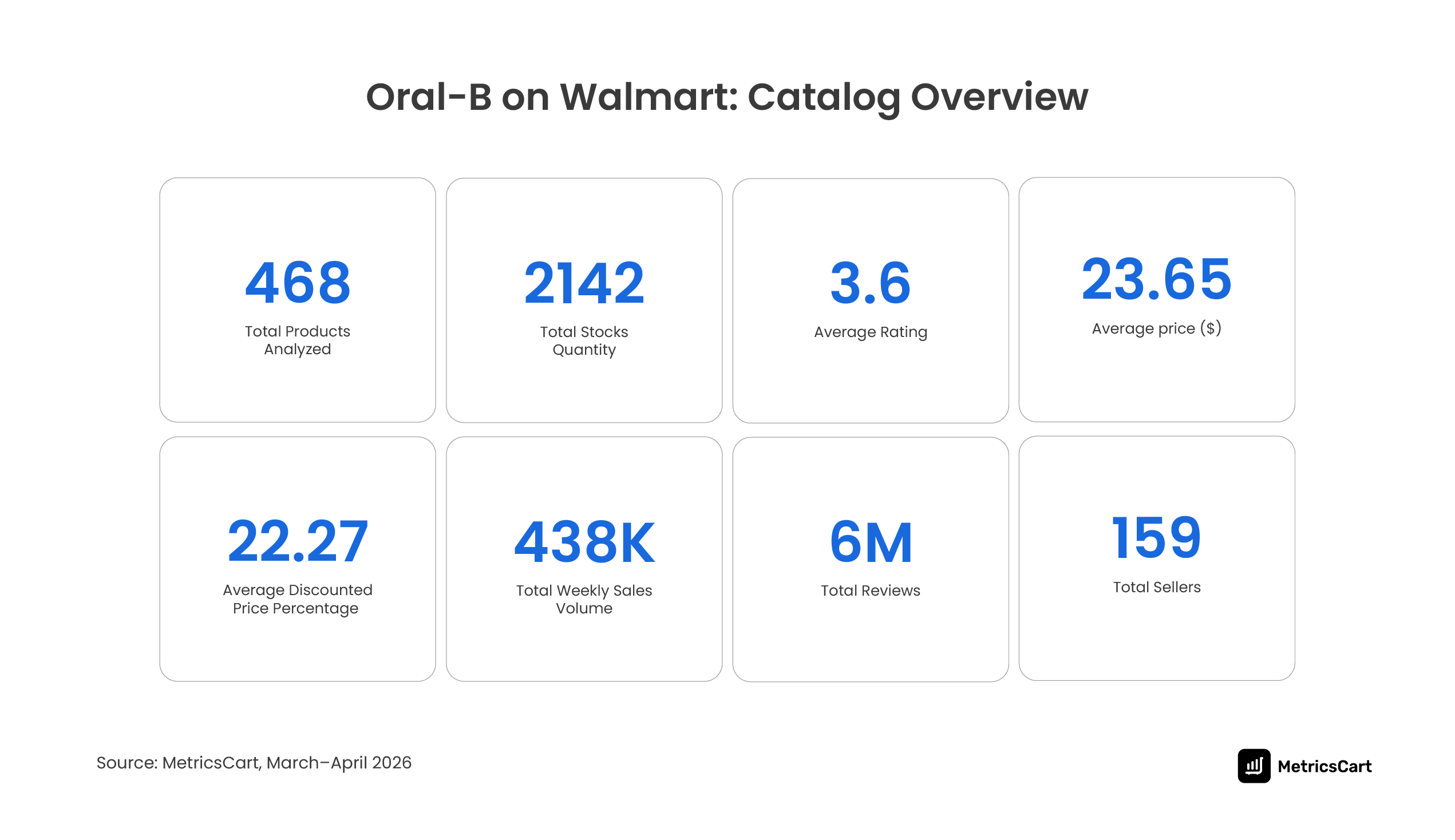
According to the MetricsCart app, Oral-B’s Walmart catalog, with 468 products, 28K units in stock, and 438K weekly sales across the catalog, is anything but passive. This is a brand that shows up with intention, broad enough to serve every kind of shopper, deep enough to hold its ground against any competitor in the oral care aisle.
The $23.65 average price tells an interesting story on its own. It is low enough to feel accessible to the everyday Walmart shopper, but not so low as to signal a discount brand. Oral-B has found a pricing sweet spot that keeps it competitive without compromising the premium credibility it has built over decades.
At 159 sellers and 6 million reviews, the brand has built a marketplace presence that most oral care competitors would need years to replicate.
Who is Oral-B Targeting at Walmart? An Age Group Breakdown
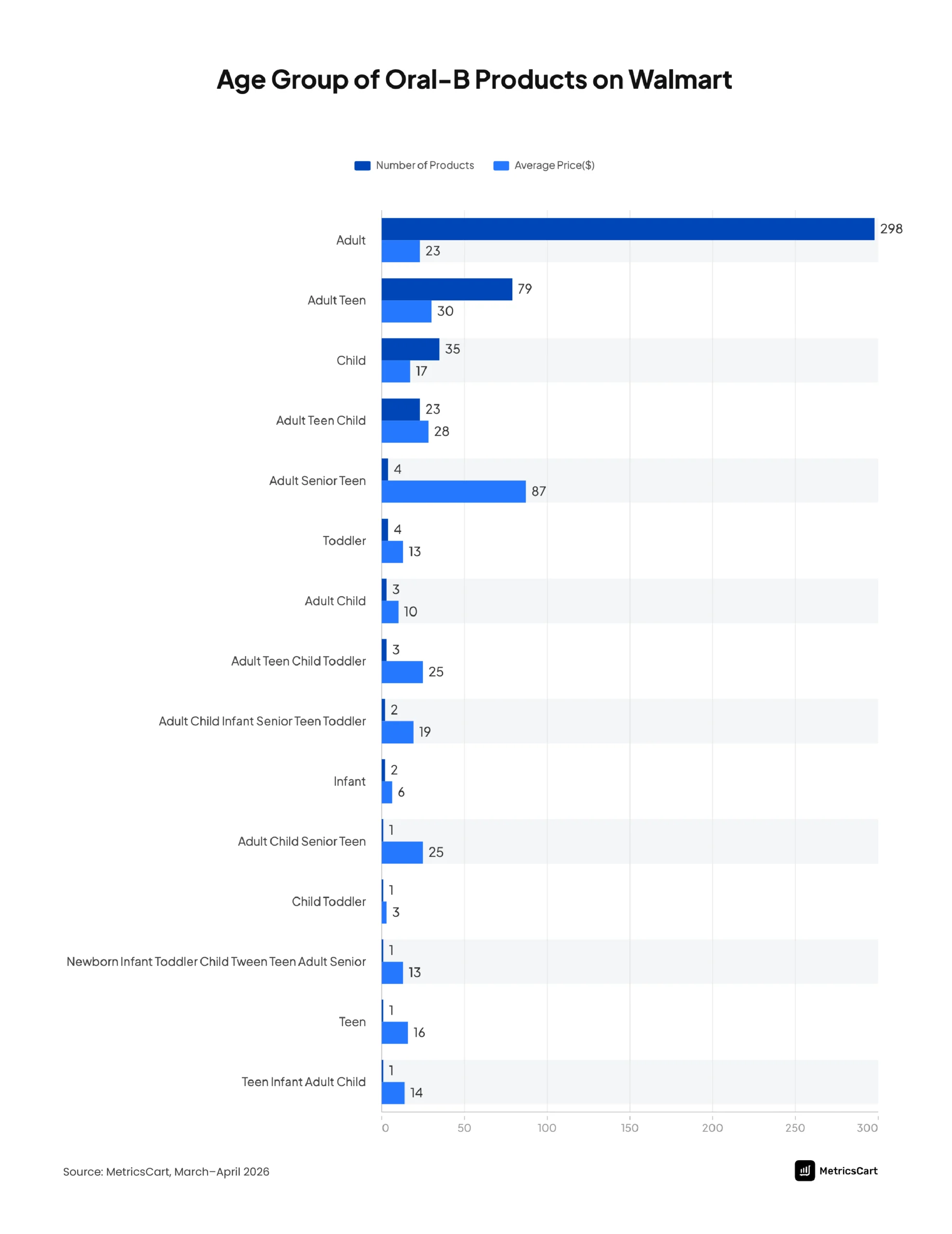
The age-group breakdown of Oral-B products on Walmart tells you exactly who Oral-B considers its primary customer. The catalog is structured around three deliberate audience tiers, each with a different job to do:
- Adults (298 products, $23 avg price): The volume engine
- Adult, Senior, Teen (4 products, $87 avg price): The premium tier
- Children (17 products, $35 avg price): The loyalty play
Adults dominate the catalog with 298 products, more than every other age segment combined. That concentration makes sense. Adults control household purchasing decisions, respond to dentist recommendations, and are the most likely to trade up from a manual toothbrush to a premium electric one.
The more interesting signal is in the Adult, Senior, and Teen segments. With only 4 products, it carries the highest average price of $87 across the entire catalog. This is Oral-B’s premium tier in its most focused form, a small, deliberately curated set of products aimed at older, more health-conscious consumers willing to pay more for advanced oral care.
Children are not an afterthought either. With 17 dedicated child products averaging $35 each, Oral-B recognizes that parents are among the most engaged oral care shoppers on the shelf. Disney-licensed toothbrushes and character-themed products show up here, a smart move that turns a routine purchase into something a child actually wants.
How Does Oral-B Price Its Products on Walmart?
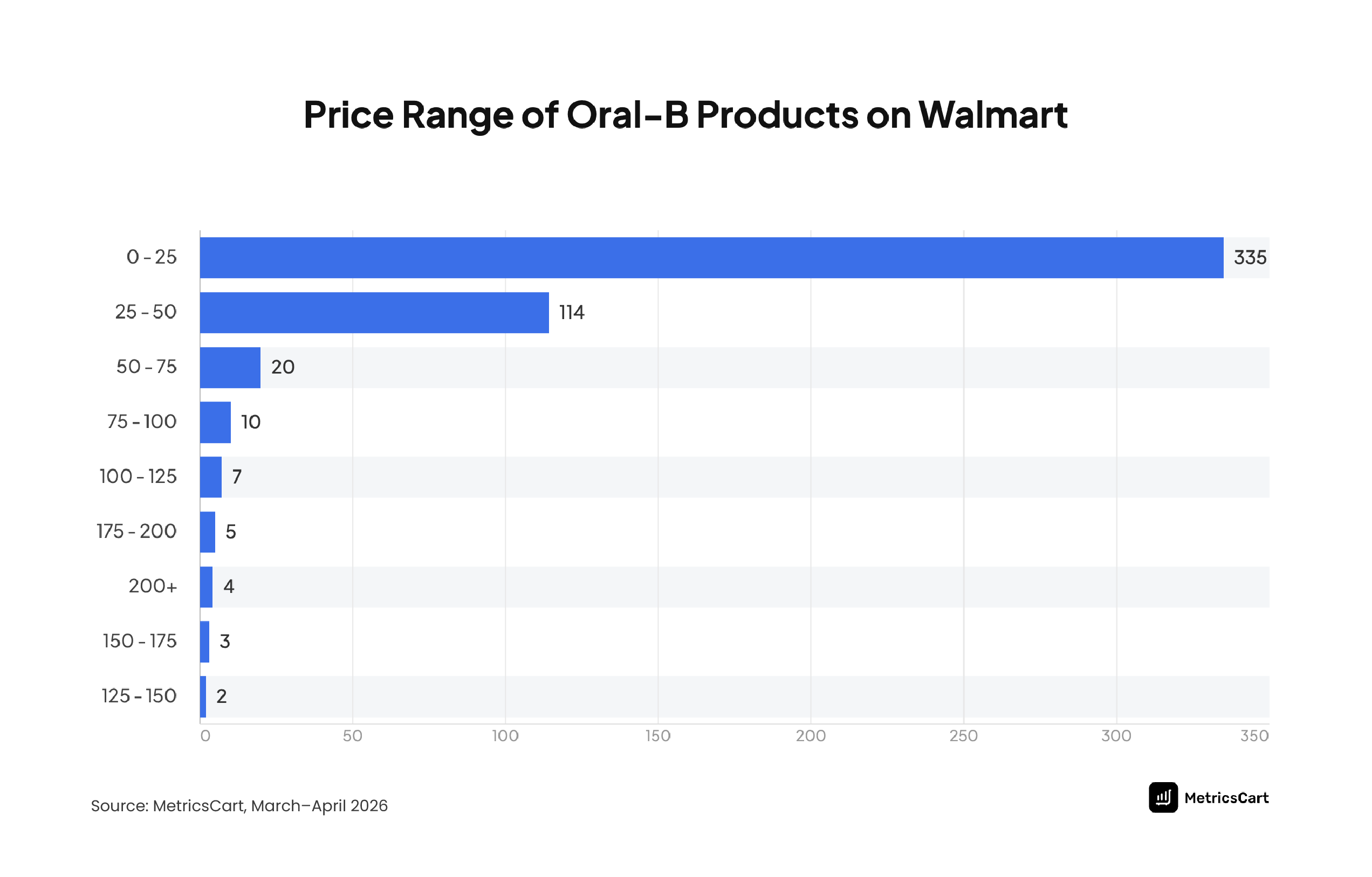
Findings from MetricsCart’s price-monitoring solution on Oral-B’s pricing architecture are among the clearest expressions of its brand strategy. At first glance, 335 products under $25 might suggest a budget-friendly catalog.
Oral-B sells products that operate on two completely different purchase cycles. Floss picks, manual toothbrushes, and kids’ toothbrushes are low-consideration, high-frequency purchases. Shoppers buy them without deliberation, replace them regularly, and respond directly to price signals.
Keeping these products under $25, and in many cases under $5, removes every barrier between a first-time shopper and the brand. The sub-$25 tier is not where Oral-B makes its margin. It is where Oral-B makes its customer base.
The premium tier operates on entirely different logic. Electric toothbrushes, multi-pack brush head replacements, and iO Series bundles are considered purchases. Shoppers research, compare, and evaluate them against a price anchor they have already formed from the sub-$25 products they have been buying for years.
By the time a Walmart shopper reaches the iO Series 9 at $265, they are not encountering Oral-B for the first time. They already trust the brand, use its products daily, and are now trading up within a relationship the brand built at the $2 floss-pick level.
Most Expensive Oral-B Products on Walmart
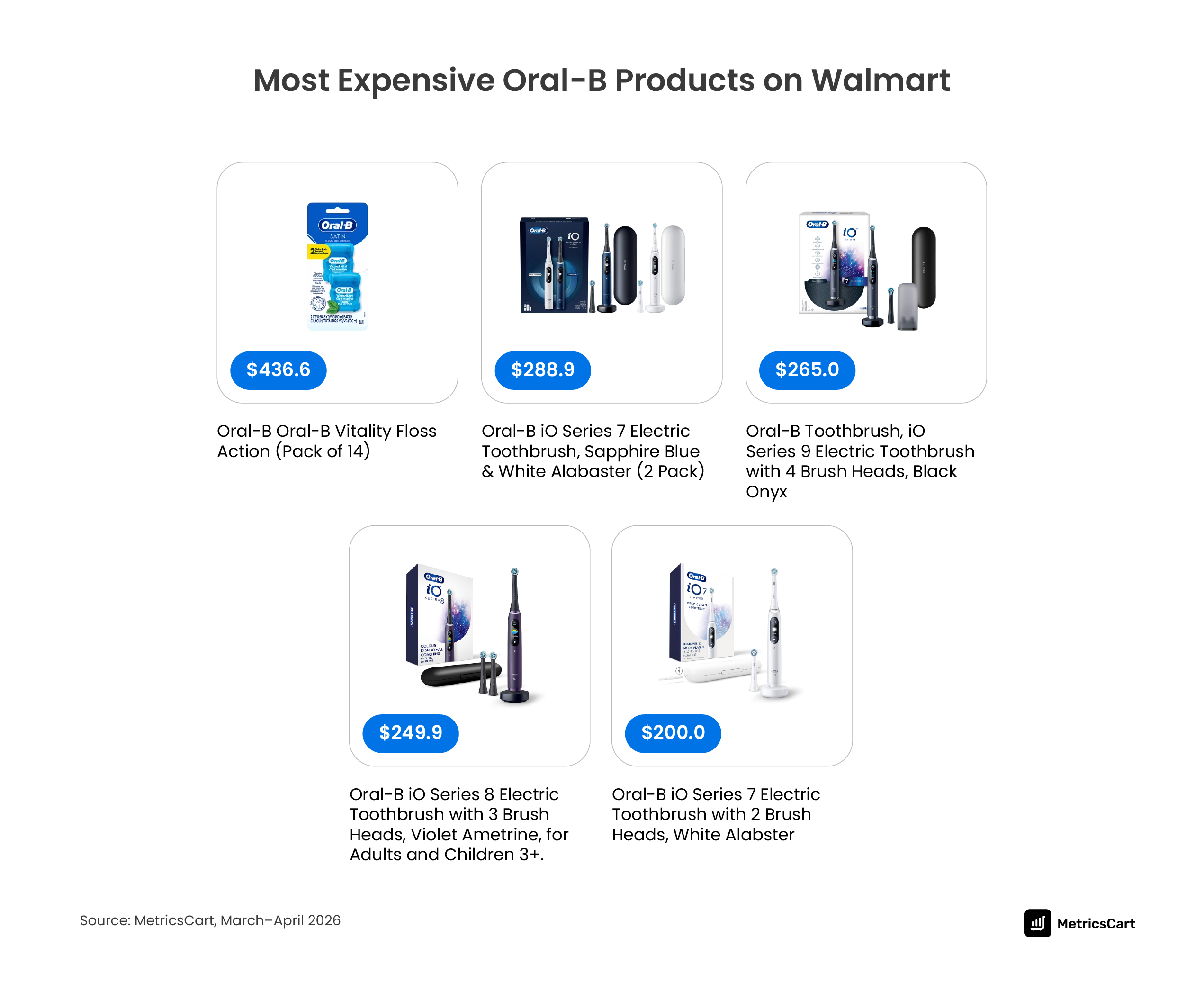
The most expensive product on Walmart’s Oral-B shelf is the Oral-B Vitality Floss Action Pack of 14, priced at $ 436.60, a floss bundle. This tells you something important about how Oral-B thinks about bundles. At scale, even a consumable like floss can command a premium price when it is packaged in a way that justifies the spend.
The second and third spots go to Electric Toothbrush bundles, the iO Series 7 Two-Pack at $288.9 and the iO Series 9 with four brush heads at $265. Both are bundle-driven and built around Oral-B’s premium iO line.
The pattern across the top 10 is consistent: 5 of the 10 most expensive products are bundle packs. Oral-B is not just selling individual products at the premium end. It is selling more of itself, at once, to shoppers who are already committed to the brand.
Most Affordable Oral-B Products on Walmart
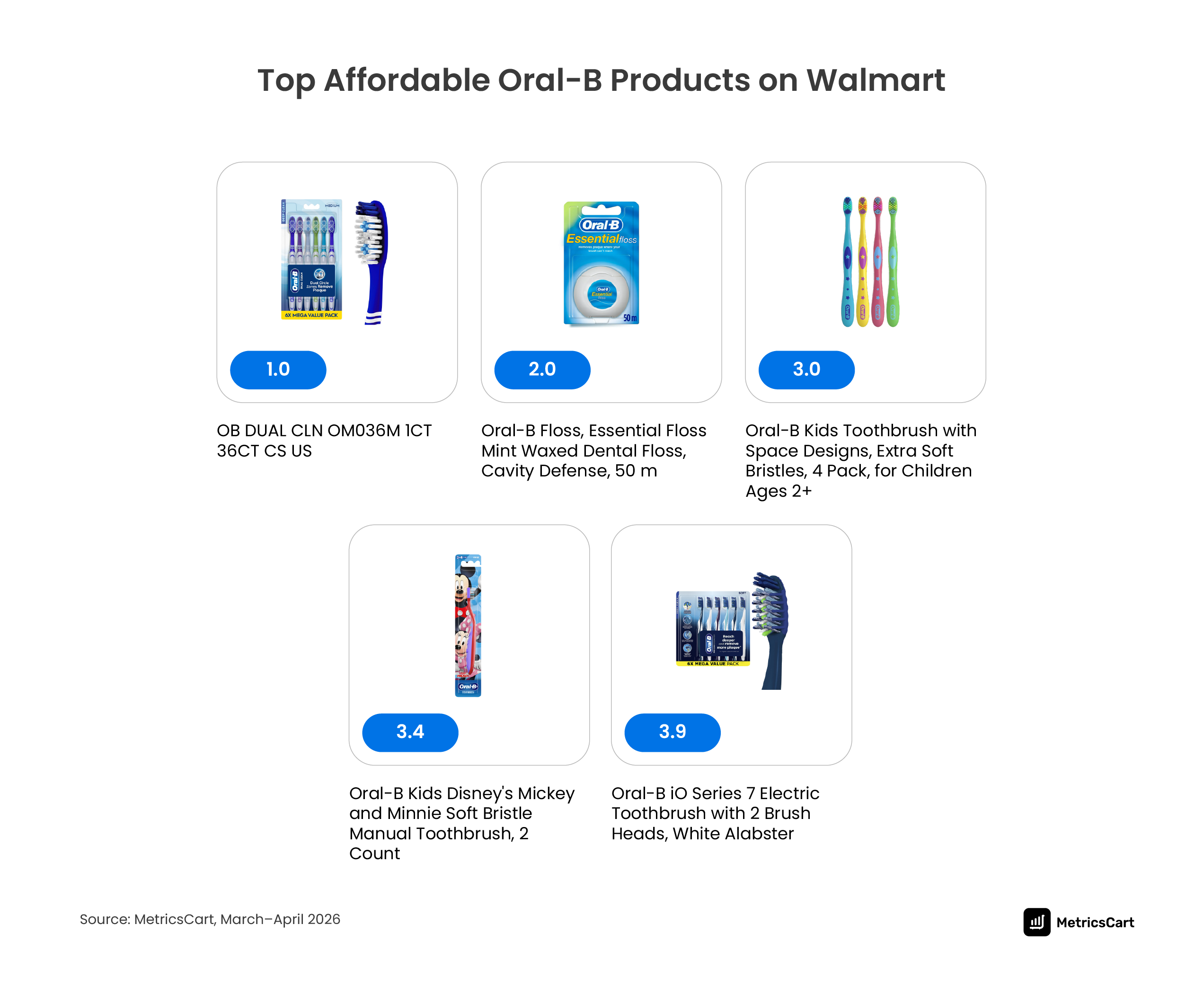
At the other end of the spectrum, Oral-B’s most affordable products start at just $1. The cheapest product in the catalog is a basic floss pick, a smart entry point that puts the brand in the hands of even the most price-sensitive shopper. Dental floss and kids’ toothbrushes dominate this tier, with the top 10 affordable products ranging from $1 to $4.80.
Floss and kids’ toothbrushes are high-frequency, high-repurchase products. By pricing them aggressively, Oral-B is not just competing for a single sale; it is slowly building a habit. And a shopper who starts with a $2 floss pack might come back for a $50 electric toothbrush six months later.
Most Discounted Oral-B Products on Walmart
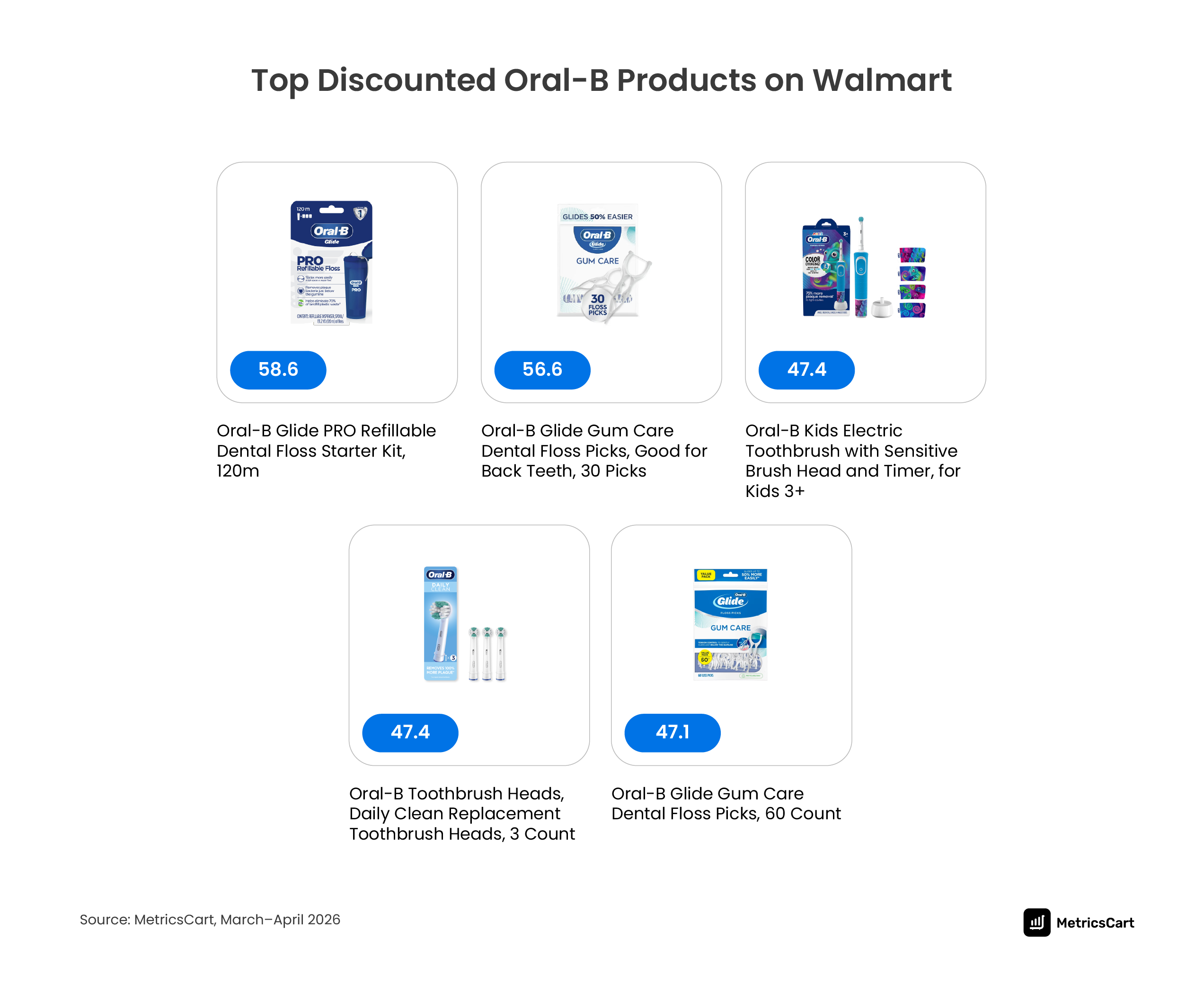
With an average discount rate of 22.27%, Oral-B is clearly not a brand that avoids promotions. But where it discounts matters just as much as how much it discounts.
The deepest discount in the catalog is on the Oral-B Glide PRO Refillable Dental Floss Starter Kit, at 58.6% off. The second is the Glide Gum Care Dental Floss Picks at 56.6% off. Both are floss products. This is intentional. Floss is a consumable; it runs out, and shoppers need to replace it regularly. A deep discount on floss does not devalue the brand. It creates a habit loop that repeatedly pulls shoppers back to the shelf.
Electric toothbrushes and replacement brush heads also appear in the discount mix, with discounts ranging from 38% to 47%. Here, the logic is different. Discounting a kids’ electric toothbrush at 47.4% off lowers the barrier to entry for a premium product category; once a family owns the handle, they are committed to buying replacement heads at full price.
Average prices held steady between $23.2 and $24.3 throughout the analysis period, even as discount rates climbed from 21% to 23% in late March. That price stability during a period of deeper discounting is the clearest sign that Oral-B is in control of its promotional strategy rather than reacting to competitive pressure.
Price floors stayed intact despite rising markdowns, the kind of pricing discipline that matters most for MAP (Minimum Advertised Price) compliance. For brands tracking authorized reseller behavior across platforms, maintaining that level of price-floor visibility is hard without continuous shelf monitoring.
What Are Walmart Shoppers Actually Buying From Oral-B?
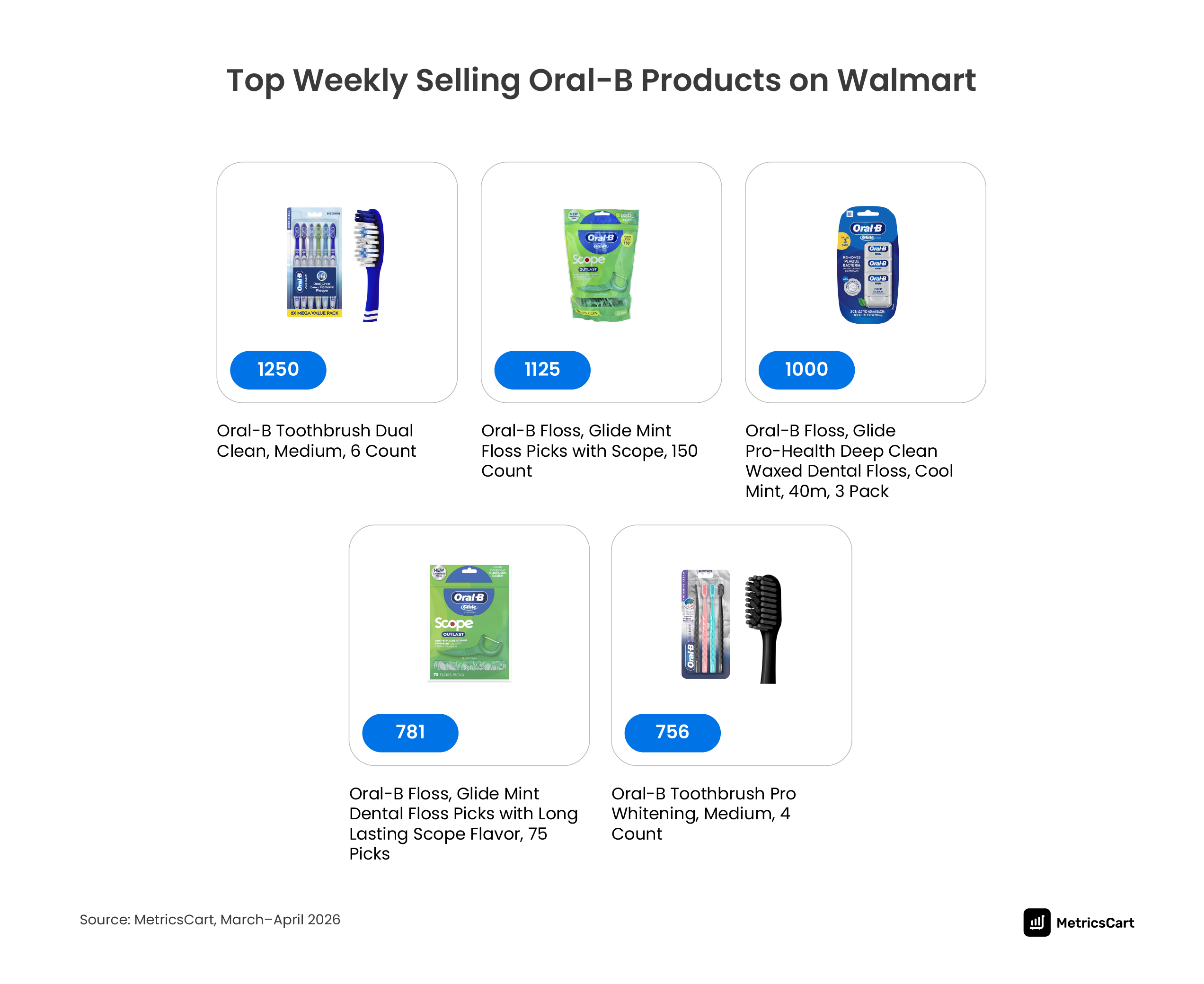
According to MetricsCart’s analysis of Oral-B’s Walmart shelf, the top weekly seller is the Toothbrush Dual Clean Medium 6-Count, moving 1,250 units per week. The fact that a multipack toothbrush tops the sales chart, and not an electric toothbrush, says something important about the Walmart shopper. Value and practicality drive the basket here. A six-pack of manual toothbrushes is a household essential, not a considered purchase.
The second and third spots go to dental floss, the Glide Mint Floss Picks with Scope at 1,125 units, and the Glide Pro-Health Deep Clean Waxed Floss 3-Pack at 1,000 units. Seven of the top twelve weekly sellers are floss products.
Floss dominates volume, not because it is exciting, but because it is necessary, affordable, and easy to buy in bulk. Oral-B has built the deepest floss catalog on the shelf and priced it to move.
Multipack toothbrushes generate the most revenue, even though they do not always lead in unit sales. The math is straightforward: a six-pack at a higher price point generates more dollars per transaction than a single floss pack, even if the floss pack outsells it in units. This two-track model, volume through floss and revenue through multipacks and electrical products, is what makes Oral-B’s Walmart strategy so well-balanced.
READ MORE | Decoding Consumer Behavior at Walmart: A Seller’s Perspective
Seller Landscape: Who Else Sells Oral-B on Walmart?
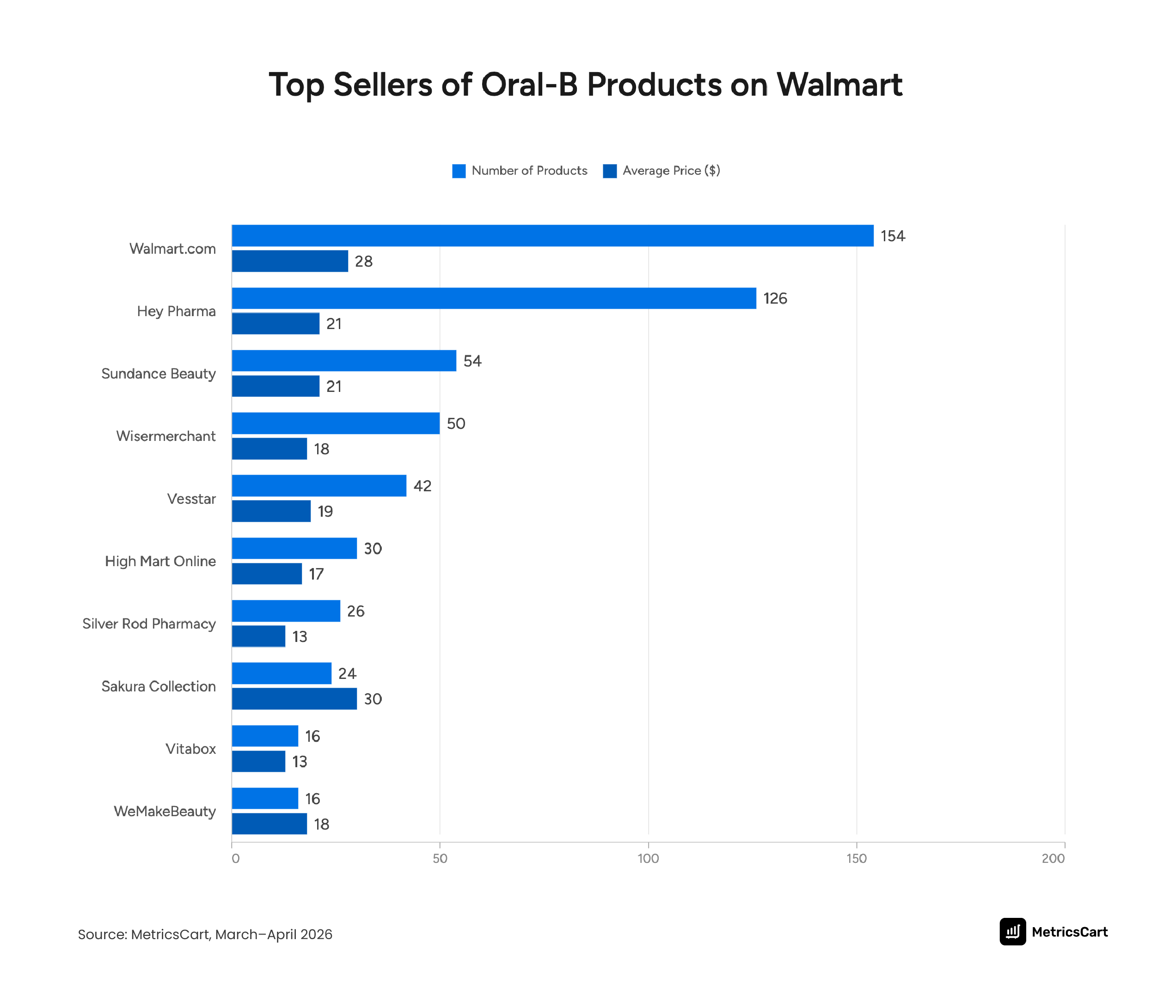
Walmart.com itself leads the seller landscape with 154 products and an average price of $28, the highest among all sellers. That premium pricing from the platform’s own listings signals that Walmart is not competing on price with third-party sellers. It is positioning itself as the authoritative source for Oral-B’s full catalog.
Hey Pharma is the most significant third-party seller with 126 products at an average price of just $21. The volume is high, and the price is low, a strategy that prioritizes shelf presence over margin. For Oral-B, this raises a familiar question that any brand with a large third-party seller network faces: at what point does low third-party pricing erode the brand’s perceived value?
The most interesting seller in the mix is Sakura Collection; just 24 products, but the highest average price among all third-party sellers at $30. A small, curated catalog at a premium price suggests a seller deliberately targeting a specific buyer who is not price-sensitive.
Oral-B on Walmart: Pricing, Reviews, and Sales Trends
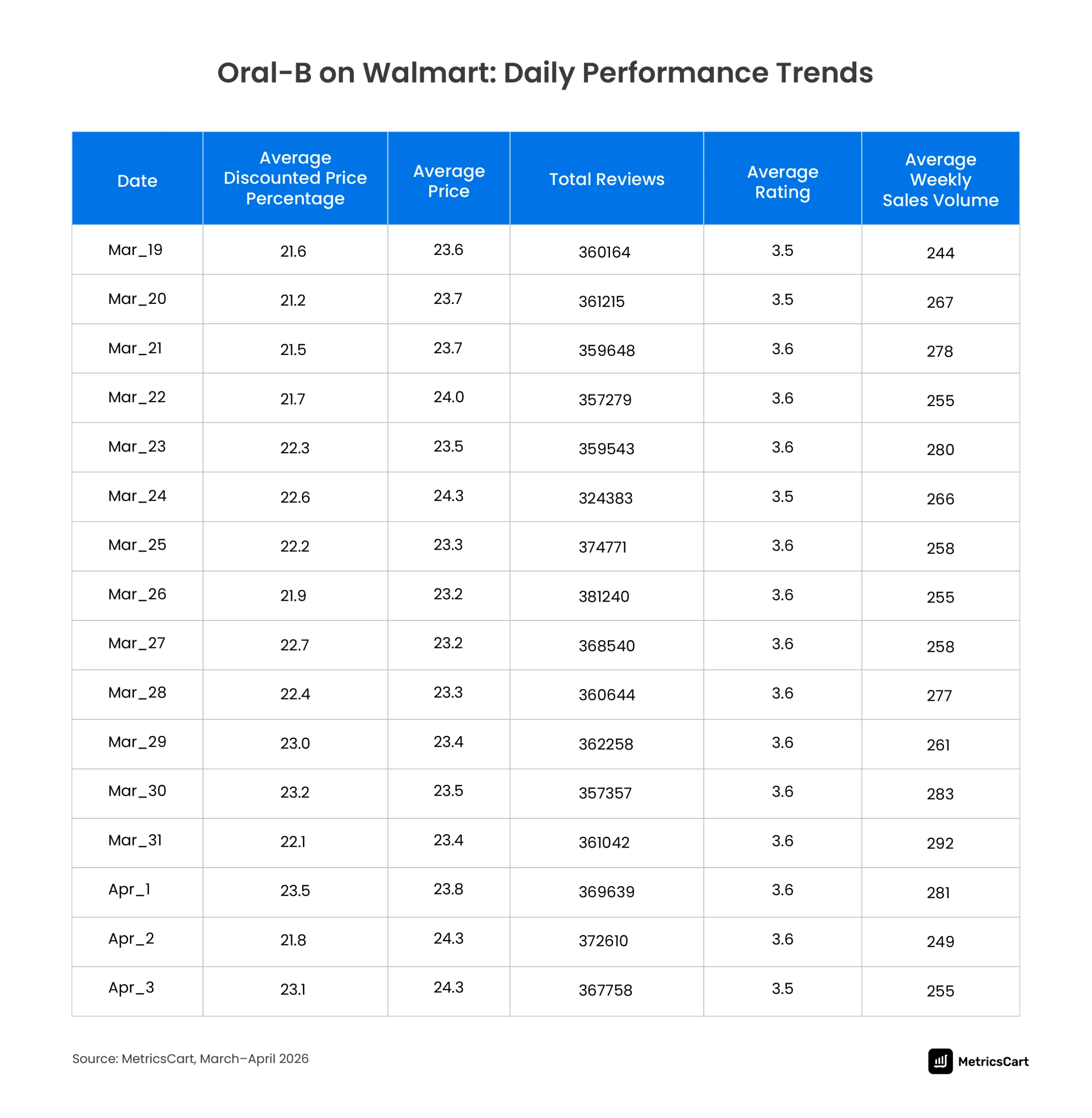
The findings from MetricsCart on Oral-B’s Walmart shelf between March 19 and April 3 revealed a clear and consistent pattern. Sales volume climbed steadily through the month, peaking around March 30 to April 1 at 292 units per day.
That peak coincided with the discount rate climbing from 21% at the start of the period to 23.5% by April 1, the clearest signal in the entire period that Oral-B uses promotional pricing as a deliberate sales lever rather than a reactive one.
Average price held firm between $23.2 and $24.3 throughout, even on the highest-volume days. This is the part most brands get wrong. They drop prices to chase volume, eroding margins in the process. Oral-B kept its price floor intact while letting discounts do the work on specific products. The result is a brand that grew sales without shrinking its value.
Total reviews grew from 360,164 on March 19 to 372,610 by April 2, a steady, organic climb that reflects consistent purchasing across the catalog. No single product spike, no viral moment. Just a brand that sells reliably, every day, to shoppers who keep coming back.
Lessons Between the Bristles: What Brands Can Learn
Oral-B’s brand strategy on Walmart is not built on any single tactic. It is built on a system where every part reinforces every other part. For brands looking to compete on the digital shelf, here is what to take away.
Let Different Products Do Different Jobs
Floss drives volume. Multipacks and electric toothbrushes drive revenue. Oral-B does not ask one product category to carry both responsibilities. Brands that build their entire catalog around a single price tier often find themselves choosing between volume and margin. A deliberately structured tiered catalog solves both problems at once.
Discount on Products That Pull Shoppers Back, Not on Products That Define Your Brand
Oral-B’s deepest discounts land on consumables like floss, products shoppers buy repeatedly. Average prices held firm even during peak sales periods. That is the difference between discounting to build habits and discounting to chase volume. One protects brand value. The other quietly erodes it.
Build Bundles That Justify a Higher Price, Not Just a Bigger Box
Five of Oral-B’s ten most expensive Walmart products are bundles. They work because they offer genuine value, more product, better per-unit economics, and greater convenience. Bundles need to earn their premium price through what is inside, not just by packaging more units together.
Third-Party Sellers Set Your Price Perception Whether You Manage Them or Not
Walmart.com lists Oral-B at an average of $28. Hey Pharma, the top third-party seller, lists 126 products at $21. That $7 gap is a brand perception risk that compounds quietly over time. Brands that do not manage their seller ecosystem risk have their value defined by whoever goes lowest.
Oral-B’s Walmart shelf did not get to 468 products, 438K weekly sales, and 6 million reviews by accident. Every pricing decision, every discount, every bundle was deliberate. For brands competing in oral care or any consumer category on Walmart, the real takeaway is not what Oral-B sells. It is how clearly the brand understands its own shelf and makes decisions accordingly.
That kind of clarity requires continuous visibility, and that is exactly what MetricsCart’s Digital Shelf Analytics delivers.
From tracking real-time pricing across seller networks to identifying discount patterns, assortment gaps, and category shifts, MetricsCart helps brands move from catching up to staying ahead. Because on a shelf this competitive, the difference between a brand that grows and a brand that gets undercut often comes down to who is watching more closely.
The best oral care brands do not skip checkups. Neither should your shelf monitoring.