Highlights
- A product can appear in stock but still be invisible to shoppers if it has lost the Buy Box, fallen off the first page of search results, or has extended delivery timelines. Being in stock and being available to buy are two different things.
- When a product goes out of stock on Amazon or Walmart, brands lose the sale first and, second, search visibility. Both platforms rank products by sales velocity, and a stockout halts that momentum.
- Sponsored ads keep running even when inventory is at zero, sending paid traffic to a page where no one can buy.
- Stockouts do not show up in standard weekly vendor reports. They only surface through continuous monitoring that connects stock status with search rankings, Buy Box ownership, and ad performance across retailers.
- As AI-powered shopping tools start making purchase decisions on behalf of consumers, being out of stock even for a few hours will mean losing sales to competitors who are available and ready to ship.
What happens when a customer searches for your product on Amazon? Your listing appears, but the status reads “Currently Unavailable.” Within seconds, the sale goes to a competitor. Multiply that by thousands of shoppers across dozens of retailers. The resulting revenue leak becomes difficult to ignore.
According to research by IHL Group, out-of-stock issues cost the global retail industry $1.2 trillion annually. But the bigger problem is that customers who leave rarely come back. 82% of U.S. consumers would switch to a competitor if their preferred brand is frequently unavailable, and 62% have already done so.
For brands selling through retail partners like Amazon, Walmart, and Target, the challenge is specific: you don’t control the shelf, the warehouse, or the replenishment schedule. What you can control is your visibility into where products are going dark and how fast you respond.
That’s where retail inventory management comes in. This guide breaks down what it involves, why it matters, which metrics to track, and what brands can do to stay ahead of stockout risks across retailers.
Platforms like MetricsCart’s Assortment & Availability solution help brands monitor product availability in real time across retail partners, giving teams the visibility they need to stay ahead of stockout risks.
What Is Retail Inventory Management?
Retail inventory management is the process of tracking how products move from suppliers to shelves and into buyers’ hands. It includes demand forecasting, purchase order management, warehouse operations, and shelf replenishment.
For DTC brands, this means managing stock in your own warehouses and stores. For CPG brands selling through retailers like Amazon, Walmart, or Target, it works differently. You don’t control the retailer’s warehouse or manage their replenishment cycle. The only option is to track what’s happening from the outside.
This is where product availability monitoring comes in. Instead of managing the full inventory lifecycle, it focuses on one question: can a shopper buy your product right now, at this retailer, in this region?
Retail inventory management helps brands:
- Track stock status across SKUs and retail partners
- Catch out-of-stock events as they happen
- Identify recurring availability gaps over time
- Monitor Buy Box ownership and seller activity on marketplace listings
What Are the 5 P’s of Retail?
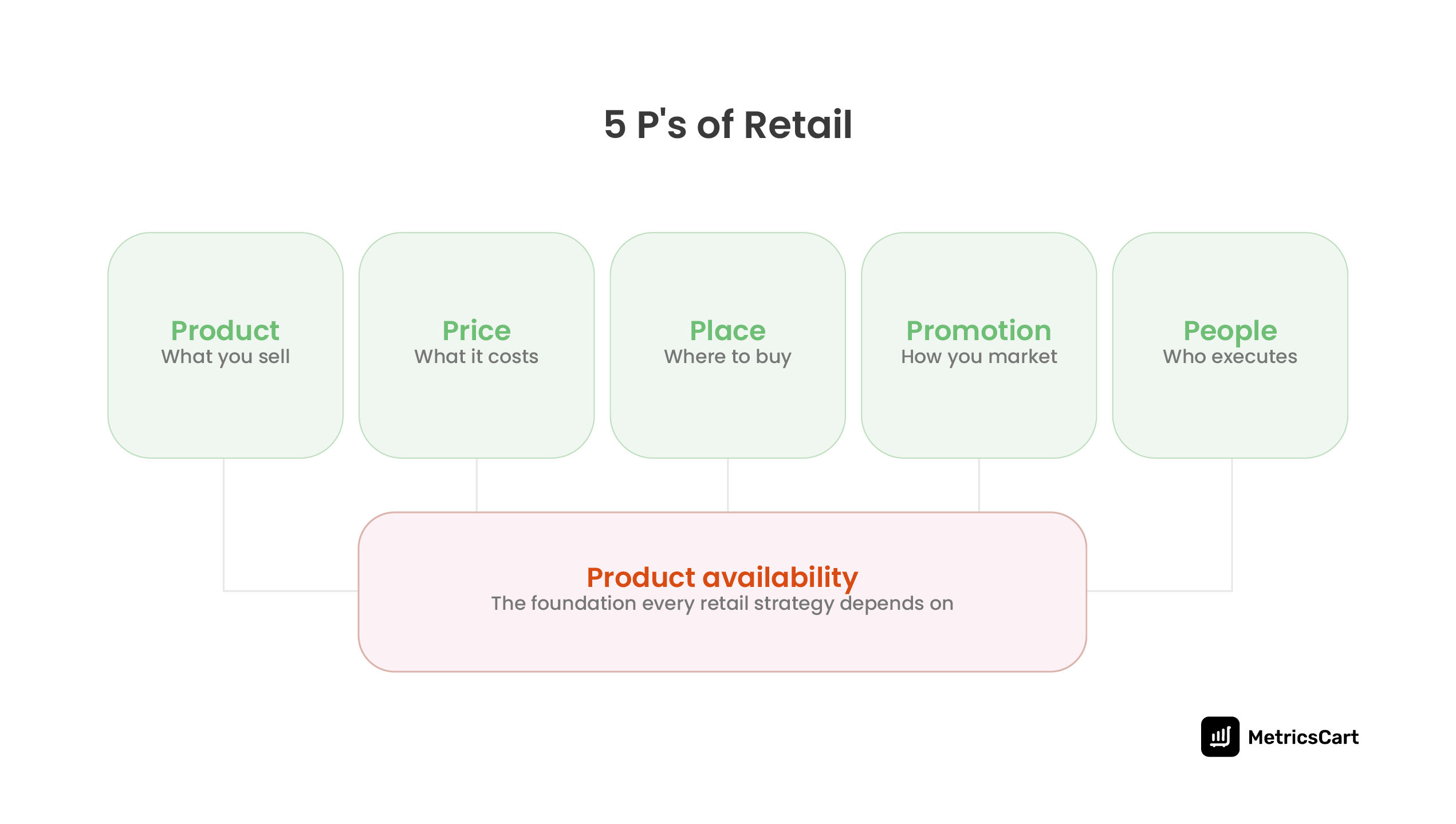
The 5 P’s of retail (Product, Price, Place, Promotion, and People) are the key strategies that have guided retail strategy for decades.
- Product covers the range, quality, and relevance of what you sell.
- Price involves setting price points that balance profitability with market competitiveness.
- Place refers to where and how customers access your products, both online and in-store.
- Promotion includes advertising, deals, and campaigns that drive traffic and conversions.
- People cover the teams (and increasingly, the technology) responsible for execution.
Product availability connects directly to every one of these pillars. The best pricing strategy delivers zero value if the product is unavailable. Promotions that drive traffic to out-of-stock pages waste budget. Place strategy depends on maintaining consistent stock levels across all distribution points.
When availability breaks down, the entire 5 P framework weakens. Monitoring availability is how brands ensure their retail strategy actually reaches the shopper.
Main Reasons Behind Out-of-Stock Issues in Retail
Stockouts rarely happen because of one thing going wrong. They’re usually the result of multiple failures stacking up across the supply chain.
For brands selling through retail partners, the causes fall into two broad categories: upstream issues you can partially control, and downstream issues you can only monitor.
What Causes Supply-Side Stockouts?
These are the problems that start before a product reaches the retailer.
- Demand forecasting errors. Promotional spikes, seasonal shifts, and viral product moments create demand surges that static forecasting models miss. When demand is underestimated, products sell through before replenishment kicks in.
- Ordering and replenishment gaps. Late purchase orders, incorrect reorder quantities, and system integration issues between brands and retailers slow down restocking.
- Supplier and logistics delays. Raw material shortages, production slowdowns, and carrier disruptions all push delivery timelines. In categories with long supply chains (consumer electronics, imported specialty foods), these delays compound fast.
What causes stockouts on the digital shelf?
These are the problems that happen after the product has left your hands.
- In-store execution gaps. Products sitting in a backroom but never reaching the shelf. Planogram errors. Misplaced inventory. The product exists in the building but is invisible to the shopper.
- Listing suppression. A missing product attribute or a content error on Walmart.com or Amazon can suppress your listing entirely. It doesn’t show up as a traditional stockout in vendor reports, but the revenue impact is the same.
- Buy Box losses. On Amazon, unauthorized third-party sellers can win the Buy Box with lower prices or different fulfillment methods. Your product is technically “in stock” through someone else, but your authorized offer is buried.
- Catalog and algorithm issues. SKU mapping errors that deactivate listings, or algorithmic delistings triggered by low sales velocity, can quietly take products offline without any supply chain failure.
Why Brands Need to Track Retail Product Availability
When a product goes out of stock on Amazon or Walmart, the first thing brands lose is the sale. The second thing they lose is search visibility.
Both platforms rank products based on sales velocity. A stockout pauses that momentum, and the algorithm starts shifting visibility to competitors. Getting that ranking back takes ad spend and promotional effort that would not have been necessary if the stockout had been caught early. Brands that track share of search alongside availability can see exactly how much ground they lose during each stockout.
The effects do not stop there. Sponsored ads keep running even when inventory is at zero, sending paid traffic to a page where no one can buy. Third-party sellers step into the gap, take the Buy Box, and often list at prices that break MAP compliance. On some platforms, products with low sales activity for an extended period can quietly disappear from search results without ever being flagged as out of stock.
These problems do not show up in standard weekly vendor reports. They only surface through continuous monitoring of product availability that connects stock status with search rankings, Buy Box ownership, and ad performance across retailers.
How to Measure Product Availability: 5 Key Metrics Every Brand Should Track
Stock Availability Rate
Stock availability rate measures the percentage of time a product is in stock and ready to buy across tracked retailers over a given period. A product showing 95% availability across 10 retailers over 30 days was purchasable 95% of the time across those partners. This is the baseline metric every brand should start with.
Out-of-Stock Frequency
Out-of-stock frequency tracks how often stockouts happen for each SKU. A product that goes out of stock once a quarter is a very different problem from one that drops out every two weeks. This metric shows whether a stockout is a one-time event or a recurring pattern.
Out-of-Stock Duration
Out-of-stock duration measures how long each stockout lasts. A two-day gap carries a very different revenue cost than a two-week gap. This helps brands decide which stockouts need immediate action and which ones can be corrected on their own.
Buy Box Win Rate
Buy Box win rate is critical on marketplace platforms like Amazon. A product can show as “in stock” through third-party sellers while the brand’s own offer has lost the Buy Box. When that happens, the brand’s authorized listing is invisible to most shoppers even though the product is technically available.
Seller Count Per Listing
Seller count per listing helps brands spot unauthorized sellers who create pricing inconsistencies across the listing. This is especially important for brands managing MAP policy compliance across multiple channels.

Tips for Brands to Improve Product Availability
Monitoring reveals problems. Acting on them is what protects revenue. Here are practical steps brands can take to improve and maintain product availability across retail partners.
Build a Tiered Product Availability Monitoring Framework
Categorize your SKUs into three tiers by revenue contribution, then assign different monitoring frequencies to each tier. Hero SKUs should be tracked daily or in real time with automated alerts. Mid-tier SKUs can be monitored daily with weekly reviews. Long-tail products only need weekly checks unless flagged.
Connect Availability Data to Demand Signals
Pair your stock data with demand indicators like search traffic, seasonal trends, and competitor stockouts. If inventory is declining at a key retailer while search volume for that product is rising, that combination should trigger proactive replenishment before the stockout happens, not after.
Build Retailer-Specific Response Playbooks
Document who to contact, what the expected replenishment lead time is, and what escalation steps to follow for each retail partner. Every retailer has different processes and communication channels. A ready playbook helps teams act within hours instead of spending the first day figuring out who to call.
Monitor Competitor Retail Product Availability
Track your competitors’ stock status alongside your own. When a key competitor goes out of stock, demand shifts. If your product is available and visible during that window, you capture share. This also helps brands spot category-wide supply disruptions before they spread.
Coordinate Availability With Retail Media Spend
Pause or redirect ad spend the moment a product goes out of stock. Running sponsored ads on an unavailable listing sends paid traffic to a page where no one can buy. Linking availability data to retail media planning stops budget waste in real time and frees up spend for moments when competitors go dark.
Use Real-Time Alerts for Stock-Outs to Shorten Response Time
Set up automated alerts that notify your team the moment a high-priority SKU goes out of stock at any retailer. Real-time alerting lets brands engage the retailer’s buyer team within hours, redirect inventory from another distribution point, and adjust ad spend before it gets wasted. In high-velocity categories where products sell hundreds of units daily, every hour of downtime is measurable revenue lost.
How Does MetricsCart Help Brands in Retail Product Availability Monitoring?
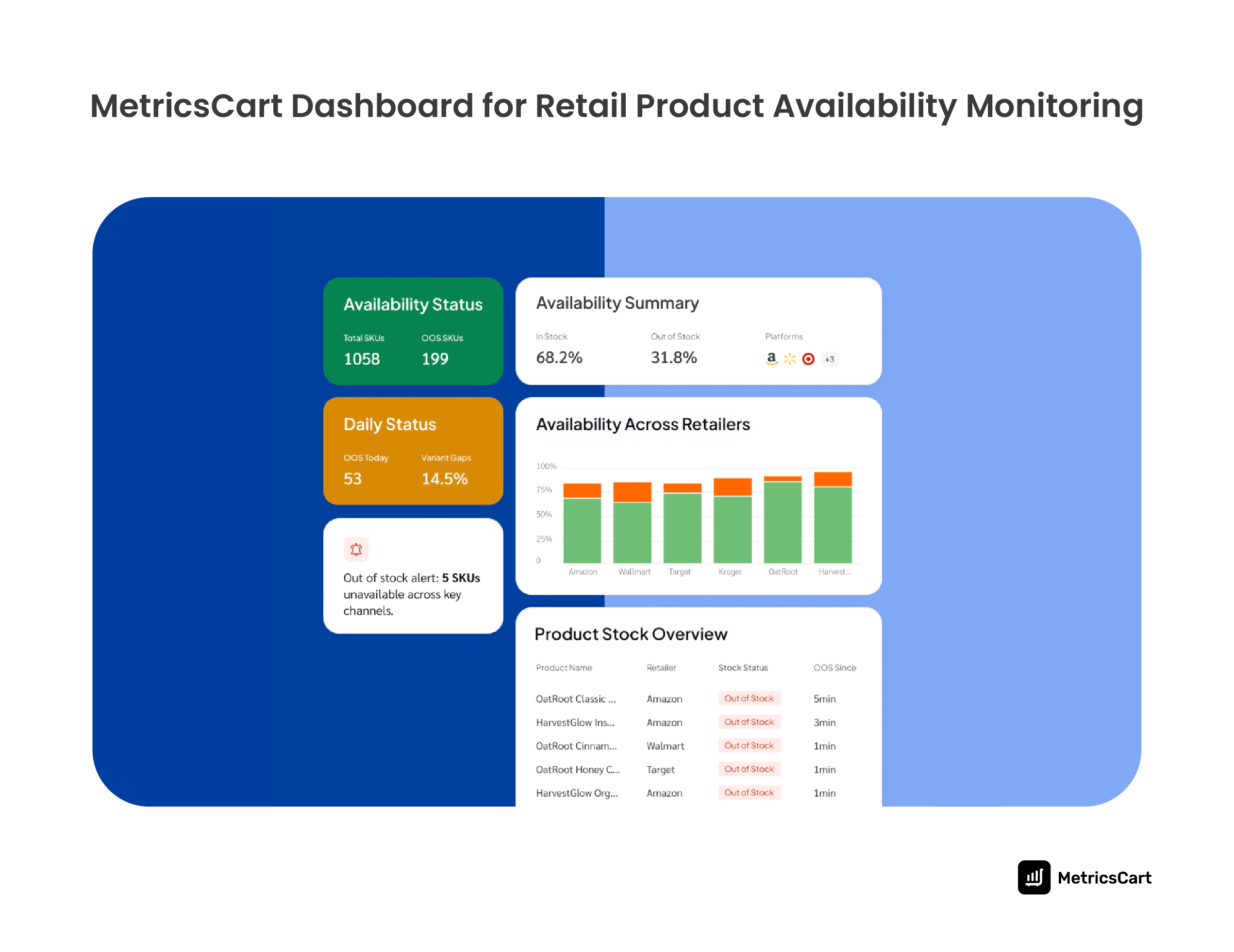
Product availability monitoring is no longer something brands can check once a week and move on. The ones that spot stockouts early and act quickly consistently stay ahead. And as AI-powered shopping tools start making purchase decisions on behalf of consumers, being out of stock even for a few hours will mean losing sales to competitors who are available and ready to ship.
MetricsCart helps brands stay on top of this. The platform tracks product availability across Amazon, Walmart, and other retail partners in real time, and sends automated alerts the moment a product goes out of stock.
It also brings together stock status, pricing, seller activity, and competitive data into one dashboard. So instead of checking multiple portals and stitching together spreadsheets, teams get one clear view of what is available, what is going dark, and where to focus first.
Product availability is the prerequisite for every other part of your retail strategy to function. Pricing, promotions, content, and advertising all depend on one thing: the product being there when the shopper is ready to buy.
Stop Losing Sales, Search Rankings, and Buy Box Ownership to Stockouts.
FAQs
Product availability is measured as the percentage of time a product is in stock and purchasable across tracked retailers over a set period. Brands track this at the SKU level across each retail partner, alongside out-of-stock frequency, stockout duration, and Buy Box win rate to get a complete picture.
In physical stores, inventory is tracked through POS systems, manual shelf audits, and, increasingly, AI-powered shelf cameras. For online retail, automated platforms crawl product pages across retailer websites to check stock status, seller activity, and fulfillment availability at the SKU level, often on a daily or hourly basis.
Real-time monitoring lets brands catch stockouts within hours instead of days. This means less wasted ad spend on unavailable listings, faster communication with supply chain teams, and shorter windows of lost sales velocity, which protects both revenue and search rankings.
When a product goes out of stock, the brand loses the immediate sale, but the effects go further. Search rankings drop, sponsored ads waste budget on empty listings, and competitors capture demand from shoppers who may not switch back.
Automated platforms track product pages across retailer websites on a set frequency. For each SKU, the system checks stock status, Buy Box ownership, active seller count, and fulfillment method. This data is collected from all tracked retailers and consolidated into a single dashboard, where brands can set alerts and track trends.