About the Report
This Digital Shelf Insights report analyzes smartphone performance across Amazon and Walmart in the US from February 2 to February 28, 2026.
By using MetricsCart’s digital shelf analytics software, we examined how smartphones and related accessories are listed, priced, reviewed, and ranked across both marketplaces, covering brand presence, assortment depth, customer engagement, discount patterns, and sponsored vs. organic visibility.
Highlights
- Samsung leads smartphone listings on both Amazon and Walmart, with 542 on Amazon and 4,054 on Walmart, making it the only brand to dominate both platforms simultaneously.
- JETech tops Amazon’s smartphone category with 1.61 million reviews, without making a single phone. Its entire review base is built on screen protectors, not handsets.
- 25% of US buyers now plan to upgrade their smartphone within 1–2 years, up from 15% in 2023, marking the sharpest shift in replacement behavior in recent years.
- Amazon hosts 1,510 smartphone brands; Walmart hosts 352. One platform lets anyone in. The other curates around names buyers already trust.
- Organic listings account for 88% of visibility on Amazon and 97% on Walmart. Search rank is the only shelf strategy that compounds.
Where Smartphone Buying Decisions Are Really Being Made
A smartphone is one of the few purchases people genuinely think about. They research it, compare options, change their minds, and come back to it, sometimes over the course of days. And more often than not, all of that happens on the very device they are about to replace.
That dynamic makes this one of the most competitive categories on the digital shelf. Over 5 billion people globally use a smartphone in 2026, and the US market alone generates close to $656 billion in revenue. The brands that win here do not just make great devices; they show up at the right moment, at the right price, with enough reviews to earn the click.
What makes right now particularly interesting is the shift in buyer behavior. A YouGov survey from late 2025 found that 45% of Americans are planning to buy a new smartphone, up from 36% in 2023. Fewer are looking for budget options. More are moving into the $301–$500 range. People are upgrading sooner and spending more when they do.
For brands, that means one thing: showing up correctly on the platforms where those decisions are being made. This report breaks down how smartphones on Amazon vs Walmart compare, and what it takes to win on both.
Upgrade Cycles Are Shrinking: 25% of Buyers Switch Within 2 Years
For a long time, smartphone upgrades followed a predictable pattern. Most buyers held on to their devices for three to four years before replacing them. That pattern is now breaking.
Nearly 3 in 10 consumers in the US planned to increase their device spending in the coming year, almost triple the share who said the same just two years ago. At the same time, the number of people holding onto a phone for more than five years has dropped sharply. This shift is not subtle. It signals a faster, more active replacement cycle in a category that was once slowing down.
There are clear reasons behind this change.
Trade-in programs have lowered the cost and friction of upgrading, making it easier for buyers to justify switching sooner.
AI-driven features – smarter cameras, on-device assistants, and real-time translation are giving users something genuinely new to upgrade for.
Wider performance gaps between device generations mean the jump from an older phone to a current one feels more noticeable than it used to.
Spending behavior is shifting alongside this. Fewer buyers are looking for sub-$300 devices, while more are moving into the $300–$500 range. This is a critical transition. Buyers are upgrading.
Smartphones on Amazon vs. Walmart: A Snapshot of Marketplace Dynamics
Amazon and Walmart both sell smartphones. But spend a few minutes looking at the insights from the Metricscart app, and it becomes obvious they are doing very different things.
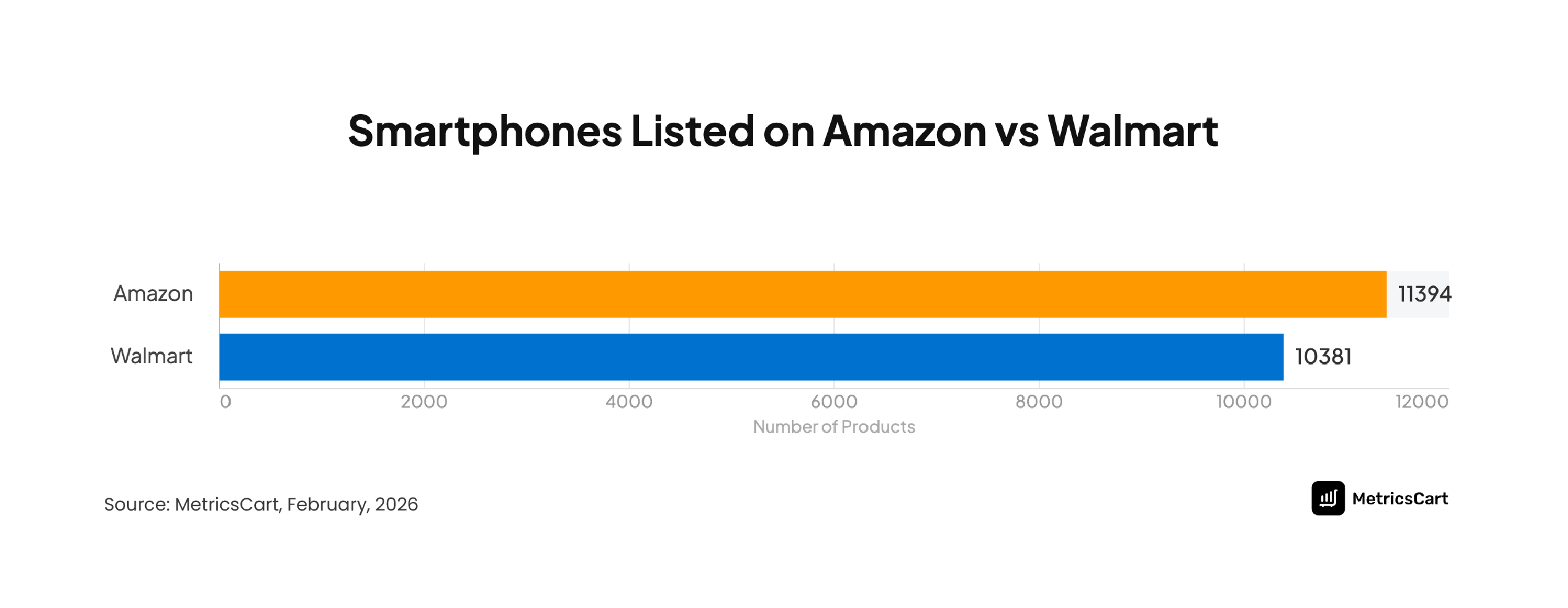
Amazon has 11,394 smartphone listings. Walmart has 10,381. On the surface, that looks close. But the brand count tells the real story: 1,510 brands on Amazon versus 352 on Walmart. That gap is not a rounding difference. It reflects two fundamentally different patterns about who gets shelf space.
Amazon lets almost anyone in. Independent sellers, international brands, niche accessory makers, long-tail SKUs, they all have a home on Amazon. For a smaller or challenger brand trying to break into the US smartphone market, Amazon is usually where that journey starts.
Walmart works differently. The brands that dominate its smartphone catalog, Samsung with 4,054 listings, Apple with 3,763, and Motorola at a distant 696, are household names. That is not a coincidence. Walmart curates toward brands its shoppers already trust. If your brand does not have that kind of recognition yet, getting meaningful shelf space at Walmart is a much harder climb.
Pricing reflects the same divide. Amazon’s average smartphone price is $212.61. Walmart’s is $270.30. That $57 gap does not mean Walmart is the more expensive platform; it means Walmart’s catalog is weighted toward the mid-range, where Samsung and Apple’s mainstream models are priced.
Amazon pulls its average down by carrying a much larger volume of sub-$100 products: accessories, prepaid SIM kits, and budget handsets. Both platforms cover the full price spectrum, but they do not concentrate in the same places.
One thing they do agree on: neither platform is running deep smartphone discounts. Amazon averages 4.04% off. Walmart averages 4.03%. For all practical purposes, that is the same number. Smartphones on both platforms sell close to their listed prices. Promotional markdowns are not how brands get found here; ranking is.
Samsung Leads Smartphone Listings on Both Amazon and Walmart
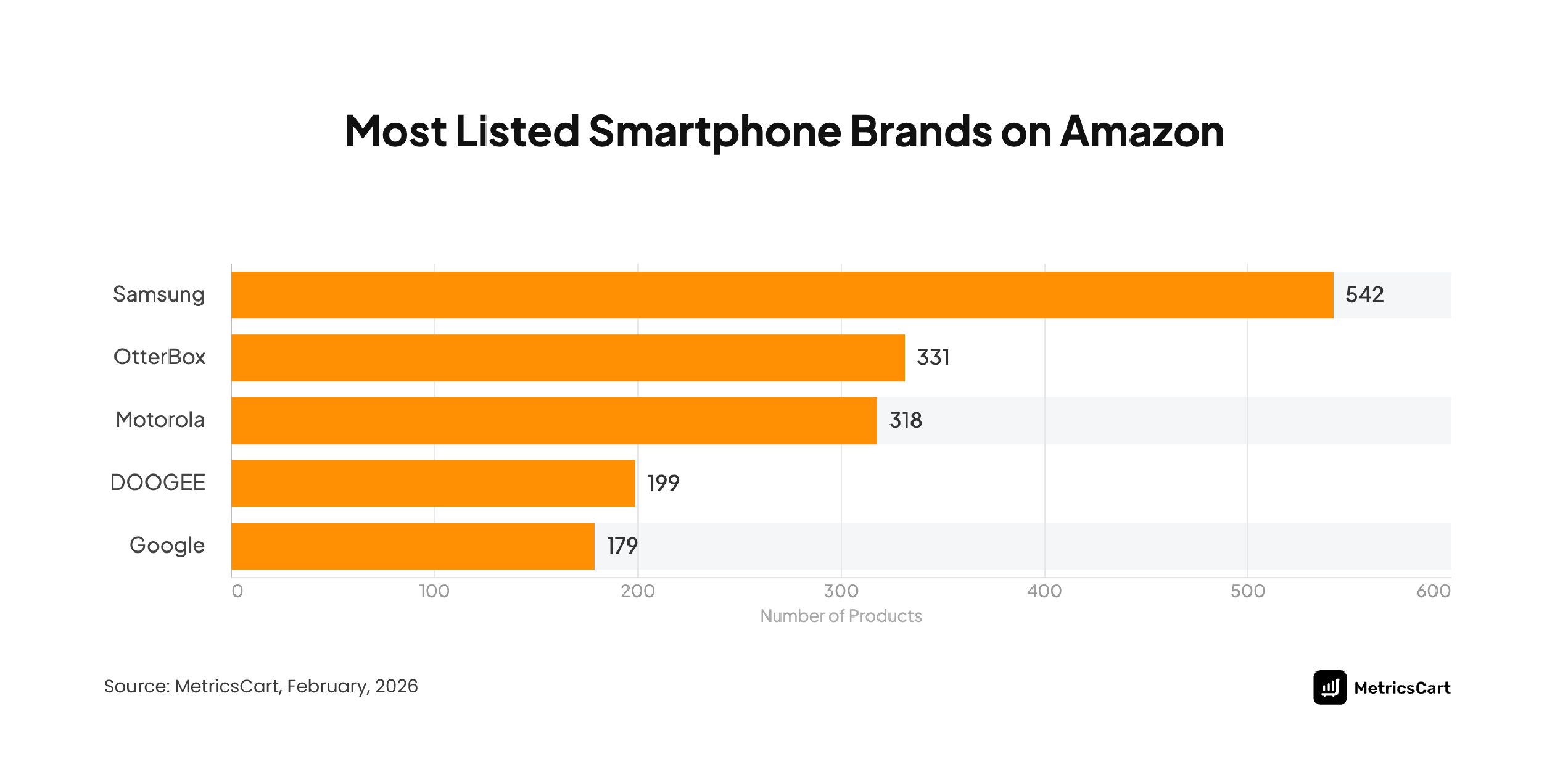
Samsung’s catalog dominance across both platforms is not a coincidence; it is the result of a deliberate strategy to be present at every price point and in every search context. With 542 listings on Amazon and 4,054 on Walmart, the brand does not just compete in the smartphone category. It structures the shelf around itself.
Why does Samsung lead so decisively? Two reasons stand out.
- First, Samsung offers one of the broadest smartphone portfolios of any manufacturer; from sub-$200 Galaxy A-series devices aimed at budget buyers to $1,000+ Galaxy S26 flagships and Z Fold foldables. This range allows Samsung to capture shoppers at every stage of the purchase intent cycle. A buyer searching for “budget Android phone” and a buyer searching for “best camera smartphone” can both land on a Samsung listing.
- Second, catalog depth translates directly into search surface area. More SKUs mean more opportunities to rank in filtered searches, by price, carrier, storage, or color.
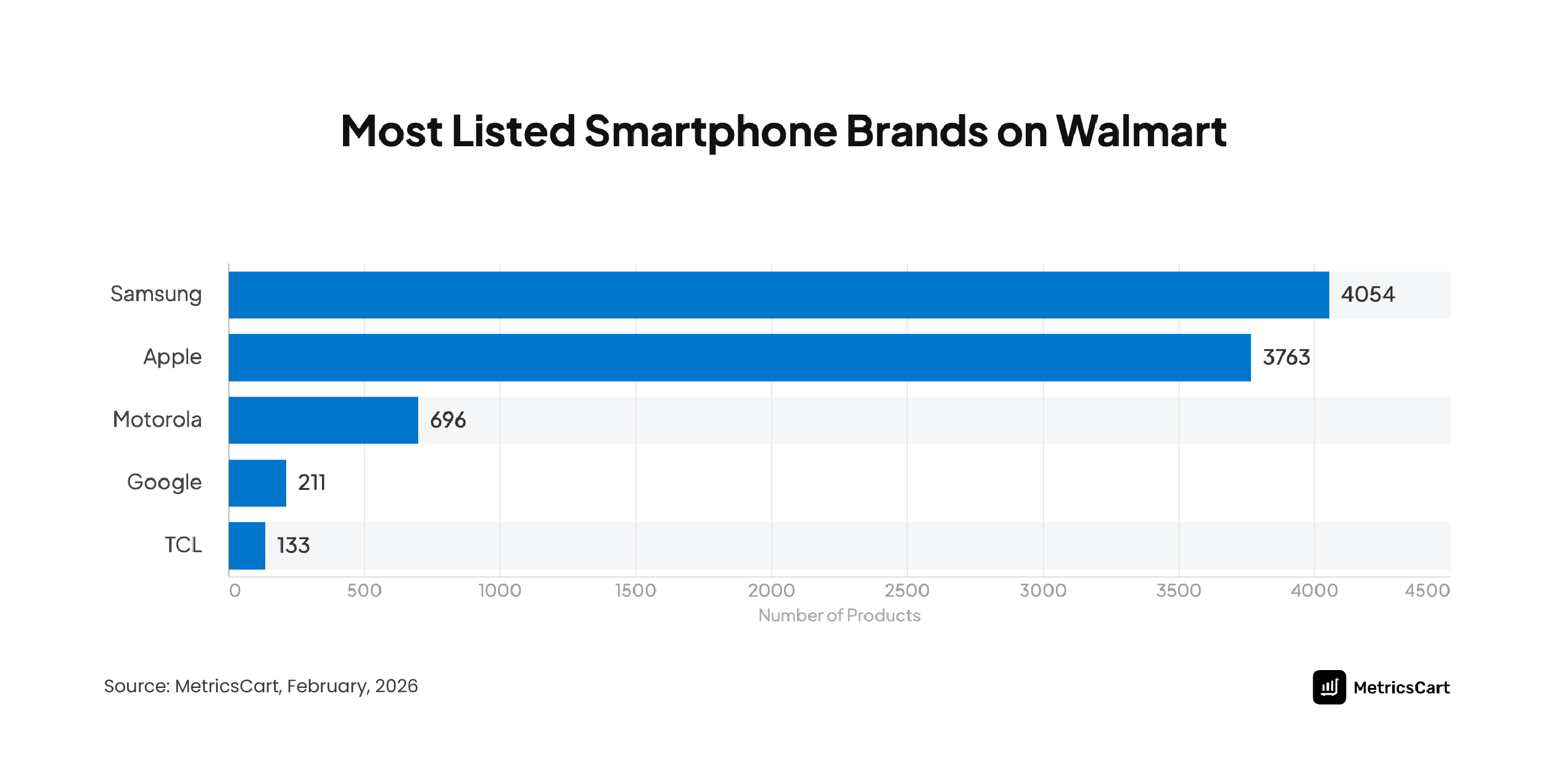
On Walmart, Samsung’s lead is even more pronounced. Apple follows with 3,763 listings, a strong second, and Motorola is a distant third at 696. The concentration of just two brands (Samsung and Apple) in Walmart’s catalog, which accounts for such a large share, reflects the platform’s preference for brands with established consumer recognition. Smaller or challenger brands face a much steeper path to shelf presence on Walmart.
Budget Smartphones Concentrate on Amazon, While Walmart Builds Depth in Mid-Range and Premium
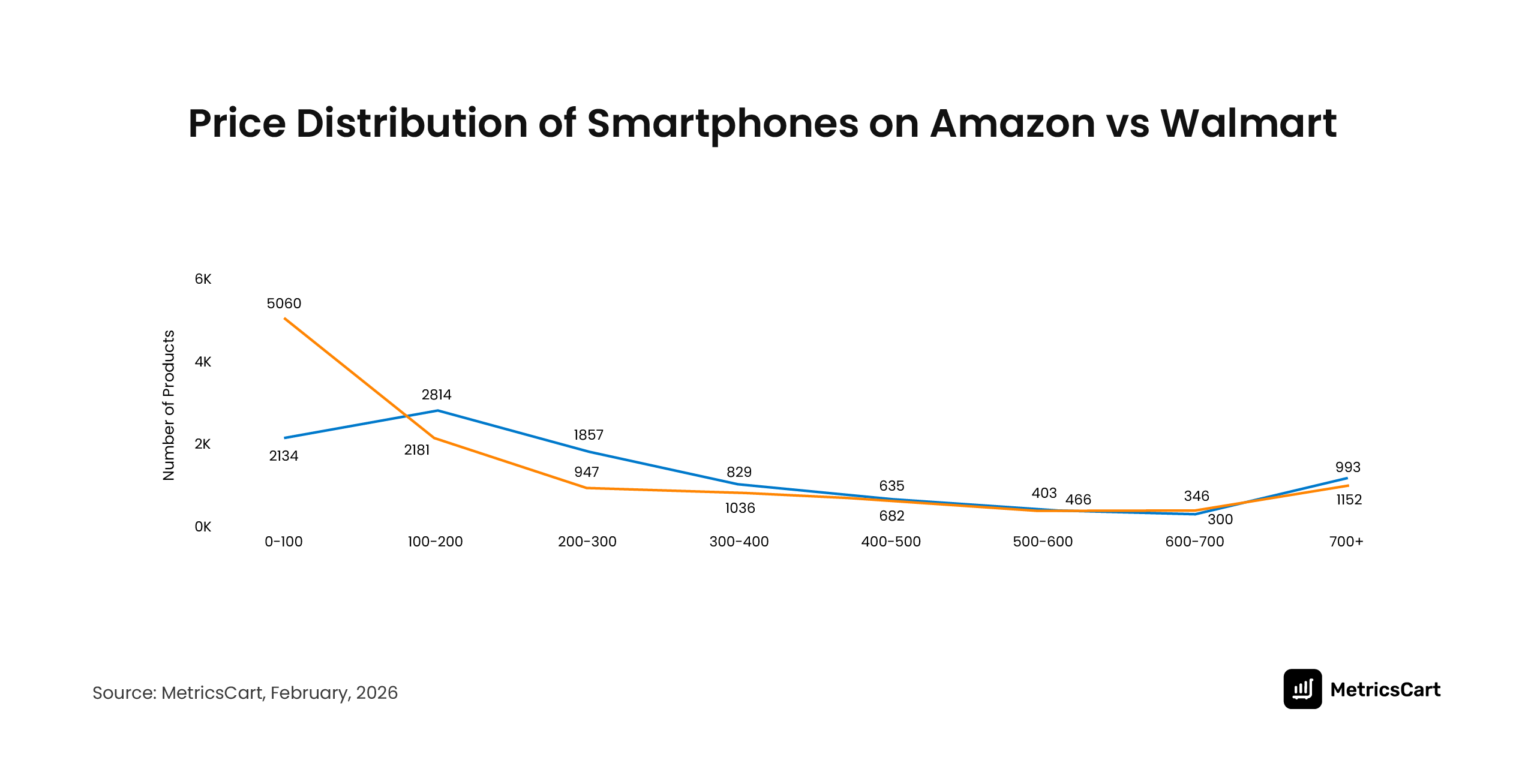
MetricsCart app findings reveal that Amazon dominates the under-$100 tier with 5,060 listings; more than double Walmart’s 2,134. At the low end of Amazon’s catalog, you find prepaid SIM kits, phone accessories, and basic Android handsets.
This breadth signals that Amazon functions as a full-spectrum marketplace where even the lowest price points have a home. For buyers looking to spend as little as possible, Amazon is where the search starts and ends.
The crossover happens in the $100–$200 range. Walmart lists 2,814 products here versus Amazon’s 2,181. The $200–$300 band continues this pattern: Walmart has 1,857 listings, compared with Amazon’s 947.
This is where Samsung’s Galaxy A-series and Motorola’s mid-tier lineup live: value-positioned devices with mainstream appeal that match Walmart’s buyer profile and its strong prepaid carrier relationships. Walmart’s buyer in this range is not hunting for the cheapest option. They want a reliable phone at a fair price from a name they recognize.
Why does Walmart tilt toward mid-range?
Walmart’s core customer base spans a wide income range, and the retailer has long leaned into trusted, nationally recognized brands over deep-discount alternatives. That trust orientation naturally concentrates catalog depth where brand-name devices live; the $100–$300 range. It also reflects Walmart’s omnichannel reality: these are the devices that move both online and in physical stores.
Affordable Products
The most affordable listings in Amazon’s smartphone category include category-adjacent items such as SIM kits, grips, and lanyards, not handsets. These products sit within the smartphone catalog but serve the accessory and setup ecosystem around a device.
Affordable Listings on Amazon: Category-Adjacent Items vs. Handsets
| Product | Price |
| SpeedTalk Mobile SIM Card Starter Kit, Smartphone Cell Phone, GPS Tracker and IoT, Plan Starting at $5 Prepaid, Data, Talk and Text, High Speed 5G 4G LTE, Android iOS, USA, 3 in 1 SIM Kit | $1.95 |
| iPhone pocket sock or New cell Phone Grips 3-in-1: Cleaner, Rings, Holder. Unique and Cute Phone Accessories. Adhesive 3 M for iPhone, Samsung Phone, Motorola, Xiaomi, Smartphone, Kindle, Tablets, etc | $2.98 |
| Adjustable Phone Lanyard Wrist Strap with 2 Tabs,360° Rotation, Universal Phone Case Wrist Strap for Most Smartphones | $2.99 |
On Amazon, the most affordable listings are dominated by accessories and entry-level add-ons. Products like prepaid SIM kits priced as low as $1.95, phone grips under $3, and lanyards around $2.99 highlight how Amazon captures high-frequency, low-value purchases. These are not primary devices, but they play a critical role in driving volume and repeat visits.
Affordable Listings on Walmart: Accessories and Entry-Level Handsets
Walmart’s lowest-priced listings also include category-adjacent accessories alongside entry-level handsets, which serve very different buyer needs.
| Product | Price |
| USB-A to USB-C Cable 3FT Charging & Data Sync, Universal Compatibility White | $1.99 |
| RXMEKW Mini Cell Phone Bm150 Mini Phone 2G Student Elderly Dual Sim Bluetooth Dial Bar Small Keyboard Phone | $8 |
| Elderly Mobile Phone, DELESYS Large Button Large Voice Multi-function Mobile Phone Large Capacity Phone for The Elderly | $8.43 |
Walmart’s budget tier is straightforward. The $1.99 USB-A to USB-C Cable is an accessory, not a handset. It sits in the smartphone catalog because buyers pick it up alongside a device, not instead of one.
The RXMEKW Mini Phone at $8 and the DELESYS Elderly Mobile Phone at $8.43 are actual handsets, but they are intended for a very specific buyer. Seniors who need large buttons, students who need a basic backup, and users who want calls and texts without the complexity of a modern smartphone.
These are not budget alternatives to Samsung or Apple. They are a different category of need entirely. Walmart’s affordable tier reflects this clearly. The entry points are low, but the platform’s real weight sits firmly in the mid-range, where its core buyers and biggest brands actually compete.
Expensive Products
At the higher end of the spectrum, the difference becomes even more pronounced.
Amazon :
| Product | Price |
| VERTU Quantum Flip Alligator Series Android Smartphone, Snapdragon 8 Gen 4,6.9″ OLED 120Hz Display,16GB RAM 1TB Storage,Quantum Privacy System,65W Fast Charging,Dual Screen Design(Gold Iron Black) | $21900 |
| Agent Q Grained Calfskin–Luxury AI Smartphone 6.02″AMOLED 120Hz Display, Snapdragon 8 Elite Chipset,16GB+1TB Storage,50MP Variable Aperture Camera, Dual Satellite, Triple-System Secure Design(Deep Blue) | $5380 |
| Apple iPhone 17 Pro Max, US Version, 2TB, eSIM, Cosmic Orange- Unlocked (Renewed) | $2450 |
Amazon supports a much wider price range, extending into ultra-premium and niche luxury devices. Listings include high-end smartphones priced above $5,000, including models priced above $20,000, such as the VERTU Quantum Flip Alligator Series Android Smartphone, alongside flagship devices like the iPhone 17 Pro Max. This reflects Amazon’s role as an open marketplace where even the most specialized products can find visibility.
Walmart:
| Product | Price |
| Restored Apple iPhone 17 Pro Max 5G 2TB – Unlocked – Cosmic Orange (Refurbished) | $2399.99 |
| Samsung Galaxy Z Fold7 SM-F966U 1 TB Smartphone, 8″ Flexible Folding Screen Dynamic AMOLED 2X QXGA+ 2184 x 1968, Octa-core (OryonDual-core (2 Core) 4.47 GHz + Oryon Hexa-core (6 Core) 3.53 GHz, 16 | $2334.55 |
| Samsung Galaxy Z Fold7 512GB Smartphone (Unlocked), Silver Shadow | $2119.99 |
Walmart, in contrast, focuses on mainstream premium devices. Its higher-priced listings are concentrated around flagship smartphones from brands like Samsung and Apple, typically ranging between $2,000 and $2,500. This tighter range suggests a more demand-driven approach, where pricing aligns closely with what the majority of buyers are willing to consider.
Amazon Shows Stronger Customer Engagement, While Walmart Skews Toward Higher-Priced Smartphones
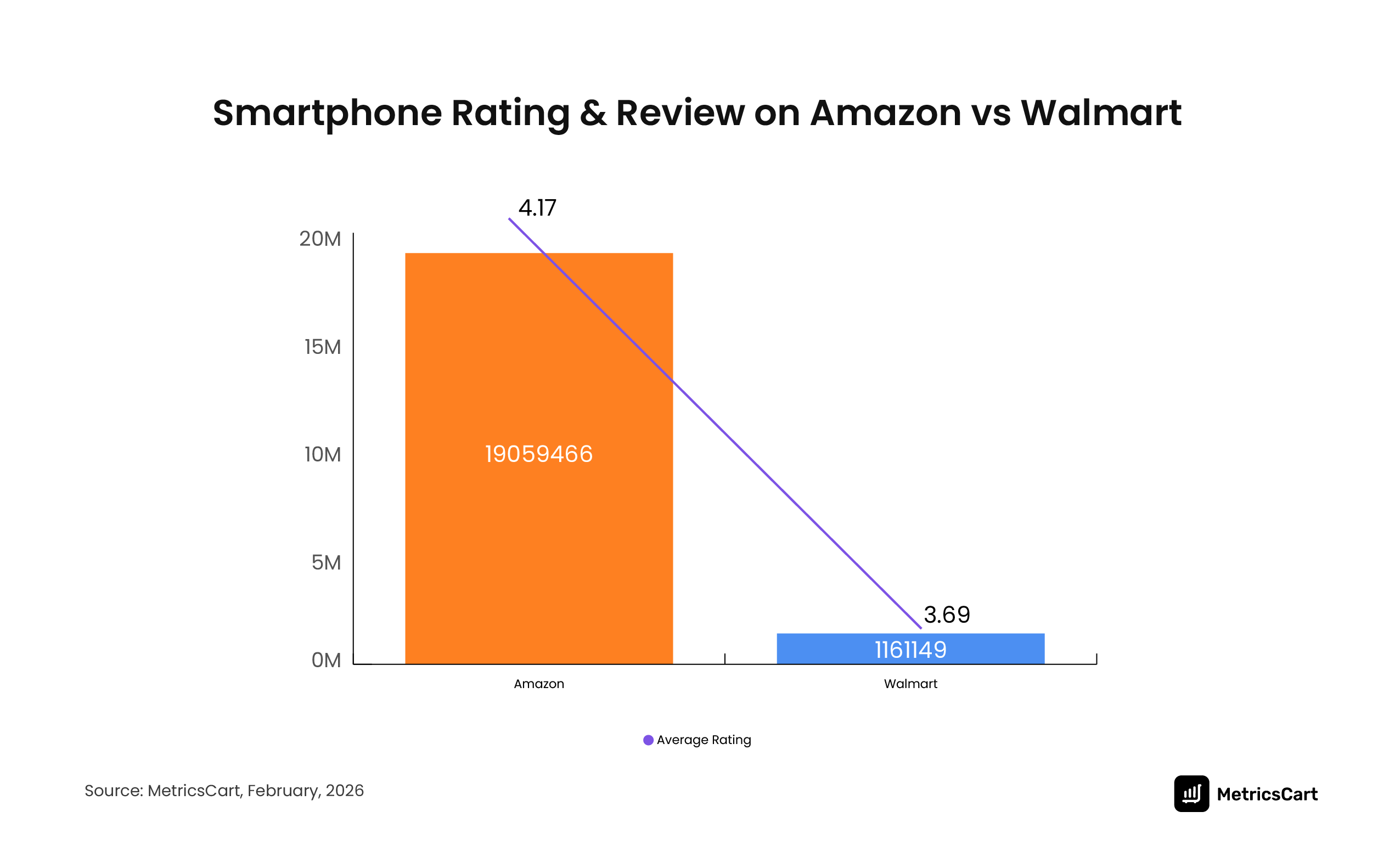
Customer reviews are the most powerful conversion signal in the smartphone category. On this front, Amazon and Walmart are not in the same league.
Based on MetricsCart’s insights, Amazon’s smartphone category accumulated over 19 million total reviews in February 2026, with an average rating of 4.17. Walmart generated approximately 1.16 million reviews, a 16x gap, with an average rating of 3.69.
The rating difference matters. A 4.17 average signals consistent satisfaction across a large, active buyer base. A 3.69 average signals greater variability, either from product-quality differences at the lower end of the catalog or from a buyer base that is quicker to register disappointment.
Why does Amazon pull so far ahead on review volume? A big part of the answer lies in what is actually being reviewed. Amazon sees substantially more reviews for smartphone accessories than for handsets.
Top Reviewed Products on Amazon
| Products | Reviews |
| JETech Screen Protector for iPhone 6 and iPhone 6s, 4.7-Inch, Tempered Glass Film, 2-Pack | 799385 |
| JETech Screen Protector Compatible with iPhone 13 mini 5.4-Inch, Tempered Glass Film, 3-Pack | 514343 |
| Ailun 3 Pack Screen Protector for iPhone 15 [6.1 inch] + 3 Pack Camera Lens Protector with Installation Frame,Case Friendly Tempered Glass Film,[9H Hardness] – HD | 409049 |
| Yootech Wireless Charger,10W Max Wireless Charging Pad Compatible with iPhone 17/17 Pro/17 Pro Max/Air/16/15/14/13/SE 2022/12/11,Samsung Galaxy S25/S24/S23,for AirPods Pro 3(No AC Adapter) | 222829 |
| PEHAEL 3+3Pack for iPhone 16 Pro Max Privacy Screen Protector with Camera Lens Protector Full Coverage Anti-Spy Tempered Glass Film 9H Hardness Easy Installation Bubble Free [6.9 inch] | 188592 |
The top reviewed product during the period was a JETech Screen Protector for iPhone 6/6s, with 799,385 reviews. An iPhone 13 mini protector from JETech came in second at 514,343. An Ailun 3-pack screen protector for iPhone 15 followed at 409,049.
These are not phones. They are part of the protective ecosystem that buyers return to Amazon for immediately after purchasing a device. The Yootech Wireless Charger, with 222,829 reviews, rounds out the top products and further confirms that accessory purchases, not handsets, are generating Amazon’s highest review volumes.
This tells a clear story. Amazon buyers purchase a phone, then come back to the same platform for accessories. That repeat behavior generates enormous review momentum for accessory brands like JETech, Spigen, and Ailun, and gives them disproportionate visibility in smartphone-adjacent searches.
Top Reviewed Products on Walmart
| Products | Reviews |
| Samsung Galaxy S25 Ultra 256GB Unlocked Android Cell Phone with 200MP Camera, Titanium Gray | 20254 |
| Samsung Galaxy S24 Ultra 256GB US Version, Unlocked Android Smartphone with 200MP Camera, 8K Video, Long Battery – Titanium Black | 19217 |
| SAMSUNG Galaxy S23 Ultra Cell Phone, Factory Unlocked Android Smartphone, 512GB Storage, 200MP Camera, Night Mode, Long Battery Life, S Pen, US Version, 2023, LAVENDER SINGLE SIM AND 1 ESIM | 17544 |
| Samsung Galaxy S7 Unlocked 32GB GSM and CDMA Smartphone, Black Onyx | 10889 |
| (New) Samsung Galaxy S7 SM-G930V 32GB, Onyx Black (Verizon) | 10781 |
Walmart’s review landscape is different. Here, reviews focus on actual devices, specifically Samsung flagships. The Samsung Galaxy S25 Ultra leads with 20,254 reviews, followed by the Galaxy S24 Ultra at 19,217 and the Galaxy S23 Ultra at 17,544.
Even older models make the list. Two variants of the Samsung Galaxy S7 have over 10,000 reviews each, a reminder that product pages on Walmart continue to accumulate feedback over long periods.
The Samsung Galaxy S25 Ultra leads with 20,254 reviews. It is Samsung’s most capable device in the current lineup,a 256GB unlocked Android smartphone built around a 200MP camera system, available in Titanium Gray. For buyers who want the best Samsung has to offer without carrier restrictions, this is the device.
The 200MP camera is not a marketing number here. It represents a genuine leap in detail, zoom capability, and low-light performance that buyers notice, use daily, and write about. That real-world engagement is what drives review volume on a device at this price point.
The Samsung Galaxy S24 Ultra follows with 19,217 reviews. Also, a 256GB unlocked Android device with a 200MP camera, 8K video recording capability, and long battery life in Titanium Black. The S24 Ultra is Samsung’s previous top-tier release, and the fact that it sits this close to the S25 Ultra in review count says something important. Walmart buyers are not always chasing the newest release.
The Walmart smartphone reviewer is buying a phone and evaluating it on its merits. Samsung’s dominance on this list reflects both the depth of its platform catalog and the genuine engagement of its buyers.
Rating distribution adds another layer of context. On Amazon, 6,844 listings carry a 4-star rating, which is the largest single group, and 2,299 hold 5 stars. On Walmart, 2,933 listings are rated 4 stars, and 1,172 carry 5 stars. Walmart shows slightly more 1-star and 2-star products than Amazon in both absolute and proportional terms, which is consistent with a wider range of seller quality at the lower end of its catalog.
JETech Tops Amazon Smartphone Reviews as a Screen Protector Brand, While Samsung Tops Walmart
The most-reviewed brands on each platform are a direct reflection of who is winning customer trust and which products are earning it.
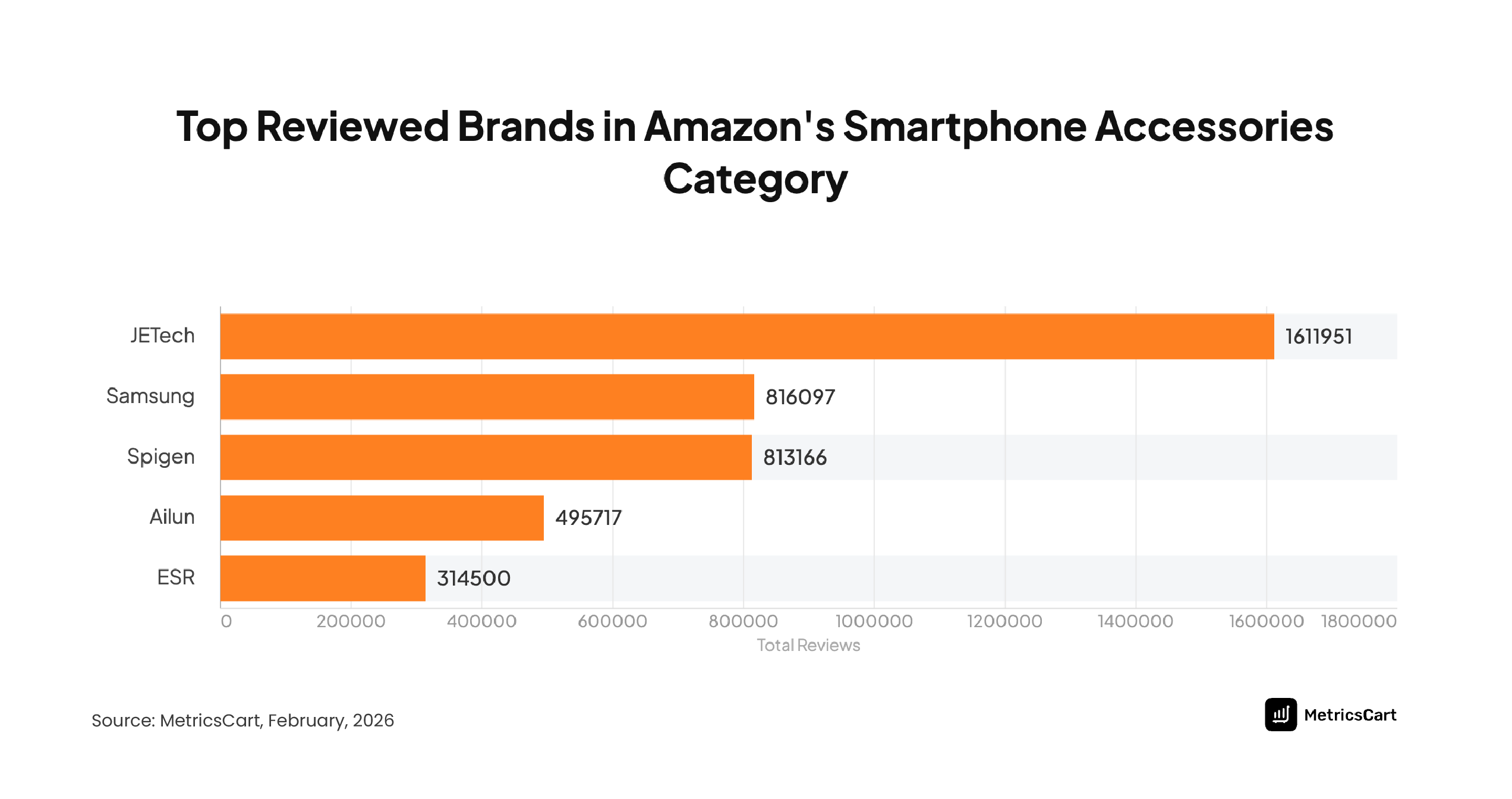
On Amazon, JETech leads all smartphone-adjacent brands with 1,611,951 total reviews. The brand’s dominance is built entirely on accessories, specifically screen protectors, that are compatible with iPhone models from the 6 through the 17 series.
JETech does not make smartphones, but it has built the single largest review base in the smartphone category by owning the moment immediately after purchase, when buyers search for protection. Samsung follows with 816,097 reviews, nearly tied with Spigen at 813,166. Ailun rounds out the top four with 495,717. What this group has in common is high-frequency, low-friction products that consumers buy repeatedly and review more willingly than a $999 handset.
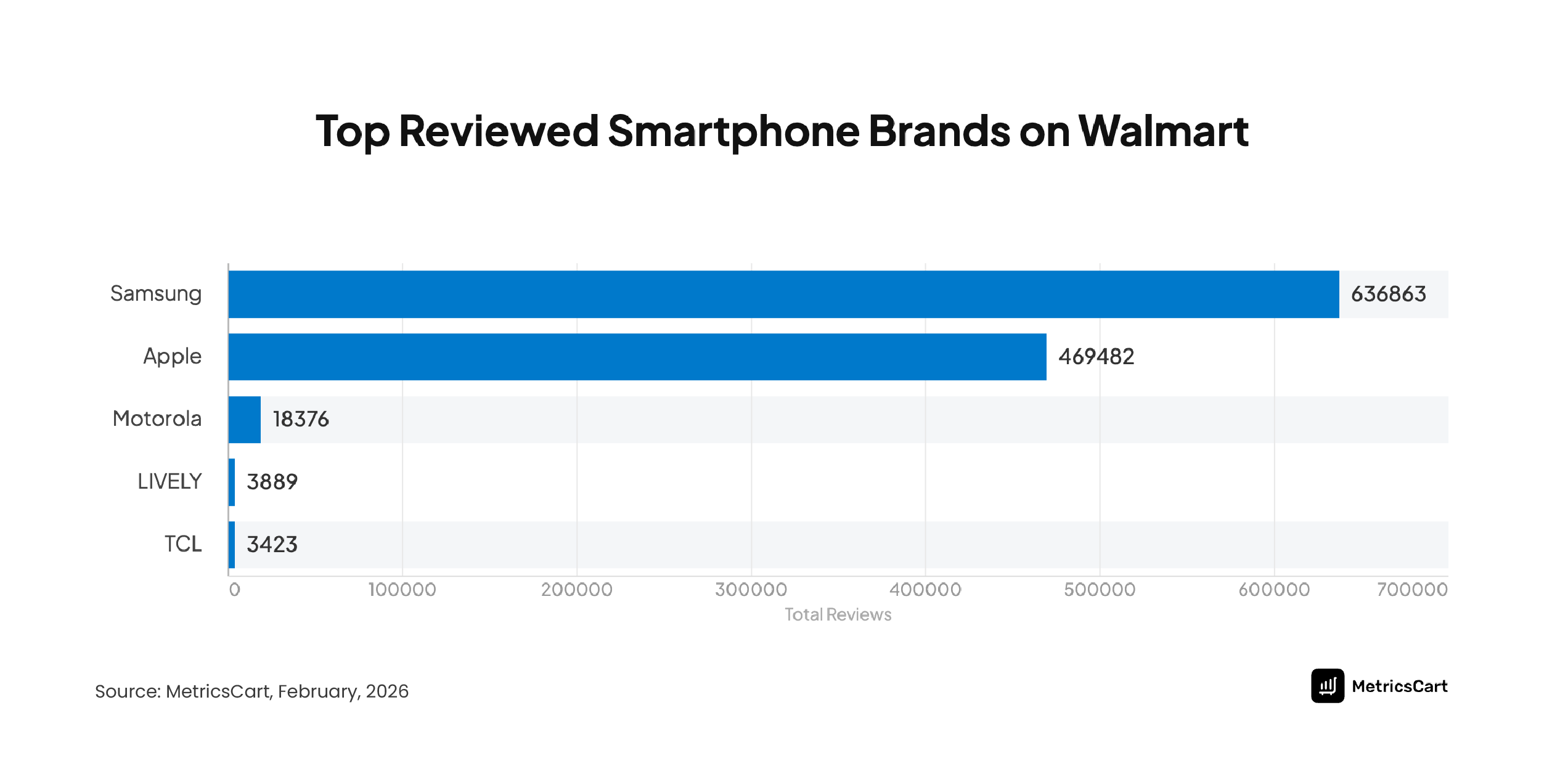
At Walmart, the dynamic is different. Samsung leads with 636,863 reviews. Apple follows with 469,482. No other brand comes close. Motorola sits at a distant 18,376. Samsung and Apple’s concentration on Walmart is clean and decisive.
Both brands benefit from Walmart’s curatorial tilt toward established names, and both carry high-profile flagship models such as the S25 Ultra, S24 Ultra, and iPhone 17 Pro Max that attract the most engaged and vocal buyers.
The Smart Takeaway for Brands
The February 2026 analysis makes one thing clear: Amazon and Walmart are not interchangeable distribution channels for smartphones. They have different shelf structures, buyer profiles, review ecosystems, and pricing sweet spots. Treating them with a single strategy is the most reliable way to underperform on both.
What Amazon Rewards
- Catalog breadth: more SKUs, more search surface area, more discovery pathways.
- Accessory ecosystem thinking: buyers return for cases, chargers, and screen protectors. Brand presence in these adjacent categories builds compounding review velocity.
- Review cultivation: Amazon’s 19M+ review base is its most powerful conversion asset. Products with strong, verified review profiles convert at meaningfully higher rates.
- Competitive base pricing: with an average listing price of $212.61, the Amazon smartphone shopper skews value-conscious. Budget and mid-tier SKUs need to be priced sharply and content-optimized.
What Walmart Rewards
- Brand authority: Walmart concentrates on established names. With just 352 brands versus Amazon’s 1,510, shelf space is earned through recognition, not experimentation.
- Mid-range positioning: Walmart’s depth is in the $100–$300 range. Samsung’s Galaxy A-series dominates here for a reason: it delivers credible specs at a price point that Walmart’s customer base responds to.
- Actual device reviews: Unlike Amazon’s accessory-driven review ecosystem, Walmart’s most-reviewed products are flagship handsets. Buyers here are evaluating phones, not protective gear.
- Omnichannel integration: Walmart’s 4,600+ physical stores create pickup and return pathways that Amazon cannot replicate. Brands that align their digital listings with in-store availability convert more reliably.
The Pricing Discipline That Both Platforms Share
Average discounts of approximately 4% on both platforms confirm that neither Amazon nor Walmart is competing on heavy promotional pricing in this category. Brands that try to buy their way to conversion with discounts are swimming against the current, especially as memory component shortages push average selling prices up across the industry in 2026.
The smartphone category on both platforms rewards brands that invest in the fundamentals: catalog depth, content accuracy, review quality, pricing integrity, and organic search rank. These are not glamorous strategies. But they are the ones that compound.
Winning the Shelf, One Screen at a Time
For smartphone brands and e-commerce teams, this data makes one thing clear: the digital shelf is where the category is won or lost. Assortment depth, pricing alignment, and review quality are not individual checkboxes; they compound, and the brands that manage them consistently are the ones that stay visible and convert.
MetricsCart helps brands track exactly these signals across Amazon and Walmart in real time, from pricing movements and review trends to listing visibility and assortment gaps. Because knowing what is happening on the shelf is the first step to doing something about it.
Disclaimer: MetricsCart is the exclusive owner of the data used in these Digital Shelf Insights reports. Any third-party usage must include proper credit to the source.
Stay ahead of every smartphone shelf shift with MetricsCart.