Steve Jobs once said, “You can’t just ask customers what they want and then try to give that to them. By the time you get it built, they’ll want something new.”
That tension sits at the heart of every NPD decision. To just develop a new idea, they need around 3 to 12 months, and by the time a product is ready, the market may have already moved on.
Our team at MetricsCart recently spoke with multiple NPD teams across industries, particularly in CPG, about how they can use digital shelf analytics to accelerate product development decisions.
And interestingly, in most conversations, the same set of questions kept coming up. Questions around pricing, demand, competition, reviews, and what actually drives success on the digital shelf.
This article brings together the top 10 digital shelf questions asked by NPD teams and answers them with practical, real-world context. If you’re a product manager, NPD lead, or part of an e-commerce team responsible for launching and scaling products, this is for you.
Highlights
- Most customer insights already exist in reviews, but they are unstructured and hard to process manually.
- LLMs help identify repeated complaints across competitors, revealing real unmet needs at scale.
- 5-star reviews clearly show which features actually drive satisfaction and repeat purchase.
- Successful products consistently get praised for a small set of repeat attributes.
- A 4.2-star rating is the minimum threshold to stay competitive on the digital shelf.
- Early ratings and reviews during launch directly impact visibility and conversion.
- Packaging sustainability is measurable through customer sentiment, not brand claims.
- Leading brands see significantly higher positive sentiment around eco-friendly packaging.
- Review velocity helps identify whether a competitor is using incentivized programs.
- Search behavior signals demand shifts before they show up in sales data.
- Reviews often reveal unexpected product use cases that can unlock new opportunities.
- Price only works when it aligns with perceived value reflected in ratings and reviews.
- New variants can fail if they don’t create new demand and only split existing sales.
- Digital shelf insights replace assumptions with real, ongoing market signals.
- Faster, data-driven decisions reduce risk and improve product success rates.
Answering the 10 Top Digital Shelf Questions Asked by NPD Teams
As brands increasingly rely on digital shelf data for product development, the focus has shifted from guesswork to evidence-backed decision-making.
Using digital shelf insights for NPD Teams, these questions can be addressed with real-time visibility into consumer demand, competitor performance, pricing dynamics, and content effectiveness.
1. Can an LLM analyze the last 6 months of competitor reviews to find the most common “unmet needs” in the CPG space?
Yes. And this is one of the fastest ways to identify the real unmet needs and reduce guesswork in product development.
Amazon alone gets 350k reviews on a peak day just within the US. And almost 90% of product feedback sits inside these unstructured reviews. Manually reading that is not practical. So instead, you can use an LLM to process thousands of reviews in minutes, cluster them into themes, track recurring issues, and know what customers truly need.
What makes this useful is pattern detection. When the same complaint shows up across multiple competitors over a 6-month period, it signals a real gap. For example, if “leakage,” “too strong fragrance,” or “poor durability” keep appearing across top SKUs, that’s not noise. That’s an unmet need at the category level.
While LLMs are great for analyzing reviews, you can also use review analytics tools like MetricsCart, so you can:
- Aggregate reviews across Amazon, Walmart, and 100+ other retailers
- Track how the same issue shows up across competitors
- Extend to social listening, pulling insights from YouTube reviews, TikTok content, and Reddit discussions
- Analyze all of this unstructured data together to identify patterns, not just isolated complaints
So instead of asking “what are customers saying,” you start answering “what problems are consistently unsolved across the market.” And instead of working with assumptions or limited feedback, you get a clear, data-backed view of what the market is still missing.

2. What Features Are Customers Praising In 5-Star Reviews Of Competitors That You Currently Lack?
5-star reviews show you exactly what is driving satisfaction and repeat purchase in your category. And the patterns become clear when you look at them at scale.
Most positive reviews are not vague. ResearchGate studies show that shoppers rely on detailed, experience-based feedback, and top-performing products are consistently praised for specific attributes, not just overall quality.
When you analyze competitor 5-star reviews, you typically see:
- Repeat feature mentions: Around 60–70% of 5-star reviews highlight the same 2–4 attributes, such as “long-lasting,” “easy to use,” “no residue,” or “good value.”
- Outcome-focused praise: Customers focus on results. Phrases like “works in one wash” or “gentle on skin” show what actually matters.
- Real-world usability: Reviews often include context such as “travel-friendly,” “easy to store,” or “mess-free packaging,” reflecting everyday use.
This is where your gaps become visible. If a competitor consistently gets praised for “fast results” or “spill-proof packaging,” and your product does not deliver on those, that is a clear feature gap that can impact conversion.
READ MORE | How to Conduct Product Trend Analysis?
3. What Is The Typical “Star Rating” Benchmark For A Successful Product Launch In The CPG Space?
This is one of the top digital shelf questions asked by NPD teams across categories, and the answer is fairly consistent.
Across major retailers like Amazon and Walmart, 4.2 stars is the minimum baseline to stay competitive. Anything below that starts to hurt conversion, especially when shoppers are comparing similar products side by side.
According to McKinsey & Company, even small improvements in ratings can lead to 30–200% growth in product sales, which shows how sensitive performance is to rating changes.
For a new launch, this threshold matters even more because early ratings directly influence visibility, ranking, and initial conversion.
From what we consistently observe, here’s how it plays out:
- 4.0 – 4.2 stars: You may get initial visibility, but conversion is unstable. Early negative reviews can slow down growth.
- 4.3 – 4.4 stars: This is where a launch starts gaining traction. The product becomes competitive and more likely to sustain momentum.
- 4.5+ stars: This is where strong launches separate themselves. Higher rankings, better conversion, and faster scaling follow.
But rating alone is not enough. Volume plays a critical role. Products that build reviews quickly alongside maintaining strong ratings tend to gain trust faster, which directly impacts how shoppers perceive and choose them.
In practice, this means a successful launch is not just about getting listed. It is about reaching a strong rating threshold early and sustaining it with sufficient review volume to build credibility, which ultimately drives long-term performance on the digital shelf.
4. Which Competitors Have The Highest “Sentiment Score” Regarding Packaging Sustainability?
You can identify this by analyzing how customers talk about packaging across reviews and social conversations.
Sustainability is no longer a niche factor. According to McKinsey & Company, a growing share of consumers consider environmental impact in purchase decisions, especially in CPG. That shows up clearly in review data.
When you measure sentiment around packaging, the top competitors usually have:
- High positive mention rates: Terms like “recyclable,” “less plastic,” or “eco-friendly” appear frequently in positive reviews
- Low negative feedback: Fewer complaints around “excess packaging,” “not recyclable,” or “misleading claims.”
- Consistency across channels: The same positive signals appear across retailer reviews and platforms like YouTube or Reddit
In most categories, leading brands see 70–80% positive sentiment on packaging-related mentions, while average players fall closer to 50–60%. That gap is significant because packaging is one of the first things customers experience and comment on.
So instead of relying on what brands claim, you are looking at which competitors are consistently getting recognized by customers for better packaging choices. That is what defines the real leaders in sustainability on the digital shelf.
5. How Do We Track The “Review Velocity” Of A New Competitor Launch To See If They Are Using “Vine” Or Incentivized Programs?
When a new competitor launches, one of the fastest ways to gauge whether they are using programs like Amazon Vine or other incentivized review strategies is by analyzing review velocity. This refers to how quickly reviews accumulate over a defined period.
While platforms don’t explicitly disclose whether a brand is using such programs, review velocity patterns often reveal the story.
Here’s what you can do, though:
Track daily review growth, especially in the first 2–3 weeks after launch. A sharp spike in reviews within a short window, followed by a slowdown, is a strong signal of incentivized activity. Compare this against similar products in the category to identify abnormal growth patterns.
Also, look at rating distribution and content consistency. A heavy skew toward 4–5 star reviews with similar phrasing or structure often indicates guided or incentivized feedback.
Finally, scan for disclosure cues like “Vine” or “received for free.” While not always present, when combined with unusual velocity patterns, they help confirm non-organic review generation.
You can also use MetricsCart’s advanced rating and review monitoring tools to identify whether reviews are incentivized or not and get valuable insights into your competitors’ strategies.
6. How Do We Monitor ‘Search Intent’ Shifts To See If Consumers Are Moving Toward A New Ingredient Or Material?
This is one of the top digital shelf questions NPD teams need to get right, because search behavior moves before the market does. What people type reflects what they want next, not what they bought last quarter.
On the digital shelf, intent shows up in keywords. When consumers start shifting toward a new ingredient or material, it appears as a change in their search behavior.
You will see modifiers like “sulfate-free,” “plant-based,” or “BPA-free” gaining share within the same category. That is your first signal.
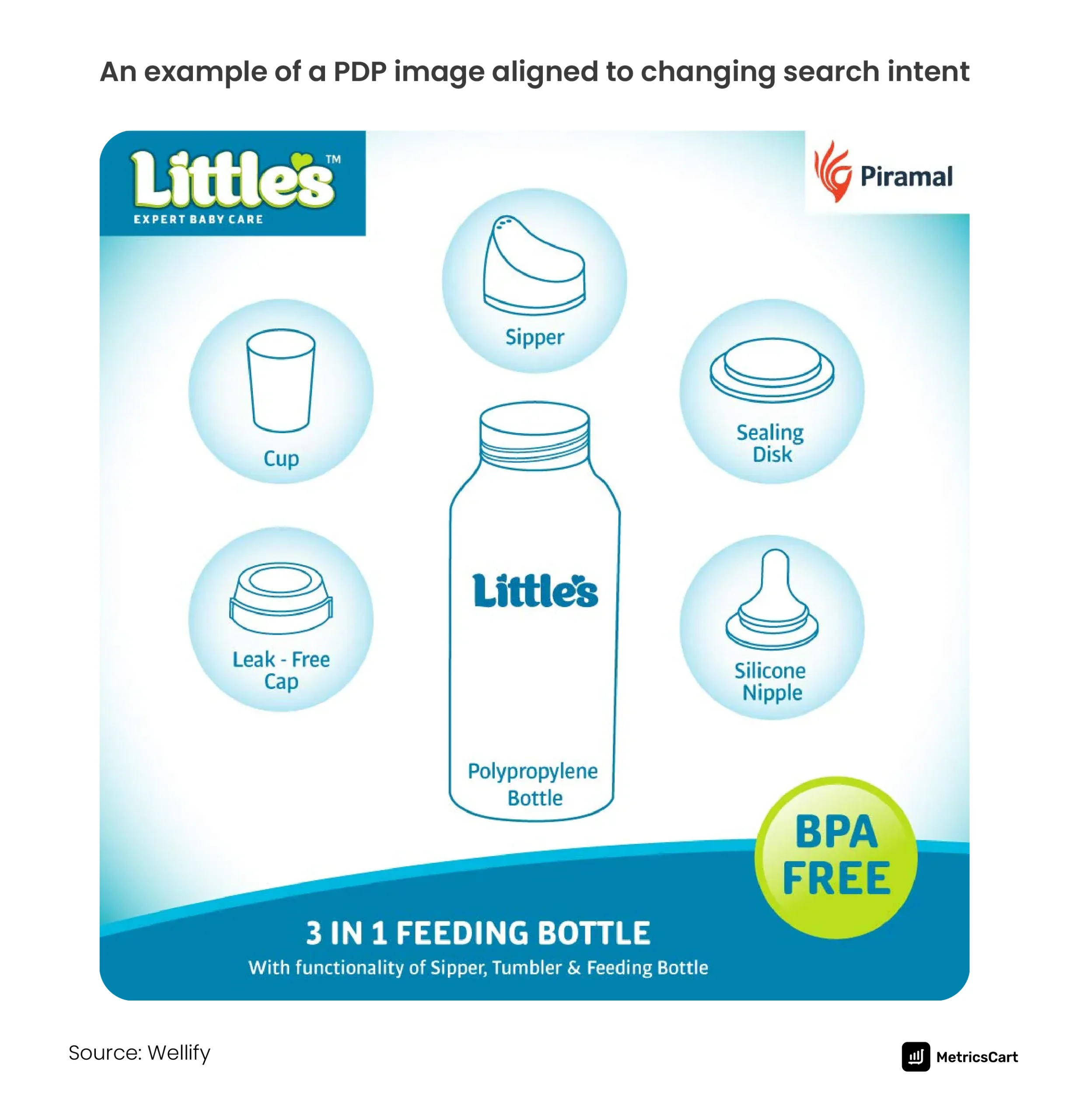
The key is not just spotting new terms, but tracking how their share of search grows over time and whether platforms start ranking those terms higher across top listings.
To make this actionable, you need to connect three signals.
- Keyword trends. Are certain ingredients or materials showing consistent growth in search frequency month over month?
- Visibility. Are products built around those attributes climbing in rankings and appearing more often in top results?
- Validation. Are reviews and ratings reinforcing the same attributes, with customers calling them out positively?
When all three align, you are no longer looking at a trend. You are looking at a shift in demand.
READ MORE | How Share of Search Works in E-Commerce?
7. Can Review Analytics Tell You If Customers Are Using Your Product For ‘Off-Label’ Use Cases You Haven’t Marketed Yet?
Yes. And for an NPD team, this is one of the most practical ways to uncover real demand without running new research.
Customers rarely stick to your intended use. But they do write exactly how they’re using the product in reviews. When you analyze enough of that text, patterns start repeating, and that’s where the signal is.
Think of it this way: if hundreds of people say “I actually use this for X,” that’s not an edge case anymore. That’s a use case you didn’t design for, but the market already validated for you.
What you want to look for is:
- Repeated phrases that point to alternate usage
- Clusters of reviews describing the same unexpected scenario
- High ratings tied specifically to that alternate use
- Steady volume over time, not just a one-off trend
This is how brands end up discovering things like if a cleaning product meant for sofa leather is being used for shoes, or a supplement being used for sleep instead of energy.
READ MORE | Product Development Using Customer Feedback: Must-Know Tips for Brands
8. How Can You Benchmark Your Prototype’s Proposed Price Point Against The Price Vs. Rating Curve Of The Current Market?
For most NPD teams, pricing a new product still relies on internal assumptions, cost structures, or competitor averages. That approach misses how customers actually make decisions.
On the digital shelf, price does not exist in isolation. It is always judged against perceived value, and that value is reflected in ratings and reviews. This is where digital shelf data for product development becomes critical.
Products do not win because they are the cheapest or most expensive. They win because their price matches the level of trust reflected in their ratings.
This creates a natural “price vs. rating curve” in the market:
- Lower-rated products compete on price
- Mid-rated products sit in the highest conversion range
- Higher-rated products can command a premium
For NPD teams, this curve acts as a real-world pricing benchmark based on actual shopper behavior, not assumptions.
READ MORE | Best Pricing Strategies for E-Commerce That Help Scale Business
9. How to Set The Right Price for a New Product
To use digital shelf insights for NPD teams effectively, you need to anchor your pricing to what the market already validates.
Start by mapping competitor SKUs across key variables. Plot price against average rating across top-performing products in your category. This shows what customers are willing to pay for different quality levels. Find where top-selling products sit. That’s your ideal price range.
Then place your product on that curve based on expected quality. If your price is too high for that level, you risk losing buyers. If it’s too low, you risk undervaluing it.
10. Can Digital Shelf Data Help Predict The ‘Cannibalization’ Risk Of Launching A New Flavor Or Size Variant?
To quickly answer this top digital shelf question asked by NPD teams, yes.
Cannibalization usually happens when a new variant does not bring new demand. It simply shifts existing demand from one SKU to another. Digital shelf data for product development helps you see that risk before launch by showing how similar products behave in the market.
Start by looking at search overlap. If your new flavor or size targets the same keywords as your existing SKUs, you are competing for the same traffic. Then check the share of search distribution across your current variants. If one SKU already dominates visibility, a new, similar variant will likely split that demand rather than expand it.
Next, analyze price and rating positioning. If the new variant sits in the same price band with similar ratings, customers have no clear reason to choose one over the other. That increases substitution risk. On the other hand, a distinct price-value gap can create incremental demand.
Reviews add another layer. Look for usage differences across existing variants. If customers clearly associate one variant with a specific need or occasion, there is room to introduce another without overlap. If reviews sound identical across variants, you are likely serving the same use case repeatedly.
For NPD teams, the goal is simple. Do not ask “will this variant sell.” Ask, “will this variant bring new demand or just redistribute what we already have.” Digital shelf data for product development gives you that answer.
The Final Answer
There it is. The answers to the 10 top digital shelf questions asked by NPD teams across every category.
And on top of these, with generative AI and AI-led shopping accelerating, digital shelf signals are no longer optional. They are shaping what customers see, compare, and buy. If your product decisions are still based on instinct or delayed research, you are already behind.
While there are many tools in the market, MetricsCart stands out by bringing all of this into one place. It gives you accurate, real-time visibility across search, content compliance, pricing, ratings, user-generated content, and competitor benchmarks across 100+ retailers and locations. It also helps monitor and automatically enforce MAP policies, so your pricing stays protected even when you are not actively tracking it.
The outcome is simple. Faster decisions, lower risk, and products that match actual demand.
Get The Insights To Know What Your Customer Truly Needs.
FAQs
Digital shelf analytics is the process of collecting and analyzing data on how products appear and perform across online retail platforms. It tracks key factors such as search visibility, pricing, content quality, ratings and reviews, and stock availability to understand real-time product performance.
Its importance has grown as consumer behavior has shifted online. Today, roughly eight in ten Americans are online shoppers. Plus, over 60% of shoppers start their buying journey by researching or browsing online, even if they complete the purchase in-store.
For NPD teams, this shifts how products should be built. Instead of relying only on surveys or historical data, teams can use digital shelf insights to understand what customers are actually searching for, what features they value, and where competitors are underperforming.
NPD teams use digital shelf data to make faster, evidence-based decisions across the product development cycle. It helps them reduce guesswork and align products with real market demand.
NPD teams should track key digital shelf metrics, including search visibility, price vs. rating curve, review volume & sentiment, share of search, content compliance, stock availability & assortment, and competitor benchmarking.
Digital shelf insights help brands align product development directly with consumer demand, behavior, and expectations. By analyzing online reviews, search trends, and competitor performance, brands can identify what customers actually want, what’s missing in the market, and where existing products fall short. As a result, product innovation becomes more targeted, faster, and significantly less risky.
By tracking SKU count, review volume concentration, and share of search distribution, teams can see if a few players dominate or if the market is fragmented.