For many enterprise brands, Profitero has been the default choice for digital shelf analytics. It set the category standard early, especially for visibility across Amazon and major retailers.
But as retail media grows, marketplaces fragment, and pricing and content rules tighten, many teams are reassessing whether Profitero+ still fits how they work today.
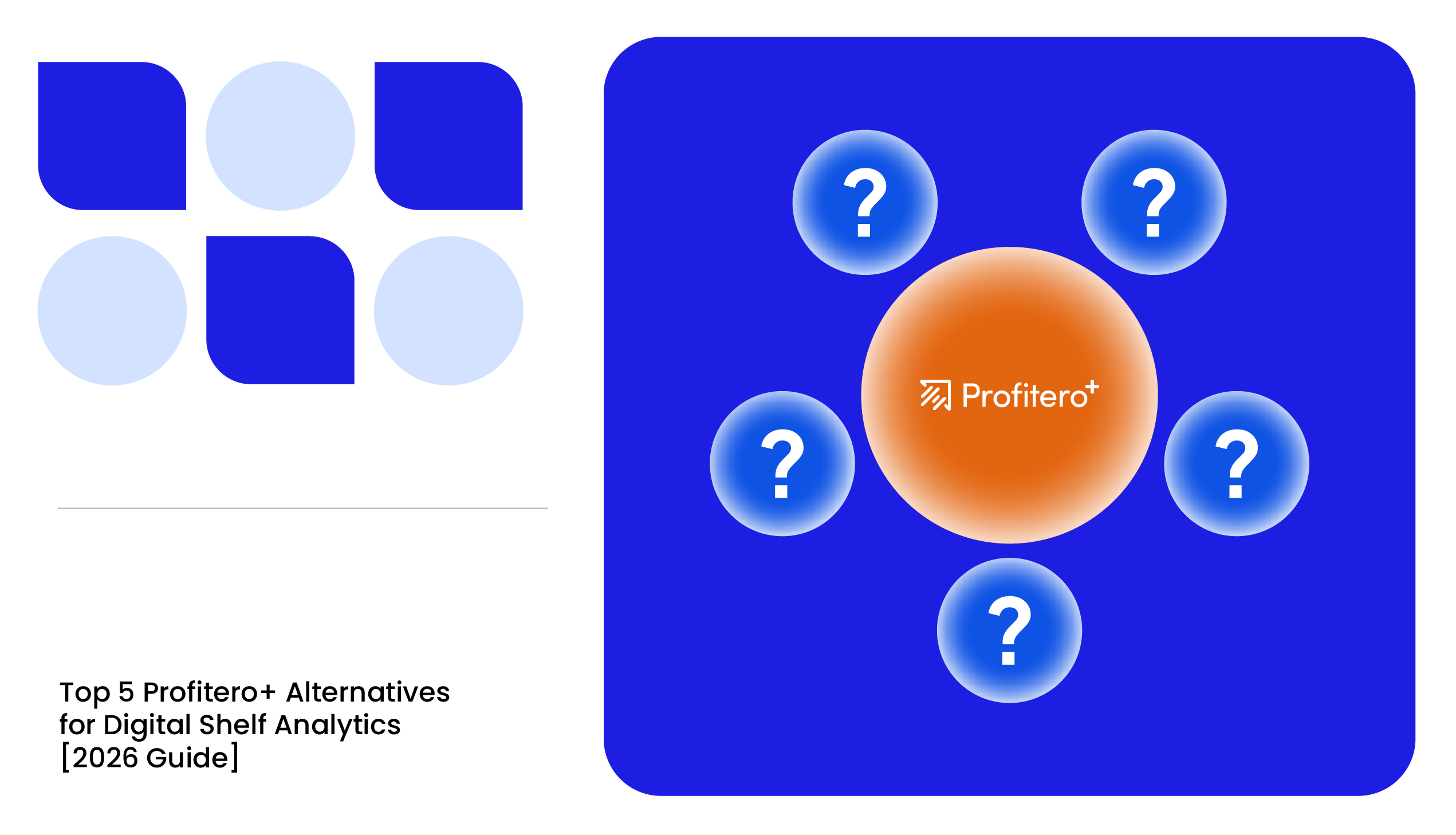
This guide covers the top 5 Profitero+ alternatives, with a clear understanding of where each platform fits and why many brands are switching.
Why Brands Are Looking for Profitero Alternatives?
As commerce teams grow more cross-functional across ecommerce, revenue, retail media, content, and operations, platforms that feel rigid or dashboard-heavy start to slow teams down.
That’s where the search for a strong Profitero alternative begins.
Common reasons teams explore Profitero+ competitors:
- Slower insight-to-action cycles
- Limited control over rules, alerts, and workflow integration
- Heavy reliance on static dashboards instead of decision-ready signals
- Scalability becomes dicey with enterprise-focused pricing
- Rising costs without proportional operational value
If this list felt relatable, let’s look at more execution-focused digital shelf analytics software alternatives.
The Top 5 Profitero+ Alternatives Brands Are Evaluating
Here are the best Profitero+ alternatives for digital shelf analytics that leaders are actively evaluating for tighter execution and stronger automation:
1. MetricsCart

MetricsCart is designed for brands that want operational control of the digital shelf, not just reporting. Where Profitero emphasizes benchmarking and visibility, MetricsCart is built around execution.
Brands use it to track pricing, promotions, MAP monitoring and enforcement, ratings and reviews, content compliance, assortment gaps, availability issues, share of search, bestseller movement, and more, all from one platform.
Where MetricsCart stands out when compared to Profitero:
- Faster alerts with SKU-level and seller-level precision
- Granular data insights ready for decision-making
- Use-friendly interface and techstack integration
- Stronger MAP enforcement workflows, not just violation detection
- Broader retailer and regional coverage, including quick commerce
- Advanced AI Copilot that answers “what changed, why it changed, and what to fix.”
- Flexible dashboards built for e-commerce brands and agencies
- Social listening & UGC analytics
- More cost-effective and scalable
Brands that want hands-on control, faster action, and one platform across pricing, content, availability, and reviews. For many teams, MetricsCart becomes one of the most complete Profitero+ alternatives for digital shelf analytics.
READ MORE | Best Digital Shelf Analytics Solutions for CPGs: A Complete Guide
2. Stackline

Stackline is widely recognized for its user experience and speed to value. The platform is easy to navigate and teams can quickly get up and running compared to Profitero’s more structured, enterprise-style setup. Implementation tends to be smoother, with fewer dependencies on long onboarding cycles.
Where Stackline truly differentiates itself is in deep marketplace and advertising intelligence. The platform goes beyond surface-level shelf metrics and dives into competitive advertising behavior, sales velocity, and margin dynamics. This makes it especially strong for brands looking to understand why performance is changing, not just where it changed.
Key strengths of Stackline:
- User-friendly interface with a shorter learning curve
- Deep competitive insights, especially in advertising and sales trends
- Automated optimizations that reduce manual work
- Strong forecasting and margin recovery capabilities
For teams whose primary goal is to automate decisions and improve margins quickly, Stackline stands out as a strong Profitero competitor.

3. DataWeave

DataWeave is often evaluated alongside Profitero when brands want deep, data-heavy visibility into product performance and market dynamics.
At its core, DataWeave is built for analytics depth. It excels in real-time price tracking, stock availability monitoring, and share-of-search analysis across platforms. Brands use DataWeave to understand how products are performing at a granular level.
Where DataWeave stands apart from Profitero is focus. DataWeave prioritizes data richness and analytical precision, especially for content and inventory insights.
Key strengths of DataWeave:
- Strong real-time price and stock tracking across platforms
- Deep share-of-search and market dynamics analytics
- Granular SKU-level visibility for content and inventory optimization
- Powerful data outputs for internal teams
- Well-suited for monitoring fast-moving competitive changes
If your priority leans towards granular analytics to support internal decision frameworks, DataWeave is an ideal Profitero alternative you can consider.
READ MORE | How to Win on the Amazon Digital Shelf in 2026? 6 Effective Strategies for Sellers
4. 42Signals

42Signals is designed for decision-ready analytics rather than exhaustive data coverage. The platform focuses on helping teams quickly identify what is impacting brand performance, across pricing discipline, availability, sentiment, and category dynamics, without requiring heavy manual analysis. Brands commonly use 42Signals to connect digital shelf behavior with consumer response and operational risk.
Where 42Signals differs from Profitero is in intent. While Profitero emphasizes large-scale data scanning across a wide global retailer network, 42Signals prioritizes AI-powered clarity and usability, especially for brand optimization use cases.
Key strengths of DataWeave:
- Data insights designed for quick interpretation, not manual analysis
- MAP violation tracking focused on brand protection and trust
- Strong category benchmarking and on-shelf availability monitoring
- Useful churn prediction signals linked to pricing and content issues
- Review sentiments and voice of customer analytics
It is frequently shortlisted by teams that want digital shelf analytics to directly support internal decision frameworks rather than long-term benchmarking exercises.
5. CommerceIQ

CommerceIQ positions itself as a unified ecommerce operations and intelligence platform rather than a pure digital shelf analytics tool.
While Profitero is widely recognized for deep digital shelf visibility, CommerceIQ’s core strength lies in connecting fragmented ecommerce data and automating operational decisions across retailers.
CommerceIQ brings together sales, marketing, supply chain, inventory, and advertising data into a single system. This allows brands to move beyond monitoring issues and toward automating responses, particularly for Amazon, Walmart, and Target.
Key strengths of CommerceIQ:
- Unifies sales, ads, inventory, and supply chain data in one platform
- Designed for operational efficiency, not just shelf visibility
- Faster setup and easier administration per user reviews
- Strong AI-driven forecasting and optimization workflows
- Better suited for centralized e-commerce operations teams
CommerceIQ is a great Profitero alternative for large brands with complex marketplace operations that prioritize automation, cross-retailer data unification, and operational efficiency.
READ MORE | How Smart Brands Use Digital Shelf Analytics to Reduce Returns and Complaints
How to Choose The Right Tool For Your Brand?
Use this step-by-step checklist when comparing the top 5 Profitero+ alternatives for your business needs:
- Define your primary job-to-be-done. Are you trying to report shelf health or fix shelf issues daily?
- List the must-have modules: Pricing + promotions, MAP, content compliance, availability, reviews, share of search, Buy Box monitoring, product matching.
- Test how fast the platform gets you to action. Ask: “What changed last 7 days and why?” If it takes exports and meetings, it’s not action-first.
- Check rule control and workflow flexibility. Can you customize alerts by retailer, seller, SKU group, region, and severity?
- Validate coverage where your revenue actually is. Your top 10 retailers, plus marketplaces and quick commerce (if relevant).
- Audit AI depth (not AI labeling). Does it explain drivers and suggest next steps? This is where MetricsCart’s Advanced AI Copilot typically matters.
- Confirm trust signals. Look for credible customer proof, scale indicators, review platforms, and clear implementation support.
Your team shouldn’t need exports and meetings to fix shelf issues. MetricsCart is built for execution-first e-commerce teams that need clarity at the SKU and seller level.
See MetricsCart in action. Get a guided walkthrough tailored to your retailers, categories, and KPIs.
Take Control of Your Brand On the Digital Shelf.
FAQs
Stackline and Profitero serve different operating models. Stackline is often stronger for brands that prioritize revenue modeling, retail media impact, and executive performance views. Profitero is commonly used for digital shelf visibility and benchmarking.
Digital shelf analytics tracks how products are represented and perform across online retailers. This includes pricing, promotions, availability, content quality, search visibility, ratings, reviews, and seller behavior. Modern digital shelf analytics software also explains why performance changes and helps teams take corrective action, not just report metrics.
Profitero is an enterprise digital shelf analytics platform used by brands to monitor online product performance across retailers. It is widely adopted for shelf measurement, scorecarding, and competitive benchmarking, especially in large global organizations.
Because small issues compound quickly. A price drop, MAP violation, missing image, or out-of-stock SKU can impact conversion within hours. Digital shelf insights help brands detect these issues early, understand their impact, and protect both revenue and brand consistency across channels.
There is no single “best” tool for every brand. The right choice depends on how your team operates. If you need structured benchmarking and reporting, traditional platforms may suffice. If you need faster detection, deeper rule control, and clear actions across pricing, MAP, content, availability, and reviews, teams increasingly choose execution-focused Profitero alternatives like MetricsCart.