Every year, the world of consumer goods reshapes itself in ways that challenge the smartest brands to rethink their digital playbooks.
As companies enter the critical planning window for the coming year, one question becomes unavoidable: What will truly separate the leaders from the rest in the future of CPG in 2026?
Is it advanced technology? Deeper consumer insights? Or something less obvious—the ability to navigate the complex intersection of data, culture, and agility?
The answer increasingly lies in mastering CPG digital commerce in 2026, where experience, intelligence, and adaptability determine success.
CPG Digital Commerce in 2026: Where the Experience is the Product
One of the most defining CPG e-commerce trends in 2026 is the disappearance of the line between product and experience.
The distinction between online and offline commerce is fading as well. Instead of simply selling products, brands are now designing end-to-end consumer journeys that seamlessly connect discovery, inspiration, and purchase. One breakthrough example: Pinterest’s introduction of native “where-to-buy” links, which instantly turn inspiration into shoppable experiences for CPG brands.
With these links, a single tap from an image ad now delivers shoppers a curated list of in-stock retailer options, driving higher engagement and stronger campaign performance than traditional landing pages.
For consumers, this frictionless multi-retailer choice makes it easier than ever to act on inspiration. For brands, it closes the gap between upper-funnel discovery and measurable lower-funnel conversions, delivering transparent purchase-intent data such as purchase clicks and value without losing sight of customer insights.
Value: Not Just Price, But Purpose
In the future of CPG in 2026, value will extend far beyond price.
Consumers increasingly measure value through trust, purpose, and responsiveness. In volatile pricing environments, the brands that succeed are not simply those managing costs; they are the ones most attuned to shifting consumer sentiment.
Forward-thinking CPGs now use AI-powered sentiment analysis like MetricsCart to track telltale signals in product reviews, ratings, and social media. Phrases like “not worth it,” “too expensive,” or “smaller than before” reveal early trouble as shoppers scrutinize price-to-value perceptions. For discretionary categories (apparel, cosmetics, imports), even minor bumps trigger switching behavior faster than for staple items.
Real-time insights aren’t enough: brands must act quickly on feedback, whether by deploying targeted discounts, loyalty perks, or reframing messaging to reinforce quality and purpose. When sentiment data flags steep value erosion, leading companies bundle slow movers with hero products, test new formats, or delist weak lines—all steered by the voice of the customer.
Today, the CPG winners are doing more than pricing strategically; they’re defending loyalty, market share, and brand integrity by listening, understanding, and adapting with agility. Price is only part of the equation; meaning, trust and proactive engagement will define real value for the future of CPG in 2026.
AI Maturity: The CPG Digital Shelf Advantage
Artificial intelligence has quickly become central to digital transformation in CPG, but adoption varies widely across organizations. While many companies are experimenting with AI, only a smaller group has reached true operational maturity.
Research from MIT CISR outlines four stages of enterprise AI maturity that increasingly define the competitive landscape in CPG digital commerce in 2026.
- Experiment & Prepare: Brands such as Adidas, Diageo, The Estée Lauder Companies, BAT, and Carlsberg Group focus on AI literacy, safe policy-making, data democratization, and on identifying where humans still need to steer the ship.
- Build Pilots & Capabilities: Innovators like 3M, Danone, Heineken, Kraft Heinz, Mondelēz, and Tyson Foods automate processes, share data via APIs, and leverage generative AI and LLMs to augment human talent.
- Develop AI Ways of Working: A nimble group including AB InBev, Nike, and PepsiCo scales up automation, experiments with reusable architectures, adopts a test-and-learn approach, and begins exploring AI agents.
- Become AI Future-Ready: The most advanced, such as Nestlé, Coca-Cola, L’Oréal, LVMH, Procter & Gamble, and Unilever—embed AI deeply in decisions and product innovation, combining traditional, generative, agentic, and robotic approaches for continuous, sustainable, and revenue-driving innovation.
AI is projected to unlock $500 billion in value for global CPGs by 2025, with investments surpassing $2.5 billion and delivering 2–5% boosts in profitability, as well as halving supply chain errors.
3 Tactical Recommendations for CPGs & FMCGs
- Start with Education and Pilots: Invest in company-wide AI literacy and small pilot projects to build foundational capabilities.
- Scale with Reusable Architectures: Architect scalable AI platforms with pretrained models, dashboards, and explore agentic AI for smarter, more autonomous operations.
- Embed AI Enterprise-Wide: Integrate AI across all decision-making levels, combining generative and robotic solutions to spark new products and business models, driving new revenue streams.
Direct-to-Consumer and Marketplace Mania
Another defining CPG e-commerce trend in 2026 is the continued expansion of both direct-to-consumer (DTC) channels and large marketplaces.
The direct-to-consumer (DTC) model continues to grow dynamically, with brands entering new and niche categories fueled by deep consumer insight and agile innovation. Success in DTC today demands more than just launching a website [it must be 2002 then!]; it requires personalized experiences powered by AI, seamless fulfillment, and ongoing engagement strategies that build community and loyalty.
Meanwhile, marketplaces like Amazon and Walmart remain critical pillars of CPG digital commerce.
Brands need to approach marketplace presence not as a one-size-fits-all channel but as a strategic mix tailored to their product, audience, and category dynamics. Mapping the right marketplace mix involves balancing scale, shopper intent, and platform strengths.
Winning brands create bundles that resonate and sell well, leveraging events and seasonality aligned to each marketplace’s calendar. Constant evolution is key—product detail pages must be continually optimized, tuned to serve brands’ distinct shopper personas, like Rufus and Sparky, and adapt to shifting search intent and algorithm changes.
Personalization, Transparency, and Wellness
AI-powered personalization isn’t optional—76% of consumers now switch brands if they feel misunderstood. Transparency is becoming a premium, with heightened demand for log file access and granular attribution. Consumers want to know what’s in, behind, and around their products—whether it’s animal welfare standards or functional ingredients that boost their health.
Health and wellness also continue to shape CPG e-commerce trends in 2026, with growing demand for functional ingredients, ethical sourcing, and sustainable production practices. Increasingly, this focus on wellness is showing up directly in product formulation.
Protein and fiber have moved from niche nutritional claims to mainstream product features, appearing across categories that historically had little association with functional nutrition—from snacks and beverages to breakfast foods and even confectionery.
What was once confined to sports nutrition is now becoming a core part of everyday consumer goods as shoppers seek products that deliver both convenience and nutritional value.
In today’s digitally driven market, community building has emerged as a critical differentiator for CPG brands seeking to break through the noise and foster lasting loyalty.
Leading brands like OLIPOP PBC demonstrate how tightly knit communities, built around shared values and lifestyle identities, can propel rapid growth, transforming products from mere items into cultural icons and identity markers.
This new wave of direct-to-consumer engagement thrives on authenticity, open conversations, and immersive experiences that invite consumers to participate, share, and advocate. For traditional and emerging CPG brands alike, investing in community is no longer optional; it’s essential to fostering relevance, sustaining growth, and standing out in a crowded marketplace.
Retail Media: Shaping CPG’s New Marketing Landscape
Retail media continues to reshape CPG marketing, but as one recent example shows, aligning expectations across retail partners can still trip brands up. A CPG company committing $2 million to a grocer’s retail media buy discovered late that half was earmarked for in-store promotions—without merchant involvement or brand awareness. This scenario isn’t rare.
60-70% of retail media investments require educating brands on how their retail partners actually operate internally.
Merchants remain central to retailer success. Their KPIs focus on product sales and margin, not media revenue, and retail media buy decisions hinge on how well investments support these core goals. While mature networks like Amazon Ads integrate merchants into retail media planning, emerging platforms often separate media and merchant functions, risking duplicated spend or missed synergy.
The highest-performing brands break down silos between trade marketing and retail media teams, creating joint plans that tie media activations to merchandising windows, unlocking incremental display space and driving double-digit sales lifts. This coordination—rather than isolated tactics—is the true leverage point.
The Way Up
Looking ahead to 2026, the future of CPG will increasingly hinge on embodying five key traits identified by DCG’s benchmarking of leading digital commerce manufacturers.
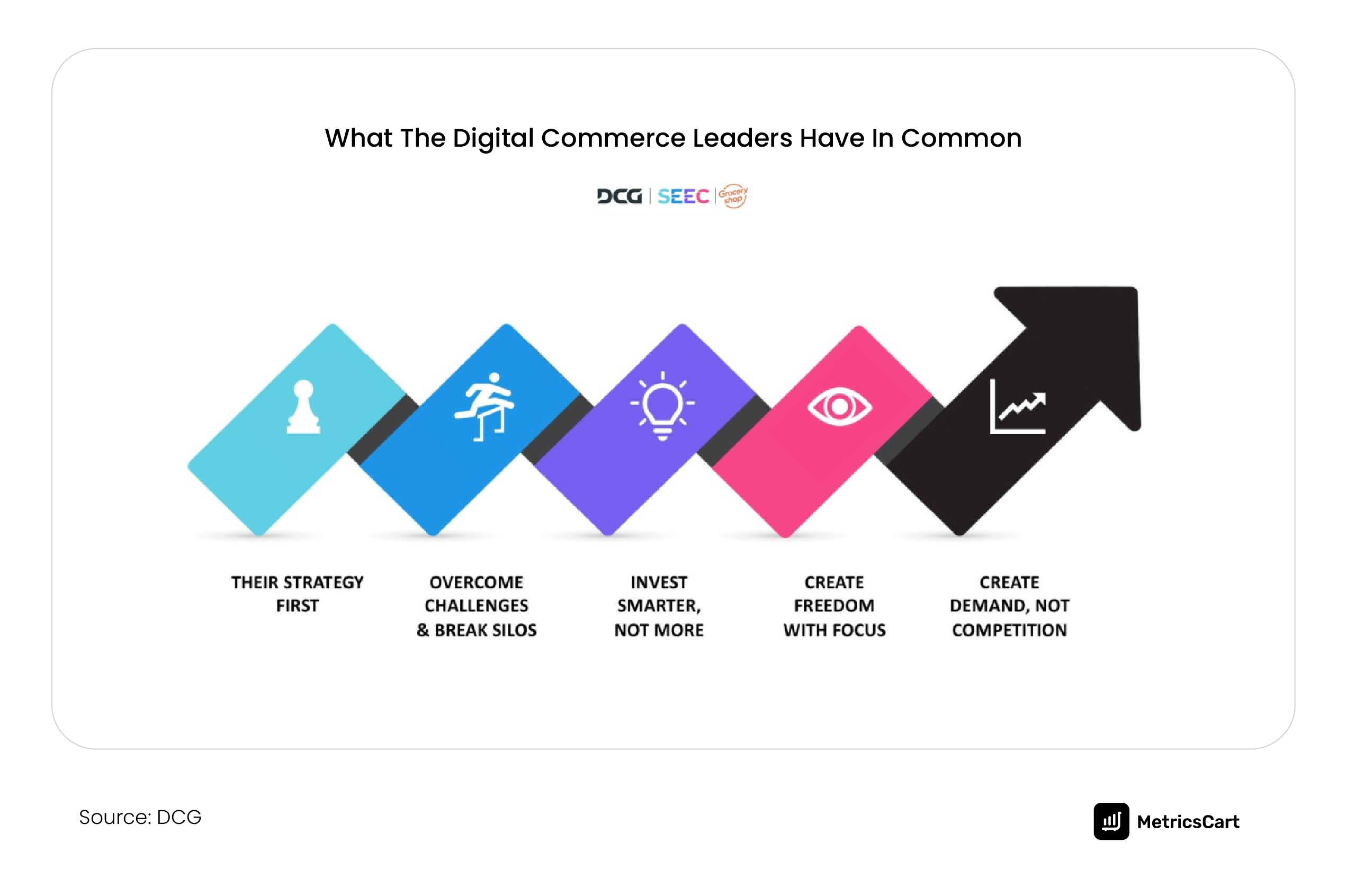
First, they prioritise their strategy—investing with clear intent and aligning initiatives with business outcomes rather than chasing shiny new tactics. Second, they overcome challenges and break down silos, fostering cross-functional collaboration that accelerates decision-making and execution. Third, they invest smarter, not more, leveraging data and analytics to optimize spend across marketing, supply chain, and digital shelf efforts.
Fourth, they create freedom with focus, empowering teams with clarity and agility to innovate without losing sight of core priorities. Finally, they create demand, not competition—building authentic connections through community, personalization, and purposeful engagement that turn shoppers into advocates.
In 2026, CPG brands that embody these traits will not only navigate disruption but shape the future—driving profitable, sustainable growth while delivering meaningful consumer experiences.
Digital commerce intelligence, AI innovation, and cultural insight are the cornerstones of this transformation, but it is strategic discipline and customer-centricity that will ultimately separate the leaders from the rest. The journey ahead is challenging but full of opportunity—for those ready to lead with purpose, precision, and partnership.
Make Smarter Decisions With Digital Commerce Intelligence.