About the Report
This Digital Shelf Insights report examines LEGO’s strategy on Walmart, focusing on how pricing, product assortment, reviews, and visibility shape its performance in the marketplace.
Using MetricsCart’s digital shelf analytics platform, we tracked 5,288 LEGO products listed on Walmart between December 7, 2025, and January 7, 2026, analyzing pricing trends, category distribution, seller activity, and customer engagement to understand what drives LEGO’s success on the platform.
Introduction
Few toy brands have shaped childhood the way LEGO has.
The company started in 1932 in Billund, Denmark, when Ole Kirk Kristiansen began making wooden toys. It was built around a simple idea: play well. Everything else, from sets to stories, grew from there.
Over time, LEGO moved from wood to plastic bricks and introduced the interlocking brick system in 1958, a design that remains the foundation of the brand today.
Today, it is one of the world’s most recognized toy brands. LEGO’s marketing strategy is built around creativity, storytelling, and community engagement. The brand started with simple bricks. Through themed collaborations and fan-inspired ideas, it has now grown into a global entertainment world.
That strategy is also visible on online marketplaces. Walmart’s digital shelf shows how LEGO balances affordable entry products, premium sets, and strong brand storytelling.
Highlights
- LEGO has 5,288 products listed on Walmart, priced at an average of $86.68, with 177,034 reviews averaging 4.62, indicating strong consumer satisfaction and consistent demand.
- Only 16 products are sponsored, while 5,272 rely on organic visibility, indicating that LEGO’s brand strength and product demand drive discovery without heavy advertising.
- Categories such as LEGO Ninjago, LEGO Star Wars, and LEGO Friends dominate product listings, underscoring the importance of storytelling and franchise collaborations in LEGO’s assortment strategy.
- Despite fewer listings, LEGO Star Wars receives the most reviews, proving that recognizable themes and collector-style sets drive stronger engagement.
- Most LEGO products on Walmart cost less than $40, highlighting a pricing strategy focused on accessibility, gift purchases, and entry-level buyers.
Lego Marketing Strategy: How Does the Brand Position Itself in the Toy Market?
The toy industry in the US is constantly evolving. In 2025, the market generated about $45.6 billion in sales, with the category returning to growth as sales rose 6% year over year.
At this point, toy brands compete not only through product design. There is storytelling, licensing partnerships, movie franchises, gaming characters, and entertainment IP that shape what children ask for and what parents buy. Licensed toys alone have become one of the fastest-growing segments of the industry.
In this environment, very few toy brands manage to remain relevant across generations. LEGO is one of the exceptions. Its success comes from staying simple at the core. The product is still a brick. But the brand built much more around it.
From the start, LEGO stood for quality, creativity, and play. Over time, LEGO’s marketing strategy evolved without losing that core. The brand did not chase every trend. It adapted its message while keeping the same promise.
Franchise collaborations such as Star Wars, Harry Potter, Minecraft, Marvel, Super Mario, Disney, and Fortnite helped LEGO connect with larger fan communities.
LEGO also expanded beyond physical sets. It moved into digital and interactive experiences through video games, apps, augmented reality, theme parks, and immersive stores. This helped the brand stay current as children’s attention shifted toward screens and mixed-media entertainment.
Another major part of LEGO’s brand strategy is community-driven marketing. LEGO understands that fans do not just want to buy. They want to participate. Platforms like LEGO Ideas allow fans to submit designs, support concepts, and watch those ideas become real products.
LEGO’s marketing strategy also succeeded in expanding its audience. Most toy brands remain trapped in a single age group. LEGO did not. It grew outward.
Today, LEGO serves:
- Young children exploring basic play
- Older kids and teens are moving into more advanced builds
- Adult fans and collectors buying premium sets for display, nostalgia, or hobby use
Let’s examine how LEGO’s marketing strategy supports its strong performance on Walmart
Action and Story-Based Themes like LEGO Ninjago, Star Wars, and Friends are the Top Product Categories on Walmart
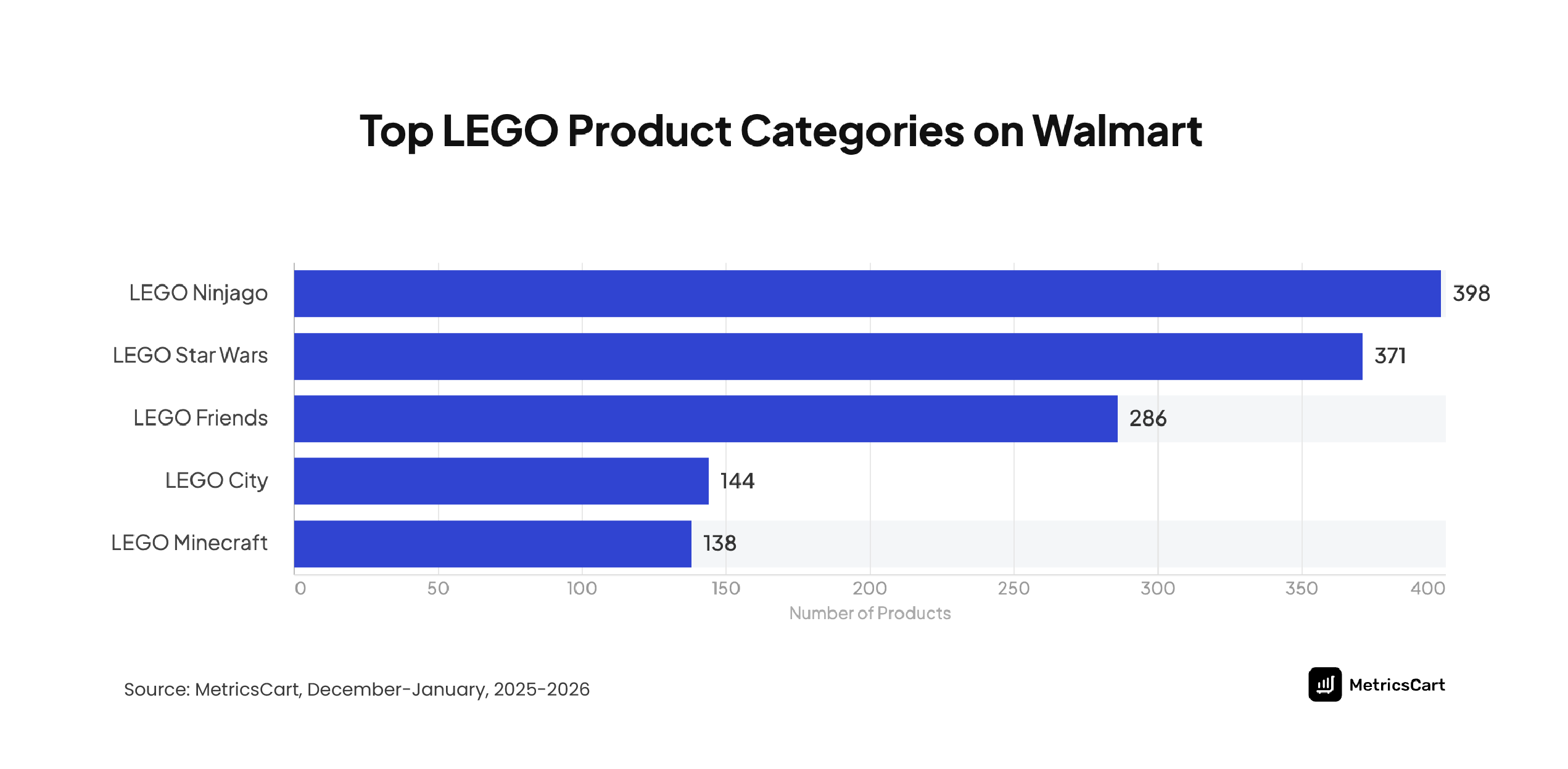
According to the Metricscart app, LEGO’s product assortment on Walmart is heavily driven by story-led themes rather than generic building sets.
LEGO Ninjago leads with 398 products, followed by LEGO Star Wars with 371 and LEGO Friends with 286. Other themes, such as LEGO City (144 products) and LEGO Minecraft (138 products), appear in smaller numbers.
This distribution reflects LEGO’s long-standing strategy of building product ecosystems around narratives and characters rather than standalone toys.
Themes like Ninjago and Star Wars operate as ongoing story universes. Each set typically represents a character, vehicle, or location tied to a larger storyline. Because these narratives continuously expand through television series, movies, and digital content, LEGO can regularly introduce new sets without disrupting the theme’s structure.
Licensed themes such as Star Wars also benefit from global entertainment popularity. Fans already familiar with the franchise are more likely to search for related products, which increases visibility and demand across marketplaces.
Similarly, Ninjago performs strongly because it is one of LEGO’s longest-running original themes, supported by animated series, digital content, and a large character roster. This allows LEGO to release multiple variations of sets while keeping the theme consistent.
The dominance of these categories also reflects how storytelling simplifies product discovery. Children recognize characters from shows or games, while parents and collectors are already familiar with the franchises. This recognition reduces the effort required to evaluate products and increases the likelihood of purchase.
As a result, story-based themes continue to dominate LEGO’s presence in the category at Walmart, reinforcing how narrative-driven products can scale more effectively than generic toy assortments.
LEGO Star Wars Dominates Reviews, with LEGO Icons and LEGO Friends Closely Behind
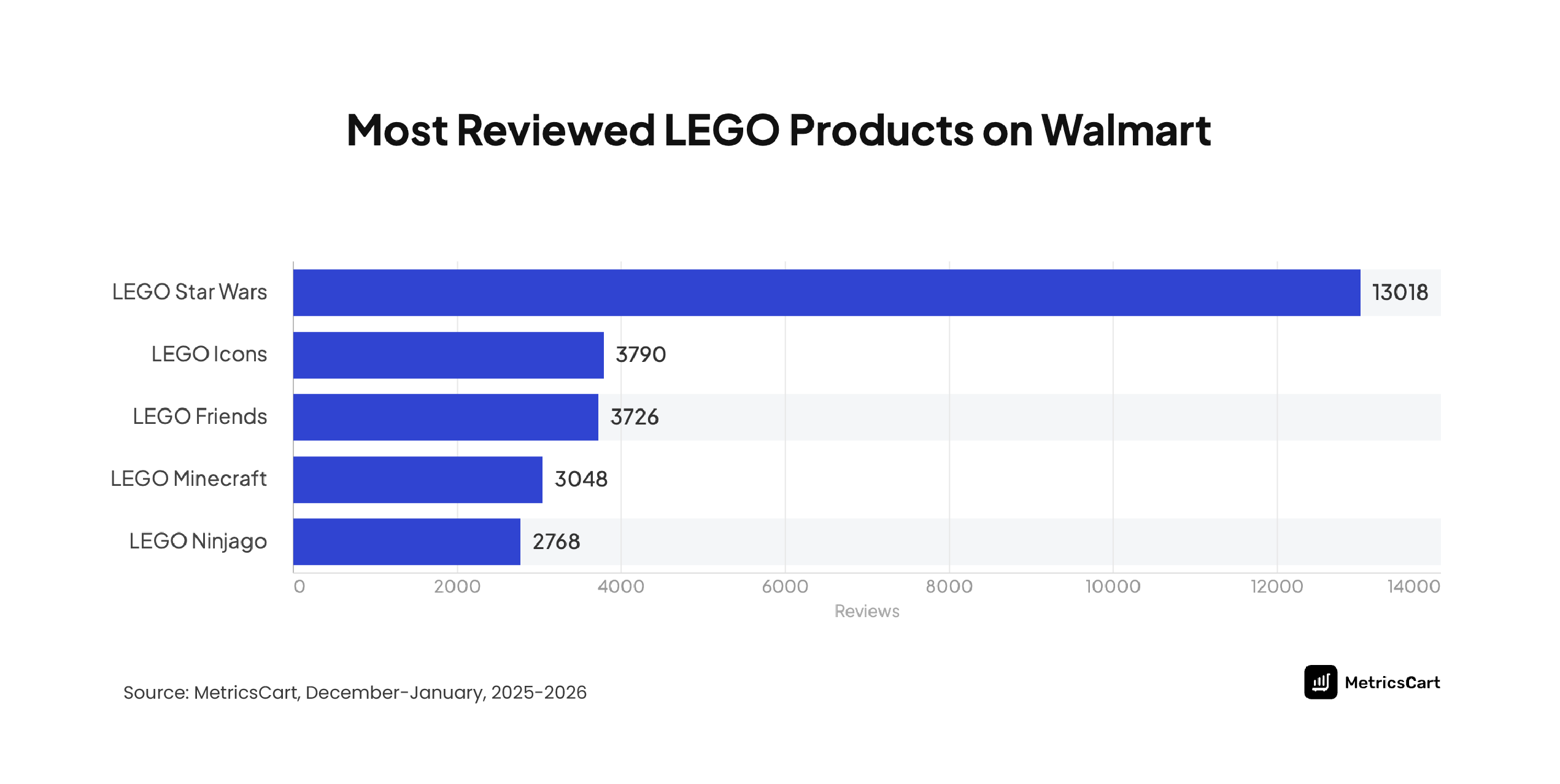
While several LEGO themes dominate the assortment, LEGO Star Wars generates the highest customer engagement on Walmart. The category has accumulated 13,018 reviews, significantly more than those of other LEGO themes on the platform.
Other high-performing categories include:
- LEGO Icons – 3,790 reviews
- LEGO Friends – 3,726 reviews
- LEGO Minecraft – 3,048 reviews
- LEGO Ninjago – 2,768 review
Star Wars LEGO appeals to both younger audiences and adult collectors, creating demand across multiple age groups. Many of these sets are purchased not only for play but also for display or collection. Ships, characters, and iconic scenes from the films often carry nostalgic value, which encourages fans to purchase multiple sets over time.
LEGO Icons and LEGO Friends also generate strong engagement, though for different reasons. Icon sets tend to attract older builders interested in detailed models, while Friends sets appeal to younger audiences with character-driven play.
Together, these patterns show how recognizable themes and audience targeting influence engagement levels across LEGO’s product categories on Walmart.
LEGO Minecraft The Baby Pig House Toy Figures & Playset is the Top-Reviewed LEGO Product on Walmart
|
Products |
Reviews |
| LEGO Minecraft The Baby Pig House Toy Figures & Playset – Building Minecraft Toy for Kids, Boys & Girls, Ages 7+ – Minifigures for Pretend Play – Easter Basket Stuffer – 21268 | 1859 |
| LEGO Classic Medium Creative Brick Box, Toy Set with Train, Car, Tiger, Birthday Gift for Kids 4+, 10696 | 1404 |
| LEGO Classic Creative Suitcase 10713 – Includes Sorting Storage Organizer Case with Fun Colorful Building Bricks, Preschool Learning Toy for Kids to Play and Be Inspired by LEGO Masters | 822 |
Among individual products, the LEGO Minecraft The Baby Pig House Toy Set stands out as the most reviewed LEGO product on Walmart, with 1,859 customer reviews.
This strong engagement reflects the growing popularity of Minecraft-themed LEGO sets, which combine the appeal of a globally recognized video game with LEGO’s building experience. The Minecraft franchise already has a large fan base among younger audiences, making these sets highly recognizable and easy for shoppers to discover.
READ MORE | What Can Online Reviews Reveal About Your Customers? Explore How Smart Brands Identify Critical Customer Insights Through Online Reviews
Sentiment Analysis of LEGO Products on Walmart
Customer ratings and review sentiment provide a clear signal of product satisfaction across LEGO’s catalog on Walmart.
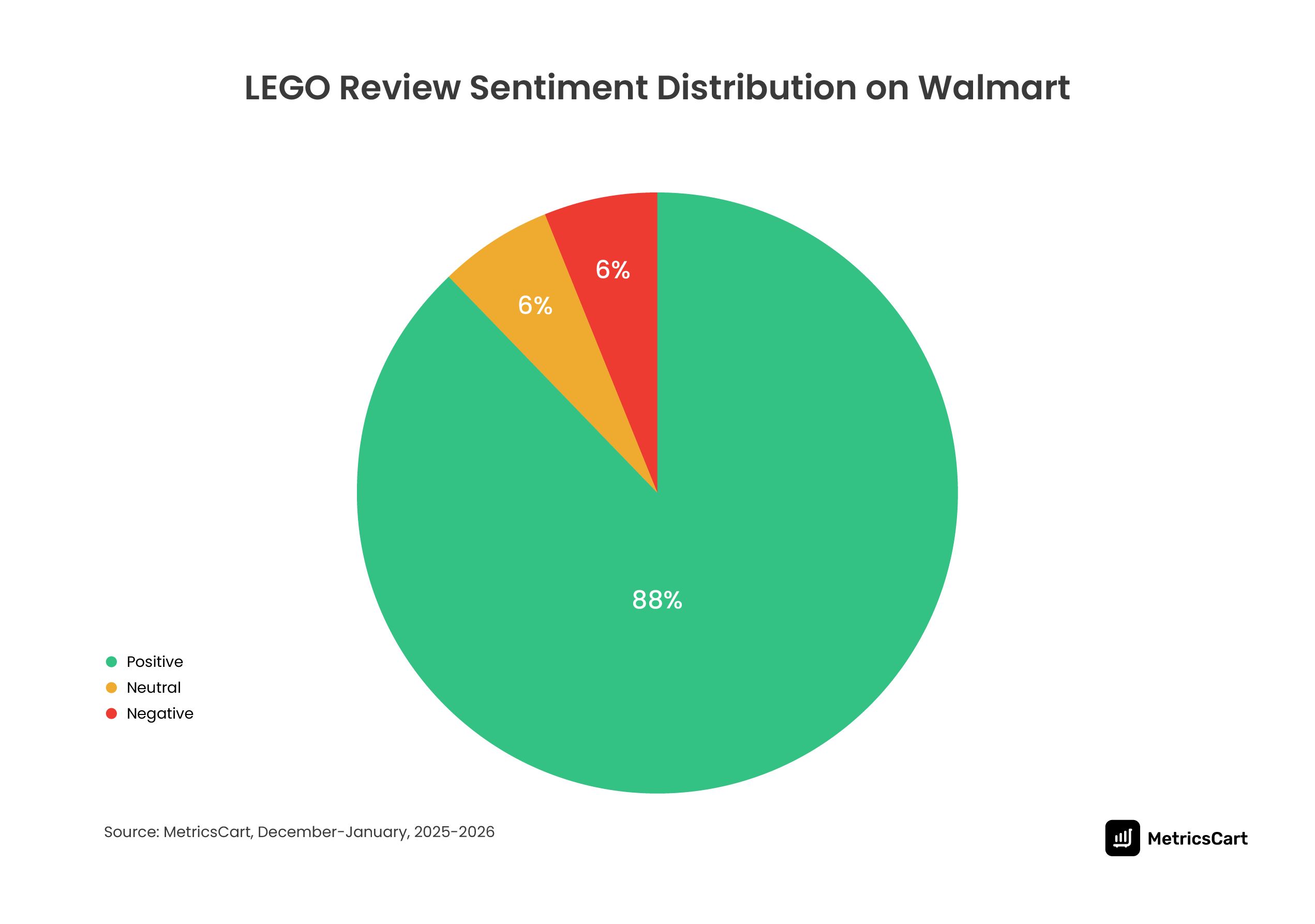
For LEGO products on Walmart, around 88% of reviews are positive, 6% are negative, and 6% are neutral. This distribution indicates high levels of customer satisfaction and consistent product quality across the brand’s offerings.
Such a strong positive sentiment is notable given the catalog’s size. LEGO has thousands of products listed on Walmart, yet the majority of reviews remain favorable. This consistency suggests that the overall product experience is largely predictable across different sets.
Several factors contribute to this pattern. LEGO products follow a standardized building system and clear instruction format, which helps reduce confusion during assembly. The brand also maintains consistent manufacturing standards across its product range, which supports reliability in the final product experience.
Rating distribution further reinforces this pattern. Most LEGO products on Walmart fall within the 4-star and 5-star rating range, with 5-star ratings appearing most frequently. Very few products receive ratings between 1 and 3 stars.
This pattern suggests that LEGO’s product experience is highly predictable. Customers usually know what to expect from the brand, which reduces dissatisfaction and increases trust. High ratings also contribute to stronger product visibility on the platform, as marketplaces often prioritize well-rated products in search results.
READ MORE | Not Seeing Enough Reviews on Walmart? Get More Reviews on Walmart: A Step-by-Step Guide
LEGO Animal Crossing Leads Affordable Sets, While LEGO Ideas Represents the Premium Segment
LEGO’s pricing structure on Walmart reflects a balance. There are accessible and premium options.
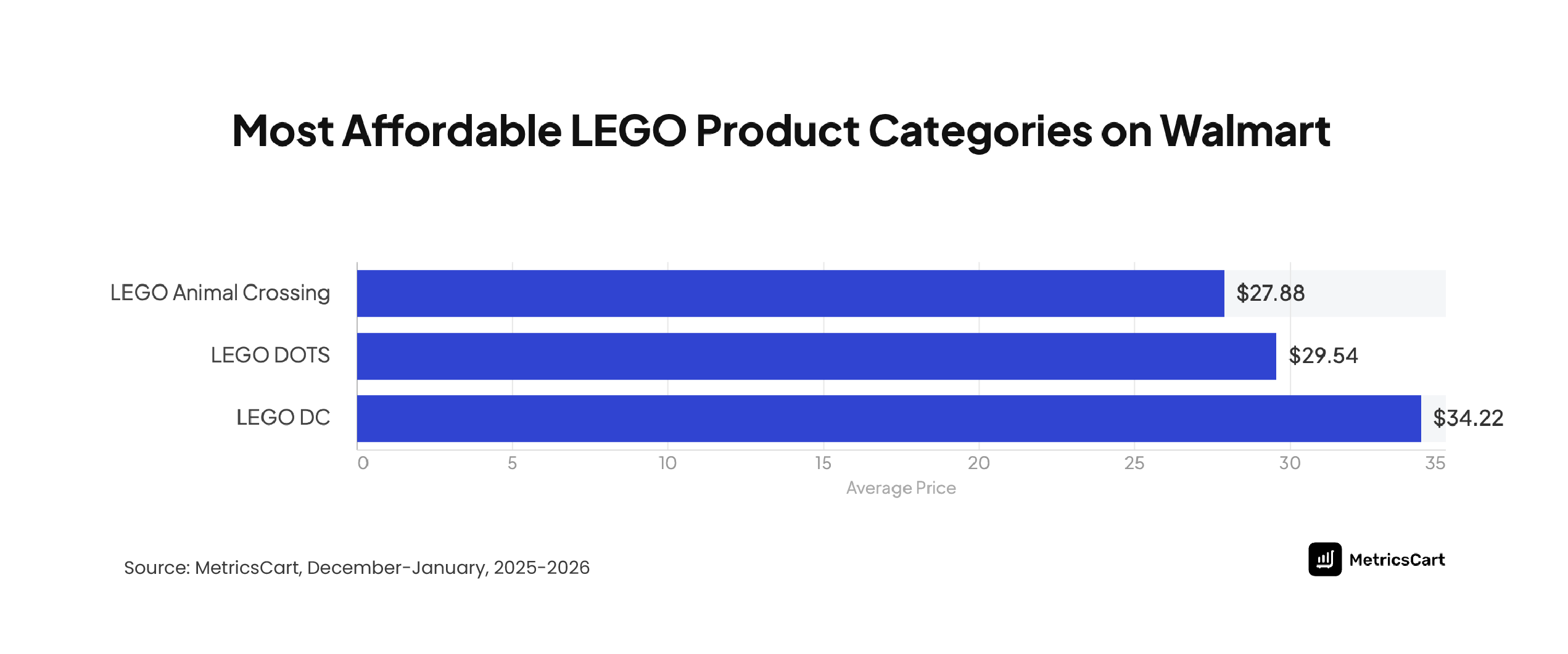
Among the product categories, LEGO Animal Crossing is the most affordable, followed by LEGO DOTS and LEGO DC. LEGO Animal Crossing leads have an average price of $27.88, followed by LEGO DOTS at $29.54 and LEGO DC at $34.22. These categories typically feature smaller sets and simpler builds, making them suitable for younger audiences and entry-level buyers.
Lower-priced categories serve several purposes within the LEGO ecosystem. They make the brand accessible to new customers, support impulse purchases, and provide affordable gift options. These sets often serve as starting points for customers who later move on to larger builds.
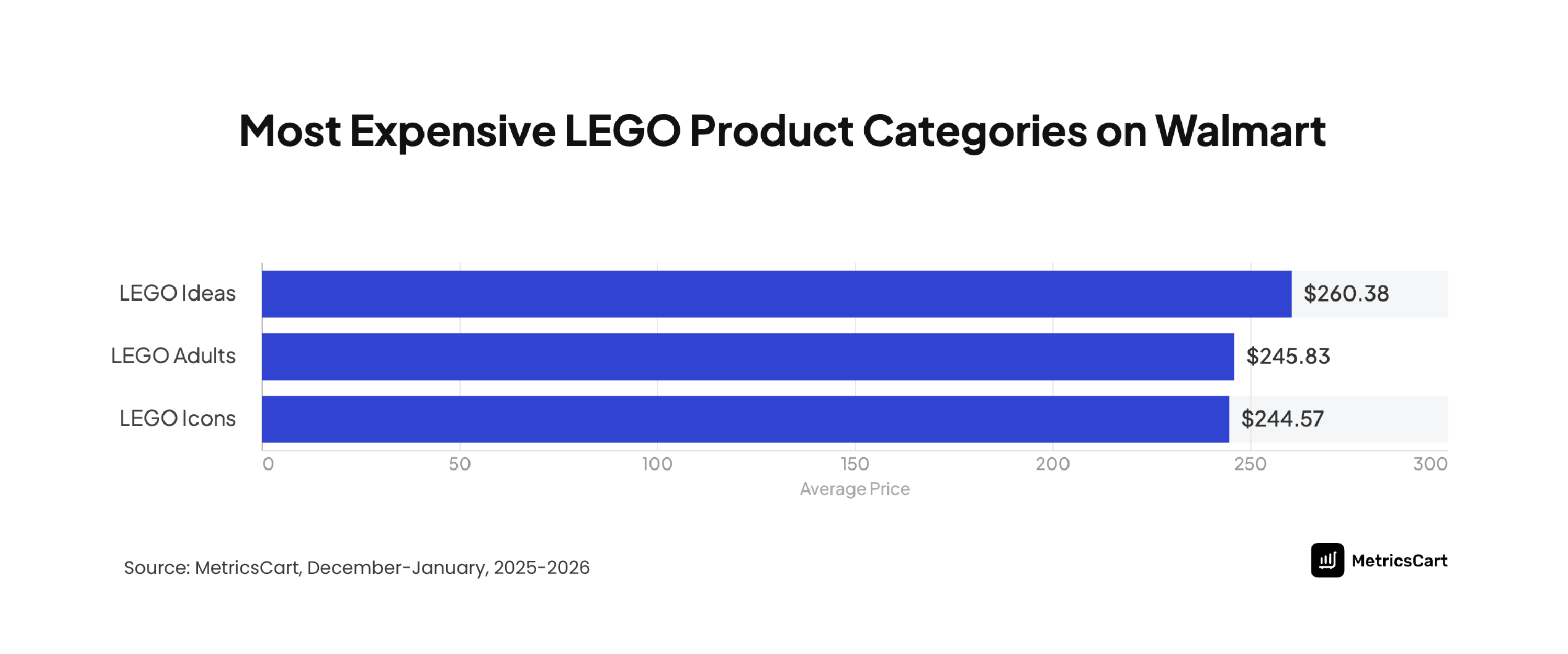
At the opposite end of the pricing spectrum are premium categories such as LEGO Ideas, LEGO Adults, and LEGO Icons. Here, LEGO Ideas leads with an average price of $260.38, followed by LEGO Adults at $245.83 and LEGO Icons at $244.57.
Premium sets typically contain more pieces, complex builds, and detailed designs. They are often designed for experienced builders or collectors who value the building process as much as the final product.
This dual pricing approach allows LEGO to serve multiple customer segments simultaneously. Entry-level sets attract new buyers and younger audiences, while premium builds appeal to dedicated fans and collectors.
By maintaining both accessible and premium categories, LEGO creates a structured product ladder that encourages customers to continue exploring the brand as their interest in building grows.
Most Affordable LEGO Products on Walmart
| Product | Price |
| LEGO Minifig Light Brown Teddy Bear – Boy/girl Friends Minifigure (very small) | $2.51 |
| LEGO City Friends: Baby Dolphin Minifigure Aqua (very small, less than 1 inch) | $2.88 |
| LEGO Friends Accessory Set: Cute Cat (Aira) at Veterinary Station Kit (21 pcs) | $3.28 |
At the lowest end of the price spectrum, the LEGO Minifig Light Brown Teddy Bear appears as the most affordable LEGO product on Walmart, priced at $2.51.
Products at this price level are typically very small accessories or minifigure add-ons rather than full building sets. They usually contain only a few pieces and are designed to complement larger LEGO builds.
Most Expensive LEGO Products on Walmart
|
Product |
Price |
| Star Wars Death Star LEGO? Star Wars Set 10188 | $1939.99 |
| LEGO Creator Expert 10276 Colosseum (9036pcs) | $1699 |
| LEGO Star Wars: A New Hope Imperial Star Destroyer 75252 Ultimate Collector Series Building Kit (4,784 Pieces) | $1624.99 |
At the opposite end of the pricing spectrum, the LEGO Star Wars Death Star Set stands out as the most expensive LEGO product on Walmart, priced at $1,939.99.
Sets at this level are typically large collector editions with thousands of pieces and highly detailed designs. They often replicate iconic scenes, vehicles, or locations from major franchises.
Among all sellers offering LEGO products, Walmart’s own retail channel has the most reviews by a wide margin. Other sellers, such as Collectible City and BricksGOGOGO, appear in the marketplace, but their review volumes are significantly lower.
This pattern highlights how retailer-operated listings often drive most engagement for large consumer brands.
READ MORE | What Makes Snack Products Sell on Walmart? Explore Digital Shelf Insights: Walmart Snack Category Analysis
Beyond the Blocks: What LEGO’s Success Means for Brands Selling Online
LEGO’s marketplace performance reflects how a clear brand strategy and a well-structured product portfolio support sustained engagement on the digital shelf. A mix of story-driven themes, accessible entry-level sets, and premium collector builds allows the brand to appeal to different customer segments while maintaining strong review momentum and visibility across the platform.
MetricsCart’s Digital Shelf Analytics platform helps teams track pricing trends, monitor product visibility, analyze ratings and reviews, and understand category and seller dynamics across major retailers. With these insights, brands can better understand what is driving performance and refine their marketplace strategy accordingly.
Disclaimer: MetricsCart is the exclusive owner of the data used in the Digital Shelf Insights reports. Any third-party use requires proper credit to the source material.
See How Your Brand Can Replicate LEGO’s Success On Walmart.