Highlights
- An incentivized review is customer feedback submitted in exchange for a reward such as a discount, free product, loyalty points, or sweepstakes entry.
- The FTC’s 2024 Consumer Reviews and Testimonials Rule does not ban incentivized reviews. It bans tying incentives to a specific sentiment.
- Amazon prohibited all seller-run incentivized reviews on Amazon in 2016. Its Vine program is the only approved exception.
- Research shows incentivized reviews can reduce selection bias but also trigger reciprocity bias and erode consumer trust.
- Best practices: offer sentiment-neutral incentives, always disclose, and target verified purchasers only.
- Ethical alternatives include post-purchase review requests, loyalty-program integration, and product sampling without review obligations.
To Incentivize or Not to Incentivize?
Here is a number that should keep every e-commerce brand manager awake at night: $51,744. That is the civil penalty the Federal Trade Commission can now levy per violation of its 2024 Consumer Reviews and Testimonials Rule. Per violation. Every single offending review could carry that price tag.
And yet, incentivized reviews remain one of the most widely discussed, widely misunderstood, and widely misapplied tactics in e-commerce marketing. Brand managers want more reviews. Sellers on Amazon want more reviews. DTC founders launching their fifth SKU into the void of zero social proof desperately want more reviews. The temptation to offer a discount, a freebie, or a few loyalty points in exchange for customer feedback is, frankly, understandable.
You won’t like the sound of this, but the practice is not inherently illegal, nor is it inherently effective. The answer to “should my brand use incentivized reviews?” is not a simple yes or no.
It is a careful, context-dependent “it depends” that hinges on how you do it, where you do it, what you disclose, and whether you understand the regulatory, psychological, and platform-specific consequences.
With a tool like MetricsCart’s ratings and reviews analysis software, track your customer feedback across 150+ retailers and see how incentivized reviews impact your online brand reputation management.
What Are Incentivized Reviews?
Before we get into the legality and ethical considerations, let’s just be clear about what it is:
Incentivized Reviews Definition
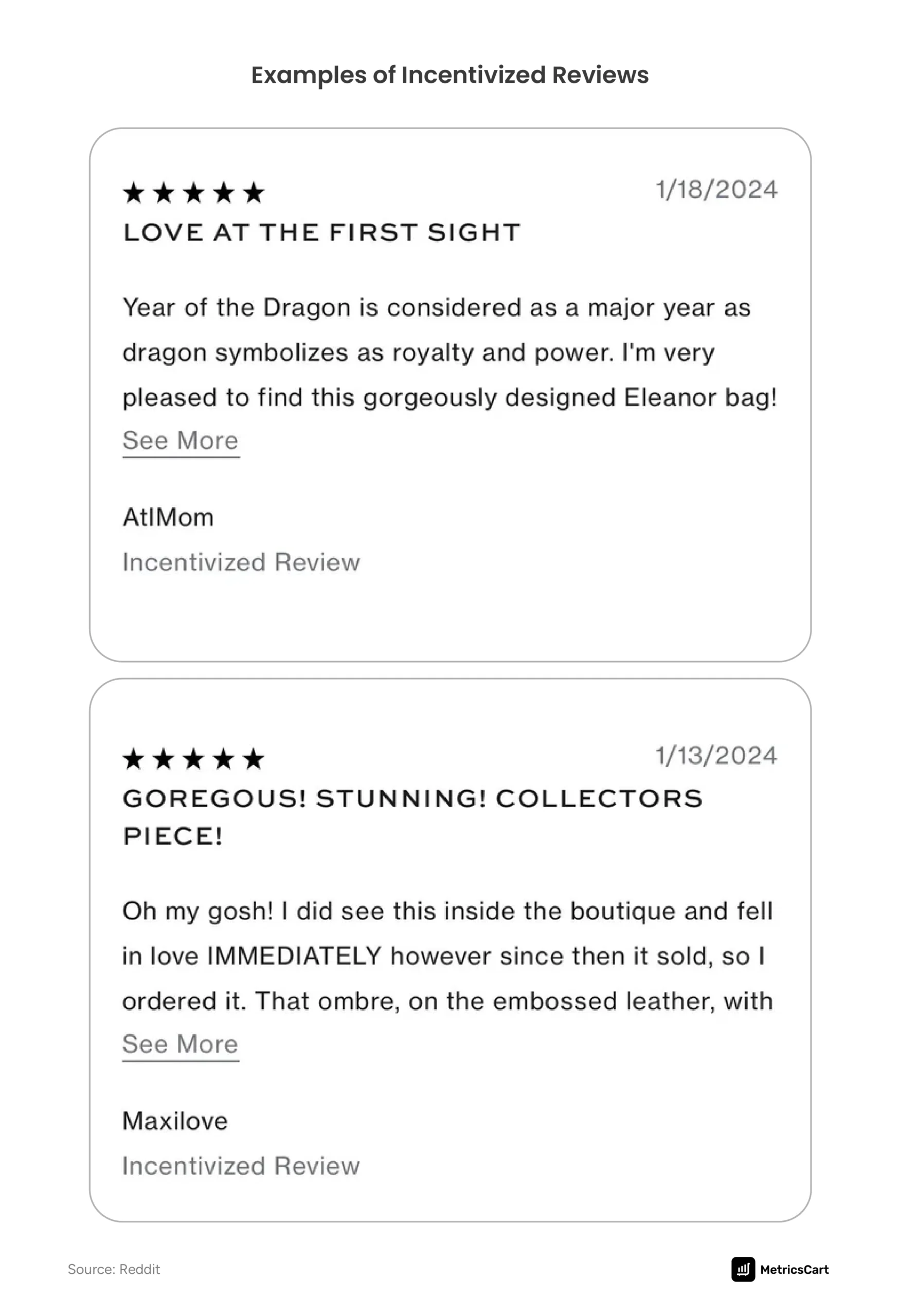
The reward can take many forms. It can be a discount code, a free product, loyalty points, a sweepstakes entry, or free shipping on a future order. The underlying structure is always the same: the brand provides a benefit, and the customer provides a review.
This is the quid pro quo that distinguishes an incentivized review from an organic one. Organic reviews happen spontaneously because a customer had an experience; usually, a very good or a very bad one, strong enough to motivate them to write about it without being asked.
Incentivized reviews appear when a brand issues a prompt and ties a reward to the act of reviewing.
Common Types of Review Incentives in E-Commerce
The incentive formats brands typically offer include:
- percentage discounts on future purchases
- free or subsidized shipping
- entry into a prize draw or sweepstakes
- free product samples (full-size or trial)
- loyalty points redeemable for rewards
Some programs, like Sephora’s Beauty Insider Community, take a subtler approach, making the criteria for earning review-based rewards deliberately opaque so that only genuinely engaged customers participate. The result, according to the Rutgers Business Review study, is that intrinsically motivated reviewers self-select, producing higher-quality feedback and a stronger sense of brand community.
The form of the incentive matters more than most brands realize. A modest loyalty-point accrual feels different to the reviewer (and to the regulator) than a free $200 product. The larger the incentive, the greater the psychological pressure to reciprocate with a positive review, even if no one asked for one.
What’s the Difference Between Incentivized Reviews vs. Fake Reviews?
Incentivized reviews come from real customers who have real experience with the product. The reviewer actually bought the item (or received it through a legitimate sampling program), used it, and formed an opinion. The incentive is a reward for the act of sharing that opinion.
Fake reviews are fabricated entirely. They might be written by someone who never touched the product, generated by bots, or purchased from review farms.
The FTC’s 2024 rule explicitly bans the creation, purchase, or dissemination of fake reviews, including those generated by AI. This is a bright-line prohibition with no exceptions.
The confusion arises because incentivized reviews can produce biased results, and when they do, they start to look and feel like fake reviews to the consumer reading them. But they are not the same thing legally, ethically, or strategically, and treating them as interchangeable leads to compliance frameworks that are either too lax or too restrictive.
READ MORE | Consumer Sentiment Analysis for CPG Brands: 2026 Growth Guide
Why Do E-Commerce Brands Use Incentivized Reviews?
If incentivized reviews carry so many caveats, why do brands keep reaching for them? Because the upsides, when the program is well-designed, are real.
1. Boosting Review Volume and Social Proof for New Products
The cold-start problem in e-commerce is brutal and relatable to many of you reading this. You launch a new product. The listing page is a ghost town with no ratings, reviews, or social proof.
A potential buyer lands on it, sees the empty review section, and bounces to a competitor with four hundred five-star endorsements. You have lost the sale before the product has had a chance to prove itself.
Incentives can accelerate the accumulation of those early reviews. The Rutgers Business Review research highlights that a higher volume of reviews is directly linked to improved product credibility, because it signals to both customers and search engines that the product is widely used and trusted.
For new or less-popular products, this initial review base can determine whether the product gains traction or dies in obscurity.
2. Reducing Selection Bias and Getting More Nuanced Feedback
Without incentives, the review pool suffers from severe selection bias: people tend to leave reviews only when their experience was extreme, an ecstatic five stars or a furious one star. The large middle of satisfied-but-not-compelled customers stays silent.
Incentives can activate that silent majority. Providing incentives for reviewing can reduce selection bias and increase the accuracy and informativeness of feedback, giving businesses a more complete and more honest picture of the customer experience.
3. SEO and Visibility Gains from User-Generated Review Content
Customer reviews are a powerful form of user-generated content, and search engines reward them.
More reviews mean:
- Increased keyword variety (customers describe products in language that SEO teams would never think of)
- Higher review recency signals (fresh reviews tell Google the product is still relevant)
- A better chance of earning rich snippets with those star ratings displayed directly in search results that dramatically increase click-through rates.
Beyond traditional SEO, reviews now feed into AI-generated product summaries. LLMs and AI shopping assistants pull from review corpora to answer consumer queries about product quality, features, and comparisons. A robust, diverse, and recent review library gives your product a better chance of surfacing in these AI-mediated buying journeys.
Keeping tabs on how reviews shape your product’s visibility? MetricsCart’s ratings and review monitoring platform tracks review volume, sentiment, and themes across Amazon, Walmart, and 150+ retailers in a single dashboard, so you know exactly what shoppers are saying and where your gaps are.
Risks and Drawbacks of Incentivized Reviews
The benefits are real. So are the costs. And the costs, if mismanaged, can be catastrophic.
1. Review Bias and the Reciprocity Effect
Human beings are wired for reciprocity. When someone gives us something, a discount, a free sample, a handful of loyalty points, we feel an unconscious obligation to give something back.
In the context of reviews, that “something back” tends to be a more favorable rating than the product might genuinely deserve.
Reciprocity bias can lead reviewers to compose a positive review despite a less positive experience. The incentive creates a subtle but measurable upward pressure on ratings.
The reviewer may not be lying, exactly. They may just round up a 3.5-star experience to a 4 or a 5, because the free shipping code on their next order makes them feel generous. Multiply that across hundreds of reviews, and you have a systematically inflated picture of product quality.
READ MORE | How To Turn Customer Reviews Into Sales: A Complete Guide
2. Consumer Skepticism and Erosion of Trust
Shoppers are not oblivious to this dynamic. Research consistently shows that consumers view incentivized reviews as less trustworthy than organic ones. And the damage extends beyond the individual incentivized review.
A study at the University of British Columbia examined what they called the “poisoning the well” effect. Using Amazon’s 2016 ban on incentivized reviews as a natural experiment, they found that the presence of incentivized reviews on a product page had spillover effects on how consumers perceived the unincentivized reviews.
In other words, once shoppers suspect that some reviews were paid for, they become skeptical of all of them, even the perfectly genuine ones. The entire review ecosystem for that product gets contaminated.
3. Review Manipulation, Quality Dilution & Short-Term Engagement
Beyond bias and trust erosion, incentive programs attract opportunists. Some users create multiple accounts to harvest rewards. Others submit superficial, one-line reviews that add no informational value.
Incentivized reviews risk producing review inflation, a higher number of reviews, but not necessarily higher quality or a more accurate representation of the customer experience.
There is also the engagement cliff. Incentivizing reviews can lower the overall number of reviews once the program ends, suggesting that the incentive replaces intrinsic motivation rather than supplements it.
Incentivized Reviews on Amazon: Policies, Bans & the Vine Program
Amazon is where most e-commerce brands encounter the incentivized review question for the first time, and Amazon’s stance is the most unambiguous of any major platform.
Amazon’s 2016 Ban on Incentivized Reviews
In October 2016, Amazon updated its community guidelines to prohibit all incentivized reviews except those facilitated through its own Vine program.
Before the ban, sellers would offer free or discounted products in exchange for reviews as long as the reviewer disclosed the incentive. Amazon also deleted all previously self-identified incentivized reviews from its platform.
Amazon also deleted all previously self-identified incentivized reviews from its platform. As Chee Chew, Amazon’s then VP of Consumer Engagement, explained in the announcement, these so-called incentivized reviews made up only a tiny fraction of the tens of millions of reviews on Amazon, but their impact on trust was disproportionate.
Amazon had already been suspending, banning, and suing thousands of individuals for attempting to manipulate reviews. The 2016 ban extended that enforcement to the entire category of seller-initiated incentivization.
Why Amazon Vine Is the Approved Exception
The Amazon Vine program operates under a fundamentally different structure. Amazon, and not the seller, selects and invites trusted reviewers based on their review history and helpfulness ratings.
Vine reviewers receive free products, but there is no requirement to post a positive review, no requirement to even post a review at all, and the total number of Vine reviews displayed per product is capped.
The critical design difference is the firewall between the seller and the reviewer. The seller pays Amazon to enroll a product in Vine, but they have zero control over who reviews it, what they say, or whether they say anything.
This removes the most corrosive element of incentivized reviews, the implicit transactional expectation between the person giving the product and the person writing the review.
What Happens If You Violate Amazon’s Incentivized Review Policy
The consequences are severe and escalating:
- Individual review removal
- Listing suppression
- Seller account suspension
- In extreme cases, legal action
Amazon uses machine learning algorithms to detect patterns consistent with incentivized reviews, including review velocity spikes, reviewer overlap across seller accounts, and linguistic patterns associated with compensated feedback.
FTC Rules on Incentivized Reviews [2024 Final Rule Explained]
The Trade Regulation Rule on the Use of Consumer Reviews and Testimonials, which went into effect on October 21, 2024, does not ban incentivized reviews outright. Read that again, because most coverage gets this wrong.
What the rule prohibits is conditioning incentives on a specific sentiment. A business that offers customers a 10% discount in exchange for a product review is not inherently breaking the law.
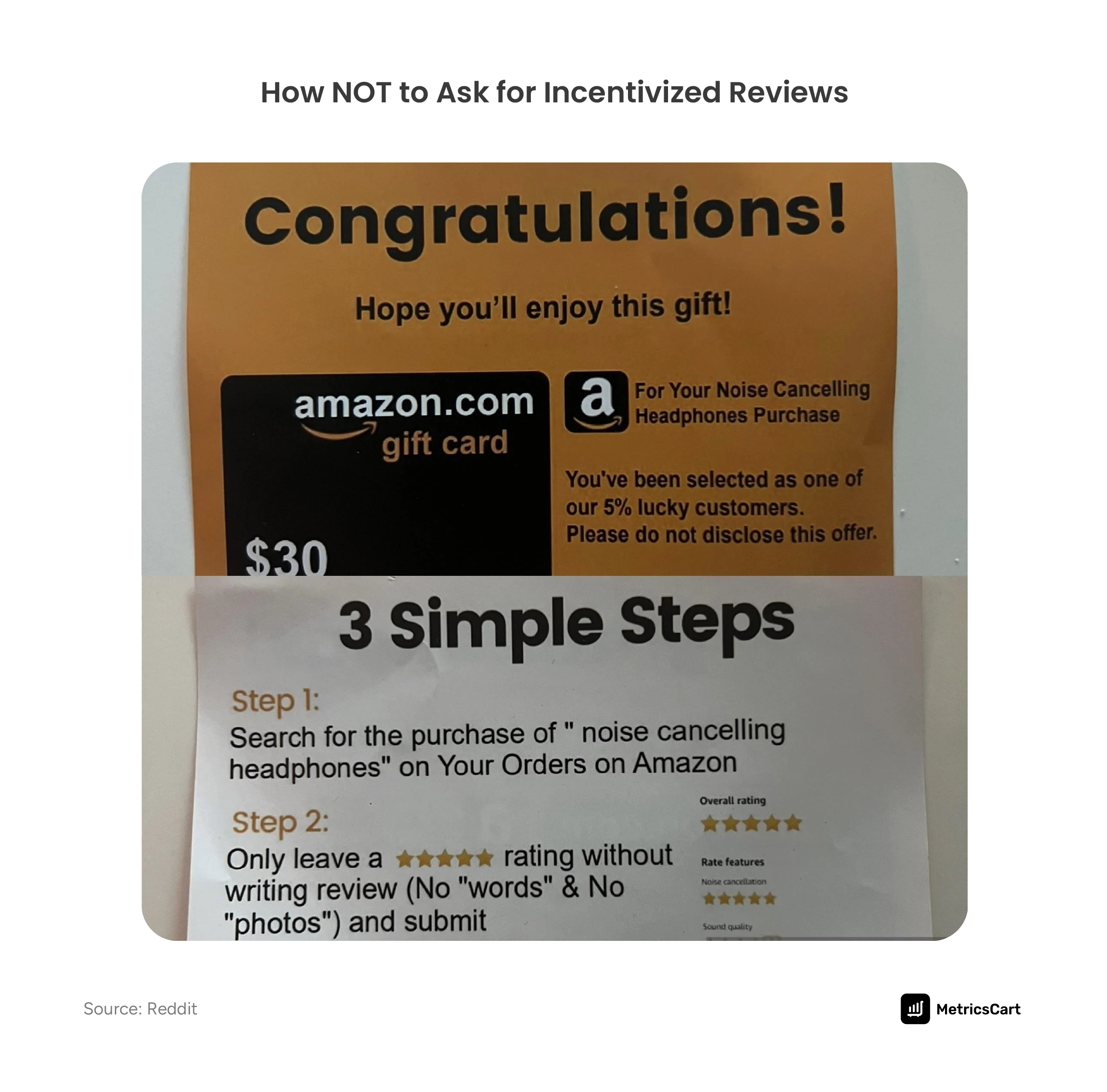
A business that offers customers a 10% discount in exchange for a five-star review is breaking the law. The distinction turns on whether the incentive is tied to the act of reviewing (permissible) or to the content of the review (prohibited).
The rule also addresses implied sentiment conditioning.
Disclosure Requirements Under FTC Endorsement Guidelines
Even when an incentive is sentiment-neutral, the FTC’s Endorsement Guides require that material connections between a reviewer and a business be disclosed clearly and conspicuously.
If a customer received a discount, free product, or loyalty points in exchange for their review, that fact must be visible to anyone reading the review, before they read it, not buried in a terms-and-conditions page.
Penalties for Non-Compliance
Violations of the rule can result in civil penalties of up to $51,744 per violation, along with consumer redress and injunctive relief. The rule also covers AI-generated fake reviews, insider reviews by company employees or their families without disclosure, and the suppression of negative reviews through threats or intimidation.

Best Practices for Ethical Incentivized Review Programs
If you have read this far and have not been scared off, here is how to do it properly:
1. Offer Sentiment-Neutral Incentives Only
Never tie rewards to a star rating, to positive language, or to any specific sentiment. Your prompt should read something like: “Share your honest feedback about your recent purchase and receive 10% off your next order.”
Avoid anything that implies you are looking for praise. “Tell us how much you love our product!” is not sentiment-neutral. It is an implied request for a positive review, and the FTC has flagged exactly this kind of phrasing.
2. Always Disclose the Incentive Clearly and Conspicuously
Place the disclosure where consumers will see it before they read the review, not after. Label incentivized reviews distinctly on your product pages.
Follow the FTC’s “clear and conspicuous” standard. Do not hide it in the fine print, terms and conditions, or in disclosures that require scrolling or clicking to find.
Disclosure is a trust-building exercise. A review labeled “This reviewer received a discount for sharing their feedback” is more credible than an unlabeled five-star review that the reader suspects might be bought.
3. Target Verified Purchasers and Monitor Review Quality
Only solicit reviews from customers with confirmed purchases. Implement quality filters that flag superficial, duplicate, or copy-pasted content.
And critically, do not suppress legitimate negative reviews; the FTC’s rule explicitly prohibits review suppression through threats or selective filtering, and doing so undermines the entire point of collecting reviews in the first place.
A best-practice framework that includes ongoing monitoring of review content, educating reviewers about what constitutes a helpful review, and providing ethical guidelines that are visible to both reviewers and review readers.
READ MORE | Weekly Review Tracking for CPG Brands: Why It Matters
4. Consider Cultural Differences in Review Perception
There are significant regional and cultural differences in how consumers perceive incentivized reviews and the platforms hosting them. What feels like a reasonable and transparent incentive program in one market may be perceived as manipulative in another.
For brands operating internationally, this means that disclosure formats, incentive structures, and even the decision of whether to offer incentives at all may need to vary by market.
European consumer protection regulations, for instance, tend to be more restrictive than their US counterparts, and consumer expectations around review authenticity differ across cultures.
Alternatives to Incentivized Reviews to Build Social Proof
Not every brand needs to incentivize reviews. For many, the legal risk, the trust risk, and the operational complexity are simply not worth it. Fortunately, there are effective alternatives.
1. Post-Purchase Email & SMS Review Request Flows
Ask customers to review their purchase at the right time, through the right channel, with zero incentive attached.
A well-timed email or SMS sent a few days after delivery, when the customer has had time to use the product, but the experience is still fresh, can generate a steady flow of organic reviews.
The key is reducing friction with one-click star rating, a short optional text box, and a mobile-optimized design.
2. Loyalty Programs That Reward Engagement
Loyalty programs that award points for reviews alongside other activities, purchases, referrals, social shares, and completing a profile sidestep the reciprocity bias problem.
The reward is tied to participation in the broader program, not to the review itself, which reduces the psychological pressure to skew positive. Sephora’s model is the most frequently cited example, and for good reason; it works.
3. Sampling Programs, Unboxing Campaigns & Community Seeding
Product sampling without an explicit review obligation, unboxing campaigns on social media, and brand ambassador or community seeding programs all generate organic user-generated content without the legal and trust complications of direct incentivization.
The reviewer may have received a free product, but there is no quid pro quo linking the sample to a review. The feedback, when it comes, is voluntary, and voluntary feedback is, by definition, more credible.
Strengthen Your Customer Engagement Strategy with MetricsCart!
Keeping tabs on how reviews shape your product’s visibility? MetricsCart’s ratings and reviews analysis platform tracks review volume, sentiment, and keyword themes across Amazon, Walmart, and 150+ retailers in a single dashboard. So you know exactly what shoppers are saying and where your gaps are.
MetricsCart uses AI-powered sentiment tracking, thematic and sub-thematic analysis, and competitor benchmarking to turn thousands of unstructured reviews into actionable intelligence, so your product, pricing, and content teams can act on what customers are actually saying.
Unlock the Power of Customer Feedback Today!
FAQs
Incentivized reviews are customer reviews where the reviewer receives a reward, such as a discount, free product, loyalty points, or sweepstakes entry, in exchange for submitting feedback about a product or service. They differ from organic reviews because a brand-initiated reward is involved in the act of reviewing.
Yes, in most cases. The FTC’s 2024 Consumer Reviews and Testimonials Rule does not ban incentivized reviews outright. It prohibits tying incentives to a specific review sentiment, such as offering a reward only for positive reviews. Sentiment-neutral incentives (e.g., “Leave a review, get 10% off”) are permissible, provided the incentive is clearly disclosed.
Amazon banned all seller-initiated incentivized reviews on Amazon in October 2016. The only exception is the Amazon Vine program, where Amazon itself selects trusted reviewers and provides them with free products. Vine reviewers are not required to post positive feedback or even to post a review at all.
They can. Consumers often perceive incentivized reviews as less reliable, and their presence on a product page can trigger suspicion where shoppers become skeptical of all reviews, including organic ones. Proper disclosure and sentiment-neutral incentives help mitigate this risk, but they do not eliminate it entirely.
Effective alternatives include post-purchase email and SMS review requests sent at optimal timing windows, loyalty programs where reviewing is one of multiple engagement activities, and product sampling or community seeding campaigns that generate organic feedback without a direct review obligation.