
Think about how people shop today. They don’t start with your brand. It begins with a search, followed by a quick scan of options. And the moment a few comments point to the same issue, maybe the texture changed, the scent feels off, or the pump keeps breaking, that hesitation kicks in. It’s subtle, but it’s enough to move them to the next option.
What makes this harder is how easy it is to switch. Nearly 4 in 10 US shoppers try a new brand within a few months, often just because something else looks slightly better. So those small, repeated signals matter.
They influence how your product shows up, and whether it gets added to the cart or passed over. The brands that stay ahead are paying attention early. They are fixing what matters before it turns into a ratings problem.
This guide breaks down how consumer sentiment analysis works for CPG brands, category by category, step by step, and how MetricsCart’s Ratings & Reviews platform turns raw review data into decisions you can act on today.
Highlights
- Shoppers rely heavily on recent reviews, and even a few recurring concerns can sow doubt, shift perceptions, and push customers toward competing products.
- Recurring complaints around packaging, performance, or product experience often point to deeper issues in formulation, design, or positioning before they impact ratings or sales.
- Negative sentiment doesn’t just affect perception; it directly influences click-through rates, conversion, and product competitiveness on the digital shelf.
- Surface-level ratings and averages fail to explain what’s actually driving sentiment, making it difficult for teams to prioritize the right fixes.
- Brands that break down sentiment by attributes and act early on emerging patterns are better positioned to maintain visibility, improve conversion, and sustain growth.
Why is Category-Level Sentiment Analysis Important for CPG Brands
Consumer sentiment varies across categories. What drives a positive review for a protein bar is very different from what drives a positive review for a laundry detergent.
Shoppers look for different things based on how they use the product. In food, taste and freshness matter most. In personal care, it’s the skin’s feel and results. In cleaning products, effectiveness and safety are important.
If you treat all your SKUs the same, you miss what really matters. Running one sentiment model across categories gives you surface-level insights, not a clear direction.
To get useful insights, you need to read sentiment in context. That means understanding what matters in each category and analyzing feedback accordingly.
Here is how the major CPG categories differ, and what that means for your sentiment strategy.
CPG Category Primary Sentiment Themes: Key Risk Signals to Monitor
| CPG Category | Primary Sentiment Themes | Key Risk Signals to Monitor |
|---|---|---|
| Food & Beverage | Taste & flavor, Texture, Ingredients, Portion/value, Freshness | Sudden taste complaints after reformulation; freshness issues linked to shelf life or logistics; ingredient mismatch with expectations |
| Personal Care | Scent/fragrance, Skin feel, Efficacy claims, Packaging, Ingredients | Allergic reaction mentions; claims not matching real-world results; pump/dispenser failures driving packaging-specific 1-star reviews |
| Household Cleaning | Cleaning efficacy, Scent, Safety/ingredients, Packaging, Residue | Safety concerns (especially for homes with children or pets); scent complaints after formula changes |
| Baby & Childcare | Safety, Skin sensitivity, Absorbency, Brand trust, Value | Mentions of rashes, irritation, or safety concerns; these spread fast and carry high reputational risk |
| Health & Wellness (OTC / Supplements) | Efficacy, Side effects, Ingredients, Ease of use, Value | Side effect clusters; efficacy complaints tied to dosage variants; compliance risks between product claims and reviews |
| Pet Care | Palatability, Ingredient quality, Health outcomes, Packaging, Value | Health-related complaints after consumption; rapid spread of negative reviews impacting the entire product line |
Each category comes with its own set of expectations, and the table above makes that clear. What drives a positive review in one category can trigger negative sentiment in another. More importantly, the risk signals differ, and that’s where most brands lose visibility.
Most sentiment analysis misses this. They classify reviews as positive, negative, or neutral, but fail to explain what specifically caused that sentiment. A low rating alone does not reveal whether the issue stems from product quality, packaging damage, ingredient concerns, delivery experience, or unmet performance expectations.
That’s why MetricsCart uses Aspect-Based Sentiment Analysis (ABSA). Instead of assigning a single sentiment score to an entire review, ABSA breaks reviews into individual themes, sub-themes, and attributes to analyze the sentiment attached to each.
For example, a customer review of a protein bar may praise the taste and texture while criticizing the sugar content and the packaging’s durability. Traditional sentiment models often flatten this into one generalized score, masking the true drivers of satisfaction and dissatisfaction.
ABSA captures each sentiment independently, giving brands a far more accurate picture of consumer perception. This becomes especially important for CPG brands, where purchase decisions are influenced by multiple factors simultaneously.
In categories like skincare, consumers may speak positively about efficacy but negatively about irritation or fragrance. In beverage reviews, positive flavor notes may be highlighted while ingredients or pricing are criticized. Without aspect-level analysis, brands risk acting on incomplete or misleading insights.
READ MORE | How to Perform Review Sentiment Analysis: A Step-by-Step Guide
How Consumer Sentiment Analysis Actually Works for CPG Brands: Step-by-Step Process
Let’s move from theory to practice. Here is exactly how a CPG brand, whether in food, personal care, or household goods, should be running sentiment analysis across its digital shelf portfolio.
Pull Reviews from All Retail Channels
Start by collecting reviews from every place you sell, including Amazon, Walmart, Target, and your own site, while ensuring compliance with data privacy standards. Each platform captures distinct customer segments and behaviors, so limiting your data can create blind spots.
Use MetricsCart to consolidate all reviews into a single dashboard, enabling you to track sentiment consistently across retailers.
Analyze Consumer Feedback with Aspect-Based Sentiment Analysis (ABSA)
Once reviews are collected, the next step is analyzing what customers are actually talking about. This is where most traditional sentiment analysis tools fall short. A product review rarely contains just one opinion. A customer may love a shampoo’s fragrance but dislike the packaging pump. Overall star ratings cannot accurately capture these layered opinions.
That’s why Aspect-Based Sentiment Analysis (ABSA) is essential for CPG brands.ABSA identifies the specific product attributes mentioned in the review and evaluates the sentiment associated with each attribute independently. This allows brands to understand not just whether customers are happy or unhappy, but exactly why.
MetricsCart’s ABSA engine categorizes sentiment across critical product themes such as:
- Ingredients and formulation
- Taste, texture, fragrance, or flavor
- Product efficacy and performance
- Packaging durability and leakage
- Safety concerns or side effects
- Value for money
- Delivery and shipping experience
This level of granularity helps brands identify recurring complaints more quickly, detect emerging product risks before ratings decline, prioritize fixes based on business impact, route insights to the appropriate internal teams, and understand which attributes drive repeat purchases and loyalty.
Instead of reacting after overall ratings drop, brands can proactively monitor specific sentiment shifts at the attribute level and take action before they impact conversions, search rankings, or customer retention.
Look for Review Patterns Across SKUs
Don’t react to single reviews. Instead, look for repeated feedback across multiple products. If the same complaint appears across several SKUs, it points to a broader issue, like formulation, packaging design, or positioning.
MetricsCart groups similar feedback into themes, helping you see whether a problem is isolated or affecting your entire portfolio.
Track How Sentiment Is Changing Over Time
Do not treat sentiment as a one-time snapshot. It changes based on product updates, promotions, and customer expectations. Watch for upward or downward trends. A slow decline can signal a problem before ratings drop significantly.
MetricsCart tracks sentiment trends over time so you can connect changes to specific actions, such as a formula update or a packaging change.
Compare Your Sentiment with Competitors
Always analyze sentiment in context. Your performance only makes sense when compared to others in your category. Look at where competitors are doing better, especially at the attribute level. That’s where you are likely losing customers.
MetricsCart shows how your sentiment compares across competitors by attribute, helping you prioritize what to improve.

Basic Review Tracking vs. MetricsCart Sentiment Analysis:
| Capability | Basic Review Tracking | MetricsCart Sentiment Analysis |
| Sentiment Depth | Overall positive, negative, or neutral | Attribute-level sentiment across themes like quality, packaging, and efficacy |
| Data Coverage | Limited to one or a few retailers | Multi-channel coverage across Amazon, Walmart, Target, DTC, and global marketplaces |
| Thematic Insights | Basic keyword tracking | Theme and sub-theme analysis to identify recurring strengths and issues |
| Trend Visibility | Static snapshots of reviews | Real-time sentiment tracking with trend detection and early issue signals |
| Actionability | Manual analysis required | AI-powered insights that highlight issues and guide next steps for teams |
Why Sentiment Is the Fastest Feedback Loop
Every review is a data point. Every theme is a signal. Every sentiment shift is an early warning. Brands that use sentiment data achieve 15% higher customer retention rates because they spot issues early and act before customers walk away.
The question is not whether your consumers are telling you how to improve your products, your listings, and your positioning. There are thousands of times a day, across every retailer you sell on. The question is whether your team is set up to hear it, interpret it, and act on it before your competition does.
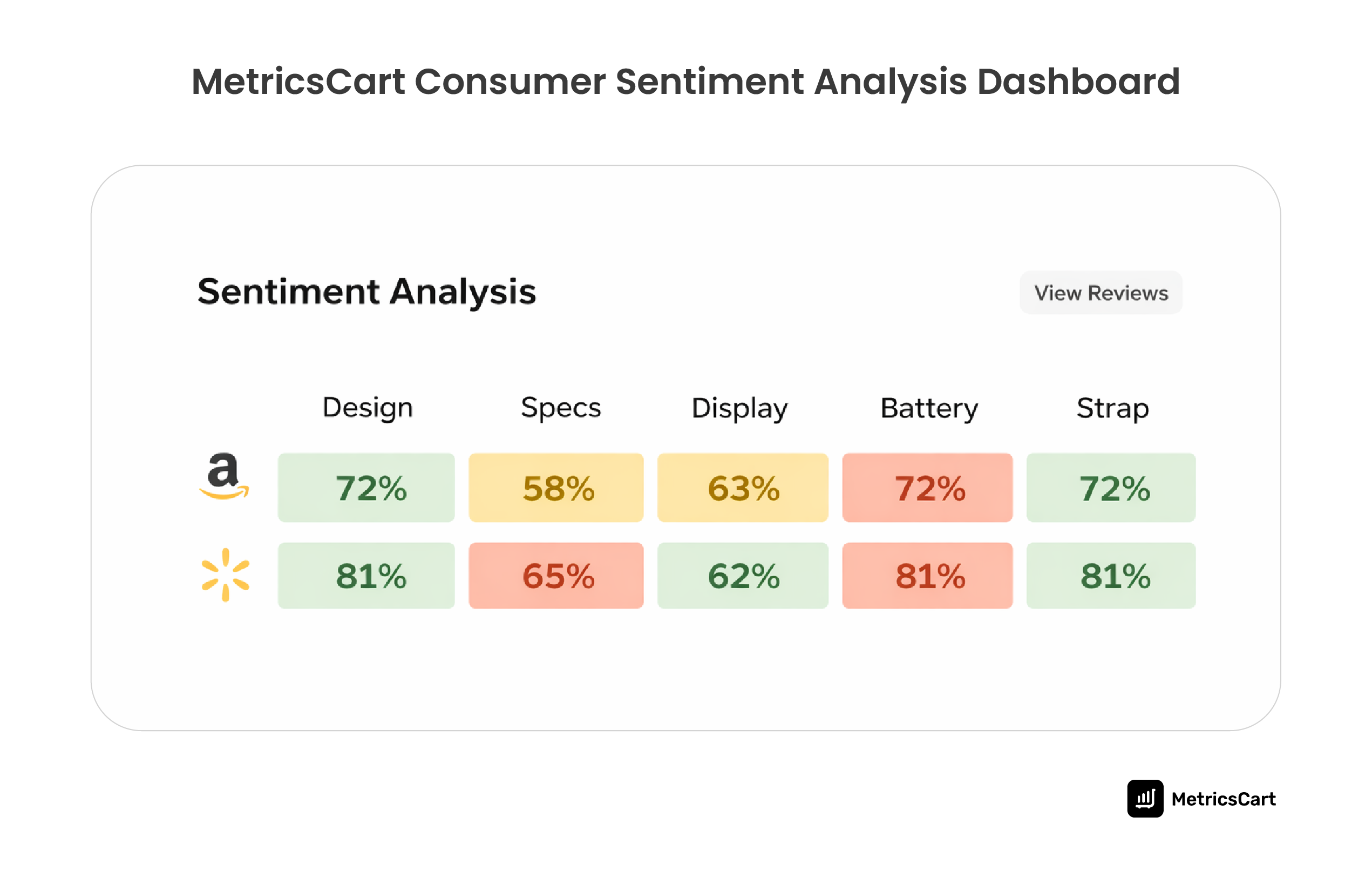
Here, MetricsCart helps you track sentiment across channels, turn it into clear actions, and respond faster; so your products and digital shelf stay ahead.
Stay On Top Of Changing Customer Sentiment Across Your Products And Channels.
FAQs
Consumer sentiment analysis helps CPG brands understand how customers feel about their products by analyzing reviews, ratings, and feedback across online channels. It goes beyond star ratings to show the reasons behind customer opinions, such as product quality, packaging, or effectiveness.
CPG brands use sentiment analysis to track customer feedback across retailers, identify recurring issues, and understand what drives positive or negative experiences. These insights help improve products, refine listings, and guide marketing and product decisions.
CPG products have short buying cycles, and customers can easily switch brands. Even a few negative experiences can impact repeat purchases. Sentiment analysis helps brands detect issues early, respond quickly, and maintain customer trust.
Yes. When brands understand what customers like and fix what they don’t, product ratings improve, and trust increases. This leads to better visibility, higher conversions, and stronger long-term sales performance.