Highlights
- The Mental Shelf is where purchase decisions begin. Before consumers reach the digital shelf, they form perceptions about brands through reviews, social proof, AI recommendations, and past experiences.
- Consumer reviews have evolved into a strategic source of market intelligence. Beyond ratings, review analysis uncovers customer sentiment, unmet needs, product issues, and emerging trends that drive smarter business decisions.
- Winning the Mental Shelf requires a cross-functional approach. Marketing, Product, R&D, Customer Experience, and Category teams can all leverage consumer review intelligence to improve products, messaging, and customer satisfaction.
- AI is reshaping brand visibility in eCommerce. AI-powered shopping assistants and review summaries increasingly rely on customer sentiment, making high-quality reviews and recurring themes more influential than ever.
- The greatest innovation opportunities often lie in competitor reviews. Analyzing customer feedback across the category helps brands identify white-space opportunities, evolving consumer expectations, and areas for differentiation.
In his book Happy Money, Ken Honda introduces the idea that each of us has a unique money personality. Some people are natural savers. Others are impulsive spenders. Some are worriers who hesitate over every purchase, while others barely think twice before clicking “Buy Now.”
These personalities don’t simply influence our savings accounts. They quietly shape every purchasing decision we make: from choosing a morning coffee to investing in a premium skincare routine or subscribing to a new software platform.
The way people make purchasing decisions today looks nothing like it did even a decade ago.
We’ve moved far beyond a world where purchasing decisions were dictated solely by income or demographics.
Social media, creator content, online communities, and AI-powered search have reshaped how consumers discover and evaluate products. People are no longer asking, “Can I afford this?” They’re asking, “Can I trust this brand?” “Does it fit my lifestyle?” and “What are people like me saying about it?”
These questions are often answered long before someone lands on an Amazon product page.
That’s what I call the Mental Shelf.
What is the Mental Shelf?
Every purchase begins long before a consumer searches for a product or walks into a store. It begins with a set of perceptions, emotions, memories, and associations that influence which brands come to mind first. This invisible space is the Mental Shelf.
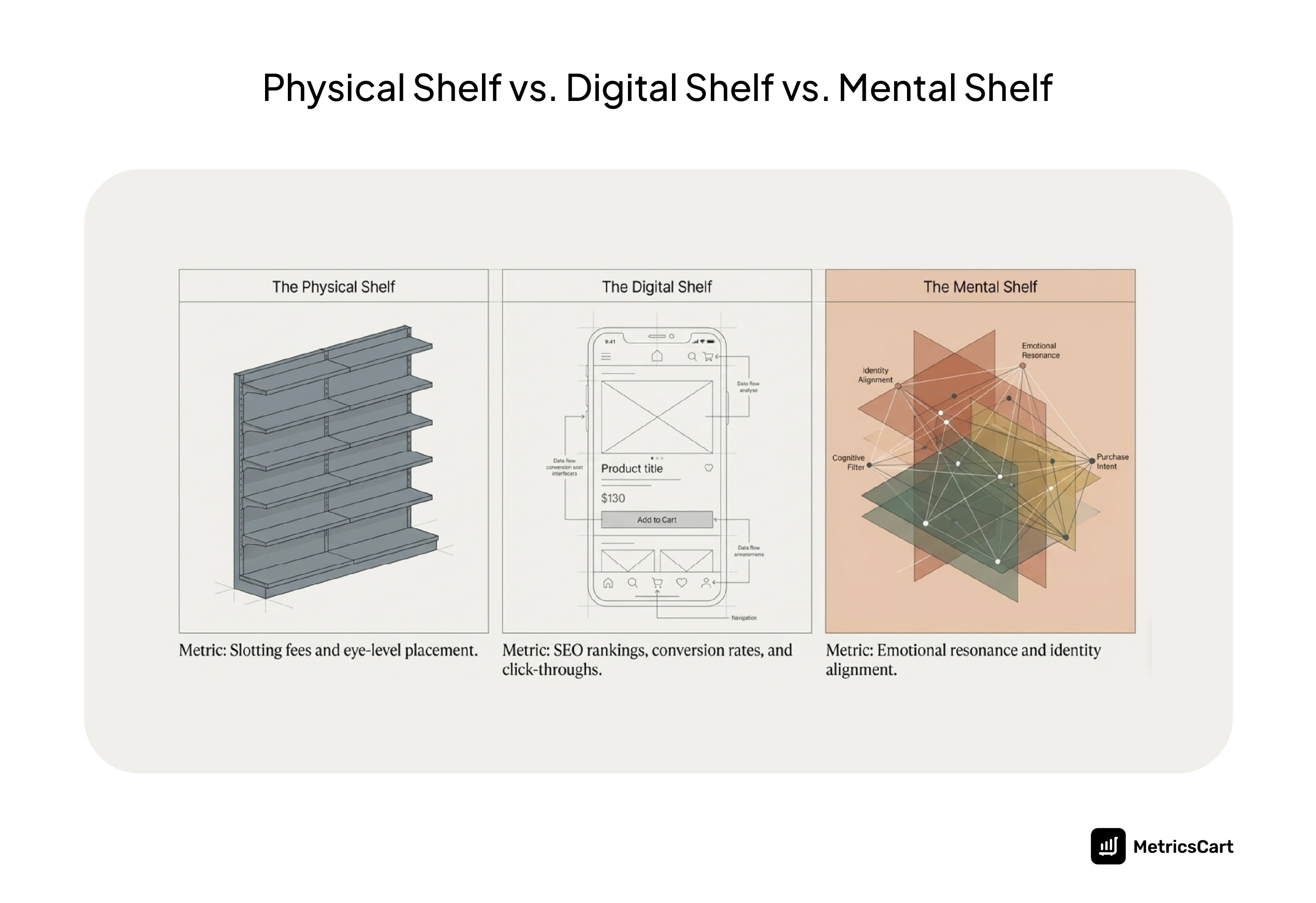
The Mental Shelf is the collection of beliefs a consumer holds about a brand, whether it’s trustworthy, premium, affordable, innovative, sustainable, or simply the “safe choice.”
It’s shaped by countless interactions over time: customer reviews, social media conversations, creator recommendations, word of mouth, advertising, previous experiences, and increasingly, AI-generated product summaries.
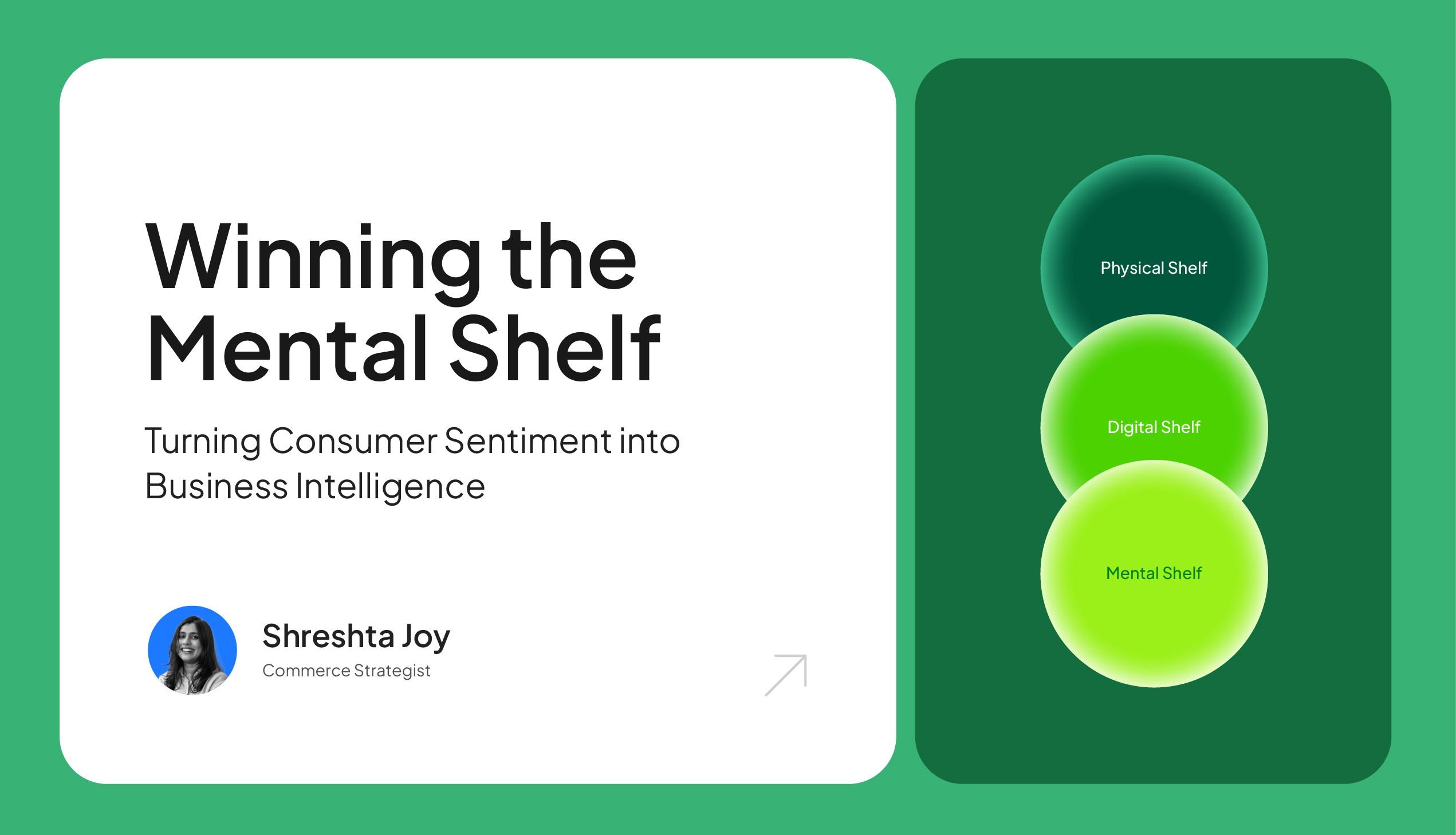
Think of it as the shelf inside a consumer’s mind. While the physical shelf determines whether a product is available and the digital shelf determines whether it’s discoverable online, the Mental Shelf determines whether it is even considered.
A consumer rarely starts their buying journey with a blank slate. When someone thinks of protein bars, skincare, coffee, or baby products, only a handful of brands immediately come to mind. Those brands have earned a place on the consumer’s Mental Shelf.
This concept builds on the marketing principle of mental availability, the likelihood that a brand comes to mind in buying situations. But in today’s digital commerce landscape, mental availability is no longer shaped only by advertising or brand recognition.
It is continuously reinforced by customer reviews, marketplace ratings, creator content, social proof, online communities, and AI-powered recommendations.
That’s why the Mental Shelf has become just as important as the digital shelf.
The digital shelf influences whether consumers can find your product.
The mental shelf influences whether they want to find it in the first place.
Consumer Reviews Are the New Consumer Research
Most brands still rely on three familiar sources of consumer insight: market research before launch, sales data after purchase, and customer reviews to understand what happened. While each is valuable, reviews have become the richest source of real-time consumer intelligence.
Unlike traditional focus groups or surveys, reviews capture authentic experiences at scale. Every day, customers voluntarily explain what they loved, what disappointed them, and how they actually use products in their daily lives.
Recent studies reinforce their growing influence. According to ConsumerAffairs, 97% of consumers read online reviews before making significant purchases, and nearly 80% have decided against buying a product because of negative reviews. Reviews have evolved from simple social proof into one of the strongest drivers of consumer purchase decisions.
Yet many organizations still treat review analysis as a post-purchase exercise owned by customer support or marketing. That’s a missed opportunity.
Reviews don’t just tell us whether customers liked a product. They reveal the emotions, expectations, and unmet needs that shape future purchasing behavior.
The Mental Shelf Framework: How Brands Win Before Consumers Buy
If the digital shelf determines whether a consumer can find your product, the Mental Shelf determines whether they’ll choose it. I think of it as a continuous cycle rather than a one-time purchase journey.
Consumer Psychology
↓
Consumer Reviews & Conversations
↓
AI & Review Intelligence
↓
Digital Shelf Optimization
↓
Purchase Decision
↓
Experience & Loyalty
↺ (feeds back into reviews)
1. Consumer Psychology
Every shopper enters the market with a unique set of motivations, beliefs, and emotional triggers. Some prioritize value, others convenience, health, sustainability, or premium experiences. Ken Honda’s concept of money personalities reminds us that purchasing decisions are rarely rational, they’re deeply emotional.
Understanding these motivations is the first step to earning a place on the Mental Shelf.
2. Consumer Reviews and Conversations
The Mental Shelf is constantly reinforced by what people hear from others. Customer reviews, Reddit discussions, TikTok videos, influencer recommendations, and word of mouth shape brand perception long before a shopper visits a product page.
Unlike traditional market research, these conversations happen continuously and reveal how consumers naturally describe products in their own words.
3. AI and Review Intelligence
We’re entering a new phase of commerce where AI is becoming the first “shopper” before the consumer.
Marketplace review summaries, AI-powered search, and conversational shopping assistants synthesize thousands of customer opinions into a few recommendations.
That means every review contributes to how algorithms understand your brand. It’s no longer enough to collect positive ratings—you need to understand the themes, emotions, and recurring product attributes that AI systems recognize.
4. Digital Shelf Optimization
Only after these perceptions are formed does the digital shelf come into play.
Pricing, product content, search visibility, stock availability, ratings, reviews, and retailer compliance determine whether a shopper can easily discover and purchase the product.
The strongest digital shelf strategies reinforce what consumers already believe about the brand rather than trying to change their minds at the point of purchase.
5. Purchase Decision
By the time consumers click “Add to Cart,” much of the decision has already been made.
They aren’t evaluating every option equally. They’re validating the brand that already feels familiar, trustworthy, or aligned with their needs.
That’s the power of the Mental Shelf.
6. Loyalty Creates the Next Consumer
The journey doesn’t end after purchase. Every experience becomes another review. Every review influences another consumer. Every consumer shapes the Mental Shelf of countless others.
The brands that recognize this continuous loop stop treating reviews as the end of the customer journey and start treating them as the beginning of the next one.
Winning the Mental Shelf Through Consumer Language
Ratings tell us what customers think. Reviews tell us why they think so.
That difference is incredibly important.
A five-star rating is useful, but a review saying, “This is the first protein shake that doesn’t upset my stomach before my morning workout,” tells us much more. It reveals the consumer’s motivation, emotional relief, and the problem the product successfully solved.
This is where consumer feedback analysis and aspect-based sentiment analysis become powerful. Instead of measuring overall satisfaction, brands can understand how consumers feel about specific attributes like taste, texture, packaging, value, durability, or ingredients.
These insights help brands close the gap between their marketing promise and the actual customer experience.
Reviews Should Drive Innovation, Not Just Reputation
The most innovative brands no longer see reviews as customer service tickets. They treat them as an always-on R&D engine. Customer feedback can uncover opportunities across multiple areas:
- Product formulation: Consumers describing a beverage as “chalky” or “watery” point directly to formulation improvements.
- New usage occasions: Reviews often reveal unexpected ways people use products, creating opportunities for new formats or entirely new product lines.
- Ingredient preferences: As demand grows for clean labels, high-protein foods, and functional nutrition, reviews help brands understand exactly which ingredients consumers value—or avoid.
- Packaging improvements: Complaints about leaking bottles or difficult-to-open lids often have a direct impact on repeat purchases.
- Competitive white space: Analyzing competitor reviews reveals unmet needs that your own customers may never mention.
Interestingly, some of the richest insights don’t come from one-star reviews.
They come from three-star reviews.One-star reviews explain what went wrong. Five-star reviews celebrate what already works. Three-star reviews often reveal what almost convinced the customer, making them an excellent source of product innovation.
Four Brands That Have Won the Mental Shelf
The Mental Shelf isn’t a theoretical concept. Some of today’s fastest-growing consumer brands have built their success by listening to consumer conversations and reinforcing positive perceptions across every touchpoint.
Poppi & Olipop: Selling a Lifestyle, Not Just Soda
The better-for-you soda category didn’t grow simply because consumers wanted carbonated drinks with fewer calories. Brands like Poppi and Olipop understood that consumers were looking for beverages that supported gut health without sacrificing taste.
Reviews consistently highlighted phrases like “finally a healthy soda that actually tastes good” and “helps satisfy my soda cravings without the guilt.”
Instead of focusing solely on nutritional claims, both brands leaned into the emotional outcomes consumers described: feeling healthier, making smarter choices, and enjoying indulgence without compromise.
The lesson? Consumers don’t buy ingredients. They buy how those ingredients make them feel.
READ MORE | Olipop vs Poppi: Marketing, Pricing, and Performance
Prime Hydration: Listening Beyond the Hype
Prime entered the market with enormous awareness driven by creators and influencers. But maintaining that momentum required listening carefully to consumer feedback.
Across marketplaces and social media, shoppers openly discussed flavor preferences, sweetness levels, availability, and packaging. Those conversations helped shape future product launches and flavor discussions while keeping the community actively involved in the brand’s evolution.
The product wasn’t just being consumed. It was being continuously co-created through consumer feedback.
Stanley: Building Community Beyond the Product
Stanley didn’t become a cultural phenomenon because it made insulated tumblers. Many brands make insulated drinkware. Stanley won because it occupied a unique place on the Mental Shelf.
Consumers associated it with routines, identity, community, gifting, and belonging. Social media amplified stories around color drops, limited editions, and personal collections. The product became a conversation starter rather than simply a hydration tool.
That’s the difference between selling features and building mental availability. People weren’t recommending Stanley because it kept drinks cold. They were recommending what owning Stanley represented.
READ MORE | Stanley Marketing Strategy: How Did the Brand Win on Target?
CeraVe: Letting Consumers Become the Marketing Team
CeraVe’s growth is a masterclass in combining dermatologist credibility with consumer advocacy. Rather than relying exclusively on traditional advertising, the brand benefited enormously from authentic recommendations across TikTok, YouTube, Reddit, and skincare communities.
Consumers repeatedly described the products using simple, relatable language:
“It actually repaired my skin barrier.”
“Affordable and recommended by dermatologists.”
“No unnecessary fragrance.”
Those recurring themes became stronger than any advertising campaign. The result was a brand that consistently appeared on consumers’ Mental Shelves whenever they searched for skincare solutions.
Consumer Feedback Is a Cross-Functional Asset
One of the biggest mistakes organizations make is treating reviews as the responsibility of a single department.
In reality, review intelligence benefits every team.
- Marketing gains authentic consumer language that resonates more than polished advertising copy.
- Product and R&D teams identify recurring quality issues and prioritize improvements based on real customer experiences.
- New Product Development teams discover emerging consumer behaviors that inspire future products.
- Supply chain teams can identify packaging and logistics issues before they become larger operational problems.
- Customer experience teams can proactively update FAQs and product information to reduce support requests.
When brands connect these insights across departments, consumer feedback becomes a strategic decision-making tool rather than a reporting metric.

The Mental Shelf in the Age of AI
The rise of AI-powered shopping assistants and marketplace review summaries is changing how consumers make decisions.
Increasingly, shoppers ask conversational questions like, “What’s the best electrolyte drink for runners?” or “Which air fryer is easiest to clean?” AI systems summarize thousands of customer reviews to generate recommendations, making review quality even more important.
Brands are no longer optimizing only for human readers. They’re also optimizing for AI systems that interpret consumer sentiment.
Every review contributes to how algorithms understand product quality, trustworthiness, and value. This makes review intelligence a critical part of brand visibility in e-commerce.
The Future Belongs to Brands That Understand the Mental Shelf
Consumer brands have spent decades optimizing physical shelves and digital shelves. The next competitive advantage lies in understanding the invisible space where purchasing decisions actually begin.
The Mental Shelf is where consumer psychology, trust, reviews, and digital experiences come together. It’s where consumers decide whether a product feels worth buying long before they click “Add to Cart.”
Brands that consistently use a rating and review analysis software like MetricsCart to analyze consumer sentiment, understand the language behind reviews, and connect those insights across marketing, product development, and customer experience will make better decisions and build stronger relationships with consumers.
Because products compete on the digital shelf.
Brands compete on the Mental Shelf.
Ready to Win both the Digital Shelf and the Mental Shelf?