Highlights
- AI is now the first stop for product research, moving half the discovery funnel away from retailer sites.
- Digital shelf data spans six layers: content, media, pricing, availability, search and placement, and reviews and Q&A.
- A missing attribute like “fragrance-free” removes a product from AI recommendations entirely, even when it qualifies.
- AI catches pricing, MAP, and content gaps in real time, closing windows quarterly audits leave open for weeks.
- AI shopping assistants retrain daily, so monthly audits fall behind the recommendation cycle before brands see the drop.
AI is now the first stop for many customers. 46% of AI users open ChatGPT, Gemini, Perplexity, or Claude for product research before a retailer site, up from just 25% in 2024. Half the research funnel has shifted in under two years.
This changes how AI uses digital shelf data. Every product title, attribute, image, and review is now read by AI systems that decide which products earn a place on that shortlist. AI Digital Shelf Analytics has become a working requirement for brands across marketplaces.
This guide covers how AI uses the digital shelf, what it decides, and where brands are losing visibility today.
What Is Digital Shelf Data?
Digital shelf data is the full set of product information generated across retailer sites, marketplaces, and quick-commerce platforms. It combines three kinds of input: what the brand publishes on the page, what shoppers add through reviews and Q&A, and how the retailer’s own system responds through search rank, buy box, and placement.
Together, these signals define how a product is discovered, evaluated, and recommended by both shoppers and AI systems.
Six layers make up this data.
- Product content: titles, descriptions, bullet points, attribute-value pairs, and enhanced content such as A+. This is the structured input that retailer search engines and AI parsers read first.
- Media: images, videos, and 360-degree views. File quality, alt text, and image metadata now feed both visual search in retailer apps and multimodal AI models.
- Pricing: list price, promotional price, MAP status, and competitor pricing across retailers. Tracked over time, this reveals promotional cadence, elasticity, and buy box volatility.
- Availability: stock levels, out-of-stock signals, delivery windows, and buy box ownership. These are real-time signals that trigger downstream decisions on media spend, replenishment, and search rank.
- Search and placement: keyword rank, sponsored versus organic position, and category placement. This shows how retailer algorithms are already ranking your product against peers in the category.
- Reviews and Q&A: star rating, review volume, sentiment distribution, and question-answer pairs. This is the layer that AI models rely on most to summarize a product in response to a shopper query.
Every AI system that touches e-commerce works from these six layers. That includes brand-side tools that run internal audits, retailer recommendation engines, and public assistants like ChatGPT that decide what to surface.
The gaps in this data are where AI visibility starts to break down. Missing attributes, inconsistent claims across retailers, or unmoderated reviews all weaken the signal AI systems have to work with.
Why Is AI Important for Digital Shelf Analytics?
AI Digital Shelf Analytics is the use of AI models to read, monitor, and act on digital shelf data in real time across every retailer where a brand sells.
Standard digital shelf analytics measures outcomes after they occur. A stockout appears in a report once a competitor has already claimed the buy box. AI digital shelf analytics identifies patterns as they form, so a pricing shift or a change in review sentiment is picked up while there is still time to respond.
That earlier signal matters more than ever:
- A missing attribute can now remove a product from AI recommendations entirely, rather than just lowering its ranking. A shopper filtering by “fragrance-free” or “gluten-free” will not see a listing missing that field, and neither will an AI assistant summarizing options in that category.
- Inconsistent data across retailers is read as unreliable and incomplete. A product priced or described differently on Amazon versus Walmart is more likely to be left out of an AI-generated answer on both, rather than just one.
- The traffic drop from exclusion shows up weeks after the cause does. By the time a decline is visible in analytics, the underlying data gap has usually been present for some time, making the fix reactive rather than preventive.
How Does AI Use Digital Shelf Data? Use Cases and Results
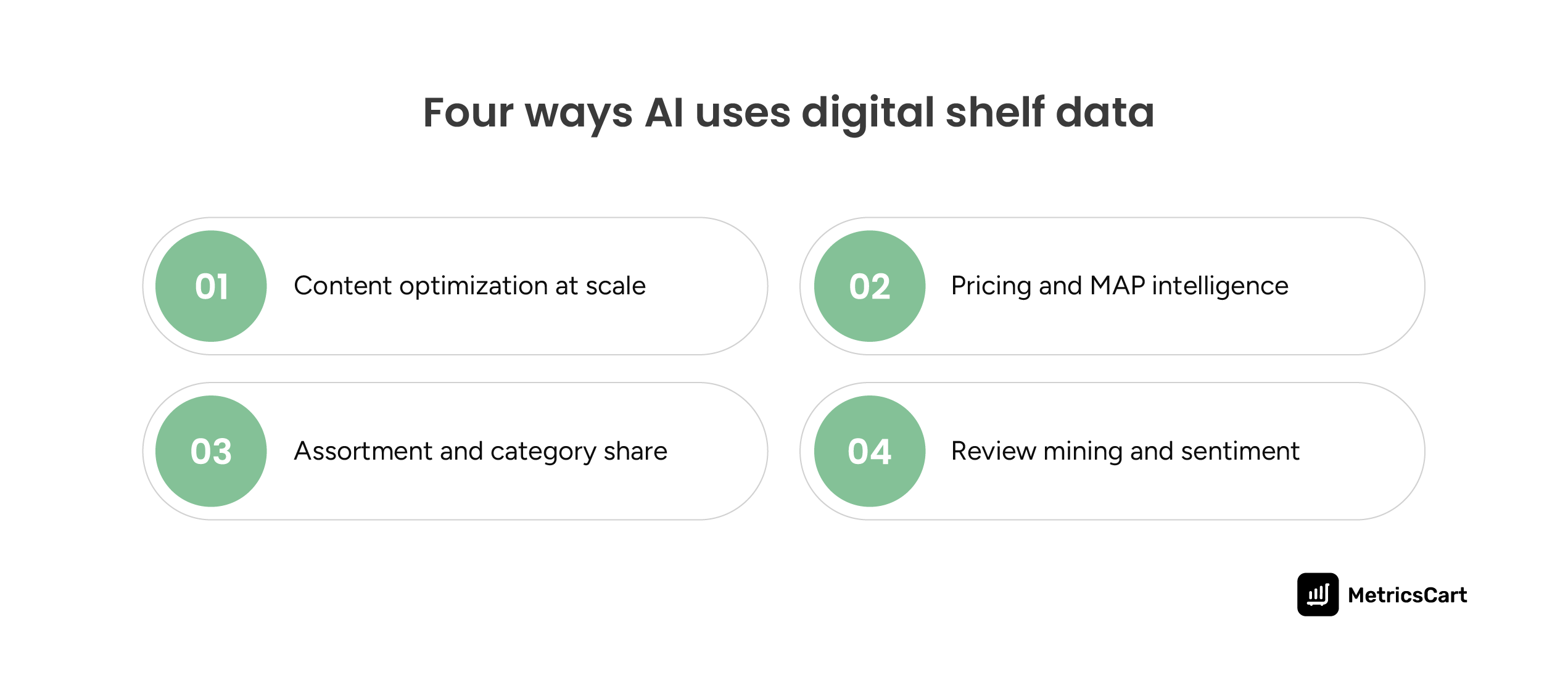
Across the four workflows below, AI takes the six layers of digital shelf data and turns them into decisions that brand teams used to make manually, on longer cycles.
1. Content Optimization at Scale
The setup: A CPG brand with 4,000 SKUs sells the same product across Amazon, Walmart, Target, and three quick-commerce apps. Each retailer has different attribute requirements, image specs, and title character limits. Manual audits catch a fraction of the gaps, and only once a quarter.
What AI does: Reads every PDP against each retailer’s content standard. Flags missing attributes, weak titles, and image compliance issues within hours. For a shampoo brand, that might mean identifying 800 Walmart PDPs missing “fragrance-free” as an attribute value, which is why those products never appear when a shopper applies that filter.
It also drafts copy against the retailer’s spec. Content teams review and approve instead of writing every PDP by hand.
The result: Time to market on a retailer-side content refresh drops from weeks to days.
2. Pricing and MAP Intelligence
The setup: An appliance brand tracks 12 competitor SKUs across Amazon, Best Buy, and Home Depot. Prices change several times a day. A weekly report misses most of the swings and almost all MAP violations by third-party sellers.
What AI does: Monitors these signals in near real time. Picks up promotional cadence patterns, for example, that a competitor drops price by 15 percent every third Thursday, and flags MAP breaks the moment they appear. Buy box loss is caught within the same session, rather than the following week, which is where continuous product availability monitoring starts to pay back the investment.
The result: In categories with high 3P seller activity, a two-day delay in catching a MAP violation on Amazon can cost a brand its buy box for a full pricing cycle. AI closes that window.
3. Assortment and Share of Category
The setup: A snack brand sells 60 SKUs across Kroger, Publix, and Target.com. It leads in single-serve at Kroger and loses to two smaller competitors in the family-pack format at Target. Sales data alone will not surface this gap for another quarter.
What AI does: Compares the brand’s assortment against category leaders at each retailer. Shows that Target shoppers filter for family-pack formats twice as often as single-serve, and that the brand ranks on page three for that filter.
The result: Range planning gets direction on which SKUs to prioritize with which retailer and where the assortment gap is widening fastest.
4. Review Monitoring and Sentiment Analysis
The setup: A baby-care brand releases a reformulated wipe. Sales hold steady for six weeks. Then they drop. By the time the internal team investigates, thousands of reviews have already flagged a packaging change that makes the dispenser harder to use.
What AI does: Applies aspect-based sentiment analysis to review corpora. Separates feedback by attribute (packaging, scent, skin reaction, price, delivery) and tracks how each moves week to week. The packaging complaint would have surfaced in week two.
The result: Product, marketing, and R&D teams get a structured, weekly-refreshed view of what shoppers respond to. Category managers also see what shoppers say about competitor SKUs, which informs the next launch.

How Brands Can Get AI-Ready on the Digital Shelf
Look back at the examples above: the shampoo brand, the appliance brand, the baby-care brand. In each case, the data existed. What was missing was someone watching it in time. That is the real cost of quarterly audits, not bad data, but late data.
AI shopping assistants do not wait for a monthly report. They read pricing, content, and reviews the moment they change and decide what to recommend accordingly. A brand checking in once a quarter is negotiating with a system that runs on a much faster clock.
Closing that lag is what an AI digital shelf platform is built to do. MetricsCart runs on the same clock as the AI systems shaping your visibility, continuously reading pricing, content, availability, and reviews across 150+ retailers. The next fragrance-free gap, MAP break, or sentiment shift gets caught the moment it appears, not the next time your team sits down to audit.
See your digital shelf the way AI sees it, before a gap costs you the recommendation.
FAQs
Digital shelf data is the full set of product information generated across retailer sites, marketplaces, and quick-commerce platforms, combining brand content, shopper reviews, and retailer-side signals like search rank and buy box status.
Product content, media, pricing, availability, search and placement, and reviews and Q&A.
AI shopping assistants read digital shelf data directly to decide which products to recommend. Missing or inconsistent data can remove a product from AI-generated recommendations entirely, not just lower its ranking.
A missing attribute, such as “fragrance-free” or “gluten-free,” means the product will not surface when a shopper or AI assistant filters or searches for that attribute, even if the product qualifies.
AI systems continuously read pricing, content, and reviews. Quarterly or monthly audits create a lag between when a data gap appears and when it’s caught, during which visibility and sales can already be affected.