Highlights
- AI Review Analysis reads every review across every retailer at once and turns them into actions brand teams can take this week.
- Sentiment analysis says reviews turned negative; AI Review Analysis says what, where, and when.
- Aspect-based scoring splits product, packaging, and service signals within a single mixed review.
- Reviews surface four free insights: recurring complaints, emerging defects, competitor gaps, and 5-star vocabulary.
- AI shopping assistants now summarize reviews before recommending, so untracked themes shape the pitch.
Somewhere in your reviews section, a shopper is spelling out exactly why the next thousand buyers will walk away. Most brands never read that far.
AI Review Analysis exists because 93% of purchase decisions are shaped by reviews, and yet that feedback usually sits unread across five or six retailers, one-star rating at a time, until a quiet pattern turns into a real return rate.
It reads every review at once, across every retailer, and turns scattered opinions into product intelligence a team can act on the same week, not the same quarter.
Similarly, MetricsCart’s ratings and reviews monitoring tracks these patterns across every marketplace where a brand sells.
What is AI Review Analysis?
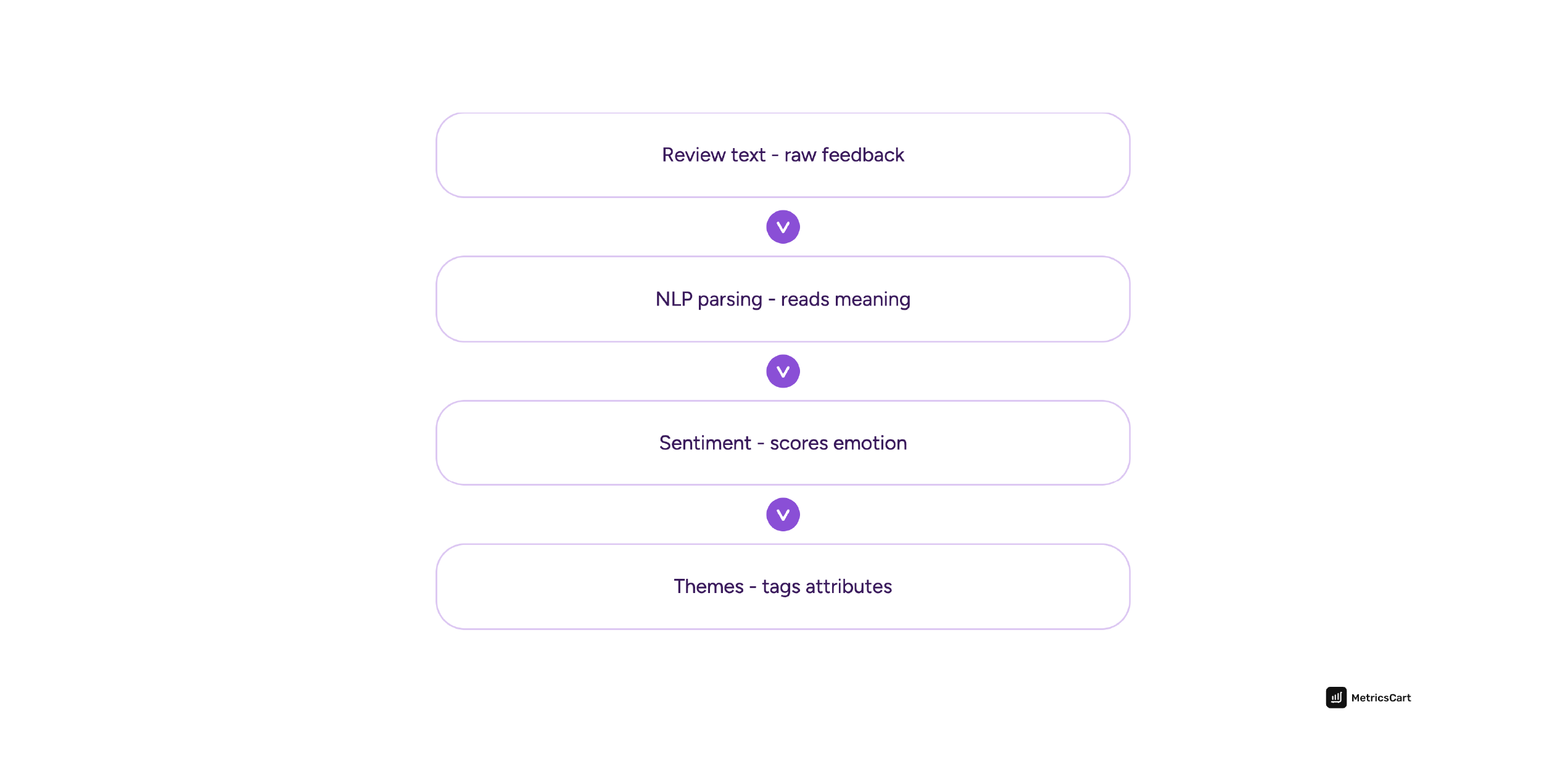
AI Review Analysis is the use of machine learning to read, categorize, and interpret customer reviews at scale. Instead of a person scrolling through pages of feedback, the system processes every review across every retailer and surfaces patterns a manual read would miss. It rests on three capabilities working together.
- Natural language processing. The system reads reviews the way a person does, understanding context, negation, and sarcasm rather than just matching keywords. It knows “not bad” is different from “bad,” and that “works fine for now” is not the same as “works well.”
- Sentiment analysis. Every review, or every sentence within a review, gets scored as positive, negative, or neutral. This goes beyond the star rating a shopper leaves. A four-star review can still contain a real complaint buried in the middle, and a one-star review can be about shipping rather than the product itself.
- Theme and sub-theme extraction. The system pulls out what shoppers are actually talking about: battery life, packaging, sizing, smell, ease of use. This is where the analytical value lies, because it attaches sentiment to a specific, fixable product attribute rather than leaving it as a vague score.
The distinction matters because a rating tells a brand that something is wrong. Topic extraction tells them what.
How Is AI Review Analysis Different from Sentiment Analysis?
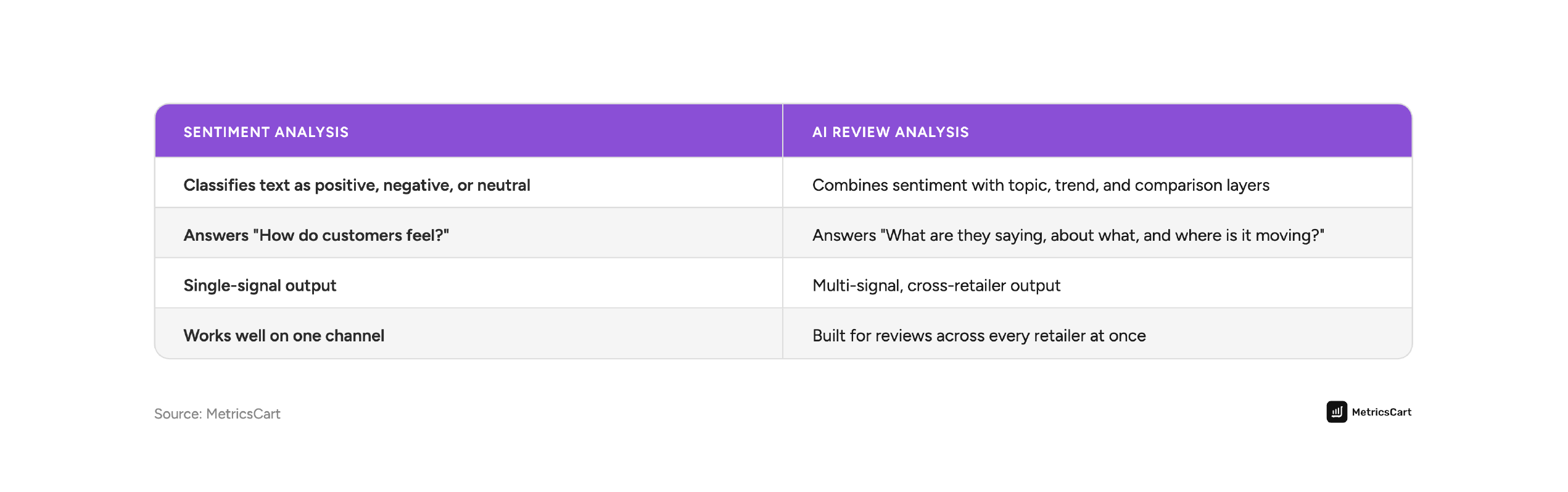
Sentiment analysis answers one question: Is this review positive or negative? AI Review Analysis answers a harder one: positive or negative about what, and why does it matter for the business?
A basic sentiment score can tell a brand manager that reviews turned negative last month. AI Review Analysis indicates that the new packaging is causing leaks in transit, that the complaint is concentrated on Walmart rather than Amazon, and that the issue began three weeks after a specific shipment batch went live. One is a health check. The other is a root cause.
How does the AI Review Analysis Platform Monitor Customer Feedback?
AI review analysis platforms transform scattered customer comments into structured, actionable insights. By combining real-time multi-channel data collection with advanced Natural Language Processing (NLP), these tools continuously track customer sentiment and automatically pinpoint specific issues across product lines, service channels, and online review sites.
The clearest way to see it is inside one review. Take this line:
“The formula works well, and my skin looks better after three weeks, but the pump broke on day four, and customer service took a week to reply.” ★★★★☆
A star rating alone reads this as 4-star. AI Review Analysis extracts more:
- Product performance: positive
- Packaging/pump: negative
- Customer service: negative
The star rating says this shopper was satisfied. The breakdown says something a brand actually needs to act on: the product works, but the packaging is failing, and support is too slow, two fixable problems hiding inside a “good” review.
Cross-Retailer SKU Aggregation
AI review analysis platforms like MetricsCart track customer feedback across localized e-commerce channels in regions like the US, UK, APAC, and MENA.
- Cross-Marketplace Ingestion: Pulls ratings, star counts, and written reviews directly from 100+ major retail platforms.
- Variant-Level Tracking: Tracks feedback down to specific Child SKUs (e.g., size, color, scent, or pack size) to isolate whether negative reviews stem from a specific variant rather than the overall product line.
Real-Time Brand Health & Conversion Defense
A sudden drop in product rating can suppress organic placement on retailer search engines (such as Amazon’s A10 algorithm). MetricsCart acts as a 24/7 observer with automated risk triggers:
- Negative Review Alerts: Instantly notifies e-commerce managers when 1-star or 2-star reviews are posted, enabling fast customer service resolution or policy dispute filings for non-compliant reviews.
- Star Rating Threshold Warnings: Triggers warnings when a product’s average rating drops below critical conversion thresholds (e.g., slipping from 4.5 stars to 4.1 stars).
Aspect-Based Sentiment Analysis (ABSA)
Shoppers frequently post nuanced reviews with mixed sentiment (e.g., “The sound quality is amazing, but the charging case broke on day two”). MetricsCart uses Aspect-Based Sentiment Analysis to disaggregate complex sentences:
- Attribute Extraction: Automatically isolates specific product dimensions such as material quality, battery life, packaging durability, or sizing/fit.
- Granular Sentiment Scoring: Assigns an independent numerical sentiment score (-1.0 to +1.0) to each isolated attribute within a single review.
Theme & Sub-Theme Clustering
MetricsCart categorizes customer comments into recurring macro and micro themes to pinpoint operational issues:
- Product Returns Reduction: If an apparel brand sees a spike in terms like “runs small,” “tight around shoulders,” or “see-through material,” product teams can update the listing size chart or adjust manufacturing specifications, directly reducing costly product return rates.
- Packaging & Shipping Diagnostics: Clusters of complaints about breakages during transit (e.g., “leaked in box”) signal to the supply chain team that secondary packaging needs reinforcement.
Competitor Review Benchmarking
E-commerce success is relative to competitors in the market category. MetricsCart benchmarks your product’s feedback directly against competing ASINs/SKUs:
- Share of Sentiment: Compares your product’s positive-to-negative sentiment ratio against top category rivals.
- Feature Gap Analysis: Scans competitor reviews to highlight what buyers dislike about competing products, giving your marketing team copy points to emphasize (e.g., “Unlike competitor X, our zipper never snags”).
What Insights Can Brands Extract from Customer Reviews using AI Review Analysis Software?
Most brands sit on more customer insight than they realize. They just never treat it as research.

As MetricsCart Co-Founder Ash Kaul puts it in Episode 50 of Digital Shelf Insider, reviews are the kind of candid, large-scale feedback brands would normally pay heavily for, available for free. Every review adds another unfiltered view of what customers value, dislike, compare, and expect from a product, creating a continuous stream of consumer insights at scale.
Watch the full episode here:
The four use cases below are what separate brands that read that data from brands that let it sit unread.
1. Recurring Product Complaints.
The same issue mentioned across dozens of reviews, whether it is a fit problem, a missing part, or a confusing instruction manual, points to a fix that protects both rating and return rate. The value is in frequency, not in any single review. A complaint mentioned twice is an outlier. The same complaint, mentioned 200 times, is a product decision waiting to happen.
2. Emerging Issues Before They Hit Sales
A defect usually shows up in reviews weeks before it shows up in the sales chart or the return log. Tracking the rate of change in a theme, not just its volume, is what catches this early. A complaint growing 20% week over week deserves attention even if its total count still looks small.
3. Competitor Review Analysis
Reviews often mention a competitor by name, either as a comparison or as the reason a shopper switched. This is direct, unpaid market research into what shoppers value in a category, and it usually surfaces gaps that a brand’s own reviews cannot show, such as a feature shoppers expect but the brand does not yet offer.
4. Marketing Language from 5-Star Reviews
Shoppers describe products in their own words, and that language often converts better than brand copy because it uses the vocabulary buyers are already using to search. Phrases pulled from five-star reviews can feed product listings, ad copy, and social content, and they tend to test well precisely because they were not written by a copywriter.

Why AI Review Analysis Matters for E-Commerce Brands in 2026
Three shifts make this more urgent now than it was even two years ago.
- Review volume has outgrown manual tracking. Feedback now spreads across Amazon, Walmart, Target, DTC storefronts, and quick-commerce apps that did not exist a few years back. A brand with a wide retail footprint can be looking at tens of thousands of reviews a year, and no team can read that volume closely enough to catch a slow-building pattern.
- AI shopping assistants now summarize reviews on a brand’s behalf. When a shopper asks an AI assistant which product to buy, the assistant reads and condenses review sentiment behind the scenes before it answers. A brand with an unclear or unresolved complaint pattern has no say in how that gets summarized. A brand that already knows its own themes can address its weak points before an assistant surfaces them to a shopper.
- The cost of a missed pattern has gone up, not down. A complaint that used to take a quarter to become visible in sales data now shows up in review text within days. Brands that wait for the sales dip to react are always working a step behind brands that catch the signal in the reviews themselves.
Together, these shifts turn review analysis from a customer service task into an input for category strategy, which is why it increasingly sits with Brand and Category teams rather than support teams alone.
MetricsCart applies AI Review Analysis across every retailer a brand sells on, pulling reviews into a single dashboard rather than separate retailer portals.
The platform groups feedback by theme, flags emerging complaints early, and tracks sentiment trends against competitor products in the same category. Brand and category teams get a clear view of what shoppers are actually saying, without having to read every review by hand.
Turn your reviews into brand decisions with MetricsCart’s AI Review Analysis.
FAQs
It uses machine learning to read and categorize customer reviews at scale, extracting sentiment, product attributes, and recurring themes instead of relying on star ratings alone.
It processes review text using natural language processing, scores sentiment, extracts topics and product attributes, and groups similar feedback into trackable themes over time.
Sentiment analysis scores a review as positive or negative. AI Review Analysis goes further, tying that sentiment to specific product attributes, competitor comparisons, and trends across a full catalog
Yes. By tracking the volume and frequency of specific complaints over time, AI can flag a rising issue, such as a packaging defect, before it shows up in sales or return data.
The right tool depends on how many retailers a brand sells on and how deep the analysis needs to be. Platforms built for digital shelf intelligence, like MetricsCart, analyze reviews across multiple retailers in one place rather than one storefront at a time.