Highlights
- Chocolate Chip Cookie Dough Mini Bars lead all Quest SKUs on Target with 29.1K reviews, but the 4.1 rating trails higher-scored products.
- Protein powders anchor Quest’s premium tier at $27.50 to $42.50, while all protein bars are $26.50 and all protein chips are $2.80, regardless of flavor.
- Consumer sentiment for Quest Nutrition on Target runs 73% positive, 19% neutral, and 8% negative.
- Only 27% of Quest’s reviews live on target.com; 40% come from influenster.com and 33% from questnutrition.com.
- Quest runs just two sponsored SKUs on Target, both ready-to-drink protein iced coffees priced at $26 and $30.
About the Report
MetricsCart analyzed 119 Quest Nutrition products listed on Target between June 8 and June 21, 2026. The analysis covers pricing distribution across formats, top-reviewed and most-upvoted SKUs, sponsored placements, customer sentiment, review themes and subthemes, and review-source distribution.
The findings show how a category-defining protein brand structures its assortment on a mass retailer’s digital shelf, which products actually convert on volume, and where the brand’s on-retailer presence is strongest and weakest.
Introduction
Protein has moved out of the gym and into the mainstream grocery basket. What was once a category owned by athletes and bodybuilders now serves busy professionals, GLP-1 users tracking macros, and Gen Z shoppers reading nutrition labels before checkout.
Mintel valued the US protein product market at $114.4 billion in 2024, with projected annual growth of 1.9% through 2028. Founded in 2010 with a single protein bar that promised the taste of a snack and the macros of a supplement, Quest Nutrition has since grown into one of the most recognizable names in high-protein snacking.
Fifteen years in, Quest Nutrition’s marketing strategy has stretched well past that first bar. The brand now spans chips, cookies, shakes, powders, and iced coffee, and its Target shelf offers one of the clearest views into how a category-defining protein brand competes for the everyday shopper.
Big on Protein, Bigger on Flavor: Quest Nutrition’s Brand Strategy
For years, the snack market has asked shoppers to choose between healthy and tasty. Quest Nutrition’s marketing strategy is built on rejecting that choice. Its tagline, “Big on protein, bigger on flavor,” makes the promise, and the products are designed to deliver both.
In September 2025, Quest sharpened that message with “Succumb to Your Instincts,” a campaign by Leo New York that reframes the healthy-versus-tasty conflict. Instead of asking shoppers to resist their cravings, the ads invite them to give in because Quest products deliver both indulgence and nutrition. The work runs across TV, streaming, digital, social, and out-of-home, and evolves the brand’s earlier “It’s Basically Cheating” positioning.
Three pillars define how Quest Nutrition markets itself in 2026:
- Format expansion beyond bars. Quest started as a protein bar company and now sells chips, cookies, chocolates, ready-to-drink shakes, protein powders, and RTD iced coffee. Every new format extends the same protein-forward promise into new snacking occasions.
- Flavor as the primary differentiator. In a category where every brand claims 20g of protein, Quest competes on the eating experience. Chocolate chip cookie dough, s’mores, birthday cake, loaded taco chips.
- Community-first content. Quest built one of the earliest large-scale online communities in the supplement category, and the brand still leans on user-generated content, recipe videos, and consumer-driven social proof rather than heavy paid advertising.
That snack-first approach to a nutrition category sets the frame for everything that follows on Quest Nutrition’s Target shelf.
Quest Nutrition’s Target Shelf, by the Numbers
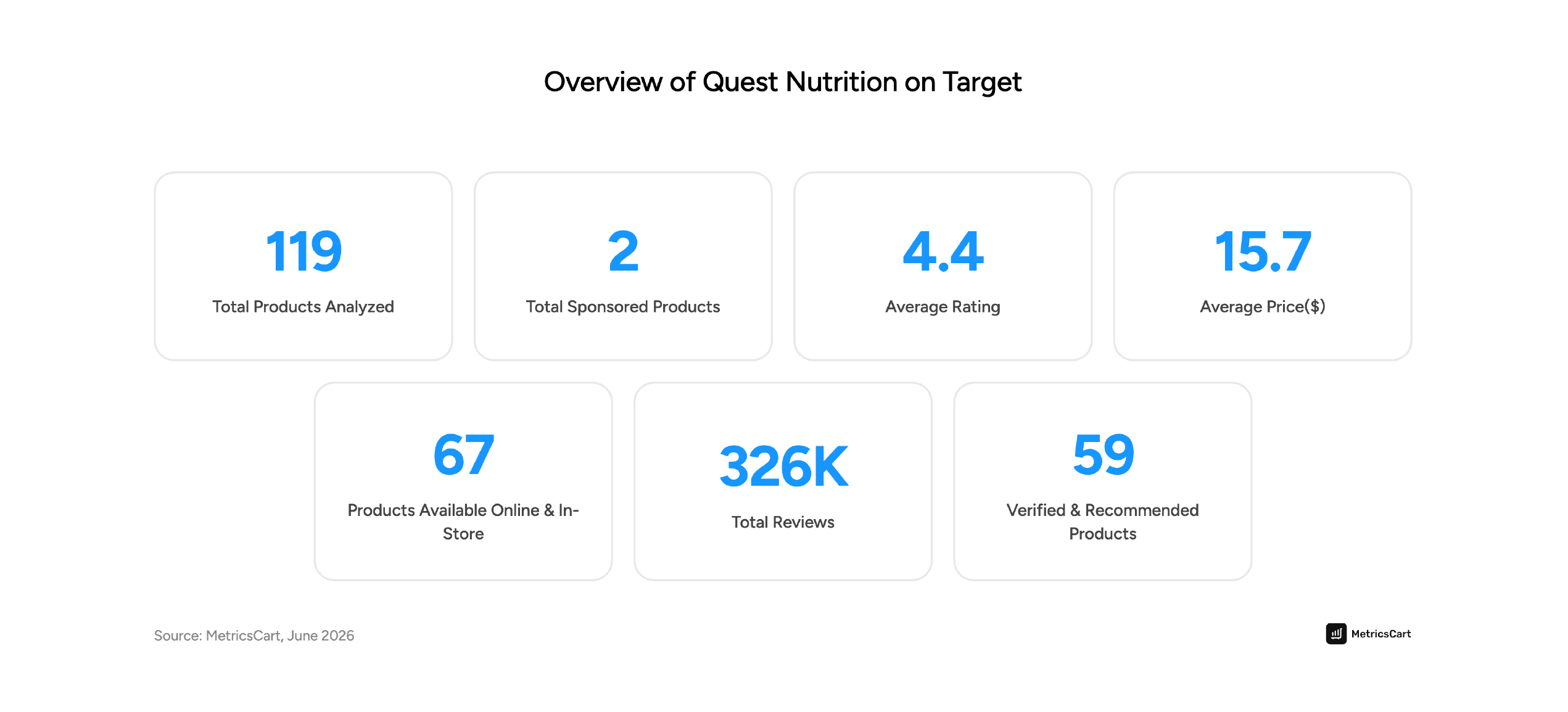
MetricsCart’s analysis surfaced the following snapshot of Quest Nutrition’s presence on Target during the June 8 to 21, 2026 window:
- 119 total products analyzed across bars, chips, powders, cookies, milkshakes, and RTD coffee
- $15.70 average price across the catalog
- 4.4 average rating across all SKUs
- 326K total reviews aggregated across the assortment
- 67 products available both online and in-store (omnichannel reach)
- 59 verified and recommended products flagged by Target
- 2 sponsored products, a very light paid presence
The mix signals a brand that leans on organic shelf presence and review depth rather than paid placement. With 59 of 119 SKUs carrying Target’s verified badge and only two running as sponsored listings, Quest Nutrition is operating primarily on brand recognition and existing customer momentum.
Quest Nutrition’s Pricing on Target: From $2.80 Protein Chips to $42.50 Powders
MetricsCart’s price monitoring shows Quest Nutrition operating a wide price range on Target, from $2.80 for single-serve chip packs to $42.50 for a 3lb protein powder tub. The brand’s pricing splits cleanly by format: powders sit in the premium tier, bars occupy a flat mid-tier, and chips anchor the everyday-snack low end.
The Most Expensive Quest Nutrition Products on Target
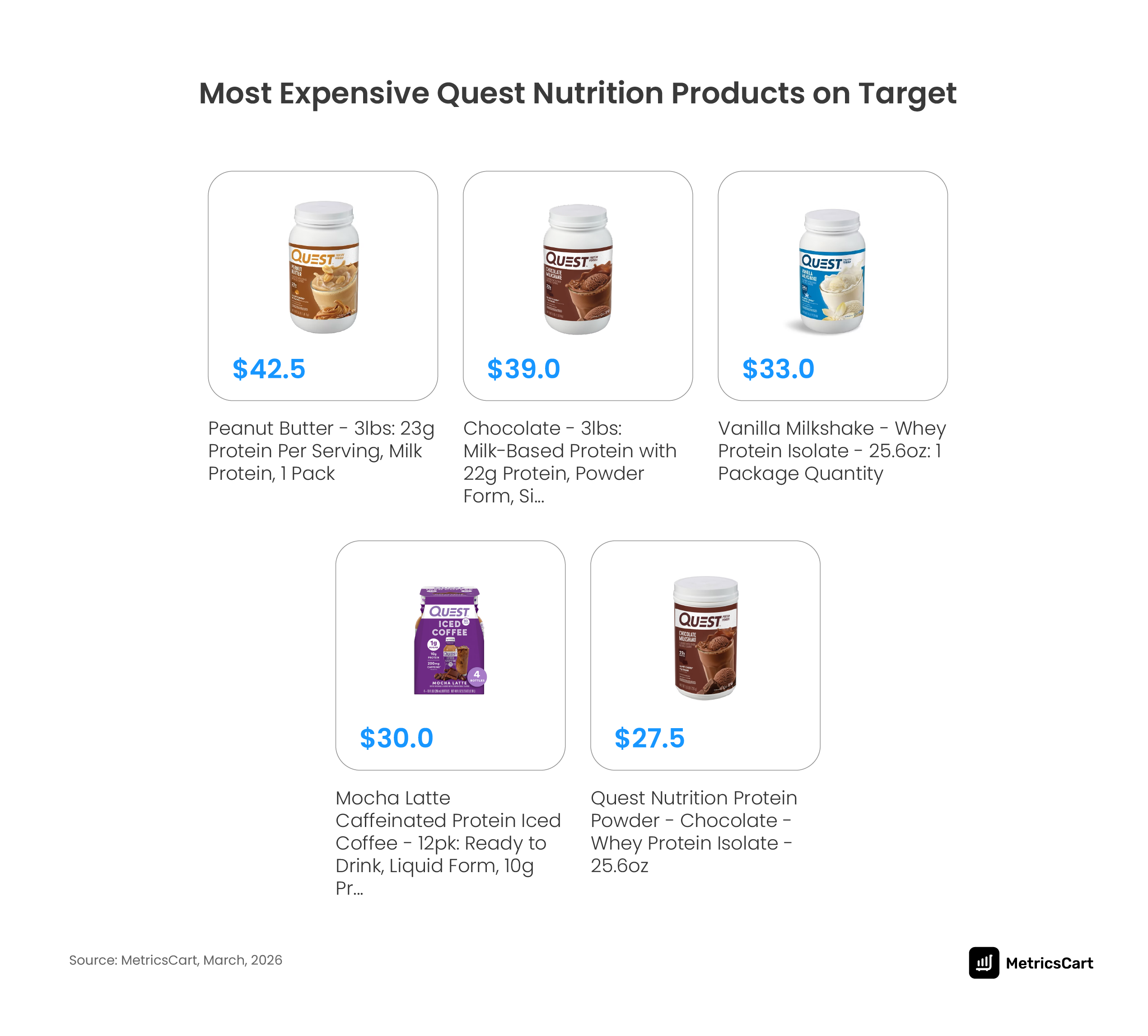
Protein powders dominate Quest Nutrition’s premium shelf on Target. The top-priced product in the catalog is the Quest Nutrition Protein Powder Peanut Butter (3lb, 23g protein per serving) at $42.50.
Three factors push it to the top of the list:
- Largest pack size in the catalog. At 3lb, it’s the biggest tub Quest lists on Target, and the price scales directly with volume.
- A different buyer than the rest of the catalog. Powder shoppers purchase for daily supplementation, not as a snack, and buy in bulk to lower the per-serving cost.
- Peanut butter is expensive to formulate. The real peanut protein content pushes ingredient costs above the vanilla or chocolate baselines.
The next two SKUs sit just below:
- Chocolate 3lb Milk-Based Protein Powder at $39.00. Same 3lb format and same daily-supplementation buyer as the top SKU, but chocolate is a cheaper flavor to produce than peanut butter, which accounts for the $3.50 gap.
- Vanilla Milkshake Whey Protein Isolate (25.6oz) at $33.00. A smaller pack (25.6oz versus 3lb) built on whey isolate, a more refined and expensive protein source than the milk-based blend in the chocolate powder. That’s why it commands a higher per-ounce price despite the lower total ticket.
Below the powder tier, Quest’s 12-count protein bar multipacks all cluster at $26.50, regardless of flavor. This flat-flavor pricing removes price as a decision variable and lets flavor preference drive the purchase, an approach borrowed from mainstream snack aisles rather than the supplement category.
The Most Affordable Quest Nutrition Products on Target
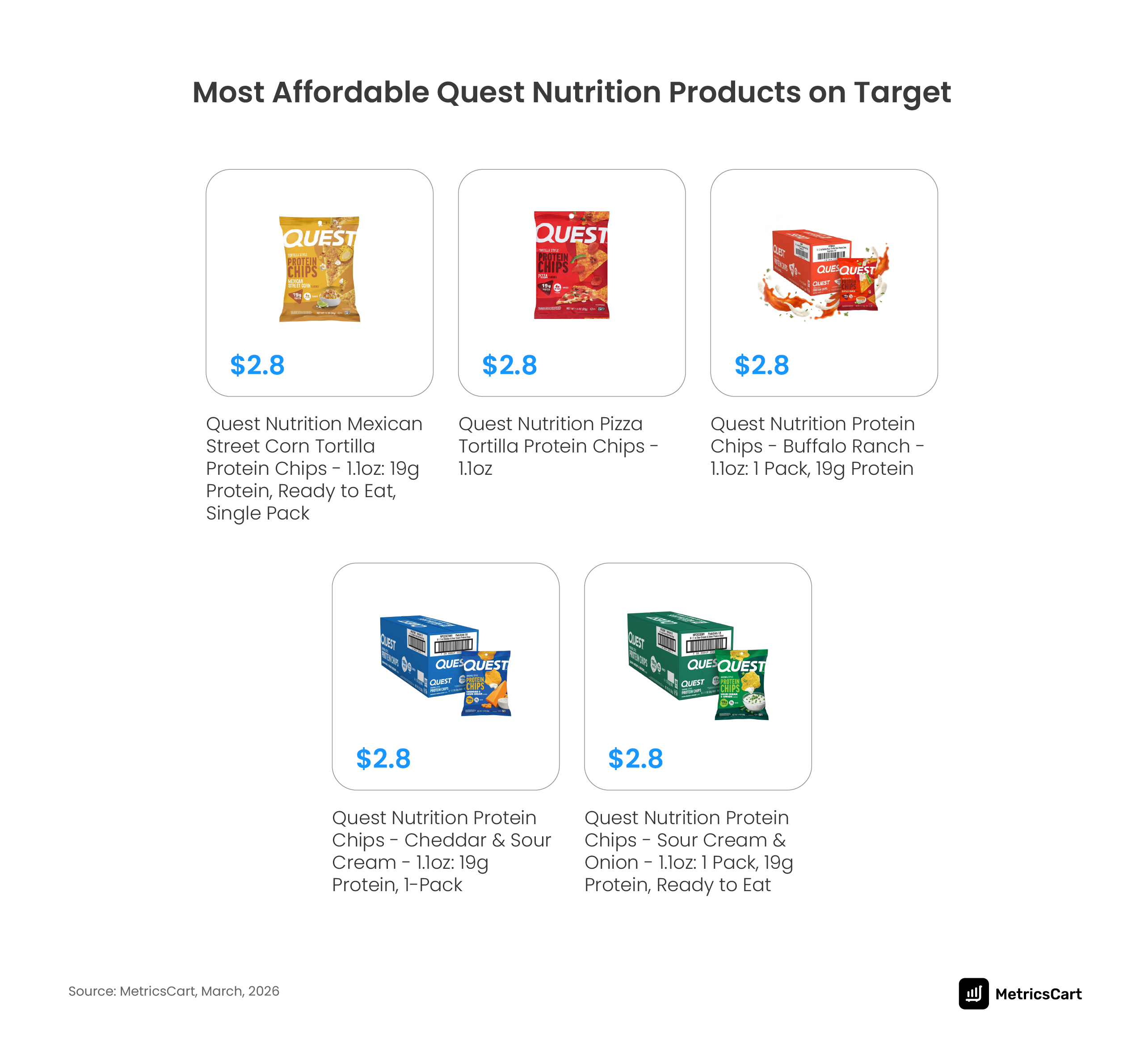
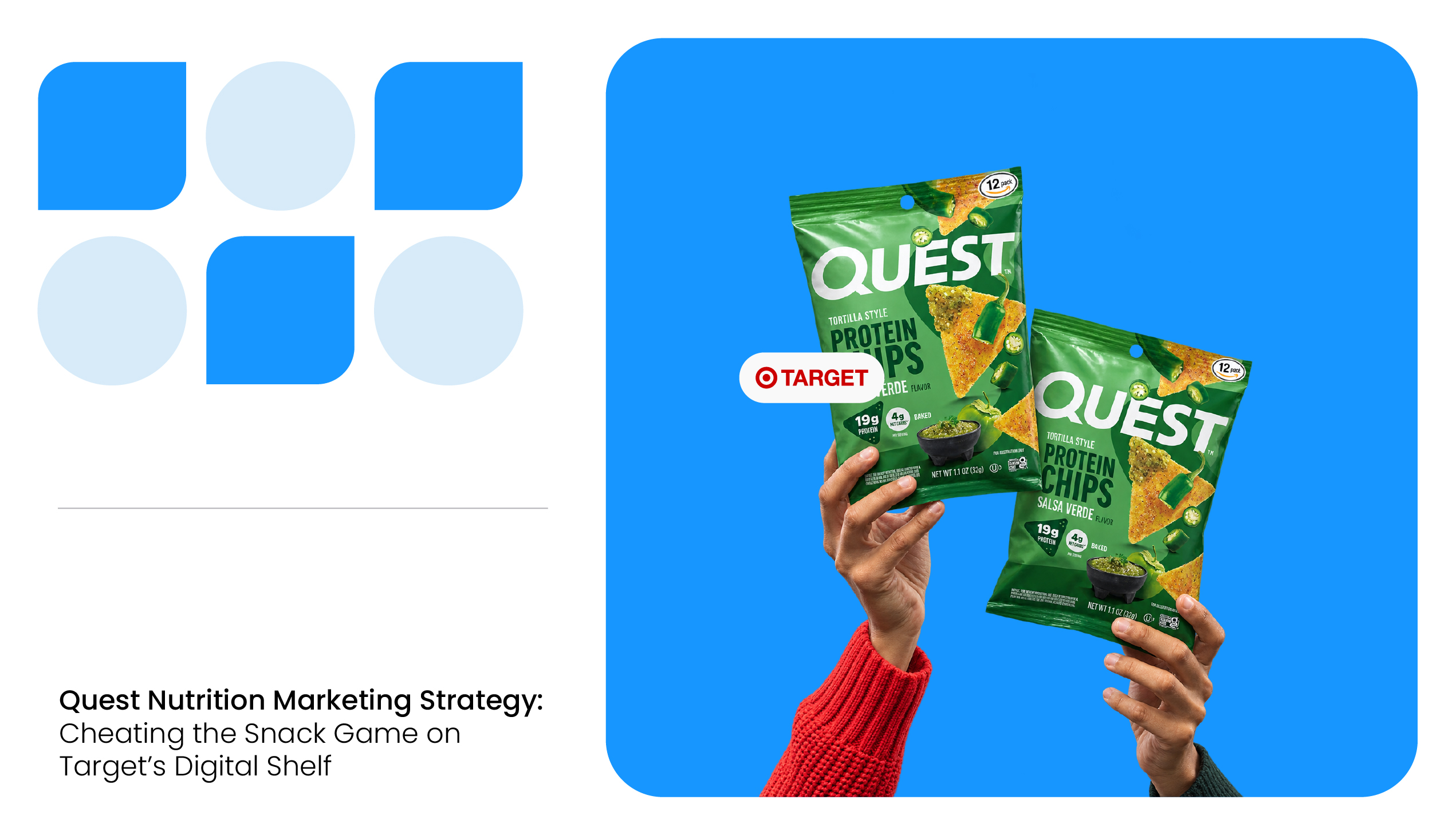
At the opposite end of the catalog, Quest Nutrition’s most affordable Target SKUs are protein chips, single-serve bars, and a milkshake. Seven protein chip flavors all cost $2.80 for a 1.1oz single-serve pack, tying for the lowest price on the shelf.
Two reasons the chips anchor the low end:
- Single-serve format designed for trial. At 1.1oz, these are impulse packs sized for one snacking occasion, not a pantry stock-up. That lowers the barrier for a first-time buyer to try Quest without committing to a $26.50 multipack.
- Flat pricing across every flavor. Every chip flavor is $2.80, so a shopper picks up Buffalo Ranch or Chili Lime based on taste preference, not per-pack discount. It’s the same flat-flavor logic Quest applies to bars, tuned to a trial-purchase price point.
Two more SKUs round out the affordable tier:
- Chocolate Chip Cookie Dough single bar (2.12oz) at $2.90. This is Quest’s most recognizable flavor, released years ago as the first bar that broke the brand beyond bodybuilders and into mainstream snacking. Offering it as a single at under $3 gives new shoppers a low-risk entry point to Quest’s flagship flavor before they commit to the $26.50 12-pack.
- Chocolate Peanut Butter Protein Crispy Bar (1.9oz) at $3.00 and 45g Protein Milkshake, Strawberry Flavored (14 fl oz Bottle) at $4.00. The Crispy Bar extends the single-serve trial format into a second flavor profile, while the Milkshake is the only ready-to-drink SKU in the low-price range.
Which Quest Nutrition Products Are Selling Best on Target?
Review count and upvote count are MetricsCart’s clearest proxies for what’s actually converting on Target’s shelf. The review count shows what shoppers are buying the most. Upvote count shows which reviews other shoppers rely on before buying. For Quest Nutrition, the two lists barely overlap, and the gap between them is where the real story sits.
The Top Reviewed Quest Nutrition Products
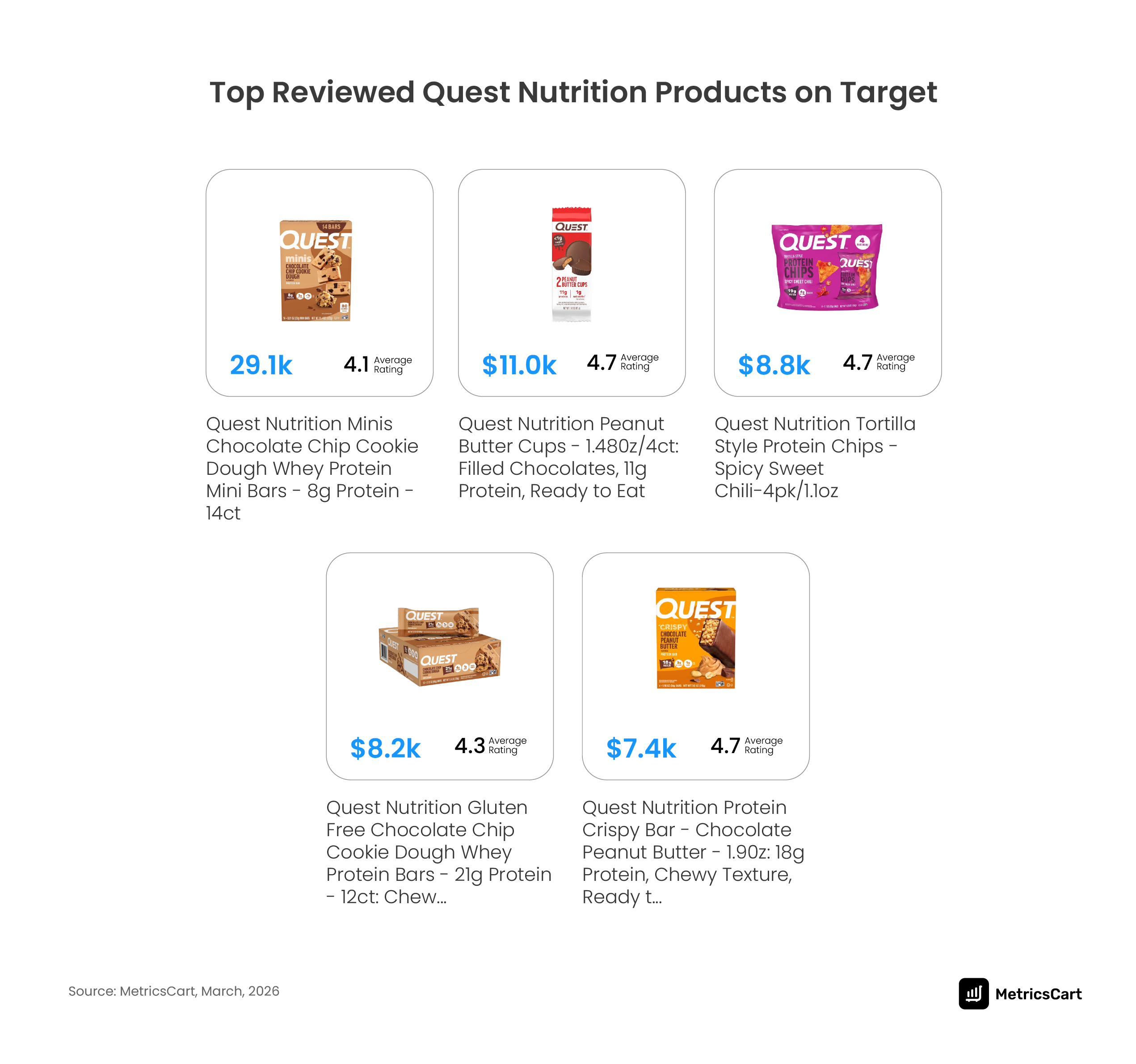
The runaway leader is Quest Nutrition Minis Chocolate Chip Cookie Dough Whey Protein Mini Bars (8g protein, 14-count), with 29.1K reviews, nearly three times that of the next-ranked product.
The Minis top the list because they pair Quest’s most recognizable flavor with a small, low-commitment format and an entry price of $17.80, well below the $26.50 price of the 12-count multipacks. The 4.1 average rating, the lowest in the top 10, reflects the trade-off: a bigger, more varied shopper base means more mixed opinions.
Sitting in second place is Quest Nutrition Peanut Butter Cups (1.48oz, 4-count) at 11.0K reviews and a 4.7 rating. Shoppers judge them against candy rather than protein bars, and Quest clears that bar easily. Third is Quest Nutrition Tortilla Style Protein Chips Spicy Sweet Chili (4pk/1.1oz) at 8.8K reviews and a 4.7 rating, proving Quest’s savory line converts on both volume and satisfaction.
Bars and chips fill the entire top 10. No protein powder makes the list.
The Most Upvoted Quest Nutrition Products
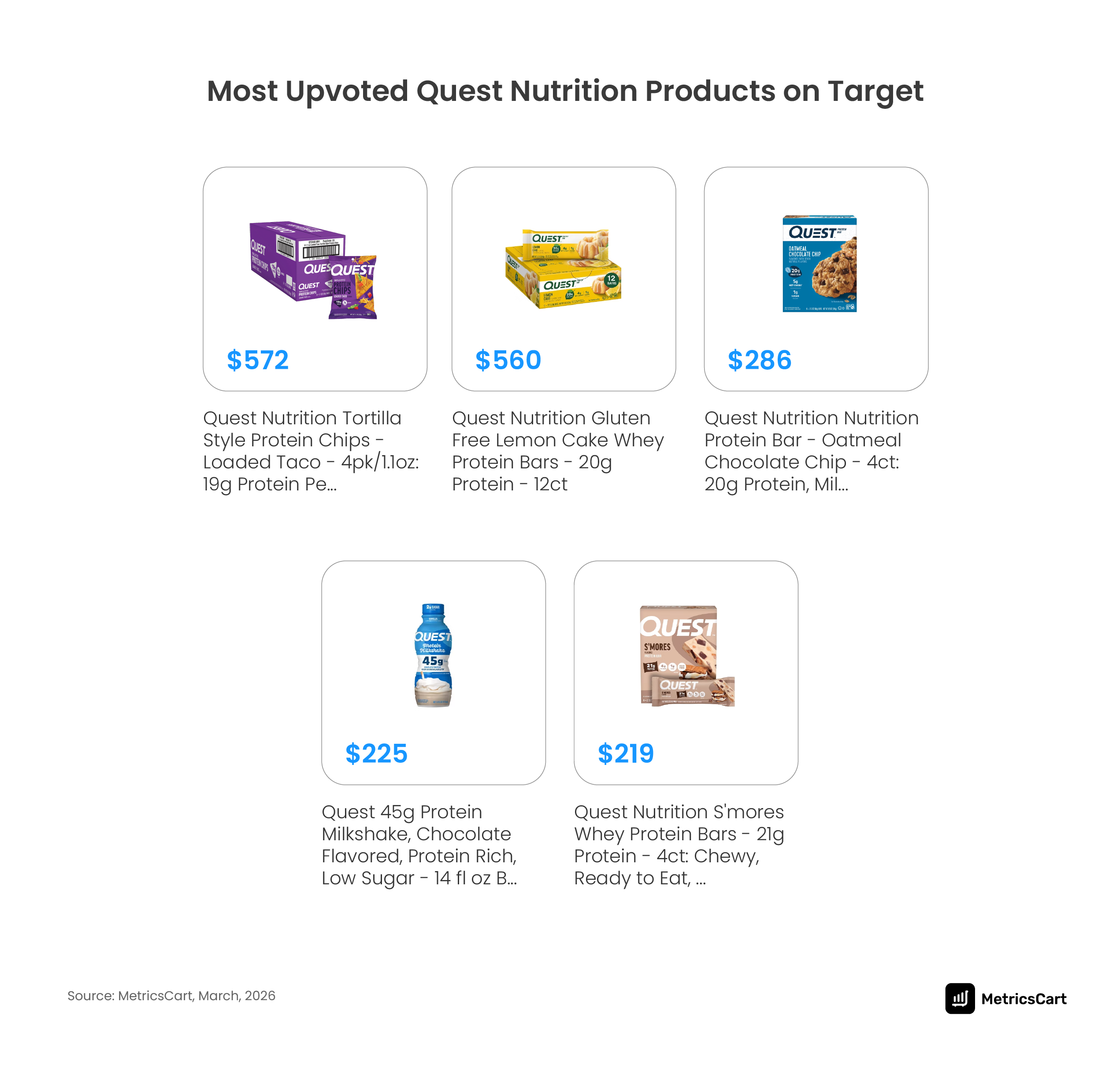
The upvote list looks very different. The Mini Bars, Quest’s biggest seller, don’t appear at all. Instead, Quest Nutrition Tortilla Style Protein Chips Loaded Taco (4pk/1.1oz) tops the list with 572 upvotes. Loaded Taco isn’t a familiar chip flavor, so shoppers looking at it want to know how it actually tastes. Reviews that answer that question get upvoted.
Sitting just below is Quest Nutrition Gluten Free Lemon Cake Whey Protein Bars (12-count) at 560 upvotes. Same pattern: unusual flavor, higher-commitment purchase, more research before buying. The next-ranked product, NutritionProtein Bar Oatmeal Chocolate Chip (4-count) at 286 upvotes, sits at roughly half.
The pattern backs up Quest’s flavor-innovation strategy. Cookie dough sells because shoppers already trust it. Loaded Taco sells because the reviews convince them to try it.
One more signal worth flagging: both sponsored Vanilla Latte and Mocha Latte Protein Iced Coffee SKUs land in the upvote top 10 (189 and 176 upvotes). For a newer format, Quest is still building on Target; that’s a strong sign shoppers are actually engaging with the launch, not just seeing paid impressions.
What Customers Are Saying About Quest Nutrition on Target: Flavor, Quality, and a 9:1 Verdict
Quest Nutrition’s Target reviews tell a broadly positive story, and the topics customers focus on reveal where the brand is genuinely winning.
What Quest Nutrition Customers Talk About Most
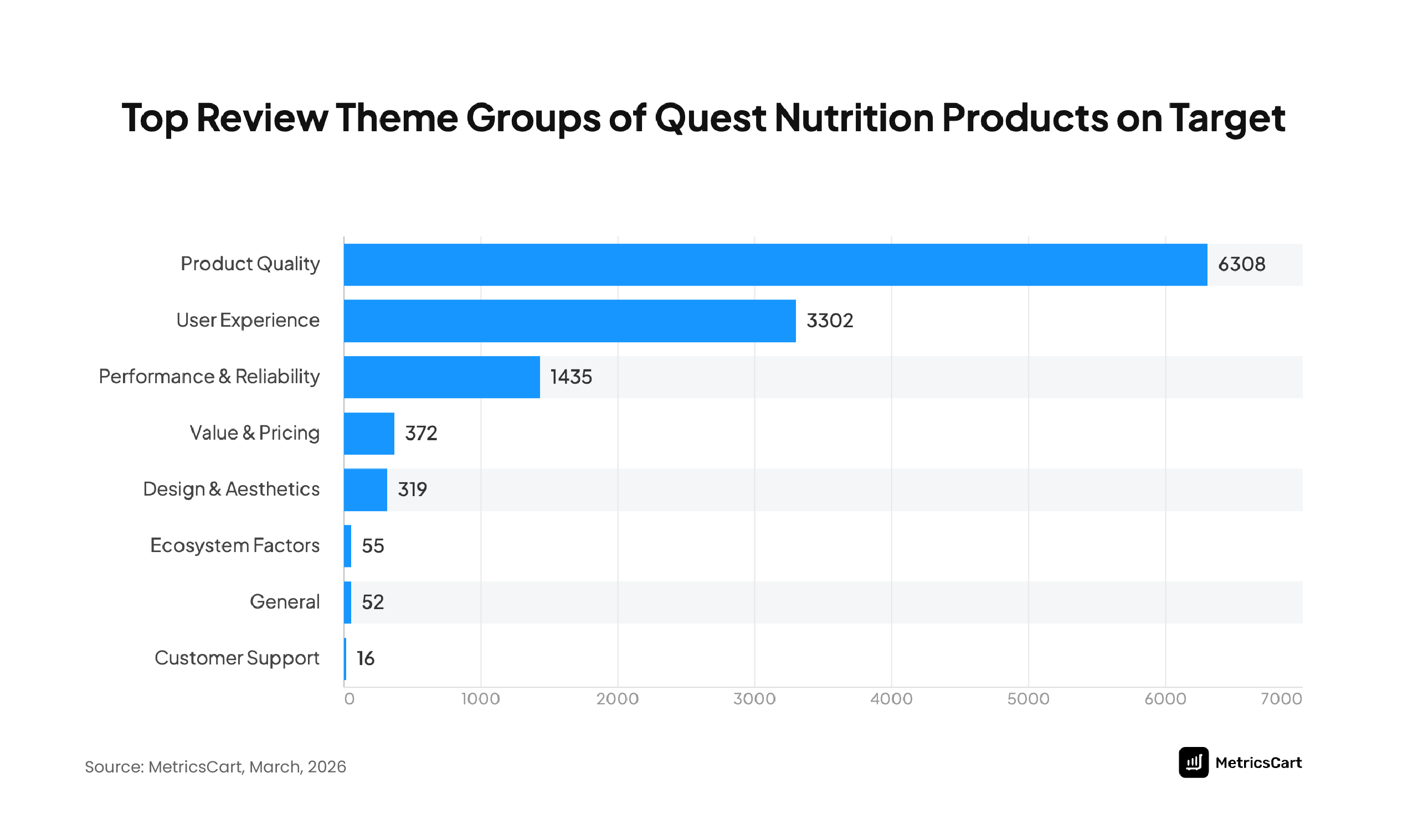
Product Quality dominates the conversation with 6,308 mentions, roughly 50% of all thematic reviews and more than twice the next-ranked theme. That concentration matters. It tells us that shoppers are judging Quest Nutrition primarily on whether the product itself delivers on taste, texture, and ingredient quality, rather than on packaging, price, or brand story.
For a brand built around the “protein food that actually tastes good” promise, this is the right conversation to be leading. The theme that Quest most needs shoppers to care about is exactly the one they’re talking about most. User Experience follows in second place with 3,302 mentions, and Value & Pricing sits far down the list at 372 mentions, indicating that Quest is not being judged as a price play.
The Most Common Review Subthemes
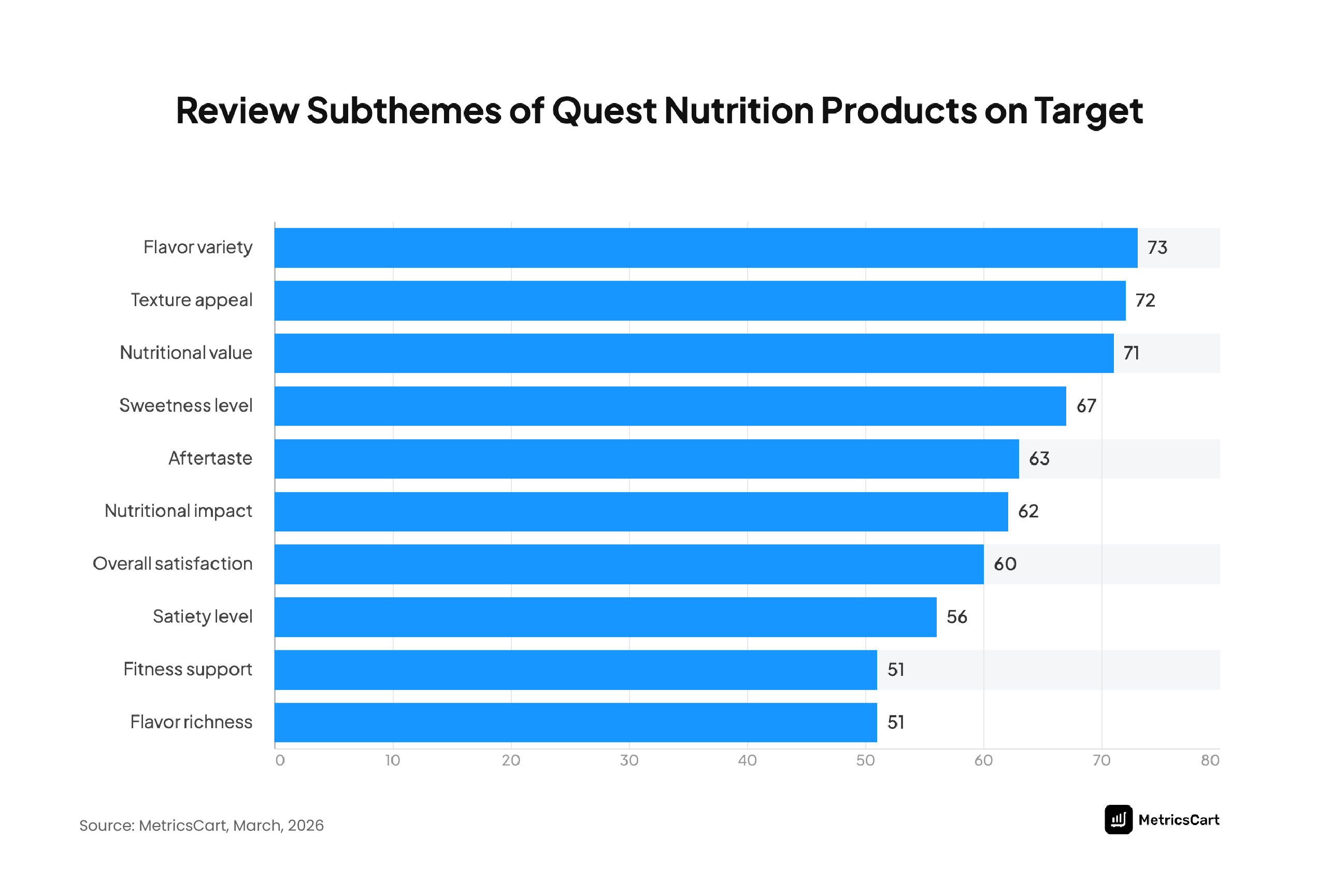
Zooming in on what shoppers actually discuss, Flavor variety tops the subtheme list with 73 mentions.
That’s a direct validation of Quest Nutrition’s core marketing strategy. The whole reason Quest launches Loaded Taco chips, Lemon Cake bars, and Birthday Cake cookies is to compete on the eating experience rather than the macro sheet. When flavor variety is the number one thing customers bring up in reviews, it means the strategy is landing with the audience Quest is trying to reach.
Texture appeal (72) and Nutritional value (71) follow closely behind. Texture matters in the protein category because dry, chalky, or gummy products dominate the shelf, and Quest’s higher ranking suggests its products avoid the common failure modes. Nutritional value near the top confirms shoppers still evaluate Quest on the numbers, but flavor and texture matter to them just as much.
The Sentiment Split: 73% Positive, 8% Negative
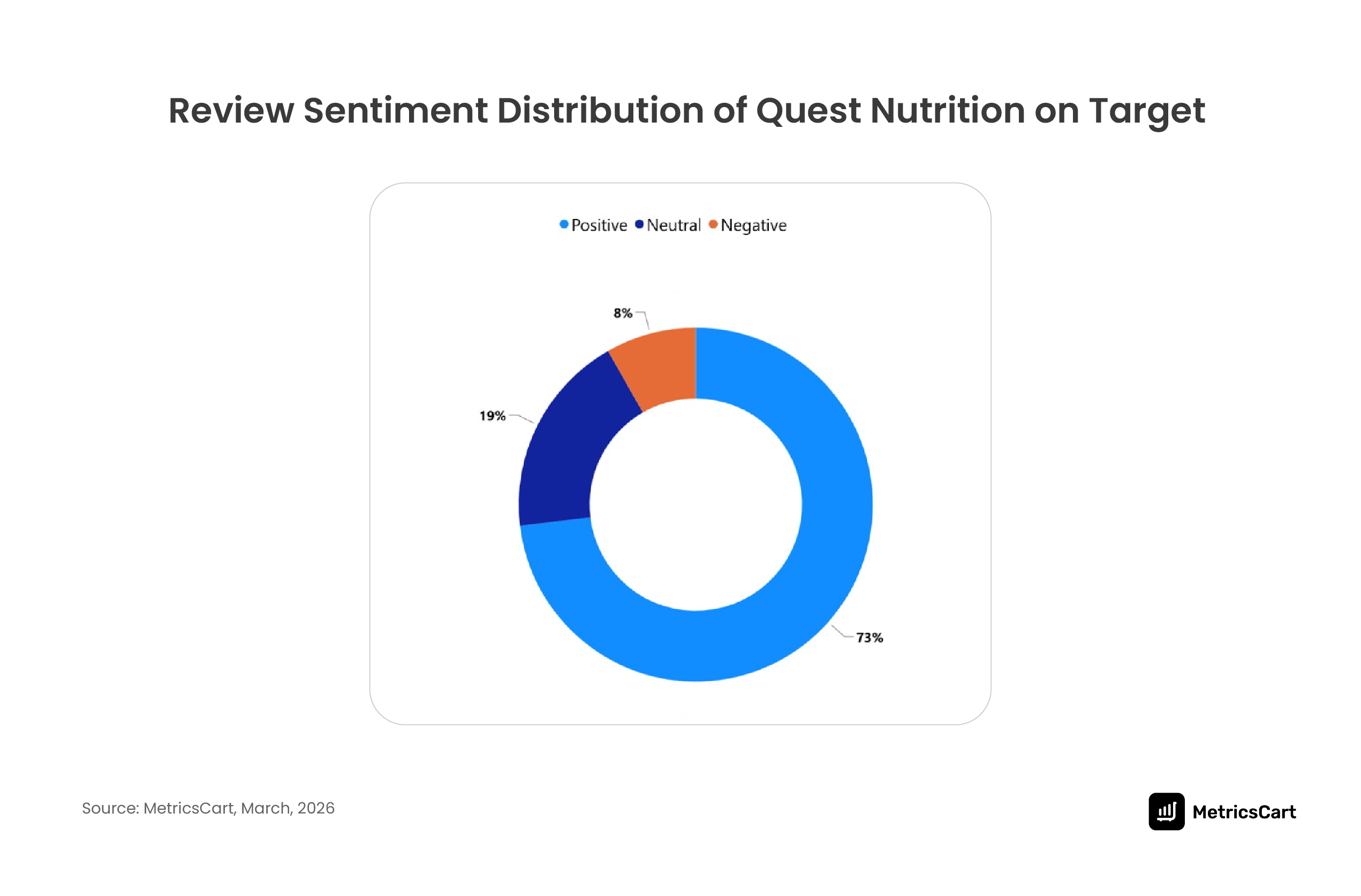
MetricsCart’s sentiment analysis of Quest Nutrition’s Target reviews shows:
- 73% positive
- 19% neutral
- 8% negative
That works out to a roughly 9:1 positive-to-negative ratio — a strong satisfaction signal for a brand with 326K reviews at scale. With only 8% of reviews landing negative, Quest Nutrition has relatively few dissatisfied buyers on Target’s shelf.
The high positive share also reinforces what the theme data shows: customers focus on quality and taste because both largely meet expectations. When product quality is the dominant topic and sentiment is 73% positive, the two data points describe the same reality from different angles.
READ MORE | Protein Powders on Google Shopping: Pricing, Reviews, Buy Box, and Seller Insights
What Quest Nutrition Gets Right, and What It Doesn’t
Quest Nutrition wins on Target by executing the fundamentals with discipline:
- Pricing is transparent and flat within each format, so shoppers pick by flavor rather than by cost.
- The catalog is tiered cleanly by buyer intent, with distinct price bands for trial, repeat purchase, and daily supplementation.
- Flavor innovation drives both discovery and detailed review activity.
- Product quality holds remarkably consistent across a review base of more than 300K, keeping negative sentiment low even at scale.
The gaps are where competing protein brands have room to move:
- Quest’s premium tier commands the highest prices but not the highest engagement, leaving an opening for challenger brands willing to compete on visibility rather than shelf price.
- A meaningful share of the customer base has neutral sentiment, meaning shoppers who are convertible to any competitor are leaning more toward flavor or novelty.
- Most of Quest’s review base lives off-retailer, which weakens its on-shelf conversion power.
- In newer formats, Quest is still building traction, giving faster-moving competitors time to establish a stronger position before the category locks down.
The protein category at Target is moving quickly, and shelf openings do not stay open for long. Whether the goal is to protect share against a category leader like Quest Nutrition or to grow into the openings the brand hasn’t yet closed, the difference between a reactive move and a strategic one is having the pricing, sentiment, and shelf-movement data in front of you as it happens.
That is exactly what MetricsCart is built for. From flavor-level review trends to daily price shifts, assortment changes, and share-of-shelf tracking across Target, Amazon, Walmart, and 150+ other retailers, brands see what is changing on their digital shelf in real time and can act on it before the window closes.
Is your protein brand winning the flavors that matter on Target?