Highlights
- AI review analysis uses natural language processing to read, classify, and quantify customer reviews at a scale manual reading cannot reach.
- The core techniques are sentiment analysis, theme and sub-theme analysis, topic modeling, emotion and intent detection, incentivized review monitoring, and fake-review filtering.
- A repeatable workflow looks like this: collect reviews across all retailers, clean the data, run sentiment and aspect analysis, cluster themes, quantify, then act.
- Brands use the output for product decisions, listing optimization, competitor benchmarking, and early detection of quality issues.
- Running this consistently and accurately across many retailers is where one-off methods break down, and a dedicated platform like MetricsCart takes over.
Every product you sell online is currently being reviewed on Amazon, Walmart, Target, and your own store. A single popular listing can collect thousands of reviews a month, and each one carries a signal about your product, your content, or the buying experience.
Reading them by hand does not scale, and skimming a handful misses the patterns that actually move sales. This is the gap that AI review analysis for e-commerce closes.
Instead of treating reviews as a wall of text, AI turns them into structured, quantified insight you can act on. This guide covers what AI review analysis is, the techniques that power it, a step-by-step process you can follow, and how to run it continuously across every retailer you sell on.
How does AI Review Analysis for E-Commerce Differ From Manual Review Reading?
The difference shows up on three fronts. The first is scale. A person can read a sample, while AI reads every review with the same effort. The second is consistency, because AI applies identical logic to review number ten and review number ten thousand, so the analysis does not drift as a reader gets tired.
The third is depth. Manual reading gives you a general impression, whereas AI extracts feature-level sentiment and recurring themes you would never spot by eye. If forty reviews quietly mention that a zipper fails after a month, a human skim will miss it while a model surfaces it as a distinct pattern.
Why are E-Commerce Reviews Hard To Analyze At Scale?
Reviews are messy input. The volume alone is a problem, and it grows every day. The feedback is scattered across many retailers, each with its own format and export quirks. Individual reviews often carry mixed sentiment, praising the product while complaining about delivery, and some rely on sarcasm that trips up simple keyword matching.
Add multilingual reviews and a steady stream of fake or incentivized ratings, and clean analysis becomes genuinely difficult. These are the exact conditions AI is built to handle, and they are also the reason a purpose-built approach matters later.
How Does AI Analyze E-Commerce Reviews?
Underneath every review analysis tool sits a set of NLP models that convert free text into structured signals. Here are the techniques that do the heavy lifting.
Sentiment Analysis
Sentiment analysis classifies feedback as positive, negative, or neutral, and often assigns a score along that scale. At its simplest, it works at the review level, giving you a fast read on how customers feel in aggregate and how that feeling shifts over time. An overall score is a useful headline number, though, on its own, it remains fairly blunt.
This is why aspect-based sentiment analysis (ABSA) matters. Rather than scoring the whole review, ABSA attaches sentiment to specific product features. A single review might be positive about battery life, negative about sizing, and neutral about packaging, and ABSA captures all three separately.
That feature-level view is where the actionable insight lives, because it tells you precisely which attribute is lifting or dragging your rating.
Theme and Sub-Theme Analysis
Theme and sub-theme analysis organizes what customers talk about into a structured hierarchy. A broad theme such as “quality” breaks down into sub-themes like durability, stitching, or material, and “delivery” splits into speed, packaging, and condition on arrival.
This layered structure lets you move from a high-level concern down to the exact details behind it, so a dip in a theme points you straight to the responsible sub-theme.
Product Attribute Level Analysis
Product attribute analysis discovers recurring topics across thousands of reviews without anyone defining the categories in advance. The model surfaces clusters on its own, so an emerging issue like “stopped working after a month” appears as its own group even if no one thought to look for it.
While theme analysis operates within a known structure, product attribute analysis identifies unexpected patterns, making it useful for catching new problems early.
Emotion and Intent Detection
Polarity tells you whether feedback is positive or negative. Emotion and intent detection go further, picking up frustration, delight, or disappointment, and flagging signals such as a customer likely to churn or return an item. These cues add texture that a simple positive or negative label misses.
Incentivized Review Monitoring
Not every biased review is fake. Incentivized reviews come from customers who received a discount, a free product, or another reward in exchange for feedback, which can skew ratings upward even when the reviewer is genuine.
AI monitors for disclosure language and behavioral patterns that mark these reviews, so you can see how much of your rating rests on incentivized feedback and read your genuine sentiment more clearly.
Fake-Review Filtering
Genuine analysis depends on genuine data. AI models flag fabricated or manipulated reviews, such as bursts of near-identical text or unnatural account behavior, and filter them out before analysis. This keeps your insight grounded in real customer feedback rather than manipulation, and it ties directly back to the noise problem raised earlier.
How to Analyze E-Commerce Reviews Using AI, Step by Step
Techniques are only half the picture. Here is a repeatable workflow for putting them to work.
Step 1. Collect Reviews Across Every Retailer And Marketplace
Gather feedback from all of your sales channels, not one. Insight drawn from a single marketplace is a partial view, and customers on Walmart may raise issues that Amazon shoppers never mention. Fragmentation across retailers is the first real hurdle, and solving it early sets up everything that follows.
Step 2. Clean and Structure the Review Data
Before analysis, deduplicate entries, remove noise, normalize formats and languages, and separate authentic reviews from spam. Messy input produces messy conclusions, so this step protects the quality of everything downstream.
Step 3. Run Sentiment Analysis
Apply the techniques above in order. Start with overall sentiment for the headline read, then layer in aspect-based sentiment to see which specific features are driving that number up or down.
Step 4. Cluster Themes and Surface Patterns
Move from individual reviews to recurring issues and strengths. Topic modeling turns raw volume into a shortlist of themes, so you spend your time on the handful of patterns that repeat rather than on one-off comments.
Step 5. Quantify and Prioritize
Convert qualitative text into metrics: feature-level sentiment scores, theme frequencies, and trends over time. These e-commerce review analytics let you rank issues by how often they appear and how much they affect the business, so your team works on what matters most.
Step 6. Act on the Review Insight
Route findings to the people who own them. Product teams get roadmap signals, content teams get listing fixes, customer experience teams get recurring complaints to resolve, and marketing gets the language customers actually use. Then repeat the cycle continuously rather than treating it as a one-time audit, because customer sentiment keeps moving.

What Brands Can Learn From AI Customer Review Analysis?
Done well, customer feedback analysis pays off in several directions at once.
Product improvement and roadmap signals: Recurring complaints and repeated feature requests become a prioritized input for product decisions, backed by real customer numbers rather than internal guesswork.
Listing and content optimization: Reviews reveal the exact language shoppers use and the questions they keep asking. That feeds sharper titles, bullets, and A+ content, and it often improves conversion because the listing now answers real objections.
Competitor and category benchmarking: Product review analysis using AI is not limited to your own catalog. Analyzing competitor reviews shows where rivals are weak, where they are strong, and what the category as a whole expects, which helps you position against them.
Early detection of quality and supply issues: A sudden drop in sentiment on a single feature can flag a defect or a bad production batch before it turns into a wave of one-star ratings. Catching it early protects both revenue and reputation.
Voice-of-customer for marketing: Emotional and thematic patterns across reviews sharpen your positioning and give campaigns messaging that echoes how customers already talk about the product.
The Limits of Doing AI Review Analysis on Your Own
The techniques and workflow above genuinely work, and a brand can get real value from running them. The difficulty is sustaining that value. General-purpose AI tools and one-off scripts struggle with sarcasm and mixed sentiment, and their accuracy varies. They tend to produce a single snapshot rather than continuous monitoring, so insight goes stale quickly.
Stitching data together from many retailers is a constant chore; building and maintaining dashboards takes engineering time; multilingual reviews add complexity; and scaling all of this across a full catalog quickly becomes a project of its own. The result is that most in-house efforts deliver a good one-time analysis and then stall.
Turning Continuous Review Analysis Into a System With MetricsCart
While the process above might seem sufficient, the hard part is doing it consistently, accurately, and across every retailer you sell on, without building and babysitting the pipeline yourself. This is where a dedicated review monitoring and analysis platform earns its place.
MetricsCart operationalizes everything this article describes. It monitors reviews and ratings across 150+ global retailers in one place, so collection and fragmentation are handled for you.
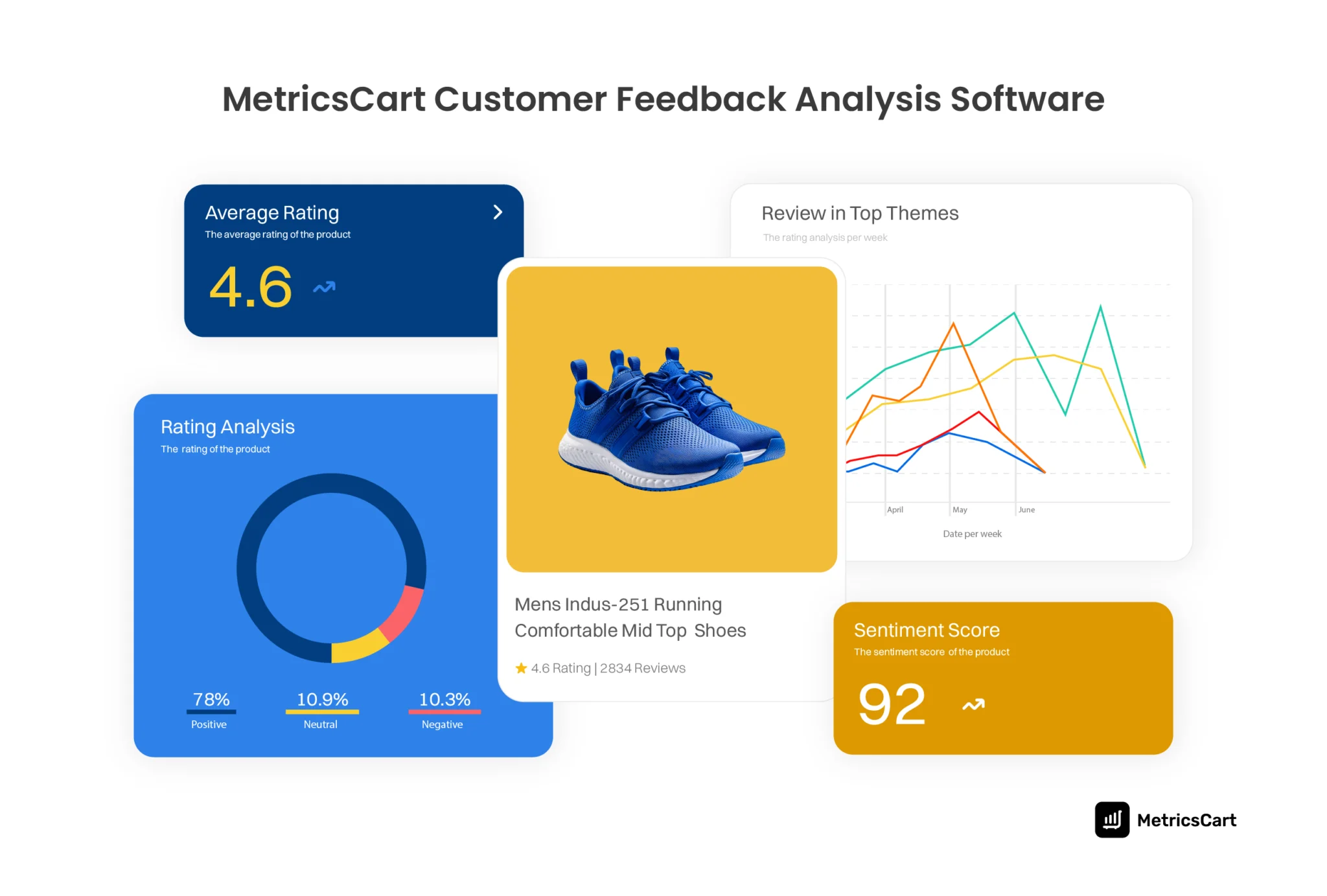
It runs sentiment analysis at scale, so feature-level insights arrive ready rather than being assembled by hand. It surfaces themes, trends, and shifts over time in clear dashboards, with alerts when sentiment moves so you catch problems early. Most importantly, it frees your team to act on insight rather than build the machinery that produces it.
Automate review analysis and surface the insights that deserve your attention.
FAQs
AI review analysis for e-commerce is the use of natural language processing and machine learning to automatically read customer reviews and turn them into structured insight. It classifies sentiment, identifies which product features customers mention, and surfaces recurring themes across thousands of reviews at a scale manual reading cannot match.
AI reads each review as text and applies NLP models to it. Those models detect sentiment, attach that sentiment to specific product features, group reviews into themes, pick up emotion and intent, and filter out fake reviews. The output is a set of scores and patterns you can measure and act on.
Yes. Sentiment analysis is one of the most established uses of AI on reviews. It labels each review as positive, negative, or neutral and can assign a score, which lets brands track how customer feeling changes over time and which products or features are trending down.
Sentiment analysis gives a single verdict for the whole review, while aspect-based sentiment analysis breaks that verdict down by feature. A review can be positive about battery life and negative about sizing at the same time, and aspect-based analysis captures both, which makes the insight far more actionable.
A general chatbot can analyze a batch of reviews you paste in, which is fine for a quick one-off look. It falls short on continuous monitoring, multi-retailer collection, dashboards, and scale. A dedicated platform like MetricsCart handles those parts automatically, so the analysis stays current across your whole catalog.