
Highlights
- Target lists 23 California Naturals products across 10 categories, while Walmart lists 14 across 6.
- Target has about 22K reviews compared to Walmart’s 14K, and both retailers average 4.5 stars.
- Almost every product is priced at $10 on both retailers. The Re: GRO Anti-Thinning Scalp Serum at $20 is the only exception, and it accounts for the whole gap in average price ($10.60 at Walmart vs $10.40 at Target).
- Body wash (4 products) and a six-product kids’ line are exclusive to Target, and Walmart’s only exclusive is the leave-in conditioner and detangler spray.
- Scent character and pleasantness lead review subthemes on both retailers (990 mentions at Target, 811 at Walmart), and Hair and Scalp Performance is the largest theme group on both (2,605 and 2,569).
About the Report: This report analyzes California Naturals’ digital shelf performance across Walmart and Target using the MetricsCart Digital Shelf Analytics platform. The analysis covers marketplace data tracked between August 17 and August 29, 2026, across 23 Target products and 14 Walmart products, and includes product count, pricing, category mix, review volume, and review themes.
By comparing the two retailers side by side, this California Naturals product analysis helps CPG and personal care brands benchmark retailer strategy and understand how assortment, pricing, and shopper feedback shape performance on the digital shelf.
Introduction
California Naturals launched in 2023 as a hair and body care line built for mass retail, and its brand strategy has stayed consistent since: clean formulas at accessible prices, sold where families already shop.
Founder Shelby Wild previously built the prestige hair care brand Playa, which sold shampoo and conditioner for $30 each. California Naturals went the other way on price. Six months after launch, it sold through Target and direct-to-consumer at $8.99 to $9.99, and its products now largely sit between $8 and $20, a tier between traditional mass and prestige brands.
The brand ended 2023 at 220% above its sales forecast. In 2026, the “Keep It Real” campaign added out-of-home advertising and community events, and the brand’s outreach now reaches tens of thousands of influencers.
The brand reports that this approach has widened its retail and ecommerce reach. According to Beauty Independent, California Naturals has registered 300% annual growth at Target and is in more than 15,000 retail doors, including Walmart, CVS, Sprouts, Target and Ulta Beauty.
It sits in 1,340 Walmart stores (about 30% of the chain) and 803 Target stores (about 40%), and it has exceeded its internal forecast at Ulta by 67% since entering in 2025. The brand is redesigning its direct-to-consumer site as its highest-margin channel, and Amazon serves as its primary stock-up and replenishment channel.
This report breaks down California Naturals on Walmart and Target across five areas: overall footprint, category assortment, pricing, review volume, and review themes. It closes with three lessons for CPG and personal care brands that sell across multiple retailers.
California Naturals on Walmart vs Target: An Overview
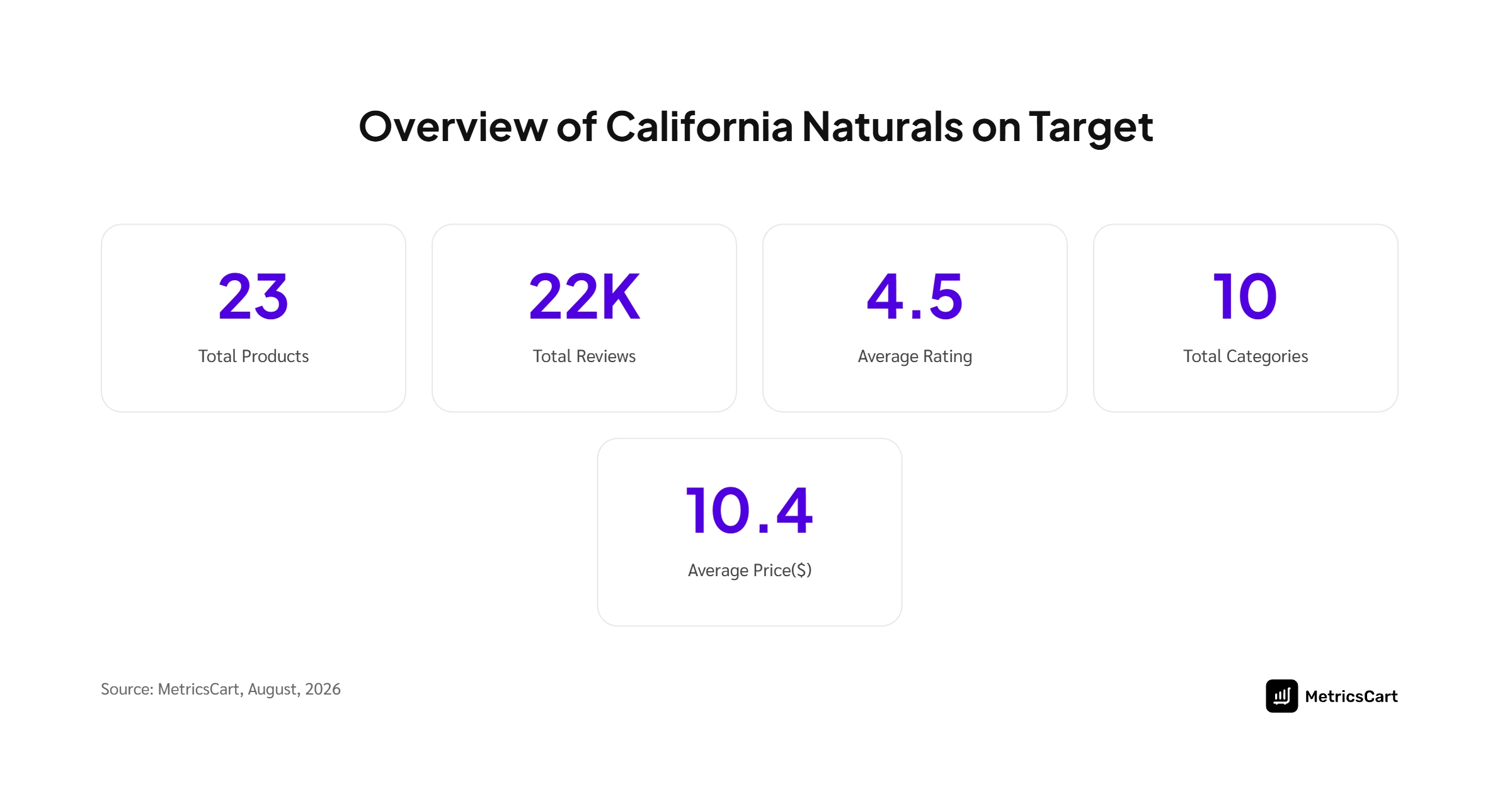
California Naturals has a presence on both retailers, and its digital shelf looks different on each. Target carries 64% more products (23 vs 14) and spans 10 categories, compared with Walmart’s 6. Target’s review base is also larger, with roughly 55% more reviews than Walmart.
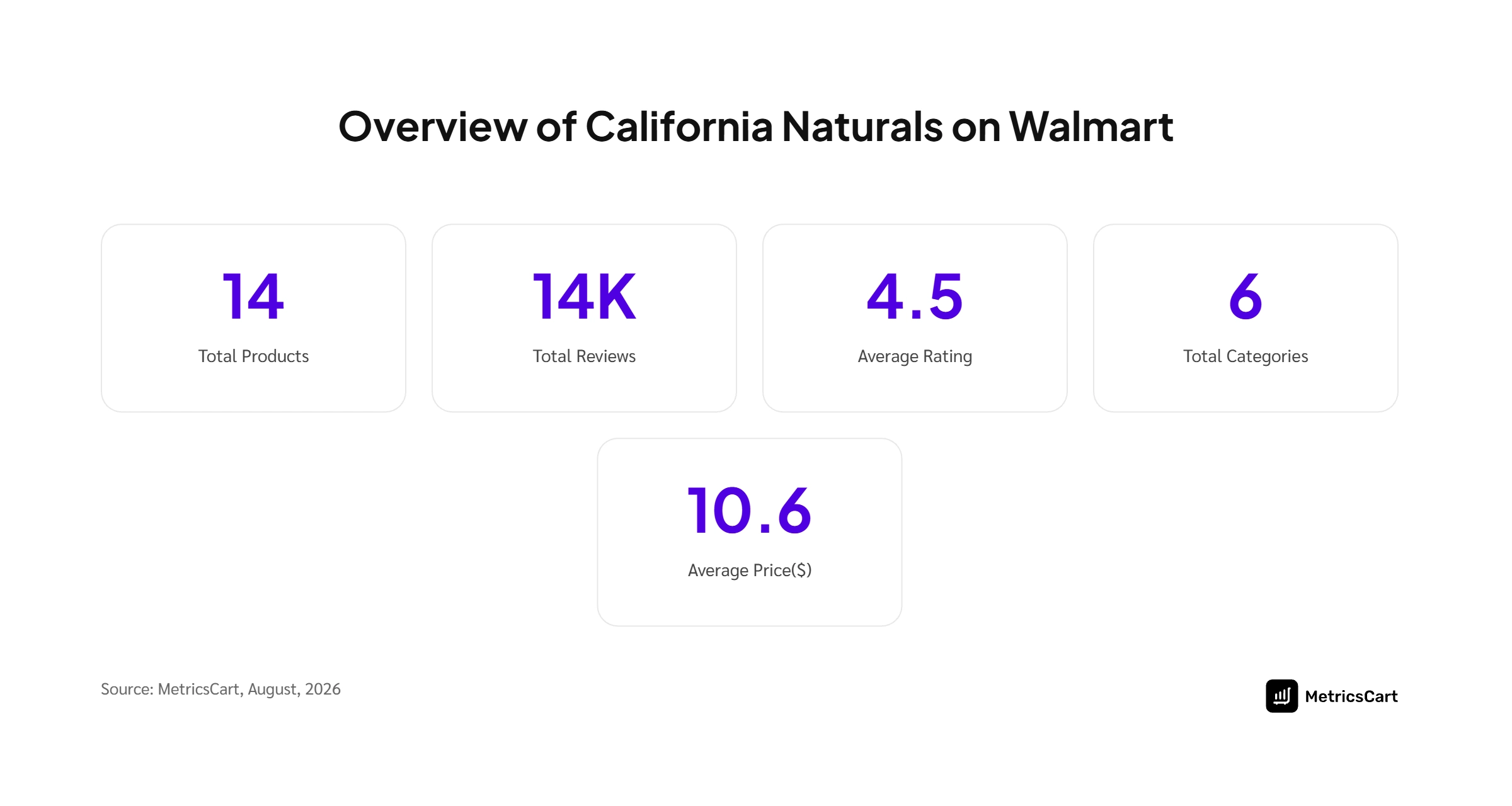
Both retailers show the same 4.5-star average rating. The brand’s average price is slightly lower at Target ($10.40) than at Walmart ($10.60), and a later section shows that this gap stems from assortment mix.
Target reports that 13 of its 23 California Naturals products are available in-store, representing 57% of its catalog. Brands can read this figure as the share of the range a Target shopper can pick up on a store visit.
California Naturals Product Analysis: Where Each Retailer Concentrates the Assortment
California Naturals offers a wide range of hair and body care products on both retailers, and the product mix differs between them. Shampoos and conditioners form the base of both shelves, with five of each on Walmart and five of each on Target.
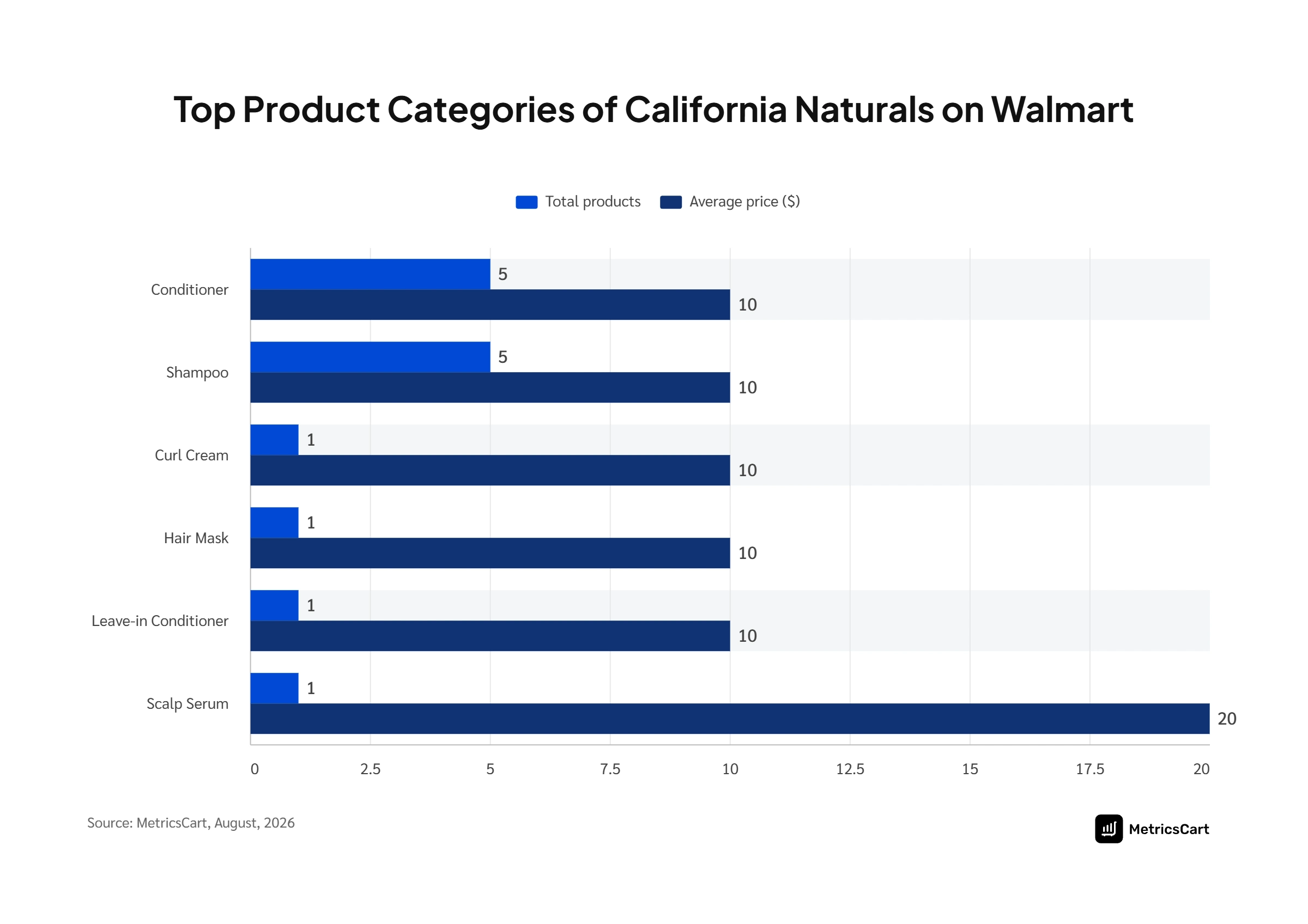
Both retailers carry the same five categories with identical product counts: five shampoos, five conditioners, and one each of curl cream, hair mask, and scalp serum. That adds up to 13 products on each retailer. Several lines carry slightly different names between the two sites.
Walmart lists the “Curl” line and “Classic Clean Toasted Coconut,” and Target lists “Dream Curl” and “Classic Coconut.”
Target adds 10 products on top of the shared core. Four are body washes (Classic Clean, Glow Oil, Sensitive Skin, and Super Moisture), and six are kids’ products: Sudsy Shampoo, Whipped Conditioner, Foaming 2-in-1 Hair & Body Wash, Tear-Free Detangler, Curly Kiddo Shampoo, and Curly Kiddo Conditioner. Walmart lists none of these.
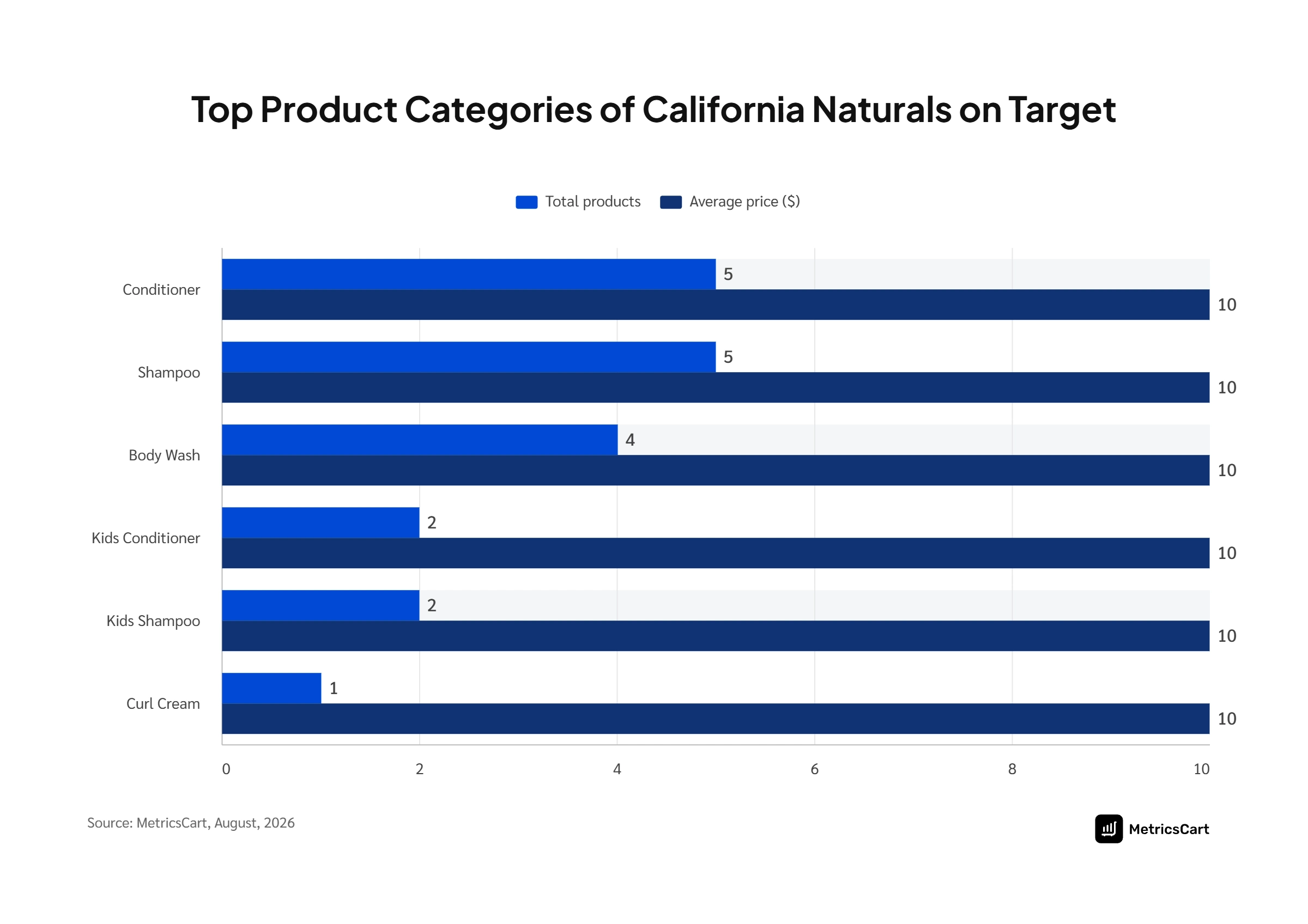
Together, these 10 products have 6,516 reviews, accounting for 29% of all Target reviews. The kids’ line spreads across four categories and accounts for 2,863 of those reviews.
Walmart’s single exclusive product is the California Naturals Leave-in Conditioner and Detangler Spray (6 fl oz, $10). Target has no leave-in product, and its closest equivalent is the kids’ Tear Free Detangler, which sits in a separate category.
The category mix points to a different role for each retailer. Target’s catalog covers hair care, body wash and children’s products in one place, which suits shoppers buying for a whole household. Walmart’s tighter range concentrates on hair care for adult shoppers.
California Naturals Pricing Analysis: Walmart vs Target
Using the MetricsCart pricing and promotion monitoring tools, we found that California Naturals prices its range almost identically on Walmart and Target. The average price is $10.60 at Walmart and $10.40 at Target, which, at first glance, suggests Walmart is slightly more expensive.
That $0.20 gap comes from assortment mix. Both retailers list the same $20 product, the Re: GRO Anti-Thinning Scalp Serum, and one $20 product in a 14-product catalog raises the average more than it does in a 23-product catalog.
Most Expensive California Naturals Products: Walmart vs Target
The Re: GRO Anti-Thinning Scalp Serum (3 fl oz) tops the price list at both retailers, at $20. Every other product on both lists is priced at $10.
Most Expensive California Naturals Products in Walmart
| Product Name | Price ($) |
| California Naturals Re: GRO Anti-Thinning Scalp Serum, 3 fl oz | 20.0 |
| California Naturals Deep Repair Hair Mask, Rose Garden Scent, 10.5 fl oz | 10.0 |
| California Naturals Curl Conditioner, 16.5 fl oz | 10.0 |
| California Naturals Curl Cream for Curly Hair, 8 fl oz | 10.0 |
| California Naturals Curl Shampoo, 16.5 fl oz | 10.0 |
Most Expensive California Naturals Products on Target
| Product Name | Price ($) |
| California Naturals Re: GRO Anti-Thinning Scalp Serum – 3 fl oz: Unscented, All Hair Types | 20.0 |
| California Naturals Classic Clean Body Wash – 16.5 fl oz: Contains Aloe, Sulfate-Free | 10.0 |
| California Naturals Classic Coconut Conditioner – 16.5 fl oz: For Dry Hair, Paraben-Free. | 10.0 |
| California Naturals Classic Coconut Shampoo – 16.5 fl oz: Vegan, Basic Cleansing, All Hair Types | 10.0 |
| California Naturals Deep Repair Hair Mask – 10.5oz: Moisturizing, Sulfate-Free, Vegan, All Hair Types | 10.0 |
Shampoos, conditioners, body washes, hair masks, curl creams, leave-in sprays and the entire kids’ line are priced at $10 on both retailers. The price is the same across bottle sizes from 6 fl oz to 16.5 fl oz. At 16.5 fl oz, $10 works out to about $0.61 per fl oz, and the 8 fl oz curl cream costs about $1.25 per fl oz at the same shelf price. Per-ounce figures are MetricsCart calculations from list price and pack size.
California Naturals Product Reviews: Target Review Volume by Product
Review volume is one of the clearest indicators of shopper engagement on the digital shelf. Using MetricsCart’s Ratings and Reviews Analysis solution, we examined how reviews are distributed across California Naturals’ products.
Most reviewed products at Target
| Product | Reviews |
| Super Moisture Conditioner, 16.5 fl oz | 1,703 |
| Super Moisture Shampoo, 16.5 fl oz | 1,482 |
| Classic Coconut Shampoo, 16.5 fl oz | 1,456 |
| Re:GRO Anti-Thinning Shampoo, 16.5 fl oz | 1,447 |
| Re:GRO Anti-Thinning Conditioner, 16.5 fl oz | 1,222 |
| Classic Coconut Conditioner, 16.5 fl oz | 1,204 |
The top six Target products are all shampoos and conditioners from the Super Moisture, Classic Coconut and Re: GRO lines. Eleven of the 23 products have more than 1,000 reviews, and the lowest-rated product has 418 reviews.
The four body washes have 1,001, 1,001, 897, and 754 reviews, averaging about 913 per product. The six kids’ products range from 418 to 532 reviews and average about 477, roughly half of Target’s overall average of 969 reviews per product. The kids’ Sudsy Shampoo (532) leads that group, and the Curly Kiddo Conditioner (418) trails it.
Walmart’s roughly 14K reviews span 14 products, averaging about 1,025 reviews per product, compared with about 969 at Target. Target’s higher total review count comes from its broader catalog, and Walmart’s per-product average is slightly higher. Per-product averages are MetricsCart calculations from the review totals.
READ MORE | Customer Feedback Analysis in E-Commerce: The Must-Know Aspects for Brands
What Shoppers Say: Review Themes on Walmart vs. Target
MetricsCart groups review text into themes and subthemes to show what shoppers discuss when they review a product. The counts below show how often each topic comes up and do not carry a positive or negative sentiment score.
Theme Groups on Walmart vs. Target
| Theme group | Target | Walmart |
| Hair and Scalp Performance | 2,605 | 2,569 |
| User Experience and Usability | 1,908 | 1,673 |
| Product Quality and Formulation | 1,004 | 1,024 |
| Value and Practical Ownership | 316 | 287 |
| General | 236 | 239 |
| Packaging and Physical Design | 189 | 160 |
| Comparisons and Overall Assessment | 176 | 114 |
| Purchase, Availability and Service | 79 | 28 |
The two retailers show nearly the same shape. Hair and Scalp Performance accounts for 40% of the 6,513 theme mentions at Target and 42% of the 6,094 at Walmart. User Experience and Usability follows at 29% and 27%, and Product Quality and Formulation at 15% and 17%. These three groups hold 85% of Target’s mentions and 86% of Walmart’s.
Target leads on usability by about 14% (1,908 vs 1,673) and records nearly three times as many purchase, availability, and service mentions (79 vs 28). Packaging draws about 3% of mentions at both retailers.
Review Sub-Themes of California Naturals on Walmart vs. Target
Scent character and pleasantness rank first on both retailers. It draws about 3.1x the mentions of the next subtheme at Target (990 vs 323) and about 2.2x at Walmart (811 vs 369). Scent strength is a separate subtheme that also appears in both top 10 lists, at 213 mentions on Target and 263 on Walmart. Scalp comfort appears on both lists at roughly 210 mentions each.
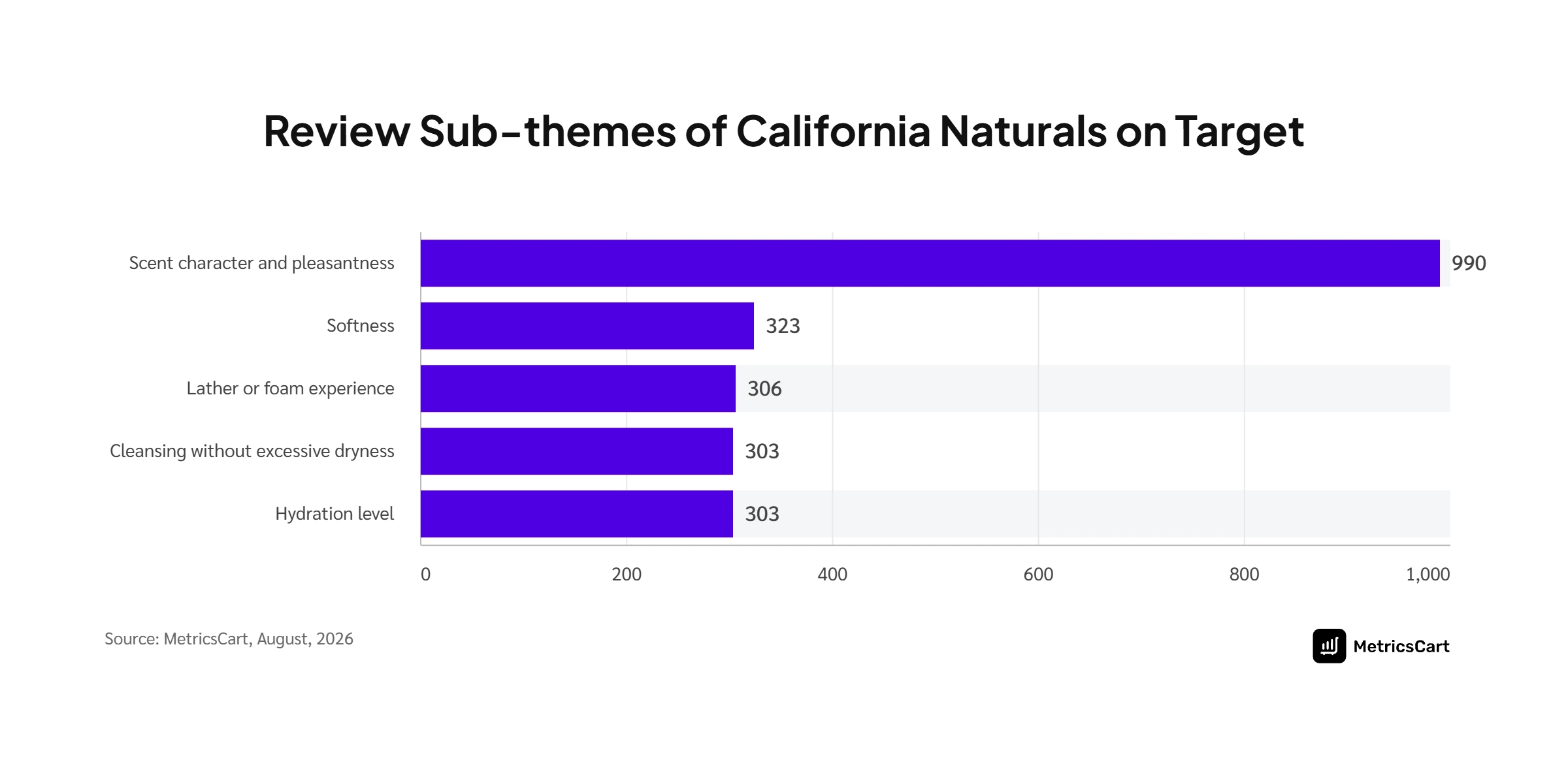
After scent, Target shoppers raise the cleansing experience: lather or foam (306), cleansing without excessive dryness (303), a clean-feeling result (294), and removal of oil and buildup (167). Target’s assortment includes body washes and kids’ washes, which plausibly raises these subthemes.
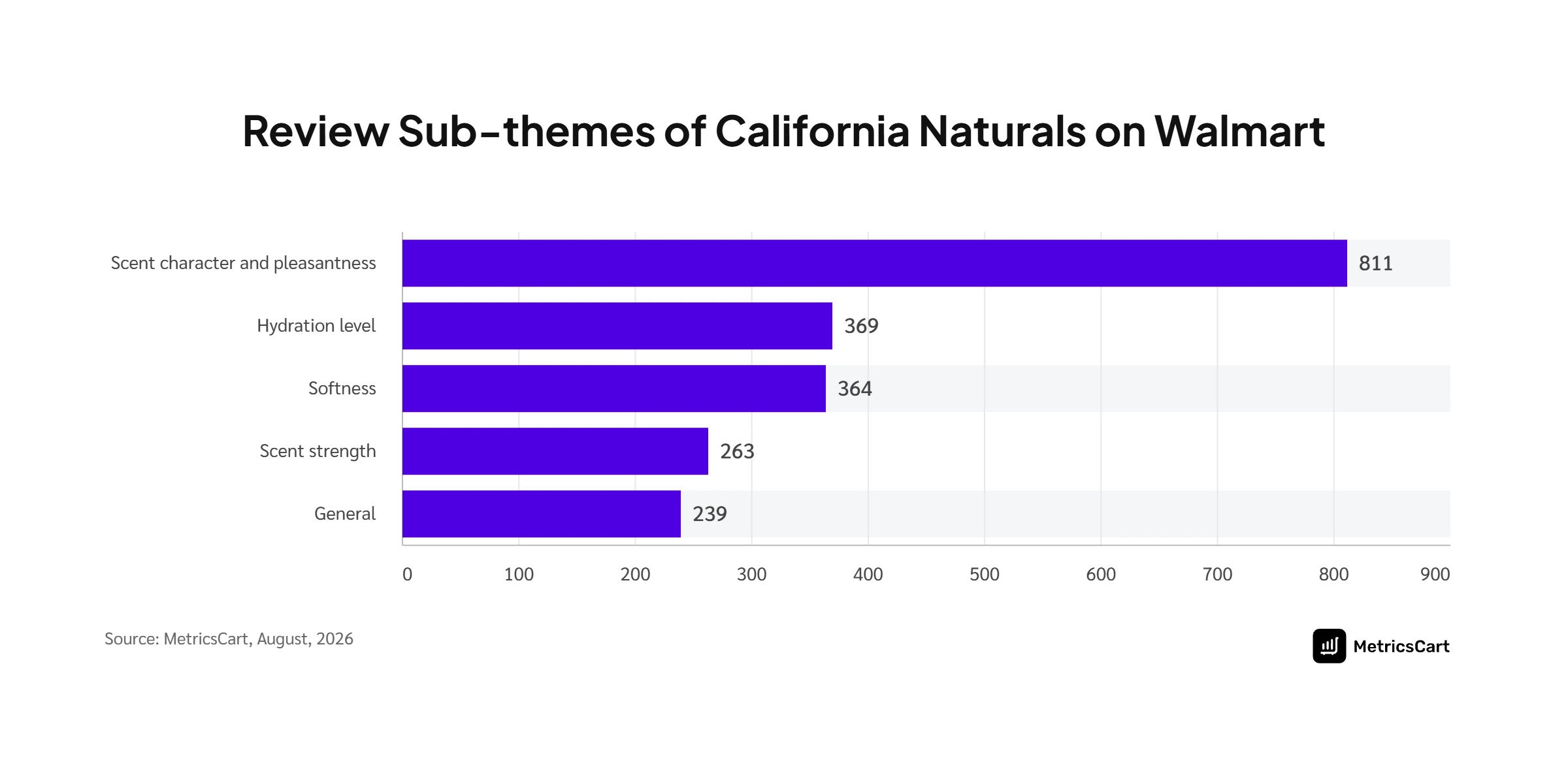
After scent, Walmart shoppers raise how the product feels in the hair: hydration (369), softness (364), the balance between nourishment and heaviness (235), texture and viscosity (225), detangling and combability (199), and free-from and sensitivity considerations (183). Walmart’s range centers on shampoos, conditioners, and treatments, which fits this vocabulary.
READ MORE | Do Review Recency and Volume Affect Sales? Everything You Need to Know
What CPG and Hair Care Brands Can Learn from California Naturals’ Digital Shelf
California Naturals’ digital shelf shows that two retailers can carry the same brand at the same price and still present different catalogs and different shopper conversations. Here are three lessons for CPG and personal care brands.
1. A Bigger Catalog Doesn’t Multiply Engagement
Target carries 64% more products than Walmart (23 vs 14) and holds about 55% more reviews. Review volume grows more slowly than catalog size, and Walmart’s 14 products average more reviews each (about 1,025 vs 969). Part of the reason is the kids’ line, whose six products average about 477 reviews each.
Brands should track engagement per product alongside SKU count. A new listing adds shelf presence, and its review volume shows whether it adds engagement as well.
2. Keep Everyday Pricing Consistent, Differentiate Through Assortment
California Naturals holds the same $10 price tier across both retailers and prices its one premium product, the $20 Re: GRO Scalp Serum, identically on each. Differentiation comes from the catalog. Body wash and the kids’ line live on Target only, and the leave-in spray lives on Walmart only.
That approach gives shoppers one consistent price signal on every shelf and puts product variety into the retailer-specific range. Exclusive lines also contribute meaningfully to the shelf: California Naturals’ Target-only products hold 29% of its Target reviews.
3. Read Review Themes by Retailer
Scent leads on both retailers, so fragrance belongs in every listing’s content. Past scent, the conversation splits. Target shoppers discuss lather, cleansing, and a clean feel. Walmart shoppers discuss hydration, texture, and detangling.
Brands can use these differences to shape titles, bullets and imagery for each retailer, and to spot which product attributes shoppers on each platform notice first.
READ MORE | 7 Common Digital Shelf Mistakes You Must Avoid
Supplementing Success with Digital Shelf Analytics Software
California Naturals’ digital shelf shows that retailer performance comes from understanding how shoppers behave on each platform. Category mix, price tiers, review volume and review themes each add a signal, and brands that watch them together can see where a retailer rewards the brand and where a gap remains.
MetricsCart is a digital shelf analytics platform that helps CPG and personal care brands monitor pricing, assortment, ratings and reviews, and other digital shelf metrics across Walmart, Target and 150+ online retailers from a single place. With product-level insights, you can benchmark against competitors, protect your pricing, improve discoverability, and make faster, data-backed decisions.
Disclaimer: MetricsCart is the exclusive owner of the data used in this Digital Shelf Insights report. Any third-party usage must include proper credit to the source.