Highlights
- Black Friday is now a six-week shopping window, so brands need to start planning well before Thanksgiving.
- Structured promotions like tiered discounts, bundles, free shipping, and loyalty pricing can drive sales without relying on deep discounts.
- Product content and availability directly impact discoverability, Buy Box eligibility, and search performance during peak season.
- Real-time monitoring of competitor pricing, share of search, MAP violations, stock, and reviews helps brands react while BFCM is still live.
- The brands that win Black Friday 2026 will start earlier, price smarter, and continuously monitor their digital shelf.
“Getting an earlier start on holiday shopping gives shoppers more control and choice,” says Marshal Cohen, chief retail advisor at Circana, the firm that tracks holiday shopping intent every year. He’s talking about why they’re moving earlier and earlier. It’s also the best one-line explanation of why most Black Friday Strategies need a rewrite.
Nearly half of shoppers now say they plan to start before Thanksgiving. Black Friday is still the single biggest shopping day of the season, but for a growing number of people, it’s no longer where the season begins. It’s closer to the middle.
A brand whose plan only kicks in the week of Thanksgiving is showing up after a chunk of shoppers have already decided where to spend. With Black Friday 2026 landing on November 27, here’s what a plan built for that reality actually needs to include.
What a Black Friday Strategy Needs to Cover in 2026
Take a brand that waits until November 28 to launch its Black Friday push.
By then, shoppers who’d normally buy in that category have already spent their budget with a competitor that opened deals on November 10, the way Best Buy and other retailers now do with dedicated ‘Member Week’ campaigns.
These are retailer-run early-access sales that offer loyalty members exclusive pricing in the weeks leading up to Black Friday. That one-week delay shows how tightly these four pieces are connected, not separate boxes to check off.
- Timing decides how much demand a brand even gets a shot at before the peak hits.
- Pricing decides how much of that demand converts profitably.
- Content and availability decide whether a product is discoverable at all, on Google, on Amazon, and increasingly through AI shopping tools.
- Digital shelf visibility lets a brand catch a competitor’s move mid-week instead of finding out in the sales report.
How to Maximize BFCM Revenue Without Deep Discounting
Every Black Friday Cyber Monday (BFCM) planning meeting has the same moment. Someone pulls up last year’s discount, someone else pulls up a competitor’s, and the conversation quickly turns into a race to see who’s going deeper. It’s the wrong conversation to be having in 2026.
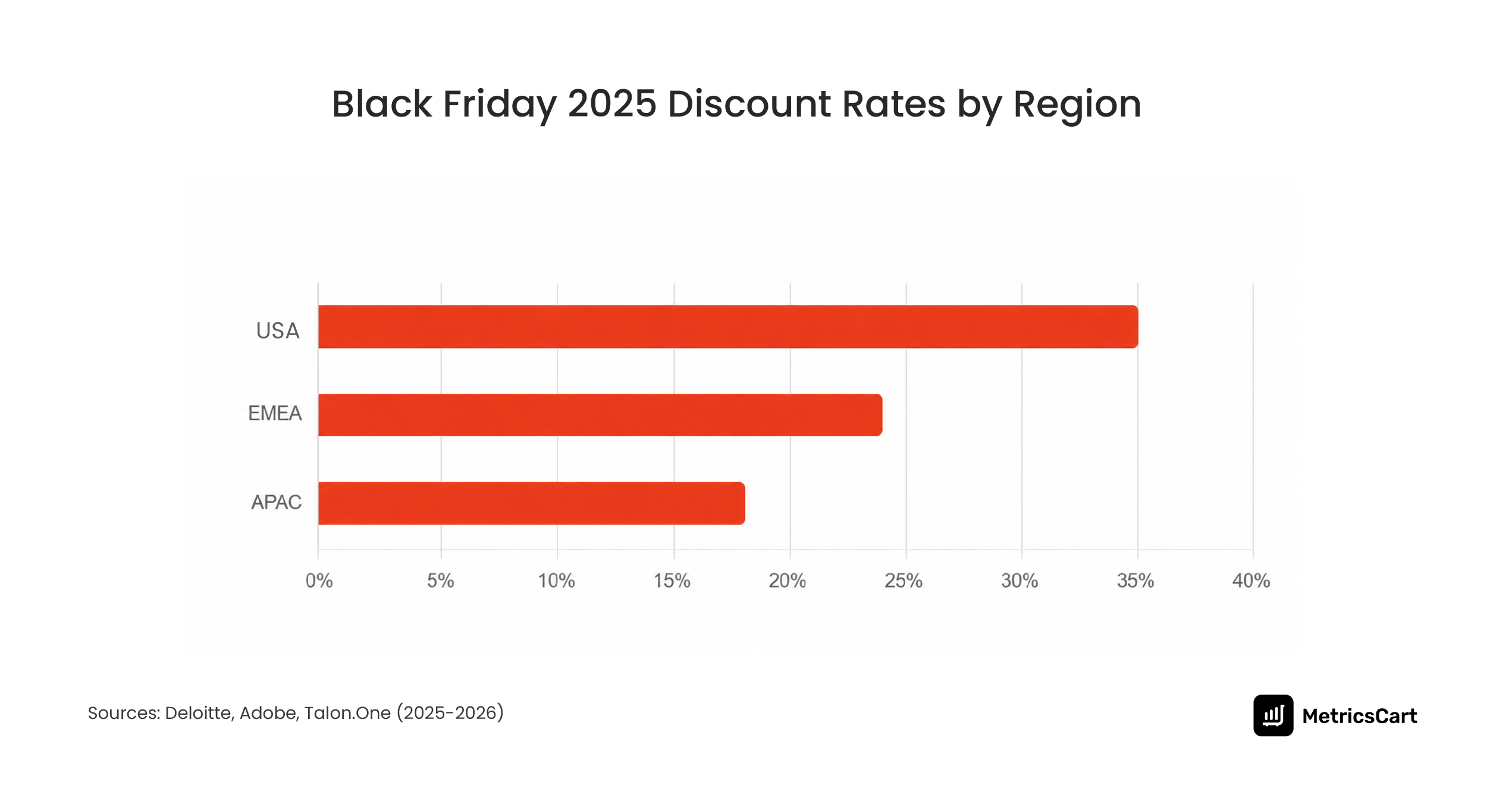
The average global discount rose from 21% in 2024 to 25% in 2025; a small bump, not the price war brands keep bracing for. The regional gaps are bigger than the year-over-year change:
- US: 35%
- EMEA: 24%
- APAC: 18%
So if the discount depth didn’t change much, what actually moved the needle? Structure did. Here’s what beat flat percentage-off deals in 2025:
Tiered Discounts and Minimum-Order Thresholds
Instead of a flat “20% off,” it’s “20% off when you spend $75.”
Even better, build it in three tiers:
- 20% off at $75
- 25% off at $125
- 30% off at $200
Shoppers add items to hit the next tier, and average order value climbs. The mechanic works because it feels like the shopper is beating the system, not because the discount is deeper.
Add a live progress bar in the cart (“$12 more to unlock 25% off”) and you get another 17-30% AOV lift on top of the tier structure itself. On Amazon, the same logic runs through spend-threshold coupons in Seller Central.
Bundles and BOGO
Bundles give up margin on one item, not every item in the cart. Volume clears, inventory moves, and the perceived value on a package usually beats the actual discount depth.
Framing matters as much as the math. A “buy 2 get 1 free” offer converts better than “33% off,” even though both describe the same pricing. Free triggers a different response than discounted.
For Amazon brands, virtual bundles are worth knowing:
- Brand-registered sellers can package 2 to 5 existing SKUs into one listing
- No new inventory needed
- Bundles can carry coupons, qualify for Lightning Deals, and run through Sponsored Brands
Category-specific BOGO like “buy any jeans, get the second half off” also works well for moving overstocked SKUs without a sitewide markdown.
Free Shipping Thresholds
Shipping costs remain the single biggest reason people abandon carts. 48% of all cart abandonments trace back to shipping cost shock at checkout. 75% of shoppers say they’ll add items just to qualify for free shipping.
The threshold sweet spot is 20-30% above your current AOV:
- Low enough to feel achievable
- High enough to lift basket size
- Add a live progress bar, and you get another 36-67% AOV lift
The strongest version of this play combines free shipping with loyalty. Sephora gives Beauty Insider members free shipping on every order with no minimum, and charges guests until they hit $50. Every abandoned cart becomes a loyalty sign-up opportunity, not just a lost sale.
Loyalty-Gated Pricing
A member-only deal filters for people who already know your brand. They convert at higher rates than shoppers who found you through an open discount.
The 2025 numbers back this up. On Black Friday, new loyalty sign-ups were 50% higher than on a normal day, and total enrollment doubled year over year.
Loyalty pricing has shifted from a discount lever to an access layer. Members get:
- Early access to Black Friday deals
- Exclusive bundles and product drops
- Tier-based pricing (higher tiers get bigger discounts)
- Free shipping perks
The play works both ways. Existing members convert on the deal, and non-members enroll to unlock it.
On Amazon, the mechanics doing this structural work were Lightning Deals, Prime Exclusive Discounts, virtual bundles, coupons, and Subscribe & Save promotions. Blanket price cuts weren’t what won.
There’s a catch, though. None of this works if you can’t see what competitors are doing in real time. A competitor drops the price on a similar SKU while you’re not watching, and you’re stuck with two bad options: match late and lose margin for no reason, or hold a price that’s already been beaten. Real-time competitor pricing data is the difference between an informed call and a guess.
What Brands Need to Monitor During the Black Friday Sales Week?
Pricing and promotions usually get planned weeks in advance. What happens to content, stock levels, competitor visibility, and review sentiment during peak week often goes unwatched until the sales report lands. By then, the damage is already done.
Content and Availability Gaps
Product content now has two audiences: shoppers and AI shopping tools. The usual checklist still applies. A+ content, good images, clear bullets, keyword coverage. But there’s a new layer on top of it.
Traffic from AI tools like ChatGPT and Perplexity to retail sites was up 770% year over year in November 2025. These tools choose which products to recommend based on how well-structured your listing content is. So a listing with weak or inconsistent content can drop out of AI-generated recommendations even if it still ranks fine in regular Amazon search.
Availability makes this worse. About 82% of Amazon purchases occur through the Buy Box, and a stockout instantly drops Buy Box eligibility. The ranking hit is bigger than most brands expect:
- One day out of stock: search rank drops around 28%
- Three or more days out of stock: search rank drops over 80%
Getting that rank back takes weeks and usually extra ad spend on top.
It’s also a bigger problem in 2026 than it was two years ago. Amazon tightened seller storage limits in 2025, cutting inventory capacity from six months of forecasted sales down to five. That leaves brands with less buffer, right when demand is peaking.
Share of Search and Competitor Pricing Shifts
Category search volume spikes during BFCM, and paid competition gets more expensive as well. Here’s the trap. A brand can hold ad spend flat and still lose visibility if the auction gets more crowded beneath them.
Share of search, tracked per retailer in real time, is the only way to know whether you’re gaining or losing ground during the week that actually matters. Finding out in December is finding out too late.
MAP Violations and Rogue Seller Activity
Unauthorized sellers pick BFCM to undercut minimum advertised pricing hard. The volume makes violations easier to hide in the noise.
The higher cost isn’t the handful of sales lost at a discount. It’s that those violations reset shoppers’ expectations of what your product should cost. That lower price expectation carries into Q1, long after the sale ends.
Review Velocity and Sentiment Swings
BFCM generates a big wave of new reviews in a short window. That wave shapes conversion for months afterward, because review recency and rating both feed into how products rank.
A sentiment problem caught during peak week, whether it’s about fit, shipping delays, or damage in transit, can be fixed while it’s still small. Caught a month later, it’s already baked into the product’s average rating. No amount of PR undoes that once it’s set.
What Should Brands Do After Black Friday and Cyber Monday?
The week after BFCM is often treated as a wind-down. It’s more useful as input for next year’s plan.
- Review which SKUs, channels, price points, and promo mechanics drove profitable revenue, not just volume. Returns cut into BFCM revenue more than the checkout numbers show. A discount that looked like a volume win in November can look different once returns are subtracted in December.
- Read the sentiment shifts in the post-BFCM review wave before they harden into a rating problem. Returns stay elevated by 8 to 15% through the first two weeks of January, per Adobe Analytics. Fit, sizing, and shipping complaints tend to surface in reviews and returns simultaneously, so this is the window to catch them.
- Check which competitors gained share of search during peak week, and why. Ad auctions get more crowded during BFCM, so a flat share-of-search number can already mean lost ground. Checking this the week after, while the promo details are fresh, makes it easier to trace a drop back to a specific competitor move.
- Track how many new loyalty members you acquired and how they behave afterward. Close to one-fifth of online sales are expected to be returned this season, per NRF. For many new members, their first real interaction with the brand will be a return, not a repeat order. How that return is handled (refund, exchange, or credit) often determines whether they come back in December.
Brands that build this into planning starting in Q1, instead of waiting until next September, go into the next BFCM with a head start instead of a blank page.
Conclusion
Black Friday is no longer a weekend. It’s a six-week window, and by 2027, AI shopping tools will decide a larger share of what shoppers even see.
Winning against that shape of season takes pricing built on real competitor data, loyalty treated as the promotional plan, content structured for both shoppers and AI, and eyes on the shelf while the season is live.
That last piece is where MetricsCart comes in. It tracks competitor prices, stock levels, share of search, MAP violations, and review sentiment across retailers in real time, so brand teams can act on shifts the same day instead of catching them in the January debrief.
Black Friday 2026 belongs to the brands that started earlier, priced smarter, and watched the shelf while the sales were actually happening.
Black Friday 2026 belongs to the brands watching the shelf in real time. Get set up before peak week hits.
FAQs
Four things working together: an early start, structured promotions instead of flat discounts, product content ready for both shoppers and AI, and real-time visibility into pricing, stock, and reviews once the sale goes live. Brands that get one right and miss the others usually leave revenue on the table.
Tiered discounts with minimum-order thresholds, bundles, free shipping offers, and loyalty-gated pricing. These consistently outperform straight percentage-off deals because they lift average order value while protecting margin.
Because product content now has to work for two audiences: shoppers scanning listings and AI shopping tools deciding what to recommend. Weak or inconsistent content can cause a product to drop out of AI-generated recommendations, even when it still ranks fine in regular search, and the impact is greatest on Black Friday.
Stockouts don’t just cost the immediate sale. They cost Buy Box eligibility, hurt search rank, and take weeks of ad spend to recover. During BFCM, when demand is at its peak, a single day out of stock can undo months of ranking work.
Yes, but not by matching their calendars. Smaller brands win by choosing a narrower promotional window, activating loyalty and email lists earlier, and running category-specific offers rather than competing on store-wide markdowns.