Key Highlights
- Amazon MAP violations happen when sellers advertise products below the brand’s approved minimum advertised price, often triggering widespread price erosion across marketplaces.
- Amazon itself does not enforce MAP policies. Brands are fully responsible for monitoring, identifying, and enforcing pricing violations across seller networks.
- Unauthorized sellers, distributor leaks, retail arbitrage, liquidation channels, and grey market inventory are some of the biggest causes of MAP violations on Amazon.
- Recurring MAP violations damage premium brand perception, reduce retailer trust, erode profit margins, and cause brands to lose control of the Amazon Featured Offer (Buy Box).
- Manual Amazon MAP monitoring through spreadsheets, audits, and periodic checks cannot scale effectively for modern e-commerce operations with thousands of SKUs and constantly changing marketplace pricing.
- Automated MAP monitoring software helps brands continuously track SKU pricing, unauthorized sellers, Buy Box movement, and repeat violators across marketplaces in real time.
- Effective MAP violation prevention requires a combination of clear MAP policies, tighter distributor controls, retailer education, continuous monitoring, and consistent enforcement actions.
- MetricsCart is a centralized MAP monitoring and enforcement platform that offers real-time alerts, seller identification, automated workflows, Buy Box monitoring, and multi-marketplace tracking.
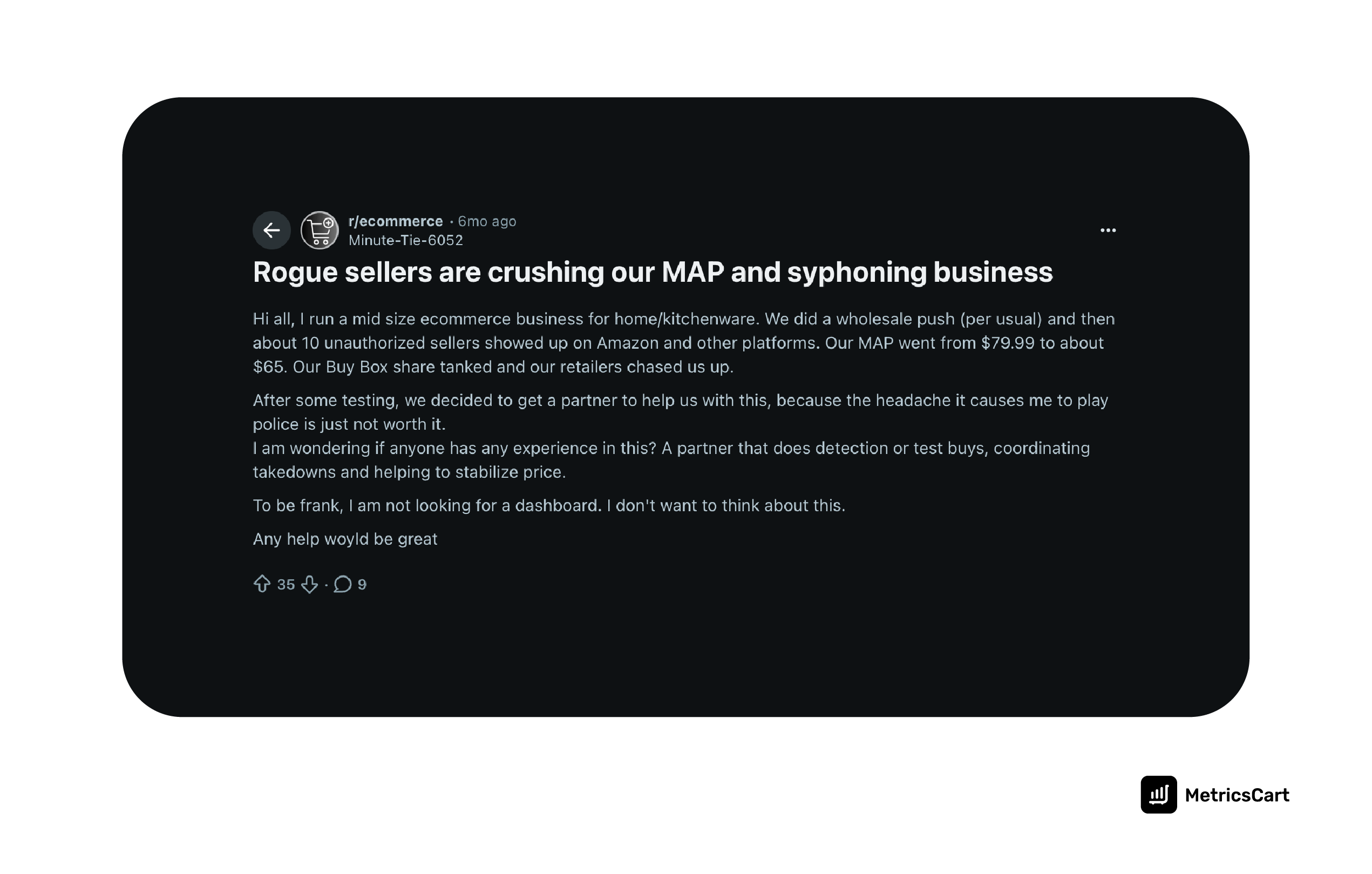
See the above Reddit post? Well, it is not a one-off struggle of an ecommerce seller. Major brands like Nike, Samsung, and Unilever also deal with the same issue every day: MAP violations.
Minimum Advertised Price or MAP, the lowest price at which a seller can legally advertise the product for, is designed to protect pricing consistency across marketplaces. But over several factors, the enforcement of MAP is not as easy as setting the rules.
This article breaks down what Amazon MAP violations are, how they happen, and how brands can effectively monitor and prevent them at scale using MAP monitoring software.
If you run an e-commerce business and have been dealing with sudden price drops, unauthorized sellers, or Buy Box instability, this guide is for you.
What Is an Amazon MAP Violation?
An Amazon MAP violation happens when a seller advertises or lists a product below the Minimum Advertised Price (MAP) set by the brand.
MAP, or Minimum Advertised Price, is a pricing policy brands use to maintain consistent pricing across retailers and marketplaces. It helps protect brand value, profit margins, and relationships with authorized sellers.
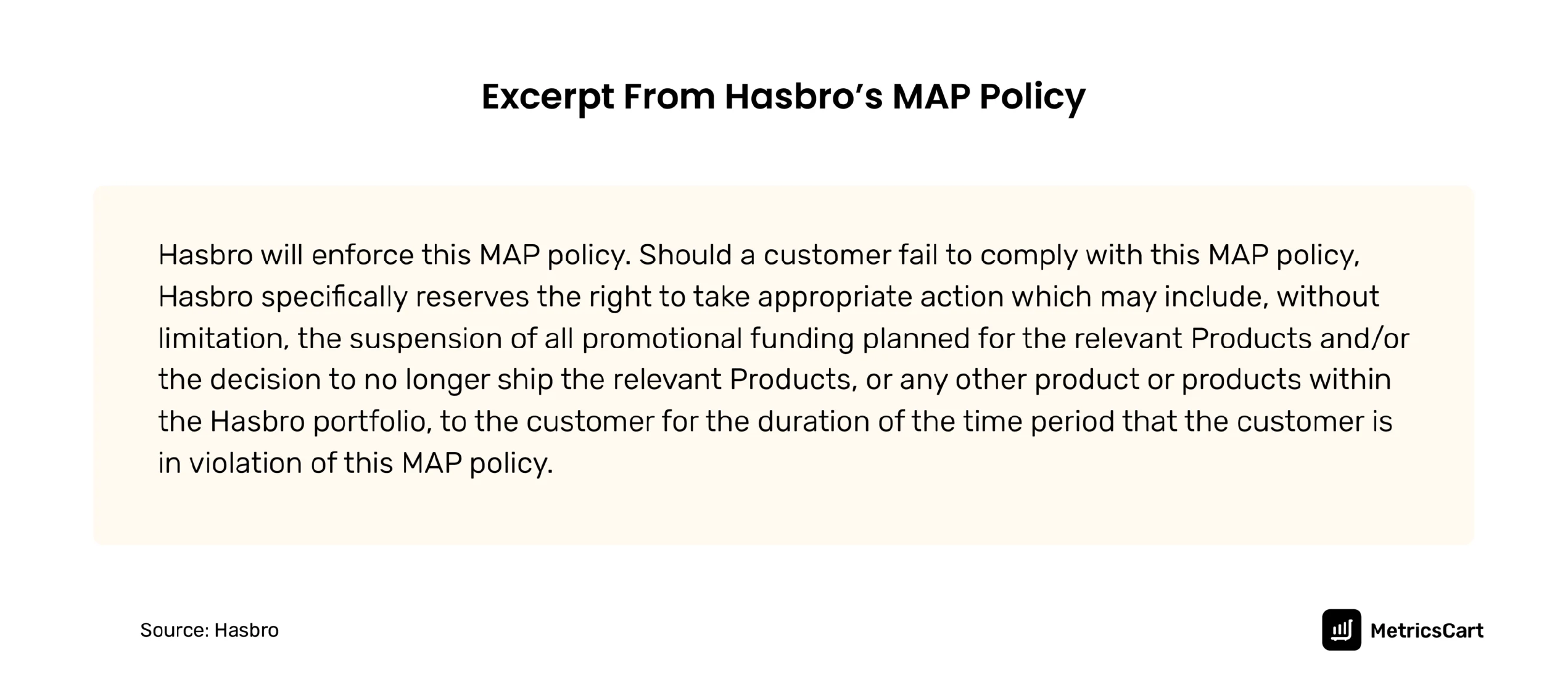
For example, if a brand sets the MAP for a product at $100, sellers are not allowed to publicly advertise it below that price on marketplaces like Amazon, Walmart, or eBay.
MAP is a brand-set agreement, not an Amazon rule. Amazon itself does not enforce MAP policies for brands. That responsibility falls entirely on the manufacturer or brand owner.
READ MORE | Discover more about MAP violations, explore—Types of MAP violations.
Common Causes of Amazon MAP Violations
Here are the most common reasons brands struggle with MAP enforcement on Amazon:
Inconsistent MAP Enforcement Across Marketplaces
Many brands enforce MAP aggressively on Amazon while ignoring Walmart, eBay, or smaller marketplaces. Sellers take advantage of these gaps and use lower prices on one marketplace to trigger repricing activity across others. Without consistent enforcement, MAP policies quickly lose credibility among sellers.
Limited Visibility Into Seller Networks
Brands often do not have full visibility into where inventory ends up after distribution. Products can move through wholesalers, liquidation channels, resellers, or secondary distributors before eventually landing on Amazon through unauthorized sellers. By the time brands identify the source, the pricing damage is already happening.
Unauthorized Sellers
Unauthorized sellers are one of the biggest drivers of Amazon MAP violations. These sellers may acquire inventory through:
- Overstock purchases
- Retail arbitrage
- Grey market distribution
- Liquidation sales
- Distributor leaks
Because they are not part of the brand’s authorized reseller network, they are far more likely to ignore MAP policies in order to win sales quickly.

To learn more about how unauthorized sellers appear on marketplaces and how you can tackle them, watch Episode 4 of MAP Masterclass by Shreshta Joy.
Marketplace Repricing Algorithms
Amazon sellers commonly use automated repricing software to stay competitive and win the Buy Box.
The problem is that repricers react to competitor pricing instantly. If one seller drops below MAP, other sellers’ repricing tools may automatically match or beat that price within minutes, creating a rapid pricing spiral.
This is why a single MAP violation rarely stays isolated for long.
Third-Party Seller Complexity
A single Amazon listing can have dozens of competing sellers at the same time. Tracking which sellers are authorized, which are violating MAP, and which are repeatedly undercutting prices becomes extremely difficult when managed manually, especially for brands managing large catalogs across multiple marketplaces.
Lack of Real-Time Monitoring
Many brands still rely on manual checks or periodic audits to monitor pricing compliance. But Amazon pricing changes constantly throughout the day. Without real-time monitoring, brands often discover MAP violations too late, after pricing erosion has already spread across sellers and marketplaces.
READ MORE | Overcoming Price Erosion: Strategies for Brands on Online Marketplaces
How Amazon MAP Violations Affect Your Brand
Amazon MAP violations do not just impact pricing. They affect brand perception, retailer relationships, profitability, and marketplace performance across the entire digital shelf.
Here is how recurring MAP violations can hurt your business:
- Brand devaluation. Consumers associate price with quality. A premium brand selling at discount prices consistently trains customers to expect lower prices, permanently shifting perception downward. Once that happens, it is difficult to recover.
- Retailer conflicts. Authorized retailers who are playing by the rules cannot compete with violators. If they keep losing the Buy Box to sellers pricing below MAP, they stop carrying the product. Brands lose their best retail relationships this way.
- Profit erosion. Price erosion is self-reinforcing. Brands get pulled into pricing wars that destroy margins for everyone, including themselves, if they sell directly.
- Loss of Control Over Featured Offer. The Featured Offer (formerly the Buy Box) goes to the seller offering the best combination of price and fulfillment. If unauthorized sellers are consistently undercutting MAP, they capture the Buy Box, and the brand loses control over its own product page.
How to Monitor MAP Pricing on Amazon and Detect Violations
Detecting Amazon MAP violations is not just about finding sellers pricing below your threshold. Brands also need to identify repeat offenders, monitor Buy Box movement, and track how pricing changes spread across marketplaces.
Most brands use one of two approaches: manual monitoring or automated MAP monitoring software.
Manual MAP Monitoring Methods
Many ecommerce teams still rely on manual processes such as:
- Searching Amazon listings manually
- Tracking prices in spreadsheets
- Performing periodic SKU audits
- Monitoring top-selling ASINs only
- Asking distributors to report violations
While this may work for smaller catalogs, it quickly becomes difficult to scale.
Amazon pricing changes constantly throughout the day, especially in competitive categories where repricers automatically adjust prices in real time. Manual monitoring also makes it difficult to:
- Detect violations early
- Monitor hundreds or thousands of SKUs
- Identify unauthorized sellers accurately
- Track repeat MAP offenders
- Monitor multiple marketplaces simultaneously
By the time teams detect a violation manually, pricing erosion may have already spread across sellers and marketplaces.
READ MORE | Is your price monitoring strategy not working out as planned? Read our blog 5 Common Price Monitoring Mistakes, to find out why!
Using Automated MAP Monitoring Software
Automated MAP monitoring platforms help brands continuously track pricing violations across marketplaces without relying on manual checks.
Platforms like MetricsCart use automated crawlers to scan marketplaces such as Amazon, Walmart, and eBay 24/7. The system maps listings to specific SKUs, compares advertised prices against predefined MAP thresholds, and flags violations in real time.

How to Prevent MAP Violations on Amazon
Most brands make the mistake of treating MAP enforcement as a reactive process. A seller drops below MAP, the team notices it days later, someone sends a warning email, and the cycle repeats. That approach does not scale on Amazon, especially when repricers and third-party sellers are involved.
Effective MAP enforcement requires a combination of policy clarity, distributor control, continuous monitoring, and operational discipline.
1. Set Clear MAP Policies
A lot of MAP policies fail because they are too vague. If you are selling on Amazon, your MAP policy should clearly define:
- The minimum advertised price for each SKU
- Which marketplaces are covered
- What qualifies as a violation
- Enforcement timelines and escalation steps
- Consequences for repeat offenders
Do not leave room for interpretation. Sellers should immediately understand what is allowed and what is not.
It is also important to apply MAP policies consistently across all marketplaces, not just Amazon. If sellers see weak enforcement on Walmart or eBay, they will eventually push pricing pressure back onto Amazon listings as well.
2. Tighten Control Over Your Distribution Network
Most unauthorized sellers do not magically appear out of nowhere. Inventory leaks somewhere in the supply chain.
This usually happens through overstock liquidation, uncontrolled wholesale distribution, distributor reselling, retail arbitrage, and grey market channels. If you do not know exactly who has access to your inventory, MAP enforcement becomes extremely difficult.
Strong brands reduce MAP violations by working with a tighter network of authorized sellers and regularly auditing distribution channels. Many also require reseller agreements that explicitly include MAP compliance terms.
3. Educate Your Retail Partners
Many MAP violations come from authorized sellers who misunderstood the policy or did not realize their repricing software was triggering violations. Regular communication about why MAP matters, including the impact on their own profitability when price erosion happens, builds a compliance culture.
4. Monitor Consistently and Continuously
Amazon pricing changes constantly throughout the day. Sellers use automated repricing tools that react to competitor pricing within minutes, which means a single MAP violation can quickly trigger a larger pricing spiral across multiple sellers and marketplaces.
This is why occasional audits or manual spot-checks are no longer enough for effective MAP enforcement.
You must continuously monitor:
- SKU-level pricing changes
- Buy Box movement
- Unauthorized seller activity
- Repeat MAP offenders
- Marketplace-wide pricing trends
Real-time visibility helps detect violations early before pricing erosion spreads across the digital shelf. Most mature ecommerce teams now rely on automated MAP monitoring platforms like MetricsCart to continuously track listings across Amazon, Walmart, eBay, and other marketplaces from one centralized dashboard.
READ MORE | Can’t seem to find the right MAP monitoring system? Check out Best MAP Monitoring Software You Should Consider for E-Commerce.
5. Enforce Consequences
A MAP policy without enforcement is just a suggestion.
Brands need a clear escalation framework for repeat violations. This usually starts with warning emails and formal notices, followed by stricter actions like supply restrictions or removal from authorized reseller programs.
The important part is consistency.
If some sellers repeatedly violate MAP without consequences, other sellers quickly realize the policy is not actively enforced. That is when pricing discipline starts breaking down across the marketplace.
💡Pro Tip: Align Internal Teams Around MAP Enforcement
MAP enforcement is not just an ecommerce responsibility. Your sales, distributor management, marketplace, legal, and brand teams should all operate from the same enforcement framework. Otherwise, one department may aggressively enforce MAP while another quietly continues supplying inventory to violating sellers.
This internal misalignment is surprisingly common in larger organizations. Without internal alignment, enforcement becomes inconsistent and difficult to scale.
So, make sure your MAP program have:
- Centralized reporting
- Shared seller visibility
- Unified escalation workflows
- Executive-level support for enforcement decisions
When every stakeholder has visibility into violations, seller activity, and enforcement actions, accountability becomes much stronger across the organization.
How MetricsCart Protects Brands from Minimum Advertised Pricing Violations
MetricsCart is a digital shelf analytics platform that offers a strong automated MAP monitoring and enforcement solution to help brands protect pricing integrity across every marketplace they sell on, including Amazon.
Here’s how the MetricsCart automated MAP monitoring and enforcement software works:
Continuous Monitoring: Once integrated into your digital shelf operations, MetricsCart continuously scans marketplace listings, maps them to specific SKUs, compares advertised prices against brand-defined MAP thresholds.
It then generates real-time alerts the moment a violation occurs. The alerts are sent directly to the user’s inbox so no need to login or have a tab open all the time.
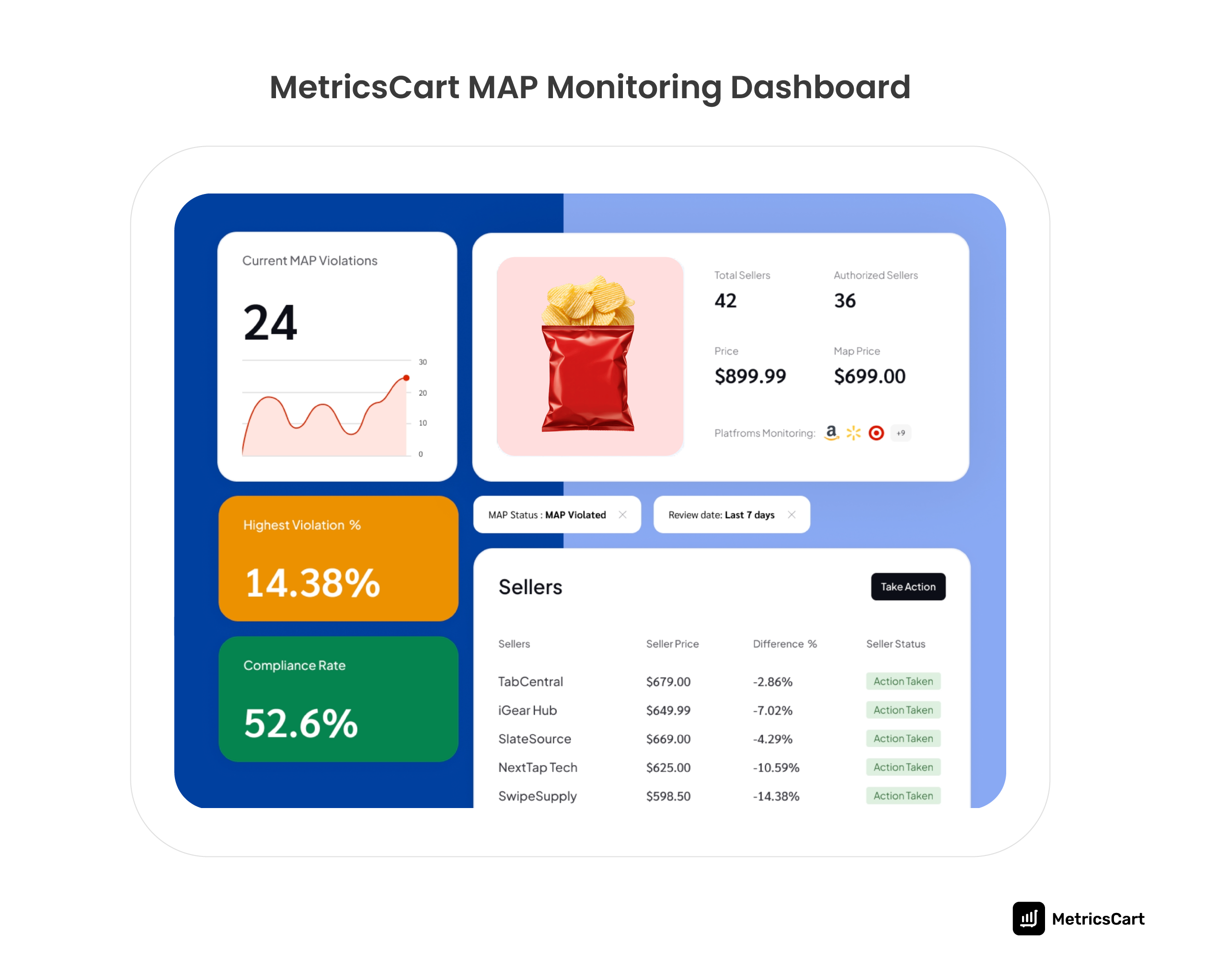
MAP Violation Detection: When a listing drops below the approved MAP price, MetricsCart automatically flags the violation, collects its evidence, and identifies the seller behind it, including unauthorized third-party merchants and repeat offenders.
This gives brands much deeper visibility into where pricing leakage is happening across their distribution network.
MAP Enforcement: As soon as a violation is detected, the automated enforcement workflow activates immediately. Brands can trigger customized warning emails, escalate repeat violations, centralize reporting, and monitor ongoing seller activity without relying on slow manual outreach or fragmented enforcement processes.
MetricsCart also helps brands monitor Buy Box ownership, seller activity, and pricing movement across marketplaces from a centralized dashboard. This allows ecommerce, legal, sales, and distributor management teams to operate from the same enforcement framework before pricing erosion spreads further across the digital shelf.
The impact of the solution is so much that one kitchen electronics brand was able to eliminate 65% of MAP violations, saving $1.2 million in brand value after implementing MetricsCart. Another private-label manufacturer as well achieved a 94% Buy Box win rate through improved pricing consistency and stronger seller control.
In addition to monitoring and MAP enforcement in e-commerce, MetricsCart also offers solutions such as share of search monitoring, assortment and availability tracking, ratings and reviews analytics, content compliance monitoring, pricing and promotion strategy.
If you need a one-stop solution for maximizing your e-commerce profits, MetricsCart is the tool you need.
Automatically monitor and enforce your MAP policies with MetricsCart.
FAQs
No. Amazon does not enforce Minimum Advertised Price (MAP) policies on behalf of brands. MAP enforcement is entirely the responsibility of the manufacturer or brand owner. Brands must monitor seller pricing, detect violations, and take enforcement action themselves.
The most effective way is through automated MAP monitoring software that continuously scans marketplaces like Amazon, Walmart, and eBay in real time. These platforms detect below-MAP listings instantly, identify violating sellers, and generate automated alerts before pricing erosion spreads further.
Yes. Modern MAP monitoring platforms allow brands to automate enforcement workflows by triggering warning emails, escalating repeat violations, tracking seller history, and centralizing reporting from a single dashboard. Because apparently humans finally realized spreadsheets and panic are not scalable operational strategies.
Brands should monitor:
1. MAP violation frequency
2. Repeat offender activity
3. Buy Box ownership rates
4. Unauthorized seller count
5. SKU-level pricing trends
6. Marketplace-wide price consistency
7. Enforcement resolution times
These metrics help ecommerce teams measure how effectively pricing integrity is being maintained.
The biggest challenges brands face while doing MAP enforcement in e-commerce include unauthorized sellers, distributor inventory leaks, automated repricing tools, fragmented seller networks, lack of real-time visibility, and inconsistent enforcement across marketplaces. Amazon’s fast-moving pricing environment makes manual enforcement extremely difficult at scale.
Yes. MetricsCart offers MAP monitoring and enforcement capabilities similar to platforms like TradeVitality and MAPtrapp. However, MetricsCart goes beyond MAP compliance by combining it with broader digital shelf analytics, including Share of Search, content compliance, ratings and reviews analysis, assortment tracking, and multi-retailer ecommerce intelligence.