Key Highlights
- A MAP policy alone is not enough. Brands must continuously monitor and enforce those policies to keep pricing under control.
- Most recurring MAP violations originate from unauthorized sellers, distributor leakage, and automated repricing across marketplaces.
- Each retail channel requires a different monitoring strategy, with Amazon, Walmart, and Google Shopping presenting unique pricing challenges.
- An effective MAP compliance program follows four key steps: monitor marketplaces, identify the seller, enforce policies through a tiered workflow, and measure compliance to prevent future violations.
- Brands that automate MAP monitoring using tools like MetricsCart MAP Monitoring & Enforcement platform can detect violations faster, streamline enforcement, and significantly reduce pricing inconsistencies across ecommerce channels.
Introduction
A Minimum Advertised Price (MAP) policy is the lowest price at which a brand allows retailers to publicly advertise a product. It helps protect pricing integrity, preserve profit margins, and maintain fair competition across authorized sales channels.
However, according to research published in KellogInsights, only 85% of authorized retailers comply with MAP policies, while fewer than 50% of unauthorized retailers do. That means, the problem is usually not the policy itself. It is the gap between having a policy and having a system to monitor and enforce it consistently across every marketplace where your products appear.
This guide explains how to tackle MAP violations across Amazon, Walmart, Google Shopping, and other online marketplaces through a practical, step-by-step workflow.
What Causes MAP Violations?
MAP violations are rarely caused by a single seller ignoring your pricing policy. In most cases, they stem from a combination of weak policy enforcement, marketplace dynamics, and uncontrolled distribution channels.
Understanding the root cause is essential because the right solution depends on why the violation occurred in the first place.
1. Your MAP Policy Doesn’t Define Clear Consequences
A MAP policy is only effective if retailers believe it will be enforced.
Harvard Business Review examined nearly 500 MAP policies and found that only 41% clearly explained the consequences of violating the policy. When penalties are vague or inconsistently applied, retailers have little reason to prioritize compliance.
A strong MAP policy should clearly communicate:
- What constitutes a violation
- How violations are detected
- The enforcement process
- The consequences of repeated violations
Without a structured enforcement framework, brands often find themselves sending repeated warning emails without changing seller behavior.
2. Marketplace Algorithms Spread Violations Quickly
Today’s e-commerce marketplaces move much faster than manual enforcement.
Many sellers use automated repricing software that continuously adjusts prices to remain competitive or win the Buy Box. When one seller advertises below MAP, competing sellers may automatically match or beat that price within minutes.
This creates a cascading effect where a single violation spreads across multiple sellers on Amazon, Walmart, and other marketplaces long before a compliance team notices it.
3. Unauthorized Sellers and Grey Market Inventory
Most recurring MAP violations originate outside your authorized reseller network.
Unauthorized sellers often source products through distributor leakage, liquidation sales, retail arbitrage, or excess inventory purchased from other businesses. Because these sellers are not part of your authorized channel, they have little incentive to follow your pricing policy.
Even when a violating listing is removed, new unauthorized sellers can appear if the underlying source of inventory remains unchecked.
4. Distributor Leakage Creates Repeat Violations
Sometimes the problem starts much earlier in the supply chain.
Authorized distributors may intentionally or unintentionally sell inventory beyond approved channels. As products move through multiple intermediaries, brands lose visibility into who ultimately sells them online.
Without identifying where the inventory entered the grey market, the same violations continue to resurface, regardless of how many sellers receive enforcement notices.
READ MORE | How Supply Chain Leaks Lead to MAP Violations
How MAP Violations Happen Across Different Retail Channels
MAP violations do not occur the same way on every e-commerce platform. Each marketplace has its own pricing algorithms, seller ecosystem, and enforcement policies, making it important to understand where violations originate and how they spread.
Amazon
Amazon is where most brands encounter MAP violations first because products may be sold by both Amazon Retail and independent third-party sellers. Plus, it does not enforce MAP policies, and its pricing algorithms constantly react to the lowest available prices online.
Combined with automated repricing tools, the Buy Box, and unauthorized third-party sellers, a single below-MAP listing can trigger widespread price matching across multiple sellers within hours.
READ MORE | MAP Violation on Amazon
Walmart
Walmart Marketplace follows a similar pricing model. Sellers compete for the Featured Offer, while automated repricing keeps prices highly competitive.
Since Walmart also does not enforce MAP policies, violations can spread quickly when unauthorized sellers or aggressive pricing strategies enter the marketplace.
READ MORE | Why You Shouldn’t Miss MAP Monitoring on Walmart (Even If You Don’t Sell There)
Google Shopping
Google Shopping is often overlooked because it is not a marketplace but a product discovery platform. Any merchant running Shopping ads can advertise your products, including unauthorized sellers.
These listings can expose below-MAP prices to shoppers and even influence pricing algorithms on Amazon and Walmart, creating cross-channel pricing issues.
Other Marketplaces
MAP violations also occur on marketplaces such as eBay, regional ecommerce platforms, and brand-owned reseller websites. In many cases, the same unauthorized seller or grey market inventory appears across multiple channels.
Monitoring only one marketplace leaves gaps that allow violations to continue elsewhere, making cross-marketplace visibility essential for effective MAP enforcement.
How to Tackle MAP Violations on Amazon, Walmart and Google Shopping: A Step-by-Step Workflow
Understanding where violations come from is one thing. Having a system to catch and respond to them is what actually protects your pricing integrity. Here is what a working enforcement workflow looks like.
Step 1: Set Up Continuous Monitoring Across All Three Platforms
Effective MAP enforcement starts with visibility. Before you can investigate a violation or contact a seller, you need to know when and where it occurs.
Many brands still rely on manual price checks, spreadsheets, or retailer complaints to identify violations. This approach is difficult to scale, especially when managing hundreds of SKUs across Amazon, Walmart, Google Shopping, eBay, and retailer websites. By the time a violation is discovered, other sellers may have already matched the lower price through automated repricing.
Instead, establish a continuous monitoring process that scans every marketplace where your products are sold. For each product, track:
- SKU or ASIN
- Current advertised price
- Marketplace
- Seller name
- Date and time of the violation
- Severity of the price deviation
Also, each marketplace has different pricing dynamics, so your monitoring strategy should reflect how MAP violations typically occur on that platform. Here’s what you should monitor across the major e-commerce channels.
| Platform | What to Monitor |
| Amazon | Advertised prices, Buy Box ownership, all sellers on the ASIN, unauthorized sellers, pricing history, and repeated MAP violations. |
| Walmart Marketplace | Featured Offer, seller pricing, unauthorized sellers, price fluctuations, and listing-level MAP violations. |
| Google Shopping | Product Listing Ads (PLAs), merchant names, advertised prices, branded keyword searches, and unauthorized merchants. |
| eBay | Seller listings, advertised prices, auction and Buy It Now prices, repeat offenders, and unauthorized sellers. |
| Brand-Owned Retailer Websites | Product pages, advertised prices, promotional banners, coupon codes, and limited-time offers that may violate MAP. |
| Regional & International Marketplaces | Local marketplace listings, reseller pricing, unauthorized distributors, and country-specific pricing inconsistencies. |
This creates a complete record of every violation and makes it easier to identify patterns over time.
As your catalog and reseller network grow, automated MAP monitoring becomes essential. Platforms such as MetricsCart MAP Monitoring and Enforcement platform continuously scan 150+ major ecommerce marketplaces, compare advertised prices against your approved MAP, and alert your team whenever a violation occurs. Instead of manually searching for pricing issues, MetricsCart enables your team to focus on investigating sellers and taking corrective action.
A kitchen electronics brand used MetricsCart to automate MAP monitoring across its reseller network, identify repeat offenders, and streamline enforcement. The result was a 65% reduction in MAP violations while protecting $1.2 million in brand value.

Once you have continuous visibility across all marketplaces, the next step is determining who is responsible for each violation.
Step 2: Detect Violations and Identify the Seller
Start by recording key details for every violation, including the seller name, marketplace, advertised price, SKU or ASIN, and the date and time the violation was detected.
Next, determine whether the seller is:
- An authorized retailer that has violated your MAP policy
- An unauthorized reseller
- A first-party retailer such as Amazon Retail or Walmart
- A repeat offender with a history of MAP violations
This distinction is important because every violation isn’t the same. An authorized distributor who accidentally priced below MAP because of a repricing tool misconfiguration needs only a warning. Meanwhile, when the violation is from an unknown third-party seller who sourced inventory through a grey market channel, that points to a larger supply chain issue.
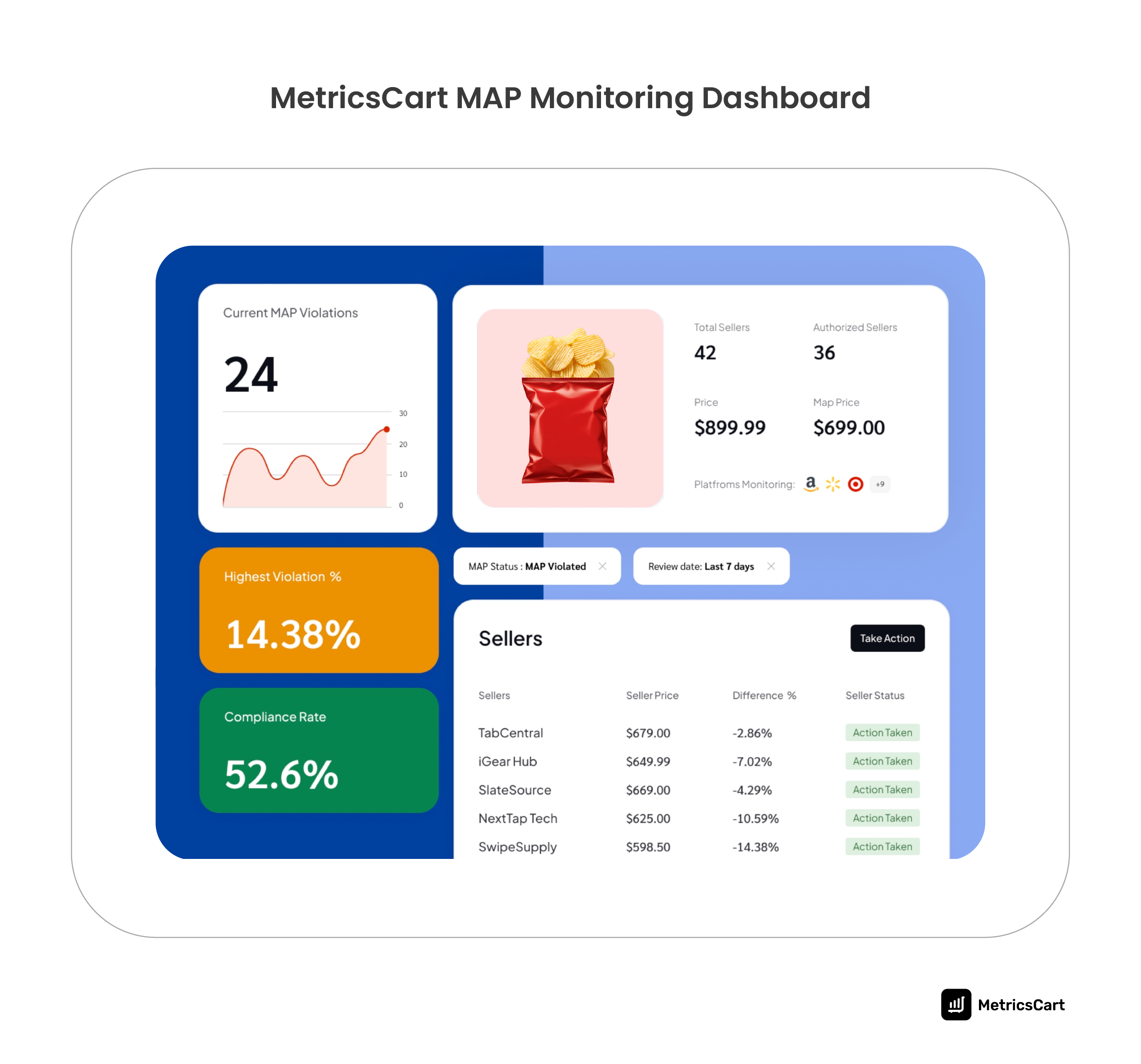
Automated MAP monitoring platforms such as MetricsCart simplify this process by identifying the seller behind every violation, distinguishing between authorized and unauthorized sellers, and maintaining a complete history of violations.
READ MORE | Why MetricsCart Is the Best MAP Monitoring and Enforcement Software for Brands in 2026
This gives compliance teams the context they need to act quickly instead of spending hours investigating each listing manually.
Once you’ve identified the seller and confirmed the nature of the violation, the next step is taking consistent enforcement action.
Step 3: Trigger a Tiered Enforcement Workflow
Once you have confirmed a violation and identified the seller, your response should follow a clear escalation path. Tiered enforcement is more effective and more efficient than treating every violation the same way.
Tier 1: First Violation Warning
Send a formal notice that includes the specific product and SKU, the ASIN or listing URL, the date and time of the violation, the advertised price, and your stated MAP.
Be clear and professional, not threatening. Most first violations from authorized sellers are resolved at this stage, especially when the seller is given specific, actionable information to correct the issue.
Document everything: screenshots with timestamps, the notice sent, and whether a response was received. This record is essential if the violation recurs or escalates.
Tier 2: Escalated Warning and Supply Review
If the seller violates again after the first warning, or does not respond within a reasonable window, escalate. For authorized sellers, this means a formal notice that continued violations will result in a supply review. For unauthorized sellers, this is where you engage legal counsel on a cease-and-desist notice.
At this tier, also investigate whether this seller is a downstream symptom of a distributor leak. Check your supply chain for the likely entry point of their inventory. Addressing the seller without addressing the supply source just moves the problem to the next storefront.
Tier 3: Supply Suspension and Legal Notice
For repeat offenders who continue violating after two notices, the consequences need to be material.
For authorized sellers, suspend supply on the violating SKU or across the account, depending on the severity and history.
For unauthorized sellers who do not respond to escalated notices, evaluate legal enforcement options based on the strength of your documentation.
Reaching this tier should be rare if earlier steps are executed consistently. Most sellers, authorized or not, respond before enforcement reaches the supply suspension stage.
Step 4: Measure Compliance and Prevent Future Violations
MAP enforcement is not a one-time project. It is an ongoing operational function that needs to be tracked over time.
Measure your overall compliance rate by marketplace, by product category, and by seller tier. If your Walmart compliance rate is 90% but your Google Shopping rate is 60%, you have identified where to focus. If violations cluster around one distributor’s accounts, you have identified a supply chain conversation that needs to happen.
Prevention requires upstream work alongside enforcement. Tighten your distributor agreements to include explicit MAP language and clear consequences for leaking inventory into unauthorized channels. Limit the number of authorized sellers to the number you can actually monitor and enforce consistently.
And if your own pricing in DTC or other channels is inconsistent with MAP, fix that first. A violation on your own website can trigger automated price drops on Amazon before any third party does.
READ MORE | Why MAP Monitoring is Non-Negotiable for Health and Beauty Brands
The Final Step to Stop MAP Violations
MAP violations are inevitable in ecommerce. Left unchecked, however, they can quickly erode margins, damage retailer relationships, and weaken brand value across multiple marketplaces.
The solution is not a stricter MAP policy. It is a repeatable enforcement process. By continuously monitoring marketplaces, identifying the sellers responsible, following a consistent enforcement workflow, and analyzing recurring violations, brands can move from reacting to pricing issues to preventing them.
As marketplaces continue to grow and pricing algorithms become more sophisticated, manual monitoring is no longer enough. Automated MAP monitoring gives brands the visibility to detect violations as they happen, identify unauthorized sellers faster, and maintain pricing integrity across every sales channel.
If you’re looking to scale your MAP compliance program, MetricsCart MAP Monitoring & Enforcement helps brands continuously monitor 150+ marketplaces, identify unauthorized sellers, automate enforcement workflows, and gain complete visibility into pricing compliance.
The result is less time spent chasing violations and more time protecting margins, retailer relationships, and long-term brand value.
Tackle MAP Violations Before They Erode Your Profit Margins.
FAQs
MAP (Minimum Advertised Price) is the lowest price at which a seller can publicly advertise your product. MSRP (Manufacturer’s Suggested Retail Price) is a suggested price with no enforcement mechanism.
MAP policies are unilaterally set by the brand and do not require a signed agreement to be communicated, but enforcement depends on your ability to monitor and act on violations.
Not directly. The CPSC ruling from July 2024 is specifically about product safety liability and recall responsibility under the Consumer Product Safety Act. It does not change Amazon’s relationship with brands under MAP agreements.
Amazon is not a party to your MAP policy, and the distributor classification does not give brands new legal authority to compel Amazon to comply with pricing floors.
At minimum, monitor every marketplace where your products are actively sold or likely to appear. For most brands, that means Amazon, Walmart, eBay, and Google Shopping.
Brands with international distribution should also monitor region-specific marketplaces. Automated monitoring platforms like MetricsCart cover 250+ marketplaces, which makes comprehensive coverage manageable.
Best practice is to respond within 24 hours of detection. The longer a violation sits, the more damage it does: other sellers notice it, match the price, and the violation spreads. Automated monitoring with real-time alerts significantly reduces detection time, and automated enforcement workflows reduce response time.
FBA commingling occurs when Amazon stores units from different sellers together in its fulfillment centers and fulfills orders from shared inventory.
This makes it difficult to trace specific units back to their original seller, which complicates enforcement when grey market inventory enters the FBA network. Brands concerned about commingling can work with authorized sellers to use individual unit labeling where possible.