Highlights
- Holiday shopping starts earlier and lasts longer: Brands need to stay ready across October deal events, Cyber Week, and the final Christmas push.
- AI is changing product discovery: With more shoppers using AI for product recommendations, complete, accurate PDP content is becoming critical for visibility.
- Real-time digital shelf monitoring matters: Stockouts, price drops, listing issues, and competitor moves can happen within hours during peak season.
- Protect every stage of the shopper journey: Monitor availability, optimize PDPs, enforce MAP, track reviews, and improve search and AI visibility.
- Use competitive data to make faster decisions: Time promotions, adjust pricing, and respond to competitor changes based on live market signals.
- Start preparing 10–12 weeks before peak: Move from regular audits to daily monitoring and, during peak week, real-time checks and rapid action
The holiday season can make or break your whole year. In just a few weeks, brands win or lose the sales they worked toward for twelve months. Last season, shoppers spent a record $257.8 billion online. One stockout, one wrong price, or one broken listing during Cyber Week can cost you your share of it in a single weekend.
In 2026, there is even less room for error. A busy market will not lift your sales the way it used to, so the brands that win are the ones that come prepared. That is what strong e-commerce holiday readiness for brands is all about. This guide keeps it simple: how shoppers behave in 2026 and seven digital shelf strategies to protect your margin through peak week.
What Are the Biggest Holiday Shopping Trends in 2026?
Three shifts define the season, and each one changes how you should prepare.
Holiday Sales Growth Is Slowing In 2026.
Holiday spending keeps rising, but the pace has cooled. Last season, total US holiday retail sales crossed $1 trillion for the first time, yet growth is expected to stay modest in 2026. When the overall market grows slowly, extra sales must come from competitors rather than from rising demand. The goal shifts from keeping up with a growing market to winning customers away from other brands.
The Holiday Shopping Season Starts Earlier And Lasts Longer.
Holiday shopping now spreads across October deal events, Cyber Week, and the final push before Christmas. Last season, shoppers spent more than $4 billion online on 25 separate days, so demand stays high for weeks, not days. That means your price, stock, and listings need to hold steady across the whole stretch, and a plan built around a single weekend will leave sales on the table.
Growing Prominence of AI in Holiday Shopping
This is the biggest change in shopper behavior, and it earns its own section.
Shoppers have made AI part of how they buy. This season, 72% of US consumers say they use AI tools like ChatGPT or Gemini for gift ideas and product recommendations. The retailers followed: Amazon renamed its Rufus assistant Alexa for Shopping in May 2026, after the tool surpassed 300 million users in 2025, and Walmart’s Sparky now works within ChatGPT and Google Gemini, too.
Here is what it means for your brand. AI assistants narrow the shopper’s choice from dozens of products down to a few. They read your product data, such as titles, specs, and reviews, then recommend the listings they can understand and trust.
Yet most brands are not ready for this shift, with only about 8% of retailers saying they feel very confident using AI in the shopping experience. For a prepared brand, that gap is open shelf space.
When Should Brands Start Preparing for the 2026 Holiday Season?
The short answer: earlier than last year, because your customers already have.
Holiday shopping starts sooner and runs longer every year. Many people begin browsing and building wish lists in October, even if they save their biggest buys for Cyber Week. If your listings, prices, and stock are not ready when that early research starts, you lose the sale before the discount even lands.
A simple schedule keeps a team ahead:
- 10 to 12 weeks out: audit stock, listing content, and search rankings across every retailer.
- 6 to 8 weeks out: lock prices and promotions, set MAP alerts, and refresh pages for the season.
- 2 to 4 weeks out: move to daily checks on price, availability, and competitor moves.
- Peak week: watch in real time and react within hours, not days.
READ MORE | How to Increase E-Commerce Sales in 2026?

7 Digital Shelf Strategies for E-Commerce Holiday Readiness in 2026
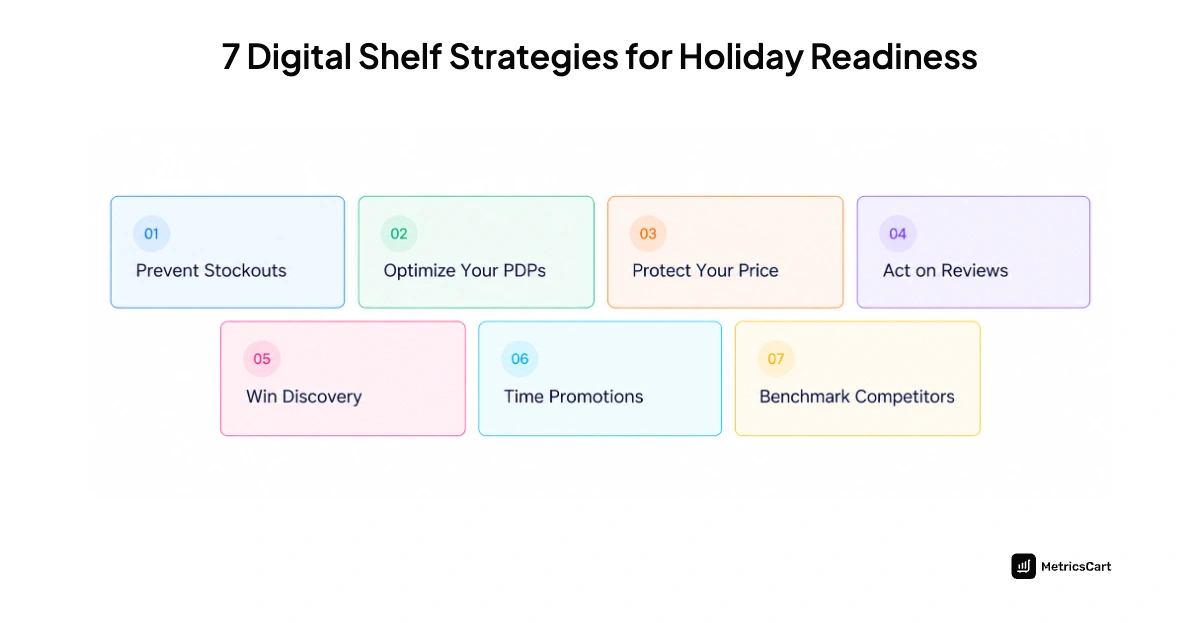
Each strategy names the problem, explains why it happens, and shows what winning looks like.
1. Prevent Stockouts With Availability and Assortment Monitoring
The fastest way to lose a holiday sale is an “out of stock” label on your bestseller. But stocking up is only half the job, because stock levels can go both ways.
Sell out of a hot product, and shoppers move to a competitor, while the retailer’s algorithm quietly drops your ranking, a hit that outlasts the missed sale. Overstock to chase demand, and you erode your price and brand value. The goal is to match supply to live demand at each retailer, so you can spot a product running low on Amazon while it still sits in stock at Walmart.
Pop Mart’s Labubu shows how costly it is to misjudge this. In 2025, the brand used tight supply to build hype; demand exploded, and resale prices ran as high as 2,000% above retail, with some stores pausing sales over crowd safety.
To catch up, Pop Mart flooded the market and ramped production about tenfold. Supply overshot demand, and resale prices collapsed by more than half.
2. Make PDPs Holiday-Ready and Conversion-Optimized
Your product pages sell for you when no one on your team is watching. In 2026, they have a second audience: the AI assistants deciding what to recommend.
A thin or messy page gets skipped by the AI before a shopper ever sees it, so a careful content pass is one of the highest-return moves this season. Work in order:
- Fix marketplace-compliance gaps first.
- Fill in every product attribute and spec.
- Add seasonal images and badges.
- Answer the questions buyers actually ask.
This is exactly what the assistants are rewarded for. Amazon’s Alexa for Shopping and Walmart’s Sparky both assess listings for completeness, from clear titles to filled-in attributes to answered questions.
That same clean data also powers paid placements like Sparky-sponsored prompts, so strong content earns its keep twice.
3. Protect Your Price From Unauthorized Sellers
Price erosion spreads fast. When a seller lists below your minimum advertised price (MAP), automated repricers copy that lower price across the market within hours, and during peak volume, a single rogue listing can pull your actual selling price down everywhere at once.
The defense is visibility and speed: track your price across every channel, catch violations the moment they appear, and enforce before the damage spreads, with one person clearly owning enforcement through peak week.
Losing control of price also costs you the story your price tells. Pop Mart saw this on the resale side, where once the scarcity premium was gone, the product’s perceived value fell with it.
4. Turn Reviews Into Holiday Sales Campaigns
Reviews have always guided shoppers, and now they also feed the AI assistants ranking your products. That makes a review dip during peak week hurt twice: it can cost you both the shopper’s trust and the algorithm’s recommendation.
The smart approach is to treat reviews as a live signal rather than a monthly report. In practice, that means watching sentiment across Amazon, Walmart, and Target in one place, and catching an emerging defect or sizing complaint before it snowballs.
When a complaint points to a content gap, fix the listing fast and feed what customers praise most directly into your ads and product pages, so your best feedback does double duty as marketing.
5. Win Holiday Discovery Across Search and AI Answer Engines
Discovery has spread out. Shoppers now find products through marketplace search, social feeds, and AI assistants, often in a single session, so ranking in one place is no longer enough to be found.
Winning here starts early: find high-intent holiday keywords before demand peaks, track your share of search against competitors to see where you are losing ground, and tune titles and keywords for seasonal terms.
The payoff is strongest on the AI side because shoppers who arrive via AI tools tend to convert at higher rates, having already narrowed their choices with the assistant’s help. Structure your product data so AI answer engines can surface you with confidence, and you will already be ranked when the traffic arrives.
6. Price and Time Promotions With Competitive Data
Everyone discounts during the holidays, so depth and timing decide whether a promotion makes money or leaks margin. At holiday volume, a discount two points deeper than needed is real money gone, so the better approach is to swap gut feel for evidence.
Use last year’s results to identify which products respond best to promotions, and monitor competitors’ live prices before setting your discount depth. A well-timed flash deal on a trending product beats a blanket sitewide cut that only trains shoppers to wait.
The aim is simple: promote the right product, at the right depth, at the right moment.
7. Outmaneuver Competitors With Real-Time Benchmarking
During peak, category dynamics shift by the hour. One competitor price move, stock swing, or content change can redraw a whole category before your next weekly report even lands.
The fix is speed: track competitor prices, availability, and content continuously instead of weekly, and set alerts so that a rival’s price drop or stockout reaches you the same day.
That lets you respond while it still matters, whether by matching a price or pushing stock. It also helps you spot white space, so when a competitor sells out of a shared category, you can step in and take the demand.
Fast response, more than any single tactic, is what compounds across the season.
READ MORE | 6 E-Commerce KPIs for the Digital Shelf: Must-Know Guide for Brands
Win Your Share of Peak Season
The holiday season often comes down to small moments that are easy to miss. A bestseller sells out while your team is busy. A price changes within hours. A listing drops out of AI recommendations overnight. Each one can cost you sales in your most important weeks, so the goal is to catch these moments early and act fast.
That is hard when Amazon, Walmart, and Target each sit in a different tab. MetricsCart brings your pricing, stock, content, search rank, and reviews into a single live view across 150+ retailers. Start early, keep a close watch, and you’ll head into the season ready to act. That is what strong e-commerce holiday readiness for brands really means.
Ready to own peak season? See your entire digital shelf before the rush begins.
FAQs
Most shoppers start in October. They browse and build wish lists early, even if they wait for Cyber Week to buy. Demand now stays high for weeks, not days, so brands should have their listings, prices, and stock ready 10 to 12 weeks before peak week.
The deals are spreading out. Black Friday and Cyber Monday still matter most, but sales now run across the full Cyber Week instead of just two days, and more people shop on their phones. Brands need steady prices, stock, and content across the whole week, not just the big two days.
It shows you everything in one place. Digital shelf analytics tracks your price, stock, content, search rank, and reviews across every retailer in real time. This helps you fix stockouts, price drops, and listing errors within hours, so you protect your sales when demand is highest.
Yes. MetricsCart tracks your products across 150+ retailers, including Amazon, Walmart, and Target, in one place. Your team no longer needs to switch between separate dashboards to see what is happening on each site.
By switching from weekly checks to real-time alerts. Live stock tracking warns you before a product sells out, and MAP monitoring flags price violations the moment they appear, so your team can act before either problem spreads.