Highlights
- MAP compliance monitoring is the systematic process of tracking product prices across online marketplaces and retailer websites to ensure no seller advertises below a brand’s established minimum advertised price.
- Brands without enforceable MAP frameworks typically experience 15-25% erosion in average selling prices within twelve months of marketplace expansion.
- A well-structured MAP pricing monitoring workflow combines automated tracking, real-time alerts, violation documentation, and a tiered enforcement protocol.
- The legal foundation for MAP enforcement in the US rests on the Colgate Doctrine (1919) and the Leegin ruling (2007), both of which support a brand’s right to set pricing policies unilaterally.
- Effective MAP monitoring and enforcement tracks five core metrics: violation rate, time to resolution, repeat offender frequency, revenue impact per violation, and channel-level compliance scores.
- Authorization programs and not just pricing policies are the real foundation for controlling marketplace chaos and stopping MAP violations before they snowball.
Introduction
Minimum advertised price policy violations are a daily reality for brands selling across online marketplaces. And the root cause is almost always the same: no functioning system for MAP compliance monitoring.
A Minimum Advertised Price (MAP) policy sets the lowest price at which authorized retailers can advertise a product. It does not control the actual selling price; retailers remain free to sell at whatever price they choose at checkout. What MAP does control is the visible price on product detail pages, search results, paid ads, and email promotions.
Having a MAP policy on paper and actually monitoring it are two completely different things.

In season 2, episode 1 of the Digital Shelf Insider podcast, Megan Harmon, Managing Partner at ThornCrest and a brand protection veteran with over 18 years of experience, explains brand protection amidst the rise of AI in e-commerce.
Watch the full episode here:
This guide breaks down everything brands need to know about MAP pricing compliance: what it is, why it matters, what to track, how to enforce it, and what the best MAP compliance monitoring tools actually look like in practice.
What Is MAP Compliance Monitoring?
There are three pricing terms that are wrongly used interchangeably in e-commerce conversations:
- MAP (Minimum Advertised Price): The lowest price a product can be advertised at. Sellers can still sell below this at checkout; they just cannot publicly display that lower price on a product page, in an ad, or in a marketing email.
- MSRP (Manufacturer’s Suggested Retail Price): A recommended selling price. It is advisory, not enforceable. It carries zero legal weight. Think of it as a suggestion on the sticker, not a rule in the contract.
- UPP (Unilateral Pricing Policy): A policy where the brand unilaterally sets both the minimum advertised and selling price, and enforces it by choosing whether or not to continue supplying a retailer. There is no agreement; it is one-directional, which is what makes it legally defensible under US antitrust law.
Michael Murphy, Partner at K&L Gates, made this distinction crystal clear on Episode 40 of the Digital Shelf Insider podcast: most brands are using the term “MAP” incorrectly. What many of them actually need, and what their legal structure more closely resembles, is a unilateral pricing policy.
READ MORE | Debunking 5 Common MAP Monitoring Myths with Michael Murphy
How MAP Compliance Monitoring Works in E-Commerce
At its core, MAP compliance monitoring is the operational layer that sits between your MAP policy document and actual marketplace behavior.
In practice, monitoring involves automated crawling of product detail pages, search result ads, price comparison engines, and retailer websites across channels like Amazon, Walmart, Target, eBay, Google Shopping, and hundreds of independent e-commerce sites. The system captures the advertised price, matches it against your MAP threshold at the SKU level, and flags violations the moment they appear.
Modern MAP pricing monitoring platforms go further. They identify the specific seller behind a violation, log timestamps and screenshots for an evidence trail, track the frequency and duration of the violation, and surface patterns that help you differentiate between a one-off pricing mistake and a chronic repeat offender.
With algorithmic repricing tools operating across Amazon and Walmart, a single MAP violation can trigger a cascading price drop across dozens of sellers within minutes.
By the time a human being notices and opens a spreadsheet, the damage is already done. Automated monitoring detects and flags violations in near-real time, giving brands the speed they need to respond before price erosion sets in.
Looking for a solution that actually keeps up? MetricsCart’s MAP monitoring and enforcement solution gives brands real-time visibility across marketplaces, automated violation alerts, and the evidence trail you need to enforce with confidence.
Why Is MAP Compliance Monitoring Essential for Brands?
If you are reading this, you probably do not need to be sold on the idea that pricing matters. But it is worth spelling out exactly why brands need to monitor MAP across marketplaces.
To Prevent MAP Violations and Price Erosions Across Marketplaces
Price erosion from MAP violations does not happen in a straight line. It happens like a domino effect. Here’s how it snowballs:
- A rogue seller, often an unauthorized reseller who acquired inventory through a distribution leak or gray market channel, drops their advertised price below MAP on a single Amazon listing.
- Amazon’s algorithmic repricing tools detect the lower price within minutes.
- Other sellers on the same listing, using their own repricing algorithms, automatically match or undercut that price to compete for the Buy Box.
- Within hours, the advertised price on your best-selling SKU has dropped 20% below MAP, and you did not even know about it until a retail partner called to complain.
- Authorized retailers, who had been faithfully maintaining MAP, now feel punished for following the rules. They either demand price concessions, reduce their orders, or quietly drop the advertised price themselves to stay competitive.
- The brand’s perceived value in consumers’ eyes declines.
Once that consumer expectation is reset, once shoppers expect your product to be available at 20% off, rebuilding that price position is extraordinarily difficult.
This is the core reason MAP monitoring matters: it is the only way to catch that first violation before the repricing algorithms turn it into twenty. A MAP policy tells sellers what the floor is. MAP compliance monitoring tells you the moment someone breaks through it, in time to act, not in time to survey the damage.
Protecting Brand Equity and Retailer Relationships Through MAP Monitoring and Enforcement
MAP monitoring and enforcement system is about maintaining the trust architecture that holds your entire distribution channel together.
When authorized retailers see that a brand is not monitoring or enforcing its MAP policy, the message they receive is clear: the rules do not apply. That perception creates channel conflict, and retailers start competing on price instead of service, selection, and customer experience. Top-performing partners lose confidence in the brand’s ability to protect their margins, and some simply walk away.
On the flip side, consistent MAP monitoring and enforcement sends a powerful signal. It tells retailers that the brand takes pricing integrity seriously, that the playing field is level, and that investing in the brand is worth it. Brands that enforce MAP consistently tend to see stronger retailer loyalty, better in-store and digital shelf placement, and healthier sell-through rates across channels.
Megan Harmon made a pointed observation: many brands are bleeding from the inside. The biggest brand protection problem is often not an external counterfeiter; it is supply chain leaks, unauthorized distributors offloading aged inventory, and a fragmented internal approach in which no single team owns the full picture. When MAP enforcement lives in a silo, or worse, when nobody owns it at all, violations multiply.
You cannot enforce what you cannot see. MAP monitoring is the visibility mechanism that makes consistent enforcement possible in the first place.
READ MORE | 4 Critical Signs To Switch Your MAP Enforcement Tool ASAP!
The Legal Landscape of MAP Enforcement in the US
One of the most common questions brands ask is: Is MAP enforcement actually legal in the United States? The short answer is yes, but with important caveats.
The legal foundation rests on this landmark case:
MAP policies tied to cooperative advertising funds (where the “enforcement” is withholding co-op dollars from non-compliant retailers) are generally on solid legal ground. Unilateral pricing policies (UPPs), where the brand simply announces its pricing expectations and makes supply decisions accordingly, are even safer from an antitrust perspective, provided they stay truly unilateral.
The risk arises when brands start negotiating, threatening, or creating implied agreements with retailers about pricing. Michael Murphy emphasized that a unilateral policy must stay unilateral.
The moment you start issuing too many warnings, allowing sales teams to grant exceptions, or treating different retailers by different rules, you are no longer operating unilaterally. You are creating the appearance of an agreement. And that is exactly where antitrust risk lives.
It is also worth noting that MAP enforcement is a US-centric concept. In many regions, including parts of Europe, the pricing policy structures that brands use in the US may not be permitted. Global brands cannot simply copy-paste a US MAP policy template into international markets without consulting local legal counsel.
Not sure if your MAP policy is actually defensible? Start with the right foundation. Read our comprehensive MAP pricing compliance guide for a full breakdown of legal boundaries and best practices in 2026.
What Should Brands Prioritize in MAP Violation Tracking?
Once you have a MAP policy in place and automated monitoring running, the next question becomes: what should you actually be watching? Not all violations are created equal, and not all data points are equally useful.
The brands that win at MAP violation tracking focus on a specific set of metrics and a specific set of signals.
Key Metrics That Matter in MAP Monitoring and Enforcement
Here are the five that matter most:
- Violation Rate: The percentage of monitored SKUs with active MAP violations at any given point. This is your headline metric, the one that tells you whether pricing discipline is holding or eroding.
- Time to Resolution: How quickly a violation is detected, flagged, and resolved. The gold standard is under 24 hours for authorized retailers and under 72 hours for unauthorized sellers. Anything longer than a week means your enforcement process has a bottleneck.
- Repeat Offender Frequency: Most MAP violations are caused by a small group of repeat MAP offenders. Identifying and acting decisively on repeat offenders has an outsized impact on overall reseller compliance.
- Revenue Impact per Violation: Not all violations hit the bottom line equally. A 5% below-MAP violation on a low-traffic SKU is different from a 25% below-MAP violation on your top-selling product during peak season. Quantifying the revenue impact per violation helps you prioritize enforcement and build the ROI case for leadership.
- Channel-Level Compliance Score: Track compliance rates by marketplace (Amazon vs. Walmart vs. Target vs. independent retailers). This reveals where your biggest enforcement gaps are and whether specific channels need additional attention or a different MAP enforcement approach.
Want SKU-level MAP violation tracking with built-in enforcement workflows? MetricsCart monitors authorized and unauthorized sellers across every major marketplace, so you see who is violating, how often, and how much it is costing you.

Best MAP Compliance Monitoring Practices for 2026
The marketplace environment in 2026 is not the same one brands were navigating even two years ago. Algorithmic repricing is faster, unauthorized sellers are more sophisticated, and the digital shelf has expanded into social commerce, voice search, and AI-powered shopping agents.
Here are the practices that separate brands with real pricing control from those who are just going through the motions.
Treat Your MAP Policy as a System
The brands winning on pricing in 2026 are the ones that treat MAP as an integrated system: policy, monitoring, enforcement, and continuous optimization, all connected. Policy without monitoring is blind. Monitoring without enforcement is toothless. Enforcement without data is inconsistent. You need all four working in concert.
Build an Authorization Layer Before You Worry About Pricing Rules
This is what Michael Murphy stressed: if you do not know who the seller is and where they source their inventory, your pricing policy will not work. Amazon problems often require an upstream solution: authorization and transparency, not just pricing rules. An authorized reseller program with clear criteria for who can sell, on which platforms, and under what identities is the foundation on which everything else rests.
READ MORE | Understanding Seller Audit: The Brand Manager’s Guide to Identifying Unauthorized Sellers
Use the Right MAP Enforcement Tool for Your Channel Structure
If cooperative advertising dollars are not central to your sales model, a traditional co-op-based MAP framework may not provide sufficient enforcement leverage. Many brands need a unilateral pricing policy (UPP) structure to effectively cut off supply to non-compliant sellers. Know which structure fits your distribution model before you invest in monitoring tools that assume the wrong one.
Invest in Monitoring That Supports Action
The value of a MAP compliance monitoring platform is in the speed and quality of the enforcement actions it enables. Can it identify who initiated a price drop versus who followed? Can it differentiate between authorized and unauthorized sellers? Does it generate enforceable evidence (screenshots, timestamps, seller details) automatically? Does it support automated violation notices and eventual enforcement?
Enforcement Plan Should Be Consistent and Non-Negotiable
No exceptions for your largest retail account. No wink-and-nod arrangements for a partner who “promises to fix it next week.” Consistency is what makes a MAP enforcement program defensible, both legally and commercially. The moment you apply rules unevenly, you undermine the entire system.
Align Cross-Functional Teams Around a Shared Understanding
MAP enforcement should not be limited to the e-commerce team. Legal, sales, channel management, and brand marketing all have a stake in pricing integrity. Megan Harmon’s observation about fragmentation is spot-on: when counterfeits are handled by one team, MAP violations by another, social monitoring by a third, and nobody connects the dots, the brand loses control. One team, one hub, one quarterback managing all facets of brand protection, that is the operating model to aim for.
Check out MAP Price Masterclass – A Complete Guide for Brands, Manufacturers, and Agencies in Ecommerce – YouTube to learn more about MAP policies and pricing control.
How MetricsCart Helps Brands With MAP Compliance Monitoring
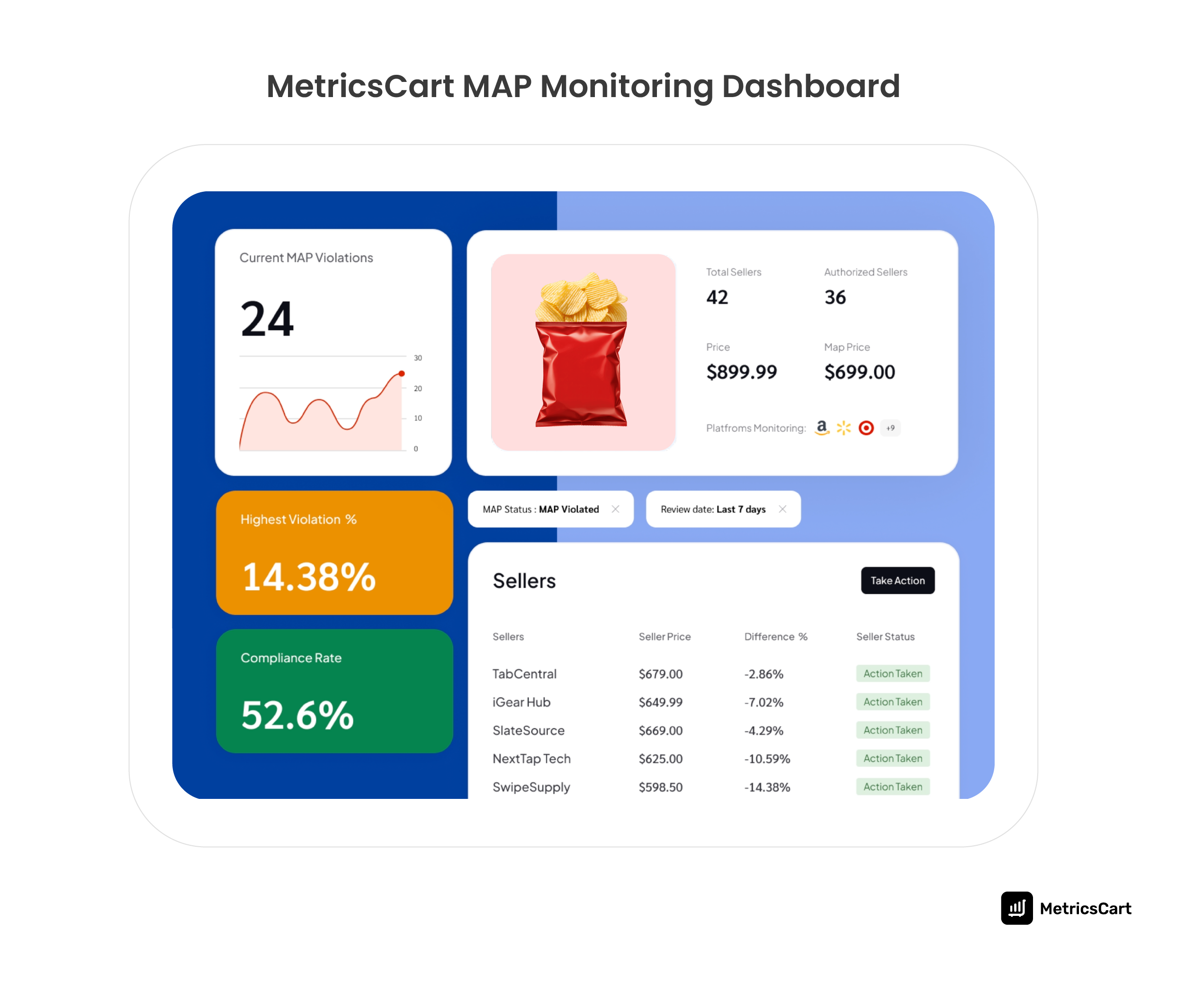
If you have read this far, you know that effective MAP compliance monitoring requires more than a spreadsheet and good intentions. It requires automated, SKU-level monitoring across every marketplace where your products are sold. It requires real-time violation detection, defensible evidence capture, and enforcement workflows that turn data into action.
That is exactly what MetricsCart’s MAP monitoring solution is built to do.
MetricsCart gives brands complete visibility into how their products are priced across Amazon, Walmart, Target, and hundreds of online retailers. The platform automatically detects MAP violations at the SKU level, identifies authorized and unauthorized sellers, captures timestamped evidence, and supports tiered enforcement workflows, from automated first notices to escalation paths for chronic offenders.
For brands managing MAP across SKUs on multiple marketplaces, the time savings alone justify the investment. But the real ROI is in pricing stability: healthier margins, stronger retailer relationships, and a brand position that does not erode whenever an unauthorized seller undercuts you.
Explore MetricsCart’s case studies to see how brands use automated monitoring to reduce violations, stabilize pricing, and rebuild retailers’ confidence across marketplaces.
Ready to take control of your pricing? Talk to MetricsCart to see how leading brands are using automated MAP compliance monitoring and enforcement to protect margins and strengthen retailer trust.
Ready to Stop MAP Violations Before They Erode Your Margins?
FAQs
MAP compliance monitoring is the process of systematically tracking product prices across online marketplaces and retailer websites to verify that all sellers are advertising at or above the brand’s established minimum advertised price. It involves automated crawling of product pages, detection of below-MAP pricing, capture of violation evidence, and initiation of enforcement actions.
A MAP violation occurs when a retailer or reseller advertises a product at a price below the minimum advertised price established by the brand’s MAP policy. This includes prices displayed on product detail pages, search result ads, price comparison engines, email promotions, and social commerce listings.
Yes. MAP enforcement is legal in the US when structured correctly. The legal foundation rests on the Colgate Doctrine, which upholds a manufacturer’s right to unilaterally set pricing policies and refuse to deal with non-compliant retailers. However, MAP policies that involve bilateral agreements, negotiations, or inconsistent enforcement can create antitrust risk.
The five core metrics for MAP enforcement monitoring are: violation rate (percentage of SKUs with active violations), time to resolution (hours/days from detection to correction), repeat offender frequency (how often the same sellers violate), revenue impact per violation (estimated margin loss per incident), and channel-level compliance scores (compliance rates broken out by marketplace).
Yes. MetricsCart delivers everything you would expect from a dedicated MAP monitoring platform: MetricsCart functions as a complete, end-to-end solution for MAP monitoring, enforcement, and analytics that CPG brands need to protect pricing integrity at scale. Key features include: SKU-level tracking across Amazon, Walmart, Target, and 150+ retailers; automated violation detection with timestamped evidence; authorized vs. unauthorized seller identification; repeat-offender tracking; tiered enforcement automation. So you are not just catching violations, you are understanding who is driving them, how they spread, and what they are costing you in margins and pricing consistency.