Highlights
- Electronics is one of the most MAP violation-prone categories on the digital shelf because high ASPs, dense seller competition, and Buy Box algorithms compound every pricing breach.
- One unauthorized listing below MAP can reset the perceived price of an electronics product across every channel within 72 hours. For products in the $300 to $1,000 range, a single MAP violation can cost a brand more revenue in one week than a year of CRM software.
- Weekly monitoring is the floor. For high-velocity SKUs and seasonal windows, daily scans are the realistic baseline.
- A MAP enforcement program is only as useful as the metrics it tracks: violation rate, Time to Resolution, repeat offender rate, and revenue at risk.
- A kitchen electronics brand used MetricsCart’s MAP monitoring and enforcement software for electronics to cut violations by 65% in the first quarter and protected $1.2M in brand value within six months.
The Cost of Slow MAP Violation Detection in Electronics
Electronics is one of the hardest categories on the digital shelf to enforce MAP (minimum advertised price) in. High ASPs make every percentage-point breach a margin event. Most ASINs carry dozens of third-party sellers, automated repricing tools react within minutes, and Amazon’s Buy Box algorithm rewards whichever seller is willing to go lowest. A single below-MAP listing can reset the perceived price of a product across channels within 72 hours.
Monthly or quarterly audits cannot keep up with that velocity. By the time a MAP violation surfaces in a review meeting, the lower price has already cascaded to authorized retailers, undermined the next promotional window, and shifted shopper price anchoring downward. This article breaks down what electronics brands lose when they do not monitor MAP weekly and what an effective MAP enforcement strategy looks like in the electronics category.
Why Electronics Brands Need a Stronger MAP Policy Than Other Categories
Brands in food, beauty, and household goods will tell you MAP enforcement is hard. They are right. The structural conditions in electronics make it harder still, and any electronics MAP policy built on assumptions borrowed from other categories will fail the moment it meets the marketplace.
High ASPs Mean Every Violation Hits Harder
Most consumer electronics products run on retail margins between 5% and 15%, which means even a modest percentage deviation below the minimum advertised price wipes out the authorized partner’s profit on the unit. A $50 below-MAP listing on a $499 soundbar is a margin event in a way a $15 deviation on a $29 shampoo is not.
The portfolio math compounds that. A $399 product violated at $349 across five sellers, each moving 40 units a week, is a $10,000 weekly margin event before any of those sellers triggers a price-match response from authorized partners. Multiply across a catalog of 200 SKUs and the scale and gravity of price violations electronics brands face becomes clear.
Marketplace Algorithms Reward Lower Prices
Amazon’s Buy Box is the most influential pricing engine in retail. It weighs price alongside fulfillment speed, seller rating, and a handful of other variables, and the seller offering the lowest compliant price tends to win the box on a contested ASIN.
Industry guidance suggests brands need to stay within roughly 5% of the lowest external offer to maintain Buy Box eligibility. That creates a trap for any brand with a strict MAP floor. If an unauthorized seller drives the external reference price down, your own authorized listing loses the Buy Box even though your price is correct under your policy.
Walmart Marketplace and eBay operate on similar systems, with lower prices weighted heavily in the algorithms that determine visibility. Channel pricing compliance is not optional in this environment. It is the precondition for getting any return at all on the advertising and merchandising dollars spent on those platforms.
Product Lifecycles Create Urgency
Consumer electronics live and die on an 18-to-36-month replacement cycle. A current-generation model needs to hold premium pricing long enough to clear authorized inventory before the next generation lands, because once price erosion starts on the current SKU it kills the launch window for the next one. Retailers will not commit shelf space or feature placement to a new product line from a brand that let its previous line collapse to clearance pricing six months early.
There is also the question of consumer behavior. The Deloitte 2025 Consumer Survey found that US households spent an average of $896 on consumer tech in the past year, up 17% from 2024. Shoppers are spending more and comparing more across channels, and price inconsistency increasingly reads as a signal of gray market product, refurbished inventory, or a brand at the end of its lifecycle.
READ MORE | A Complete MAP Pricing Guide: Everything Brands Need To Know
What Happens When MAP Price Violations in Electronics Go Unchecked
The consequences of skipping weekly MAP compliance monitoring are sequential. They start small and they compound. By the time most brands recognize the damage, the cost of recovery is several multiples of what continuous monitoring would have cost in the first place.
Price Erosion Cascades Across Channels in Days
One unauthorized seller drops the price on Amazon. The other sellers on the ASIN watch the Buy Box change hands, and their automated repricing tools respond in an hour. Within 48 hours, the lower price has stabilized as the new floor on Amazon, leading to price erosion. Within a week, Walmart sellers have picked up the same reference point, eBay listings have adjusted, and authorized brick-and-mortar dealers are asking why their own promotional pricing suddenly looks expensive.
Authorized Resellers Lose Trust (and Eventually, Interest)
The retailers and the authorized resellers who matter the most in electronics: once they lose trust in your pricing integrity, it becomes easy for them to walk away.
They follow MAP because they expect the brand to enforce it on everyone else. When they watch unauthorized sellers run below MAP on Amazon for weeks without consequence, the conclusion they draw is that the policy is a piece of paper.

Inconsistent enforcement produces the second-order effect documented in an HBR research: authorized partners themselves start testing the policy. Enforcement is selective enough that even compliant partners begin to wonder if the rules apply to them.
Promotions Get Undercut Before They Launch
Electronics brands plan the year around four or five major promotional windows: Black Friday, Cyber Monday, Prime Day, Back-to-School, and the launch event tied to the next-generation product. Each window represents a meaningful share of annual revenue. Each one assumes the brand controls the advertised price going into the campaign.
When unauthorized discounting has been running unchecked for six weeks before the campaign, the planned promotional price stops functioning as a promotion. It is the same price shoppers have been seeing all month. Media budget gets spent, merchandising space gets booked, and the conversion lift fails to arrive.
Weekly minimum advertised price monitoring is the only mechanism that surfaces this pattern in time to act on it, whether that means tightening enforcement before the window opens or adjusting the campaign price so it lands as a genuine discount.
Brand Perception Shifts from Premium to Commodity
This is the slowest of the consequences and the hardest one to reverse. Shoppers seeing the same product at consistently different prices across channels rarely assume one seller is in violation. They assume the product is worth the lower price and someone is overcharging them, or they assume the cheaper unit might be gray market, refurbished, or counterfeit.
Premium positioning in consumer electronics depends on pricing consistency more than in almost any other category. A premium soundbar that consistently appears at MAP across every channel reads as premium. The same product appearing at three different prices reads as a category at the end of its lifecycle. Once that perception sets in, advertising spend cannot buy it back.
Defend premium positioning every day. MetricsCart’s MAP monitoring and enforcement software automates unauthorized discount detection across every marketplace your products sell on. See how it works.
Why Brands Need MAP Monitoring Software for Electronics
Manual MAP audits were defensible when most electronics brands sold through a smaller set of physical retailers and online listings updated weekly rather than hourly. In 2026, neither of those conditions still holds. Purpose-built MAP monitoring software for electronics is the only realistic way to keep pace with the volume, velocity, and complexity of modern marketplace pricing.
Automated SKU-Level Price Scanning Across Every Marketplace
A typical electronics brand has 200 to 2,000 active SKUs across four to six marketplaces, with anywhere from 10 to 60 third-party sellers per high-velocity ASIN. A manual audit team checking 50 listings per week covers a vanishingly small fraction of that surface area. Automated monitoring scans the entire catalog every day, captures the advertised price on every active listing, and surfaces any deviation from MAP within the same scan cycle.
Marketplace prices change multiple times per day on bestseller SKUs because of how repricing tools interact with the Buy Box algorithm. Weekly is the floor for a brand willing to accept some lag. Daily scans, and in some cases multiple daily scans on hero products, are what the category demands during peak windows.
Unauthorized Discount Detection and Seller Identification
Detecting a price below MAP is the straightforward part of the work. Identifying who is responsible, why, and how to respond is where most manual programs fall apart. Effective unauthorized discount detection distinguishes between an authorized partner whose repricing tool drifted, a Tier 2 reseller experimenting with promotional pricing without permission, and an unknown third-party seller working from diverted inventory.
The response for each of those differs. Treating a strategic Tier 1 partner like an anonymous violator damages the relationship in ways that take quarters to repair. Treating a counterfeiter like a partner wastes weeks while the damage compounds. Good software captures seller storefronts, fulfillment methods, pricing histories, and listing content changes like image swaps or title edits that often indicate counterfeit or diverted product. That context makes enforcement targeted rather than reflexive.
Timestamped Evidence That Makes Enforcement Actionable
Proper MAP monitoring software captures evidence packages that include the product listing, the advertised price, the seller identity, the URL, and the date and time of the violation, all locked and unalterable.
That distinction matters at every level of escalation. The seller who ignored three notices over six weeks responds differently to a documented evidence package showing eighteen separate violations across a 90-day window. Platform reports to Amazon Brand Registry or Walmart Brand Portal move faster when they arrive with structured proof attached. Legal counsel acts faster when working from a defensible record. The evidence layer is what turns enforcement from a hopeful exercise into a documented one.

Building a MAP Enforcement Strategy That Actually Works for Electronics Brands
Brands that get measurable results from their MAP enforcement strategy treat the program as an operational discipline with defined inputs, defined actions, and defined outputs, audited the same way any other commercial function would be.
Set Monitoring Frequency Based on Category Velocity
Not every SKU justifies the same monitoring frequency. High-velocity products, new launches, and seasonal hero SKUs need daily scans, with multiple daily scans during peak windows like Prime Day or Black Friday. Long-tail SKUs, slow-movers, and end-of-life products run on weekly scans without meaningful additional risk.
Brands monitoring 1,000 SKUs at a uniform cadence are either over-investing in the bottom 700 or under-investing in the top 100. Both waste resources. A simple tiering exercise, ranking SKUs by revenue contribution, channel exposure, and price sensitivity, usually identifies the 50 to 100 products that warrant the most aggressive scan frequency.
Tiered Enforcement Action Plan to Tackle MAP Violations
Enforcement should match the type of violation, the type of seller, and the severity of the breach. A first-time violation from an authorized partner receives an automated notification and a short grace period to correct. A repeat violation from the same partner escalates to account-manager intervention, with consequences attached to promotional support or co-op funding.
Anything 30% or more below MAP goes to priority enforcement regardless of seller type, because at that depth of discount the violation cascades before any normal response can catch it. Repeat offenders, defined as sellers with three or more violations in a 90-day window, escalate toward legal action or sustained platform reporting until the listings come down.
Track these Metrics to Know Whether Your MAP Enforcement Strategy Is Working
Most internal MAP programs measure activity rather than outcome. They count notices sent, which tells you how busy the team has been without telling you whether the program is working. The metrics that actually indicate effectiveness are different:
- Violation Rate: The percentage of monitored listings out of compliance at any given time. The target is a steady decline quarter over quarter.
- Time to Resolution (TTR): The hours between detection and correction. Strong programs run under 24 hours for high-priority SKUs.
- Repeat Offender Rate: The share of violations coming from sellers who have violated three or more times in 90 days. High concentration means a small group is responsible for most of the damage, which makes targeted enforcement easy and effective.
- Revenue at Risk: The estimated weekly margin loss from active violations. This is the number that translates the program into a language finance and the C-suite responds to.
- Compliance Score by Retailer: Monthly scorecards ranking authorized partner compliance, used in QBR conversations to make pricing discipline part of the partnership review.
READ MORE | 4 Critical Signs To Switch Your MAP Enforcement Tool ASAP!
How a Kitchen Electronics Brand Eliminated 65% of MAP Violations and Protected $1.2M in Brand Value with MetricsCart
A high-end kitchen electronics brand selling on Amazon, Best Buy, Wayfair, and eBay applied the framework above with MetricsCart and recovered control of its pricing within two quarters.
The Challenge: Unauthorized Sellers and Pricing Chaos
The brand was managing a surge in MAP violations from unauthorized third-party sellers across its core kitchen product range. The breaches were visible to authorized retail partners, who could see them on Amazon and had begun questioning whether the brand was serious about defending the price floor. The premium positioning the brand had been built on was eroding in real time.
The internal team was tracking violations manually. The process was slow, incomplete, and reactive. There was no visibility into violation rate trends, no way to identify repeat offenders, and no quantification of revenue impact.
The Solution: Automated MAP Monitoring and Enforcement with MetricsCart
The brand deployed MetricsCart’s MAP Monitoring module for 24/7 automated marketplace scanning. The implementation captured daily data on SKU-level pricing against MAP, full violation logs with seller details and storefront links, Buy Box tracking, listing content changes, and timestamped evidence on every breach.
The first month of structured data revealed what manual auditing had been missing. Roughly 18% of the unauthorized seller base was responsible for nearly 60% of all violations. The brand stopped sending blanket outreach and concentrated enforcement on the cluster doing most of the damage. Buy Box tracking surfaced a separate pattern: violations were concentrated on weekends, a window the previous manual audit cycle was never looking at.
The Results: 65% Violation Reduction, 92% Compliance, $1.2M Protected
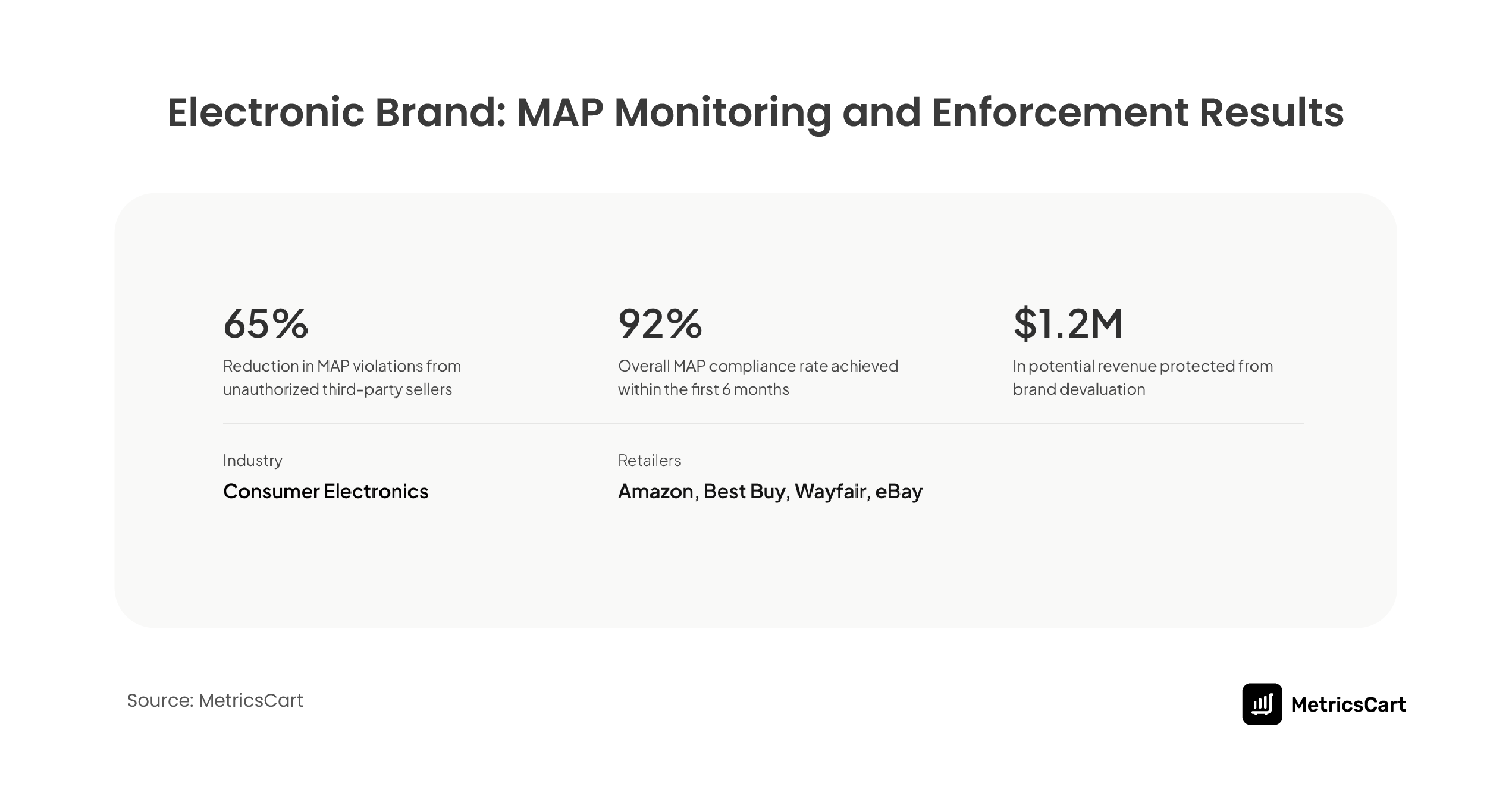
Within the first quarter, MAP violations from unauthorized third-party sellers dropped by 65%. Within six months, overall MAP compliance reached 92% across the monitored SKUs. The brand estimated $1.2M in revenue protected from brand devaluation across that window, calculated against the trajectory the previous violation rate would have produced.
Authorized partners responded with stronger promotional support and renewed featured placement on key SKUs. Premium pricing held across the channels that mattered. The full breakdown is available in the case study.
With MetricsCart, Stop the Cascade Before It Starts
For electronics brands selling across modern marketplaces, MAP monitoring cadence is the operational layer that determines whether the rest of the digital shelf strategy works.
Advertising spend, launch calendars, retailer relationships, and premium positioning all rest on whether the advertised price is the price the brand actually set and is being adhered to.
MetricsCart supports brands that have accepted this and need the system to back it up: continuous monitoring across Amazon, Walmart, Best Buy, eBay, and 150+ retailers.
For electronics brands evaluating MAP monitoring software for electronics and considering what a daily monitoring program would look like against a specific catalog and channel mix, the next step is straightforward.
Take control of channel pricing compliance with MetricsCart and see how you can protect your electronics brand’s price integrity online.
Tighter Channel Pricing Compliance Starts Here.
FAQs
MAP, or Minimum Advertised Price, is the lowest price a retailer is allowed to advertise a product for, as set by the brand or manufacturer. Electronics brands need MAP policies because their products sell across multiple channels with dozens of third-party sellers per ASIN, which makes them especially vulnerable to price wars. A clear electronics MAP policy gives the brand a defensible framework for maintaining pricing consistency across Amazon, Walmart, Best Buy, eBay, and authorized dealer sites.
At a minimum, weekly. For high-velocity SKUs, new launches, and peak retail windows like Prime Day or Black Friday, daily monitoring is the working standard. Electronics pricing moves faster than most categories because marketplace algorithms reward lower prices and third-party sellers use automated repricing tools that adjust multiple times per day.
Time to Resolution (TTR) measures how many hours pass between detecting a MAP violation and bringing the seller back into compliance. Strong programs run under 24 hours for high-priority SKUs. Long TTR means more days of lost margin, more sellers matching the lower price, and more damage to authorized retailer relationships.
MAP monitoring is the detection layer: scanning marketplaces, identifying MAP violations, and capturing evidence. MAP enforcement is the action layer: sending violation notices, escalating repeat offenders, reporting unauthorized sellers to marketplace platforms, and tracking resolution outcomes. Effective brand protection programs require both.
Yes. MetricsCart fully supports and delivers everything you would expect from a dedicated MAP monitoring platform, including continuous violation detection, seller tracking, and enforcement workflows.
At the same time, it goes further by combining MAP monitoring with deeper pricing, seller, and digital shelf intelligence. This means you are not only identifying violations but also understanding who is driving them, how they spread, and what impact they have on pricing consistency and margins. For teams that want both strong MAP compliance and broader visibility into their online pricing ecosystem, MetricsCart functions as a complete, end-to-end solution.