
Google recently announced the launch of the Universal Commerce Protocol. A few months earlier, OpenAI introduced a similar concept with its Agentic Commerce protocol. Both announcements are significant, and together they point to one clear reality: we are much closer to agentic commerce than most of us expected.
As our CEO and Co-founder, Ash K., puts it:
Agentic commerce will not replace retailers, product detail pages, brands, or commerce itself. But it will significantly narrow the room for error on your digital shelf.
This means, as commerce evolves, accuracy on the digital shelf becomes non-negotiable. Pricing gaps, content errors, and availability issues will no longer be tolerated.
And to operate in this environment, brands must move beyond what manual checks and human oversight can realistically manage. E-commerce product monitoring enables the scale, speed, and reliability needed to maintain a trusted digital shelf in an agent-driven commerce world.
Highlights
- Agentic commerce is narrowing the margin for error on the digital shelf, making accuracy across pricing, content, availability, and reviews non-negotiable.
- E-commerce product monitoring gives brands continuous visibility into how products appear and perform across marketplaces, retailers, and D2C channels.
- A strong monitoring strategy is built on 5 pillars: price and promotion, MAP monitoring and enforcement, content and compliance, availability and assortment, and ratings and customer feedback.
- Product performance intelligence connects these signals, helping brands identify issues early and act before revenue, visibility, or trust is impacted.
- Tools like MetricsCart enable brands to move beyond manual checks and fragmented dashboards by delivering unified, actionable digital shelf insights at scale.
What is E-commerce Product Monitoring?
E-commerce product monitoring is the practice of continuously tracking how your products appear and perform across online sales channels like marketplaces, retailer websites, and your own D2C store. It involves monitoring critical factors such as pricing, availability, product content, ratings, and visibility to ensure everything remains accurate, competitive, and compliant.
Instead of reacting after sales drop or customers complain, product monitoring helps brands spot issues early, understand changes in the digital shelf, and maintain control over how their products are represented and discovered online.
In practice, many teams also refer to this as online product monitoring or digital shelf monitoring. Regardless of the term, the purpose is the same: to maintain consistent, optimized, and high-performing product presence across every online touchpoint.
5 Pillars of a Successful Product Monitoring Strategy
A successful product monitoring strategy goes beyond checking prices once in a while. It gives brands continuous visibility into every factor that determines how a product performs on the digital shelf and where execution gaps typically occur.
Here are the four pillars that form the foundation of that control.
Pillar 1: Price & Promotion Monitoring
Pricing is one of the most sensitive and volatile elements in e-commerce. This pillar in product monitoring for e-commerce focuses on tracking list prices, selling prices, discounts, coupons, and promotional campaigns across marketplaces and retailers. It helps brands detect unauthorized price drops, price mismatches between channels, and aggressive competitor discounting.
However, accurate pricing intelligence depends on robust product matching. The same product can appear across multiple listings, sellers, variant structures, and regional catalogs. Without precise SKU-level, UPC-based, title, image, and attribute matching, brands risk comparing incorrect listings, missing unauthorized sellers, or misinterpreting competitive price movements.
Effective price and promotion monitoring, therefore, combines real-time tracking with advanced product matching algorithms that identify identical or highly similar products across platforms.
This ensures that every pricing comparison reflects the correct product, seller, and channel context, forming a reliable foundation for competitive benchmarking, policy enforcement, and strategic pricing decisions.
READ MORE | 5 Best Price Monitoring Tools 2026: A Complete Guide
Pillar 2: MAP Monitoring & Enforcement
Minimum Advertised Price (MAP) is the lowest price at which a retailer or seller is allowed to advertise a product, as defined by the brand. Unilateral Pricing Policy (UPP) is a similar framework in which a brand sets pricing guidelines that sellers must follow to continue doing business with the brand. Both are designed to protect brand equity, maintain fair competition among channel partners, and prevent margin erosion.
When these policies are ignored, violations are not just pricing discrepancies. They are channel discipline failures that directly undermine retailer relationships, compress margins, and weaken long-term pricing power.
This pillar of e-commerce product monitoring focuses on identifying MAP and UPP violations across marketplaces, sellers, and regions in real time. It includes seller identification, automated alerts, historical tracking, and structured evidence capture, such as timestamped screenshots to support enforcement actions.
Unlike general price tracking, MAP enforcement requires audit-ready documentation and consistent oversight. Without systematic monitoring, violations often persist unnoticed until channel conflict escalates or brand positioning is permanently diluted.
Pillar 3: Content & Compliance Monitoring
Content is the first interaction a shopper has with your product on the digital shelf. Product titles, images, bullet points, descriptions, and enhanced content collectively determine whether a shopper trusts the product enough to consider buying it.
This pillar of product monitoring for e-commerce focuses on ensuring that product pages remain accurate, complete, and compliant across marketplaces. It involves tracking changes to PDP content, identifying missing or incorrect attributes, and validating listings against brand guidelines and retailer-specific requirements.
Content issues often go unnoticed because they do not trigger obvious alerts, yet they directly affect conversion rates, return rates, and customer confidence. Continuous content and compliance monitoring help brands catch these gaps early, maintain consistency at scale, and ensure that every product page reflects the intended brand and product experience.
READ MORE | The Hidden Costs of Inconsistent Product Content: Are You Losing Sales?
Pillar 4: Availability & Assortment Tracking
Availability is where product performance intelligence becomes tangible. No matter how strong the pricing or content is, an unavailable product cannot convert, and repeated availability issues quickly erode visibility, ranking, and shopper trust.
This pillar of e-commerce product monitoring focuses on tracking in-stock and out-of-stock status, Buy Box ownership, regional availability, and assortment gaps compared to competitors. By connecting availability signals with demand and visibility data, product performance intelligence helps brands understand not just where products are unavailable, but why those gaps matter and how they impact performance.
Pillar 5: Ratings, Reviews & Customer Feedback
According to a Forbes report, 98% of online shoppers read reviews before making a purchase, and products with higher ratings consistently have higher conversion rates than comparable alternatives with weaker feedback. McKinsey also says that customer feedback data, when analyzed systematically, plays a critical role in improving product performance and customer satisfaction across digital channels.
This indicates that ratings and reviews are among the strongest performance signals on the digital shelf because they directly influence shopper trust, conversion, and discoverability.
And so, the fourth pillar of e-commerce product monitoring focuses on tracking rating trends, review volume, velocity, and recurring themes within customer feedback at the SKU level. Rather than treating reviews as qualitative noise, structured review analysis turns them into measurable signals that reveal product issues, unmet expectations, and competitive strengths.
When applied correctly, this product performance intelligence connects review insights with pricing, content, and availability signals. This allows brands to identify early warning signs, prioritize corrective action, and reinforce what is working, using real customer voice as a decision input rather than a post-mortem metric.
Top 3 E-Commerce Product Monitoring Tools to Try
If you want product monitoring without manually refreshing tabs until your eyeballs glaze over, these tools help automate the heavy lifting.
MetricsCart
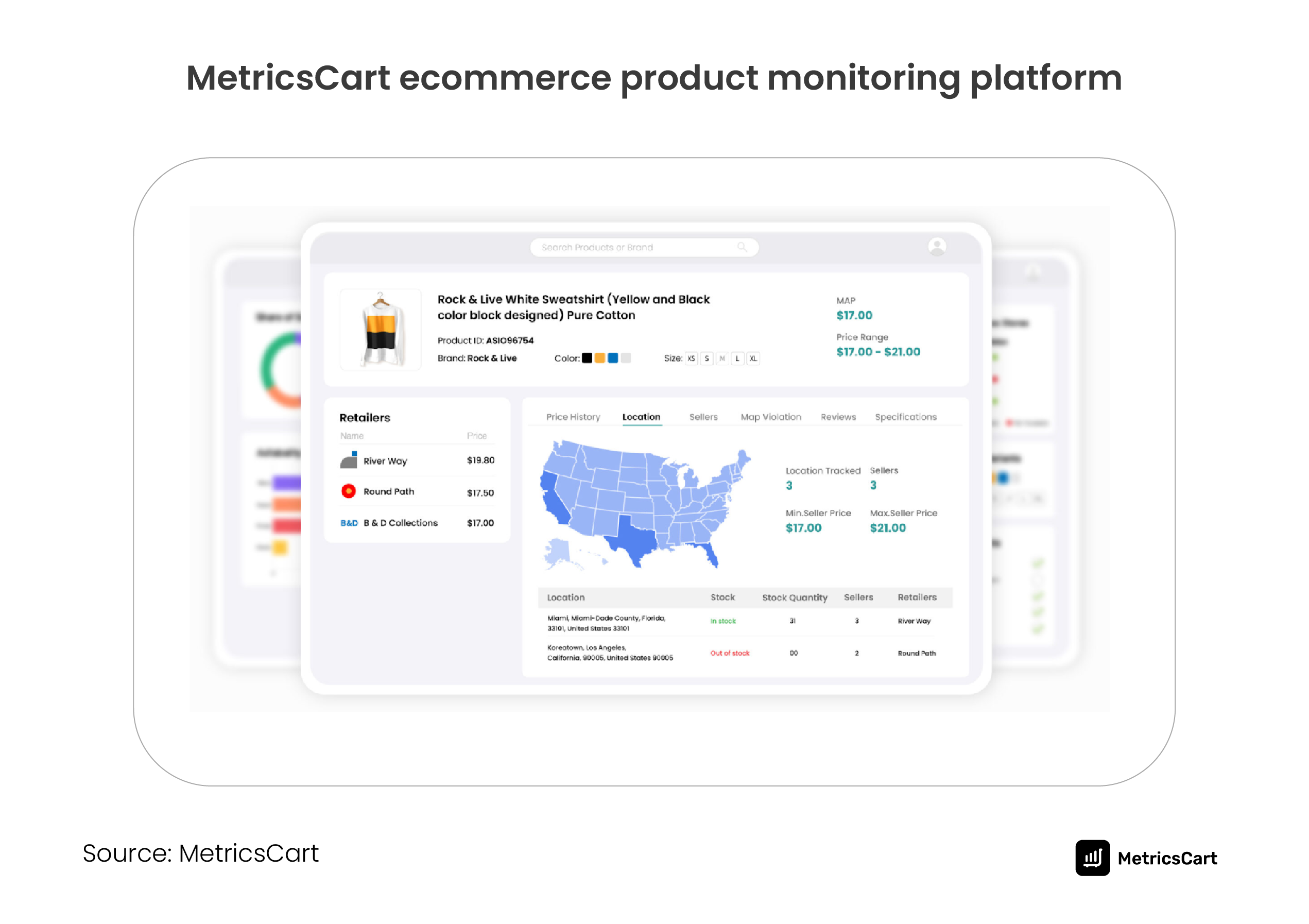
MetricsCart is one of the best e-commerce product monitoring platforms built for e-commerce teams, especially those selling consumer goods and durables. It helps brands track how their products appear and perform across 100+ e-commerce marketplaces by monitoring key factors such as pricing, availability, and search visibility.
The aim is to give teams a clear, centralized view of their digital shelf so they can spot issues, benchmark against competitors, and optimize listings without manually hunting down data.
Top Features of MetricsCart
- End-to-end Digital Shelf Analytics across pricing, content, availability, search visibility, reviews, and Buy Box.
- Real-time pricing and promotion monitoring across online retailers
- MAP and UPP monitoring and enforcement with seller identification and violation tracking.
- Unauthorized seller detection and seller compliance analysis.
- Automated warning emails and evidence collection with screenshots for MAP violations.
- Content compliance monitoring with customizable scorecards for titles, bullets, images, and videos.
- Live content analyzers for titles, descriptions, and bullet points.
- Inventory availability tracking at store, regional, and seller levels.
- Assortment gap analysis against competitors.
- Ratings and reviews analysis using theme and sub-theme detection.
- Consumer insights from online conversations, such as Reddit threads, YouTube videos, and TikTok reels.
- SKU-level customer feedback insights and competitor benchmarking.
- Search visibility and share-of-search tracking for organic and paid keywords.
- Product matching across marketplaces, including variant and UPC-based matching.
- Bestseller and BSR tracking with category and competitor insights.
- Walmart and Amazon Buy Box monitoring with pricing, fulfillment, and seller impact analysis.
- Historical trend analysis across all digital shelf metrics.
- Unified dashboards and customizable reports for cross-functional teams.
- Real-time alerts and actionable insights to support faster execution decisions.
Pricing
MetricsCart e-commerce product monitoring solution offers flexible pricing starting at $1000 per month, with plans tailored to your brand’s goals and scope of coverage.

Prisync
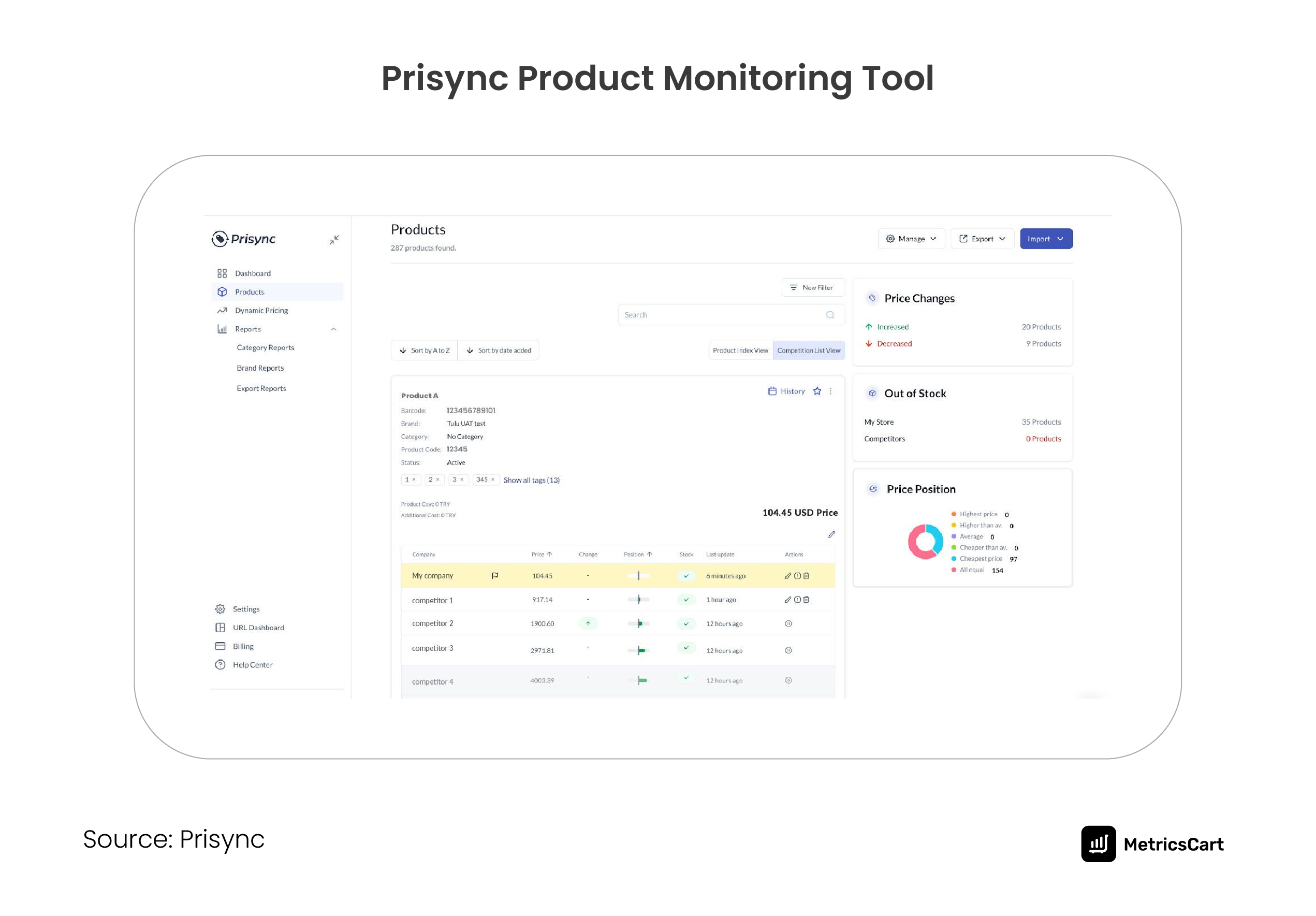
Prisync is a competitive pricing intelligence platform built primarily for teams that want visibility into how their prices compare against competitors across online stores. It focuses on tracking price changes and promotional activity to help businesses stay competitive in price-sensitive categories.
The platform gives pricing and merchandising teams a centralized view of competitor pricing trends, allowing them to respond to market changes without manually checking multiple websites.
Top Features of Prisync
- Competitive price tracking across selected online retailers.
- Real-time alerts for competitor price changes.
- Promotion and discount monitoring.
- Historical price tracking and trend analysis.
- Pricing comparison dashboards.
- Exportable pricing reports for internal analysis.
Pricing
Prisync pricing starts at $99 per month for up to 100 products.
Hotjar
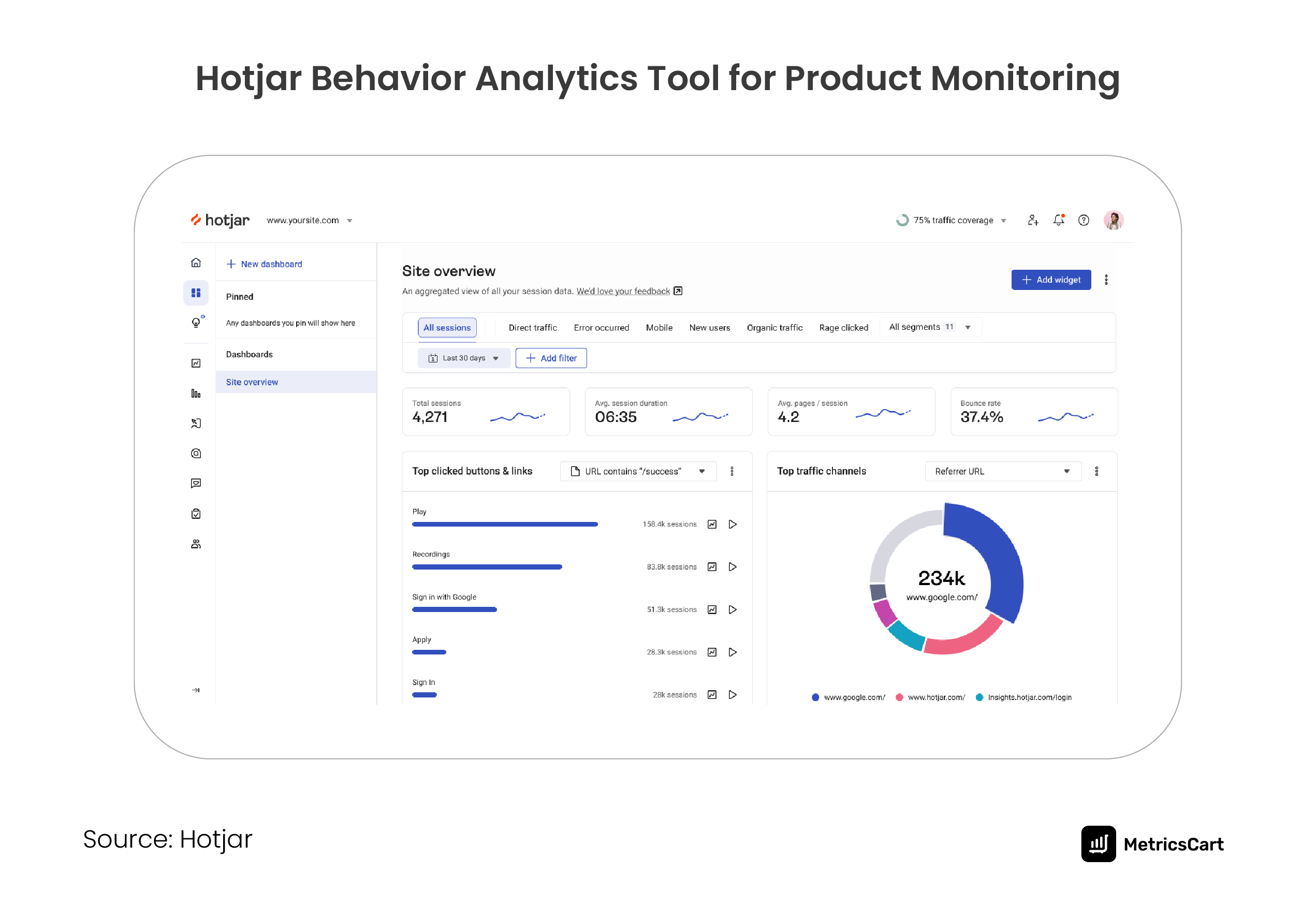
Hotjar is a behavior analytics tool designed to help teams understand how users interact with their own websites. It focuses on visualizing on-site behavior rather than monitoring external marketplaces or competitors.
The platform is commonly used by UX, CRO, and product teams to identify friction points on product pages and improve the overall shopping experience on direct-to-consumer websites.
Top Features of Hotjar
- Heatmaps showing where users click, scroll, and engage.
- Session recordings to replay real user journeys.
- On-page surveys and feedback widgets.
- Funnel and form analysis for conversion optimization.
- User behavior insights for UX improvements.
Pricing
Hotjar offers a free plan, with paid plans starting at around $39/month, depending on traffic volume and feature access.
Final Take: Monitor Less Noise, Act on the Right Signals
E-commerce product monitoring in 2026 is no longer about tracking every possible metric. It is about identifying the signals that directly influence revenue, visibility, and customer trust, and acting on them before declines in performance become visible in financial reports.
Brands that succeed on the digital shelf focus on disciplined monitoring, cross-functional alignment, and faster decision-making. By investing in comprehensive product performance intelligence tools like MetricsCart rather than fragmented dashboards, you can reduce risk, improve execution, and build resilience in an increasingly competitive e-commerce landscape.
Strengthen your e-commerce product monitoring with MetricsCart
FAQs
Brands need product monitoring tools because manual checks cannot keep up with the speed and complexity of modern e-commerce. Prices change multiple times a day, listings are edited without notice, inventory fluctuates by region, and customer feedback spreads instantly. Monitoring tools provide real-time visibility and reduce the risk of revenue loss caused by execution gaps.
E-commerce product monitoring typically tracks pricing and promotions, MAP and UPP compliance, product content quality, inventory availability, assortment coverage, search visibility, ratings and reviews, competitor benchmarks, bestseller rankings, and Buy Box ownership. Together, these signals form product performance intelligence.
Yes. E-commerce product monitoring and digital shelf monitoring are often used interchangeably. Both refer to tracking how products appear and perform across online retail environments, including marketplaces, retailer websites, and D2C channels.
Traditional e-commerce analytics focus on outcomes such as traffic, sales, and revenue after they occur. Product monitoring focuses on execution signals before revenue is impacted, such as price changes, content gaps, stockouts, or review trends. This allows brands to act proactively rather than reactively.
In 2026, product monitoring needs to be continuous or near real-time. Marketplaces update prices, availability, and content frequently, and delayed monitoring increases the risk of missed issues. Most leading brands monitor critical signals daily or in real time.