Highlights
- Gen Alpha does not respond to ads. They respond to experiences that are in-game, creator-led, and participatory by design.
- Gaming platforms like Roblox and Minecraft are not just entertainment for Gen Alpha. They are where brand discovery, social interaction, and purchasing decisions happen.
- Gen Alpha’s review-and-recommendation behavior is already shaping household purchases. 42% of family spending is influenced by their opinions today, not in five years.
- Short-form video is table stakes. What actually moves Gen Alpha is content that invites them to react, share, or participate rather than just watch.
- The brands building Gen Alpha loyalty now will have a significant head start when this generation fully enters the independent-purchasing stage by 2030.
The New Rules of Gen Alpha Attention
There is a 12-year-old somewhere adding a product to her mom’s cart after watching a 47-second YouTube video. Her younger brother just spent his $22 weekly allowance on a Roblox item from a brand he discovered in-game. Neither of them saw a single traditional ad today.
This is Gen Alpha; born between 2010 and 2025, and already reshaping how money moves.
According to a 2025 report by DKC, Gen Alpha influences 42% of household spending and collectively controls more than $100 billion in direct annual spending. They are not waiting to grow up to have economic power. They already have it.
And yet most brand teams are still building marketing plans that treat Gen Alpha like a younger version of Gen Z. That mistake is becoming more expensive by the quarter.
Gen Alpha is the first generation to grow up with AI as a normal, everyday tool. They have never known a world without YouTube, Roblox, or algorithmic feeds. They just do not browse the internet. They live in it. And they expect every brand interaction to be real and worth their time.
This guide breaks down exactly who Gen Alpha is, what Gen Alpha marketing strategy implies, which brands are getting it right, and what your team needs to start doing differently in 2026.
How does Gen Alpha’s Spending Behavior Differ in 2026?
Before jumping to strategy, it helps to understand what is actually driving Gen Alpha’s decisions.
Purchasing influence:
Gen Alpha is not just a future consumer. They are a current one. The typical Gen Alpha child has $2,340 in annual spending money, with top categories including snacks, toys, electronics, beverages, and entertainment. Beyond direct spending, they are the household’s unofficial product research team, recommending what to buy, where to order, and which brand to choose.
Platform behavior:
Around 60% of Gen Alpha use YouTube, and the platform is expected to overtake traditional TV among this group by 2026. About 44% use TikTok, and among US Gen Alpha TikTok users, 89% open the app daily. But the platforms that define this generation most are gaming environments: Roblox, Minecraft, and Fortnite, which function as decentralized social hubs where brand discovery happens through immersive 3D interactions rather than static feeds.
Review and recommendation behavior:
Because Gen Alpha trusts peers more than brands, their opinions often surface in product reviews, comments, and recommendations long before they show up in sales reports. MetricsCart’s Ratings & Reviews Analysis helps brands surface those patterns early by turning scattered customer feedback into valuable insight.
AI interaction:
This is the sharpest difference from every generation before them. Gen Alpha uses AI tools to search, create, learn, and make decisions, and they are genuinely comfortable doing it. For brands, this means your product discovery strategy needs to account for AI-assisted search, not just traditional SEO.
Gen Alpha vs. Gen Z: Key Marketing Differences
| Factor | Gen Z | Gen Alpha |
| Technology relationship | Digital natives | AI natives |
| Content preference | Short-form video | Interactive, participatory content |
| Discovery channel | Social search (TikTok, Instagram) | Creator platforms + AI-assisted discovery |
| Brand trust signal | Peer reviews, influencer endorsement | Creator authenticity, gamified proof |
| Purchasing role | Independent buyers | Household influencers + early independent buyers |
For brands, that shift means strategies built for Gen Z attention will not automatically translate into Gen Alpha trust.
How to Market to Gen Alpha Effectively: 5 Strategies That Actually Work
Build for Participation, Not Passive Consumption
Gen Alpha does not want to watch your brand. They want to be inside it.
The brands that understand this are building experiences where Gen Alpha can create, compete, customize, and share. For instance, Roblox has over 25 million daily concurrent users, and in May 2025, it introduced the ability to buy physical products directly from within Roblox experiences. Nike has had a presence on Roblox since 2021 through Nikeland, where users can play virtual sports and buy digital shoes for their avatars. That is actual participation.
If your brand is still thinking in terms of campaigns and impressions, you are speaking a language Gen Alpha does not respond to.
Use Creator Marketing, But Pick the Right Creators
Gen Alpha does not care about celebrity. They care about relatability.
The creators who move them are the ones who feel like a slightly older version of themselves; funny, unfiltered, and clearly not reading from a script. MrBeast, Ryan’s World, and gaming creators with family-friendly audiences consistently drive product awareness among Gen Alpha. What they share in common: they feel earned, not placed.
Micro-creators often outperform macro-influencers here. A creator with 200,000 engaged subscribers who genuinely uses your product will convert better than a celebrity with 5 million followers doing a scripted read. Gen Alpha can tell the difference every single time.
Prioritize Visual, Interactive, and Gamified Content
Static ads do not reach Gen Alpha. Gamified content does.
Nike’s Run Club and Training Club are good examples outside of traditional gaming. Both apps use challenges, badges, leaderboards, and progress tracking to turn fitness into something that feels like a game. That keeps Gen Alpha coming back to the Nike brand long before they are making purchases on their own.
For food and beverage brands, gamification looks different. Think limited-time challenges, collectible packaging, tag-a-friend mechanics, and content that feels less like marketing and more like a dare. The goal is to give them something to do with your brand, not just something to look at.
Lead With Sustainability and Values, But Mean It
66% of Gen Alpha say they prefer to buy from brands that do good for the world. That number matters, but sincerity matters more for them.
Gen Alpha has grown up watching brands talk about sustainability while doing very little about it. They are good at spotting the gap. Patagonia is often cited as an example of a brand whose sustainability messaging matches its operations. Programs like Worn Wear encourage customers to repair, resell, and extend the life of products instead of replacing them. That kind of commitment is visible, consistent, and genuinely hard to fake.
For CPG brands, this shows up in packaging. Customers notice and write about it in reviews. It is not just a values statement. It is measurable, trackable data that shows up on your digital shelf, whether or not you are paying attention.
Show Up Where Gen Alpha Searches
Gen Alpha does not only Google things. They ask, explore, and discover across YouTube, Roblox, TikTok, and increasingly through tools that pull answers together for them. The way they find brands is nothing like the way older generations did.
This means your brand needs to be easy to find and understand across all those touchpoints. Clear product information, strong review volume, an active presence on the platforms they use, and content that actually answers the questions they are asking.
If your brand is hard to find or hard to understand on the channels Gen Alpha trusts, they will find someone else without a second thought. There is no shortage of options competing for their attention.
Gen Alpha Marketing Examples: Brands Getting It Right in 2026
Food, Snack, and Beverage Brands
Sour Patch Kids ranks fifth on Gen Alpha’s “coolest brands” list in the US, ahead of Nintendo, Oreo, and Roblox. The reason is simple: they do not run ads that look like ads. Their TikTok content is chaotic, meme-driven, and intentionally illogical, which is exactly the kind of content Gen Alpha finds funny enough to share. Their strategy is not about reaching Gen Alpha. It is about giving Gen Alpha something worth sending to a friend. Tag-a-friend prompts, duet challenges, and absurdist slideshows turn followers into co-creators rather than passive viewers.
Nutter Butter has leaned fully into bizarre, horror-adjacent visuals. A cookie on fire. Surreal scenarios that make no obvious sense. It works because the brand never tries to explain itself. Gen Alpha’s content consumption is fast, high-volume, and rewards weirdness. A post that makes someone say, “what did I just watch?” is a post that gets reshared.
Domino’s uses extreme flavor experiments and limited-edition stunts that feel less like product launches and more like social experiments Gen Alpha will screenshot and share. The brand sits at the intersection of food, humor, and collectible culture, which is exactly where Gen Alpha spends its attention.
Toys, Games, and Experiences
Lego is the only toy brand in the top 15 of Gen Alpha’s coolest brands list. The reason is not nostalgia. It is participation. Lego Life, their social platform for kids, lets Gen Alpha share their own creations, join challenges, and get recognized for what they build. Lego is not selling a product. It is running a creative community that happens to sell products.
Minecraft keeps Gen Alpha cycling back, even when they think they have outgrown it. The franchise rewards mastery, creativity, and social building across YouTube, gaming ecosystems, and most recently, the Minecraft Movie. It aligns with what Gen Alpha values most: autonomy, creative freedom, and doing things together with friends.
Roblox and branded virtual worlds. Nike, Gucci, Walmart, and American Eagle have all built persistent branded presences inside Roblox. These are not banner ads placed inside a game. They are immersive environments where Gen Alpha spends real time, earns items, and builds positive associations with a brand without ever sitting through a traditional ad.
Jellycat turned toy purchases into theatrical rituals. The Jellycat Diner at FAO Schwarz and the Fish ‘n’ Chip shop at Selfridges let kids “order” and “cook” plush toys before taking them home. It is shareable, talkable, and inherently social. The kind of thing Gen Alpha brings back to their friend group as a story, not just a purchase.
Apparel and Beauty
Nike operates on multiple levels at once. Sport identity, high-profile collaborations with Zendaya and SKIMS, Nikeland on Roblox, and campaigns that help younger audiences build a sense of self within the brand. It is not one strategy doing the work. It is an entire ecosystem pulling in the same direction.
Adidas leans into fandoms, football clubs, and nostalgia-driven styles like the Gazelle in a way that makes the purchase feel like a shared ritual between parents and kids. Parents recognize the reference. Kids claim it as their own identity. Both walk out of the store happy.
e.l.f. and NYX have built virtual worlds in Roblox where Gen Alpha can co-create looks and express themselves. Beauty brands that would traditionally wait until a consumer turns 16 are now building genuine brand affinity at 10 through play rather than advertising.
Sol de Janeiro and the broader “Sephora Kids” wave show how Gen Alpha discovers adult-designed brands through YouTube tutorials and creator content, then turns them into social currency among their peers. These brands win by combining playful, visually striking packaging with gentler formulations suited for younger skin and consistent sustainability messaging. The product earns its place in the friend group before it earns its place in the bathroom cabinet.
Gen Alpha Social Media Marketing Trends to Watch in 2026
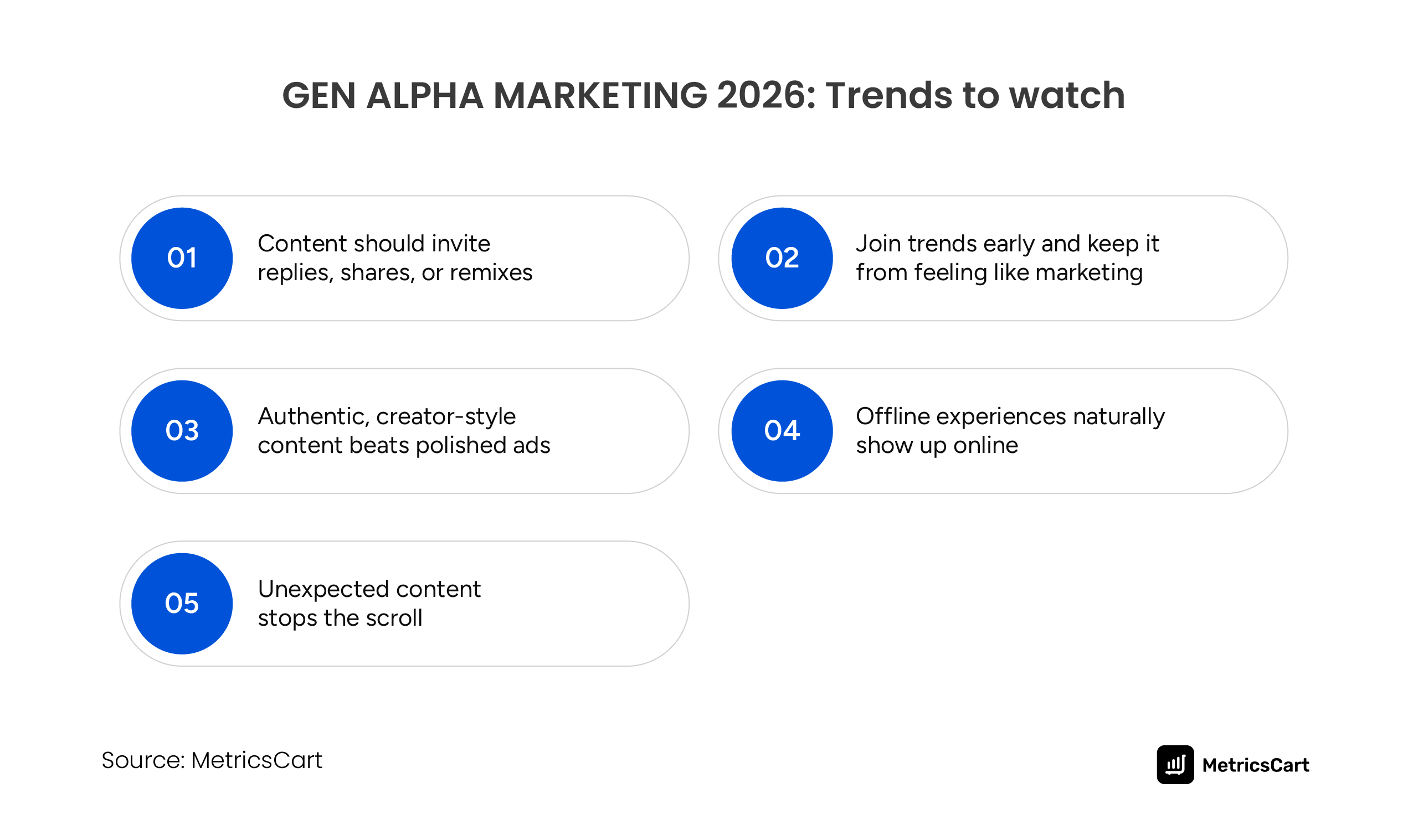
Short-Form Video Is Table Stakes Now
Every brand is making short-form video now. Gen Alpha knows it, and they scroll past most of it. The real question is not whether you are making short-form content. It is whether your content gives them a reason to do something; react, duet, share, or send it to a friend. Content that just asks for attention rarely gets it.
Join the Conversation Before It Feels Like Marketing
When Tommy Hilfiger joined TikTok’s viral “airball” trend without promoting a product, the post earned over 2 million likes. No brief, no product placement, just a brand that showed up and joined in. Gen Alpha rewarded it because it felt real for them. The brands winning in 2026 are the ones with social teams fast enough to jump into cultural moments without waiting for three rounds of approvals.
Let the Creator Lead
Polished, brand-directed content is losing ground to content that looks like it came from a real person. Employee-generated content, creator-native formats, and behind-the-scenes storytelling are consistently outperforming studio-produced campaigns. The shift is both creative and structural: give creators genuine freedom, and trust that authenticity will outperform polish every time.
Bring Something Real to the Physical World
Gen Alpha lives online, but they are increasingly drawn to experiences that happen offline. Phone-free events, in-store theatrical moments, and community experiences that feel genuinely worth attending are cutting through in ways digital content alone cannot. If an experience is remarkable enough to talk about in person, it will end up online anyway.
Weird Works, Lean Into It
Random, weird, and hard-to-explain content is not a mistake for Gen Alpha. It is a feature. Nutter Butter’s horror-adjacent visuals, Sour Patch Kids’ absurdist slideshows, and Crocs leaning into “Crocsmaxxing” all point to the same thing: Gen Alpha trusts brands that are comfortable being strange. Safe content blends into the feed. Strange content stops the scroll.
READ MORE | Future of CPG 2026: AI, Retail Media, and the New Rules of Digital Commerce
How MetricsCart Helps Brands Track What Gen Alpha Actually Thinks
Gen Alpha sentiment does not show up in traditional brand surveys. It shows up in product reviews, creator comment sections, and the language customers use when talking about what they bought and what they returned.
MetricsCart’s ratings and reviews analysis surfaces exactly that language. For CPG and DTC brands managing a digital shelf across Amazon, Walmart, and other major retailers, this means seeing which product features Gen Alpha and their parents respond to, which packaging claims land, and where competitors are pulling ahead in sentiment before it shows up in sales data.
The brands that will own Gen Alpha in 2026 are building that relationship right now. And the ones making the smartest decisions are the ones reading the right signals.
Gen Alpha is talking about your category right now. Are you listening?
FAQs
Focus on participation over passive consumption. Gen Alpha wants to be inside brand experiences, not watching them. Gamification, creator partnerships, and platform-native content on YouTube, Roblox, and TikTok consistently outperform traditional advertising with this generation.
YouTube is the dominant platform, used by around 60% of Gen Alpha. Gaming environments like Roblox and Minecraft function as social networks for this group. TikTok is growing fast, with 89% of US Gen Alpha TikTok users opening the app daily. Brands with persistent presences in gaming platforms are reaching Gen Alpha in the spaces they trust most.
Gen Alpha has grown up with AI tools, algorithmic feeds, and in-game storefronts as everyday fixtures. They expect to participate in brand worlds, not just consume content. Gen Z playbooks built around polished influencer content and Instagram aesthetics do not translate well to a generation that values interaction over observation.
Their top spending categories are snacks (59%), toys (55%), entertainment (34%), electronics (31%), and beverages (31%), according to Numerator’s 2025 research. Beyond direct spending, they influence household purchases across clothing, food, travel, and technology.
Through YouTube creators, in-game brand experiences, and peer recommendations. They rarely encounter brands through traditional advertising. The most effective discovery path is a creator they trust, genuinely using or reviewing a product, inside a platform they already spend time on every day.