
Highlights
- Pet product reviews play a significant role in purchase decisions because pet owners rely on other customers’ experiences to assess products for animals that cannot provide direct feedback.
- Product issues such as formula changes, quality inconsistencies, packaging defects, or adverse pet reactions often surface in reviews across multiple marketplaces within days.
- Brands that monitor reviews on only one retailer risk missing broader trends that could be affecting customers elsewhere.
- A rating drop from 4.5 to 4.1 may seem small, but it can push a listing below the cutoff marketplaces use to rank and recommend products, leading to a loss of search rank and wasted ad spend.
- Five themes dominate pet product reviews: palatability, digestive reaction, packaging, ingredient concerns, and transition experience.
- Tracking sentiment and review themes helps brands detect emerging issues earlier, prioritize improvements, and protect product performance before ratings and sales are affected.
The pet market is huge, and pet parents spend freely within it. Americans spent $158 billion on their pets in 2025, and 94 million US households now own at least one pet.
That is what makes a bag of dog food or a new cat treat unlike a normal purchase. When a pet parent buys a new food or treat, they are not buying for themselves. They are buying for someone who cannot say “I liked it” or “this made me sick.”
So they watch. They notice the sniff, the soft stool on day three, the bag that split open during delivery. And then they do something very useful for the next buyer: they write it all down. These reviews are the only record of how a product actually performed.
That gap, between what pet parents are clearly saying and what brands actually catch, is exactly what pet product review monitoring is built to close.
Pet product review monitoring is the process of collecting, organizing, analyzing, and tracking customer reviews across online marketplaces to identify recurring product issues, customer sentiment trends, and emerging risks before they affect ratings, search visibility, or sales.
This guide walks through what pet parents are really telling you, why the star rating hides most of it, and why brands need review monitoring software like MetricsCart to keep watch across every marketplace at once.
READ MORE | Pet Care E-Commerce Market in the US: Essential Insights
Pet Product Review Monitoring: Decoding What Pet Parents Are Saying
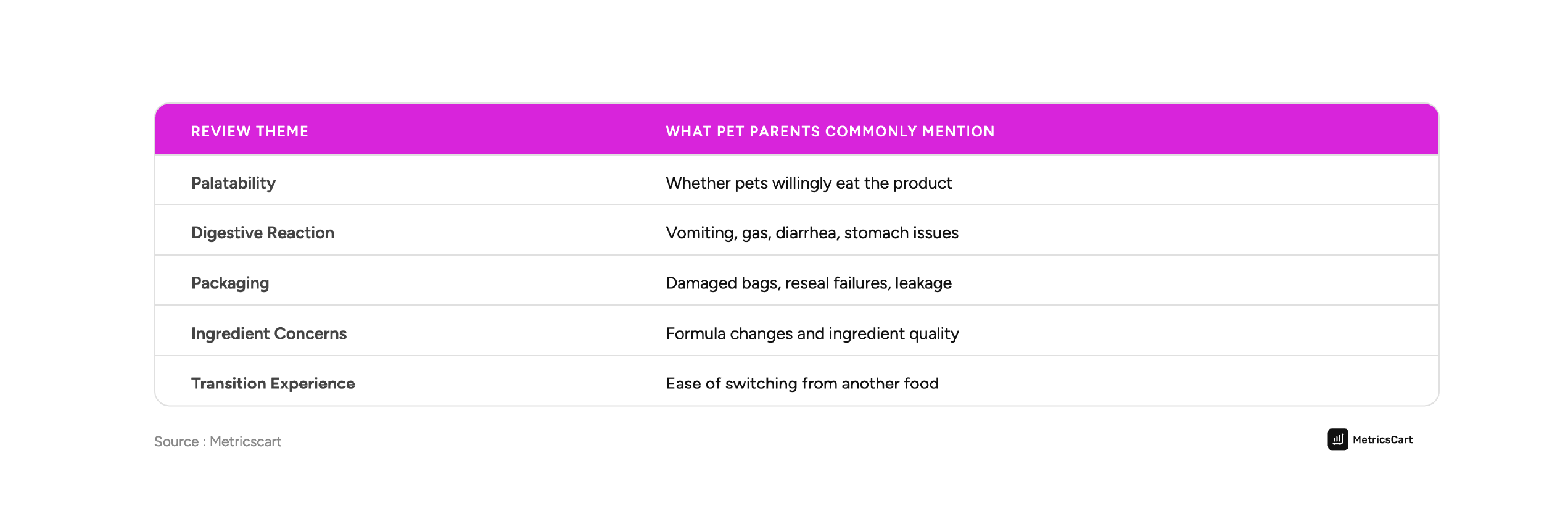
Once you gather the reviews in one place and read them as a body of evidence, the same handful of themes recur. Five common review themes that dominate pet products are as follows:
Palatability: This is the first question every food or treat review answers: Will the pet actually eat it? Reviews range from “my dog inhaled it” to “wouldn’t touch it after one sniff.” For a brand, palatability complaints are the clearest sign of returns and one-time buyers who never come back for a second bag.
Digestive reaction: These are the reviews that mention soft stool, vomiting, or gas in the days after switching to the product. They carry a lot of weight and spread quickly, because a product that makes a pet sick is exactly what every other shopper is afraid of.
Packaging: This covers bags that arrive split open, reseal strips that stop working, and portion sizes that do not match what the listing promised. These complaints are easy to wave off as minor, but they keep coming up and slowly chip away at trust, especially for repeat and subscription buyers.
Ingredient concerns: Pet owners read labels closely and notice even small changes. When a brand swaps an ingredient or updates a recipe, reviews quickly fill with comments like “they changed the formula and my dog won’t eat it anymore,” often before the star rating moves at all.
Transition experience: This is about how smoothly a pet moved from its old product to the new one, including mixing ratios and fussiness during the switch. It tells a brand how much effort it takes to turn a first-time customer into a loyal repeat customer.
The value is not in any one review. It is in seeing how often each theme appears, which ones are rising, and whether the sentiment around them is turning, the kind of pattern no amount of manual skimming reliably catches.
What Happens When Pet Product Brands Fail to Monitor Reviews?
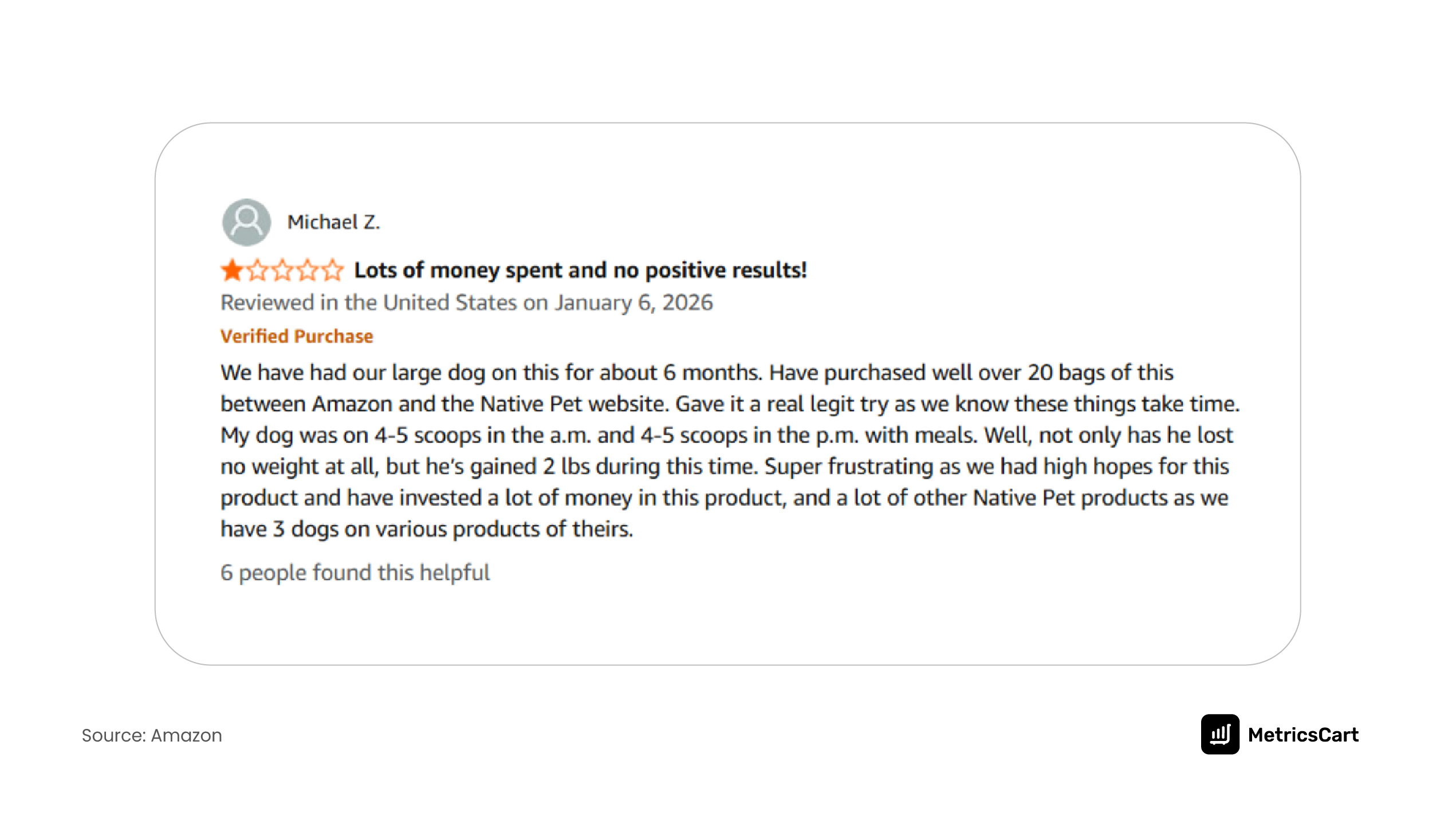
In pet care, a review is trusted more than anything the brand says about itself.
A pet parent deciding between two foods does not believe the packaging. They believe the other pet parent who wrote, “my picky eater finally finished a bowl,” or the one who warned, “gave my dog an upset stomach for three days.” Their entire purchase is built on that trust.
Product Issues Appear Across Marketplaces Before Brands Notice
The same SKU sits on Chewy, Amazon, Walmart, and Petco at once. When something goes wrong, complaints appear across all four platforms within days. A brand watching only one retailer sees a single complaint and dismisses it.
A brand watching all four sees a pattern and pulls the batch, contacts the supplier, or updates the listing before the problem scales. Multi-marketplace review monitoring is what separates a one-week fix from a one-quarter revenue hit.
Star Ratings Drop Only After the Damage Is Already Done
By the time a product’s average rating drops, the problem has been live for weeks. The early warning signs are different: a cluster of 1- and 2-star reviews on one SKU, the same complaint appearing in different words from different buyers, or a previously active listing going quiet.
These patterns do not immediately move the star rating, but they tell a brand exactly which product, issue, and retailer need attention right now. Waiting for the rating to fall means acting on damage already done instead of preventing it.
Late Detection Costs Brands Search Visibility and Ad ROI
When a brand only catches the problem after the rating has slipped from 4.5 to 4.1, it is already demanding attention. That drop looks small, but it matters more than it seems. Marketplaces like Amazon and Chewy use rating cutoffs to decide which products to show first, and falling below one of those cutoffs can quietly drop a listing down the search results.
Once that happens, three things go wrong at once: fewer shoppers find the product, the ones who do see the negative reviews first, and the brand keeps paying for ads that send people to a page now talking them out of buying.
Negative Pet Product Reviews Stay on a Listing After the Issue Is Fixed
Reviews don’t just disappear once a problem is fixed. A complaint written during those unmonitored weeks can sit on the listing for months, and “Most Helpful” voting often pushes recent negative reviews straight to the top, where every new shopper sees them first.
That keeps dragging down the conversion rate long after the actual supply chain issue has been resolved, so the brand is still losing sales to a problem it no longer has.
None of this is loud or sudden, which is precisely what makes it dangerous. It is slow, quiet erosion that only resembles a crisis once it appears in the sales figures. By that point, recovery is a months-long effort.
What KPIs Should Pet Brands Track in Review Monitoring?
Once you accept that the average rating is not enough, the question becomes what to measure instead. A useful review monitoring program tracks a handful of signals, not just one number:
- Average star rating trend, broken out by SKU, by marketplace, and over time, so a dip on Walmart isn’t hidden by strength on Amazon.
- Review velocity: the number of new reviews per week. A sudden spike signals either a problem or a campaign, and you want to know which.
- Sentiment score by theme, tracking palatability, packaging, and digestion separately, since the average can be steady while one theme quietly turns negative.
- Negative review concentration, the share of 1 and 2-star reviews mentioning the same issue. A high concentration points to one fixable problem rather than scattered noise.
- Competitor review benchmarks, your rating, and themes against the category average, so you know whether a dip is your problem or the whole category’s.
- Response rate and response time, for brands that reply to reviews, since a fast, visible response can blunt the damage of a negative one.
- Review coverage gaps, SKUs with very few reviews. These are blind spots, products you have almost no read on, and they are where the next surprise usually comes from.
Read together, these turn a vague sense of “our reviews are fine” into something a brand manager can actually report on and act against.

How MetricsCart Help Pet Brands Monitor and Analyze Reviews?
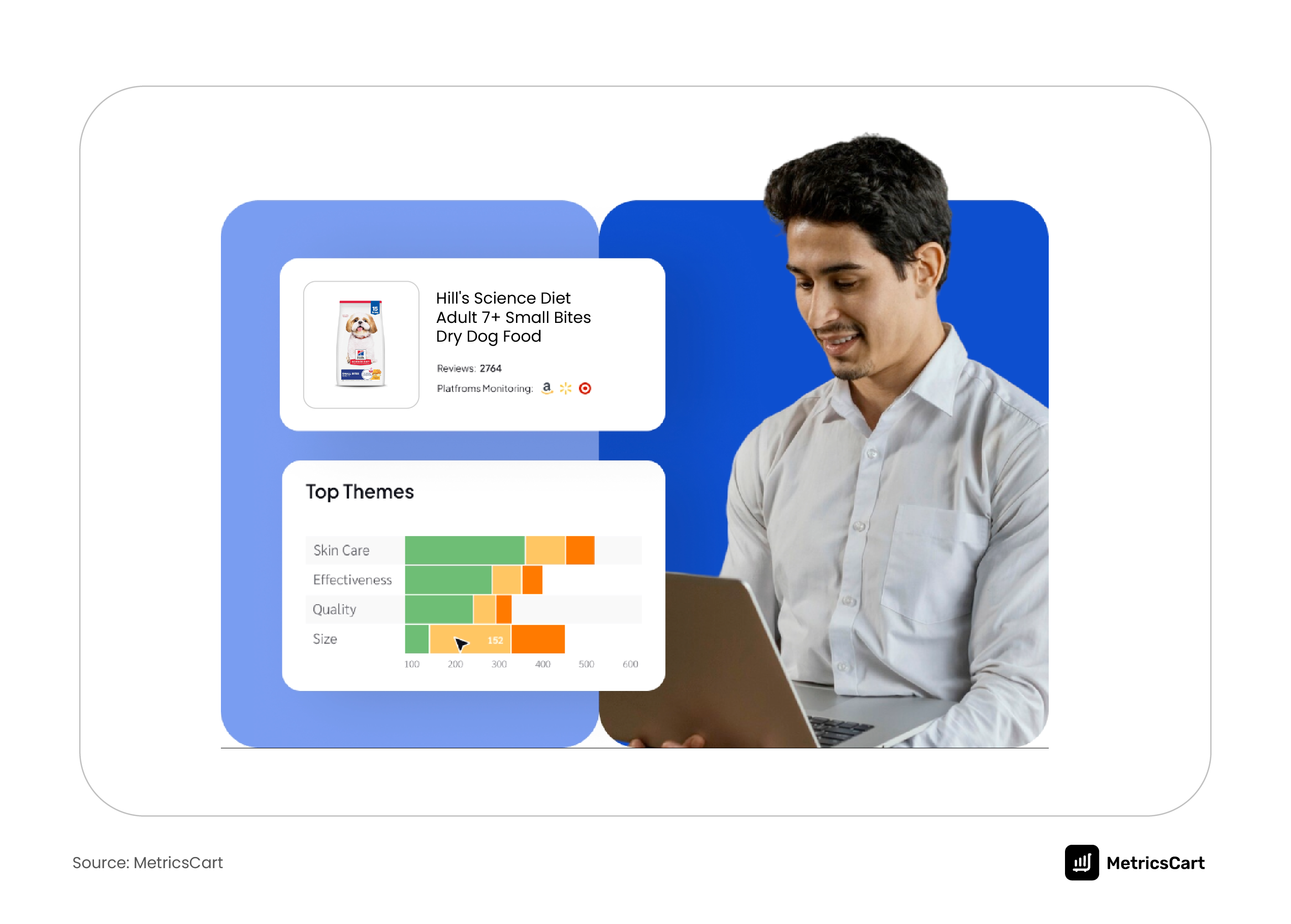
Most pet brands are not short on feedback. They are short on a way to make sense of it. Reviews are coming in across Chewy, Amazon, Walmart, Target, and Petco simultaneously, covering everything from palatability to packaging, and there is no single place to see what all of it means for a specific SKU.
MetricsCart’s review monitoring platform is built to fix exactly that. Here is what it does specifically for pet brands.
- Unified marketplace coverage. Chewy, Amazon, Walmart, Petco, and other global platforms are tracked in one place. No switching between tabs, no manual exports.
- Theme and sub-theme breakdown. MetricsCart groups reviews into categories that matter for the pet category: palatability, digestive reaction, packaging, ingredient concerns, and feeding experience. Sub-themes give a more granular view of exactly what shoppers are mentioning most within each area.
- Sentiment tracking over time. A shift in how pet parents feel about packaging on one SKU shows up as a trend, not a surprise. Brands can see sentiment moving before it hits the star rating.
- Early warning signals by SKU. A spike in negative reviews on a specific variant, a sudden drop in review velocity, a cluster of complaints about the same issue. MetricsCart surfaces these patterns at the product level so brands know where to look first.
- Competitor benchmarking. Pet brands can compare their review themes and sentiment scores directly against competing products on the same platforms, making it easier to spot where rivals are losing customers and where there is room to win.
Pet care is one of the few categories where a single undetected review trend can cost a brand its rating, its shelf position, and its retailer relationships all at once.
As the category grows and competition across platforms intensifies, the brands that will hold their ground are the ones treating review data as a real-time signal rather than a quarterly metric. That shift from reactive to proactive is what separates brands that catch problems early.
Get ahead of your next pet product issue before it hits your ratings.
FAQs
Pet brands monitor reviews by pulling them from every marketplace they sell on, such as Chewy, Amazon, Walmart, and Petco, into one place, then grouping the feedback into themes and tracking sentiment over time. Most use a dedicated review-monitoring platform to do this at scale, since checking each site by hand does not work for more than a handful of products.
If reviews point to something real, like a packaging issue or pets rejecting a new formula, don’t sit on it. Brands that move within days, pulling the batch, updating the listing, or flagging the supplier, can often fix the issue before it ever shows up as a rating drop. If you wait for the star rating to drop, you’re already losing search ranking, too.
The most common complaints in pet product reviews are palatability, digestive reactions, packaging failures, and ingredient or formula concerns. These four themes appear most often across pet food and treat categories, with packaging and sizing issues also common for supplies and accessories.
Yes, small pet brands benefit from review monitoring even with a limited product range. A smaller catalog means each product carries more weight, so knowing exactly what drives negative reviews and where competitors are falling short is just as valuable for a small brand as for a large one.
No, review monitoring is useful for any pet brand, not just food brands. Pet supplies, grooming products, and accessories all generate reviews with patterns worth tracking, especially complaints about packaging, sizing, and durability.
Pet brands should check their reviews at least once a week. For fast-selling or newly launched products, daily monitoring is better, since it gives the brand a quicker chance to catch and respond to a problem before it spreads.