Key Highlights
- Blink’s Amazon catalog showcases 109 products, meanwhile Ring lists 463 products on Amazon, giving Ring more than 4x the shelf presence on the platform.
- Despite having fewer products, Blink’s average price ($143.73) is slightly higher than Ring’s ($131.60), pointing to a tighter, more premium-focused assortment.
- Ring leads in total reviews (2.05M vs. 1.89M), but both brands hold near-identical ratings. 4.48 for Ring, 4.41 for Blink.
- Ring offers slightly steeper discounts (12.81%) compared to Blink (10.68%).
- Blink’s positive sentiment score (92.31%) narrowly beats Ring’s (88.21%), despite Ring’s larger review base.
- Ring commands every price tier from $0 to $300+. Blink’s catalog quickly exceeded $100.
About the report
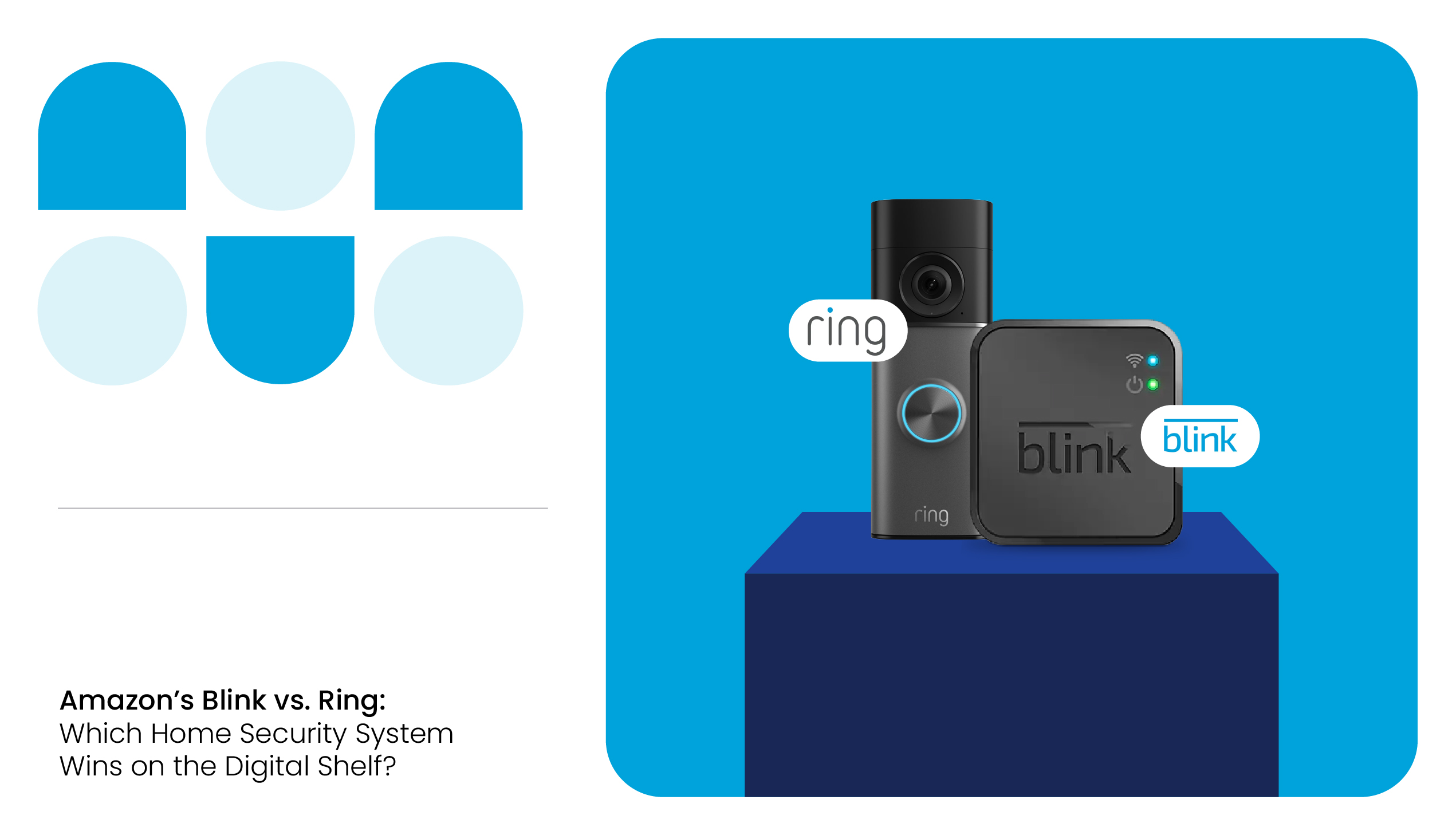
This report analyzes the home security brands Blink and Ring’s digital shelf performance on Amazon using the MetricsCart Digital Shelf Analytics platform. The analysis is based on marketplace insights collected between April 2 and April 15, 2026, covering product assortment, pricing trends, promotional activity, ratings, reviews, customer sentiment, sponsored visibility, and product distribution across price ranges.
This Amazon Blink vs. Ring analysis helps e-commerce, category, and brand leaders benchmark digital shelf strategy and understand how assortment depth, pricing architecture, review performance, and customer perception contribute to category leadership.
Introduction
Amazon is often viewed as a platform, a retail partner, or simply a distributor. But if you look closely at how Amazon manages its consumer technology portfolio, you can see how much influence it has over shaping entire product categories in e-commerce.
Take Blink and Ring, for example. When Amazon acquired both home security brands, many expected the company to merge them into a single business, consolidating the portfolio to build a single dominant brand.
But on the contrary, Amazon kept them separate and positioned each brand for a different customer segment. What followed was a carefully structured corporate duopoly that helped Amazon expand category coverage, dominate more digital shelf space, and maximize customer lifetime value (CLTV) across the home security market.
Yes. Amazon acquired Ring in 2018 and Blink in 2017. Amazon has kept them as separate brands rather than merging them into a single business.
Amazon Ring vs. Blink Comparison: An Overview
| Metric | Ring | Blink |
| Total Products | 463 | 109 |
| Average Price | $131.60 | $143.73 |
| Average Discount | 12.81% | 10.68% |
| Total Reviews | 2,047,853 | 1,889,913 |
| Average Rating | 4.48 | 4.41 |
| Positive Sentiment | 88.21% | 92.31% |
| Negative Sentiment | 3.06% | 3.08% |
| Products Rated 5 Stars | 208 | 38 |
| Products Rated 4 Stars | 165 | 71 |
| Sponsored Listings | 0 | 7 |
| Price Range Coverage | $0 – $300+ | $0 – $300+ |
| Strongest Price Tier | $0–$50 (159 products) | $0–$50 (42 products) |
| Most Reviewed Product | Rechargeable Battery Pack (126,997) | Blink Mini Indoor Camera (309,188) |
Catalog Architecture for Blink and Ring: Engineered Asymmetry
On Amazon, Ring carries 4 times more products in comparison with Blink. Ring carries 463 products on Amazon, while Blink has 109. Ring’s deep shelf presence is heavily driven by accessory SKUs and multi-pack variants, creating an ecosystem loop, whereas Blink focuses strictly on standalone, core hardware units.
This massive difference is a structural decision about what each brand is supposed to do.
Ring is built for dominance through volume. More SKUs mean more searchable entry points, more coverage across long-tail queries, and more opportunities to capture a buyer at whatever stage of the purchase funnel they happen to be in.
Ring’s catalog is designed to ensure that no home security search on Amazon ends without a Ring product in the results.
Meanwhile, Amazon is building Blink for efficiency. A leaner catalog is easier to manage for content quality, pricing integrity, and inventory health. It also creates a cleaner brand identity.
Blink means wire-free cameras that are simple to set up and affordable to own. There is no confusion about what Blink is for.
| Ring | Blink | |
| Total Products | 463 | 109 |
| Catalog Role | Full-market dominance | Focused segment capture |
| Sponsored Listings | 0 | 7 |
| Primary Strength | Breadth and ecosystem depth | Simplicity and sentiment |
Neither brand needs paid amplification to compete. Of Ring’s 463 products, none are sponsored. Blink has just seven sponsored listings across its entire catalog.
Both brands have built organic shelf authority strong enough to win without retail media spend, which indeed is a structural advantage that any new entrant would struggle to replicate.
Pricing: Amazon’s Deliberate Segmentation Across Every Tier
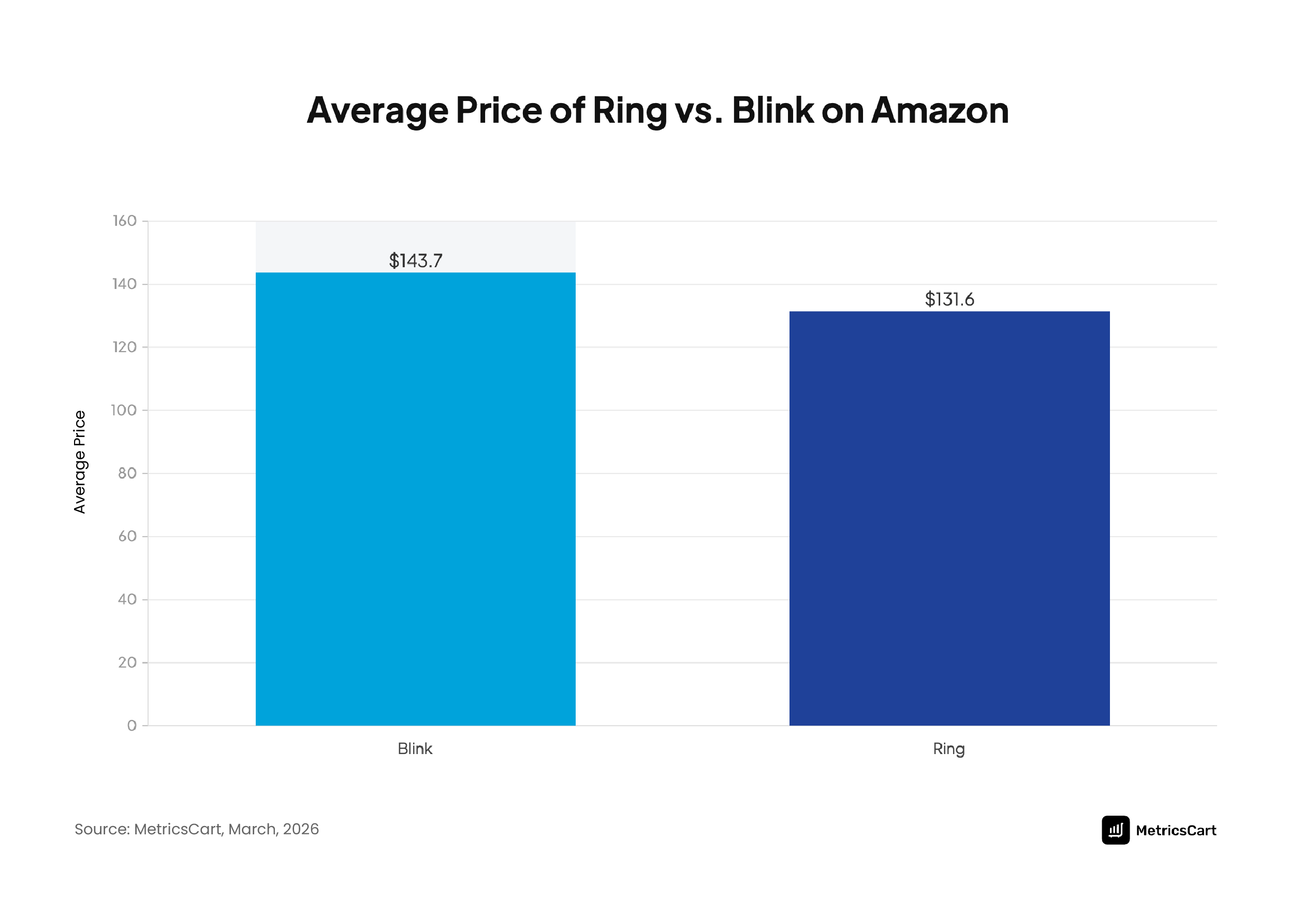
The lower average price of Ring is $131.60, while that of Blink is $143.73. This might seem to contradict the idea that Ring is the premium brand.
But Ring’s lower average is a product of its catalog breadth, not its positioning. Ring has 159 products priced under $50, pulling the average down. At the same time, Ring carries 50 products at $300 and above. It is not a budget brand. It is an everything brand.
Blink’s higher average price reflects a more concentrated assortment. With fewer products clustered in the mid-tier, Blink’s average is pulled upward. But its catalog is limited to above $100, and it has no meaningful premium products above $200 price.
With this curated price architecture of both brands, Amazon is carving up the price spectrum between them. A shopper with a $40 budget finds Blink’s entry-level cameras and Ring’s budget doorbell side by side. A shopper with a $300 budget finds Ring’s premium multi-camera systems. Blink largely disappears from the conversation above $150. That is a boundary, and it appears to be an intentional one.
Ring’s slightly higher discount rate of 12.81% versus Blink’s 10.68% reinforces this. Ring uses promotional pricing as a conversion tool across a wide, competitive catalog. Blink’s lower discount rate reflects a tighter assortment that does not need to work as hard to justify its price points.
Reviews and Ratings: The Trust Infrastructure, Highest Satisfaction on Both Sides
Review volume is one of the most reliable proxies for purchase frequency and category authority on Amazon. Ring holds 2,047,853 total reviews. Meanwhile, Blink on Amazon has 1,889,913 reviews.
This review volume difference could also stem from the reason that Ring has a scale advantage that comes with a four-times-larger catalog.
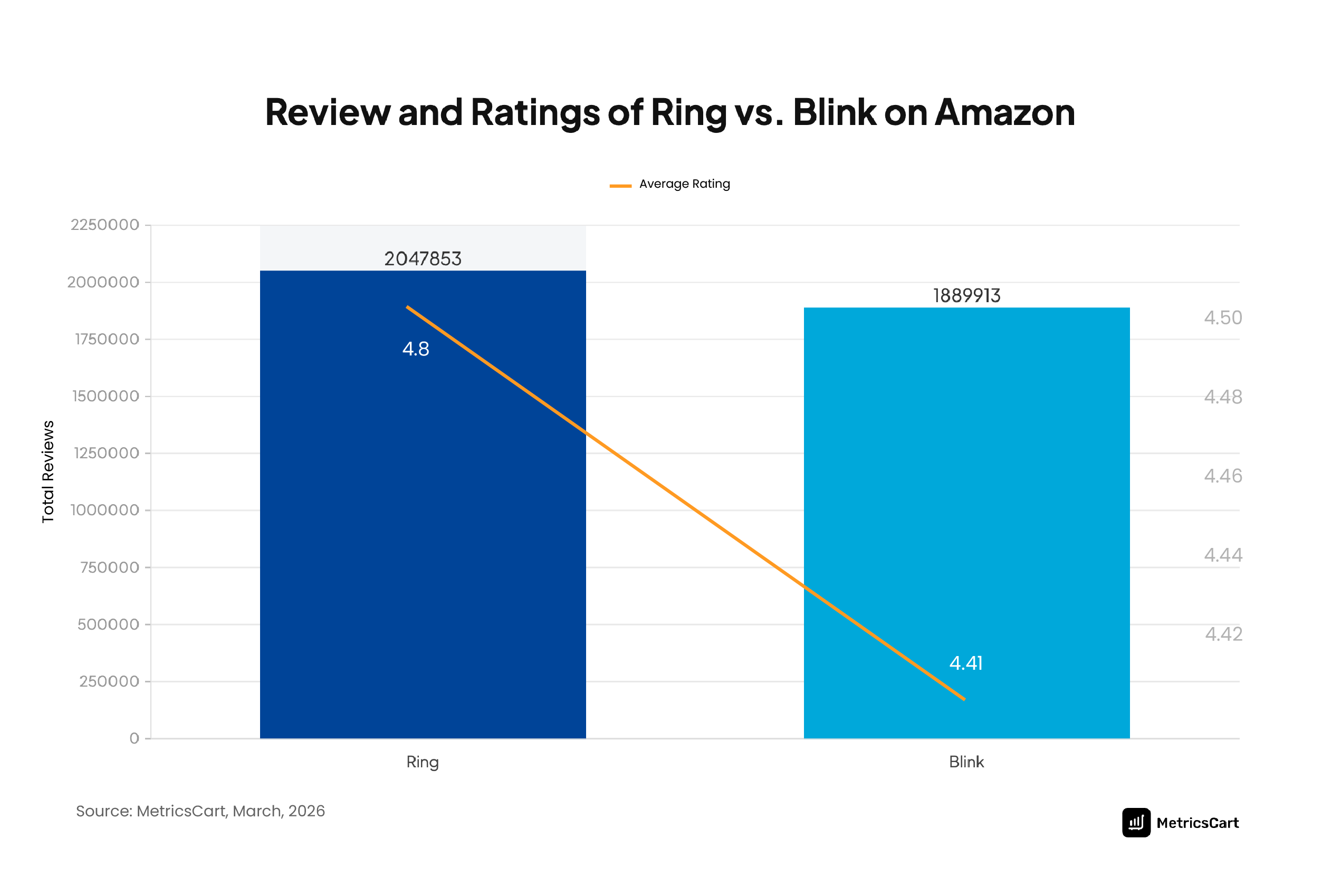
Both brands sit comfortably above 4.4 stars, which in a competitive hardware category represents strong and consistent product quality. Very few products from either brand carry ratings below three stars, which is a sign that Amazon is managing both catalogs for quality, not just volume.
The more revealing data point is the distribution of reviews by star level rather than by product count.
READ MORE | Explore the best Blink products on Amazon in April 2026
Why Ring Earns Five Stars and Blink Earns Four
Blink’s 1,830,372 four-star reviews compared to Ring’s 622,734 at the same level is a striking inversion. Ring dominates at five stars. Blink dominates at four. This reflects a fundamental difference in what each brand delivers and what each brand’s buyer expects.
| Star Level | Ring Reviews | Blink Reviews |
| 5 Stars | 1,424,958 | 59,541 |
| 4 Stars | 622,734 | 1,830,372 |
| 3 Stars | 155 | — |
| 2 Stars | 1 | — |
| 1 Star | 5 | — |
Ring buyers are purchasing into a full ecosystem:
- professional-grade features,
- color night vision,
- two-way audio,
- cloud recording,
- alarm integration.
When that ecosystem delivers, it earns a five-star response.
Blink buyers are purchasing simplicity. Easy setup, long battery life, solid video quality, no monthly subscription required. That experience consistently earns four stars: genuinely good, but without the feature depth that drives the top rating.
From a customer lifetime value perspective, the five-star response Ring generates is also a retention signal. A customer who calls their Ring doorbell a five-star product is far more likely to buy a Ring outdoor camera, a Ring Chime Pro, and eventually a Ring Alarm system. Blink’s four-star buyer is satisfied but not necessarily compelled to expand.
READ MORE | Best Ring products on Amazon in April 2026
Customer Sentiment: Blink’s Quiet Edge
The sentiment insights revealed by MetricsCart Ratings and Reviews platform don’t really buy into Ring’s dominance outright.
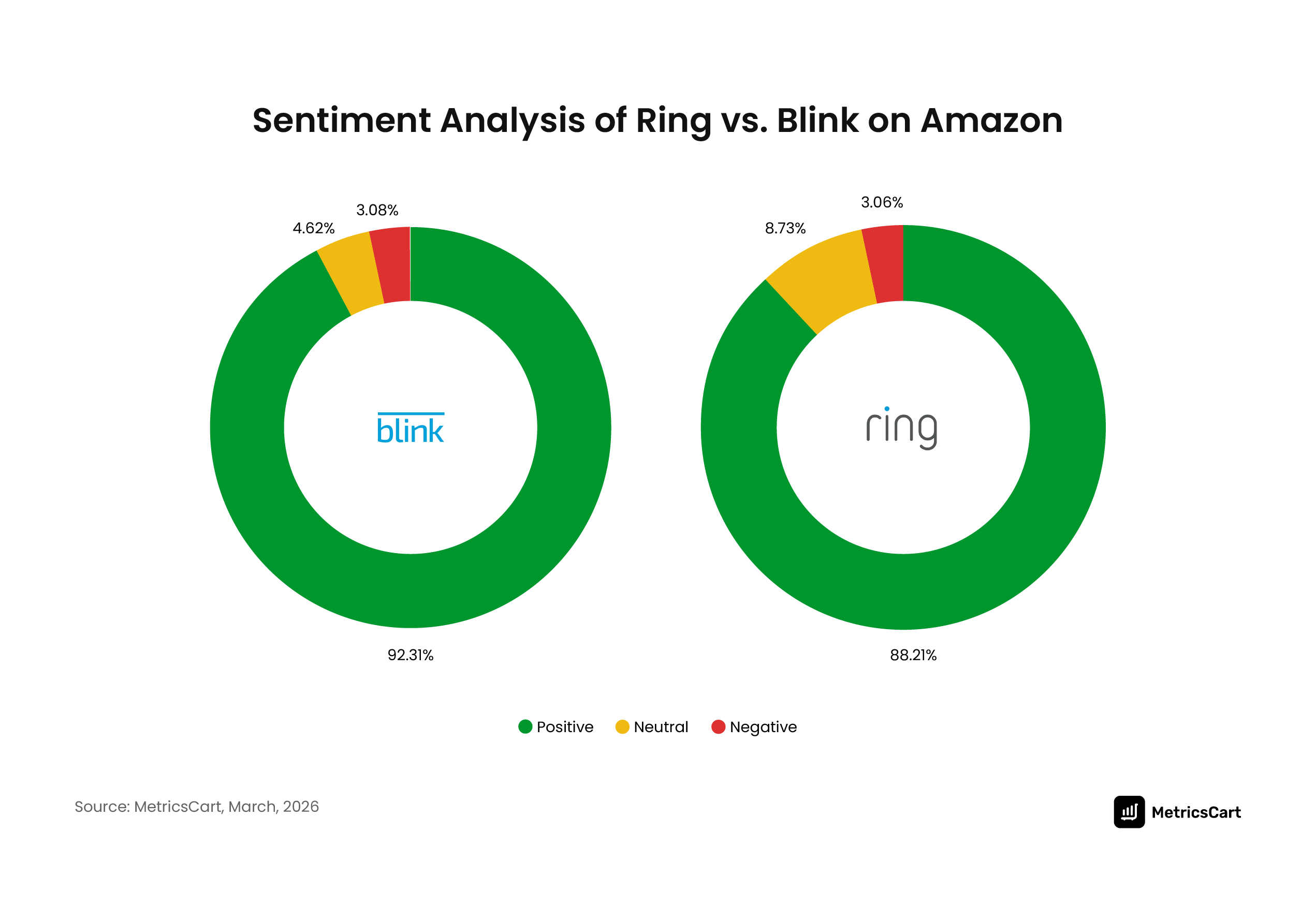
Blink’s reviews come in at 92.31% positive, compared to Ring’s 88.21%. Negative sentiment is minimal for both. 3.08% for Blink and 3.06% for Ring.
Blink’s higher positive sentiment across a smaller catalog is a quality signal worth taking seriously. It suggests that Blink’s focused product line delivers on its promises more consistently than Ring’s broader range, which is almost inevitable given the complexity involved in maintaining quality across 463 SKUs.
Ring’s 8.73% neutral sentiment rate versus Blink’s 4.62% also points to a larger proportion of Ring customers who received an adequate but not exceptional experience, likely a byproduct of managing a catalog with far more variation in product type, price point, and use case.
From a brand health perspective, Blink’s sentiment profile is quietly strong. It is not capturing the most customers or generating the most reviews. But the customers it does capture are leaving with a cleaner, more consistently positive impression.
Top Reviewed Products: What Customers Are Actually Buying
So, which is better? Blink or Ring? The top reviewed products reveal what each brand’s customers are actually doing, and the contrast is instructive.
Blink’s Top Reviewed Products
| Product | Reviews |
| Blink Mini – Compact indoor plug-in camera, 1080p HD (Black) | 309,188 |
| Blink Add-On Sync Module 2 | 49,764 |
| Blink Outdoor 4 – 3 camera system | 45,826 |
| Blink Outdoor 4 – 1 camera system with Sync Module Core | 25,640 |
| Blink USB Flash Drive for local video storage | 22,573 |
Blink’s most reviewed product is the Blink Mini. It is an affordable, plug-in indoor camera that sits at the very bottom of the price range. It’s 309,188 reviews dwarf the second-ranked product by a factor of six.
This tells you where Blink wins: the entry point. Blink is a category introduction product. Buyers who are new to home security cameras, or who want the simplest possible setup without a subscription, gravitate to Blink’s core lineup and, largely, stay there.
Ring’s Top Reviewed Products
| Product | Reviews |
| Ring Rechargeable Quick Release Battery Pack | 126,997 |
| Ring Video Wired Doorbell (newest model) | 81,709 |
| Ring Outdoor Cam (Stick Up Cam) – 2-pack, White | 62,317 |
| Ring Outdoor Cam (Stick Up Cam) – 3-pack, White | 62,305 |
| Ring Chime Pro | 57,347 |
Ring’s most reviewed product is not a camera. It is a battery pack. That single data point encapsulates Ring’s entire strategy. The most-reviewed Ring product is an accessory, a battery pack, that only exists because Ring customers already own Ring hardware and are maintaining or expanding their systems. Ring’s top five products are
- a battery pack,
- a wired doorbell,
- two multi-camera outdoor packs, and
- a Chime Pro
These are the products of an ecosystem at scale. That means, customers are not just buying Ring. They are living inside it.
Amazon’s Blink vs. Ring: Top 5 Takeaways for Brands
Amazon’s Blink vs. Ring strategy is a blueprint for how a platform operator can use owned brands to structurally dominate a category while leaving the appearance of open competition intact. There are several lessons here that apply well beyond Amazon’s portfolio.
Catalog Size Is a Strategic Choice, Not a Vanity Metric
Ring’s 463-product catalog and Blink’s 109-product catalog are not the result of one brand working harder than the other. They reflect two deliberately different roles.
Brands managing their own Amazon presence need to make the same intentional decision: are you building for breadth and search coverage, or for precision and brand clarity?
Trying to do both without a clear strategic rationale produces a catalog that is too large to manage well and too unfocused to build a strong identity around.
Price Architecture Should Tell a Story
Neither brand prices arbitrarily. Ring’s distribution across every tier from $0 to $300+ creates a natural customer journey within the brand.
Blink’s concentration in the accessible and mid-tier range keeps its identity clean and its messaging consistent. For any brand competing in a category with multiple price points, the question is not just what to charge. It is what story your price distribution tells about who you are and who you are for.
Organic Shelf Authority Is the Most Durable Competitive Advantage
With a combined total of just seven sponsored listings across 572 products, both brands are winning almost entirely on organic performance. Review volume, rating quality, and product relevance are doing the work that most brands spend heavily on paid placement to achieve.
Building that kind of organic authority takes time and consistent product quality, but once built, it is extraordinarily difficult for a competitor to displace through ad spend alone.
Sentiment Is a Leading Indicator, Not a Lagging One
Blink’s 92.31% positive sentiment rate is the kind of number that does not show up in a sales report but matters enormously for long-term brand health. High positive sentiment means customers are not just satisfied, they are becoming advocates. Brands that track sentiment at the product level, rather than waiting for aggregate rating trends to surface problems, can catch quality and messaging issues before they become visible in the headline numbers.
Five Stars Drive Ecosystems, Four Stars Drive Satisfaction
When it comes to ratings and reviews, Ring dominates at five stars, and Blink dominates at four. This review distribution between Ring and Blink is a reminder that customer lifetime value is emotional as much as transactional.
A four-star experience retains a customer. A five-star experience expands them. Brands building product ecosystems need to ask honestly which response their flagship products are generating, and why.
Turning Digital Shelf Intelligence into Category Strategy
The Blink and Ring story on Amazon is, at its core, a story about control. Amazon acquired two brands giving smart security systems for home and gave each one a precise role in a larger system. One to open the category, one to own it at depth.
For anyone competing in any category where platform-owned brands hold significant shelf presence, like Blink and Ring, they must understand the game being played around them to even have a chance to win.
And for that, you must know where to look and how to look. Product count distribution, price tier coverage, review star distribution, sentiment breakdown, sponsored versus organic ratios: each of these insights, when tracked consistently and read together, tells you precisely about what a brand is doing and why.
Amazon tracks these metrics automatically to run its duopoly. For competing third-party brands, extracting this level of multi-layered data—cross-referencing review star distributions with pricing tiers—is impossible manually.
This is where a Digital Shelf Analytics platform like MetricsCart becomes helpful.
It transforms raw marketplace noise into actionable category strategy. It gives brand managers the visibility to benchmark their own performance, identify structural gaps, and make decisions based on what the market intelligence actually holds rather than what the category looks like on the surface.
Disclaimer: MetricsCart is the exclusive owner of the data used in these Digital Shelf Insights reports. Any third-party usage must include proper credit to the source.
Ready to Climb to the Top of Your Category?